







Cigna Dental Insurance Reviews: Ratings, Complaints & Is It Worth It?
Cigna dental insurance earns a solid 7 out of 10 in our editorial review: it is one of the more affordable, financially stable dental carriers, with 100% preventive coverage and a large national network, but it is held back by waiting periods on basic and major work, limited implant coverage on its cheaper plans, and customer-service reviews that run hot and cold. If you mostly need cleanings, exams, and routine care, a low-cost Cigna plan is usually worth it. If you are planning major restorative work, orthodontics, or sedation, read the fine print first, because that is where the value gets thin.
- Affordable entry point. Cigna's low-deductible individual plans start at about $19 per month, among the most budget-friendly in the category.
- Preventive care is the strong suit. Cleanings, exams, and routine x-rays are covered at 100% in-network with no waiting period on most plans.
- Waiting periods bite. Basic work typically waits 6 months and major work 12 months, unless you qualify for a waiver or pick an Advance plan.
- Sedation is usually excluded. IV sedation, general anesthesia, and nitrous oxide are generally not covered unless the plan lists them or the care is medically necessary.
- Ratings are mixed. Financial-strength grades are excellent, but user-satisfaction scores and complaint volume on service and claims drag the experience down.

What's in This Review
- What Is Cigna Dental Insurance?
- How We Rated Cigna Dental
- Cigna Dental Plans and Pricing
- What Cigna Covers and the Waiting Periods
- Cigna Dental Care (DHMO) vs. Cigna Dental PPO
- Does Cigna Cover Sedation or Anesthesia?
- Cigna Dental Reviews: Ratings and Complaints
- Pros and Cons
- Who Should Choose Cigna (and Who Shouldn't)
- Cigna vs. Delta Dental and Other Alternatives
- Final Verdict: Is It Worth It?
- Frequently Asked Questions
What Is Cigna Dental Insurance?
Cigna is one of the largest health-benefits companies in the United States, and its dental arm sells both individual and family dental plans and employer-group plans. On the individual side, Cigna offers two broad structures: Dental PPO plans (sold directly to consumers in most states) and Cigna Dental Care DHMO plans (more common through employers). Across both, the company reports serving more than 17 million dental members.
The appeal is scale and price. Cigna's dental network spans roughly 300,000 dental office locations and about 89,000 providers nationwide, and its individual plans are priced to compete at the budget end of the market. That combination of a large network and low premiums is exactly why Cigna shows up on nearly every "best cheap dental insurance" list, and why it is worth a careful look rather than a quick yes or no.
For anyone comparing carriers side by side, the question is never just "is Cigna good?" but "is Cigna good for me?" This review answers that by scoring Cigna on the factors that actually move the needle, then comparing it to the rest of the market.
Source: Cigna official dental plans page | Money's Cigna dental review
How We Rated Cigna Dental
This is a research-based editorial review, not a hands-on test of a single policy. We assessed Cigna against its publicly documented plan details, its official coverage policies, and independent third-party ratings, then scored it on the eight factors that actually decide whether a dental plan is worth paying for. We did not accept marketing claims at face value, and every figure in this review links to the source that states it.
Our scoring factors: price and value, preventive coverage, major/restorative coverage, waiting periods, network size, plan flexibility, customer satisfaction, and financial strength. Each is scored out of 10 and explained in the sections below. The overall score is a weighted read of all eight, not a simple average.
Because dental plans vary by state, employer group, and plan year, treat our scores as a decision-making guide, not a guarantee for your specific policy. The one step no review can replace is pulling the Summary of Benefits for the exact plan you are considering and confirming your dentist is in network.
Source: Cigna official dental plans page
Cigna Dental Plans and Pricing
Cigna's individual dental lineup is built in tiers, and the price you pay tracks closely with the annual maximum and the breadth of covered services. On the low end sit the low-deductible plans; at the top sit the high-maximum and Advance plans that add implants and drop waiting periods.
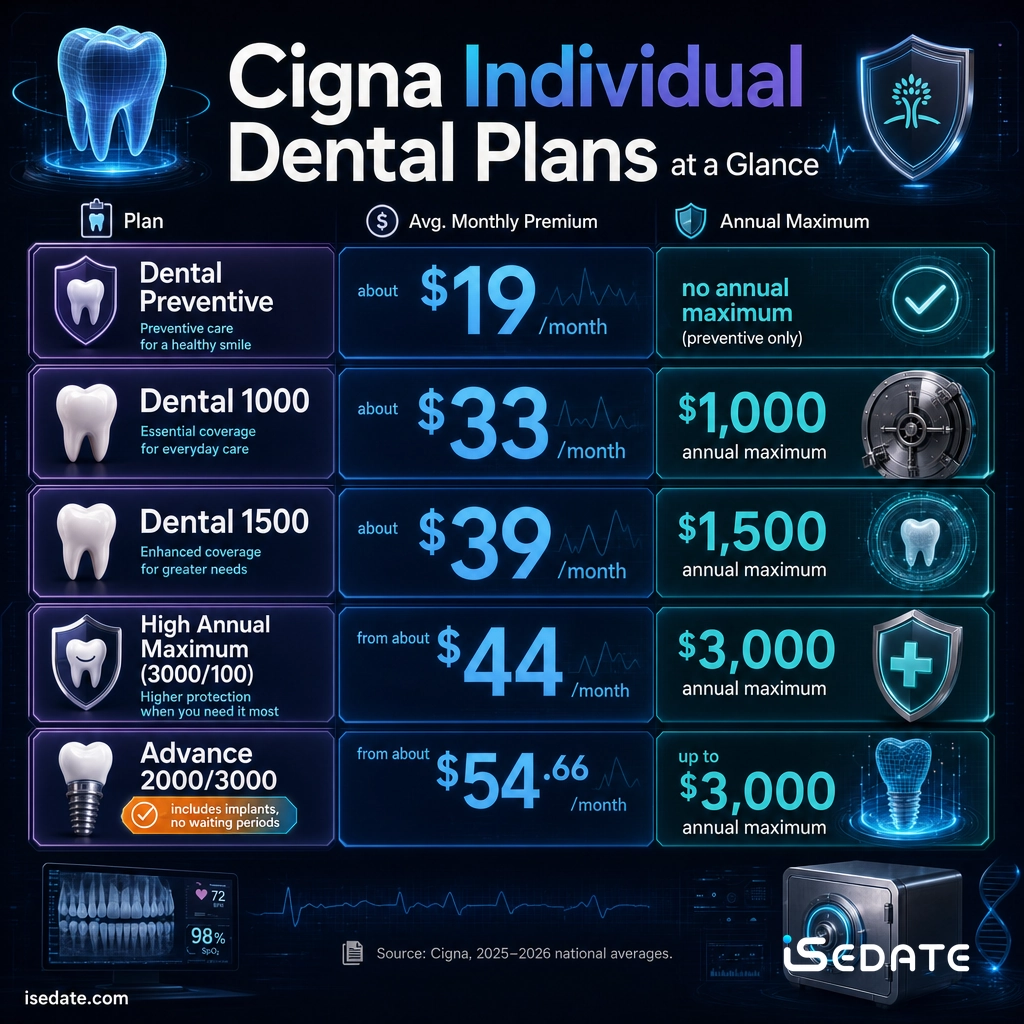
| Plan | Avg. monthly premium | Annual maximum | Implants | Orthodontia |
|---|---|---|---|---|
| Dental Preventive | ~$19 | None (preventive only) | No | No |
| Dental 1000 | ~$33 | $1,000 | No | No |
| Dental 1500 | ~$39 | $1,500 | No | Yes (50%, $1,000 lifetime max) |
| High Annual Maximum (3000/100) | from ~$44 | $3,000 | Select plans | Select plans |
| Advance 2000 / 3000 | from ~$54.66 | up to $3,000 | Yes ($2,000 lifetime max) | Child ortho on select plans |
Two pricing details are easy to miss. First, the low-deductible plans carry a small restorative deductible, around $50 for an individual and $150 for a family, while the Preventive plan has no deductible at all. Second, the quoted "average" premium can differ sharply from your real quote: Money's review found the Dental 1500 ran roughly $34 in Orlando but as high as $68 in Boston for the same 35-year-old shopper. Always pull a quote for your own ZIP code before comparing.
Source: Cigna official dental plans page | Money's Cigna dental review
What Cigna Covers and the Waiting Periods
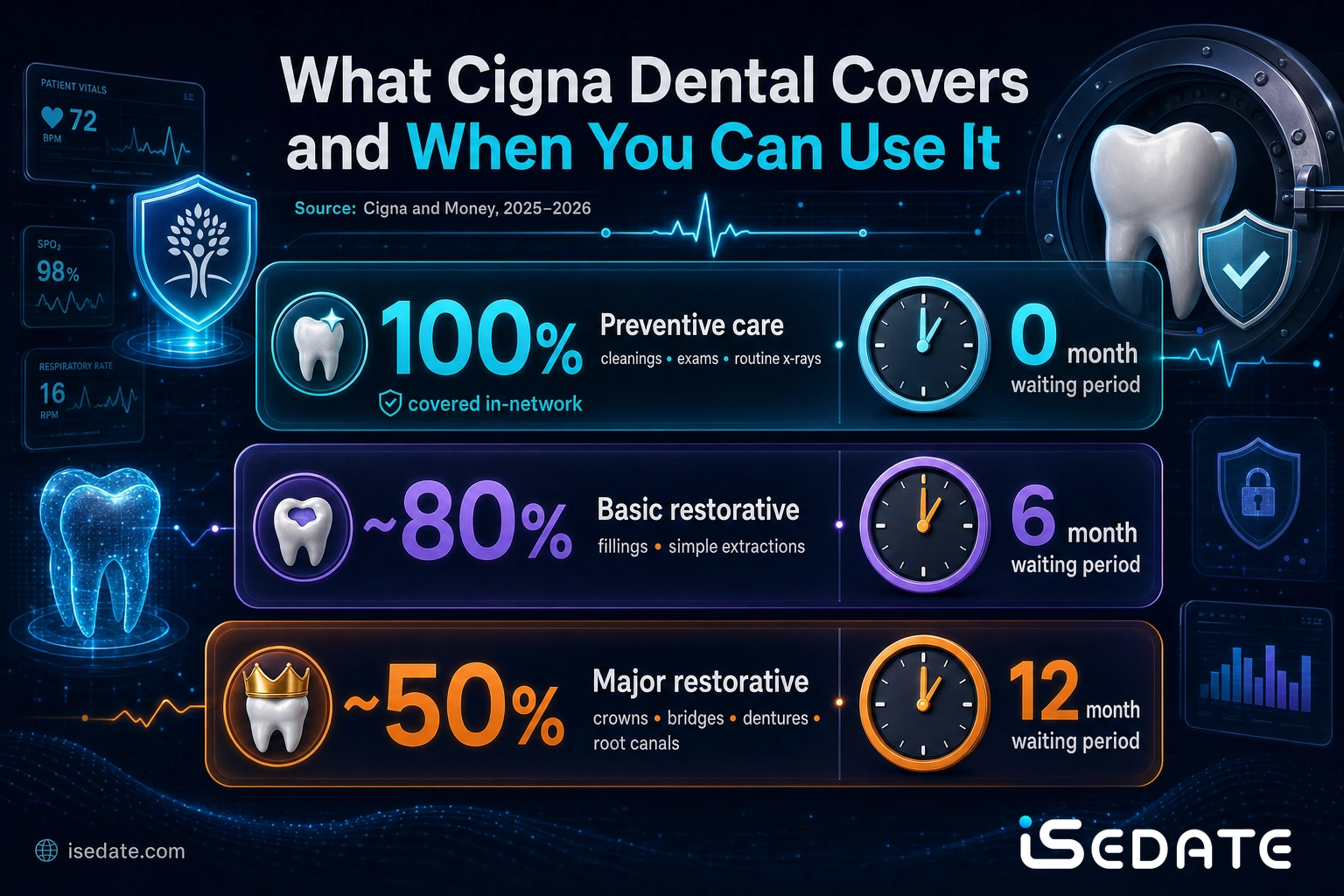
Cigna's coverage follows the standard dental three-class model, and the percentages are where the plan shines for routine care and softens for everything else.
- Preventive (cleanings, exams, routine x-rays): covered at 100% in-network, with no waiting period on most plans. Children 13 and under also get 100% coverage for sealants, fluoride, and space maintainers.
- Basic restorative (fillings, simple extractions): Cigna pays about 80%, leaving you a 20% coinsurance, after a 6-month waiting period.
- Major restorative (crowns, bridges, dentures, root canals): Cigna pays about 50%, after a 12-month waiting period.
The waiting periods are the single biggest catch for anyone who buys dental insurance because they already know they need work. The good news: Cigna waives the basic and major waits if you had 12 or more months of qualifying prior dental coverage that included major restorative services and you enroll within 63 days of your old plan ending. The company's Advance plans go further and apply no waiting periods to any class of service, which is part of why they cost more.
The implant misconception. Older reviews claim Cigna excludes dental implants on every plan. That was once true, but it is now outdated: Cigna covers implants on select Bundled and Advance plans, subject to a $2,000 lifetime maximum and a 12-month waiting period. The budget low-deductible plans (Preventive, Dental 1000, Dental 1500) still exclude implants entirely, so plan tier is what decides implant coverage, not the Cigna brand.
Source: Cigna official dental plans page | Money's Cigna dental review
Cigna Dental Care (DHMO) vs. Cigna Dental PPO
One of the most searched Cigna questions is DHMO versus PPO, and the answer comes straight from Cigna's own guidance: the trade is flexibility versus cost.
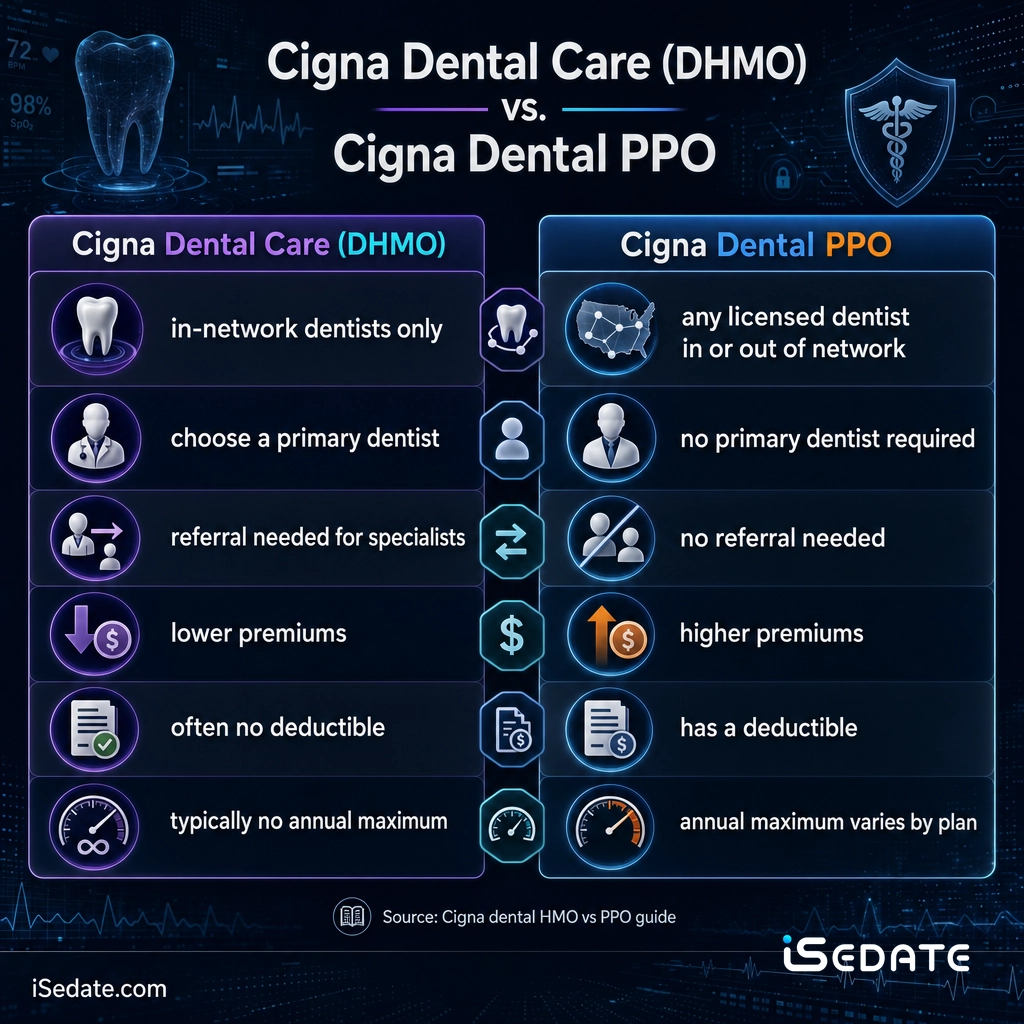
| Feature | Cigna Dental Care (DHMO) | Cigna Dental PPO |
|---|---|---|
| Choice of dentist | In-network only; pick a primary dentist | Any licensed dentist, in or out of network |
| Out-of-network care | Emergencies or where required by law | Covered at a lower rate |
| Specialist referrals | Referral from primary dentist required | No referral needed |
| Premiums | Lower | Higher |
| Deductible | Often none | Yes |
| Annual maximum | Typically none | Varies by plan |
In plain terms: the DHMO is cheaper and simpler but locks you into one network and one primary dentist, while the PPO costs more but lets you keep whichever dentist you want and see specialists without a referral. If you already have a dentist you trust, confirm whether they take the specific DHMO network before you enroll, because a DHMO is only as good as its local roster. If you travel, change jobs often, or want maximum freedom, the PPO is usually the better fit despite the higher premium.
Source: Cigna's dental HMO vs PPO guide

Does Cigna Cover Sedation or Anesthesia?
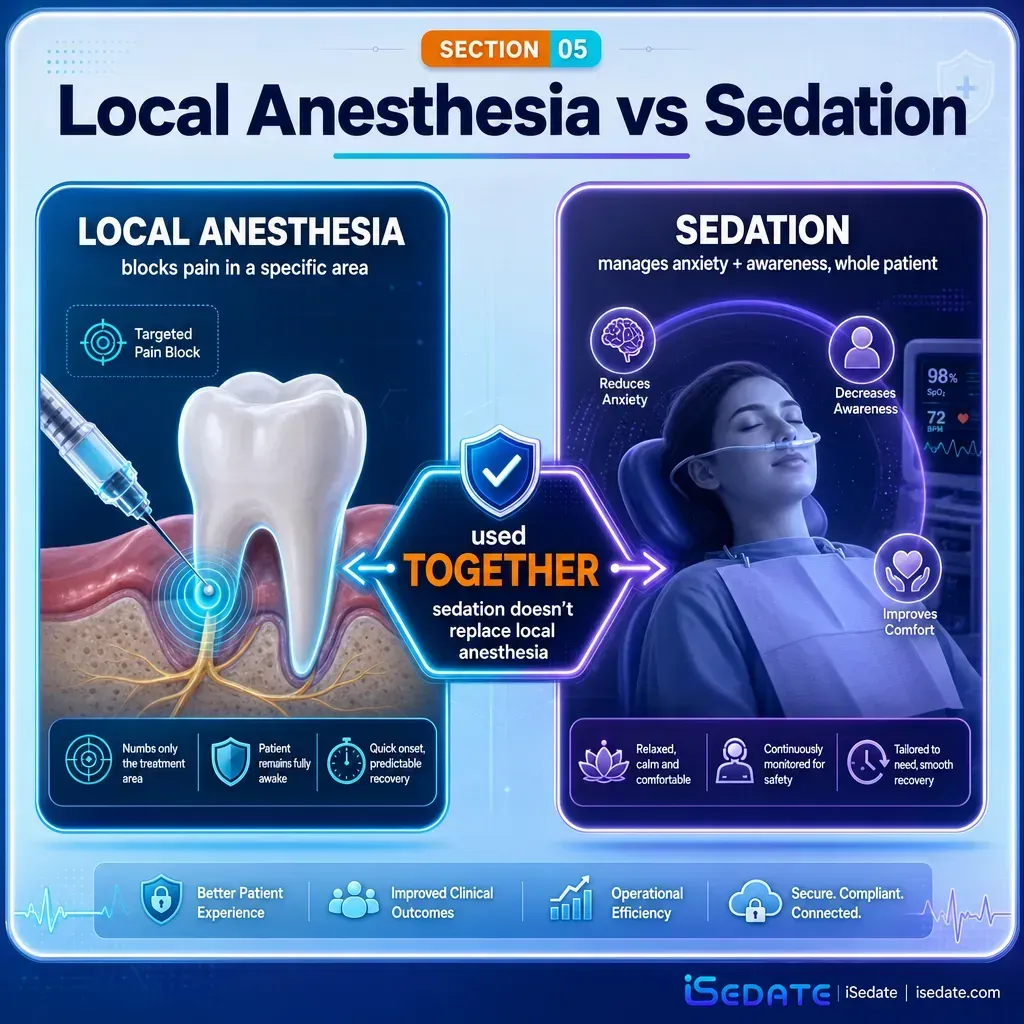
This is where a general dental review usually goes quiet, and where it matters most for patients who need sedation and for the practices that provide it. The short answer: most Cigna dental plans do not cover sedation as a routine benefit.
Cigna's plan documents commonly state that IV sedation, general anesthesia, and nitrous oxide are not covered unless they are specifically listed on the plan's Patient Charge Schedule. Separately, facility and anesthesia services tied to a dental procedure can fall under Cigna's medical coverage policy, which says coverage is affected by the member's benefit-plan language and by state mandates. Cigna also maintains distinct clinical criteria for deep sedation and general anesthesia and for IV sedation, meaning these services are evaluated for medical necessity rather than approved automatically.
Myth: "Cigna will cover sedation because I'm an anxious patient." Anxiety or a preference for comfort alone rarely clears the bar. Coverage for deeper sedation or general anesthesia is far more likely when it is medically necessary, for example a severe phobia that genuinely prevents treatment, or a special-needs patient who cannot be treated safely while awake, and even then it may run through the medical plan rather than the dental plan. Verify in writing before the appointment.
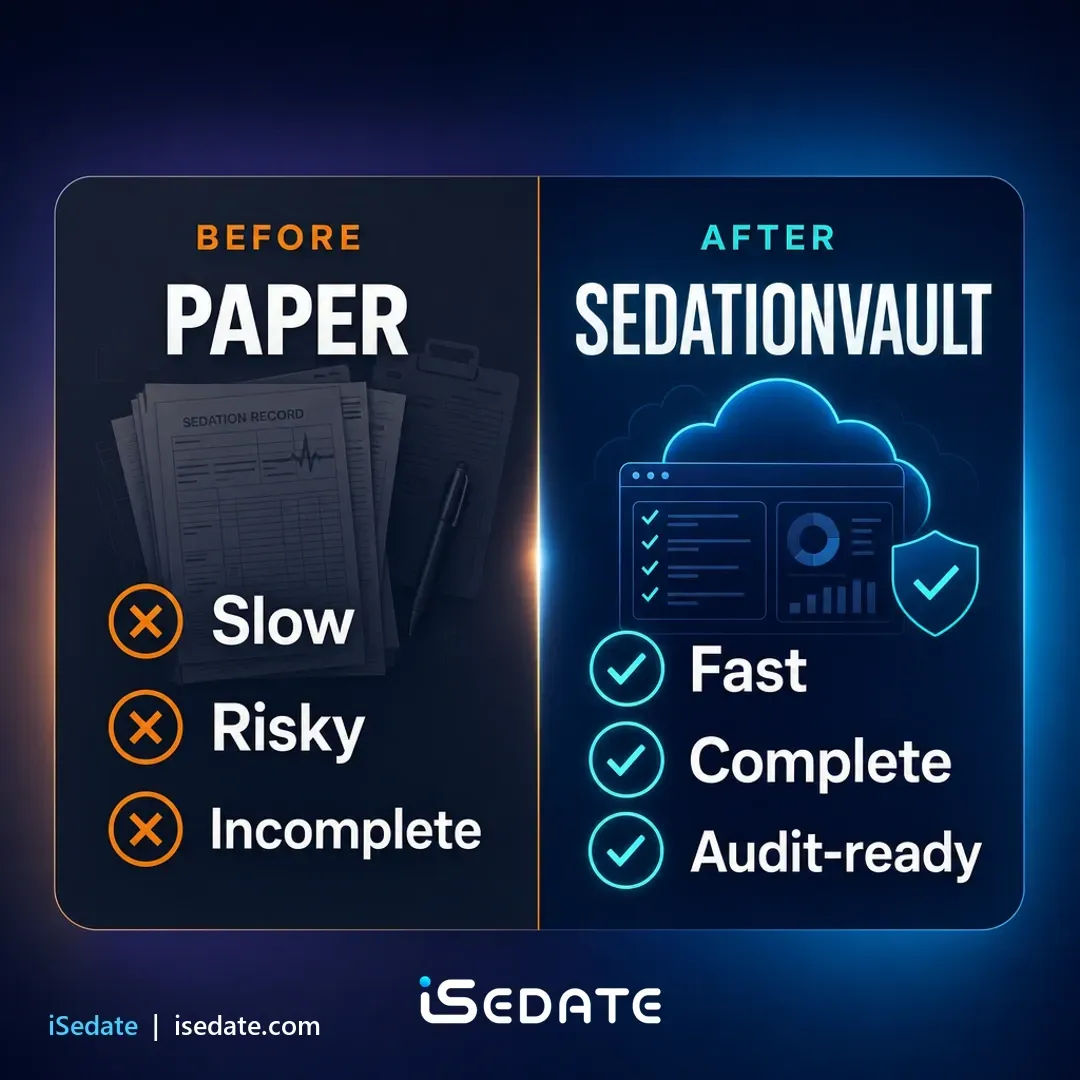
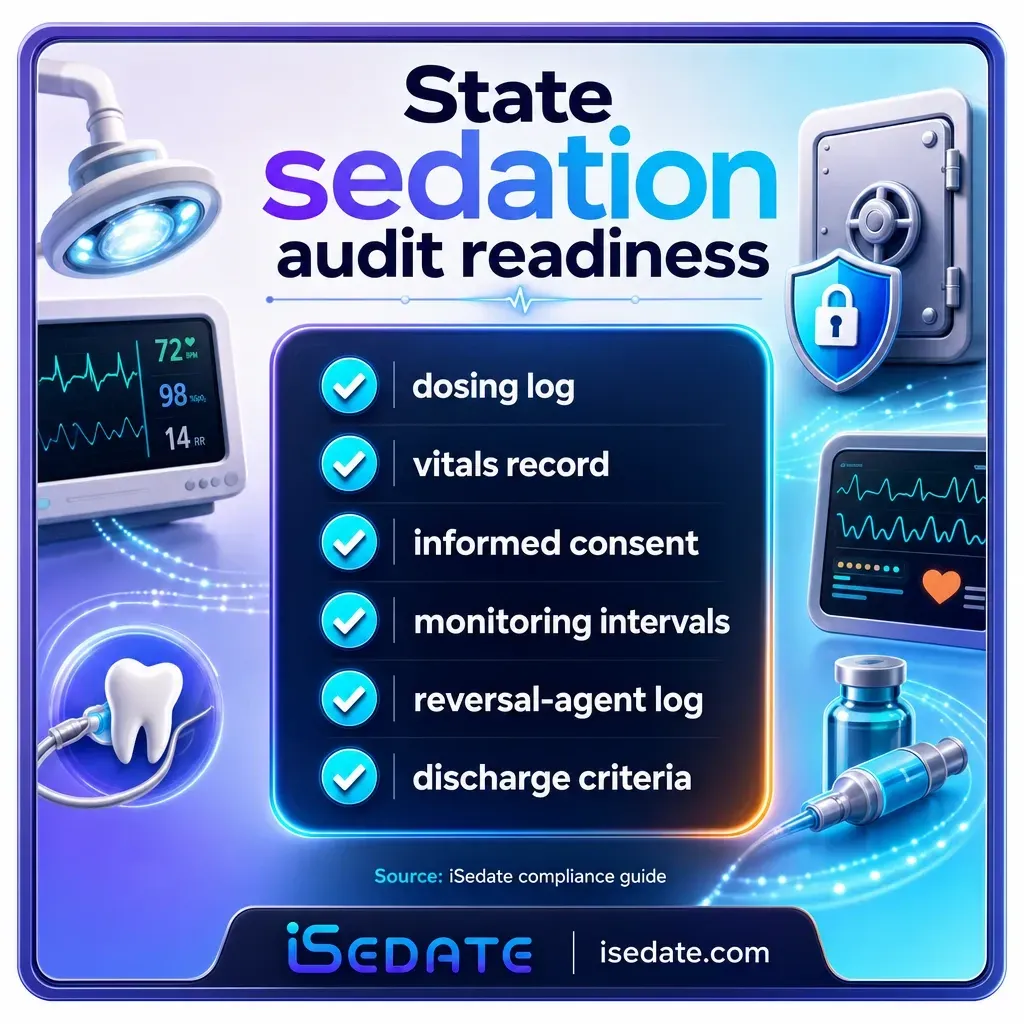
For the dental and oral surgery practices reading this, the sedation-coverage gray zone is a documentation problem as much as a billing one. When anesthesia is billed as medically necessary, the claim lives or dies on the completeness of the sedation record: indication, monitored vitals, drugs and doses, and time stamps. Practices that chart sedation cleanly and produce an audit-ready report get paid faster and defend denials better. That is the exact problem iSedate's SedationVault dental sedation compliance tools are built to solve, turning a messy paper trail into a one-click, defensible record.
Source: Cigna anesthesia and facility services coverage policy | Cigna official dental plans page
Cigna Dental Reviews: Ratings and Complaints
Cigna is a tale of two scorecards. On financial stability, it rates near the top of the industry. On customer experience, the reviews are noticeably rougher.
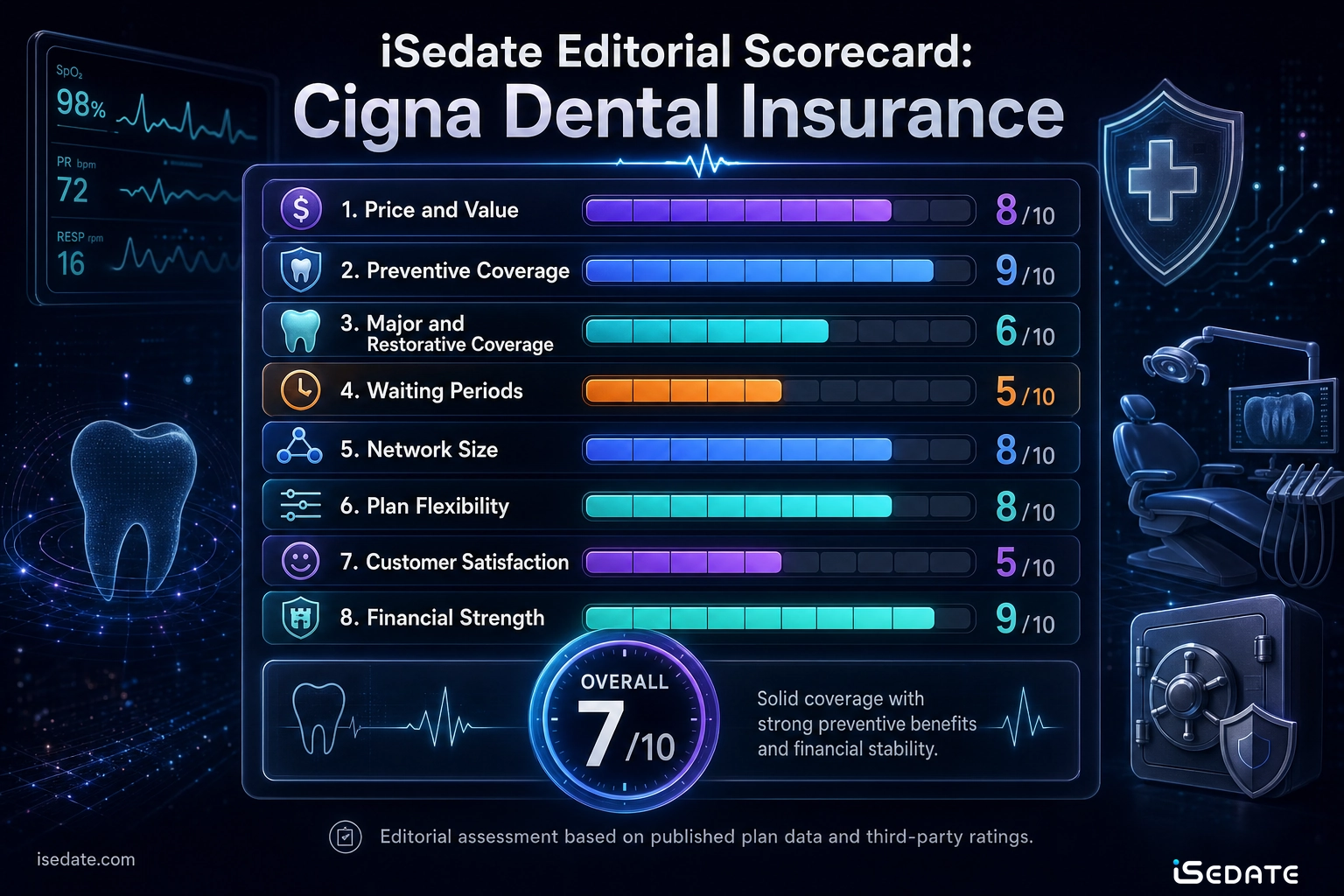
On the strong side, Cigna carries an "A" (Excellent) financial-strength grade from AM Best and an "A" (Strong) rating from S&P Global, and it landed slightly above the industry average in J.D. Power's dental satisfaction research. That stability matters: a carrier that pays claims reliably for decades is not a small thing.
On the weaker side, aggregate user sentiment is mixed to low. BestCompany shows a 3.1 out of 5 average across 127 reviews with a large cluster of one-star ratings, Money's own reader review score sits at just 1.21 out of 5, and Cigna is not Better Business Bureau accredited for its dental line. The recurring complaints are consistent: difficulty reaching a live person, claim denials or delays, and a network that some members found thinner than expected in their area. Positive reviewers, by contrast, tend to praise the low price and the ease of routine, preventive visits.
Our read: the complaint pattern is classic for a high-volume, budget-priced carrier. If you stay in network and use the plan for what it is best at (preventive and basic care), you are far less likely to hit the friction points that generate the angry reviews. The one-star stories cluster around major work, claims disputes, and out-of-network surprises.
Source: BestCompany Cigna dental reviews | Money's Cigna dental review
Pros and Cons of Cigna Dental Insurance
Pulling the full picture together, here is the honest ledger.
Pros
- Among the cheapest entry points in the category, with plans from about $19 per month.
- Preventive care covered at 100% in-network with no waiting period on most plans.
- Large network: roughly 300,000 dental office locations and 89,000 providers.
- Excellent financial-strength ratings (AM Best "A", S&P "A").
- Flexible structure: a low-cost DHMO and a see-any-dentist PPO, plus Advance plans with no waiting periods.
Cons
- Waiting periods of 6 months (basic) and 12 months (major) on standard plans.
- Implants excluded on the cheaper low-deductible plans.
- Sedation and general anesthesia generally not covered unless medically necessary and listed.
- Mixed-to-low user-satisfaction scores and no BBB accreditation.
- In-network dentist list can feel thin in some local markets.
Source: Money's Cigna dental review | Cigna official dental plans page
Who Should Choose Cigna (and Who Shouldn't)
Cigna is a strong fit if you: want the lowest realistic premium for preventive and basic care, are happy to stay in network, and do not need major work right away. For a healthy adult who needs two cleanings a year and the occasional filling, a Cigna low-deductible plan is hard to beat on price.
Cigna is a weaker fit if you: need implants or major restorative work soon (the waiting periods and plan limits erode the value), require reliable sedation coverage, or place a high premium on white-glove customer service. In those cases, compare annual maximums, waiting-period waivers, and sedation language across carriers before committing.
Source: Cigna official dental plans page
Cigna vs. Delta Dental and Other Alternatives
Cigna rarely gets shopped alone. The most common head-to-head is Cigna versus Delta Dental, which runs the largest dentist network in the country and tends to win on network depth while Cigna often wins on individual-plan price. Aetna and Guardian are the other two names that show up most in the same searches, each with its own trade-offs on network, waiting periods, and major-work coverage.
The practical move is to compare three to four carriers on the four numbers that decide value for your situation: monthly premium, annual maximum, waiting periods, and whether your dentist is in network. You can line Cigna up against every major carrier in our dental insurance company directory, which keeps each carrier's contact details and plan basics in one place.
Source: Money's Cigna dental review
Final Verdict: Is Cigna Dental Insurance Worth It?
Cigna dental insurance is worth it for the right buyer. For affordable preventive and basic coverage from a financially rock-solid carrier with a big network, it is one of the easiest recommendations in the category, which is why it scores well on price, preventive coverage, network, and financial strength. The points it loses are real and specific: waiting periods on anything beyond preventive, implant coverage locked to the pricier tiers, sedation that is usually excluded, and a customer-service reputation that is middling at best.
The bottom line: buy Cigna for routine care and basic restorative work, stay in network, and pick a plan tier that actually lists the services you expect to use. If you need major work, orthodontics, or sedation covered soon, run the numbers against Delta Dental and one or two others before you sign. The smartest shoppers do not ask "is Cigna good?" in the abstract; they ask "is this Cigna plan good for my mouth, my dentist, and my next 12 months?"
If you run a dental or oral surgery practice and sedation documentation is part of your day, see how a cleaner compliance record changes claim outcomes.
See how SedationVault documents sedation cases
Source: Cigna official dental plans page | BestCompany Cigna dental reviews
Frequently Asked Questions
Is Cigna good dental insurance?
How much does Cigna dental insurance cost per month?
Does Cigna dental insurance cover sedation or general anesthesia?
What is the difference between Cigna Dental Care (DHMO) and Cigna Dental PPO?
Does Cigna dental have waiting periods?
Does Cigna dental insurance cover dental implants?
Methodology and sources. This review is a research-based editorial assessment, not a hands-on test of one policy. Plan structures, premiums, coverage percentages, waiting periods, network size, and implant and orthodontia rules were taken from Cigna's official individual dental plans page and Cigna's dental HMO vs PPO guide, cross-checked against Money's independent Cigna dental review. Sedation and anesthesia coverage reflects Cigna's published medical coverage policy on anesthesia and facility services for dental treatment and its dental clinical criteria. User-satisfaction and complaint data come from BestCompany (3.1/5 across 127 reviews), Money's reader review score (1.21/5), and the AM Best, S&P Global, and J.D. Power ratings cited in Money's review. Figures reflect sources available as of 2026 and can vary by state, employer group, and plan year; confirm the Summary of Benefits for the exact plan before enrolling. Scores (out of 10) are iSedate's editorial judgment based on this published data.
Sources: Cigna official dental plans page | Cigna dental HMO vs PPO guide | Cigna anesthesia and facility services coverage policy | Money's Cigna dental review | BestCompany Cigna dental reviews