






Guardian Dental Insurance Reviews: Ratings, Complaints & Is It Worth It?
Guardian dental insurance is financially rock-solid and backed by a large PPO network, but its reviews tell two different stories: editorial scores near 4.6 out of 5 sit beside user ratings closer to 2.5 out of 5, driven almost entirely by claim-denial complaints. Our verdict is 7.2 out of 10. Guardian is a dependable preventive-care plan from a top-rated insurer, as long as you go in understanding its waiting periods and annual maximum before you count on it for a crown or implant.
- Top financial strength: A.M. Best affirmed Guardian at A++ (Superior) with a stable outlook on September 12, 2025, its highest tier for claims-paying ability.
- The ratings split is the story: curated editorial reviews rate Guardian around 4.6 out of 5; open user-review sites sit near 2.5 out of 5, almost entirely over denied claims.
- Strong preventive, standard limits elsewhere: preventive care is usually covered right away, but major work can carry a 12-month wait and a modest annual maximum.
- Most complaints are expectation gaps: waiting periods, 50 percent major-work coinsurance, and exclusions are common to dental insurance, not unique to Guardian.
- For practices: Guardian reimburses cleanly when documentation is complete; sedation and major-procedure claims are where thin records cause denials.
What's in This Review
- Is Guardian Dental Insurance Good? The Short Answer
- What Is Guardian Dental Insurance?
- How We Scored Guardian
- The Guardian Dental Insurance Scorecard
- Financial Strength: Guardian's Strongest Card
- Coverage, Waiting Periods, and Annual Maximums
- Guardian Dental Complaints: What Reviewers Actually Say
- The Ratings Split, Explained
- Guardian vs Delta Dental: Quick Take
- Should Your Practice Accept Guardian?
- Is Guardian Dental Insurance Worth It?
- Final Verdict: 7.2 out of 10
- Frequently Asked Questions
Is Guardian Dental Insurance Good? The Short Answer
Yes, with a caveat. Guardian is a 165-year-old mutual insurer with the highest financial strength rating A.M. Best issues, and its individual and group dental plans cover preventive care strongly. The caveat is expectations: Guardian is dental insurance, not a dental discount that pays for everything. Members who read the plan documents tend to be satisfied, while members who assumed a "100 percent preventive" plan would also cover a same-year crown tend to leave one-star reviews.
That gap is exactly why Guardian's scores are so split, and it is the single most useful thing to understand before you enroll or, if you run a practice, before you decide to accept it.
What Is Guardian Dental Insurance?
Guardian dental insurance is sold by The Guardian Life Insurance Company of America, a mutual insurer founded in 1860. Guardian offers both employer-sponsored group dental plans and individual and family plans you can buy directly, most of them built on its DentalGuard Preferred PPO network. You can quote and compare the individual plans on Guardian's official dental insurance pages.
Guardian does not publish a single nationwide dentist count, and network depth varies by ZIP code, but independent reviews consistently describe a large PPO network of more than 100,000 participating dentists. As with any PPO, the only number that matters to you is whether your dentist is in-network, which you can confirm in Guardian's find-a-dentist tool before buying.
How We Scored Guardian
This is an editorial review, not a paid placement and not a first-person "we bought a policy" test. We synthesized primary sources (Guardian's own plan materials and A.M. Best's rating action) with independent review platforms and dental-industry data, then scored Guardian against six criteria that actually determine whether a dental plan is worth the premium.
The six categories are financial strength and stability, network access, plan value and annual maximums, waiting periods, claims experience and member satisfaction, and transparency and enrollment. Each is scored out of 10, and the overall score is the average. We weighted nothing artificially: a carrier that is financially flawless but frustrating at claim time should, and does, land in the middle of the range.
The Guardian Dental Insurance Scorecard
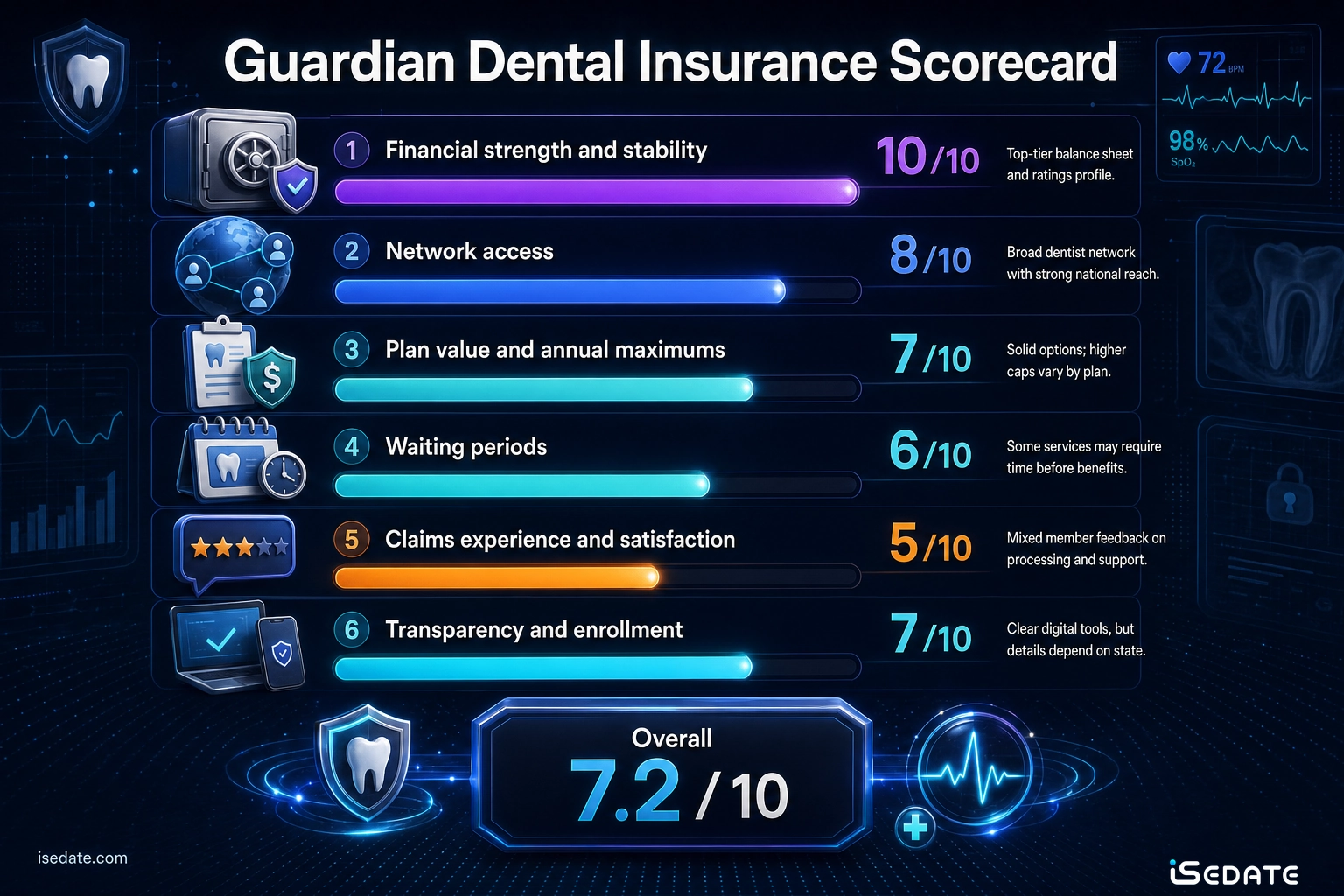
| Category | Score | Notes |
|---|---|---|
| Financial strength and stability | 10/10 | A++ (Superior) from A.M. Best, affirmed September 2025 |
| Network access (DPPO) | 8/10 | Large PPO network; depth varies by ZIP code |
| Plan value and annual maximums | 7/10 | Strong preventive coverage; modest maximums that rise in years two and three |
| Waiting periods | 6/10 | None for preventive; up to 12 months for major work on some plans |
| Claims experience and satisfaction | 5/10 | Strong editorial scores clash with recurring denial complaints |
| Transparency and enrollment | 7/10 | Clear online quoting; exact terms vary by state and plan |
| Overall | 7.2/10 | Financially excellent; manage expectations on claims and timing |
Financial Strength: Guardian's Strongest Card
If there is one thing reviewers across the spectrum agree on, it is that Guardian is financially sound. On September 12, 2025, A.M. Best affirmed The Guardian Life Insurance Company of America's Financial Strength Rating at A++ (Superior) with a stable outlook, and affirmed its Long-Term Issuer Credit Rating at "aa+" (Superior).
Why does this matter for a dental plan, where individual claims are usually small? Because financial strength is the quiet promise that the carrier will still be there, and still paying, over the life of your coverage. A++ is A.M. Best's top category, and very few insurers of any kind hold it. On this criterion, Guardian is as strong as dental insurance gets.
Source: A.M. Best rating affirmation (September 2025)
Coverage, Waiting Periods, and Annual Maximums
Guardian's plans follow the standard dental-insurance structure, which is where most of the confusion (and most of the one-star reviews) comes from. Here is how the typical Guardian plan breaks down, straight from Guardian's own plan materials.
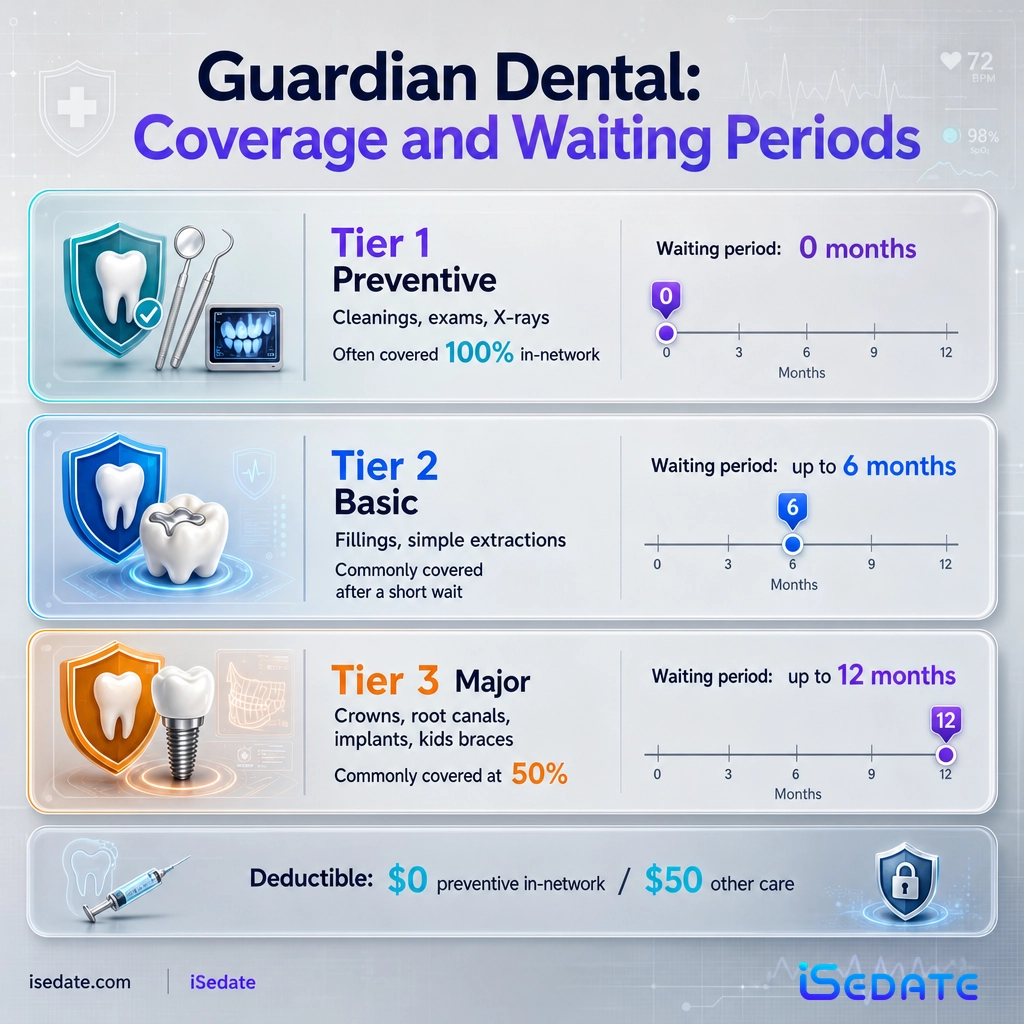
| Care level | Typical Guardian coverage | Waiting period |
|---|---|---|
| Preventive (cleanings, exams, X-rays) | Usually covered right away, often at 100% in-network | None |
| Basic (fillings, simple extractions) | Covered after a short wait on many plans | Up to 6 months (varies by state and plan) |
| Major (crowns, root canals, implants, kids' braces) | Covered on higher plan tiers, commonly at 50% | Up to 12 months on some plans |
| Deductible | $0 preventive in-network; $50 for other care | n/a |
Two more details decide whether a plan pays off. First, Guardian charges no deductible for preventive services when you use a network dentist, and a $50 deductible for other care. Second, Guardian's annual maximum (the most the plan pays in a year) increases in the second and third years on many of its individual plans, rewarding members who stay enrolled.
That annual maximum is where dental insurance as a category shows its age. The American Dental Association notes that many plans still promote a $1,000 annual maximum, a level that was set roughly 40 years ago, even as some plans now offer $2,000 or more. The National Association of Dental Plans reports maximums have been creeping up, with most PPO enrollees now at $1,500 or higher. Guardian sits inside this norm, which is good and bad: competitive with the market, but the market itself caps what any dental plan will pay in a year.
If you need a crown, implant, or other major work this year, run the math before you enroll. On most plans, major work waits 12 months, is covered at about 50%, and still counts against the annual maximum. A $1,500 crown on a new plan with a 12-month major-work wait may pay you nothing in year one. Enroll early, before the work is needed, or the premium can outrun the benefit.
Source: Guardian's official dental plan materials | ADA News on dental annual maximums | National Association of Dental Plans benefits data
Guardian Dental Complaints: What Reviewers Actually Say
Credibility in a review comes from the negatives, so here are the complaints that show up most often in Guardian's user reviews, in plain terms.
- Denied or reduced major-work claims. The loudest complaints involve crowns and night guards that members expected to be covered and were not, often because of the waiting period, the 50% coinsurance, or a plan exclusion.
- Waiting-period frustration. Members who needed major work soon after enrolling ran into the 12-month wait and felt the plan was useless in year one.
- Pre-existing and missing-tooth exclusions. Several reviewers cite denials tied to conditions that pre-dated the policy, a standard but poorly understood limitation.
- Escalation to state regulators. A handful of reviewers describe filing complaints with their state insurance commissioner over denied claims.
Read closely, most of these are the structural limits of dental insurance rather than evidence that Guardian uniquely mishandles claims. That does not make them painless, and it is fair to weigh them, which is why claims experience is Guardian's lowest score on our card. But it reframes the question from "is Guardian a scam" to "did the member and the plan agree on what was covered." They usually did not.
Source: BestCompany user reviews of Guardian dental | Retirement Living's Guardian dental review
The Ratings Split, Explained
The clearest picture of Guardian is not any single score, it is the distance between the scores.
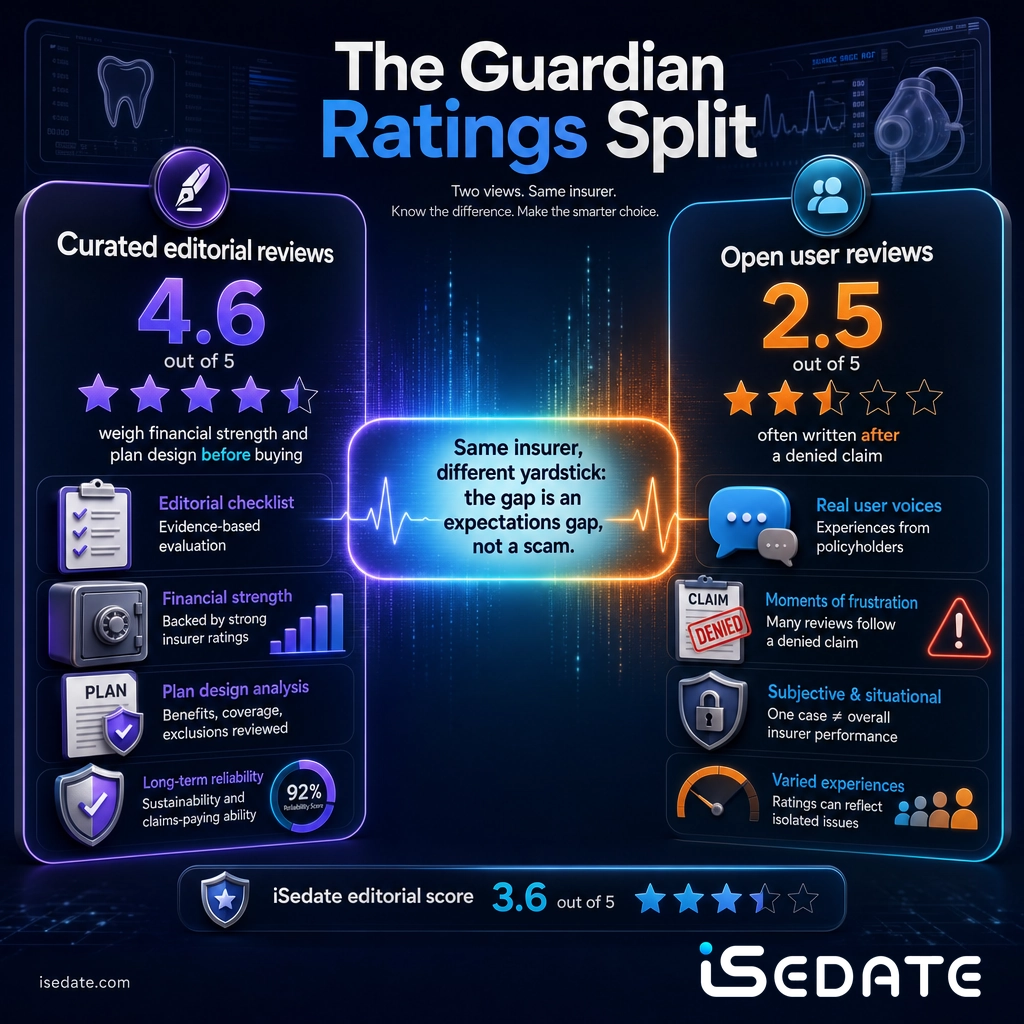
Guardian Dental: Where the Ratings Land (out of 5)
Editorial sites that read the plan documents and weigh financial strength tend to rate Guardian highly, around 4.6 out of 5. Open user-review sites, where people arrive after a denied claim, sit near 2.5 out of 5. Neither is wrong. They are measuring different things: one measures the plan on paper, the other measures the gap between what members expected and what they received.
The ratings split is not a contradiction, it is a diagnosis. Guardian scores well on everything you can verify before you buy (financial strength, network, coverage design) and poorly on the one thing you only discover at claim time: whether your expectations matched the fine print. Enter with accurate expectations and Guardian behaves like a 4.6; enter expecting dental insurance to work like a membership that pays for everything and it behaves like a 2.5.
Guardian vs Delta Dental: Quick Take
The most common comparison shoppers make is Guardian against Delta Dental, the largest dental carrier in the country. Both are financially strong and both run large PPO networks, so the decision rarely comes down to brand. It comes down to three checks: is your specific dentist in each network, how do the annual maximum and waiting periods compare for the care you actually need, and what is the premium difference. Delta's headline advantage is network size; Guardian competes on plan flexibility, strong preventive coverage, and its A++ financial strength.
For a deeper side-by-side, see our dedicated Guardian vs Delta Dental comparison (linked above once published) and our full Delta Dental review.
Should Your Practice Accept Guardian?
If you run a dental or oral surgery practice, the Guardian question is different from the patient question. Guardian is one of the larger PPO payers, so being in-network can bring a steady stream of patients. The two trade-offs are the contracted fee schedule, which discounts your usual fees, and the documentation burden on the claims most likely to be scrutinized: sedation, anesthesia, and major restorative work.
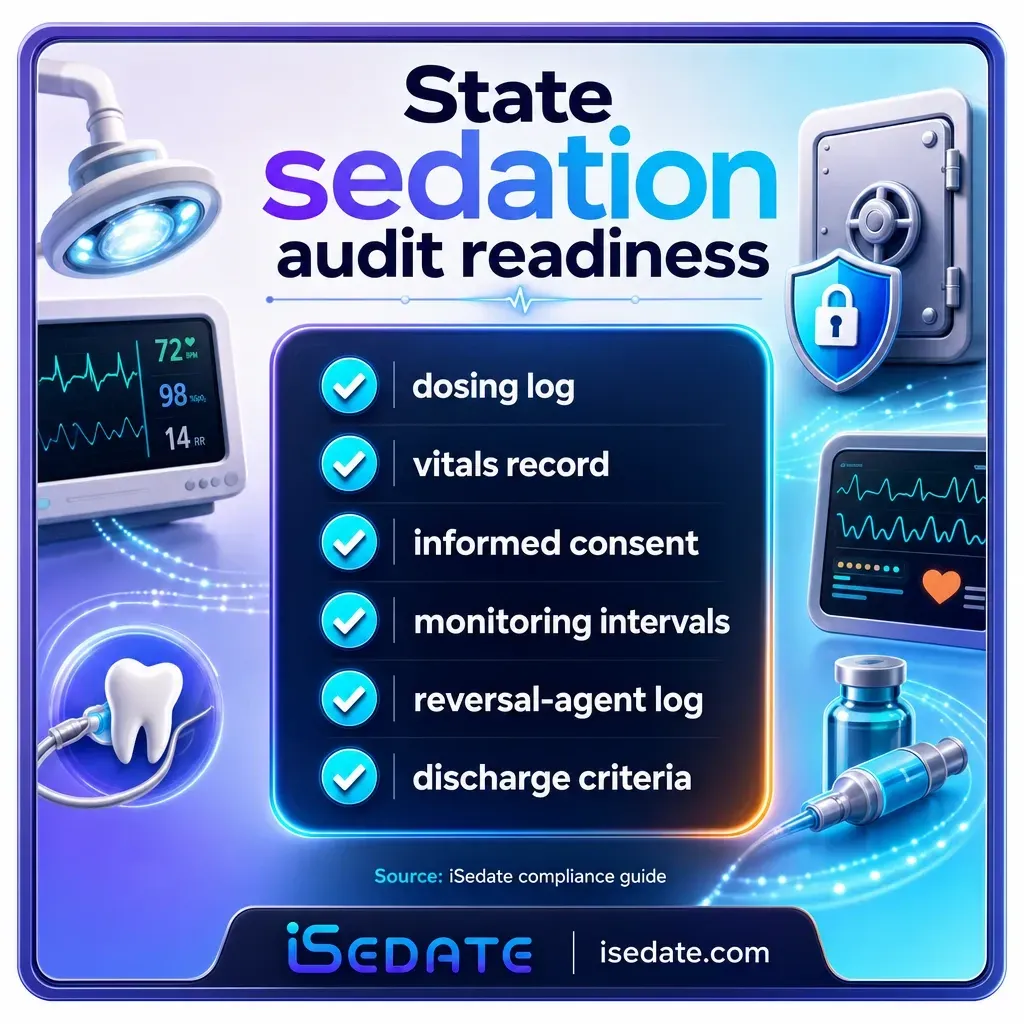
Here is the pattern every sedation practice eventually learns. Preventive and basic claims flow through automatically. The claims that get denied, down-coded, or clawed back on audit are the complex ones, and they are denied for the same reason again and again: incomplete or inconsistent documentation. A missing time-stamped vitals record, a consent form that does not match the procedure note, or a sedation log that cannot be produced on request turns a legitimate, covered procedure into a denied claim.
Before you join or drop a Guardian panel, pull your last 12 months of denied and down-coded claims and sort them by procedure type. If sedation and major work dominate the list, the fix is usually documentation, not the payer. Clean, audit-ready records are the cheapest way to raise your net reimbursement from any PPO, Guardian included.
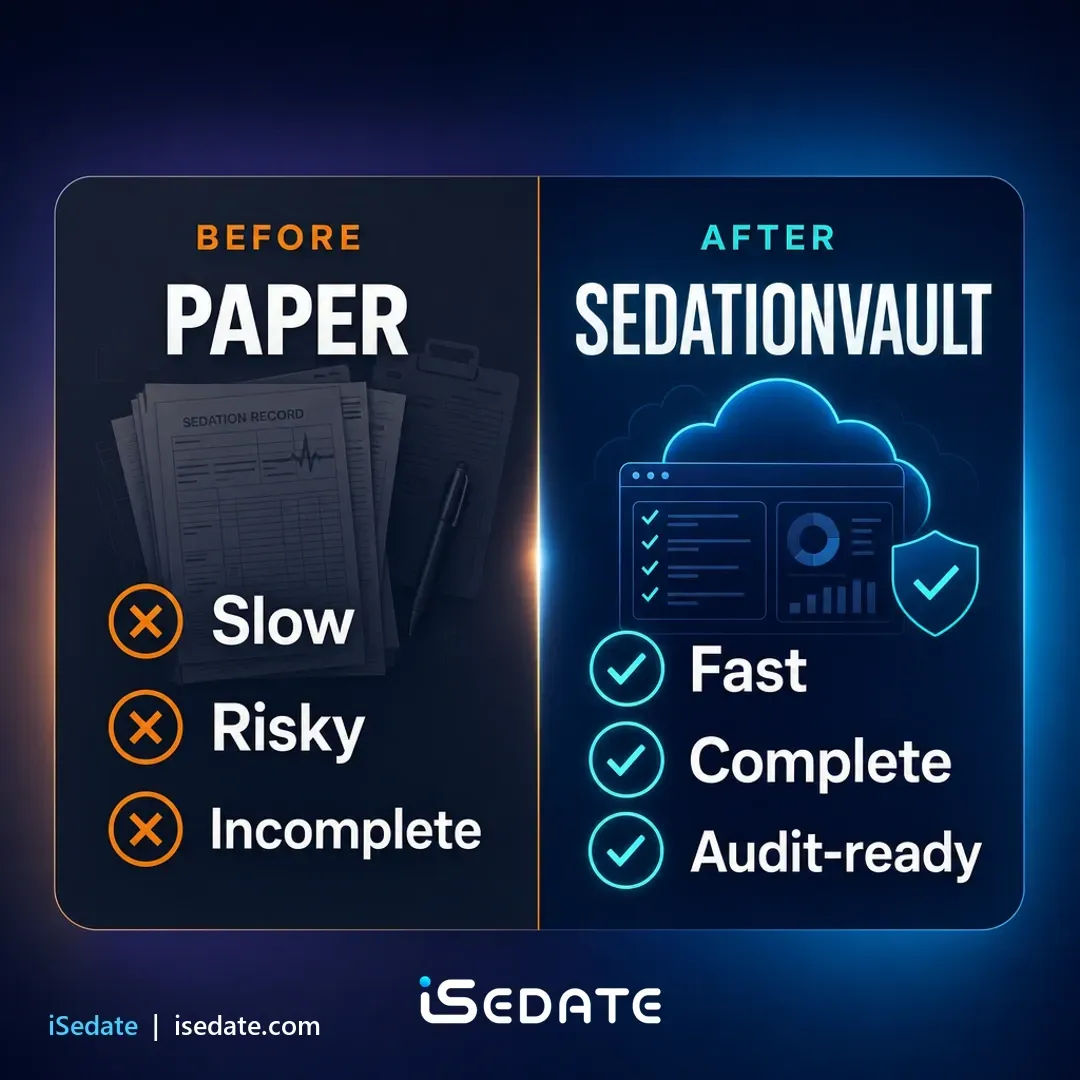
This is where accurate sedation record-keeping pays for itself. When every sedation visit produces a complete, time-stamped, audit-ready record, the documentation a payer asks for is already in hand, denials drop, and appeals get easier to win. SedationVault by iSedate was built for exactly this: real-time sedation and vitals charting that generates one-click audit-ready sedation reports and keeps your sedation compliance documentation consistent across every case. It will not change Guardian's fee schedule, but it removes the single most common reason sedation claims get denied in the first place. See how it fits a sedation workflow on our page for sedation dental practices.
Keep your sedation claims audit-ready with SedationVault
Is Guardian Dental Insurance Worth It?
Worth it for: people who want preventive and basic coverage from a financially unshakable carrier, who will enroll before they need major work, and who will take two minutes to confirm their dentist is in-network. For this buyer, Guardian is a strong, fairly priced plan.
Think twice if: you need a crown or implant this year, because the 12-month major-work waiting period and the annual maximum may mean the plan pays little in year one. Also think twice if your preferred dentist is out of network in your ZIP, which erases most of the PPO value.
Myth: "A 100 percent preventive plan means Guardian pays 100 percent of my dental costs." It does not. The 100 percent applies to preventive visits with a network dentist. Basic and major work carry coinsurance (you pay a share), waiting periods, a deductible, and an annual maximum. Understanding that one distinction prevents the exact disappointment behind most of Guardian's negative reviews.
Final Verdict: 7.2 out of 10
Guardian dental insurance is a financially excellent plan with a broad network and genuinely strong preventive coverage, held back from a top score by the ordinary frustrations of dental insurance: waiting periods, coinsurance, and a modest annual maximum that catch unprepared members off guard. The A++ financial strength is real, the network is real, and most of the one-star reviews trace back to an expectation gap rather than a broken plan.
For patients: enroll early, confirm your dentist, and treat it as preventive-first coverage, and Guardian delivers. For practices: Guardian reimburses cleanly when your documentation is complete, so the lever within your control is records, not the payer. On both sides, the recurring theme of this review is the same, expectations and documentation decide whether Guardian feels like a 4.6 or a 2.5.
Frequently Asked Questions
Is Guardian dental insurance good?
What is Guardian's financial strength rating?
Does Guardian dental insurance have waiting periods?
Why do people complain about Guardian dental claims?
Guardian vs Delta Dental: which is better?
Is Guardian dental insurance worth it for major dental work?
Should my dental practice accept Guardian?
Methodology and sources. This review synthesizes primary and independent sources rather than a single purchased policy. Financial strength is from A.M. Best's September 12, 2025 rating affirmation of The Guardian Life Insurance Company of America. Plan structure, waiting periods, deductibles, and annual-maximum behavior are drawn from Guardian's own dental plan materials. Member sentiment and complaint themes are drawn from independent review platforms including Retirement Living and BestCompany. Dental-benefit industry context is from the American Dental Association and the National Association of Dental Plans. Scores are iSedate's editorial assessment against six defined criteria; coverage terms vary by state and plan, so confirm the specific Summary of Benefits and Coverage before enrolling. Sources: A.M. Best rating affirmation, Guardian official dental plans, Retirement Living, BestCompany, ADA News, National Association of Dental Plans.