






How to Prepare Your Dental Office for Sedation Procedures
Preparing a dental office for sedation isn’t just about buying equipment. Preparation means standardizing screening and consent, configuring rooms for rapid setup, rehearsing roles, auditing crash carts, and building a documentation workflow that captures vitals and doses in real time. Use this blueprint to get office-based nitrous, oral, and IV sedation ready—safely, efficiently, and in a way that scales.
Table of Contents
How to Prepare Your Dental Office for Sedation Procedures
Build a sedation playbook your entire team can follow
The five phases you’ll repeat on every sedation visit
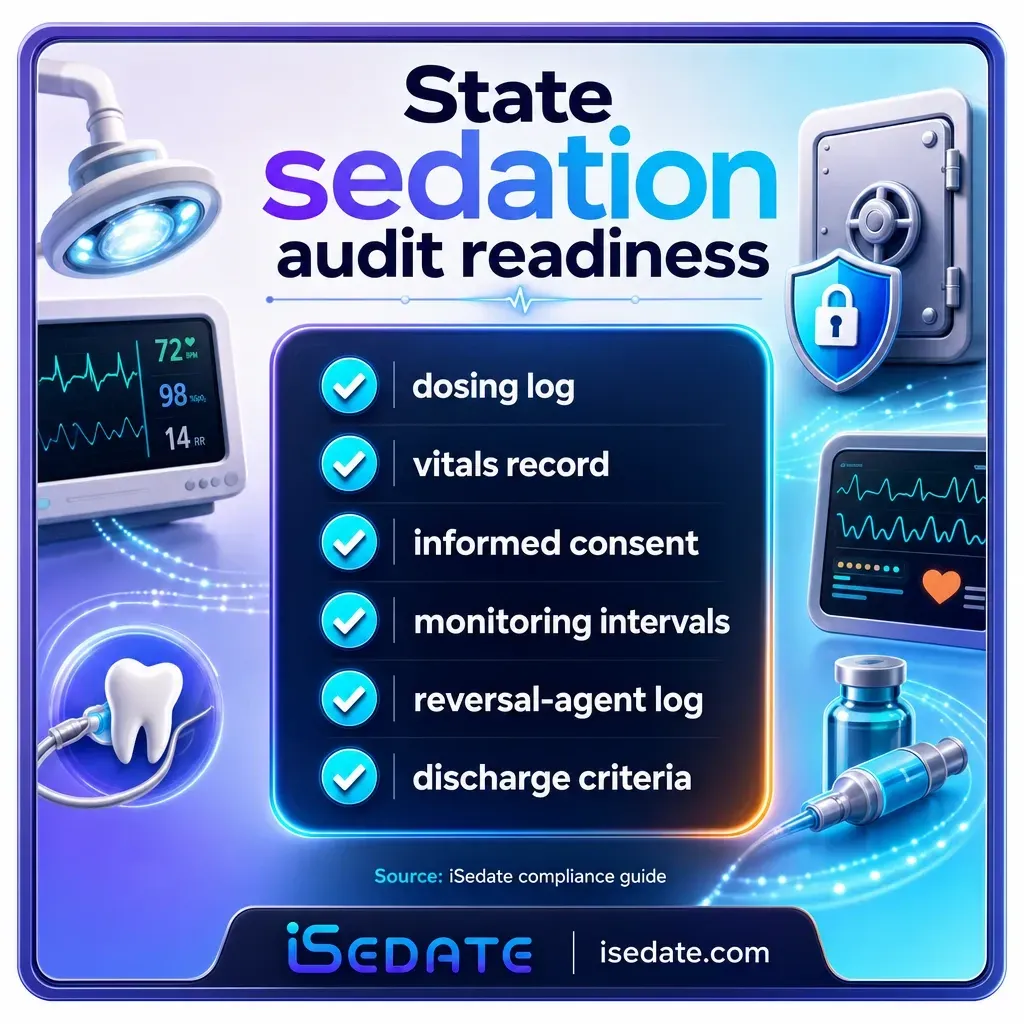
The artifacts your chart must show every time
Assign roles so execution is automatic under pressure
Standardize pre-op screening so day-of goes smoothly
Screening essentials your form should include
Configure rooms for a 60-second “ready” sequence
Room setup that works in any operatory
Train your team to chart in real time—not after the fact
Documentation habits that make audits easy
Stock and audit your crash cart like it matters—because it does
Minimum cart contents for office-based sedation
Create modality-specific day-of flows
Rehearse emergencies until the choreography is boring
Quarterly mock codes you should schedule now
Prepare your front desk and recovery space too
Operational pieces that keep the day predictable
Set clear discharge criteria so decisions aren’t subjective
Objective criteria you can post on the wall
Train new staff with a digital-first onboarding plan
Budget the switch from paper and phase upgrades sensibly
Keep patients informed so they arrive prepared
Common pitfalls and how to avoid them
A prepared sedation office turns complex visits into predictable routines. Preparation starts with a shared playbook, role clarity, and a room layout that puts airway tools and monitors within arm’s reach. This guide shows how to set up your environment, people, and documentation so every case runs the same safe way from intake to discharge.
Build a sedation playbook your entire team can follow
A clear, one-stop playbook prevents drift as schedules get busy. Your playbook defines the phases of care, exact checklists, and where each artifact lives in your record.
The five phases you’ll repeat on every sedation visit
● Pre-op intake and risk screening
● Consent review and day-of room setup
● Induction and interval monitoring with live documentation
● Recovery, discharge criteria, and escort handoff
● Post-visit QA, restock, and case review
The artifacts your chart must show every time
● Completed medical history, meds, allergies, and focused airway screen
● Modality-specific consent tied to the day’s plan
● Time-stamped vitals and medication entries at defined intervals
● Recovery scoring and objective discharge criteria met
● A legible, exportable sedation record for audits and referrals
Use Sedation visit record software to keep these artifacts consistent and visible.
Assign roles so execution is automatic under pressure
Preparation fails when responsibilities are fuzzy. Assign four roles that don’t depend on which clinician is on the schedule and rehearse the handoffs.
Create and track these role checklists with Dental sedation compliance.
Standardize pre-op screening so day-of goes smoothly
Good screening prevents last-minute cancellations and unsafe surprises. Your intake should capture medical stability, medication interactions, airway risk, and prior sedation response.
Screening essentials your form should include
● Comprehensive medication and allergy review, including home pre-meds
● Focused airway and sleep apnea screen
● Prior sedation experiences and any paradoxical reactions
● Fasting and escort confirmation for oral/IV plans
● Clear criteria for deferral, physician clearance, or referral
Keep your screening, instructions, and clearance notes inside Sedation dentistry software so the whole team stays aligned.
Configure rooms for a 60-second “ready” sequence
Room design is preparation made visible. Arrange the space so oxygen, suction, monitors, and airway tools live in fixed positions, and teach a short “power-up” routine.
Room setup that works in any operatory
● Power on monitors; verify SpO₂, BP cycling, and alarm thresholds
● Connect capnography if indicated; place nasal cannula in reach
● Confirm oxygen PSI and fit; pre-attach BVM to regulator
● Test suction and position tips; place bite blocks and chin support
● Stage reversal agents; confirm expirations and dosing card visibility
● Set crash cart brake; post drawer map and QR code to policy
If you’re building from scratch, align your cart with Sedation Crash Cart Requirements.
Train your team to chart in real time—not after the fact
Preparation means the Recorder can capture entries without slowing care. Teach read-backs and running totals so every dose is accurate to the decimal.
Documentation habits that make audits easy
● Announce “drug–dose–route–time,” then enter it live
● Record concentration (mg/mL) and keep doses in mg; add mL secondarily if used
● Tie each dose to an indication and immediate response
● Use visible running totals with mg/kg ceilings for peds cases
● Log nitrous as start time, peak %, titration range, duration at peak, and O₂ at end
For dose accuracy and examples, see document sedation doses accurately and chart long cases in IV sedation charting software.
Stock and audit your crash cart like it matters—because it does
A great crash cart saves seconds you don’t have. Preparation includes stocking, labeling, and auditing it on a weekly/monthly rhythm with sign-offs.
Minimum cart contents for office-based sedation
● Airway: OPAs/NPAs across sizes, lubricant, suction, spare mask gaskets
● Breathing: oxygen source with posted PSI minimums, BVM with adult/ped masks
● Circulation: cuffs in multiple sizes, AED mounted near cart
● Drugs: flumazenil, naloxone, epinephrine, diphenhydramine, albuterol, ondansetron, glucose gel
● Monitoring: spare pulse ox probes and batteries; capnography cannulas if in scope
● Supplies: IV start kit and fluids if IV sedation is in scope
Track audits and expirations inside compliance checklists for sedation.
Create modality-specific day-of flows
Nitrous, oral, and IV sedation share principles but differ in timing and control. Preparation means you’ve mapped each flow clearly.
If patients ask about driving rules, share Can you drive after sedation dentistry https://isedate.com/post/can-you-drive-after-sedation-dentistry and send home instructions from Sedation dentistry recovery https://isedate.com/post/what-to-expect-after-sedation-dentistry-recovery-guide.
Rehearse emergencies until the choreography is boring
Preparation turns rare events into controlled ones. Run short, focused drills that mirror likely scenarios and document what you learned.
Quarterly mock codes you should schedule now
● Airway obstruction with rapid desaturation
● Paradoxical agitation after oral benzodiazepine
● Vasovagal syncope and hypotension
● Bronchospasm in known asthmatic
Use the field-tested checklist in 10 Best Practices for Managing Sedation Emergencies.
Prepare your front desk and recovery space too
Sedation touches scheduling, escorts, and discharge logistics. Preparation includes scripting and space, not just operatory setups.
Operational pieces that keep the day predictable
● Pre-visit transport confirmations via text; collect escort name and phone
● Recovery chair designation with pulse ox, BP cuff, and easy monitor view
● Printed, modality-specific discharge instructions reviewed with escort
● Day-end “tomorrow’s sedation” huddle to preview cases and special needs
For program-level design, review Sedation workflow that scales.
Set clear discharge criteria so decisions aren’t subjective
Preparation means your team knows when someone is truly ready to go and how to document it the same way every time.
Objective criteria you can post on the wall
● Stable SpO₂, HR, BP within acceptable ranges and trending steady
● Orientation to person, place, time; purposeful responses
● Ambulates with minimal assistance; tolerates oral fluids
● Nausea and pain controlled; escort understands instructions for oral/IV cases
Record final vitals and the responsible clinician in digital sedation visit records.
Train new staff with a digital-first onboarding plan
Preparation includes onboarding that sticks. New hires should master room setup, monitor placement, alarm thresholds, and real-time charting before they ever lead a case.
See digital sedation training to build a 30–60–90 plan with micro-modules, drills, and competency sign-offs.
Budget the switch from paper and phase upgrades sensibly
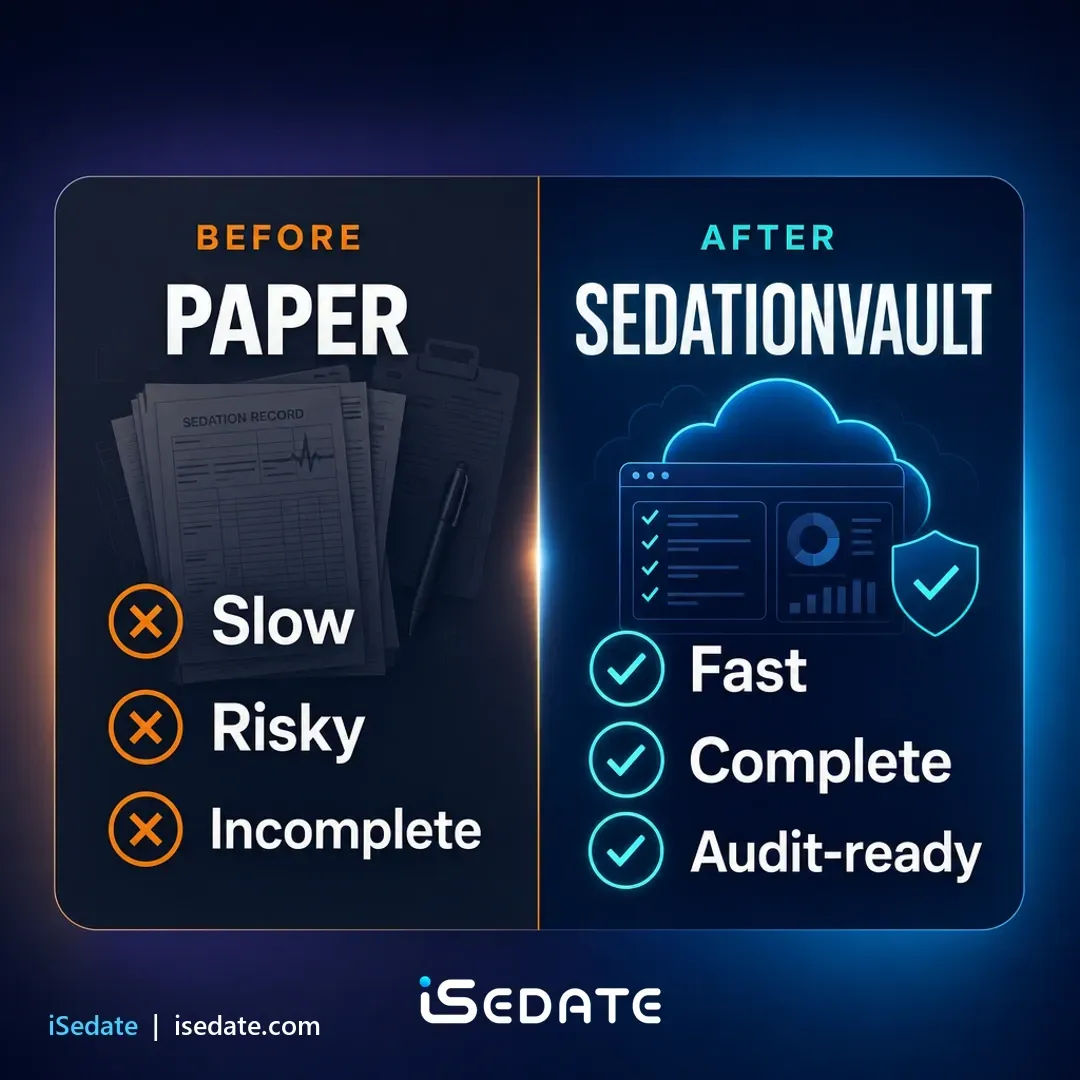
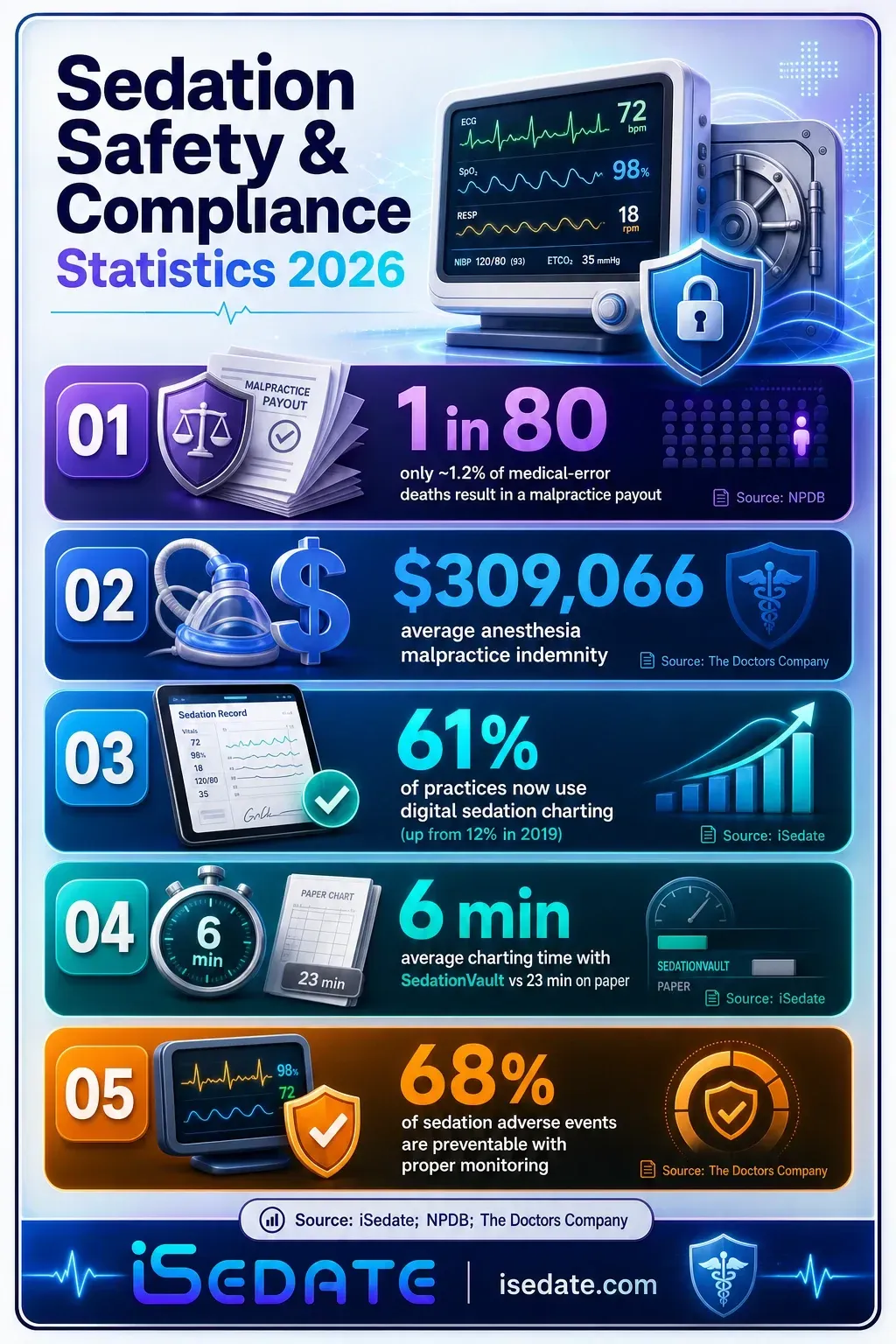
Moving to digital makes preparation visible and repeatable, but it requires planning. Start with your highest-impact modules—visit records and IV charting—then add compliance templates and analytics as your team gets comfortable.
Compare options in iSedate vs. paper records and price seats and modules via Plans & Pricing.
Keep patients informed so they arrive prepared
Prepared patients make prepared visits. Give plain-language prep sheets and link to foundational education.
Point anxious patients to What is sedation dentistry and safety questions to Is sedation dentistry safe https://isedate.com/post/how-safe-is-sedation-dentistry-what-the-research-says. For practice selection guidance, share Sedation dentistry near me https://isedate.com/post/sedation-dentistry-near-me-how-to-choose-the-right-dentist.
Common pitfalls and how to avoid them
Prepared teams sidestep predictable errors with simple systems.
Five pitfalls you can eliminate this week
● Expired reversal agents: add a monthly audit with two signatures
● Missing pediatric sizes: create a clearly labeled “PEDI” drawer section
● Nitrous documented as a checkbox: log peak %, range, and O₂ flush
● Late entry dose edits: assign a dedicated Recorder with read-backs
● Drift from checklists: embed prompts and required fields in the chart
Tie these fixes to sedation compliance software so updates propagate instantly.
Bottom line
Preparation is a system, not a shopping list. When you standardize screening, room setup, interval charting, crash cart readiness, and discharge criteria—and back it all with digital prompts—sedation days run calm and consistent. Patients feel safer, providers work smoother, and your records stand up to any review.
Next Steps
Book a Free Demo to see how iSedate’s Digital Sedation Visit Records Software can streamline and replace paper sedation visit records—saving time, money, and increasing compliance while reducing liability and improving the quality of patient records.
Ready to modernize your sedation documentation? Book a Free Demo