






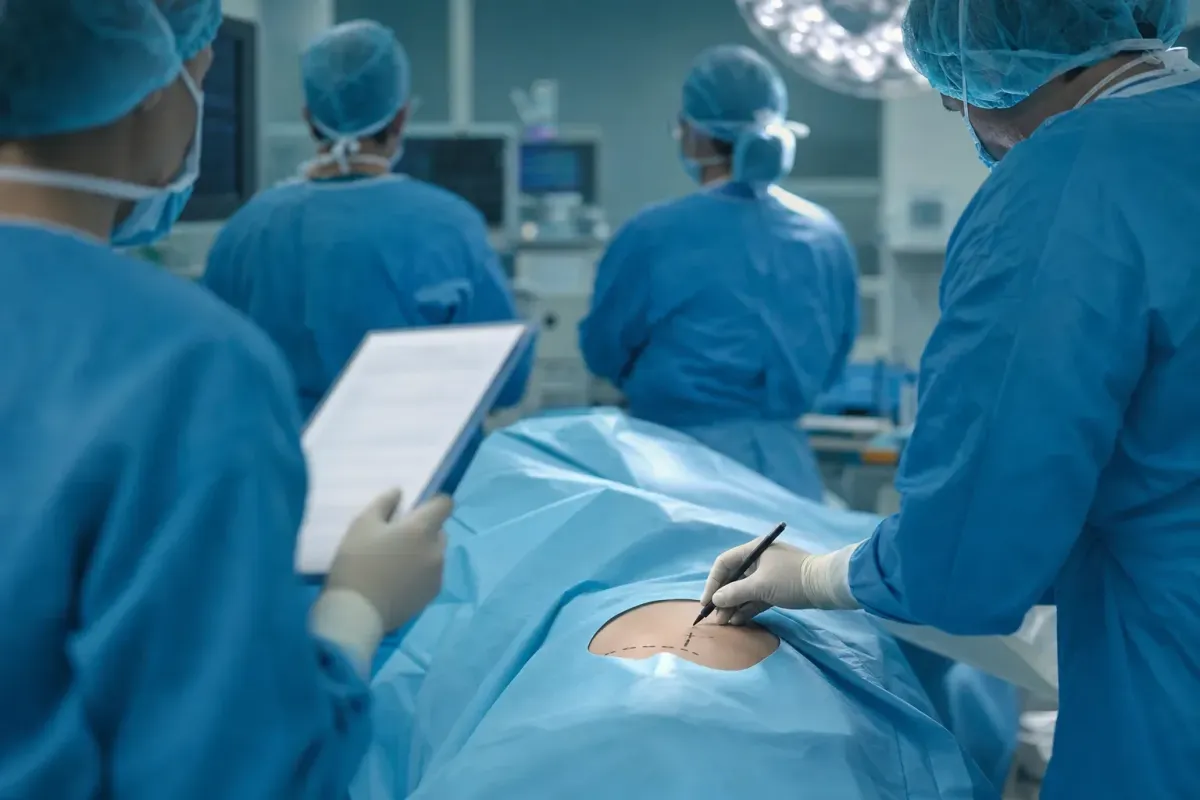
Surgical Never Event Statistics (2026): Incidence, Anesthesia, and Prevention
Never events are the medical errors that are not supposed to be possible: operating on the wrong site, leaving an object inside a patient, or a healthy patient dying under anesthesia. They are rare, clearly defined, and almost entirely preventable, which is exactly why they carry such weight in patient safety and litigation. For sedation providers, one never event category is directly on point: the death of a healthy patient under anesthesia.
- The National Quality Forum defines 29 never events in seven categories, including wrong-site surgery, retained objects, and death of a healthy patient under anesthesia.
- A 2013 study estimated more than 4,000 surgical never events occur each year in the United States.
- In 9,744 paid malpractice claims for surgical never events, retained foreign body led at 49.8 percent, followed by wrong procedure (25.1 percent) and wrong-site surgery (24.8 percent).
- The NQF specifically classifies death of an ASA Class I (healthy) patient under anesthesia as a never event.
- About 71 percent of never events reported to the Joint Commission over a two-decade span were fatal.
- Voluntary reporting likely understates true incidence; one comparison suggested underreporting by a factor of 20 or more.
- Since 2009, Medicare has not reimbursed costs associated with never events, and the Universal Protocol is the primary prevention tool.
What's in This Guide
1What Counts as a Never Event
The term has a precise definition, which is what makes never events measurable and accountable in a way that most adverse events are not. Understanding the definition is the starting point for understanding the data.
The term "never event" was introduced in 2001 by Dr. Ken Kizer, then head of the National Quality Forum, to describe errors so serious they should never happen. The NQF's list of serious reportable events now includes 29 adverse events across seven categories, and the Joint Commission classifies these same events as sentinel events. To qualify, an event must be unambiguous, meaning clearly identifiable and measurable; serious, meaning it results in death or significant disability; and usually preventable. The surgical category alone includes wrong-site surgery, wrong-patient surgery, wrong procedure, unintended retention of a foreign object, and intraoperative or immediately postoperative death in a healthy patient.
This precision matters because it separates never events from the broader universe of adverse outcomes. A poor result from a properly performed procedure is not a never event; operating on the wrong knee is. The clarity of the definition is what allows these events to be tracked, reported, and, since 2009, excluded from Medicare reimbursement. It also makes them powerful in litigation, because a never event is, almost by definition, evidence that something preventable went wrong.
Source: Never Events primer, AHRQ Patient Safety Network | NQF Serious Reportable Events list (National Quality Forum)
See how iSedate's SedationVault supports the record
2How Often They Happen
Never events are, by design, rare, but rare is not the same as never, which is the entire point. The incidence data shows events that are individually uncommon but collectively persistent.
A 2013 study estimated that more than 4,000 surgical never events occur each year in the United States, even though any single hospital may experience a specific event like wrong-site surgery only once every 5 to 10 years. The Joint Commission has received roughly 800 sentinel event reports per year since 2007, with wrong-site surgery, foreign body retention, and falls consistently among the most common. Recent Joint Commission data has shown these events not declining but in some years rising: wrong surgery increased 26 percent and unintended retention 11 percent from 2022 to 2023, and retained objects rose for a fourth consecutive year through 2024.
The persistence is the story. Despite decades of concerted effort, checklists, protocols, and public reporting, never events have not been eliminated, and some categories have recently increased. This does not mean the safety systems have failed; it may partly reflect better reporting. But it confirms that these events remain a live risk in every setting where invasive procedures and anesthesia are performed, including office-based settings, and that vigilance rather than complacency is warranted.
Source: Never event incidence, AHRQ PSNet | 2023 Joint Commission sentinel event increases, American College of Surgeons
See how compliance documentation works3The Malpractice Claim Data
Because never events are unambiguous and serious, they translate readily into malpractice claims. The largest analysis of never-event claims comes from the National Practitioner Data Bank and reveals which events dominate litigation.
A peer-reviewed analysis of 9,744 paid malpractice claims involving surgical never events reported to the National Practitioner Data Bank found that retained foreign body was the most common at 49.8 percent, followed by wrong procedure at 25.1 percent, wrong-site surgery at 24.8 percent, and wrong-patient surgery at 0.3 percent. These four events account for nearly all surgical never-event claims, and their relative frequency has been stable across studies. Retained objects lead in part because they can go undetected until symptoms appear, sometimes long after the procedure, extending both the harm and the liability window.
The claim data underscores how consequential these events are. A California study of never events found that roughly two-thirds of retained-object cases required additional surgery to correct, and regulators mandated an average of 13 corrective actions per incident, most focused on policy-adherence monitoring. Never events do not merely generate a claim; they trigger corrective mandates, regulatory scrutiny, and often a second procedure, compounding the harm to the patient and the exposure to the provider.
The dental and oral-surgery relevance is direct. Retained objects in dental and oral surgery have included dental retractor cords and instrument fragments, and wrong-site events include operating on or extracting the wrong tooth, one of the more commonly reported dental never events. Any invasive procedure carries never-event exposure, and office-based dental and oral surgery settings are not exempt from the verification and documentation disciplines developed in hospital surgery. The same protocols that prevent wrong-site surgery in an operating room, verification, marking, and a documented time-out, apply to the dental operatory.
Source: Mehtsun et al., Surgical never events in the United States, Surgery (NPDB analysis), PubMed
Explore anesthesia record software4The Anesthesia Never Event
Among the 29 never events, one is directly relevant to every sedation and anesthesia provider. It is defined narrowly and specifically, and it places anesthesia safety at the center of never-event prevention.
The National Quality Forum specifically defines "intraoperative or immediately postoperative/post-procedure death in an ASA Class I patient" as a never event. An ASA Class I patient is a normal, healthy person, and the NQF specification includes all such deaths where anesthesia was administered, whether or not the planned procedure was completed, with "immediately postoperative" meaning within 24 hours. In plain terms: when a healthy patient dies under or shortly after anesthesia, it is classified as a preventable event that should never have happened.
This is the never event most relevant to office-based sedation. A patient presenting for elective dental or oral surgery under sedation is frequently an ASA Class I or II patient, healthy apart from the dental issue. Their death under sedation falls squarely within the category the NQF considers a never event. This framing raises the stakes for sedation monitoring: it is not merely that a sedation death is a tragedy and a potential malpractice claim, but that it is formally classified as an event that proper care should prevent. The anesthesia never event is, in effect, the patient-safety system's judgment that a healthy patient should not die from sedation, and that when it happens, prevention failed. The underlying incidence of these deaths is covered in our review of dental sedation death statistics.
Source: NQF anesthesia never event definition, AHRQ PSNet | NQF event 1E, ASA Class I patient death specification
Book a demo to see live vitals monitoring
5The Reporting Gap
A crucial caveat runs through all never-event data: the numbers almost certainly undercount the true incidence, because most reporting is voluntary. Understanding this gap is essential to reading the statistics honestly.
Because reporting sentinel events to the Joint Commission is voluntary, the agency itself cautions that no conclusions should be drawn about the true relative frequency of events. The scale of the gap is illustrated by a striking comparison: when New York State used mandatory reporting, it received far more wrong-site surgery reports in two years than the Joint Commission received nationally over a period three times as long, a discrepancy suggesting voluntary reporting may underestimate true incidence by a factor of 20 or more. Historically, only about two-thirds of sentinel events were self-reported by the institutions involved, with the rest surfacing through patient complaints or media.
The reporting gap cuts in two directions for interpretation. It means the roughly 4,000 annual figure and the Joint Commission's counts are floors, not ceilings, the true numbers are higher. But it also means that year-to-year changes in reported events may reflect reporting behavior as much as actual incidence. The honest reading is that never events are more common than the official tallies show, and that the data is best used to understand patterns and drivers rather than precise rates. For a provider, the practical implication is that these events are a real and somewhat underappreciated risk, not a negligible one.
Source: Sentinel Event reporting and underreporting, StatPearls (NCBI)
See audit-ready PDF reports6Prevention and the Record
Never events are, by their own definition, usually preventable, which means the prevention toolkit is well established. The tools share a common thread: structured verification and documentation at every critical step.
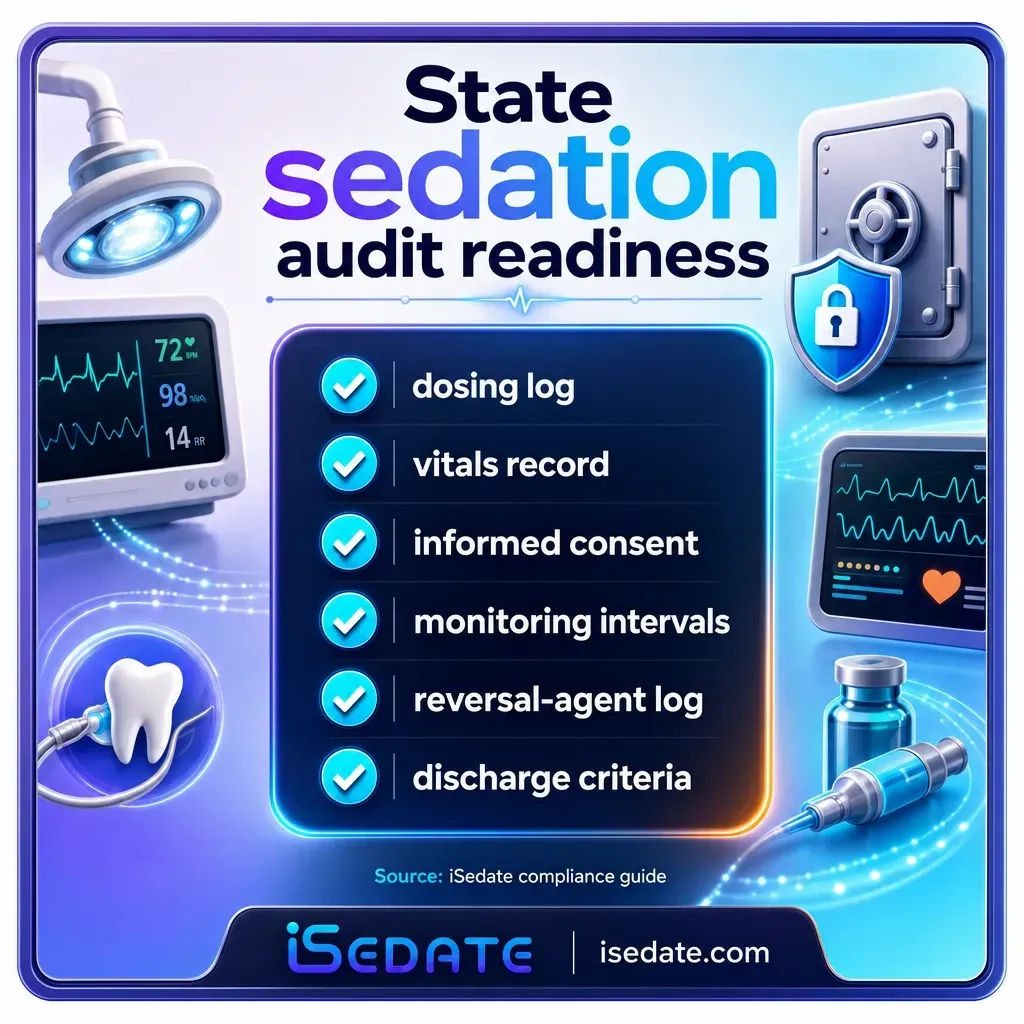
The cornerstone is the Joint Commission's Universal Protocol, which requires three steps before every procedure: pre-procedure verification of the patient, procedure, and site; marking of the operative site; and a time-out immediately before starting, during which the entire team confirms the patient's identity, the correct site, and the correct procedure. Structured surgical safety checklists extend this verification across the perioperative period. For anesthesia specifically, the same time-out applies, and the American Society of Anesthesiologists emphasizes that anesthesia providers actively participate in it, along with continuous physiologic monitoring and careful medication verification, since wrong-medication and wrong-dose errors are their own never-event risks. Each of these safeguards produces a documentable checkpoint. The ASA also recommends a separate anesthesia consent as part of this verification discipline, a point we cover in our review of informed consent litigation statistics in dentistry.
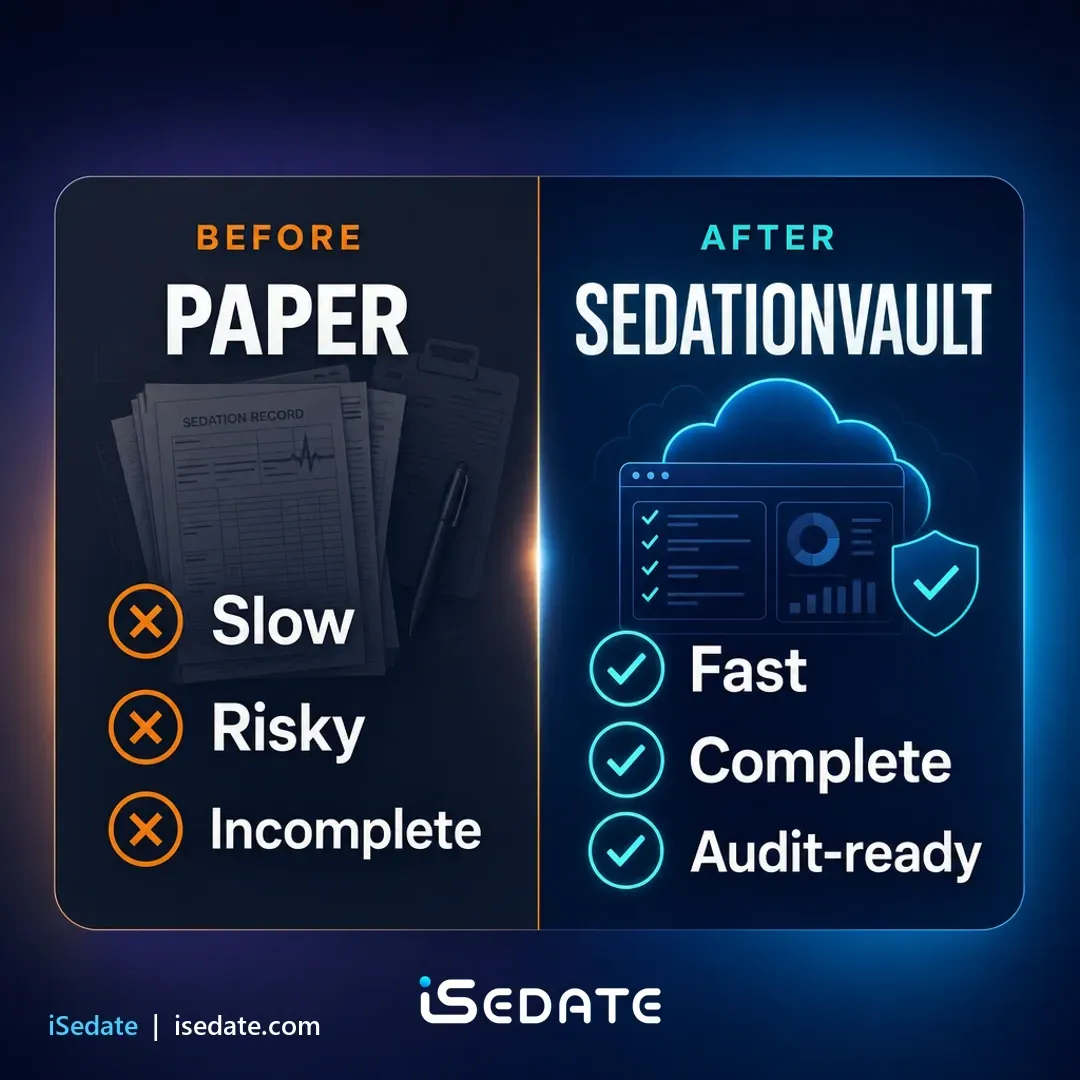
This is where documentation becomes inseparable from prevention. A time-out that is performed but not recorded, or monitoring that occurs but is not captured, leaves no evidence that the safeguard was in place, which matters both for continuous safety and for defensibility if an event occurs. The way missing monitoring documentation drives outcomes in litigation is examined in our review of standard of care violation statistics in sedation cases. This is where iSedate's SedationVault fits the never-event framework for sedation providers. By pulling vitals directly from compatible monitors such as Edan, MindRay, and Criticare, timestamping every entry, and producing an audit-ready PDF, SedationVault captures the continuous monitoring that guards against the anesthesia never event and documents that it was performed. It does not conduct the time-out, replace the verification steps, or substitute for clinical judgment and rescue readiness. What it does is ensure the monitoring safeguard against a healthy patient's death under sedation is both active and provable.
Never events are defined as preventable, which means that when one occurs, the question becomes which safeguard failed. For the anesthesia never event, the death of a healthy patient under sedation, the core safeguard is continuous physiologic monitoring paired with timely rescue. Documentation does not prevent the event, but it is what demonstrates the safeguard was in place and functioning, and in a category of events formally presumed preventable, the absence of that documentation is especially damaging. Capturing monitoring automatically makes the safeguard against this never event provable rather than merely asserted.
Contributing sources: NQF serious reportable event definitions; Joint Commission Universal Protocol; anesthesia patient-safety guidance.
Interpretation original to iSedate.
Source: Universal Protocol for preventing wrong-site surgery, AHRQ PSNet
See IV sedation charting with continuous vitalsEvery Statistic in One Table
| Statistic / Fact | Figure | Source | Year |
|---|---|---|---|
| NQF serious reportable events (never events) | 29 in 7 categories | National Quality Forum | 2016 |
| Term "never event" coined | 2001 | NQF (Kizer) | 2001 |
| Estimated surgical never events per year (U.S.) | 4,000+ | AHRQ PSNet (2013 study) | 2013 |
| Wrong-site surgery frequency per hospital | Once per 5–10 years | AHRQ PSNet (2006 study) | 2006 |
| Sentinel events reported annually | ~800 | Joint Commission | 2023 |
| Never events reported 1995–2015 that were fatal | ~71% | Joint Commission / AHRQ | 2016 |
| Paid never-event malpractice claims analyzed | 9,744 | Mehtsun et al. (NPDB) | 2013 |
| Retained foreign body share of claims | 49.8% | Mehtsun et al. (NPDB) | 2013 |
| Wrong procedure share of claims | 25.1% | Mehtsun et al. (NPDB) | 2013 |
| Wrong-site surgery share of claims | 24.8% | Mehtsun et al. (NPDB) | 2013 |
| Wrong surgery increase, 2022 to 2023 | +26% | Joint Commission / ACS | 2024 |
| Retained-object cases requiring additional surgery (CA) | ~67.6% | JAMA Network Open / CDPH | 2020 |
| Anesthesia never event | ASA Class I patient death | NQF (event 1E) | 2011 |
| Voluntary reporting underestimation factor | 20x or more | State mandatory-reporting comparison | 2001 |
| Medicare non-reimbursement of never events since | 2009 | CMS | 2009 |
Frequently Asked Questions
What is a never event in surgery?
How often do surgical never events happen?
What is the most common surgical never event?
Is a healthy patient dying under anesthesia a never event?
How are surgical never events prevented?
This article draws on primary and Tier 1 sources: the National Quality Forum's list and definitions of serious reportable events; the Agency for Healthcare Research and Quality Patient Safety Network; Joint Commission sentinel event data as reported by the American College of Surgeons; a peer-reviewed analysis of surgical never-event malpractice claims from the National Practitioner Data Bank; a JAMA Network Open analysis of California Department of Public Health never-event data; and Centers for Medicare and Medicaid Services reimbursement policy. Incidence figures for never events are widely acknowledged to undercount true rates because most reporting is voluntary; they are presented as reported figures and floors rather than precise incidence rates, and the reporting limitations are noted throughout. This article is educational and is not legal advice. Where iSedate derives an original interpretation, it is labeled as an iSedate Analysis with its inputs shown.