




AIMS Adoption Statistics (2026): How Anesthesia Software Went From 5% to Standard of Care
In 2006, an estimated 5% of U.S. operating rooms had anesthesia software. By 2020, roughly 84% of academic anesthesiology departments planned to use it. That climb, from rare novelty to standard of care in less than two decades, was not driven by mandate. It was driven by documented benefits overcoming stubborn barriers, and the same forces are now reaching the office-based settings AIMS never served.
- In 2006, only an estimated 5% of U.S. operating rooms had an AIMS installation (PMC functionality review).
- Adoption accelerated to about 44% of academic centers planning or completing implementation by the early 2010s (PMC).
- By 2020, about 84% of U.S. academic anesthesiology departments planned to use an AIMS, up from 75% in 2014 (Anesthesia Patient Safety Foundation).
- The most-cited benefit was more accurate clinical documentation, named by 79% of surveyed anesthesiologists (Trentman et al., PubMed).
- The most-cited problems were difficult EMR integration (61%) and unanticipated ongoing IT support (49%) (Trentman et al.).
- Historical full AIMS setup cost reached over USD 100,000 per operating room, the primary adoption barrier (Grand View Research).
- Office-based sedation providers were priced out of hospital-scale AIMS, the gap iSedate's SedationVault was built to close.
What's in This Guide
1 The Adoption Trajectory: 5% to Standard of Care
The adoption of anesthesia software is one of the clearer technology-diffusion stories in healthcare, precisely because it started so low and climbed so steadily. Anesthesia Information Management Systems (AIMS) capture perioperative patient data automatically, and for their first two decades almost nobody used them.
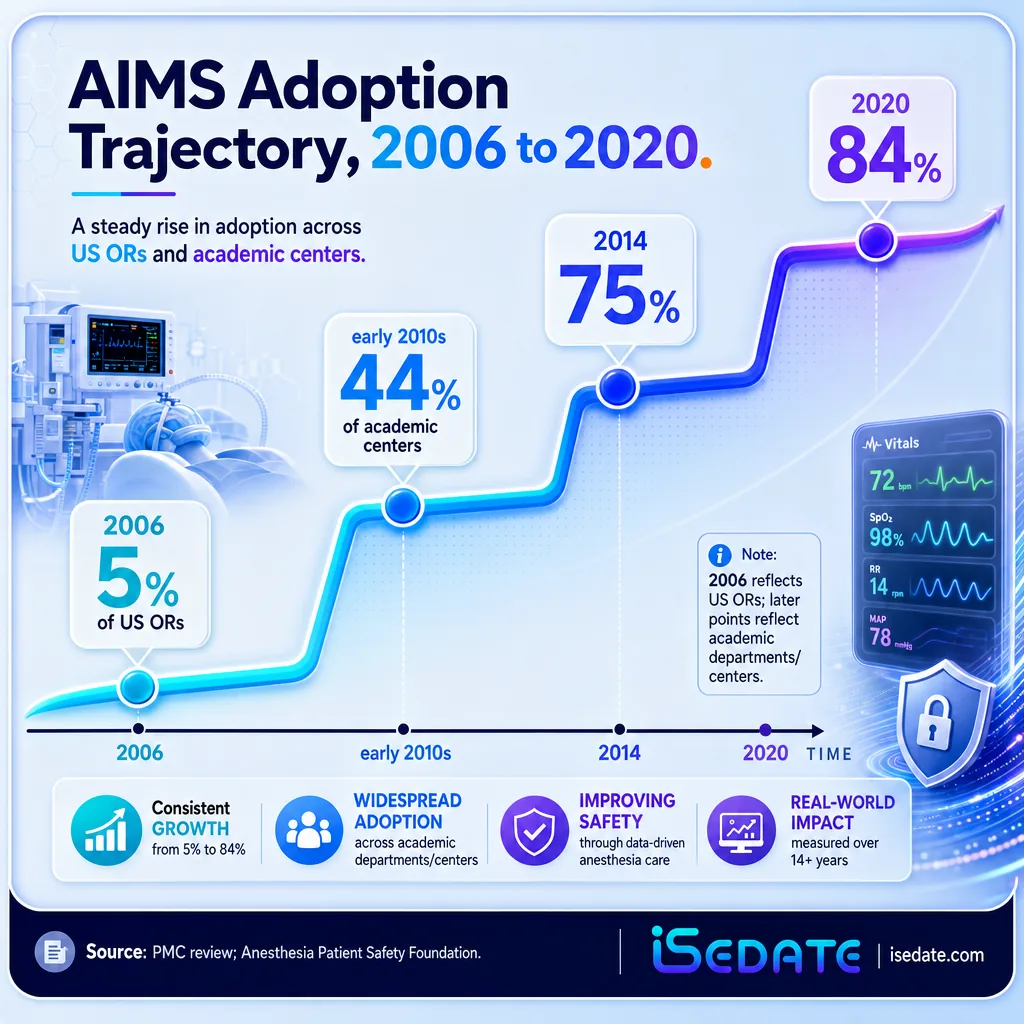
Plotted on a timeline, the curve is textbook technology diffusion: a slow, cost-constrained start, an inflection as the technology matured and benefits became provable, then rapid uptake toward saturation in the settings that could afford it. The key phrase is "could afford it." This is an adoption curve for academic and hospital settings, and it says nothing about the dentist or oral surgeon running sedation in a private office.
Source: PMC AIMS functionality and installation review | Grand View Research citing APSF data
See iSedate's SedationVault2 Why Departments Adopted: The Benefits
Adoption climbed because the benefits were real and measurable, not theoretical. A survey of U.S. anesthesiologists, published in the Journal of Clinical Monitoring and Computing, quantified what practitioners actually valued.
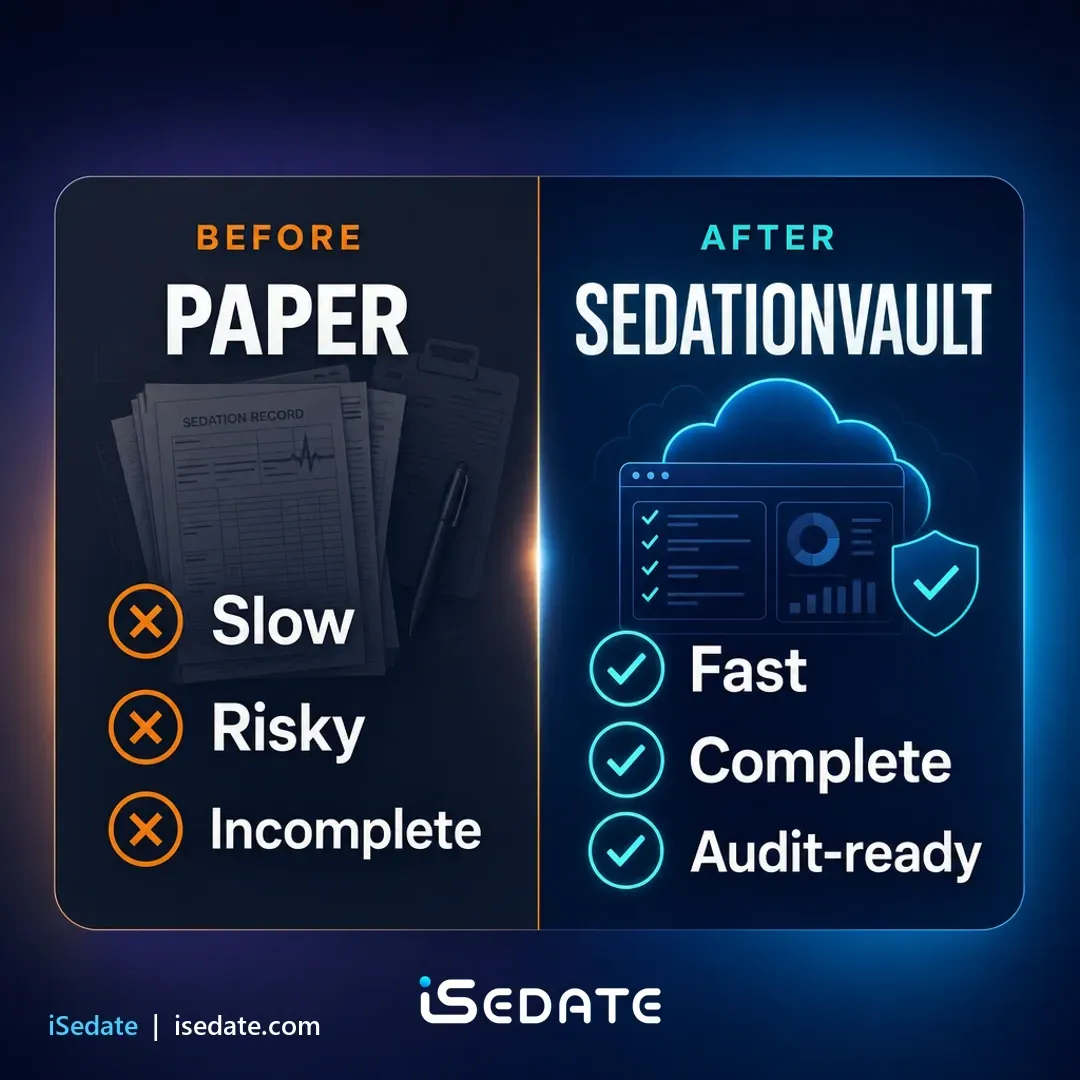
Accurate documentation topped the list, and for good reason. Automated capture of vital signs and drug administration directly from monitors removes the manual-entry step where errors and omissions occur, exactly the failure mode that makes paper records risky. Beyond documentation, the literature consistently names additional benefits: automated support for billing and revenue capture, quality assurance, satisfaction of regulatory mandates, decision and research support, and freeing the provider to focus on the patient rather than the paperwork.
iSedate Analysis: The benefit that matters most for sedation
Of every documented AIMS benefit, "more accurate clinical documentation" (79%) is the one that maps most directly onto office-based sedation. In a hospital OR, a documentation lapse is caught by layers of staff and systems. In a two-operatory dental practice running IV sedation, the sedation record is often the only record, and its accuracy is what a board or malpractice carrier examines. The benefit that drove hospital adoption is even more valuable where there is less institutional backstop, which is precisely the office-based setting.
Calculation and interpretation original to iSedate.
Source: Trentman et al., adoption of AIMS by US anesthesiologists | ScienceDirect, the value proposition of AIMS
See automated anesthesia records3 What Slowed Adoption: The Barriers
If the benefits were clear, why did adoption take twenty years? Because the barriers were equally real, and they were mostly about cost and complexity.
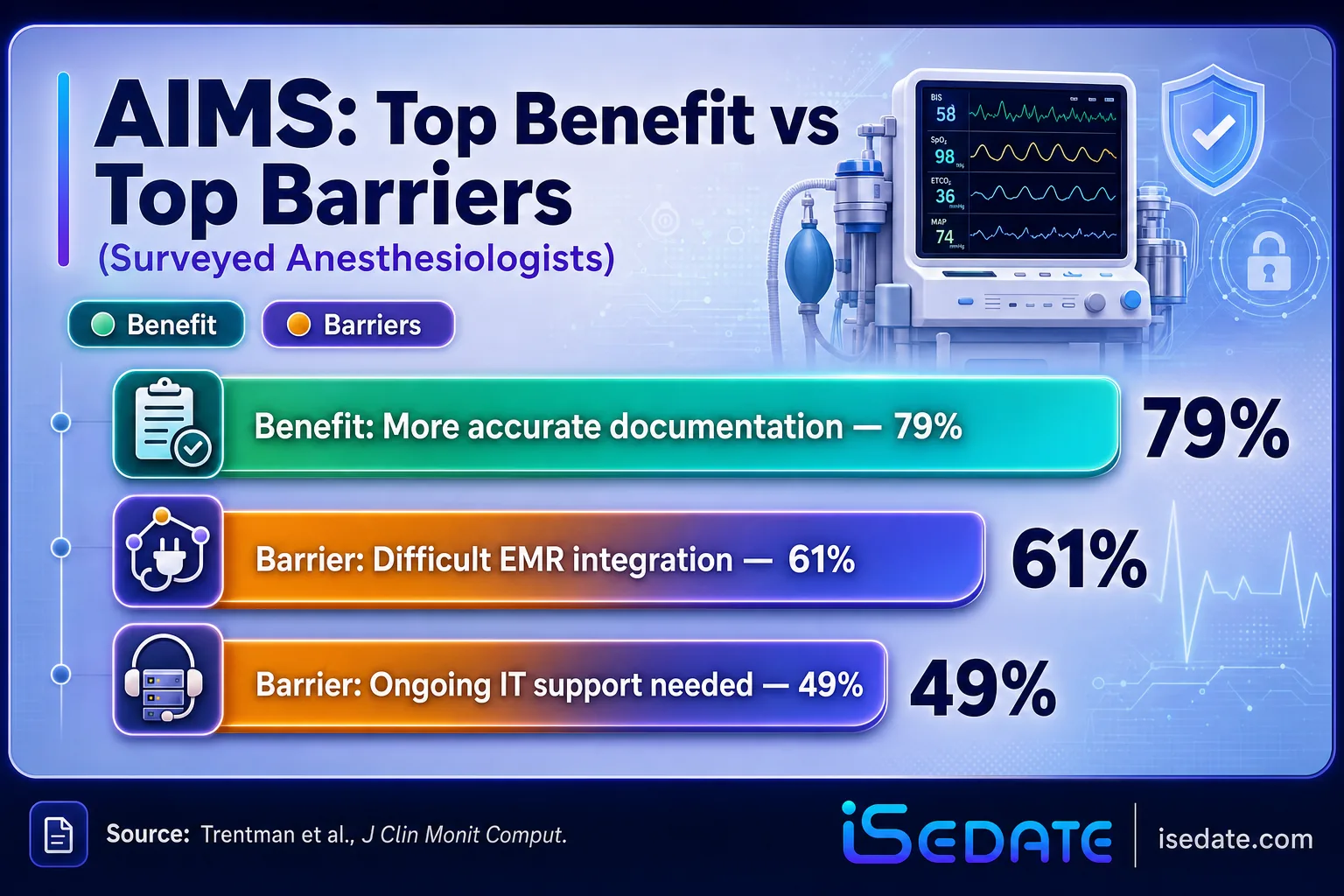
The literature adds more: inability to justify return on investment, inherent system complexity, difficulty acquiring funding, and substantial ongoing operating and maintenance costs. Notably, departments that successfully adopted AIMS usually had substantial financial support for both implementation and maintenance, a resource a small practice simply does not have. Every one of these barriers is a variation on the same theme: hospital-scale AIMS was expensive, complex, and IT-heavy, which is exactly why it stayed in hospitals.
Myth: "AIMS is too complex and expensive for anything but a hospital." That was true of first-generation, on-premise, hardware-heavy AIMS built around a six-figure per-OR install. It is not an inherent property of anesthesia software. Cloud-based, subscription-priced systems eliminate the server, the six-figure install, and much of the ongoing IT burden, which is what makes the benefits accessible to office-based providers for the first time. The barriers were about the deployment model, not the concept.
Source: Trentman et al. barrier data | ScienceDirect on AIMS ROI and cost barriers
See SedationVault subscription pricing4 The Clinician Workflow Factor
Cost was the biggest barrier, but not the only one. A recurring theme in the peer-reviewed literature is that AIMS succeeds or fails on clinician acceptance, and acceptance depends on workflow fit.
Studies identify the lack of clinician involvement in planning, design, and installation as a distinct barrier to adoption. Providers worried that the system would increase their workload or reduce their autonomy, and where an AIMS was viewed as slow or error-prone, resistance surfaced over the long term even after initial acceptance. One successful implementation deliberately designed the electronic record to look as close to the trusted paper record as possible, respecting the time-tested logic of the workflow it replaced rather than overriding it.
iSedate Analysis: Workflow fit is the whole game for sedation
The clinician-acceptance research carries a sharp lesson for sedation software. During active sedation, the provider's attention must be on the patient, not on fighting a clumsy interface. A system that adds workload mid-procedure will be worked around or abandoned, and a half-completed sedation record is not a defensible one. The design requirement is minimal friction: capture that happens automatically from the monitor, with the record built in the background. That is the difference between a sedation tool that gets used every time and one that becomes shelfware, and it is the standard a Sedation Intelligence System must meet.
Calculation and interpretation original to iSedate.
Source: Canadian Journal of Anesthesia on clinician acceptance | PMC AIMS implementation workflow case study
Book a SedationVault demo5 What This Means for Office-Based Sedation
Put the whole adoption story together and its lesson for office-based sedation is unmistakable. The benefits that drove hospital adoption, accurate documentation above all, apply just as much to a dental or oral surgery practice. The barriers that slowed it, six-figure installs, EMR-integration pain, heavy IT support, were properties of first-generation hospital deployment, not of anesthesia software itself.
That is why the adoption curve stalled at the office door for so long, and why it is finally moving. When the deployment model changes from a hardware-heavy hospital install to a cloud-based, subscription-priced system, the cost and IT barriers that kept AIMS out of small practices largely disappear, while the documentation and safety benefits remain.
iSedate Analysis: Bringing the benefits without the barriers
The historical trade-off was stark: to get AIMS-grade documentation you needed a hospital budget and a hospital IT department. iSedate's SedationVault is built to break that trade-off for office-based sedation, delivering the core benefit, accurate, automated, audit-ready documentation, without the six-figure install or the on-site server. It captures vitals from compatible monitors such as Edan, MindRay, and Criticare, logs drug administration, and produces board-ready reports, then exports a clean PDF into whatever chart the practice already keeps, whether Dentrix, Eaglesoft, or Open Dental. Reference figures for the founders' own practice reflect thousands of documented sedation procedures, a practice-level dataset, not a nationwide claim.
Calculation and interpretation original to iSedate.
Framed as a Sedation Intelligence System rather than a scaled-down hospital AIMS, it adds what office-based providers specifically need: drug inventory, license and certification tracking, emergency-equipment oversight, and audit-ready board reporting. The two-decade adoption curve that saturated hospitals is now arriving where sedation actually happens most often, in the office.
Source: PMC AIMS adoption review | Trentman et al. adoption survey
See SedationVault for dentists6 Summary Table: Every Statistic at a Glance
| Statistic | Figure | Source | Year |
|---|---|---|---|
| U.S. operating rooms with AIMS | 5% | PMC functionality review | 2006 |
| Academic centers planning/using AIMS | 44% | PMC functionality review | early 2010s |
| Academic departments planning AIMS use | 75% | APSF | 2014 |
| Academic departments planning AIMS use | 84% | APSF | 2020 |
| Cited more accurate documentation as benefit | 79% | Trentman et al. | 2011 |
| Cited difficult EMR integration as problem | 61% | Trentman et al. | 2011 |
| Cited ongoing IT support as problem | 49% | Trentman et al. | 2011 |
| Survey respondents using/installing/seeking AIMS | At least 50% | Trentman et al. | 2011 |
| Historical AIMS setup cost per OR | ~USD 104,000 | Grand View Research | 2016 |
| Primary adoption barrier | Cost / ROI | ScienceDirect; Trentman et al. | 2008-2011 |
| Key acceptance factor | Clinician workflow fit | Can J Anesth; PMC | 2013 |
| Office-based sedation adoption (historical) | Largely absent | iSedate analysis | 2026 |
Frequently Asked Questions
What is the AIMS adoption rate?
What are the main benefits of AIMS?
What are the biggest barriers to AIMS adoption?
Why did AIMS adoption accelerate?
Do office-based sedation providers use AIMS?
Methodology & Sources
This article prioritizes peer-reviewed primary research on AIMS adoption. Peer-reviewed sources: Trentman et al., "Adoption of anesthesia information management systems by US anesthesiologists," Journal of Clinical Monitoring and Computing (via PubMed); PMC reviews of AIMS functionality, installation, and implementation; the Canadian Journal of Anesthesia on clinician acceptance; and ScienceDirect on the AIMS value proposition. Institutional sources: Anesthesia Patient Safety Foundation (academic adoption rates); Grand View Research (per-OR setup cost).
Note on scope: this article is scoped to AIMS adoption over time, its documented benefits, and the barriers that shaped it. For anesthesia software market size, segmentation, and the office-based market gap, see the companion report on sedation and anesthesia software market statistics. The 2011 Trentman survey carried a low response rate and possible self-selection bias, noted by its authors; its percentages describe respondents, not a full census, and are presented on that basis. Statistics reflect the most recent available data as of 2026 and will be refreshed annually.
Media & press usage: Journalists and researchers are welcome to cite these statistics with attribution to iSedate and a link to this page. The iSedate Analysis boxes contain original interpretation unique to this article.