









Anesthesia Awareness and Monitoring Litigation Statistics (2026)
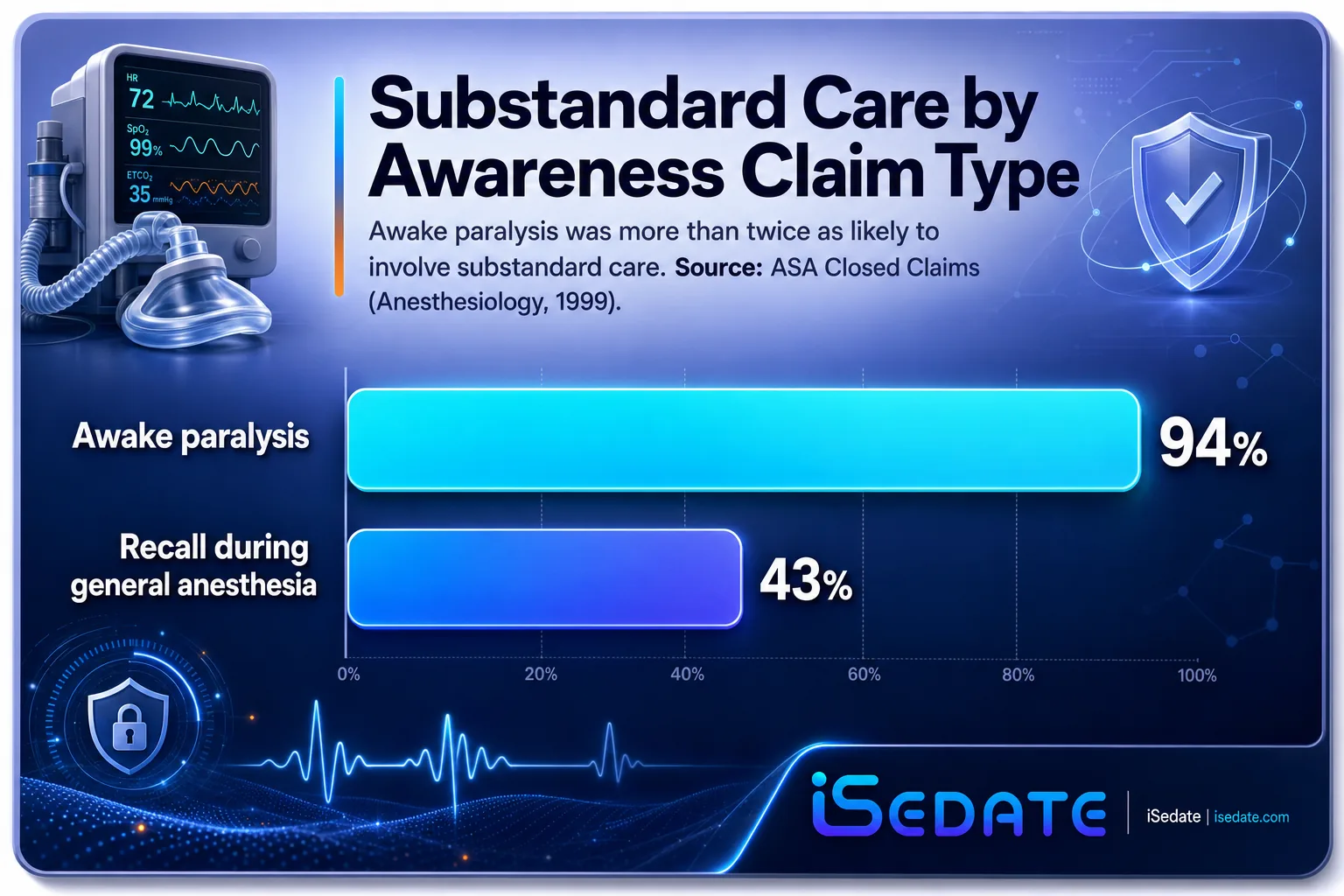
In the ASA Closed Claims analysis of anesthesia awareness, care was judged substandard in 94 percent of awake-paralysis claims but only 43 percent of recall-during-anesthesia claims. The distinction matters: awareness litigation turns less on whether a patient was aware than on whether the record shows the anesthetic and monitoring were managed as they should have been.
- Intraoperative awareness with explicit recall occurs in roughly 0.1 to 0.2 percent of general anesthesia cases, with a cited multicenter U.S. estimate near 0.13 percent.
- Awareness claims were 79 of 4,183 claims (1.9 percent) in the ASA Closed Claims analysis: 18 awake paralysis and 61 recall claims.
- Care was substandard in 94 percent of awake-paralysis claims versus 43 percent of recall claims, a highly significant difference.
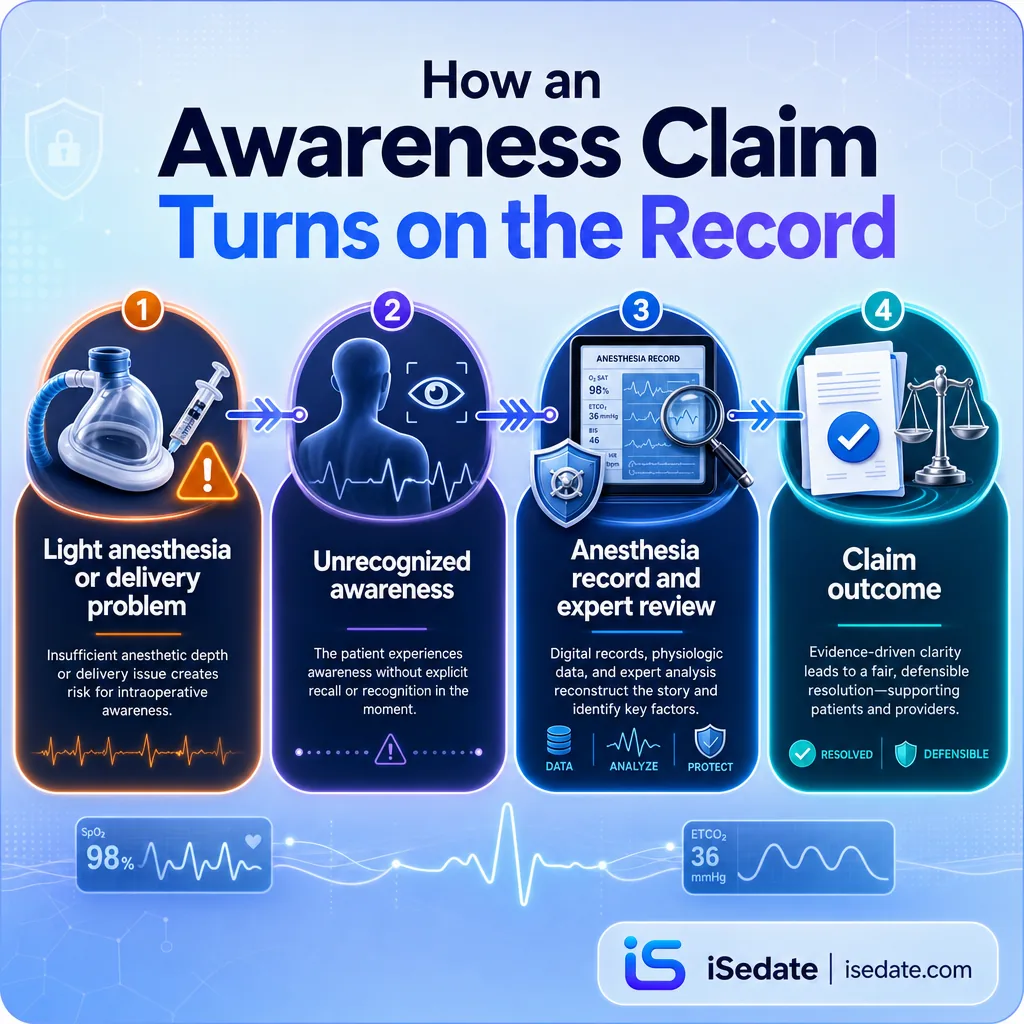
- The ASA project attributed awareness to light anesthesia (37%) and delivery problems (28%), with about a third of cases undetermined.
- Depth-of-anesthesia monitoring shows mixed results: the B-Aware trial cut awareness by about 0.74 percentage points, while B-Unaware found no significant difference.
- The Joint Commission has treated awareness as a sentinel event since a 2004 alert, and PTSD is often central to the damages claimed.
What's in This Guide
1 How Common Awareness Actually Is
Anesthesia awareness is rare, but its rarity is exactly what makes it hard to study and easy to dispute in court. The incidence figures come from prospective studies that interviewed patients after surgery.
A multicenter United States study estimated the incidence of awareness with explicit recall at about 0.13 percent, consistent with European studies putting the general range at 0.1 to 0.2 percent. Rates climb in specific settings, with older reports of much higher awareness in cardiac surgery, and they fall in others. The UK's fifth National Audit Project found that most self-reported awareness cases involved neuromuscular blocking drugs, at an incidence around 1 in 8,200 when those drugs were used.
Rare is not the same as unimportant. Detection depends entirely on the patient recalling and reporting the event, so published rates likely undercount true incidence. Patients with a prior history of awareness were about five times more likely to experience it again in one large analysis, and awareness is a leading reason for anesthesia-related compensation claims. The rarity cuts against providers in litigation, because a plaintiff argues that a properly managed anesthetic would have made an already uncommon event avoidable.
Source: StatPearls: Intraoperative and Anesthesia Awareness | Anesthesiology: Prevention of Intraoperative Awareness with Explicit Recall
Explore anesthesia record software2 Awareness in Closed Claims
The clearest litigation picture comes from the ASA Closed Claims Project, which analyzed awareness claims as a distinct category and separated two very different scenarios.
Awareness claims made up 79 of 4,183 claims, or 1.9 percent. Of these, 61 were for recall during general anesthesia and 18 were for awake paralysis, meaning a conscious patient was given a paralytic and could not move or signal distress. The demographic profile was consistent: the majority of awareness claims involved women (77 percent), patients younger than 60 (89 percent), relatively healthy ASA physical class I to II patients (68 percent), undergoing elective surgery (87 percent).
Awareness Claim Types and Substandard-Care Rate (ASA Closed Claims)
The recall-during-anesthesia claims were more likely to involve women and anesthetic techniques using intraoperative opioids, muscle relaxants, and no volatile anesthetic. That pattern points to lighter planes of anesthesia, and it is exactly the scenario where documented depth and drug management become the crux of the case.
Source: Anesthesiology: Awareness during anesthesia, a closed claims analysis
See how sedation compliance records are built3 Causes and the Standard-of-Care Divide
Why awareness happened determines whether a claim succeeds. The closed-claims data draws a sharp line between two categories of cause.
Awake paralysis is overwhelmingly a preventable error. In 94 percent of those claims, care was substandard, typically an error in drug labeling or administration that led to a paralytic reaching an awake patient. Recall during general anesthesia is more ambiguous: substandard care was found in 43 percent of those claims, a statistically significant difference. The ASA Closed Claims Project attributed awareness to light anesthesia in about 37 percent of cases and to problems with anesthesia delivery in about 28 percent, with roughly a third of cases undetermined.
Compare the two awareness scenarios from the ASA closed-claims data. Awake paralysis was substandard in 94 percent of claims; recall during general anesthesia in 43 percent. The gap is 51 percentage points, meaning an awake-paralysis claim was more than twice as likely to be tied to a documented care failure (94 divided by 43 is about 2.2 times). The difference is not about how aware the patient was, it is about whether the record shows a discrete, avoidable error like a mislabeled syringe.
Formula: 94 percent minus 43 percent = 51 percentage-point gap; 94 / 43 = 2.19 times the substandard-care rate.
Interpretation: the more a case hinges on a specific documented action, drug labeling, administration, timing, the more the outcome follows the record. Calculation and interpretation original to iSedate, derived from the ASA Closed Claims awareness analysis.
Source: Anesthesiology: Awareness during anesthesia closed claims analysis | ASA Closed Claims awareness causes summary
Generate audit-ready anesthesia records4 Depth-of-Anesthesia Monitoring Evidence
Because light anesthesia drives many recall cases, depth-of-anesthesia monitors were developed to catch it. The trial evidence on whether they prevent awareness is genuinely mixed, and that matters in court.
The Bispectral Index monitor processes an EEG signal into a number from 100 (awake) to 0 (no activity), with a range of 40 to 60 suggested for general anesthesia. The B-Aware trial of 2,500 high-risk patients found a BIS protocol reduced awareness by about 0.74 percentage points versus standard practice. The B-Unaware trial, however, found no significant reduction versus an end-tidal anesthetic gas protocol, and both arms achieved awareness rates below the predicted level. One prospective cohort reported awareness of 0.04 percent with BIS versus 0.18 percent in a historical control group without cerebral monitoring.
Why the Mixed Evidence Cuts Both Ways
The unsettled evidence means monitoring is not a simple checkbox that resolves liability. Plaintiffs argue that available monitoring should have been used; defendants argue that the standard of care does not mandate a specific monitor and that the trial evidence is inconclusive. What both sides agree on is the value of the record. Whether the case is about depth monitoring, gas concentrations, or drug delivery, the contemporaneous anesthesia record is the evidence that decides which narrative the facts support.
Source: NEJM: Prevention of Intraoperative Awareness in a High-Risk Surgical Population | Michigan Awareness Control Study protocol and cohort data
Explore the SedationVault platform5 Monitoring Failures and Litigation
Awareness is one thread in a broader litigation category: failure to monitor. The same principle that governs awareness cases governs sedation and post-anesthesia monitoring claims.
The Joint Commission classified anesthesia awareness as a sentinel event and issued a Sentinel Event Alert on preventing it in 2004. Awareness litigation frequently centers on the psychological aftermath, including post-traumatic stress disorder, rather than physical injury, and expert testimony plus the anesthesia record are the core evidence. More broadly, inadequate patient monitoring is repeatedly cited as one of the most common causes of sentinel events, and post-anesthesia and post-sedation monitoring failures are a recurring basis for malpractice claims.
For office-based sedation providers, the lesson transfers directly. The events most likely to generate a claim are those where a patient's state changed and the change was not caught, documented, or acted on in time. Continuous, recorded monitoring is both the clinical safeguard and the evidentiary record.
Source: BJA Education: Unintended awareness and monitoring of depth of anaesthesia | StatPearls: Intraoperative and Anesthesia Awareness
Book a demo of SedationVault Compare SedationVault plans and pricingAnesthesia Awareness and Monitoring Litigation Statistics: Summary Table
| Statistic | Figure | Source | Year |
|---|---|---|---|
| Awareness with explicit recall incidence (multicenter US) | ~0.13% | Sebel et al., Anesth Analg | 2004 |
| General awareness incidence range | 0.1-0.2% | Multiple developed-country studies | 2004-2021 |
| Self-reported awareness with NMB (UK NAP5) | 1:8,200 | NAP5 / StatPearls | 2014 |
| Awareness claims as share of database | 1.9% (79/4,183) | ASA Closed Claims (Anesthesiology) | 1999 |
| Recall-during-anesthesia claims | 61 | ASA Closed Claims (Anesthesiology) | 1999 |
| Awake-paralysis claims | 18 | ASA Closed Claims (Anesthesiology) | 1999 |
| Awake-paralysis claims with substandard care | 94% | ASA Closed Claims (Anesthesiology) | 1999 |
| Recall claims with substandard care | 43% | ASA Closed Claims (Anesthesiology) | 1999 |
| Awareness claims involving women | 77% | ASA Closed Claims (Anesthesiology) | 1999 |
| Awareness claims, patients under 60 | 89% | ASA Closed Claims (Anesthesiology) | 1999 |
| Awareness attributed to light anesthesia | 37% | ASA Closed Claims Project | 2000s |
| Awareness attributed to delivery problems | 28% | ASA Closed Claims Project | 2000s |
| Awareness reduction with BIS (B-Aware, high risk) | 0.74 pp | Lancet (Myles et al.) | 2004 |
| Awareness reduction with BIS (B-Unaware) | Not significant | NEJM (Avidan et al.) | 2008 |
| Awareness with BIS vs historical control | 0.04% vs 0.18% | Ekman et al. cohort | 2004 |
| Recurrence risk with prior awareness history | 5x (RR 5.0) | Aranake et al., Anesthesiology | 2013 |
| Joint Commission Sentinel Event Alert on awareness | Issued | The Joint Commission | 2004 |
Frequently Asked Questions
How common is anesthesia awareness?
What share of anesthesia claims are awareness claims?
Is awake paralysis more often caused by a preventable error?
Does BIS monitoring prevent anesthesia awareness?
Is anesthesia awareness a reportable sentinel event?
Methodology and Sources
This article compiles statistics from primary and authoritative sources only. Figures are current as of 2026 and drawn from the most recent available data at the time of writing. Awareness discussed here refers to intraoperative awareness with explicit recall under general anesthesia; it is distinct from intended, responsive sedation.
- Anesthesiology (Sandin, Domino, and colleagues), Awareness during anesthesia: a closed claims analysis (79 of 4,183 claims; awake paralysis versus recall).
- Anesthesia and Analgesia (Sebel et al.), multicenter U.S. incidence study (~0.13 percent), and related developed-country incidence literature.
- Lancet (Myles et al., B-Aware) and NEJM (Avidan et al., B-Unaware), randomized trials of BIS-guided anesthesia, plus prospective BIS cohort data.
- The Joint Commission, Sentinel Event Alert on preventing intraoperative awareness (2004).
- StatPearls and BJA Education, incidence, risk factors, NAP5 neuromuscular-blockade findings, and recurrence risk.
Incidence figures come from prospective studies relying on postoperative patient interviews and are subject to recall and reporting limitations. Closed-claims percentages describe claimed events, not population incidence. Trial results on depth-of-anesthesia monitoring are genuinely mixed and are reported as such. The iSedate Analysis is derived from the cited closed-claims figures and labeled as original to iSedate.
Media and press: Journalists and researchers are welcome to cite these statistics with attribution to the original primary sources named above. When referencing the iSedate Analysis, please attribute it to iSedate with a link to this page.