






Anesthesia Closed Claims Statistics (2026): What the Data Reveals
Adverse respiratory events were the single largest class of anesthesia injury in the American Society of Anesthesiologists Closed Claims Study, accounting for 34 percent of claims and ending in death or brain damage in about 85 percent of those cases. Decades of closed-claims analysis turned that finding into the monitoring standards that define safe sedation today.
- The ASA Closed Claims Project database holds roughly 8,954 claims, about 5,230 of them from 1990 or later, built from insurer data since the mid-1980s.
- Respiratory events were the largest injury class at 34 percent of claims, causing death or brain damage in about 85 percent of cases, and 72 percent were judged preventable with better monitoring.
- Three mechanisms drove three-quarters of respiratory claims: inadequate ventilation (38%), esophageal intubation (18%), and difficult intubation (17%).
- Death and brain damage fell from about 56 percent of claims in the 1970s to 32 percent in the 1990s as pulse oximetry and capnography spread.
- Office-based dental anesthesia is tracked separately by OMSNIC, which insures roughly 80 percent of oral and maxillofacial surgeons and points to airway failure as a leading driver.
- Closed claims reveal patterns, not incidence: they capture claims that closed, not the full population of anesthetics, so they understate true injury rates.
What's in This Guide
1 What Closed Claims Data Is
A closed claim is a malpractice claim that has reached final resolution, whether by settlement, verdict, or dismissal. Studying claims after they close lets analysts examine the full arc of an adverse event, from the clinical care through the legal outcome, without the case still being contested.
The American Society of Anesthesiologists launched its Closed Claims Project in the mid-1980s to study anesthesia injuries and improve patient safety. Trained anesthesiologist-reviewers read each claim file, including the medical records, and code standardized details about the patient, the event, the care, and the outcome. Early collections drew on more than 4,000 claims from dozens of malpractice insurers. The database has since grown to roughly 8,954 claims, about 5,230 of them from 1990 forward.
Why the Method Matters
Because reviewers work from the actual records, closed claims analysis is only as good as the documentation in each file. The project's most influential findings, on respiratory events and monitoring, emerged precisely because reviewers could reconstruct what monitoring was in place and what the record showed at the moment things went wrong. Sparse records limit what any closed-claims reviewer can conclude.
Source: National Library of Medicine: Respiratory Depression in Non-Operating Room Anesthesia | Anesthesia Patient Safety Foundation: Closed Claims Project
Explore anesthesia record software2 Respiratory Events, the Largest Class
The Closed Claims Project's defining discovery was that breathing, not the heart or the drugs directly, drove the worst anesthesia outcomes. That finding reshaped monitoring practice.
In a landmark analysis, adverse respiratory events accounted for 522 of 1,541 claims, or 34 percent, the largest single class of anesthesia injury. Death or brain damage occurred in 85 percent of those respiratory cases, and the median settlement or award was about $200,000. Critically, 72 percent of the outcomes were considered preventable with better monitoring.
Leading Mechanisms of Adverse Respiratory Events (Closed Claims)
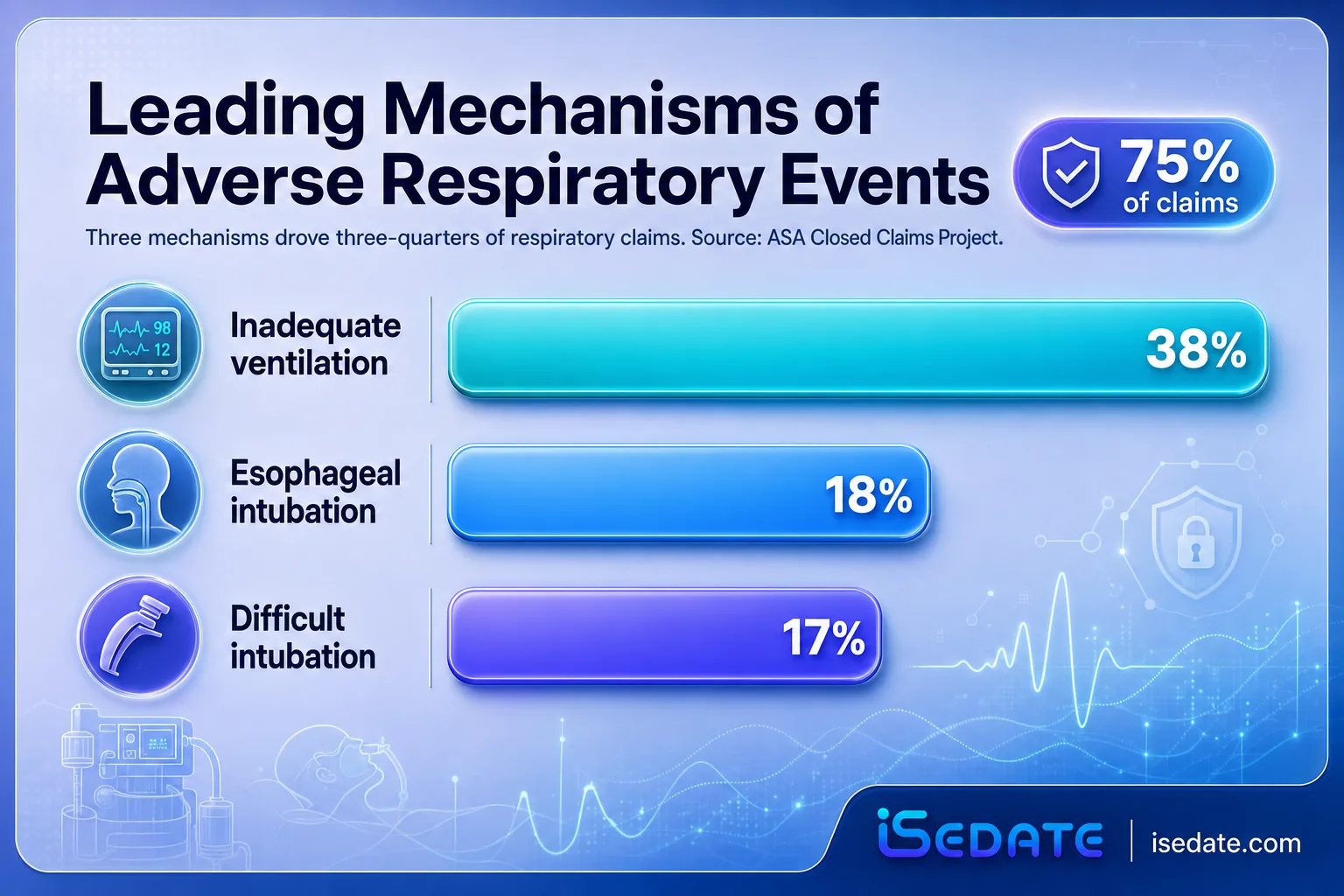
Three mechanisms accounted for about three-quarters of respiratory claims: inadequate ventilation (38 percent), esophageal intubation (18 percent), and difficult intubation (17 percent). Reviewers concluded that pulse oximetry and capnography, used together, would have prevented most of these outcomes. That single insight became the evidentiary basis for making these monitors a standard of anesthesia care.
Closed claims tell a different story. The predominant path to death and permanent brain damage was not a drug reaction but a failure of ventilation and oxygenation that went unrecognized in time. The lesson the data drove home is that continuous monitoring of breathing, capturing oxygenation with pulse oximetry and ventilation with capnography, is what separates a recoverable event from a catastrophic one. The safety gains came from seeing the problem sooner, not from changing the drugs.
Source: Anesthesiology: Adverse respiratory events in anesthesia, a closed claims analysis | ASA Closed Claims Project overview
See how sedation compliance records are built3 The Decline in Death and Brain Damage
The most encouraging story in closed claims is a downward trend. As monitoring improved, the share of claims involving the worst outcomes fell sharply.
Across the ASA database, death and brain damage fell from about 56 percent of claims in the 1970s to 32 percent in the 1990s. Respiratory events causing those outcomes declined from roughly 50 percent of such claims before 1986 to 28 percent by 1992. After difficult-airway guidelines were introduced, death or brain damage from difficult airways at induction dropped from 62 percent to 35 percent in one 2005 review.
As respiratory claims fell, the mix shifted. Nerve injury rose to about 21 percent of claims, and airway injury doubled from 4 percent to 8 percent. By the 2000s, the most common complications in the database were death (26 percent), nerve injury (22 percent), and permanent brain damage (9 percent), and claims for chronic pain management and monitored anesthesia care were growing as a share of the total.
Combine two closed-claims findings to size the safety shift. Death and brain damage fell from 56 percent of claims to 32 percent between the 1970s and 1990s, a drop of 24 percentage points, or a relative decline of about 43 percent (24 divided by 56). Over a similar window, respiratory-event death and brain damage fell from about 50 percent to 28 percent of such claims, a 22-point drop, or roughly 44 percent relative. The two declines move together, and both track the era when continuous oxygenation and ventilation monitoring became routine.
Formula: (56 minus 32) / 56 = 42.9 percent relative decline in death and brain damage claims; (50 minus 28) / 50 = 44.0 percent relative decline in respiratory death and brain damage.
Interpretation: the two curves declining in parallel is the closest thing closed claims offer to a natural experiment on monitoring. Calculation and interpretation original to iSedate, derived from ASA Closed Claims Project published figures.
Source: Anesthesia Patient Safety Foundation: Closed Claims safety evolution | Best Practice and Research Clinical Anaesthesiology: Closed claims analysis
Explore the SedationVault platform4 Office-Based and Dental Anesthesia Claims
The ASA database centers on operating-room anesthesia, but office-based dental sedation has its own closed-claims record, and the volume of care involved is substantial.
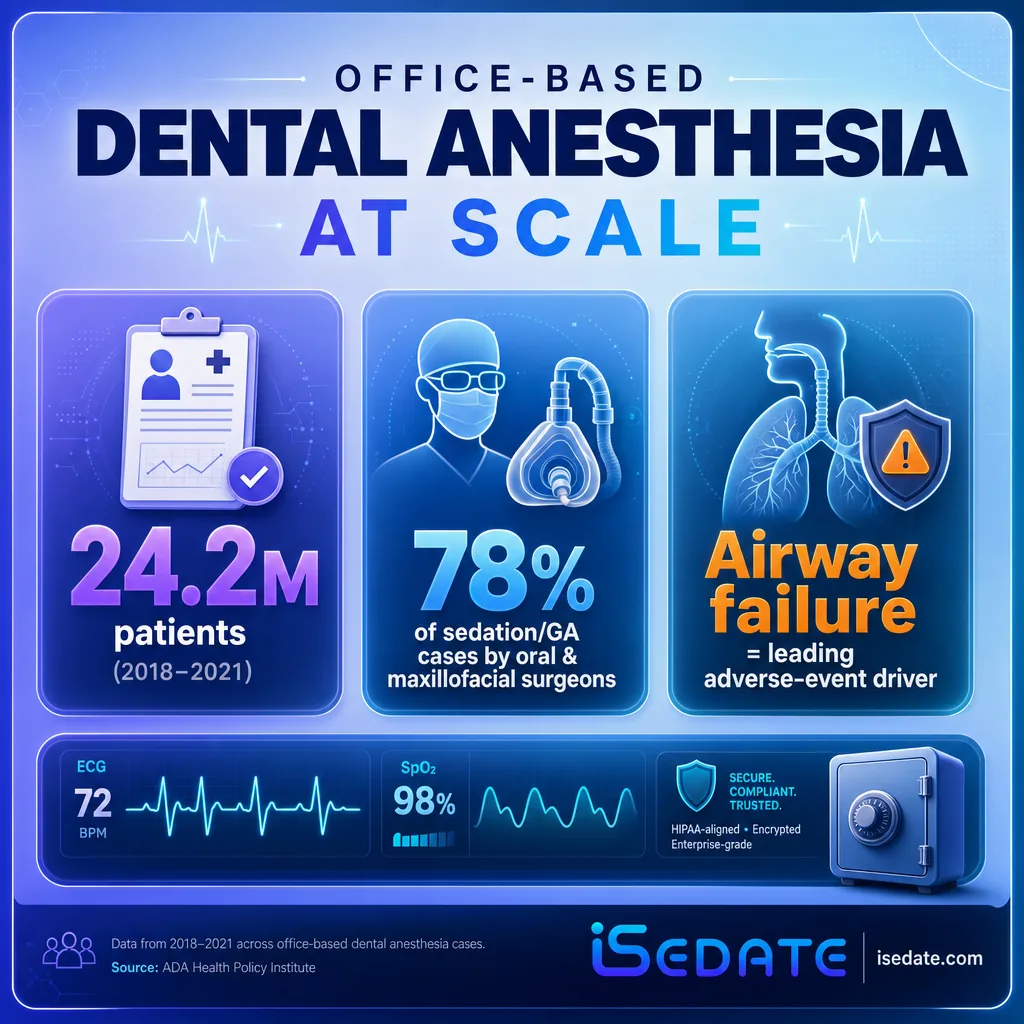
Between 2018 and 2021, office-based dental anesthesia services reached more than 24 million privately insured individuals, and oral and maxillofacial surgeons performed about 78 percent, or 6,929,439, of the roughly 8.9 million moderate and deep sedation and general anesthesia cases. Because OMSNIC insures roughly 80 percent of oral and maxillofacial surgeons, its closed-claims database is the primary window into office-based dental anesthesia outcomes.
The office-based data echoes the ASA findings. Analyses of OMSNIC closed claims point to a strong correlation between airway-related failure and adverse events in open-airway techniques, which is why the specialty emphasizes continuous monitoring of both ventilation and oxygenation. In non-operating-room and monitored anesthesia care settings broadly, oversedation leading to respiratory depression, paired with inadequate monitoring, makes up the majority of claims.
Source: National Library of Medicine: Patient Safety at Forefront of OMS Anesthesia Delivery | Journal of the American Dental Association: deep sedation safety analysis
Generate audit-ready anesthesia records5 What Closed Claims Cannot Tell You
Closed claims are powerful for spotting patterns, but they have a built-in limitation that every reader of these statistics should understand.
Closed claims capture only events that became malpractice claims and then closed. There is no denominator of all anesthetics administered, so the data cannot produce an incidence or prevalence rate. Many adverse events never generate a claim, and the mix of what does can shift with legal and insurance trends rather than clinical ones. Researchers are explicit that closed claims offer a snapshot for identifying causes and prevention strategies, not a measure of how often injuries occur.
Separate mortality estimates try to fill that gap. One cited figure put office-based dental anesthesia mortality at about 1.3 deaths per million cases, and prospective registries such as the specialty's anesthesia safety study aim to measure adverse-outcome frequency directly rather than inferring it from claims.
The Common Thread
Whether the data comes from the ASA project, OMSNIC, or a prospective registry, the recurring finding is the same: the events that end worst are respiratory, and the difference between a near-miss and a tragedy is usually whether the deterioration was seen and documented in time. A complete, timestamped sedation record capturing continuous vitals is both a safety tool and, if a claim ever closes, the evidence a reviewer relies on.
Source: Oral Health Group: Safety of Dental Anaesthesia literature review | AAOMS OMS Quality Outcomes Registry
Book a demo of SedationVault Compare SedationVault plans and pricingAnesthesia Closed Claims Statistics: Summary Table
| Statistic | Figure | Source | Year |
|---|---|---|---|
| ASA Closed Claims Project began | Mid-1980s | ASA Closed Claims Project | 1984-1985 |
| Total claims in ASA database (one count) | 8,954 | ASA / closed claims analysis | 2011 |
| Claims dated 1990 or later | 5,230 | ASA / closed claims analysis | 2011 |
| Respiratory events as share of claims | 34% (522/1,541) | Anesthesiology (Caplan et al.) | 1990 |
| Respiratory claims ending in death or brain damage | 85% | Anesthesiology (Caplan et al.) | 1990 |
| Respiratory outcomes preventable with better monitoring | 72% | Anesthesiology (Caplan et al.) | 1990 |
| Median respiratory claim settlement/award | ~$200,000 | Anesthesiology (Caplan et al.) | 1990 |
| Mechanism: inadequate ventilation | 38% | Anesthesiology (Caplan et al.) | 1990 |
| Mechanism: esophageal intubation | 18% | Anesthesiology (Caplan et al.) | 1990 |
| Mechanism: difficult intubation | 17% | Anesthesiology (Caplan et al.) | 1990 |
| Death and brain damage share, 1970s to 1990s | 56% to 32% | APSF / ASA Closed Claims | 1970s-1990s |
| Respiratory death/brain damage, pre-1986 to 1992 | 50% to 28% | ASA Closed Claims | 1986-1992 |
| Difficult-airway death/brain damage at induction, post-guidelines | 62% to 35% | ASA Closed Claims review | 2005 |
| Most common 2000s complication: death | 26% | Closed claims analysis | 2000s |
| Office-based dental anesthesia recipients | 24.2 million | AAOMS / FAIR Health | 2018-2021 |
| Sedation/GA cases performed by OMS | 78% (6.93M) | AAOMS / FAIR Health | 2018-2021 |
| OMS insured through OMSNIC | ~80% | OMSNIC / literature | 2020 |
| Office-based dental anesthesia mortality estimate | 1.3 per million | Cited literature (Deegan) | 2001 |
Frequently Asked Questions
What is the ASA Closed Claims Project?
What is the most common type of anesthesia injury in closed claims?
Have anesthesia death and brain damage claims declined?
How do office-based dental sedation closed claims compare?
Why do closed claims underestimate the true rate of anesthesia injury?
Methodology and Sources
This article compiles statistics from primary and authoritative sources only. Figures are current as of 2026 and drawn from the most recent available data at the time of writing. Closed-claims percentages describe the composition of claimed events within each database and are not incidence rates for the general population.
- American Society of Anesthesiologists Closed Claims Project and peer-reviewed analyses in Anesthesiology (Caplan, Posner, Cheney, and colleagues), including the landmark adverse-respiratory-events analysis (522 of 1,541 claims).
- Anesthesia Patient Safety Foundation, Closed Claims Project safety evolution summary (death and brain damage trends by decade).
- Best Practice and Research Clinical Anaesthesiology, closed claims analysis (database size and 2000s complication mix).
- AAOMS and FAIR Health, office-based dental anesthesia volume (2018-2021), and OMSNIC closed-claims literature on office-based airway events.
- Journal of the American Dental Association and related literature on dental anesthesia mortality estimates.
Figures from different studies span different decades and databases and are not directly comparable. Dollar figures are in the dollars of their source year and are not inflation-adjusted here. Derived percentages in the iSedate Analysis box are calculated from the cited published figures and labeled as original to iSedate.
Media and press: Journalists and researchers are welcome to cite these statistics with attribution to the original primary sources named above. When referencing the iSedate Analysis, please attribute it to iSedate with a link to this page.