








Anesthesia in Oral Surgery Statistics 2026: Modalities, Provider Models, Monitoring & Regulation
Anesthesia is what makes office-based oral surgery possible, and it is the most heavily regulated, most scrutinized part of the specialty. The data behind it, which modalities are used, who administers them, what monitoring is mandated, and how wildly the rules vary by state, describes a practice environment where documentation is not optional; it is the permit condition.
Key Takeaways
- Dental anesthesia providers devote the largest share of practice, about 40%, to intravenous deep sedation (survey data).
- The operator-anesthetist model, where the surgeon both operates and anesthetizes, is standard in oral surgery but contested by anesthesiology and pediatric groups.
- Since January 2014, the AAOMS has required capnography for all moderate sedation, deep sedation, and general anesthesia, enforced through its Office Anesthesia Evaluation.
- Standard monitoring, pulse oximetry, blood pressure, ECG, and capnography, is delivered by multiparameter monitors from makers including Criticare and Edan.
- Vital signs are typically documented at least every 5 minutes, with records commonly retained 6 years (longer for minors).
- A 2025 review found striking variation across the 50 states and the ADA, AAOMS, and ASA guidelines.
- The through-line: every one of these standards produces a documentation obligation, and the anesthesia record is where compliance is proven.
What's in This Guide
Sedation Modalities and Usage
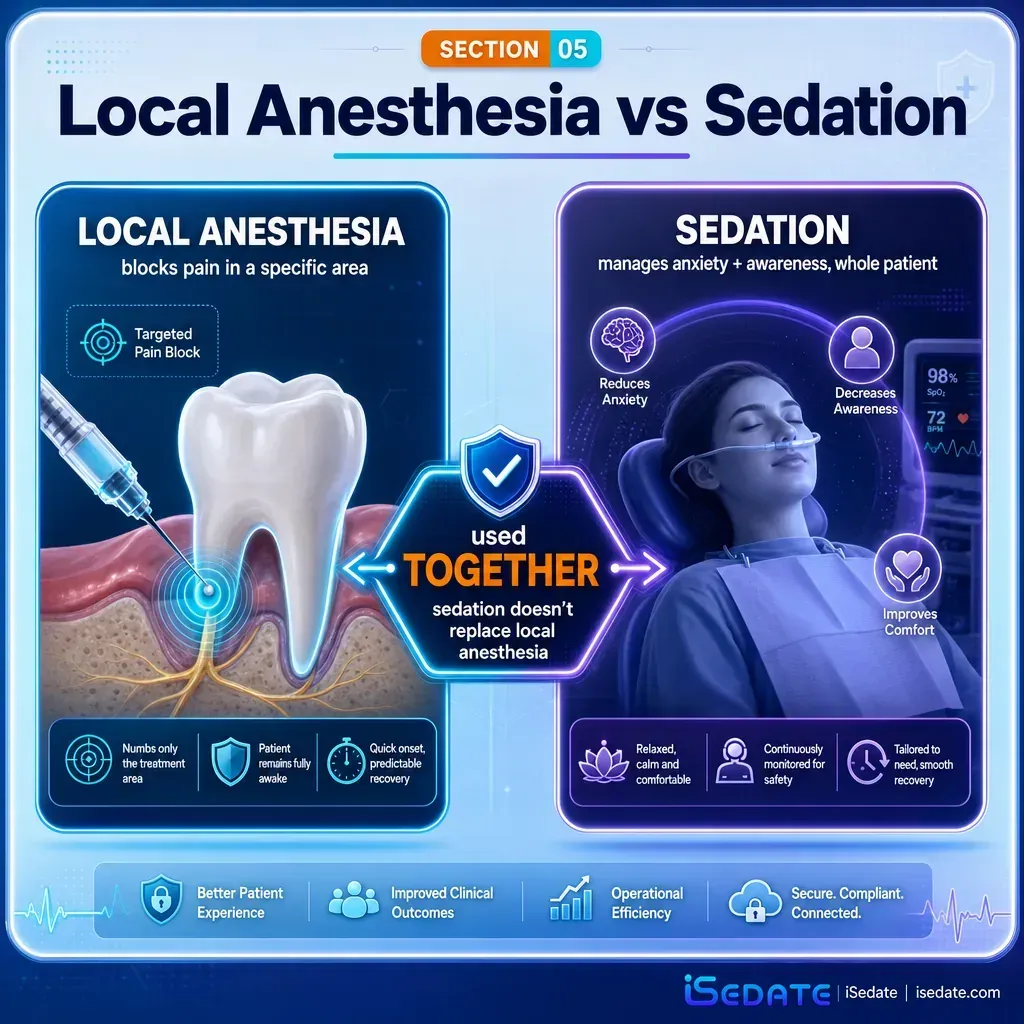
Oral surgery anesthesia is not one thing but a spectrum, and providers move patients along it based on the procedure, the patient, and the risk. The levels, using the ASA and CMS terminology now standard across the field, run from local anesthesia alone through minimal sedation (nitrous oxide), moderate or conscious sedation, deep sedation, and general anesthesia.
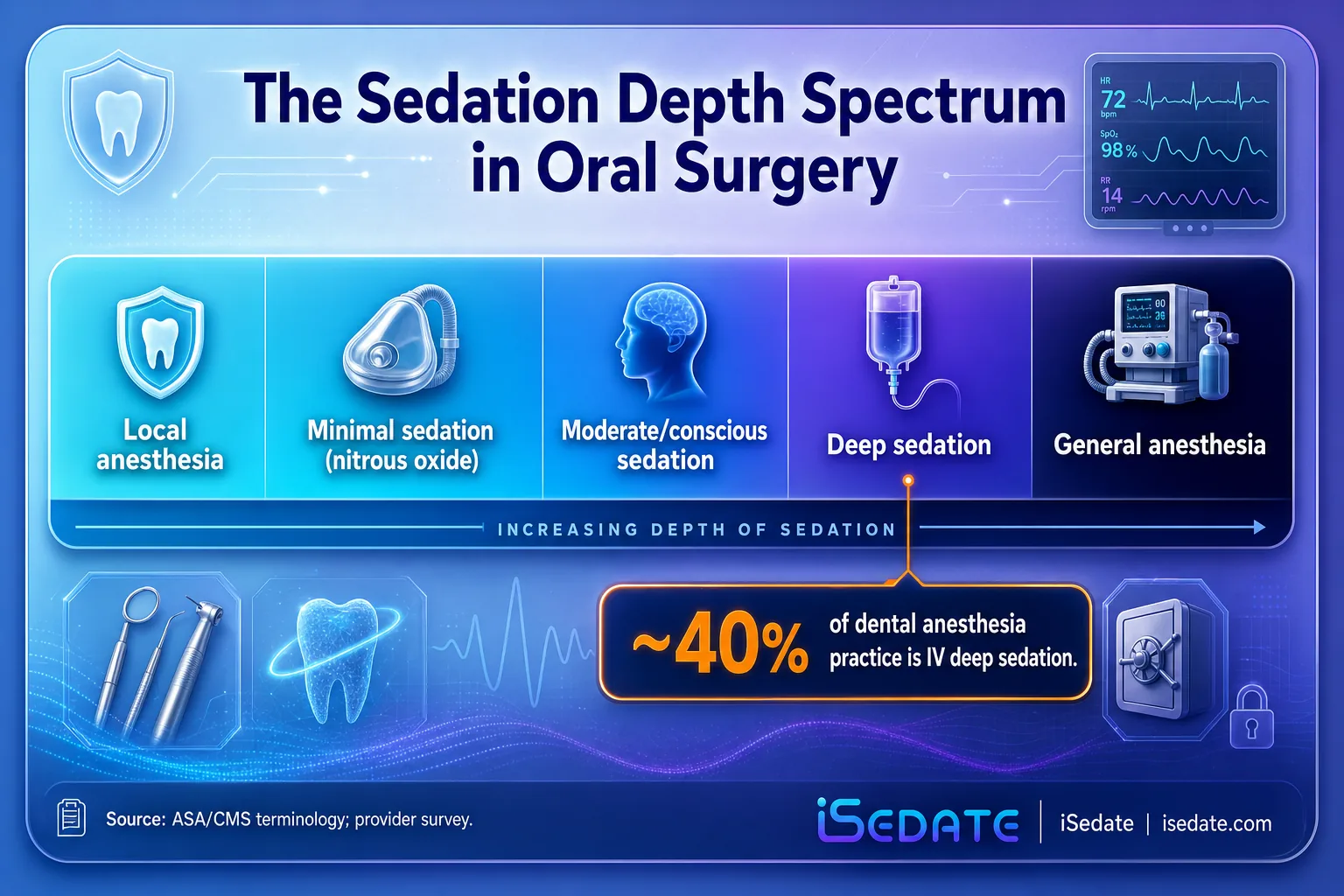
A survey of U.S. dental sedation and anesthesia providers found that intravenous deep sedation was the single most-used technique, accounting on average for about 40% of respondents' anesthesia practice. The AAOMS notes that in an ideal setting, ASA physical status I and II patients, those healthy or with only mild systemic disease, are the best candidates for office-based deep sedation and general anesthesia, because they retain the cardiovascular and pulmonary reserve to tolerate it. Patient selection, in other words, is itself a documented clinical decision anchored to the ASA classification.
Source: Practice Characteristics Among Dental Anesthesia Providers (PMC) | AAOMS Office-Based Anesthesia White Paper
See IV sedation chartingThe Operator-Anesthetist Model
The defining feature of oral surgery anesthesia, and its most debated one, is the operator-anesthetist model. In this arrangement, also called the single-provider or oral surgery anesthesia team model, the operating oral surgeon simultaneously performs the procedure and administers the sedation or anesthesia, supported by trained surgical and anesthesia assistants.
Proponents point to the surgeon's extensive anesthesia training: an OMS team leader completes 12 to 14 years of post-secondary education including several months of hospital-based anesthesiology training during residency, and the AAOMS's open-airway technique keeps the surgeon and a trained assistant in continuous control of the airway with capnography confirming ventilation. The AAOMS recommends two assistants during deep sedation or general anesthesia, with DAANCE certification available for anesthesia assistants.
The model is genuinely contested, and readers deserve both sides. Anesthesiology and pediatric organizations, including the ASA and, following the 2015 death of six-year-old Caleb Sears, the American Academy of Pediatrics and American Academy of Pediatric Dentistry, argue that one person cannot both perform surgery and manage anesthesia to the same safety standard, and advocate a separate, dedicated anesthesia provider, especially for young children. The 2019 AAP/AAPD guideline calls for an anesthesia-trained provider for pediatric deep sedation, with the operating dentist PALS-certified to assist. Oral surgery organizations defend the team model's safety record. This is an active patient-safety debate, not a settled question, and any practice operating under the model should be able to document that its team, training, and monitoring meet the applicable standard.
Source: Anesthesia Patient Safety Foundation | AAOMS Office-Based Anesthesia White Paper
See how SedationVault records the anesthesia team's workMonitoring Standards and Capnography
Whatever the provider model, the monitoring standard has converged, and capnography is the centerpiece. Since January 2014, the AAOMS has required capnography, continuous end-tidal CO2 monitoring, for every patient under moderate sedation, deep sedation, or general anesthesia in office-based settings, a requirement approved in 2012 and enforced through the periodic Office Anesthesia Evaluation.
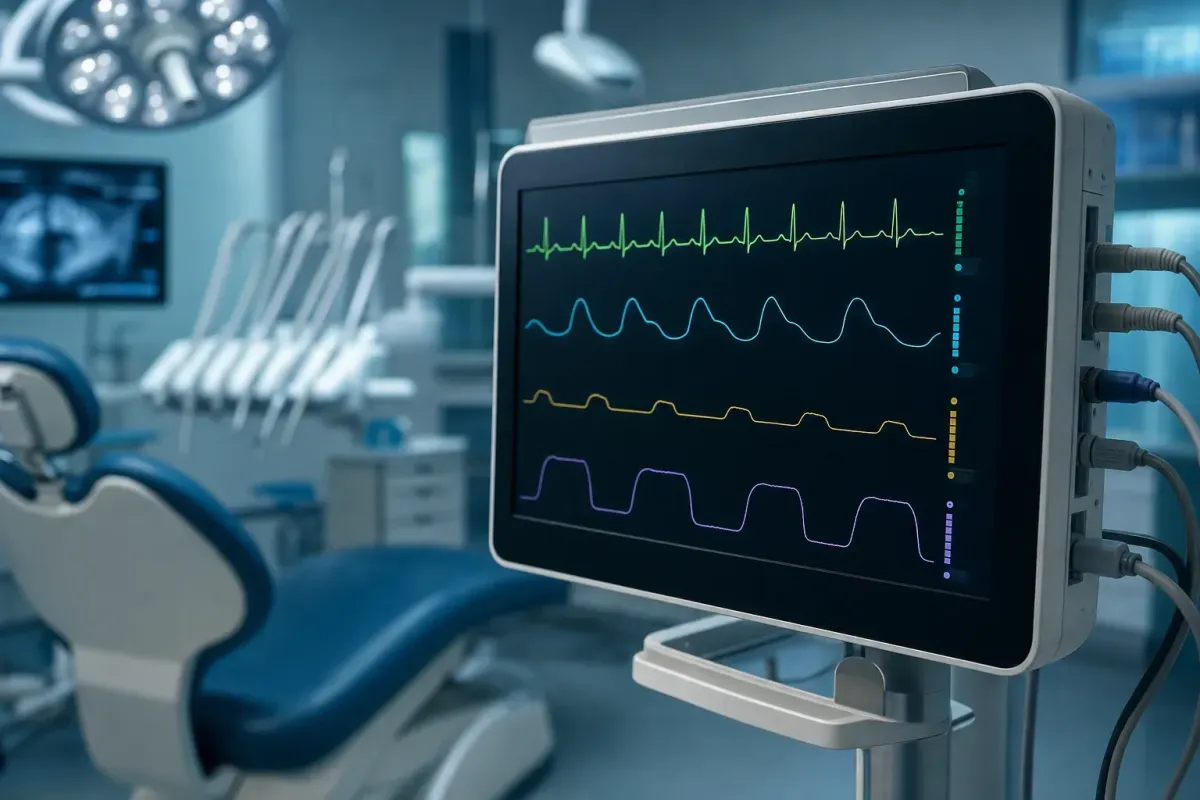
The clinical rationale is decisive: pulse oximetry detects oxygen desaturation only after it has occurred, while capnography flags respiratory depression, airway obstruction, and apnea minutes earlier, a critical margin when a patient is sedated in a dental chair without an intubated airway. Most oral surgery offices meet the standard with a multiparameter monitor tracking ECG, SpO2, blood pressure, and end-tidal CO2 together, from manufacturers including Criticare, Edan, Philips, and Nihon Kohden. The ASA and ADA have adopted parallel capnography requirements, and multiple state boards mandate it independently.
Where iSedate's SedationVault fits. The monitoring mandate creates a documentation mandate: those continuous signals have to land in the record, accurately and on a timestamped interval. SedationVault feeds live vitals from compatible monitors (Edan, MindRay, Criticare, and more) directly into the sedation record, timestamping readings so the every-five-minutes standard is met automatically rather than transcribed by hand mid-procedure. It pairs that with the pre-sedation assessment, ASA classification, and digital consent, then generates one-click, audit-ready PDF reports built for exactly the Office Anesthesia Evaluation this section describes.
Source: AAOMS capnography requirement summary | ASA Statement on Dental Office-Based Sedation
See compliance-ready reportingThe State Regulatory Landscape
Oral surgery anesthesia is regulated primarily at the state level, through dental-board anesthesia permits tied to a provider's training. The result is a patchwork, and the inconsistency is itself a documented finding.
A 2025 review in the anesthesia literature examined dental anesthesia guidelines and regulations across all 50 states and the ADA, AAOMS, and ASA, and found striking variation in definitions of sedation, patient selection, fasting requirements, emergency preparedness, drug administration, monitoring, equipment, training, permit requirements, life-support certification, adverse-event reporting, and inspection. State rules are concrete and enforced: permit tiers by sedation depth, required ACLS or PALS certification, capnography and defibrillator equipment, quarterly emergency-drug checks, pre-anesthesia evaluation including ASA class and Mallampati score, intraoperative vitals every five minutes, Aldrete-score discharge criteria, and multi-year record retention. Common inspection deficiencies include expired emergency medications, inoperable capnography, and incomplete vital-sign documentation.
Source: Dental Anesthesia Guidelines and Regulations of US States (PubMed, 2025)
Compare SedationVault plans and pricingDocumentation as a Permit Condition
Read the statistics above together and a single theme emerges. Every element of oral surgery anesthesia, the modality chosen, the provider model, the monitoring performed, the state permit held, resolves into something that must be recorded. Anesthesia is the one area of the practice where the documentation is not just good clinical hygiene; it is the condition on which the permit and the inspection depend.
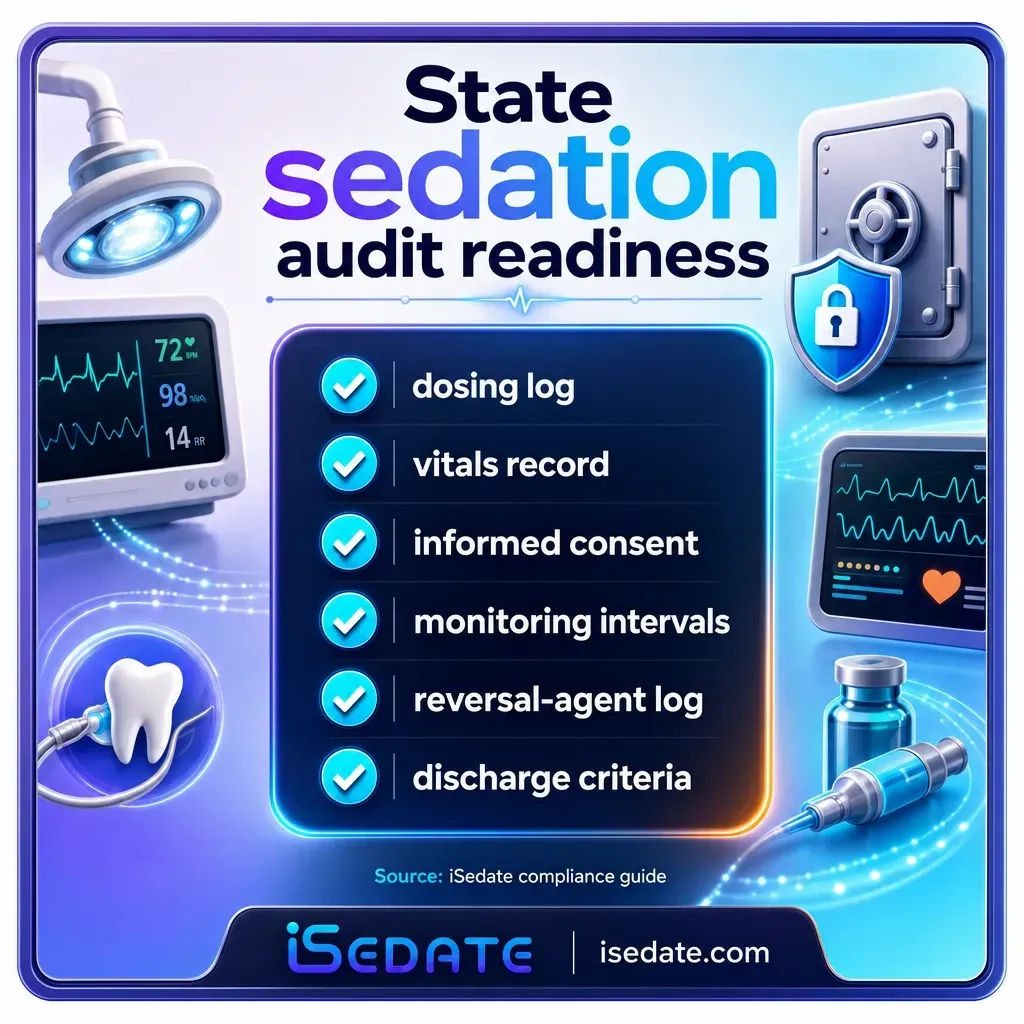
A compliant anesthesia record spans three phases: a pre-anesthesia evaluation (ASA classification, airway assessment, NPO status, comorbidity and medication review), an intraoperative record (procedure times, vitals at least every five minutes including capnography, medications administered), and a documented recovery and discharge (Aldrete score, verbal orientation, safe ambulation, responsible escort). When an adverse event, a board inspection, or a malpractice review occurs, this record is the evidence. The frequent inspection deficiencies, incomplete vital-sign logs and undocumented checks, are documentation failures, not clinical ones, which is precisely the category a purpose-built system removes.
Where iSedate's SedationVault fits. SedationVault is built around these three phases. It captures the pre-anesthesia assessment and ASA class, streams timestamped intraoperative vitals from compatible monitors (Edan, MindRay, Criticare, and more) at the required interval, records medications and consent, and documents recovery and discharge, then produces one-click, audit-ready PDF reports. Its Sedation Intelligence System adds the surrounding compliance layer the state rules demand: drug inventory and logs, license and certification tracking (ACLS, PALS, DAANCE, permits), emergency equipment oversight, and board-ready reporting. For a practice operating under the operator-anesthetist model, it turns a stack of regulatory obligations into a single provable record.
Source: State dental anesthesia regulatory checklist (example)
Book a SedationVault demoAnesthesia in Oral Surgery Statistics: Summary Table
| Statistic | Figure | Source | Year |
|---|---|---|---|
| Share of anesthesia practice: IV deep sedation | ~40% | Anesth. Prog. provider survey | 2026 |
| Sedation depth levels (standard terminology) | 5 | ASA / CMS | 2026 |
| Ideal candidates for office deep sedation/GA | ASA I–II | AAOMS white paper | 2024 |
| OMS team-leader post-secondary education | 12–14 years | AAOMS white paper | 2024 |
| Assistants recommended during deep sedation/GA | 2 | AAOMS | 2024 |
| AAOMS capnography mandate effective | January 2014 | AAOMS | 2014 |
| Standard monitored signals | ECG, SpO2, NIBP, EtCO2 | AAOMS / ASA | 2026 |
| Vital-sign documentation interval | Every 5 min | State regulations | 2025 |
| Common record-retention period | 6 years (longer for minors) | State regulations | 2025 |
| Pediatric guideline (2019) | Separate anesthesia provider | AAP / AAPD | 2019 |
| Caleb's Law enacted (California) | Effective Jan 1, 2017 | California legislation | 2017 |
| Regulatory variation across states/bodies | Striking / substantial | Anesthesia lit. review | 2025 |
| Monitor manufacturers (multiparameter) | Criticare, Edan, Philips, others | Industry / AAOMS OAE | 2026 |
| Life-support certifications commonly required | ACLS and/or PALS | State regulations | 2025 |
| Discharge-criteria tool | Aldrete score | State regulations | 2025 |
Frequently Asked Questions
What types of anesthesia are used in oral surgery?
What is the operator-anesthetist model in oral surgery?
Is capnography required for oral surgery anesthesia?
How is dental and oral surgery anesthesia regulated?
What monitoring is required during oral surgery sedation?
Methodology & Sources
Modality-usage data is from a provider survey published in Anesthesia Progress (Practice Characteristics Among Dental Anesthesia Providers). Provider-model and training figures, along with monitoring technique, are from the AAOMS Office-Based Anesthesia White Paper and the Anesthesia Patient Safety Foundation. The capnography mandate and its enforcement through the Office Anesthesia Evaluation are documented by the AAOMS and corroborated by state dental-board rules and the ASA statement on dental office-based sedation. The regulatory-variation finding is from a 2025 review in the anesthesia literature (indexed in PubMed) examining all 50 states and the ADA, AAOMS, and ASA guidelines. Specific documentation and equipment requirements are drawn from representative state regulations (e.g., Utah, Washington, Pennsylvania, New Hampshire). The operator-anesthetist debate is presented with both the oral surgery position and the anesthesiology/pediatric position represented. Monitor-manufacturer references reflect industry and Office Anesthesia Evaluation documentation. Where a figure derives from combining sources, it is labeled as an iSedate Analysis with its inputs shown.
Media and press usage: Journalists and researchers are welcome to cite the statistics in this article with attribution to the original primary sources named above, and to iSedate for any analysis labeled as original. A link back to this page is appreciated.
This article discusses anesthesia practice, regulation, and adverse outcomes including a patient death referenced in the context of legislation. It is an informational overview for clinical and practice-management audiences and is not medical or legal advice. Regulatory requirements vary by state and change over time; practices should confirm current rules with their state dental board.