







Board Audit and Sedation Compliance Statistics (2026): What Inspections and Claims Reveal
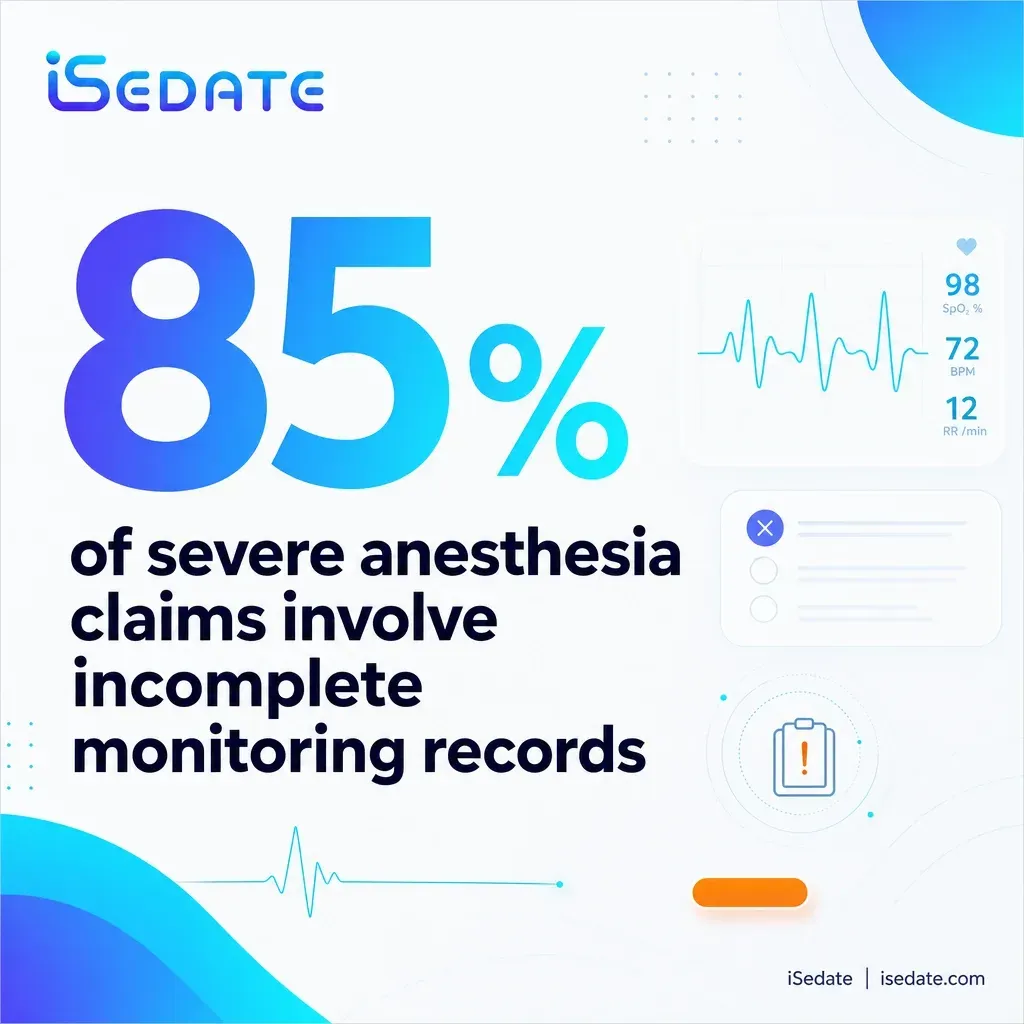
When a dental board audits a sedation case, it usually starts with a single record, and in a review of 1,185 closed dental claims, documentation issues appeared in 19% of them. Board audits and malpractice claims are both decided largely on what the chart shows, which makes the sedation record the pivot point between a defensible practice and an exposed one. The data below covers how inspections work, what gets cited most, and why the record is the asset that matters.
- A first-stage compliance inspection in Texas audits one sedation record chosen by the inspector; an escalated risk-based inspection audits five records plus a competency evaluation.
- Incomplete documentation is one of the most cited violations in sedation compliance nationwide.
- In 1,185 dental claims closed 2010 to 2020, documentation issues appeared in 19%, with insufficient documentation the leading sub-factor.
- A failed re-inspection in Texas can put a provider's entire dental license at risk, not just the sedation permit.
- Inspection coverage is uneven: a Louisiana audit found 35.5% of dental offices went uninspected across two fiscal years, and North Carolina found some facilities may never be re-inspected after permitting.
- The Texas OIG's most common sedation errors include missing informed consent, undocumented staff and medications, and failure to classify ASA status.
- The governing legal principle is blunt: if it is not recorded, it was not done, and a contemporaneous record beats a reconstructed one.
What's in This Guide
01 How Board Sedation Audits Work
Sedation regulation sits almost entirely with state dental boards, not federal agencies, so the specifics differ by state. But the structure of a records audit is broadly similar, and Texas provides a well-documented model worth understanding because the mechanics reveal exactly what boards look for.
Under the Texas model, the initial compliance inspection pairs a checklist with an audit of one sedation record for the highest permit level the provider holds, applying the board rules in effect when the patient was treated. If a violation is identified, the provider must immediately cease sedation services until they prove it is corrected, and pay a fee of up to $500. Fail to remedy within 30 days and the case escalates to a risk-based inspection that pulls five records and adds a competency evaluation reviewed by the board's dental review panel.
The audit always begins with the record. A clean, complete chart for any case the inspector happens to pull is what keeps a Tier 1 inspection from becoming a Tier 2 investigation. Because the inspector chooses the record, consistency across every case matters more than having a few exemplary charts. The provider cannot predict which case will be audited, so the only reliable strategy is uniform documentation on all of them.
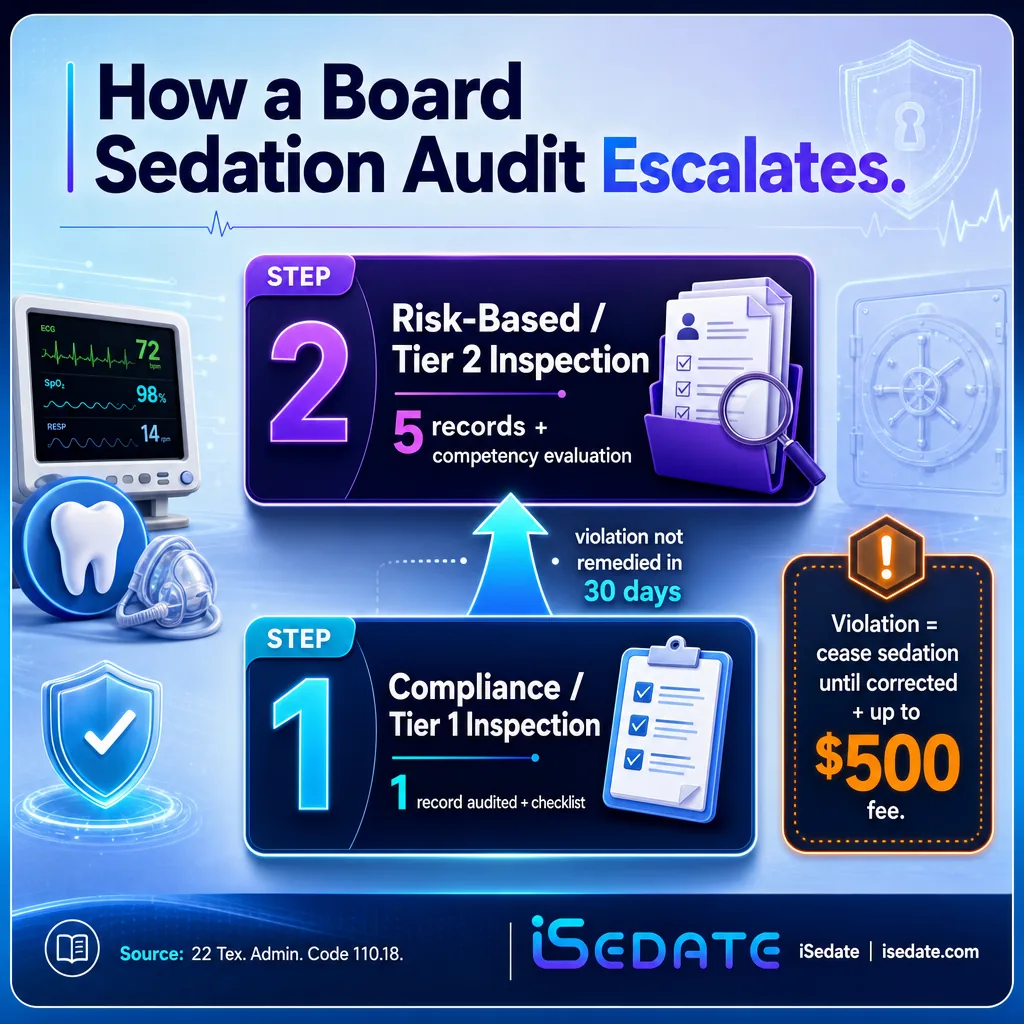
Source: 22 Tex. Admin. Code 110.18 (Cornell LII) | Rules for Dentists Administering Sedation
See how SedationVault supports board compliance
02 The Most-Cited Violations
Across states and inspectors, the same violations recur, and they cluster around documentation rather than clinical technique. Incomplete documentation is described as one of the most cited violations nationwide. The Texas Health and Human Services Office of Inspector General, which reviews sedation records for compliance, published a list of the errors its investigators see most.
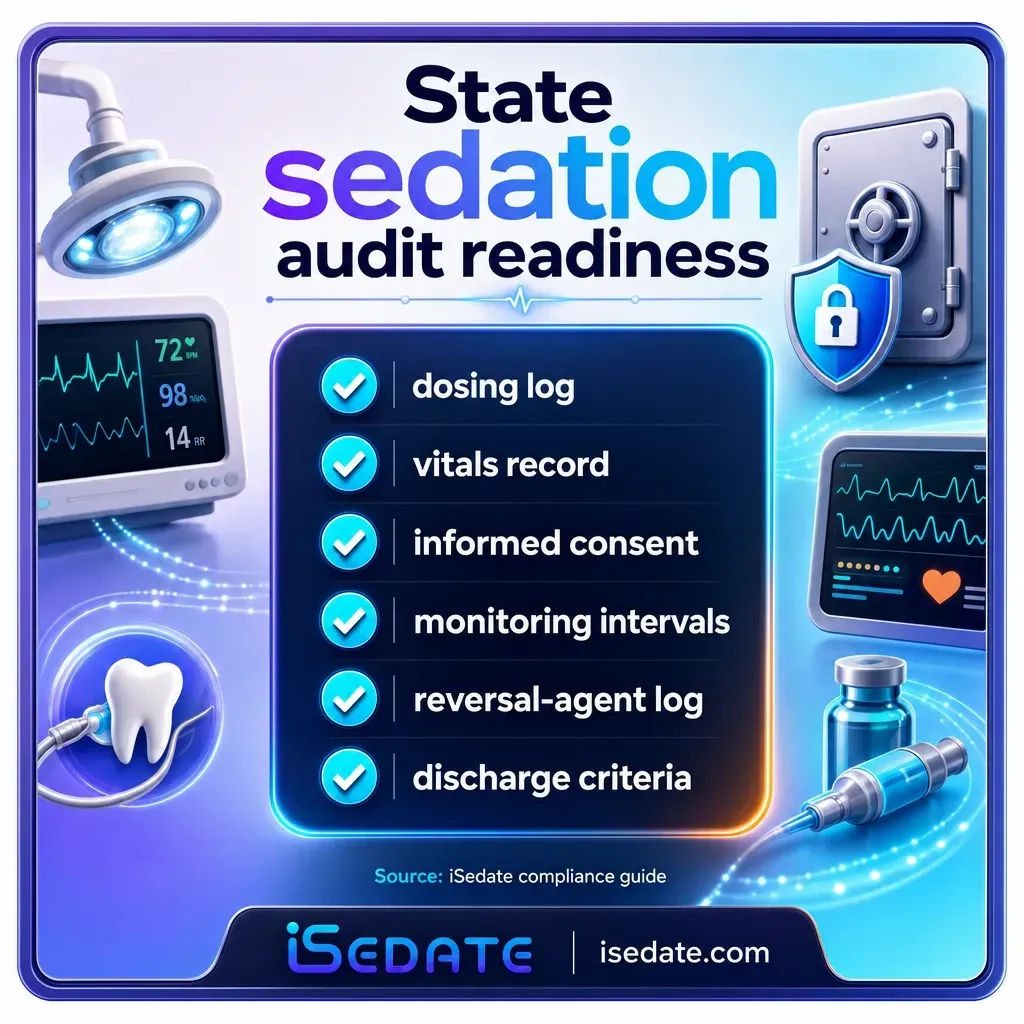
The OIG's commonly cited errors include failure to document who administered the medication and which staff were present, lack of specific informed consent for nitrous oxide or sedation, failure to stop a procedure when vitals indicate a deeper level than permitted, and failure to correctly assess and classify the patient by ASA physical status. Notably, missing monitoring intervals and recovery criteria are called out as major violations. In Texas, time-interval recording violations are common enough that the board built a specific affidavit remedy just for them, a strong signal of how often they appear.
The most frequently cited violations are documentation failures, not clinical errors. Missing monitoring intervals, absent informed consent, and undocumented staff or medications are recordkeeping problems. A provider can deliver clinically sound sedation and still fail an inspection purely on the completeness of the chart. This is good news, because documentation is fully controllable, unlike the rare clinical emergency.
Commonly Cited Sedation Documentation Errors (Texas OIG)
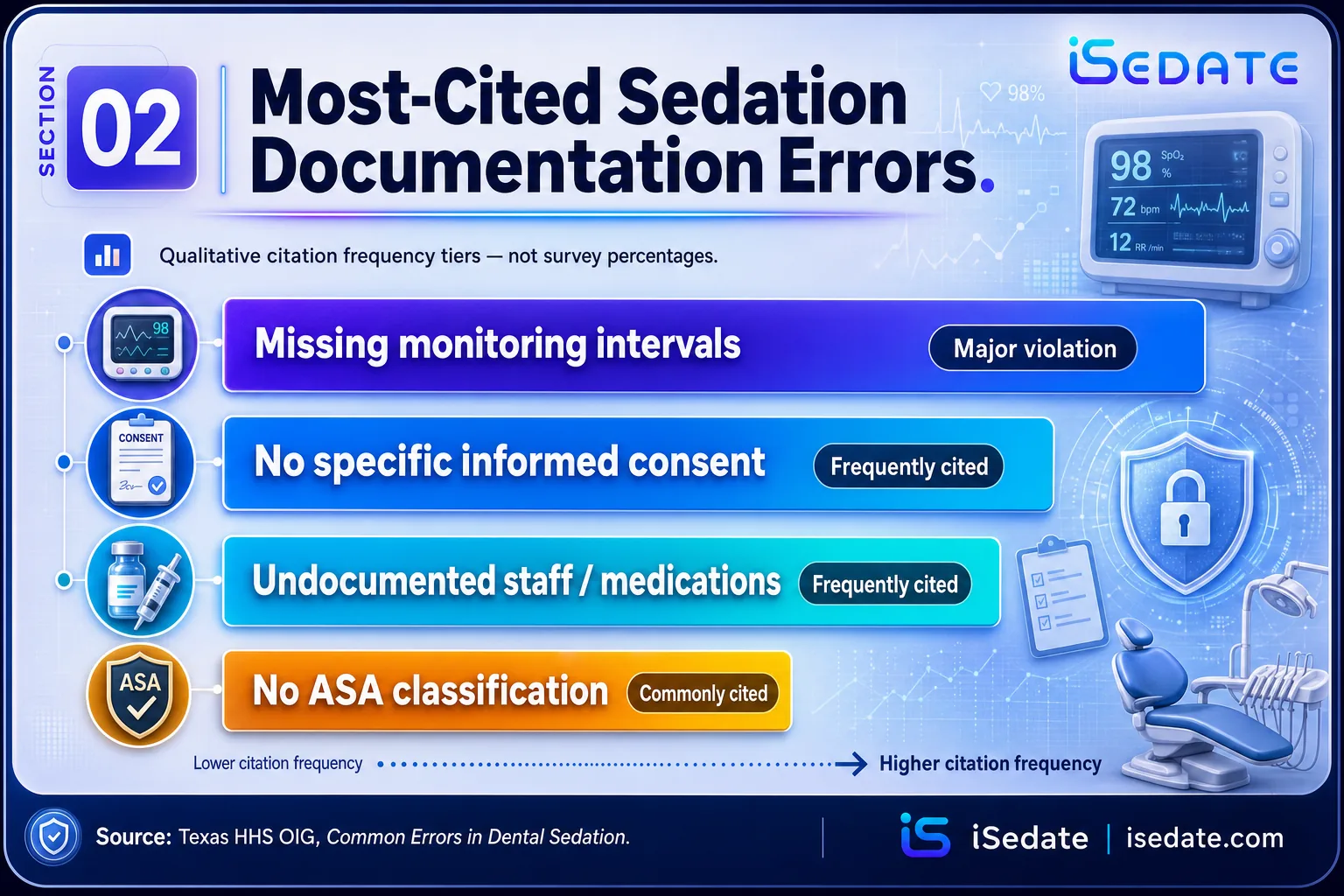
Source: Texas HHS OIG, Common Errors in Dental Sedation
See digital consent capture in SedationVault
03 Documentation in Malpractice Claims
Board audits are one exposure; malpractice claims are the other, and they share the same pivot point. The most useful hard number here comes from a large closed-claims review conducted by The Doctors Company, which analyzed dental claims closed over a decade.
Documentation issues ranked as the fifth-leading causal factor overall and appeared in 19% of the 1,185 claims. Within that category, insufficient documentation was the leading sub-factor, followed by content decisions such as altering the record and documentation mechanics such as charting the wrong patient. Analysts found a direct correlation between poor documentation and the adverse event itself in a subset of claims. The record is not a side issue in these cases; it is frequently entangled with the harm and almost always central to the defense.
Two independent bodies of evidence point at the same failure. Board inspectors cite incomplete documentation as one of the most common violations, and closed-claims analysts find documentation issues in 19% of dental claims with insufficient documentation leading. These are not separate problems, they are the same gap viewed from two directions: the regulator sees it during an audit, the plaintiff's attorney sees it during discovery. A single complete sedation record answers both.
Sources: Texas HHS OIG common errors list; The Doctors Company review of 1,185 dental claims. Calculation and interpretation original to iSedate.
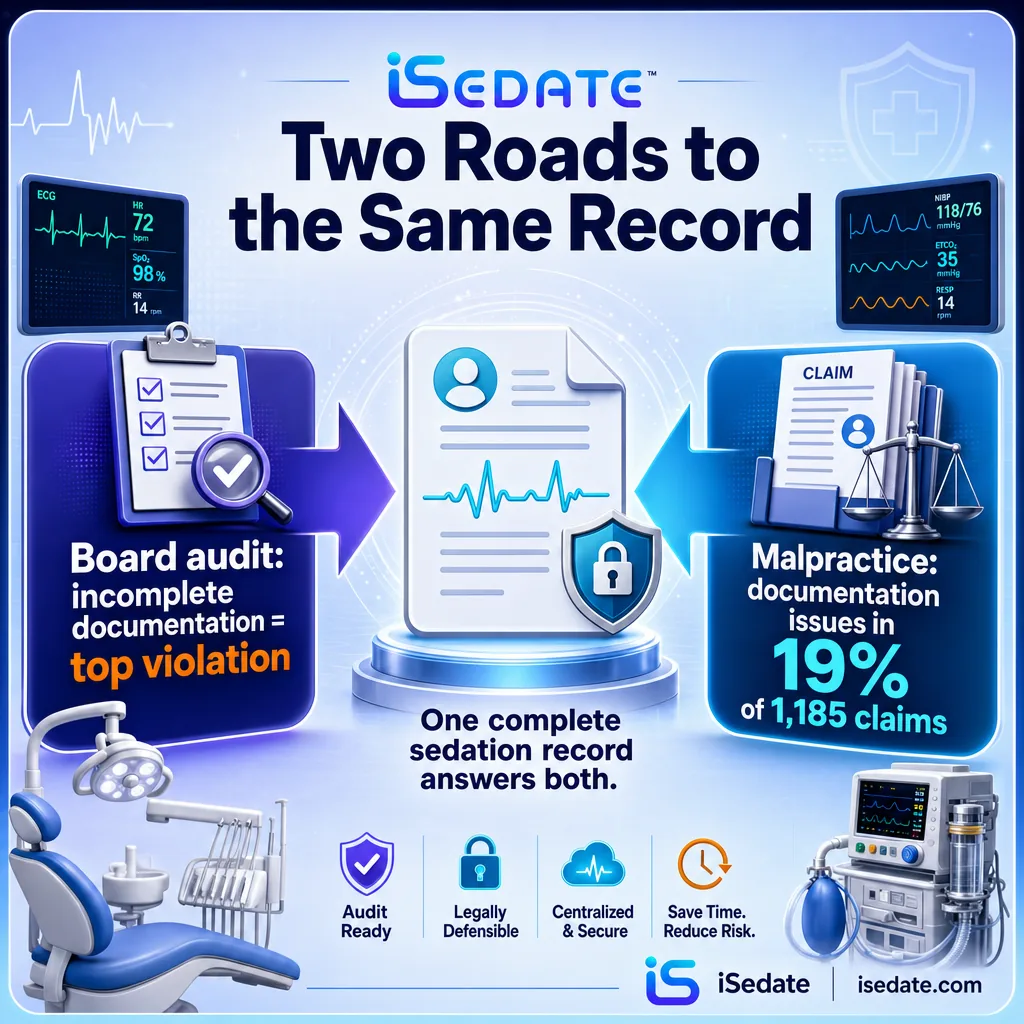
Source: The Doctors Company, Patient Safety in Dentistry: Documentation
Generate audit-ready PDF records for every case
04 Uneven Inspection Coverage
One counterintuitive finding from state audits is that many sedation providers are inspected rarely, if ever, after their initial permit. This does not lower the stakes, it raises them, because when an inspection or complaint does arrive, it often follows an adverse event and arrives without warning.
A Louisiana Legislative Auditor report found the state board did not inspect 568 of 1,600 dental offices, about 35.5%, between fiscal years 2012 and 2014. A North Carolina State Auditor report noted that because inspections there are largely complaint-driven and do not occur at regular intervals, some facilities may never be inspected again after initial permitting. That same North Carolina report was prompted in part by suspected sedation deaths, a reminder that the inspection that finally comes is often triggered by a bad outcome.
If inspections were frequent and scheduled, a provider could prepare for a known date. Because they are often complaint-driven and unpredictable, the audit tends to arrive alongside an adverse event, when the record is being scrutinized precisely because something went wrong. There is no opportunity to improve documentation retroactively. The only defense is a record that was already complete when the case was treated.
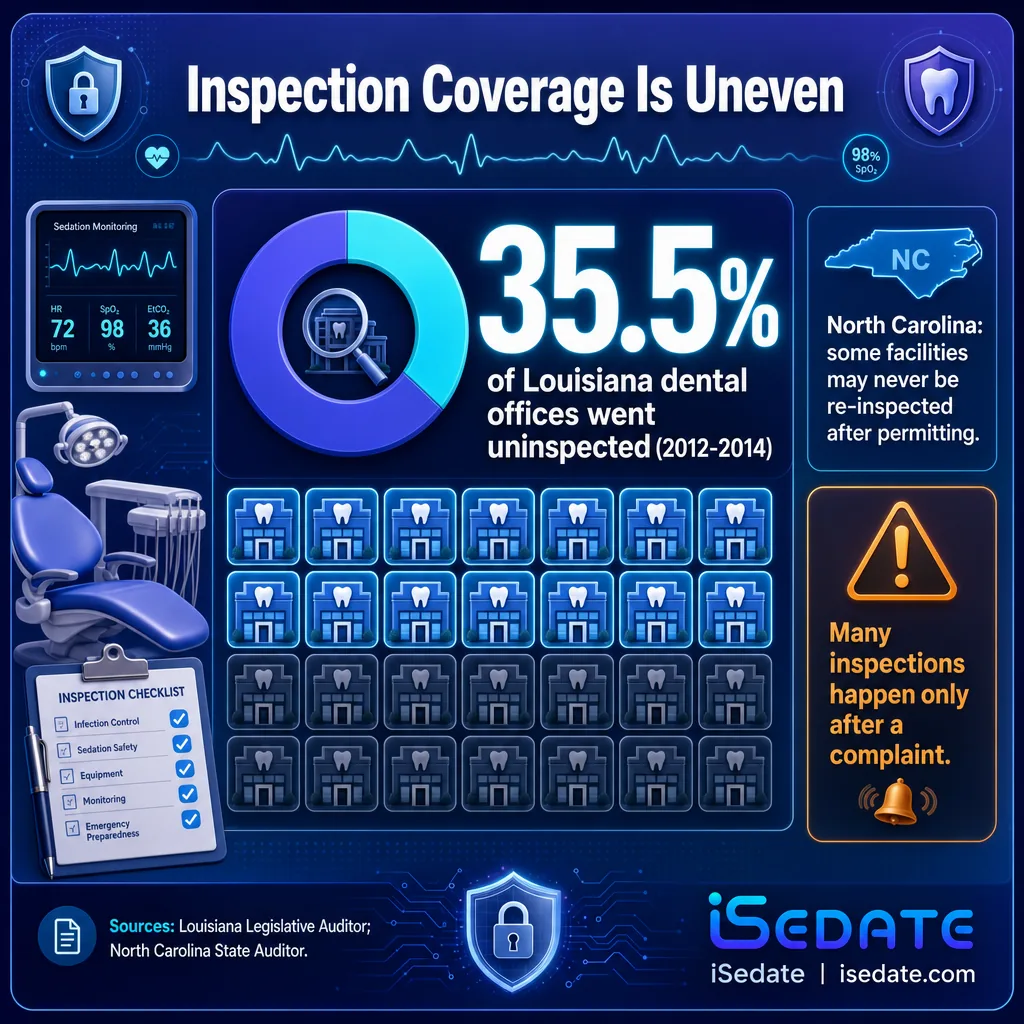
Source: Louisiana Legislative Auditor, Regulation of the Dental Profession | North Carolina State Auditor report
See how oral surgeons stay audit-ready
05 Why the Record Is the Asset
Everything above converges on a single principle that malpractice defense attorneys and dental boards state almost identically: the record is the asset. The dental record is frequently described as the single most powerful legal asset in a malpractice defense, and the governing adage in cases where the record is silent is direct.
A complete, contemporaneous record does two things at once. It satisfies the board inspector auditing for compliance, and it offsets patient allegations in a malpractice claim, sometimes convincingly enough that a plaintiff's attorney declines the case before it starts. The opposite is also true and dangerous: material changes made to a record after learning of a lawsuit are, in the words of defense counsel, virtually impossible to defend, and they hand the plaintiff a credibility argument. This is why secure digital systems with audit trails are recommended, they timestamp entries and record access, removing any question of after-the-fact alteration.
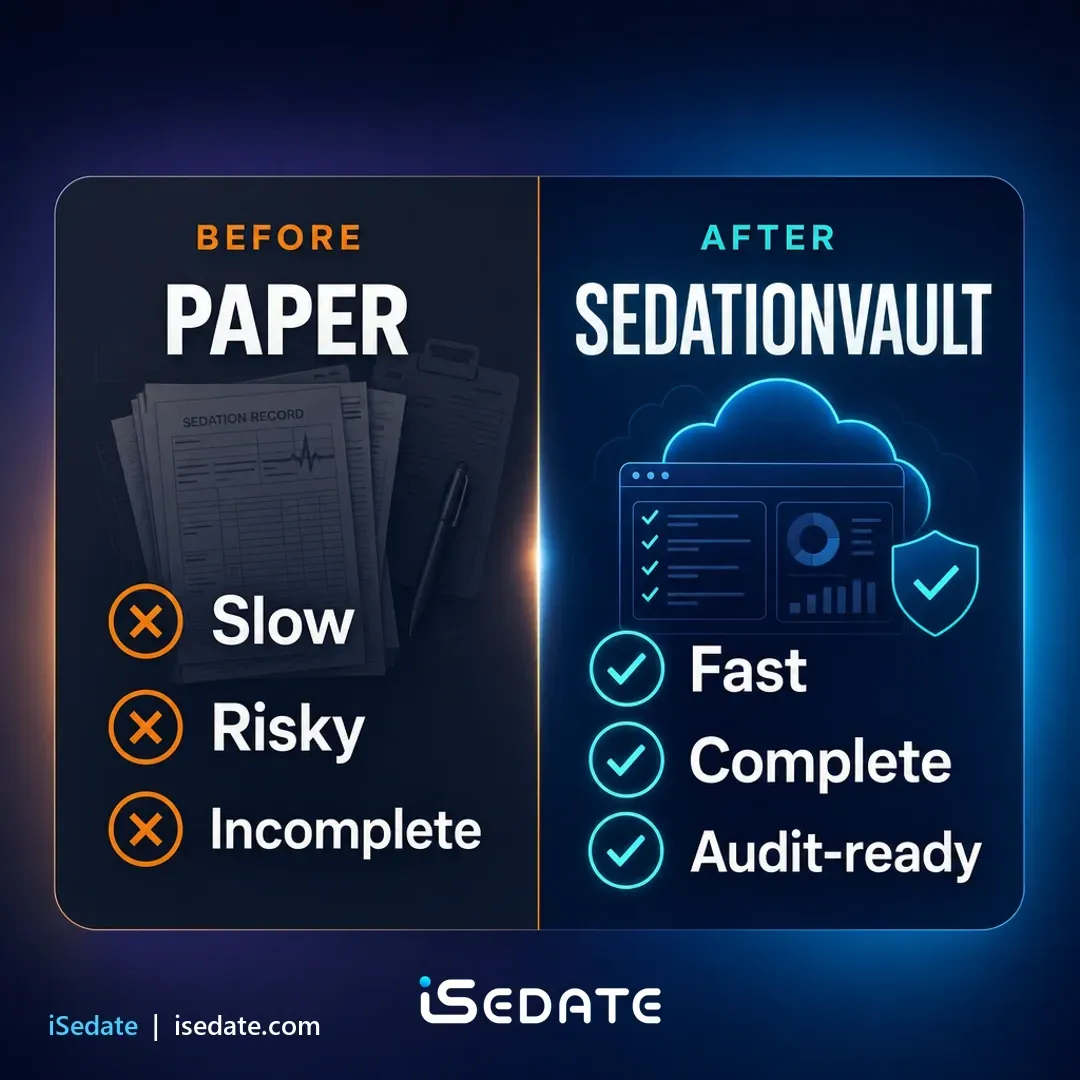
The recurring failure in both board audits and malpractice claims is the same: incomplete or non-contemporaneous sedation records. iSedate's SedationVault captures live vitals from compatible monitors, including Edan, MindRay, Criticare, and more (the Edan X10 is a common example), so monitoring intervals are recorded automatically as the case proceeds rather than reconstructed afterward. It captures digital consent, and produces a one-click, audit-ready PDF of the complete case. The Sedation Intelligence Platform extends this to license and certification tracking, drug logs, and audit-ready board reporting, the exact items inspectors pull.
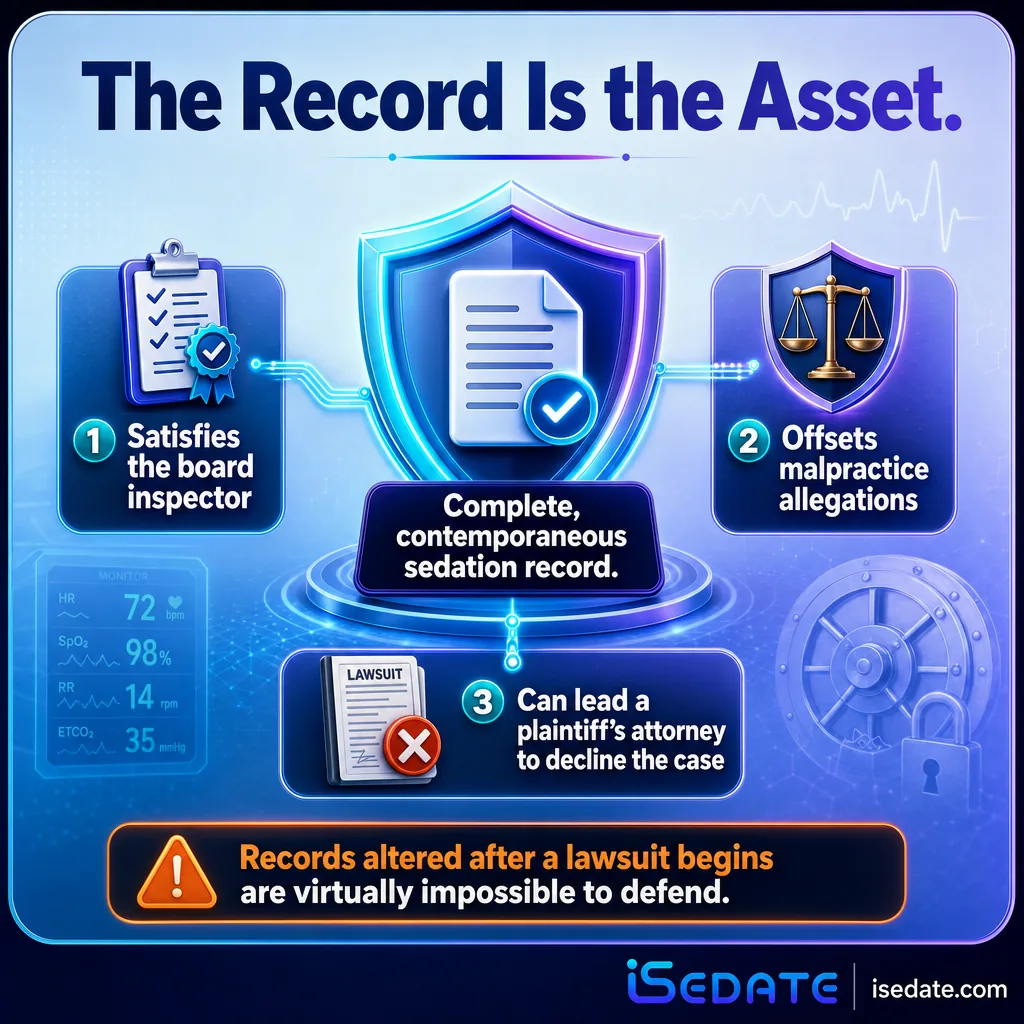
Source: The Doctors Company, Defensible Medical and Dental Records | ADA, Writing in the Dental Record
See SedationVault
06 Summary Table: Every Statistic
| Statistic | Figure | Source | Year |
|---|---|---|---|
| Records audited in Texas Tier 1 compliance inspection | 1 | 22 Tex. Admin. Code 110.18 | 2018 |
| Records audited in Texas Tier 2 risk-based inspection | 5 | 22 Tex. Admin. Code 110.18 | 2018 |
| Window to remedy a Tier 1 violation | 30 days | 22 Tex. Admin. Code 110.18 | 2018 |
| Maximum re-inspection fee after violation | $500 | 22 Tex. Admin. Code 110.18 | 2018 |
| Dental claims reviewed (closed 2010-2020) | 1,185 | The Doctors Company | 2022 |
| Claims in which documentation issues appeared | 19% | The Doctors Company | 2022 |
| Rank of documentation as a causal factor | 5th | The Doctors Company | 2022 |
| Leading documentation sub-factor | Insufficient documentation | The Doctors Company | 2022 |
| Louisiana dental offices not inspected (2012-2014) | 35.5% (568 of 1,600) | Louisiana Legislative Auditor | 2015 |
| North Carolina facilities re-inspected after permitting | Some never | North Carolina State Auditor | 2015 |
| Most cited sedation violation category | Incomplete documentation | State board / inspector findings | 2025 |
| Common OIG-cited errors | Consent, staff/meds, ASA status | Texas HHS OIG | 2023 |
| Consequence of failed Texas re-inspection | Possible license revocation | TSBDE / dental compliance sources | 2023 |
| Governing legal adage on records | If not recorded, not done | The Doctors Company | 2022 |
| Recommended safeguard against alteration disputes | Digital records with audit trails | Dental malpractice defense counsel | 2025 |
07 Frequently Asked Questions
What happens during a dental board sedation inspection?
What is the most commonly cited sedation compliance violation?
How often do documentation problems appear in dental malpractice claims?
Are all sedation providers inspected regularly?
Why does documentation matter so much for defensibility?
All figures trace to primary or authoritative sources: state administrative code, state auditor and inspector-general reports, and closed-claims analysis. Inspection mechanics are state-specific; Texas is used as a documented model and is noted as such. Sources include:
- 22 Texas Administrative Code 110.18, Inspection of Sedation/Anesthesia Providers
- Texas Health and Human Services Office of Inspector General, "Common errors in dental sedation"
- The Doctors Company, "Patient Safety in Dentistry: Documentation" (review of 1,185 dental claims, 2010-2020)
- The Doctors Company, "Defensible Medical and Dental Records"
- Louisiana Legislative Auditor, "Regulation of the Dental Profession"
- North Carolina State Auditor, report on the NC State Board of Dental Examiners
- American Dental Association, "What and How to Write, or Change, in the Dental Record"
- Dental license defense and malpractice sources on recordkeeping standards
Board audits and malpractice claims both come down to the sedation record. iSedate's SedationVault records monitoring intervals automatically, captures consent, and produces audit-ready documentation for every case, so the chart is complete before anyone asks to see it. To see how it works in your practice, book a demo.