










Dental Board Disciplinary Action Statistics (2026): Sedation and Anesthesia
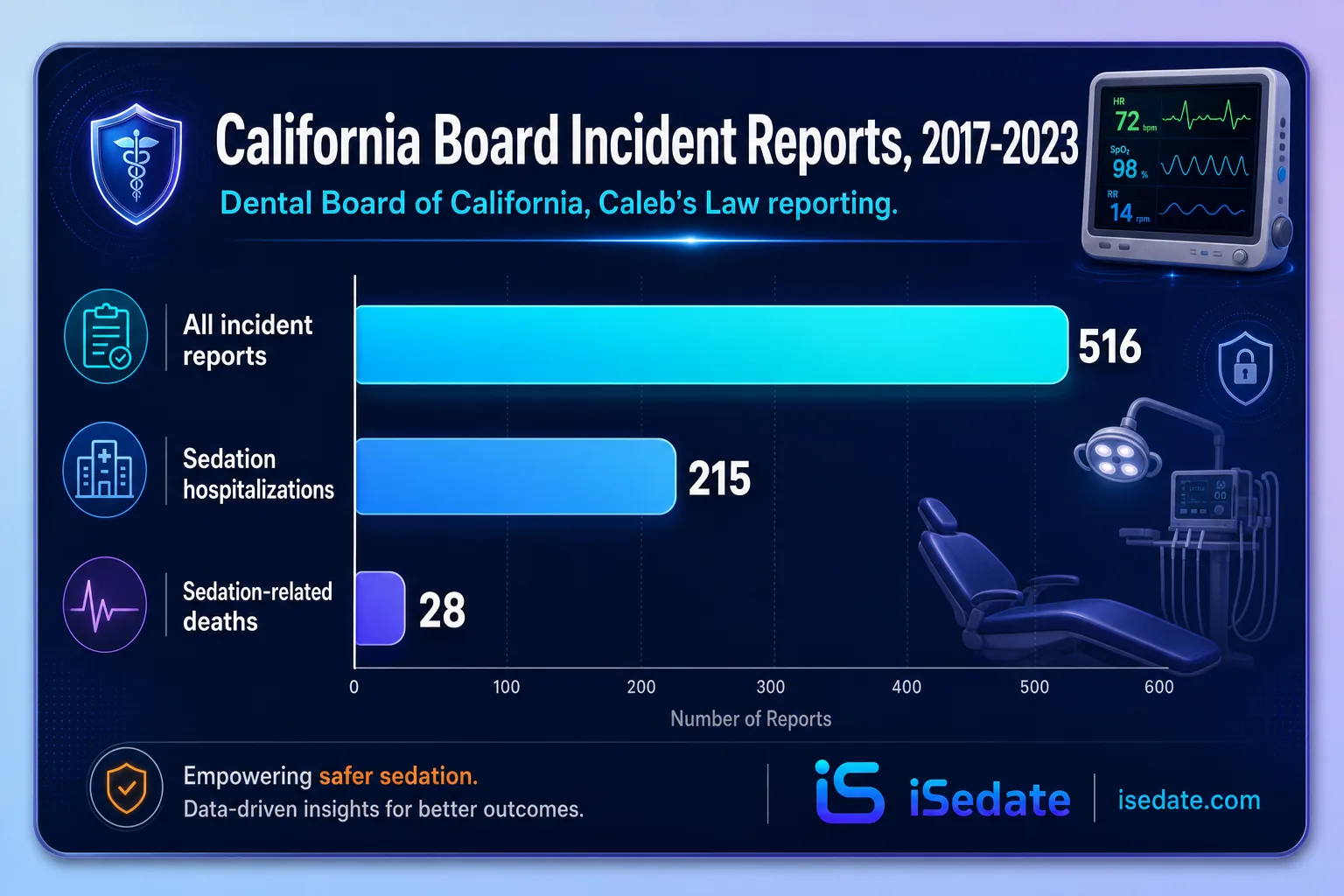
Between January 2017 and August 2023, the Dental Board of California received 516 incident reports of patient deaths and hospitalizations, including 28 deaths during or shortly after a procedure in which sedation or anesthesia was administered. State boards, not any national registry, are where sedation adverse events surface first, and their disciplinary records show what happens next.
- The Dental Board of California logged 516 incident reports from 2017 to 2023 under Caleb's Law, including 215 sedation-related hospitalizations and 28 sedation-related deaths.
- Texas's dental board reported being notified of 102 patient deaths over one five-year period, and disciplined roughly 6 dentists after a patient death since 2010.
- State dental boards must report final adverse actions to the National Practitioner Data Bank, which has collected disclosable reports since 1990; failing to report can cost up to $39,811 per action.
- Board sanctions for sedation violations include permit restriction or revocation, probation, chart audits, and license suspension or revocation, often applied through a tiered disciplinary matrix.
- Peer-reviewed mortality series estimate roughly 2.6 sedation and anesthesia deaths per year in one dataset, with anesthesia and medication complications the leading cause.
- There is no uniform national mandate for reporting dental sedation adverse events, so the true incidence remains under-counted, and the licensee's own records carry the burden of proof.
What's in This Guide
1 Mandatory Adverse-Event Reporting by the Numbers
A dental board can only discipline what it learns about. Most states require licensees to self-report a defined set of serious events, and the strongest data comes from states that formalized those requirements after a high-profile pediatric death.
California's Caleb's Law requires licensees to report a patient death during a dental procedure, a death later found to be related to one, and the removal of a sedation or anesthesia patient to a hospital or emergency center. The board created a standardized courtesy form in 2017 that captures the patient's ASA physical status, the medications used, the monitoring equipment, the sedation depth, and the complications that occurred. That structured intake is what makes the California dataset unusually complete.
What the Report Form Captures
The California reporting form is essentially a sedation record in miniature: procedure date, patient age and weight, ASA status, primary and coexisting diagnoses, sedation setting, medications, monitoring equipment, planned airway management, planned depth of sedation, and the complications that arose. Every field maps to something a defensible chart already contains. When a report is thin, the board's investigators reach for the underlying record.
Source: Dental Board of California Report on Pediatric Deaths Related to General Anesthesia
See how sedation compliance records are built2 Sedation Deaths and Hospitalizations in Board Data
Death and serious-harm reports are rare relative to the volume of sedation performed, but they are the events most likely to trigger a board investigation. State-level counts, where they exist, give the clearest picture.
In the California data, of the 28 sedation-related deaths reported, the board identified one pediatric death involving general anesthesia or deep sedation. It was investigated, referred to an anesthesia expert, and closed with no violation after the expert found no deviation from the standard of care. That single case illustrates the pattern: a report triggers review, and an expert reads the record to decide whether discipline follows.
California Board Incident Reports by Category (2017-2023)
Peer-reviewed research fills in the clinical pattern that board data alone cannot. Analyses of dental anesthesia mortality have found that anesthesia, sedation, and medication complications are the leading cause of reported deaths, ahead of cardiovascular events, infection, and airway complications. A widely cited series of pediatric cases identified 44 deaths associated with dental anesthesia in patients under 21 across three decades, most in an office setting with a general or pediatric dentist as the provider.
It does not, and researchers say so directly. There is no mandated national reporting of dental sedation adverse events, so published case series often rely on media reports rather than systematic collection. The California and Texas figures are among the more complete because those states built reporting requirements, but even they capture only what licensees and complainants submit. The absence of a denominator means these counts understate, not overstate, the underlying rate.
Source: Dental Board of California anesthesia deaths report | Journal of the American Dental Association deep sedation safety analysis
Explore anesthesia record software3 Sanctions and the Disciplinary Matrix
When a board does act on a sedation complaint, the penalty is rarely a single blunt instrument. Boards work from a graduated menu of sanctions, and sedation permits are frequently the first privilege restricted.
Texas illustrates the escalation ladder. Its board can issue a warning, a reprimand, probated or enforced suspension, or revocation, and can restrict or revoke sedation and anesthesia permits as a probation condition. Administrative penalties can reach $5,000 per violation, with each day of an ongoing violation eligible for its own penalty. California's disciplinary guidelines add sedation-specific probation terms, including third-party patient monitors and detailed patient logs when a licensee's anesthesia practice is at issue.
Across the state frameworks reviewed here, sedation and anesthesia permits appear as a distinct, separately restrictable privilege in every disciplinary structure, alongside the general license. Combine three observations: Texas lists permit restriction or revocation as an explicit sanction; California requires permit good standing to be free of any unresolved disciplinary proceeding; and both tie permit renewal to continuing education and, for pediatric endorsements, documented case counts. The through-line is that a board can suspend a dentist's ability to sedate without ending their ability to practice dentistry at all.
Formula: qualitative synthesis of three state permit frameworks (TX, CA, plus general "good standing" definitions), not a numeric average.
Interpretation: sedation privileges are the pressure point a board reaches for first, which raises the stakes on sedation-specific documentation. Calculation and interpretation original to iSedate, derived from Texas and California dental board sources.
Source: Dental Board of California Disciplinary Guidelines | Texas State Board of Dental Examiners disciplinary actions
Explore the SedationVault platform4 The National Practitioner Data Bank
A board's action does not stay local. Final adverse actions against a dentist flow into a federal registry designed to follow a practitioner across state lines.
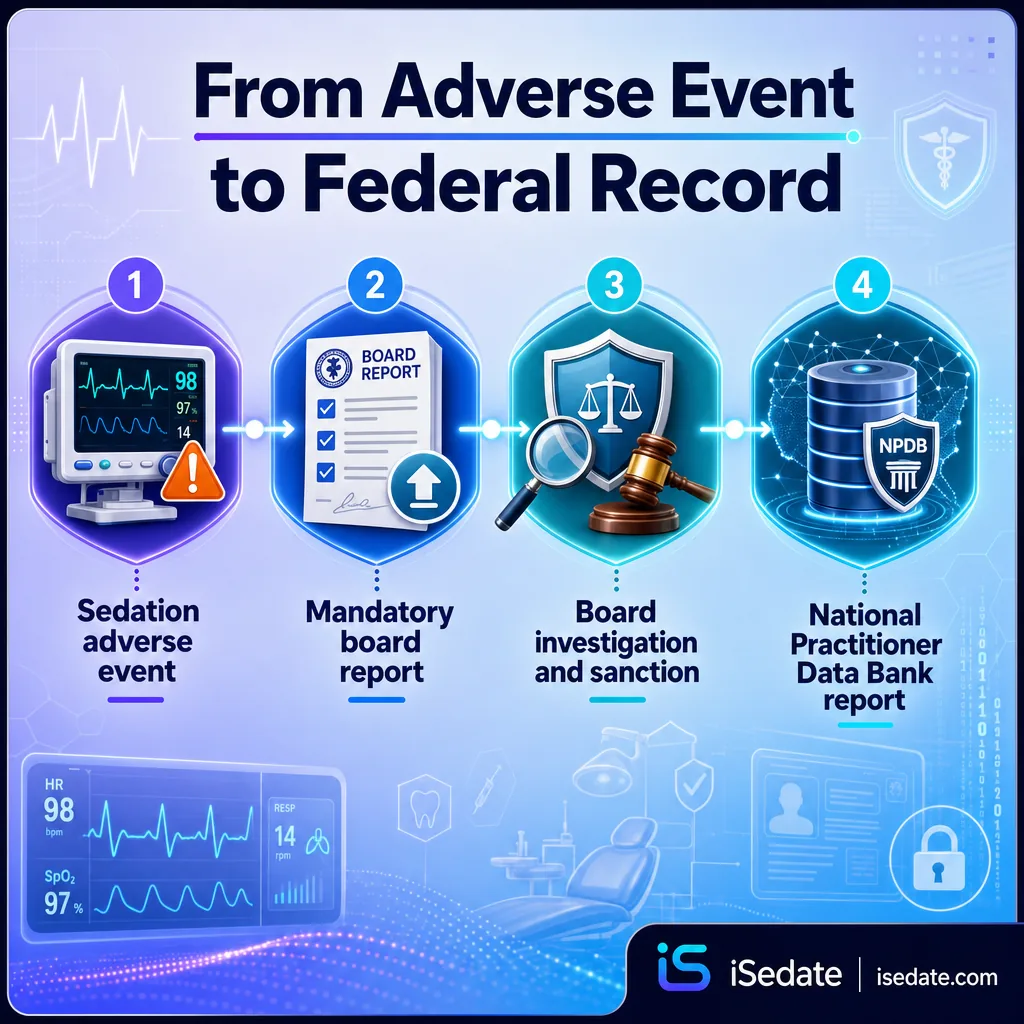
The National Practitioner Data Bank was created under the Health Care Quality Improvement Act of 1986 and began operating in 1990. State dental boards must report final adverse licensure actions, including revocation, suspension, reprimand, censure, and probation, as well as surrenders of a license while under investigation. Malpractice payments made on behalf of a dentist are reported too. The system was built to flag practitioners who might move between states to avoid detection.
The reporting obligation carries teeth. A board that fails to submit required reports can have its reporting responsibility removed by the Secretary of HHS, and other reporting entities face civil money penalties per unreported action. For a dentist, a single sedation-related board action can generate a permanent, queryable federal record that hospitals, boards, and, in limited circumstances, plaintiffs' attorneys can access.
Source: National Practitioner Data Bank reporting requirements | 45 CFR Part 60 National Practitioner Data Bank regulation
Generate audit-ready sedation records5 Reporting Gaps and the Record's Role
The disciplinary system has real blind spots, and understanding them clarifies why a complete sedation record matters at every step.
The American Dental Association does not collect case information or disciplinary actions on sedation and anesthesia, and researchers have noted that this makes the degree of enforcement hard to judge. Some state boards have historically lacked authority to conduct random safety inspections of sedation offices, a limitation boards have themselves raised with legislatures. Where reporting exists, deadlines are tight: some states require notice of a sedation-related death or hospital transfer within seven days.
Why the Chart Decides the Outcome
Every board investigation converges on the same question an expert asks in civil litigation: does the record show that care met the standard? In the one California pediatric death that reached full review, the case closed with no violation because an anesthesia expert, reading the records, found no deviation. A contemporaneous, structured sedation record, capturing vitals, medications, monitoring, and timing, is what lets that review resolve in the licensee's favor. A thin or reconstructed record leaves the board with questions the dentist cannot answer.
Source: ADA spokesperson commentary on sedation enforcement data | Office Anesthesia in Dentistry safety review
Book a demo of SedationVault Compare SedationVault plans and pricingDental Board Disciplinary and Sedation Statistics: Summary Table
| Statistic | Figure | Source | Year |
|---|---|---|---|
| California board incident reports (death or hospitalization) | 516 | Dental Board of California | 2017-2023 |
| Sedation-related hospitalizations in California reports | 215 | Dental Board of California | 2017-2023 |
| Sedation-related deaths in California reports | 28 | Dental Board of California | 2017-2023 |
| Pediatric GA/deep-sedation deaths found (California) | 1 (no violation) | Dental Board of California | 2017-2023 |
| Patient deaths reported to Texas board (one period) | 102 | TSBDE / KPRC investigation | 2011-2016 |
| Texas dentists disciplined after a patient death | ~6 | TSBDE records | Since 2010 |
| Average sedation/anesthesia deaths per year (one series) | 2.6 | JADA mortality analysis | 2015 |
| Pediatric dental-anesthesia deaths in a 3-decade series | 44 | Pediatric Anesthesia study | 1980-2011 |
| NPDB operations began | 1990 | HRSA / NPDB | 1990 |
| Max civil penalty per unreported adverse action | $39,811 | NPDB / HRSA | 2024 |
| Reporting window for a final adverse action | ~30 days | NPDB / HRSA | 2024 |
| Disciplinary matrix violation tiers | 4 | TSBDE disciplinary matrix | 2024 |
| Administrative penalty ceiling (one state) | $5,000 per violation | TSBDE | 2025 |
| Facility-violation correction window | 30 days | TSBDE rules | 2025 |
| Death/transfer reporting window (some states) | 7 days | State dental practice acts | 2024 |
| National mandated sedation adverse-event registries | 0 | Peer-reviewed researchers | 2021 |
| ADA collection of sedation disciplinary data | None | ADA spokesperson | 2016 |
Frequently Asked Questions
What do dentists have to report to their dental board after a sedation adverse event?
How many sedation-related deaths are reported to dental boards?
What penalties can a dental board impose for a sedation violation?
Are dental board disciplinary actions reported nationally?
Do dental boards inspect offices that provide sedation?
Methodology and Sources
This article compiles statistics from primary and authoritative sources only. Figures are current as of 2026 and drawn from the most recent available data at the time of writing.
- Dental Board of California, Report on Pediatric Deaths Related to General Anesthesia in Dentistry (BPC section 1601.4; data collected 2017-2023 under Caleb's Law), and the Board's Disciplinary Guidelines.
- Texas State Board of Dental Examiners (TSBDE), disciplinary actions, anesthesia permit rules (22 Tex. Admin. Code), and reported patient-death notifications referenced in a KPRC investigation.
- National Practitioner Data Bank (HRSA), reporting requirements and 45 CFR Part 60, including civil money penalty amounts and reporting timelines.
- Journal of the American Dental Association and Pediatric Anesthesia, peer-reviewed dental anesthesia mortality analyses (2.6 deaths per year in one series; 44 pediatric deaths, 1980-2011).
- American Dental Association spokesperson commentary on the absence of centralized sedation disciplinary data.
State-specific figures are not directly comparable across jurisdictions because reporting requirements, definitions, and time periods differ. Death and adverse-event counts reflect reported events only and, per the cited researchers, likely understate true incidence given the absence of a national mandated registry. The iSedate Analysis box is a qualitative synthesis of state permit frameworks and is labeled as original to iSedate.
Media and press: Journalists and researchers are welcome to cite these statistics with attribution to the original primary sources named above. When referencing the iSedate Analysis, please attribute it to iSedate with a link to this page.