







Dental Credentialing and Enrollment Statistics (2026): Timelines and Costs
Dental credentialing runs on a central data system that connects more than 1,000 health plans to over 4 million provider records, yet a single new-provider application still takes a median of about 117 days to become effective. For practices, credentialing is where revenue starts, and where it most often stalls.
Key Takeaways
- CAQH connects the industry: over 1,000 health plans and more than 4 million provider records, with about 2.5 million active providers (CAQH).
- Median credentialing timeline near 117 days, ranging from roughly 81 to over 210 days depending on payer and state (industry data).
- Re-attestation every 120 days is required and takes most dentists 5 to 10 minutes; lapsing it silently freezes applications (ADA/CAQH).
- Re-credentialing every 2 to 3 years per payer, a full primary-source verification review (industry practice).
- $2.1 billion dental savings opportunity remains from automating administrative transactions (CAQH Index).
- Medicaid enrollment differs: 90 to 180 days, with extra federal and state steps and often no CAQH (industry data).
- Staff cost is real: in-house credentialing runs 6 to 10 hours of staff time per provider per payer (industry data).
What's in This Guide
1 The CAQH Backbone
Almost every dental credentialing conversation starts with one system. Understanding its scale explains why it is both the industry's greatest time-saver and its most common point of failure.
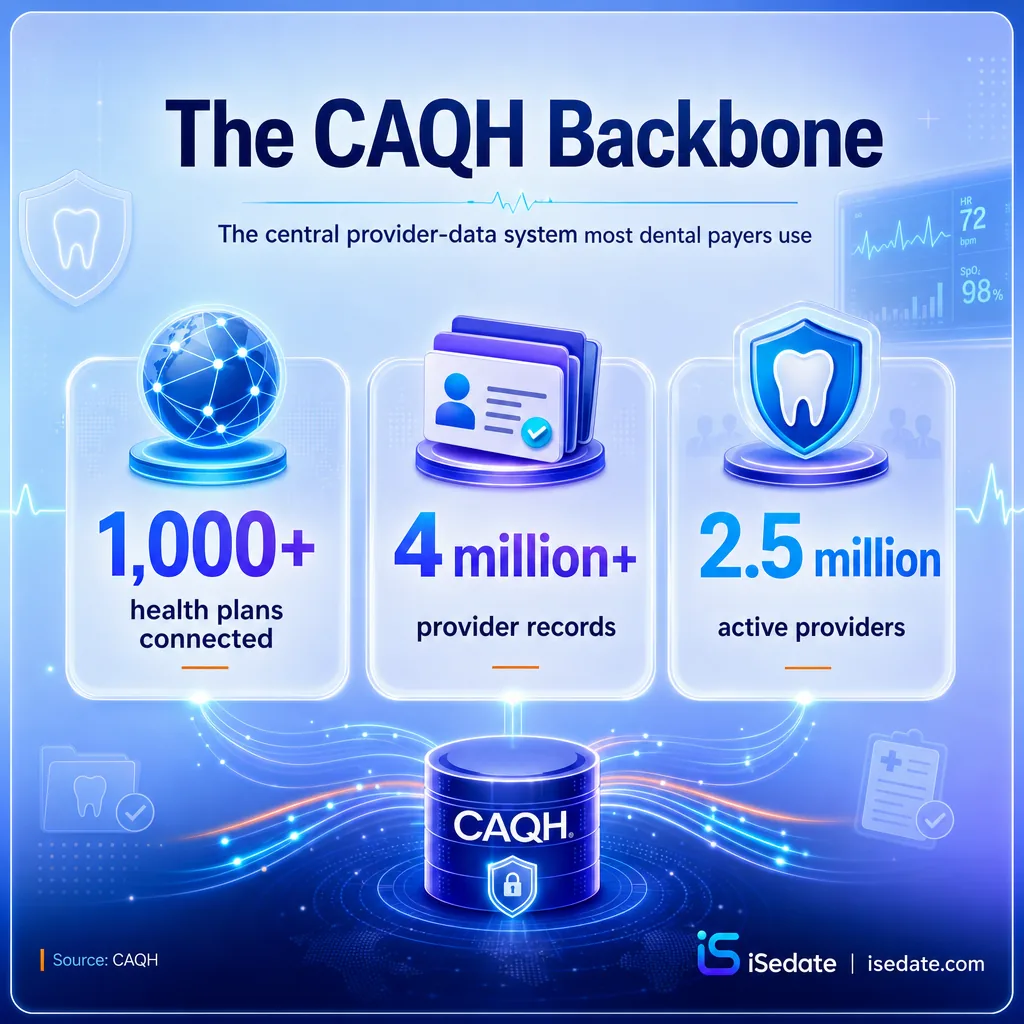
CAQH, which rebranded to DataSpring in June 2026, is the central provider-data repository the dental industry standardized on. Providers enter their license, education, work history, malpractice, and disclosures once, then authorize each payer to pull the data, eliminating duplicative applications. The network connects over 1,000 health plans and other entities to more than 4 million provider records, with about 2.5 million providers actively entering and verifying their information. Through a partnership with the ADA, U.S. licensed dentists can access the service free at ADA.org/godigital in all 50 states, the District of Columbia, and U.S. territories.
Myth: A CAQH profile means you are credentialed
CAQH is data aggregation, not credentialing itself. Industry analysis estimates it covers only about 40 percent of the total credentialing work, the data storage and sharing piece. It does not submit applications, track payer status, or tell you when a contract is effective. Every payer still runs its own verification and committee review on top of the CAQH data. Treating a completed CAQH profile as the finish line, rather than the starting line, is a common and costly misunderstanding.
The system's value is real, but it is only as good as the data in it. A single expired malpractice certificate or a lapsed attestation can silently block every downstream payer verification, which is why maintenance, not initial setup, is where most credentialing programs succeed or fail.
Source: CAQH (DataSpring) | ADA Credentialing Service
How office managers keep provider records audit-ready
2 Credentialing Timelines
The most common question a new associate asks is how long until they can bill. The honest answer is a range, and the median is longer than most payers advertise.
Industry timeline data tracking 1,200 dental credentialing applications across the top 10 U.S. dental payers found a median of about 117 days from application submitted to provider effective. The 25th percentile was 81 days, the 75th percentile 162 days, and the 90th percentile 211 days. The commonly advertised 90-day figure describes roughly the fastest third of the curve, not the typical experience.
Dental Credentialing Timeline Distribution, Days to Effective (industry data)
The two slowest phases, primary source verification and payer committee review, are entirely outside the practice's control. What a practice can control is submission strategy: submitting to all payers in parallel rather than one at a time, since each payer's clock runs concurrently. With parallel submission and a clean CAQH attestation, practices commonly see meaningful approvals in five to eight weeks; with sequential submission and CAQH friction, the same enrollment can take six to nine months.
Source: Dental credentialing timeline data (OneExpert)
Explore SedationVault, the Sedation Intelligence System
3 Re-Attestation and Re-Credentialing
Credentialing is not a one-time event. Two separate recurring cycles keep a provider active, and confusing them is a frequent source of billing interruptions.
Re-attestation is the lightweight check. CAQH requires providers to log in, review their profile, and attest that the data is current every 120 days, a task the ADA notes takes most dentists just 5 to 10 minutes. Because the portal is NCQA-accredited, this quarterly cycle is mandatory. When attestation lapses, payers pulling the data see it as stale and reject the pull, so an application or re-credentialing in motion simply stops progressing, often without an obvious error.
Re-credentialing is the heavier process. Most payers re-credential providers every 2 to 3 years, with some Medicaid and union plans on a 2-year cycle and a few specialty plans on 4 years. This is a full review where the payer re-runs primary source verification, reviews disclosure questions, and re-issues a participation agreement. Payers typically notify providers about six months ahead, and missing the window can terminate the provider from the panel and trigger retroactive claim denials.
iSedate Analysis: The maintenance burden multiplies
Consider a two-provider practice contracted with six payers. Each provider owes a CAQH re-attestation every 120 days, three times a year, and a full re-credentialing with each payer every 2 to 3 years. That is roughly six attestation events annually across the practice, plus a rolling schedule of major re-credentialing projects, one every few months on average once the payer cycles are staggered. Credentialing is not a task a practice completes; it is a calendar it maintains indefinitely.
Formula: 2 providers times 3 attestations per year equals 6 attestation events annually, plus 2 providers times 6 payers divided by a roughly 2.5-year re-credentialing cycle, about 5 major re-credentialing projects per year on a staggered schedule.
Calculation and interpretation original to iSedate.
Source: ADA Credentialing Service | Dental credentialing cycle data (OneExpert)
See how compliance-ready records keep documentation current
4 The Cost of Credentialing
Credentialing is often treated as free because no invoice arrives, but the cost is real. It shows up as staff hours, delayed revenue, and a large industry-wide inefficiency.
Handling credentialing in house costs little cash but roughly 6 to 10 hours of staff time per provider per payer, time the practice manager spends on payer portals instead of running the office. Third-party credentialing services commonly charge 200 to 600 dollars per application to absorb that work. Either way, the bigger cost is the revenue delay: a provider cannot bill a payer until the effective date, so every extra week in the pipeline is a week of that provider's payer revenue foregone.
At the industry level, the inefficiency is measured in billions. The 2025 CAQH Index found that U.S. healthcare avoided an estimated 258 billion dollars in administrative costs through electronic transactions, yet a 21 billion dollar savings opportunity remains from fully automating manual and partially manual transactions. Of that remaining opportunity, about 2.1 billion dollars is specific to the dental industry.
The CAQH Index is built on data from more than 600 provider organizations and health plans representing 63 percent of insured lives, and it estimates that fully automated administrative workflows save an average of 70 minutes per patient visit. Credentialing sits inside this broader administrative burden: the same manual, document-heavy processes that slow claims also slow provider onboarding, and both improve when the underlying data is clean and electronically shareable.
Source: 2025 CAQH Index
Compare SedationVault plans and pricing
5 Medicaid Enrollment Is Different
One track breaks the rules learned from commercial payers. Practices that treat Medicaid enrollment like commercial credentialing routinely underestimate it.
The terminology shifts first: commercial payers credential providers, while Medicaid programs enroll them. Enrollment adds steps that commercial credentialing does not, including federal sanctions checks, state-specific disclosures, and sometimes in-person site visits. Timelines of 90 to 180 days are normal, and longer during policy transitions.
Structure differs too. In states that deliver Medicaid through managed care organizations, a provider must first enroll with the state Medicaid program, then separately credential with each MCO, two processes rather than one. Medicaid enrollment also frequently does not use CAQH, relying instead on state-specific portals and forms. The practical implication is that if Medicaid is a meaningful revenue line, it should be the first credentialing track a practice starts, not the last.
This connects to the broader access picture. Because Medicaid enrollment is slower and more complex, and because Medicaid reimbursement runs well below commercial rates, the administrative friction compounds the financial disincentive. Only about 41 percent of dentists participate in Medicaid, and the enrollment burden is one of several barriers that keeps that share flat even as states expand benefits.
Source: Dental credentialing operational data (Needletail) | ADA Health Policy Institute
Summary Table: All the Numbers
| Statistic | Figure | Source | Year |
|---|---|---|---|
| Health plans connected through CAQH | 1,000+ | CAQH | 2025 |
| Provider records in CAQH | 4 million+ | CAQH | 2025 |
| Providers actively maintaining CAQH profiles | 2.5 million | CAQH | 2025 |
| Member records in CAQH | 235 million+ | CAQH | 2025 |
| Share of credentialing work CAQH covers | ~40% | Industry data | 2026 |
| Median credentialing time to effective | ~117 days | Industry data | 2026 |
| 25th percentile timeline | 81 days | Industry data | 2026 |
| 75th percentile timeline | 162 days | Industry data | 2026 |
| 90th percentile timeline | 211 days | Industry data | 2026 |
| CAQH re-attestation interval | 120 days | ADA/CAQH | 2026 |
| Re-attestation time to complete | 5-10 min | ADA | 2026 |
| Typical re-credentialing cycle | 2-3 years | Industry practice | 2026 |
| In-house staff time per provider per payer | 6-10 hrs | Industry data | 2026 |
| Typical third-party fee per application | $200-$600 | Industry data | 2026 |
| Dental administrative savings opportunity | $2.1 billion | CAQH Index | 2024 |
| Total healthcare admin cost avoided | $258 billion | CAQH Index | 2024 |
| Remaining total automation opportunity | $21 billion | CAQH Index | 2024 |
| Time saved per visit with full automation | 70 minutes | CAQH Index | 2024 |
| Medicaid enrollment timeline | 90-180 days | Industry data | 2026 |
| Dentists participating in Medicaid/CHIP | 41% | ADA HPI | 2024 |
Frequently Asked Questions
How long does dental credentialing take?
What is CAQH and why does it matter for dental credentialing?
How often do dentists need to re-attest and re-credential?
How much does credentialing cost a dental practice?
What is the difference between credentialing and enrollment?
Methodology and Sources
CAQH infrastructure figures (plans connected, provider and member records, active providers, re-attestation requirements, and the $258 billion avoided and $21 billion / $2.1 billion savings opportunities) are from CAQH, including the 2024 and 2025 CAQH Index reports, which draw on data from more than 600 provider organizations and health plans representing 63 percent of insured lives. Re-attestation timing and process details are from the ADA Credentialing Service (powered by CAQH). Dentist Medicaid participation is from the ADA Health Policy Institute.
Credentialing timeline figures (median ~117 days, percentile distribution), per-application costs, staff-hour estimates, and the CAQH "40 percent of the work" and Medicaid enrollment characterizations come from credentialing-industry operational data published by credentialing service vendors. These vendor datasets are identified as such and reflect the vendors' own tracked applications rather than a government or association benchmark; they are presented as directional industry data. Individual payer, state, and practice experiences vary. Cost and timeline figures are typical ranges, not fixed values.
Media and press: Journalists and researchers are welcome to cite these statistics with attribution to iSedate and a link to this page. Each figure includes its original source for independent verification.