







Dental Practice Marketing Statistics (2026): Budgets, Patient Acquisition Cost & What Actually Works
About 93% of patient journeys now begin with a search engine, and 71% of patients research a dentist online before booking. Dental marketing has shifted from optional promotion to measurable growth infrastructure. The practices winning are not the ones spending the most, they are the ones tracking what works, and matching their spend to services worth acquiring patients for.
- Established dental practices typically invest 4 to 7% of gross revenue in marketing; new practices often spend 15 to 20% of projected first-year revenue (industry survey data).
- Patient acquisition cost runs about USD 150 to USD 300 for general dentistry, rising to USD 400 to USD 800 for implants, cosmetic, and sedation cases (Software Advice; industry data).
- Referrals are the highest-converting channel, cited by 77.5% of practices as most effective (2025 dental marketing survey).
- About 93% of patient journeys start with a search engine, and 71% of patients research a dentist online before booking (industry data).
- Online reviews influence about 90% of patients choosing a new dentist (Software Advice).
- Appointment-reminder texts cut no-show rates by about 30%, protecting revenue with no new acquisition spend (Patterson Dental research).
- Patient lifetime value averages several thousand dollars, making a well-tracked 5-to-1 marketing return achievable, with high-value services like sedation raising the stakes.
What's in This Guide
- Marketing Budgets: What Practices Spend
- Patient Acquisition Cost & Lifetime Value
- The Highest-Performing Channels
- Search, Reviews & the Online-First Patient
- Retention: The Overlooked Multiplier
- Marketing High-Value Services Like Sedation
- Summary Table: Every Statistic at a Glance
- Frequently Asked Questions
1 Marketing Budgets: What Practices Spend
The first question every practice owner asks is how much to spend. The data gives a clear, consistent answer that scales with practice maturity.
For a practice collecting USD 1 million annually, the 4 to 7% guideline translates to roughly USD 40,000 to USD 70,000 per year. Most practices now direct about 80% of that budget to digital channels and 20% to traditional methods, a reversal from a decade ago. The trend line is unmistakable: annual dental marketing spend is at an all-time high in 2024 to 2025 and still climbing, as practices treat marketing as growth infrastructure rather than discretionary expense.
Bigger budgets don't win, better-tracked budgets do. One survey found practices rated their own marketing satisfaction at just 6.98 out of 10, with the biggest gap in tracking ROI. The recurring finding across every credible source is that the practices pulling ahead are not the highest spenders, they are the ones who measure which channels actually produce patients and reallocate accordingly. Spending without tracking is the most common and most expensive mistake in dental marketing.
2 Patient Acquisition Cost & Lifetime Value
The two numbers that determine whether marketing is profitable are patient acquisition cost (PAC) and patient lifetime value (LTV). Understanding both turns marketing from a gamble into arithmetic.
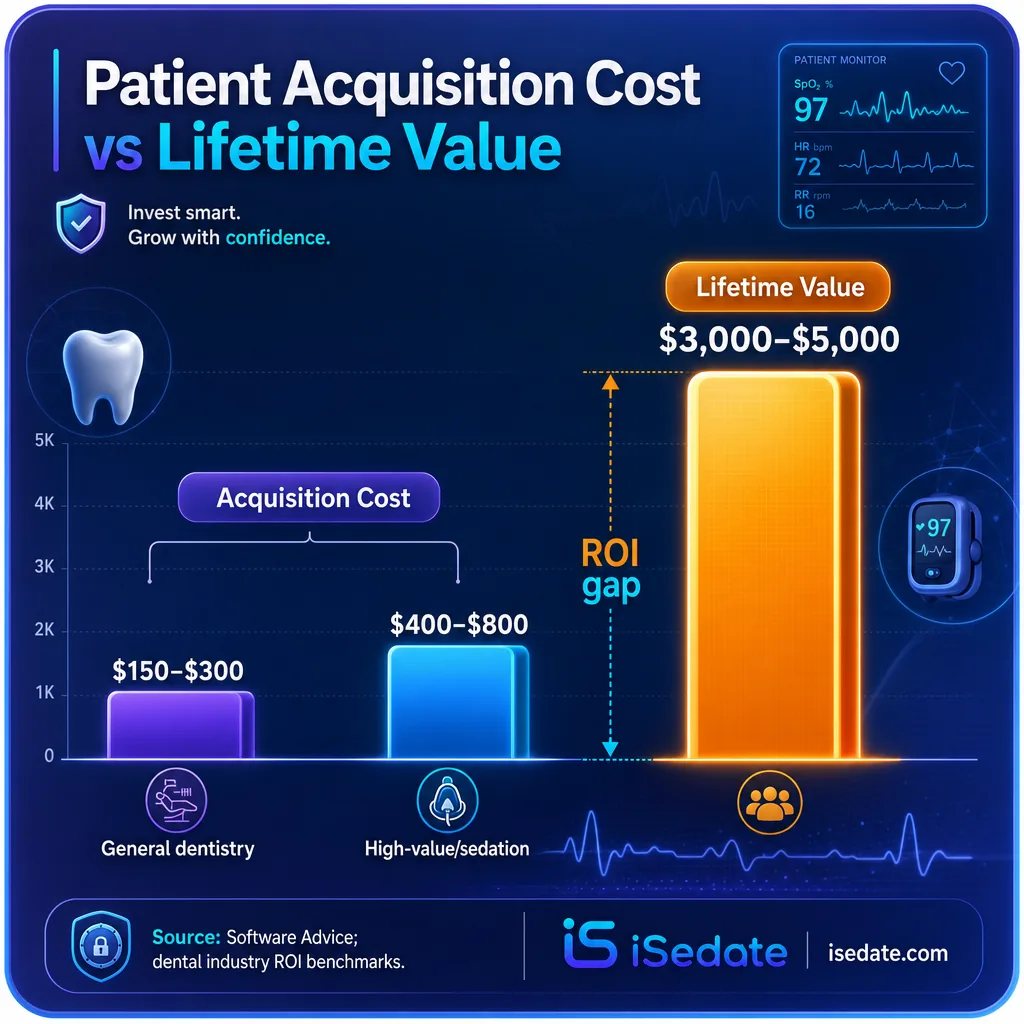
The economics are compelling once laid out. Consider a practice spending 5% of USD 1 million revenue, USD 50,000, at a USD 200 average acquisition cost: that funds about 250 new patients a year, roughly 21 per month. At an average lifetime value of USD 3,500, those 250 patients represent about USD 875,000 in lifetime revenue from a single year of marketing spend. This is why a well-run dental marketing program commonly targets a 5-to-1 return, and why the highest-value practices watch acquisition cost as a percentage of lifetime value rather than in isolation.
iSedate Analysis: Why high-value services change the acquisition math
Acquisition cost rises for high-value services, USD 400 to USD 800 for implants, cosmetic, and sedation cases versus USD 150 to USD 300 for general dentistry, but so does the return. A sedation or implant patient carries a far higher case value and often higher lifetime value than a routine-cleaning patient. The practices that win at high-value marketing accept the higher acquisition cost because the lifetime economics justify it. The catch: marketing a high-value service only pays off if the practice can actually deliver it safely and profitably, which is where operational capability, not just advertising, decides the outcome.
Calculation and interpretation original to iSedate. Illustrative figures based on industry-standard PAC and LTV ranges.
3 The Highest-Performing Channels
Not all marketing channels perform equally, and the data overturns a common assumption: the flashiest channels are rarely the most effective.
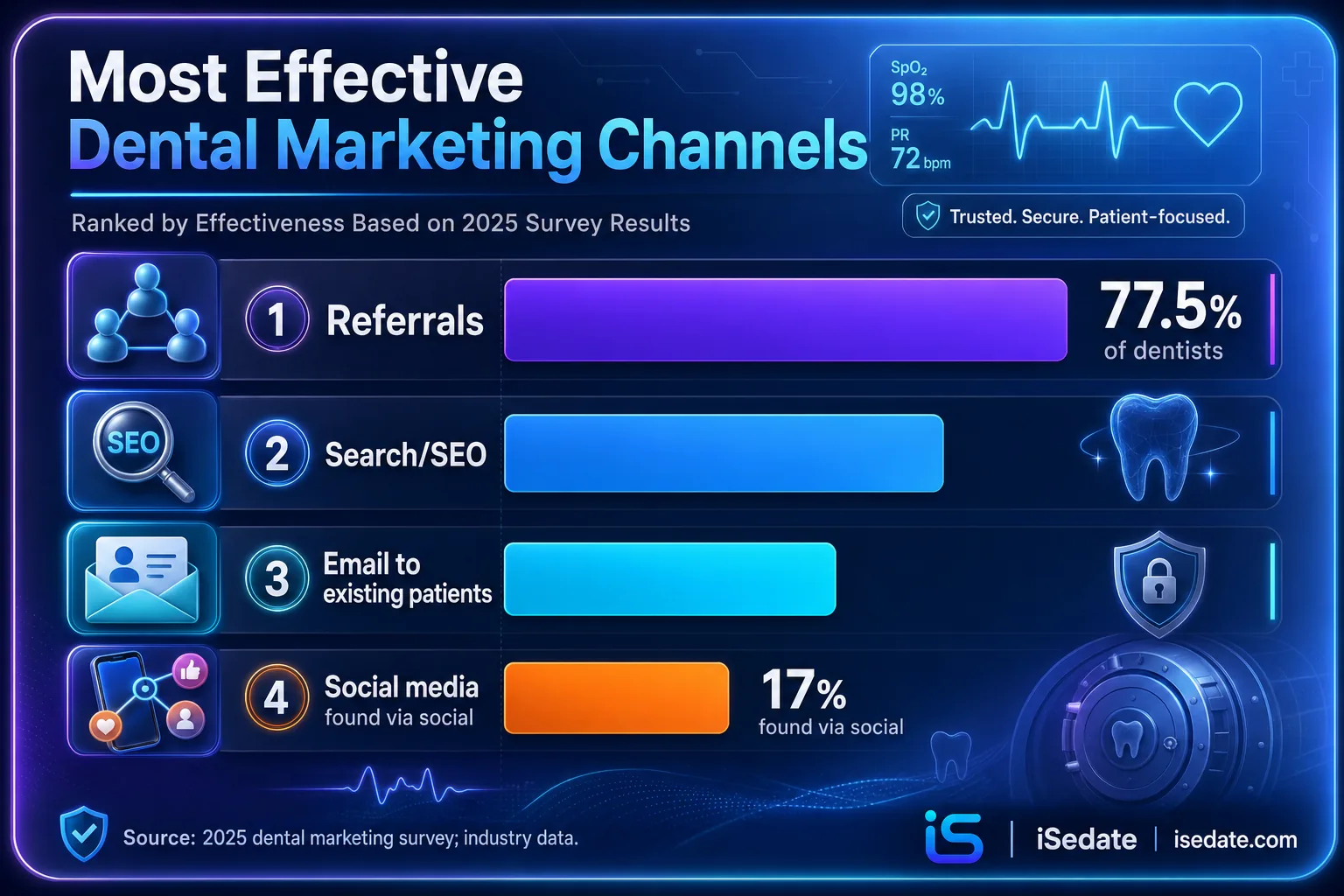
Referrals top every list because they arrive pre-trusted and convert at the highest rate. Behind them, search dominates discovery. Social media plays a real but narrower role: among dentists who use it, about 97% use Facebook as their primary platform, but only around 17% of patients report finding their dentist via social media, so most practices use social for engagement and reputation rather than direct acquisition. The practical takeaway is to fund the channels that convert, referrals, search, and email to existing patients, before chasing the channels that merely generate impressions.
See what Suffari can do for your practice4 Search, Reviews & the Online-First Patient
The modern dental patient is online-first, and the numbers make clear that a practice's digital presence is now its front door.
The pattern is a chain: a patient searches, lands on a practice's website or Google Business Profile, reads reviews, compares credentials, and only then books. Break any link, no search visibility, a thin website, few reviews, no online booking, and the patient moves to a competitor. Notably, only about 26% of dental practices offer online booking, meaning practices that do gain an immediate conversion advantage. A complete Google Business Profile alone can generate several times more clicks than an incomplete one, which is why local SEO and review management consistently deliver the lowest patient acquisition costs.
iSedate Analysis: The credibility link most practices underuse
Here is a connection the data implies but few practices act on: 71% of patients evaluate credentials and services before booking, and reviews influence 90% of choices. For a practice offering sedation, the ability to demonstrate safety and professionalism, not just advertise the service, is itself a marketing asset. Patients researching sedation dentistry are often anxious patients doing careful homework. A practice that visibly runs sedation to a high, documented standard has a credibility advantage in exactly the research phase where 71% of patients make their decision. Provable safety is a marketing message, not only a compliance one.
Calculation and interpretation original to iSedate.
5 Retention: The Overlooked Multiplier
The most profitable marketing statistic is one most practices ignore, because it is not about acquisition at all.
Despite acquisition costing five to seven times more than retention, one survey found about 64% of practices allocate over 80% of their marketing budget to acquisition. That imbalance leaves easy revenue on the table. Reactivating a lapsed patient, reducing no-shows, and encouraging existing patients to accept recommended treatment all cost far less than winning a stranger, and they compound the lifetime value that makes acquisition profitable in the first place. A balanced program funds retention and acquisition together rather than treating them as competitors.
Build a balanced growth plan with Suffari6 Marketing High-Value Services Like Sedation
The clearest strategic thread in the data is that high-value services change the entire marketing equation, and sedation dentistry is a prime example.
Sedation dentistry addresses dental anxiety, one of the most common reasons patients avoid care entirely. That makes it both a growth service and a patient-access service: it converts people who would otherwise not book at all. Like implants and cosmetic work, it carries a higher patient acquisition cost (USD 400 to USD 800 range) but a correspondingly higher case and lifetime value. The marketing logic is sound, provided one condition holds.
iSedate Analysis: Marketing a service you can deliver and defend
Marketing a high-value service works only when the practice can deliver it safely, profitably, and defensibly. For sedation, that means the operational side has to match the marketing promise: safe monitoring, complete documentation, and audit-ready records. A practice that markets sedation heavily but documents it poorly is advertising its own liability. This is where the marketing conversation and the operations conversation meet. iSedate's SedationVault supports the delivery side, capturing vitals from compatible monitors such as Edan, MindRay, and Criticare, logging drugs, and producing audit-ready records, so the sedation service a practice promotes is one it can stand behind. It exports a clean PDF into whatever chart the practice already keeps, whether Dentrix, Eaglesoft, or Open Dental. Reference figures for the founders' own practice reflect thousands of documented sedation procedures, a practice-level dataset, not a nationwide claim.
Calculation and interpretation original to iSedate.
The division of labor is clean: marketing fills the schedule, and the operational systems make the high-value service safe and profitable to deliver. Practices that get both right, promotion and provable delivery, are the ones that turn a service like sedation into durable growth rather than a liability.
Book a SedationVault demo7 Summary Table: Every Statistic at a Glance
| Statistic | Figure | Source | Year |
|---|---|---|---|
| Established practice marketing budget | 4-7% of revenue | Industry survey data | 2025 |
| New practice marketing budget | 15-20% first-year revenue | Industry survey data | 2025 |
| Practices planning to increase budget | 74% | Industry poll | 2022-2023 |
| Digital vs traditional budget split | ~80% / 20% | Industry data | 2025 |
| Patient acquisition cost (general) | $150-$300 | Software Advice | 2024 |
| Patient acquisition cost (high-value) | $400-$800 | Dental vertical benchmarks | 2025 |
| Patient lifetime value (5 yrs) | $3,000-$5,000 | Industry ROI data | 2026 |
| Referrals as most effective channel | 77.5% | 2025 marketing survey | 2025 |
| High-value patients from referrals | 37.4% | Industry data | 2024 |
| Email marketing ROI | $36 : $1 | Dental Economics | 2023 |
| Patient journeys starting with search | 93% | Industry data | 2025 |
| Patients researching dentist online first | 71% | Industry data | 2024 |
| Patients influenced by online reviews | 90% | Software Advice | 2024 |
| Practices offering online booking | ~26% | Industry data | 2024 |
| Dentists using Facebook (of social users) | 97% | Industry data | 2024 |
| Acquisition vs retention cost | 5-7x higher | Marketing survey data | 2024 |
| No-show reduction from reminder texts | ~30% | Patterson Dental research | 2023 |
Frequently Asked Questions
How much should a dental practice spend on marketing?
What is the average patient acquisition cost for a dental practice?
What is the best marketing channel for dentists?
What is a good marketing ROI for a dental practice?
Does offering sedation dentistry help attract patients?
Methodology & Sources
Figures are drawn from dental industry benchmark data and named research bodies including the American Dental Association Health Policy Institute, Software Advice, Dental Economics, Patterson Dental research, and published 2024 to 2026 dental practice marketing surveys. Where a statistic originates in an aggregated industry compilation rather than a single primary study, it is labeled as industry survey or benchmark data.
Note on ranges and variance: marketing benchmarks vary by practice size, location, service mix, and market competitiveness, so figures are presented as ranges rather than fixed values. Patient acquisition cost, lifetime value, and ROI figures are illustrative benchmarks, not guarantees; actual results depend on each practice's execution and market. This article covers dental practice marketing broadly; for practical strategy tailored to a specific practice, professional guidance is recommended. Statistics reflect the most recent available data as of 2026 and will be refreshed annually.
Media & press usage: Journalists and researchers are welcome to cite these statistics with attribution to iSedate and a link to this page. The iSedate Analysis boxes contain original interpretation unique to this article.