







Dentist Burnout & Stress Statistics 2026: Prevalence, Causes & Well-Being Data
Burnout in dentistry is not a fringe concern; it is close to the norm. In the ADA's most recent trend data, more than four in five dentists reported major stress and career burnout. Understanding how widespread it is, what drives it, and what support exists is the first step toward a healthier profession.
Key Takeaways
- The ADA's 2024 Trend Report found 82% of dentists reported feeling major stress and career burnout.
- A 2024 study in the Journal of Occupational Medicine and Toxicology found 44% of dentists reported burnout symptoms, most often emotional exhaustion.
- CareQuest research found 71% of oral health providers reported increased burnout since the COVID-19 pandemic.
- Burnout is measured across three dimensions: emotional exhaustion, depersonalization, and reduced personal accomplishment (Maslach Burnout Inventory).
- In ADA data, 16% of dentists reported anxiety in 2021, more than three times the 2003 share, and 13% reported depression.
- Leading drivers include time pressure, administrative burden, staffing shortages, insurance friction, and perfectionism.
- Free, confidential resources exist, including the ADA's Well-Being Index and, for anyone in crisis, the 988 Suicide and Crisis Lifeline.
What's in This Guide
How Widespread Burnout Is
The scale of burnout in dentistry depends heavily on how it is measured, but every recent source points the same direction: it is common. The headline figure comes from the ADA's own trend research.

The ADA Council on Communications' 2024 Trend Report found that 82% of dentists reported feeling major stress and career burnout. A 2024 study in the Journal of Occupational Medicine and Toxicology, using a clinical symptom threshold rather than a self-report of "feeling" burned out, put the figure at 44%, with emotional exhaustion and reduced job satisfaction reported most frequently. CareQuest Institute research found that 71% of oral health providers reported increased burnout since the COVID-19 pandemic. The range between 44% and 82% reflects different measurement methods, not disagreement about the underlying reality: burnout is a defining challenge of the profession.
Source: ADA News (2024 Trend Report data) | CareQuest Institute research (compiled)
U.S. dentist workforce statisticsThe Three Dimensions of Burnout
Burnout is not simply being tired. In research, it is a specific occupational syndrome measured across three distinct dimensions, most often using the Maslach Burnout Inventory, the standard instrument in the field.
Emotional exhaustion is the feeling of being emotionally overextended and drained; depersonalization (or cynicism) is a detached, impersonal response toward patients and colleagues; and reduced personal accomplishment is a decline in one's sense of competence and achievement. Studies consistently find emotional exhaustion to be the most commonly elevated dimension among dentists. Recognizing burnout as a measurable syndrome, rather than a vague sense of being overwhelmed, is what makes it possible to screen for and address it.
Source: Burnout Syndrome Among Implant Dentistry Professionals (PMC)
Dental practice statisticsWhat Drives Dentist Burnout
The causes of burnout in dentistry are well documented and cumulative. No single factor dominates; instead, several pressures stack on the same person, often the practice owner who is simultaneously clinician and business manager.
Commonly identified drivers include time pressure and demanding appointment schedules, administrative burden (billing, insurance verification, documentation, and regulatory compliance), staffing shortages that push more work onto fewer people, insurance friction, financial and overhead pressure, the physical strain of long hours in confined, static postures, daily exposure to patient anxiety, litigation concerns, and perfectionism. A UK study identified productivity stress and work content among the categories of stressors causally linked to burnout. For practice owners specifically, the burden of running the business, team turnover, schedule gaps, lagging collections, compounds the clinical load, and it is the burnout driver owners are least likely to discuss with colleagues.
A note on perfectionism. The traits that make someone an excellent dentist can also raise risk. Perfectionist personality types are often selected into professional programs like dentistry for their academic discipline and high standards, but the same tendencies, combined with unrealistic self-expectations, are associated with higher risk of depression and other difficulties. Recognizing this is not a criticism of high standards; it is a reason to pair them with deliberate self-care and support.
Source: Burnout rate among dental professionals post-COVID (PMC) | JADA (occupational stressors among dentists, 2025)
Staffing and turnover statisticsBroader Mental Health Trends
Burnout does not exist in isolation. It overlaps with, and can contribute to, broader mental health concerns, and some indicators in dentistry have worsened over the past two decades.
In the ADA's 2021 Health and Well-Being Survey, 16% of dentists reported anxiety, more than three times the share reported in 2003, and 13% reported depression. Research also notes that unmanaged occupational stress can contribute to anxiety, depression, low job satisfaction, and, in the most serious cases, thoughts of self-harm, which is why the profession's growing attention to well-being matters. Dentistry, like other high-responsibility health professions, has recognized that clinician mental health is a patient-safety and workforce-sustainability issue, not only a personal one.
If this is affecting you. If you are a dental professional experiencing burnout, anxiety, depression, or thoughts of self-harm, you are not alone and support is available. The ADA Well-Being Index (below), your state dental association's wellness program, and licensed mental health professionals can all help. If you are in crisis or thinking about harming yourself, please contact the 988 Suicide and Crisis Lifeline (call or text 988 in the U.S.) right away.
Source: ADA 2021 Health and Well-Being Survey (compiled)
Dentist workforce statisticsThe Administrative Burden Factor
Among the drivers of burnout, one is worth isolating because it is both frequently cited and, unlike patient anxiety or staffing markets, partly within a practice's direct control: administrative and documentation load.
Burnout research explicitly lists excessive administrative tasks and dissatisfaction with medical record systems among the factors linked to clinician burnout, and dental-specific guidance repeatedly points to billing, insurance, documentation, and compliance as work that pulls clinicians away from patient care. The encouraging part is that this category is addressable: professional bodies note that many routine administrative tasks can be delegated or automated, and that better systems for scheduling, records, and workflow can meaningfully reduce the load. Reducing administrative friction will not solve burnout on its own, but it removes one of the few stressors a practice can directly act on.
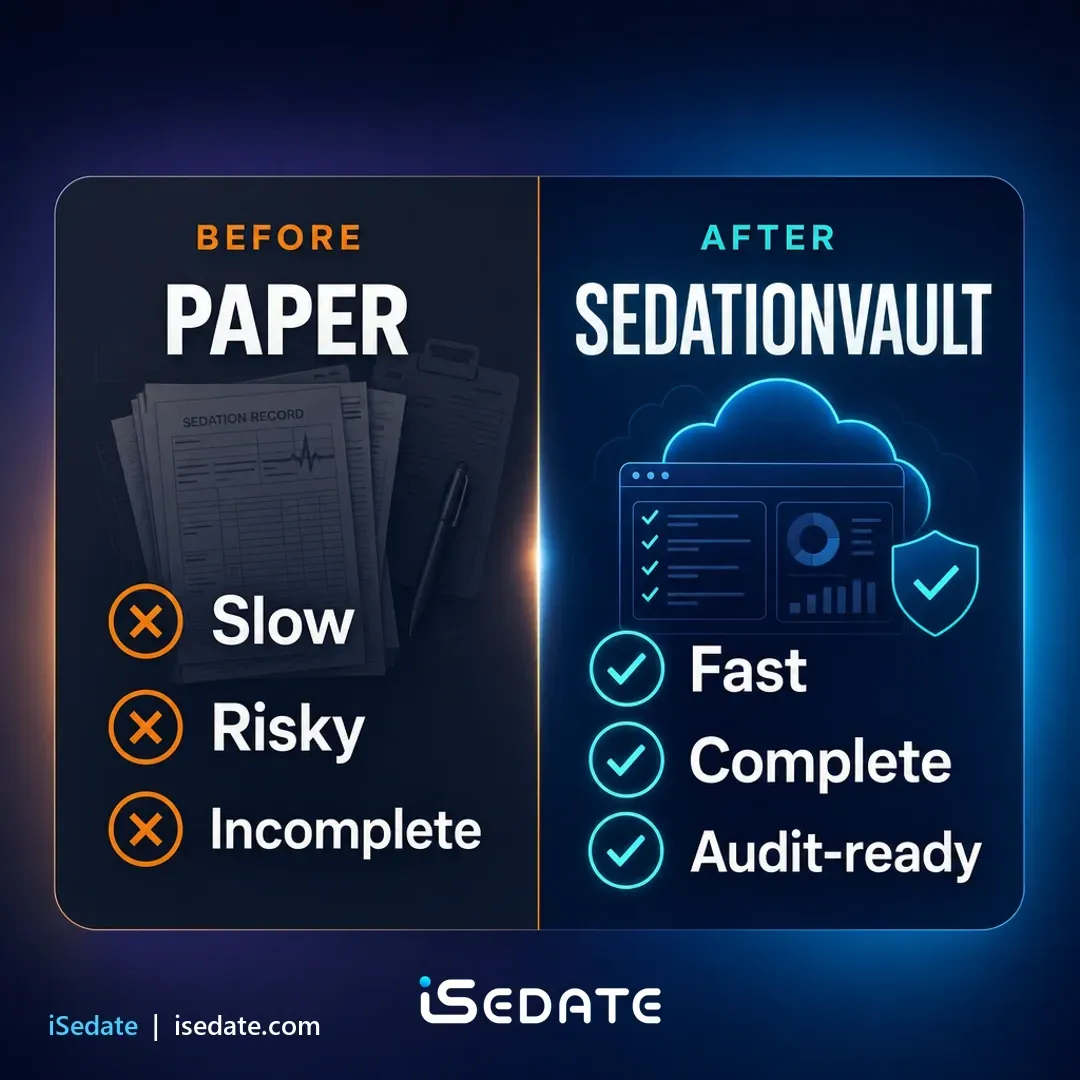
Where iSedate's SedationVault fits, briefly. For practices that provide sedation, charting and compliance are part of the documentation load research links to burnout. SedationVault is designed to reduce that specific friction: it feeds live vitals from compatible monitors (Edan, MindRay, Criticare, and more) into a timestamped record, captures digital intake and consent, and produces one-click, audit-ready PDF reports, so the sedation record is generated as care happens rather than reconstructed afterward. It is one narrow lever among many, but easing documentation is a concrete, controllable step, and this article's larger point is that the human toll of burnout deserves attention well beyond any single tool.
Source: Burnout factors including administrative tasks and record systems (PMC)
See how SedationVault reduces charting loadResources and Support
The most important shift in recent years is that dentistry has moved from treating burnout as a private failing to treating it as a workforce issue with real support behind it.
In 2025 the ADA expanded free access to the Well-Being Index, an anonymous, validated assessment developed by Mayo Clinic, from member dentists to all dental team members and nonmember dentists. The nine-question screen takes about five minutes, covers burnout, fatigue, depression, stress, and quality of life, and connects users to ADA and state-level resources on completion. Many state dental associations run confidential well-being and peer-assistance programs as well. And for anyone in immediate crisis, the 988 Suicide and Crisis Lifeline is available by call or text at any time. Reaching out is a sign of strength, not weakness.
Source: ADA extends Well-Being Index to dental team members
Book a SedationVault demoDentist Burnout & Stress Statistics: Summary Table
| Statistic | Figure | Source | Year |
|---|---|---|---|
| Dentists reporting major stress and burnout | 82% | ADA Council on Communications Trend Report | 2024 |
| Dentists reporting burnout symptoms | 44% | J. Occupational Medicine and Toxicology | 2024 |
| Providers with increased burnout since COVID | 71% | CareQuest Institute | 2024 |
| Dentists reporting anxiety | 16% | ADA Health and Well-Being Survey | 2021 |
| Increase in anxiety vs 2003 | ~3x | ADA Health and Well-Being Survey | 2021 |
| Dentists reporting depression | 13% | ADA Health and Well-Being Survey | 2021 |
| Burnout dimensions (Maslach) | 3 | Maslach Burnout Inventory | 2026 |
| Most commonly elevated dimension | Emotional exhaustion | Multiple studies | 2024 |
| Postgraduate trainee high burnout (review) | 75.4% | Systematic review (PubMed) | 2024 |
| UK dentists unable to cope with job stress | 43% | British Dental Association | 2019 |
| Well-Being Index screen length | ~5 min, 9 questions | ADA / Mayo Clinic | 2025 |
| Crisis line | 988 | 988 Suicide and Crisis Lifeline | 2026 |
Frequently Asked Questions
How common is burnout among dentists?
What causes dentist burnout?
What are the three dimensions of burnout?
Has dentist mental health worsened over time?
What resources exist for dentist well-being?
Methodology & Sources
Prevalence figures are drawn from the ADA Council on Communications' 2024 Trend Report (82%), a 2024 study in the Journal of Occupational Medicine and Toxicology (44%), and CareQuest Institute research (71%); the range reflects differing measurement methods (self-reported feelings versus validated clinical thresholds). The three-dimension framework is the Maslach Burnout Inventory, the standard research instrument. Mental health trend figures are from the ADA's 2021 Health and Well-Being Survey. Cause and driver data are compiled from peer-reviewed studies (including post-COVID dental burnout research and a 2025 JADA analysis of occupational stressors) and professional-body guidance. Well-Being Index details are from ADA announcements. This article is intended to inform and to point readers toward support; it is not a clinical or diagnostic tool. Where a study used an international sample, that context is noted.
A note on this topic: Burnout and mental health are sensitive subjects. If you or a colleague are struggling, please consider reaching out to the ADA Well-Being Index, a state dental well-being program, a licensed mental health professional, or, in a crisis, the 988 Suicide and Crisis Lifeline. This article is an informational overview and not a substitute for professional help.
Media and press usage: Journalists and researchers are welcome to cite the statistics in this article with attribution to the original primary sources named above. A link back to this page is appreciated.