







Expert Witness and Chart Review Statistics in Dental Malpractice (2026)
In The Doctors Company review of 1,185 dental malpractice claims closed between 2010 and 2020, documentation issues appeared in 19 percent of claims, ranking as the fifth-leading causal factor analysts identified. When a case reaches an expert witness, the record is the evidence, and what the chart shows, or fails to show, often decides whether care can be defended.
- Documentation issues were a factor in 19 percent of 1,185 dental claims reviewed by The Doctors Company, with clinical findings, informed consent, and clinical rationale the three most common gaps.
- In the 2010 to 2024 closed-claims analysis, improper performance of a procedure was the top allegation at 60 percent, and 35 percent of all claims closed with an indemnity payment averaging $116,000.
- Roughly 29 to 32 states require a certificate or affidavit of merit, a sworn expert attestation that the claim has a reasonable basis, before a malpractice case can move forward.
- Trial verdicts historically favor the defense: a baseline study of 1970s claims found about 93 percent of verdicts went to the defendant, and most claims never reach a verdict at all.
- Electronic dental record metadata and provenance audits are discoverable, so who edited the chart and when can become evidence.
- The reviewer's task is comparison: the standard of care versus what the record documents, which is why a complete, contemporaneous chart is the strongest defense asset a practice controls.
What's in This Guide
1 Documentation as a Causal Factor in Claims
Documentation rarely causes a patient injury on its own, but it shapes almost every claim that follows one. When analysts at The Doctors Company reviewed a large body of closed dental claims, documentation surfaced as a recurring thread running through cases that were otherwise about clinical care.
Within the insufficient-documentation group, three gaps dominated. Missing or incomplete clinical findings led the list, followed by informed consent and clinical rationale. Each of these is exactly what an expert reviewer reaches for first when reconstructing what happened.
Top Sources of Insufficient Documentation (The Doctors Company, n = 172)
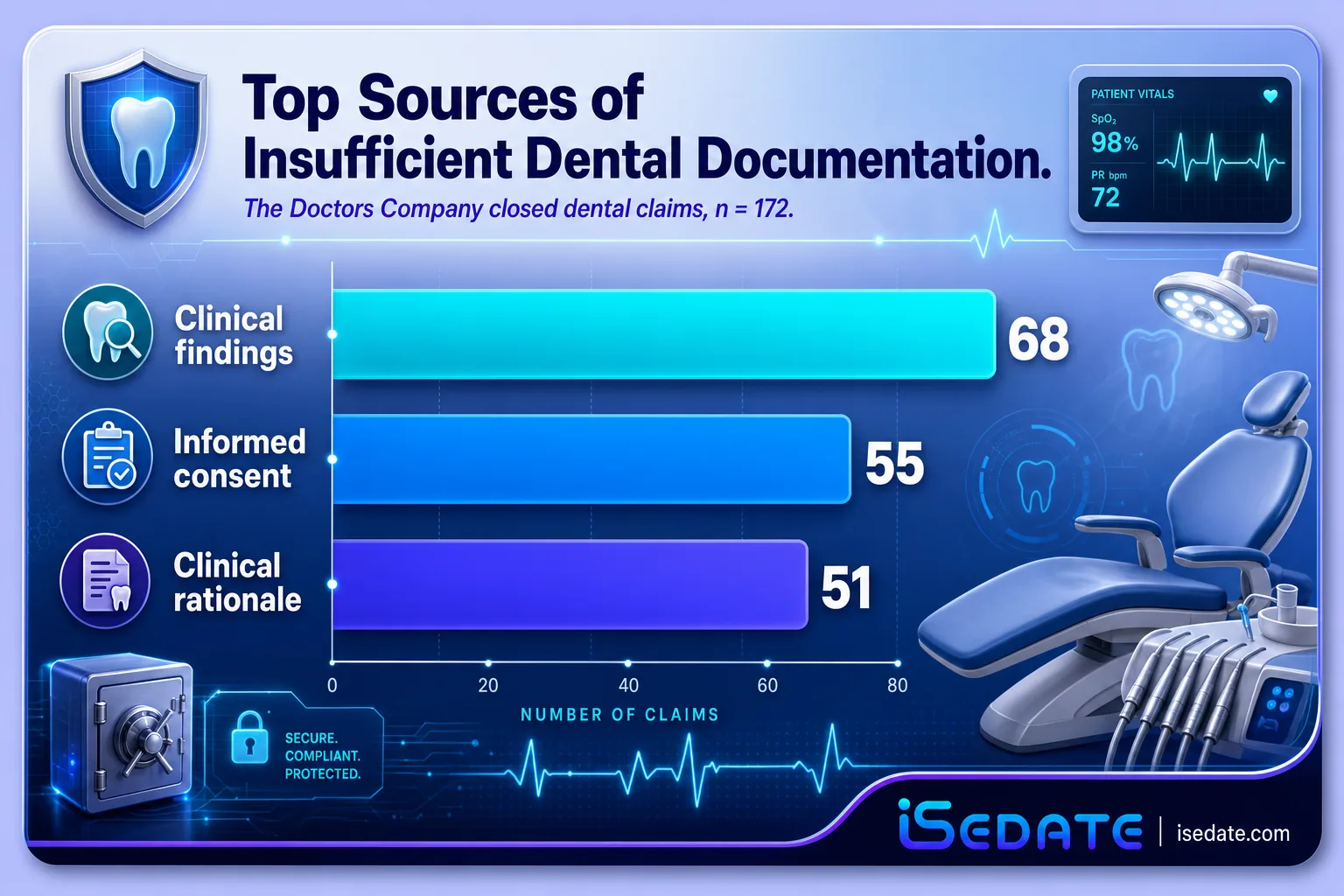
Reviewers cannot grade care they cannot see. When a finding, a consent discussion, or the reasoning behind a treatment decision is absent from the record, the defense loses the ability to prove it happened. The Doctors Company analysts flagged content decisions such as altering the record as a distinct and damaging category, because a late or inconsistent edit converts a documentation gap into a credibility problem.
Source: The Doctors Company: Patient Safety in Dentistry, Documentation
See how audit-ready compliance documentation works2 What Chart Reviewers Look For
A dental expert asked to review a case does not start with an opinion. They start with the file. State record rules define what a defensible chart contains, and those same elements form the checklist a reviewer runs before forming any conclusion about the standard of care.
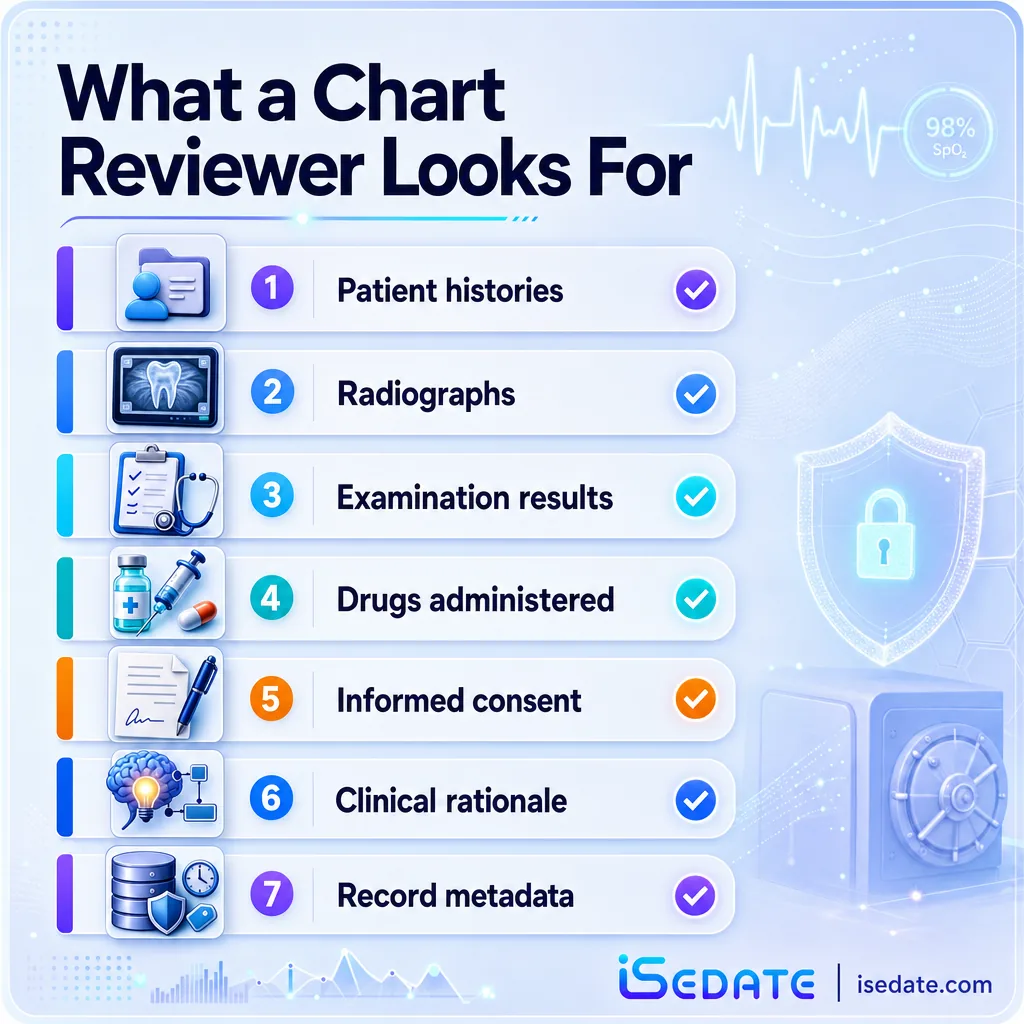
Florida's dental record rule is a representative example, requiring that the record contain enough information to identify the patient, support the diagnosis, justify the treatment, and document the course and results of care. In practice that means patient histories, radiographs, examination results, test results, records of drugs prescribed or administered, and reports of consultations or referrals.
The Reviewer's Comparison
Expert review is a comparison exercise. The reviewer establishes the applicable standard of care, then reads the record to decide whether the documented care met that standard and whether any deviation caused the alleged injury. Gaps in the record do not automatically prove negligence, but they shift the argument onto ground the defense cannot control. A chart that tells the clinical story, in the reviewer's words a record that will be a "good witness," is the difference between defending the care and defending the paperwork.
Electronic records add a second layer. Modern systems log metadata behind the visible chart: who made an entry, when it was entered, and how long the record was open. Some capture provenance, tracing where copied information originated. Both are discoverable in litigation and regulatory review, which is why copy-paste entries and post-incident edits carry outsized risk.
Combine two findings from The Doctors Company dataset. Documentation issues appeared in 19 percent of 1,185 claims, meaning roughly 225 claims carried a documentation factor. Within the insufficient-documentation subset of 172 items, informed consent (55) and clinical rationale (51) together account for 106 items, or about 62 percent of that subset. In other words, nearly two-thirds of documented insufficiency clustered in exactly the two areas that are captured at the point of care, during the consent conversation and the treatment decision, not reconstructed afterward.
Formula: (55 informed consent + 51 clinical rationale) / 172 total insufficient-documentation items = 61.6 percent.
Interpretation: the record elements most often missing are the ones a structured, timestamped charting workflow captures in the moment. Calculation and interpretation original to iSedate, derived from The Doctors Company Closed Claims Data (February 2021).
Source: The Doctors Company documentation analysis | The Doctors Company Dental Closed Claims Study
Generate audit-ready sedation records in one click3 The Expert Witness Role by the Numbers
In almost every dental malpractice case, the plaintiff must present expert testimony to establish three things: the applicable standard of care, a deviation from it, and a causal link between that deviation and the injury. Courts treat these as beyond the knowledge of the average juror, so the expert becomes the bridge between the record and the verdict.
Cases that reach trial are frequently described as a "battle of the experts," with plaintiff and defense reviewers offering competing opinions built from the same file. Qualification standards matter here. Statutes commonly require the expert to have knowledge of the defendant's specialty and recent active clinical practice, and to limit each side to a defined number of experts per discipline. A periodontist opines on periodontal care; an oral surgeon on surgical extractions.
Experts are constrained by the record. A reviewer familiar with the standard of care cannot testify to a consent discussion or a differential diagnosis that does not appear in the file. Courts have held that failing to consider available records goes to the weight of an expert's testimony, so a record that is incomplete weakens even a well-qualified expert's opinion. The chart sets the ceiling on what any expert can defend.
Source: MLMIC Insurance: The Expert Witness in Dental Malpractice Cases
Capture and store digital consent with the record4 Certificate of Merit and Pre-Suit Screening
Before a malpractice case reaches discovery in much of the country, a qualified expert has already read the record. Certificate-of-merit and affidavit-of-merit statutes require a sworn attestation, filed with or shortly after the complaint, that a qualified expert reviewed the file and believes the claim has a reasonable basis.
These requirements grew out of tort-reform efforts to filter frivolous claims before they consume court resources. The mechanics vary widely. Some states require an expert-signed affidavit; others accept an attorney certification based on expert consultation. Deadlines range from filing alongside the complaint to windows of 30, 60, 90, or 120 days. A defective or missing certificate can end a case before discovery, and in 2026 the U.S. Supreme Court addressed how these state rules apply in federal diversity cases in Berk v. Choy.
Why the Record Decides the Screen
Every merit screen runs on the same input: the dental record. The reviewing expert cannot certify a standard-of-care deviation, or rule one out, without a file to read. For a defendant practice, a complete and internally consistent record is the first thing that meets the plaintiff's expert, months before any courtroom. The screen is also where documentation gaps first give the plaintiff an opening.
Source: National Conference of State Legislatures: Merit Affidavits and Expert Witnesses
Explore the SedationVault platform5 Claim Outcomes and the Record's Weight
Most dental malpractice claims do not end in a plaintiff's verdict. Understanding where they do end shows why the record carries so much weight at every stage.
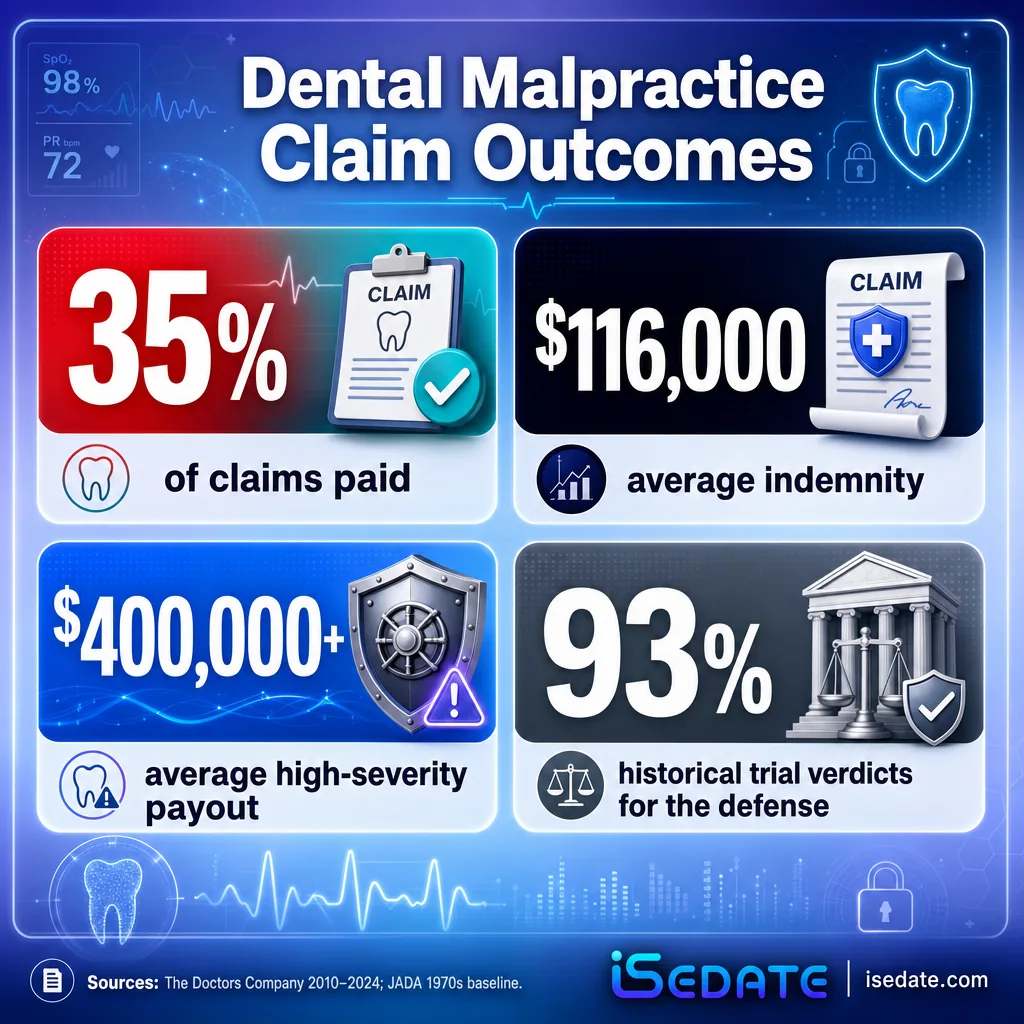
In the 2010 to 2024 closed-claims analysis, improper performance led allegations at 60 percent. Procedure type drove outcomes: extraction-related claims resulted in payment 59 percent of the time with a mean indemnity of $150,000, and implant-related claims paid 46 percent of the time at a mean of $115,000. High-severity claims were rare at 3 percent, but every one closed with a payment averaging more than $400,000.
Share of Claims Paid by Procedure Type (The Doctors Company, 2010-2024)
Historical baseline data underscores how defense-favorable trials have been. In a study of claims closed in the 1970s, trial verdicts were reached in just over 7 percent of cases, and roughly 93 percent of those verdicts favored the defendant, with half of all claims resolving with no payment. Trials are the exception; the record's quality shapes the far larger population of claims that settle or are dropped.
Roughly one in four patients in the 2010 to 2024 study sought care from another practitioner because of dissatisfaction and poor communication about expectations, a reminder that clear documentation of what was discussed protects the practice long before a claim is ever filed.
Source: The Doctors Company Dental Closed Claims Study | JADA baseline dental malpractice claims analysis
Compare SedationVault plans and pricing Book a demo of SedationVaultDental Malpractice Expert Witness and Chart Review Statistics: Summary Table
| Statistic | Figure | Source | Year |
|---|---|---|---|
| Dental claims reviewed for documentation factors | 1,185 | The Doctors Company | 2010-2020 |
| Claims with documentation as a causal factor | 19% | The Doctors Company | 2010-2020 |
| Insufficient-documentation items catalogued | 172 | The Doctors Company | 2021 |
| Top gap: missing clinical findings | 68 items | The Doctors Company | 2021 |
| Gap: informed consent | 55 items | The Doctors Company | 2021 |
| Gap: clinical rationale | 51 items | The Doctors Company | 2021 |
| Direct poor-documentation to adverse-event correlations | 14 claims | The Doctors Company | 2021 |
| Top allegation: improper performance | 60% | The Doctors Company | 2010-2024 |
| Claims closed with an indemnity payment | 35% | The Doctors Company | 2010-2024 |
| Average indemnity payment | $116,000 | The Doctors Company | 2010-2024 |
| Median indemnity payment | $50,000 | The Doctors Company | 2010-2024 |
| Extraction-related claims paid | 59% ($150K mean) | The Doctors Company | 2010-2024 |
| Implant-related claims paid | 46% ($115K mean) | The Doctors Company | 2010-2024 |
| High-severity claims (share, all paid) | 3% ($400K+ avg) | The Doctors Company | 2010-2024 |
| Patients seeking care elsewhere over dissatisfaction | ~1 in 4 | The Doctors Company | 2010-2024 |
| States requiring a certificate or affidavit of merit | ~29-32 | NCSL / legal analyses | 2025 |
| Historical trial verdicts favoring the defendant | ~93% | JADA baseline study | 1970s |
| Historical claims reaching a trial verdict | ~7% | JADA baseline study | 1970s |
Frequently Asked Questions
How often is documentation a factor in dental malpractice claims?
What does a dental expert witness review before giving an opinion?
How many states require a certificate or affidavit of merit in malpractice cases?
How often do dentists win dental malpractice trials?
Can electronic dental record metadata be used in a malpractice case?
Methodology and Sources
This article compiles statistics from primary and authoritative sources only. Figures are current as of 2026 and drawn from the most recent available data at the time of writing.
- The Doctors Company, Patient Safety in Dentistry: Documentation (closed claims review of 1,185 dental claims, 2010-2020; Closed Claims Data, February 2021).
- The Doctors Company, Dental Closed Claims Study (descriptive analysis of dental claims with loss years 2010-2024, using the CRICO-Candello Clinical Taxonomy).
- National Conference of State Legislatures (NCSL), Medical Liability/Malpractice Merit Affidavits and Expert Witnesses; supporting counts from legal-sector analyses (2025).
- MLMIC Insurance Company, The Expert Witness: A Key Player in Dental Malpractice Cases (standard-of-care elements and expert testimony mechanics).
- Journal of the American Dental Association baseline study, Dental malpractice: baseline data from insurance claims closed in the 1970s (defense verdict and no-payment rates).
Where sources reported ranges or estimates, the range is preserved rather than reduced to a single figure. Certificate-of-merit state counts vary by source depending on how hybrid, case-law, and partially enforceable statutes are classified. Derived figures in the iSedate Analysis box are calculated from the cited primary data and labeled as original to iSedate.
Media and press: Journalists and researchers are welcome to cite these statistics with attribution to the original primary sources named above. When referencing the derived iSedate Analysis figure, please attribute it to iSedate with a link to this page.