










Medical Board Anesthesia Investigation Statistics (2026)
In a case-controlled study of physicians disciplined by the Texas Medical Board, anesthesiologists had about 2.45 times the odds of losing their license entirely compared with other disciplined physicians. When a board investigates an anesthesia case, the stakes for the provider are unusually high, and the record of care is what the investigation turns on.
- Anesthesiologists had roughly 2.45 times the odds of license revocation among disciplined physicians in a Texas Medical Board study, the highest-severity sanction.
- Physician disciplinary rates vary fourfold by state, averaging 3.76 actions per 1,000 physicians per year in a 2010 to 2014 analysis of National Practitioner Data Bank data.
- State boards took roughly 1,200 to 1,300 serious disciplinary actions per year nationally in 2021 through 2023, ranging from 1.82 down to 0.17 per 1,000 physicians by state.
- Almost 5 percent of board complaints result in a sanction; most close with no action, and hearings are uncommon.
- Of about 21,647 disciplinary actions in one five-year dataset, 23.7 percent were major actions involving revocation, suspension, or surrender.
- The National Practitioner Data Bank has been the national reporting backbone since 1990, and it is what makes anesthesia board actions traceable across state lines.
What's in This Guide
1 Physician Discipline Rates by the Numbers
How often a physician faces serious board discipline depends heavily on which state licenses them. National datasets show both the scale of board activity and how unevenly it is distributed.
A longitudinal study using National Practitioner Data Bank records and American Medical Association demographics found significant, fourfold variation in disciplinary action rates between states, from about 2.13 to 7.93 actions per 1,000 physicians. The same dataset counted 21,647 disciplinary actions, of which 5,137, or 23.7 percent, were major actions involving revocation, suspension, or surrender.
Serious Disciplinary Actions per 1,000 Physicians, by Board (2021-2023)
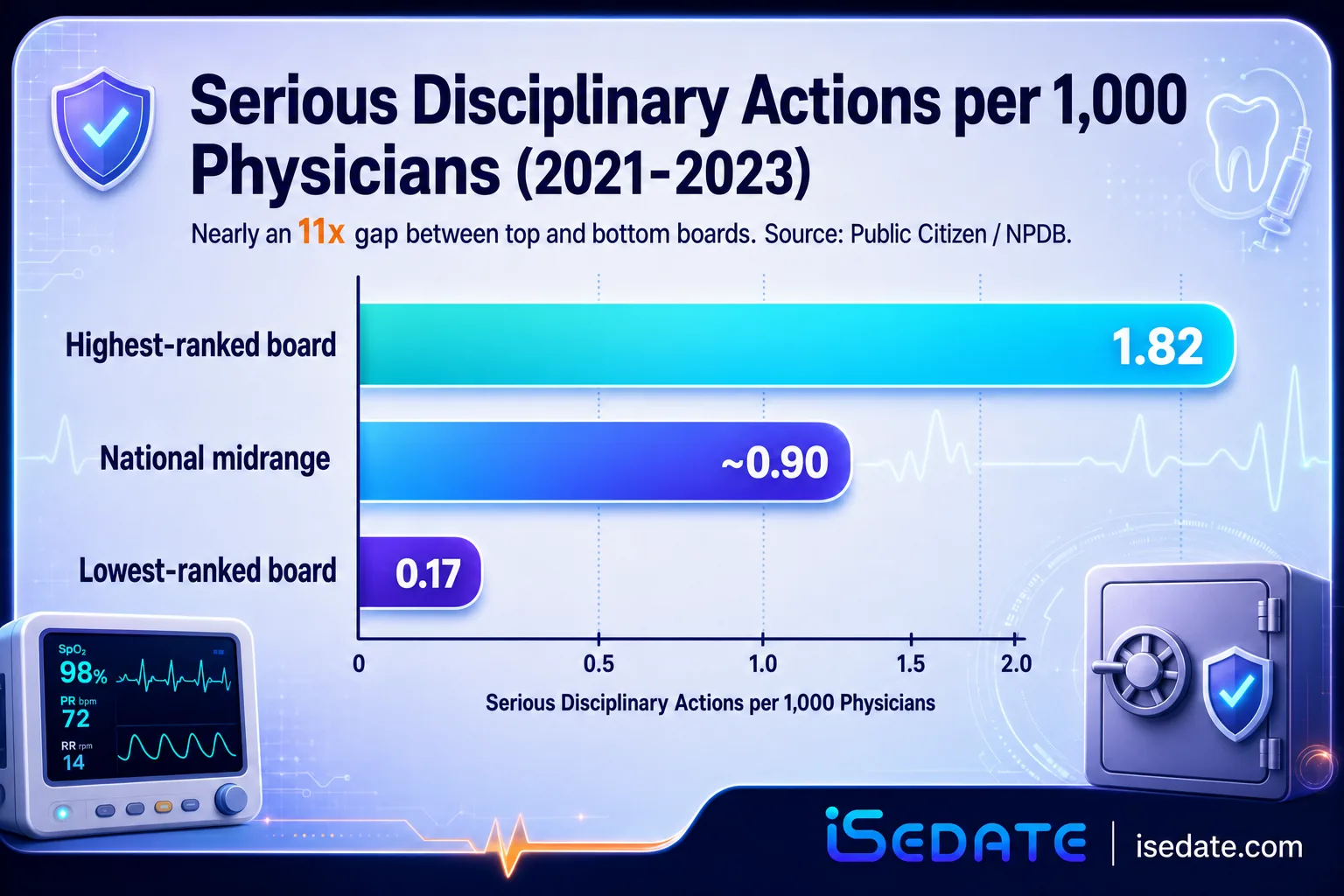
A watchdog ranking of state boards for 2021 through 2023 counted 1,289 serious disciplinary actions in 2021, 1,250 in 2022, and 1,196 in 2023. The rate ranged from a high of 1.82 serious actions per 1,000 physicians to a low of 0.17, a difference of nearly 11 times between the top and bottom boards. Because there is no reason to think physicians in one state misbehave more than in another, researchers attribute that gap to board performance, not provider behavior.
Source: BMJ Quality and Safety: Variations by state in physician disciplinary actions | Public Citizen state medical board ranking
Explore anesthesia record software2 Anesthesia Specialty and Revocation Risk
Not every specialty carries the same disciplinary exposure. Anesthesia stands out, and the reason ties back to the severity of what can go wrong when sedation or anesthesia is mismanaged.
The Texas Medical Board study analyzed 1,129 physicians disciplined over a ten-year period and used logistic regression to identify what predicted the most severe outcome, license revocation. Anesthesiologists (odds ratio 2.45), general practitioners (1.80), and psychiatrists (2.68) faced elevated revocation odds, as did physicians with multiple disciplinary actions (1.91) and those longer in practice. The pattern reflects the fact that anesthesia errors, particularly airway and medication events, tend toward catastrophic outcomes that draw the most severe sanctions.
Malpractice-claim frequency and board-severity are different measures. Anesthesiology sits near the middle for how often physicians are sued, at roughly a 7 percent annual claim rate in one large analysis, yet its disciplined practitioners face some of the highest revocation odds. Low claim frequency does not mean low consequence: when an anesthesia case reaches a board, the potential outcome is unusually severe.
Two Tier-1 findings sit in tension. In the NEJM specialty analysis, 7.4 percent of all physicians faced a malpractice claim in an average year, with anesthesiology near the middle of specialties by claim frequency. Yet in the Texas Medical Board data, anesthesiologists carried a 2.45 odds ratio for outright license revocation, among the highest of any specialty studied. Placing these side by side shows that anesthesia's risk profile is defined by severity, not volume.
Formula: NEJM annual claim frequency (7.4 percent, all physicians) contrasted with Texas Medical Board revocation odds ratio (2.45 for anesthesiologists). These are distinct measures and are compared, not combined.
Interpretation: the record of an anesthesia case matters most precisely because the downside is severe, not because cases are common. Calculation and interpretation original to iSedate, derived from NEJM (Jena et al.) and the Texas Medical Board revocation study.
Source: Archives of Internal Medicine: Factors associated with high-severity disciplinary action | NEJM: Malpractice Risk According to Physician Specialty
See how sedation compliance records are built3 From Complaint to Sanction
Most complaints to a medical board never become discipline. Understanding the funnel explains why the cases that do advance are so heavily documentation-dependent.
A federal assessment of state medical boards found that almost 5 percent of complaints result in some level of sanction, and most cases close without any action. Board staff described complaint-driven discipline as a reactive process that generates a large volume of investigation to find a small number of actionable cases. Hearings are uncommon, and court appeals after a final board decision are a very small share of total cases.
State medical boards use a graduated set of responses, from non-punitive administrative actions and required continuing medical education to fines, reprimands, probation, suspension, and revocation. Throughout, the physician is entitled to due process, and the board must prove a violation of the Medical Practice Act rather than assume one.
Where the Record Enters
At the investigation stage, which resolves most cases, the board relies on medical expertise and the documented record to decide whether a complaint is actionable. A complete anesthesia record, capturing vitals, medications, timing, and monitoring, is what lets an investigator or reviewing expert close a case early. A sparse record extends the investigation and increases the odds a case advances toward a hearing.
Source: HHS ASPE: State Discipline of Physicians case studies | Federation of State Medical Boards: About Physician Discipline
Generate audit-ready anesthesia records4 The NPDB and How Data Is Compared
Every serious anesthesia board action feeds one national system, and that system is what makes the statistics in this article possible.
Since September 1990, state licensing boards, hospitals, and other health care entities have been required to report certain adverse licensing and disciplinary actions to the National Practitioner Data Bank, and malpractice payers must report all payments made on behalf of a practitioner. Researchers build board rankings from NPDB categories such as revocations, suspensions, summary restrictions, voluntary surrenders while under investigation, and denials of renewal. Probation is often excluded from "serious" counts because many of its conditions are unenforceable.
Hospitals must query the NPDB for every new physician, dentist, or practitioner appointment and re-query their entire staff at least every two years. That continuous querying is why a single anesthesia board action can follow a provider throughout a career and across state lines.

Source: Public Citizen NPDB methodology | National Practitioner Data Bank reporting requirements
Explore the SedationVault platform5 Board Action Versus Malpractice
Board investigations and malpractice claims are frequently confused, but they measure different things and resolve on different tracks.
The distinction matters for interpreting anesthesia statistics. A board action follows a formal complaint, investigation, and hearing, and signals a finding that the Medical Practice Act was violated. A malpractice claim is a civil demand for damages, and the Federation of State Medical Boards cautions that claims are not always reliable measures of competence, since specialty, patient mix, and geography all influence claim volume. In the NEJM analysis, 7.4 percent of physicians faced a claim in an average year but only 1.6 percent had a claim that led to payment, meaning most claims closed without compensation.
The same event, an adverse anesthesia outcome, can spawn both a board investigation and a malpractice claim running in parallel, each with its own standard of proof. In both, the reviewing expert and the investigator reach for the same artifact: the documented record of what was administered, monitored, and observed.
Source: NEJM: Malpractice Risk According to Physician Specialty | FSMB on board action versus malpractice
Book a demo of SedationVault Compare SedationVault plans and pricingMedical Board Anesthesia Investigation Statistics: Summary Table
| Statistic | Figure | Source | Year |
|---|---|---|---|
| Anesthesiologist odds of license revocation (disciplined physicians) | 2.45x | Texas Medical Board study | 1989-1998 |
| Revocation odds, multiple prior disciplinary actions | 1.91x | Texas Medical Board study | 1989-1998 |
| Physicians in the revocation study | 1,129 | Texas Medical Board study | 1989-1998 |
| Mean disciplinary actions per 1,000 physicians/year | 3.76 | BMJ Quality and Safety | 2010-2014 |
| State variation in disciplinary rates | Fourfold (2.13-7.93) | BMJ Quality and Safety | 2010-2014 |
| Total disciplinary actions in study window | 21,647 | BMJ Quality and Safety | 2010-2014 |
| Share that were major actions | 23.7% | BMJ Quality and Safety | 2010-2014 |
| Serious disciplinary actions nationally (2021) | 1,289 | Public Citizen | 2021 |
| Serious disciplinary actions nationally (2023) | 1,196 | Public Citizen | 2023 |
| Highest state serious-action rate per 1,000 | 1.82 | Public Citizen | 2021-2023 |
| Lowest state serious-action rate per 1,000 | 0.17 | Public Citizen | 2021-2023 |
| Complaints resulting in a sanction | ~5% | HHS ASPE | 2006 |
| Prejudicial actions per 1,000 physicians/year | ~6 | HHS ASPE | 2006 |
| Physicians facing a malpractice claim per year | 7.4% | NEJM (Jena et al.) | 1991-2005 |
| Physicians with a claim leading to payment per year | 1.6% | NEJM (Jena et al.) | 1991-2005 |
| Claims not resulting in a payment | 78% | NEJM (Jena et al.) | 1991-2005 |
| Mandatory NPDB reporting began | September 1990 | HRSA / NPDB | 1990 |
| Hospital NPDB re-query interval | Every 2 years | HRSA / NPDB | 2024 |
Frequently Asked Questions
How often do state medical boards discipline physicians?
Are anesthesiologists more likely to lose their medical license?
What share of medical board complaints result in a sanction?
Where does medical board disciplinary data come from?
How is a medical board investigation different from a malpractice case?
Methodology and Sources
This article compiles statistics from primary and authoritative sources only. Figures are current as of 2026 and drawn from the most recent available data at the time of writing. This article concerns physician medical boards and anesthesiologists; for state dental board sedation discipline, see our companion analysis in this series.
- Archives of Internal Medicine, Factors associated with high-severity disciplinary action by a state medical board (Texas Medical Board case-controlled study, N=1,129; anesthesiologist revocation odds ratio 2.45).
- BMJ Quality and Safety, Variations by state in physician disciplinary actions by US medical licensure boards (NPDB and AMA data, 2010-2014; 21,647 actions, 23.7 percent major).
- Public Citizen Health Research Group, Ranking of the Rate of State Medical Boards' Serious Disciplinary Actions, 2021-2023 (built on NPDB data).
- U.S. Department of Health and Human Services (ASPE), State Discipline of Physicians case studies (complaint-to-sanction rates).
- New England Journal of Medicine (Jena et al.), Malpractice Risk According to Physician Specialty (40,916 physicians, 1991-2005).
- National Practitioner Data Bank (HRSA) and the Federation of State Medical Boards, reporting requirements and disciplinary process definitions.
Rates are not directly comparable across studies because time periods, states, and definitions of "serious" or "major" actions differ. The Texas revocation odds ratios describe relative risk among already-disciplined physicians, not the absolute probability that any given anesthesiologist will be disciplined. The iSedate Analysis contrasts two distinct measures and does not combine them into a single figure.
Media and press: Journalists and researchers are welcome to cite these statistics with attribution to the original primary sources named above. When referencing the iSedate Analysis, please attribute it to iSedate with a link to this page.