






Patient Monitoring Device Market Statistics (2026): Size, Growth, and Segments
The global patient monitoring device market sat somewhere between roughly $37 billion and $64 billion in 2025, depending on which research firm you read, and is broadly forecast to grow at 6% to 10% a year. Within it, capnography is a small but steadily growing niche, and ambulatory and office-based settings are among the fastest-growing segments. The data below covers the size, the growth, the segments, and the honest reason the numbers disagree.
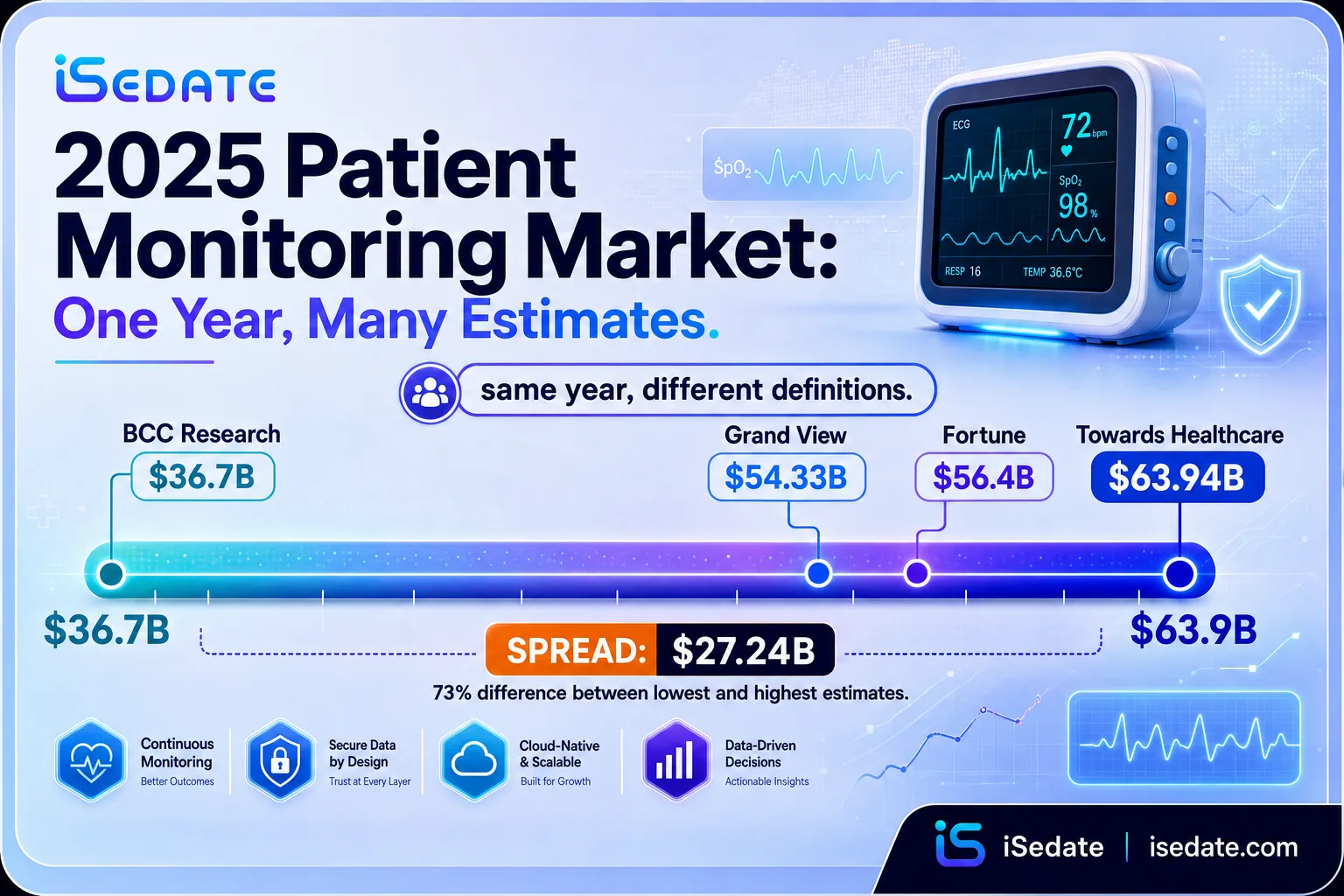
- The 2025 patient monitoring device market is estimated between roughly $36.7 billion and $63.9 billion, with several firms in the mid-$50 billion range.
- Growth forecasts commonly run 6.4% to 10.5% CAGR, reaching anywhere from $76 billion to $137 billion over 5 to 10 years.
- North America leads, holding roughly a 35% to 42% share across reports, while Asia-Pacific is the fastest-growing region.
- The capnography equipment niche is far smaller, about $0.4 billion to $0.63 billion in 2025, growing at roughly 4% to 7%.
- Procedural sedation and ambulatory surgery centers are called out as among the fastest-growing capnography applications and settings.
- Leading vendors include Philips, GE HealthCare, Medtronic, Dräger, Nihon Kohden, Mindray, Masimo, and EDAN, several of which supply office-based sedation monitors.
- Estimates vary widely because firms define the market, base years, and scope differently, so any single figure is one point in a range.
What's in This Guide
01 The Overall Market Size
The patient monitoring device market is large, growing, and measured differently by nearly every firm that tracks it. Rather than pick one number and present it as fact, it is more useful to see the range and understand what it represents.
To give concrete anchors: BCC Research put the 2025 market at $36.7 billion, growing to $55.8 billion by 2030 at 8.7%. Grand View Research estimated $54.33 billion in 2025, reaching $118.21 billion by 2033 at about 10.5%. Fortune Business Insights valued it at $56.4 billion in 2025, and another firm at $63.94 billion. MarketsandMarkets projected roughly $55.6 billion in 2026 growing to $76.11 billion by 2031 at 6.4%. These are not contradictions so much as different lenses on the same expanding market, and the consistent signal across all of them is steady high-single-digit to low-double-digit growth.
Whatever the exact figure, the growth drivers are remarkably consistent across firms: rising chronic disease prevalence, aging populations, the shift toward home-based and ambulatory care, and demand for continuous, wireless, and wearable monitoring. The direction of travel is not in dispute, only the precise size of the prize.
Source: Grand View Research | BCC Research | MarketsandMarkets
See SedationVault
02 Why the Estimates Disagree
Before going further, it is worth being direct about why a reader can find the same market valued at $36.7 billion or $63.94 billion for the same year. Understanding this makes every other number in this article more useful, not less.
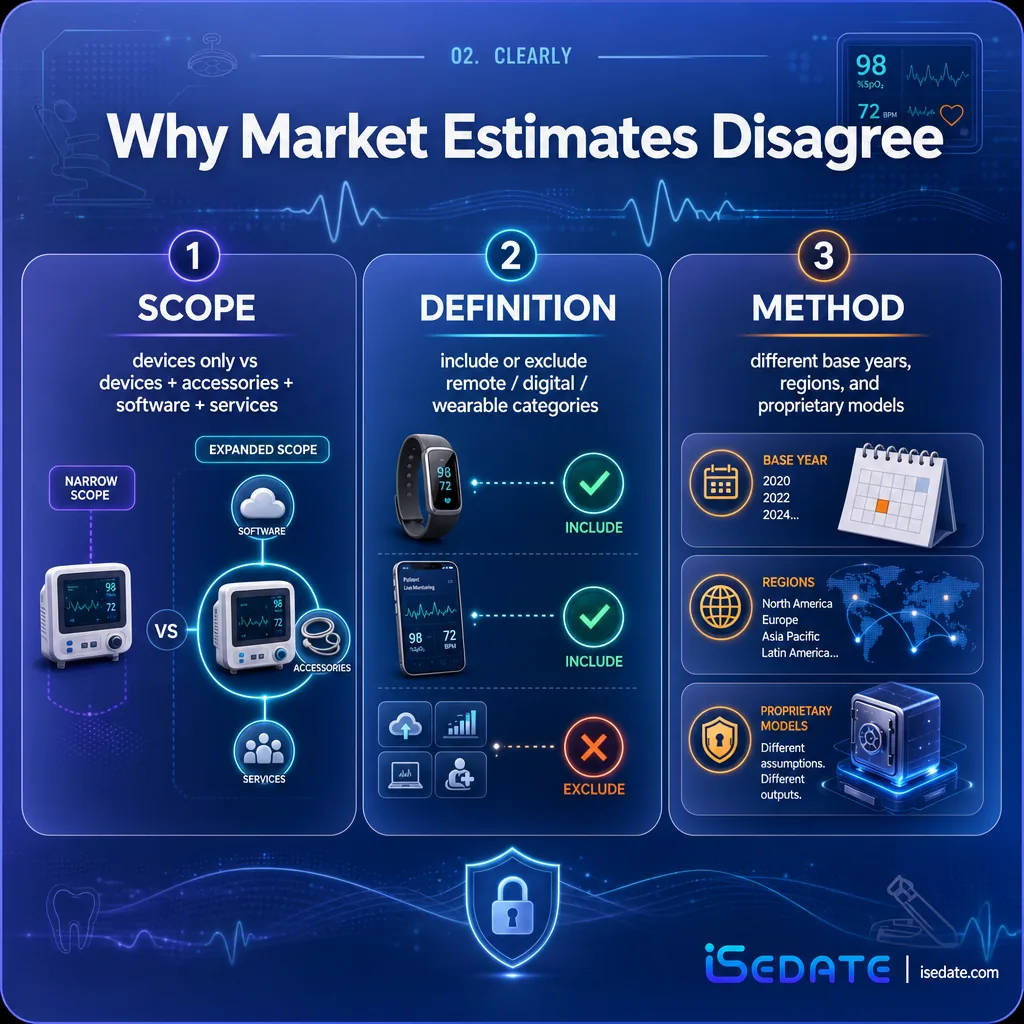
The variation comes down to three things. First, scope: one firm's "patient monitoring devices" market bundles in disposable accessories and software, while another counts only hardware. Second, definition: the closely related remote patient monitoring market is forecast near a 19% CAGR and the digital patient monitoring market even higher, so whether those get folded in dramatically changes the total. Third, method: firms use different base years, regional breakdowns, and proprietary models, which several openly note. The practical takeaway is to read any single market figure as one estimate within a range, and to weight the consistent direction and drivers over any one headline.
There is not, and treating any single number as the definitive market size is a mistake. Market-research figures are modeled estimates, not audited accounts, and they legitimately differ based on scope and method. When you see a precise-sounding number like "$54.33 billion," read it as one firm's estimate within a broader range, useful for direction and comparison, not as a settled fact.
Source: Mordor Intelligence | Fortune Business Insights (remote monitoring)
See the anesthesia record software
03 Segments: Where the Money Is
The market breaks down by product type, end-user setting, and region, and the segment data reveals where growth is concentrated, which matters for anyone buying or building monitoring technology.
By region, North America consistently leads with roughly 35% to 42% of the market, while Asia-Pacific is repeatedly named the fastest-growing region. By end user, hospitals dominate revenue, with one firm putting their share near 66%, but home healthcare and ambulatory settings post the highest growth rates, around 11% CAGR in some reports. By product, multi-parameter and cardiac monitoring devices lead, and multi-parameter systems, the category most relevant to sedation, are tracked as their own multi-billion-dollar sub-market. The clear story is that monitoring is migrating outward from the hospital toward outpatient, ambulatory, and office-based settings, which is precisely where office-based sedation lives.
Three segment findings point the same direction. Hospitals still dominate revenue (~66%), but home and ambulatory settings grow fastest (~11% CAGR), and within capnography specifically, ambulatory surgery centers are the fastest-growing end user. Taken together, the monitoring market's growth edge is in exactly the non-hospital, office-based environments where sedation providers operate, which means the tools, standards, and vendor attention are increasingly oriented toward the settings iSedate serves.
Sources: Mordor Intelligence; Grand View Research; MarketsandMarkets capnography segment data. Calculation and interpretation original to iSedate.
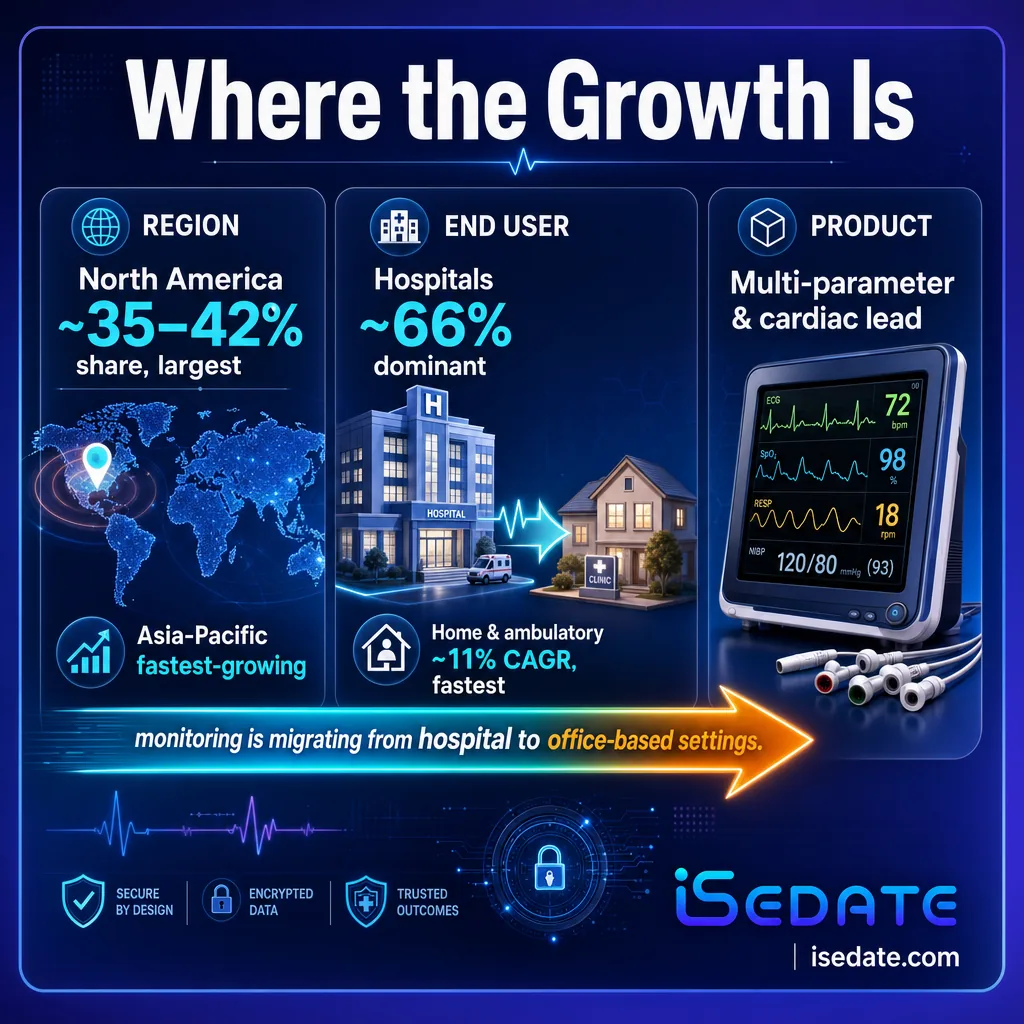
Source: Mordor Intelligence (segment shares) | Grand View Research (regional and product data)
See SedationVault for office managers
04 The Capnography Niche
Because capnography is central to sedation safety, its market deserves a closer look. It is a small slice of the overall monitoring market, but its growth is tied directly to the sedation-monitoring requirements tightening across the profession.
Estimates for the capnography equipment market in 2025 range from roughly $0.4 billion to $0.63 billion, with CAGRs generally in the 4% to 7% band, though broader definitions that include the full monitoring context run higher. The more interesting detail is the composition: within capnography, procedural sedation is flagged as a fast-growing application, and ambulatory surgery centers as the fastest-growing end-user setting. Disposables and accessories, such as sampling cannulas, make up a large and recurring share of revenue, because they are single-use and must be replaced. Professional-society endorsements making CO2 monitoring effectively required for moderate sedation are repeatedly cited as a demand driver, which links this market directly to the compliance trends affecting sedation providers.
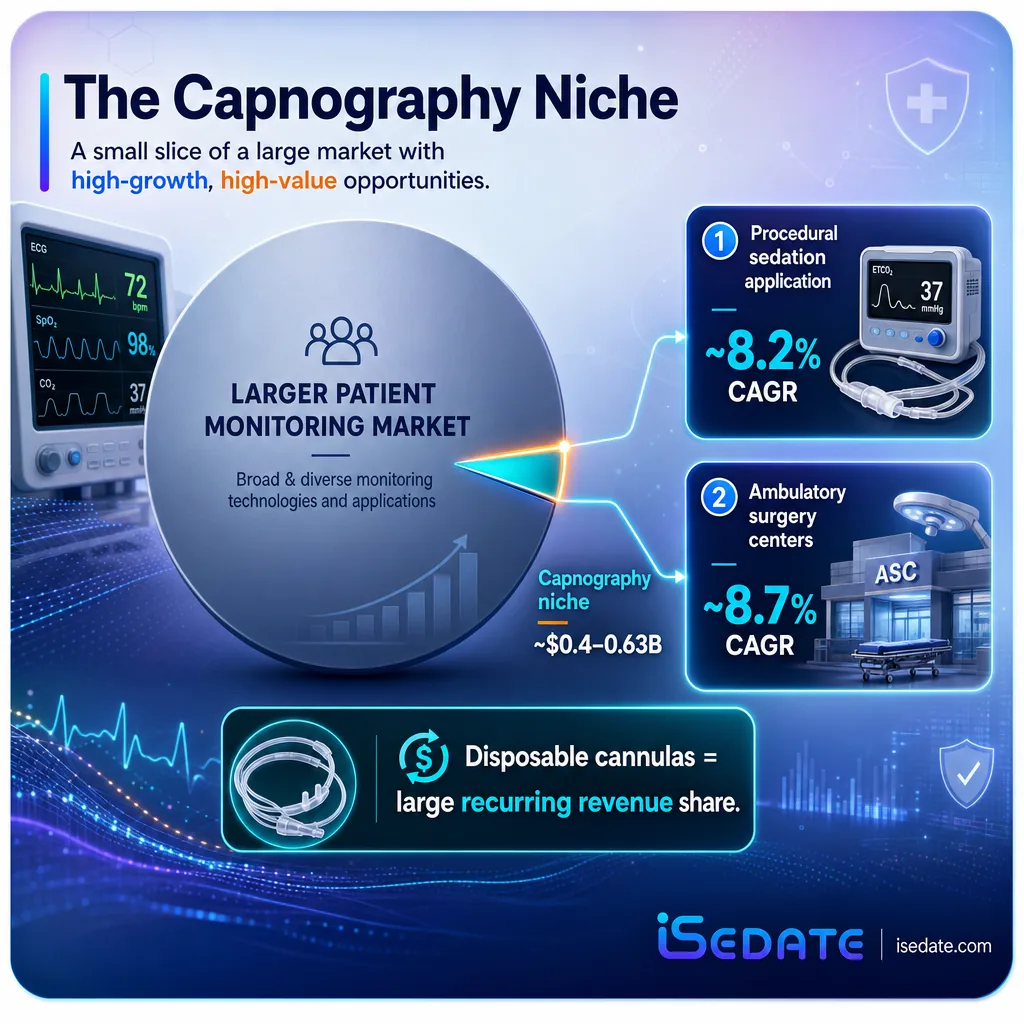
Source: Mordor Intelligence (capnography devices) | MarketsandMarkets (capnography equipment)
See how SedationVault supports compliance
05 Vendors and What It Means for Offices
The competitive landscape matters to sedation providers for a practical reason: the monitors an office already owns, or is considering, come from this vendor set, and interoperability with charting software depends on it.
The named market leaders include Koninklijke Philips, GE HealthCare, Medtronic, Drägerwerk, Nihon Kohden, Mindray, Masimo, Abbott, and EDAN Instruments. Several of these, notably Mindray, Dräger, Nihon Kohden, and EDAN, make the multi-parameter and capnography monitors commonly found in office-based sedation and oral surgery settings. The market has also seen active consolidation and partnership activity, including reported strategic tie-ups involving Philips, Medtronic, Masimo, and Nihon Kohden, aimed at integrating pulse oximetry, capnography, and multi-parameter monitoring. For a sedation provider, the relevant question is not market share but whether their monitor's data can flow into their sedation record.
A monitor is only as useful for documentation as its ability to feed a chart. iSedate's SedationVault is designed to capture live vitals from compatible monitors, including Edan, MindRay, Criticare, and more (the Edan X10 is a common example), so the data these market-leading devices produce flows directly into a continuous, audit-ready record rather than being transcribed by hand. As monitoring hardware and sedation software converge, that compatibility is what turns a monitor into a complete documentation solution.
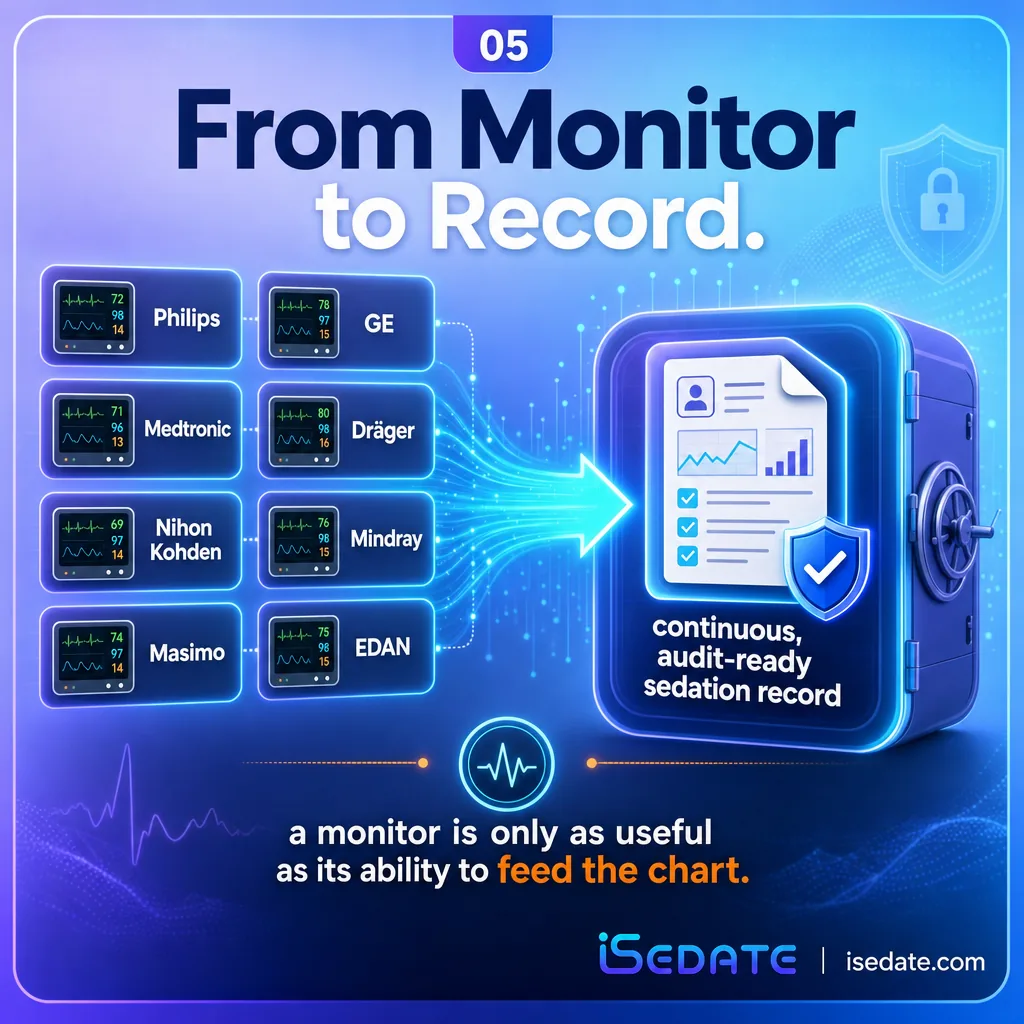
Source: Towards Healthcare (vendor landscape) | MarketsandMarkets (capnography vendors)
Book a Demo
06 Summary Table: Every Statistic
| Statistic | Figure | Source | Year |
|---|---|---|---|
| Patient monitoring market (low estimate) | $36.7B | BCC Research | 2025 |
| Patient monitoring market (mid estimate) | $54.33B | Grand View Research | 2025 |
| Patient monitoring market (high estimate) | $63.94B | Towards Healthcare | 2025 |
| Forecast market size (Grand View) | $118.21B by 2033 | Grand View Research | 2033 |
| Forecast market size (MarketsandMarkets) | $76.11B by 2031 | MarketsandMarkets | 2031 |
| Reported CAGR range | 6.4% - 10.5% | Multiple firms | 2025-2033 |
| North America market share | ~35% - 42% | Grand View / Mordor | 2025 |
| Hospital end-user share | ~66% | Mordor Intelligence | 2025 |
| Home/ambulatory end-user CAGR | ~11% | Mordor Intelligence | 2026-2031 |
| Remote patient monitoring CAGR | ~19% | Fortune Business Insights | 2026-2034 |
| Capnography equipment market | ~$0.4B - $0.63B | MarketsandMarkets / Mordor / FMI | 2025 |
| Capnography CAGR range | ~4% - 7% | Multiple firms | 2025-2033 |
| Procedural sedation capnography application CAGR | ~8.2% | Mordor Intelligence | 2026-2031 |
| Ambulatory surgery center capnography CAGR | ~8.7% | Mordor Intelligence | 2026-2031 |
| Side-stream capnography technology share | ~55-62% | Mordor / Fortune Business Insights | 2025 |
| Leading vendors | Philips, GE, Medtronic, Dräger, Nihon Kohden, Mindray, Masimo, EDAN | Multiple firms | 2025-2026 |
07 Frequently Asked Questions
How big is the patient monitoring device market?
How fast is the patient monitoring market growing?
How large is the capnography equipment market?
Who are the major patient monitoring device companies?
Why do market size estimates vary so much?
All figures come from published market-research reports and are presented as ranges because estimates vary by firm, scope, and method. Market-research figures are modeled estimates, not audited financials. Sources include:
- Grand View Research, "Patient Monitoring Devices Market" (2025-2033)
- BCC Research, "Patient Monitoring Devices: Global Markets"
- MarketsandMarkets, "Patient Monitoring Devices Market" and "Capnography Equipment Market"
- Mordor Intelligence, "Patient Monitoring Market" and "Capnography Devices Market"
- Fortune Business Insights, patient monitoring and remote patient monitoring reports
- Towards Healthcare, patient monitoring devices market sizing
- Future Market Insights and IMARC Group, capnography equipment market reports
Figures are rounded and expressed as ranges; consult the underlying reports for precise, dated numbers and full methodology.
As monitoring hardware and sedation software converge, the value is in connecting the two. iSedate's SedationVault captures live vitals from compatible monitors and turns them into a continuous, audit-ready record for every case. To see how it works in your practice, book a demo.