







Sedation and Anesthesia Insurance Coverage Statistics (2026)
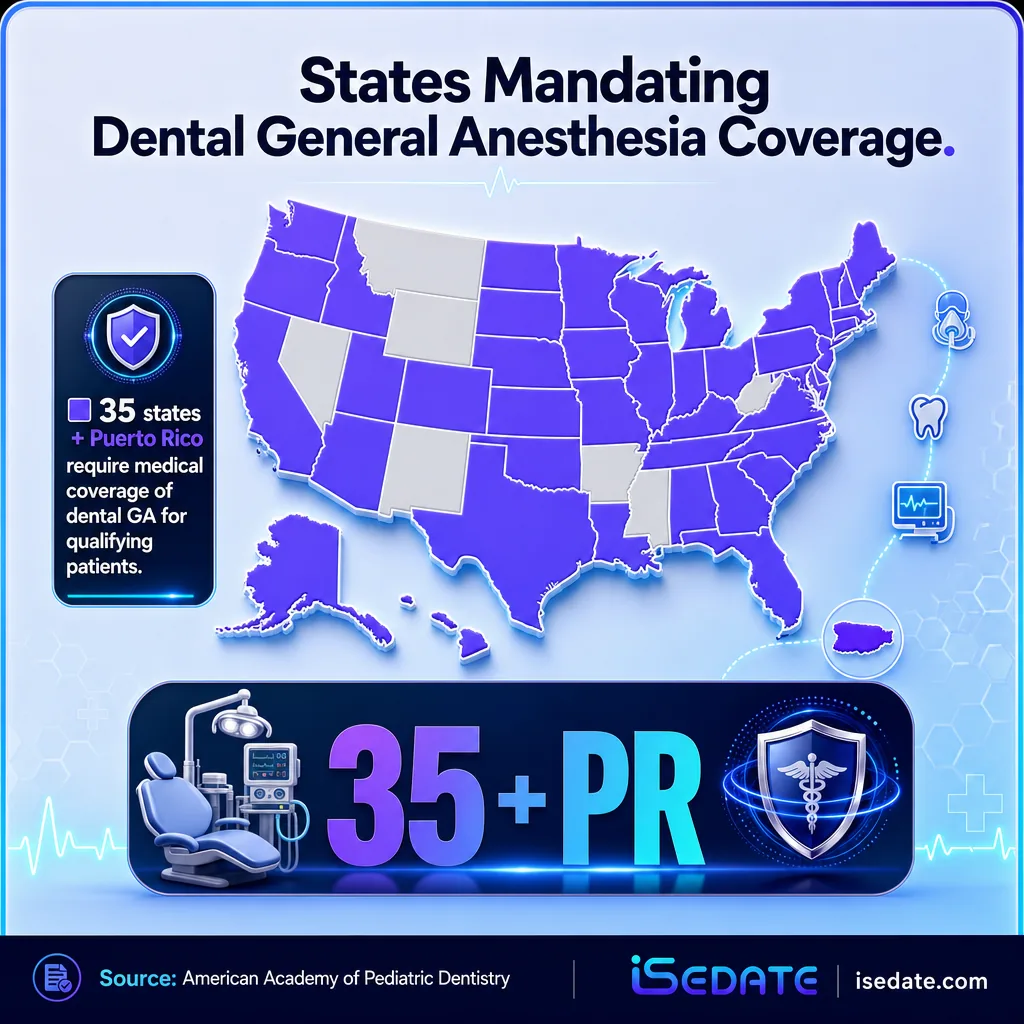
Thirty-five states and Puerto Rico now require medical plans to cover general anesthesia for qualifying dental patients, yet most routine sedation is still treated as elective and paid out of pocket, according to AAPD and carrier policy data. Whether a sedation claim is paid often comes down to one word: documentation.
Key Takeaways
- 35 states plus Puerto Rico have enacted laws mandating medical coverage of dental general anesthesia for qualifying patients (AAPD).
- Coverage hinges on medical necessity: IV sedation and general anesthesia are covered when documented as necessary; nitrous and elective oral sedation usually are not (carrier policies).
- Medical vs dental benefit matters: qualifying anesthesia is often paid under the medical plan, with facility charges, not the dental plan (Aetna, Cigna, BCBS policies).
- Costs add up fast: IV sedation commonly adds 250 to 500 dollars and general anesthesia 300 to 1,200 dollars to a procedure (ADA CDT fee data, carrier estimates).
- "Not medically necessary" is inconsistently defined across payers, a long-standing source of denials (peer-reviewed commentary).
- Reform is active: Texas SB 527 in 2025 barred exclusion of medically necessary dental GA for young or unable-to-treat patients (ADA).
- Dental annual maximums cap exposure: most plans cap total benefits near 1,000 to 2,000 dollars a year, limiting sedation coverage (NADP, carrier data).
What's in This Guide
1 State Coverage Mandates
Coverage for dental general anesthesia is not left entirely to insurers. A majority of states have passed laws requiring it for the patients who need it most, though the mandates are narrow.
Since 1995, the American Academy of Pediatric Dentistry has helped states obtain medical plan coverage for the costs of general anesthesia in dental treatment of young and special-needs patients. As of AAPD's reporting, 35 states and Puerto Rico have enacted such legislation, with more considering it.
These mandates are specific in what they cover. They typically require plans to pay for the general anesthesia and associated facility charges when a qualifying patient needs dental treatment, but they generally do not require coverage of the dental procedure itself or the dentist's professional fee. State laws also commonly permit the insurer to require prior authorization for the anesthesia.
Myth: A state mandate means sedation is always covered
The mandates are narrow by design. They apply to defined groups, usually young children and special-needs patients who meet clinical criteria, and to general anesthesia and facility charges, not to elective sedation for an anxious but otherwise healthy adult. Many mandates also carve out self-funded ERISA plans, which are governed by federal rather than state law, so a large share of employer coverage may fall outside a state requirement. A mandate improves the odds of coverage for qualifying patients; it does not guarantee that every sedation claim is paid.
Reform continued in 2025. As part of a wave of dental insurance legislation, Texas passed Senate Bill 527, which prohibits health plans that cover general anesthesia from excluding medically necessary general anesthesia for dental services provided to young enrollees or patients unable to undergo treatment without it due to a documented reason.
Source: American Academy of Pediatric Dentistry | ADA News
See how compliance-ready records support coverage documentation
2 Medical Necessity: The Coverage Test
The single biggest factor in whether sedation is covered is whether it qualifies as medically necessary. Carrier policies and state laws converge on a similar set of criteria.
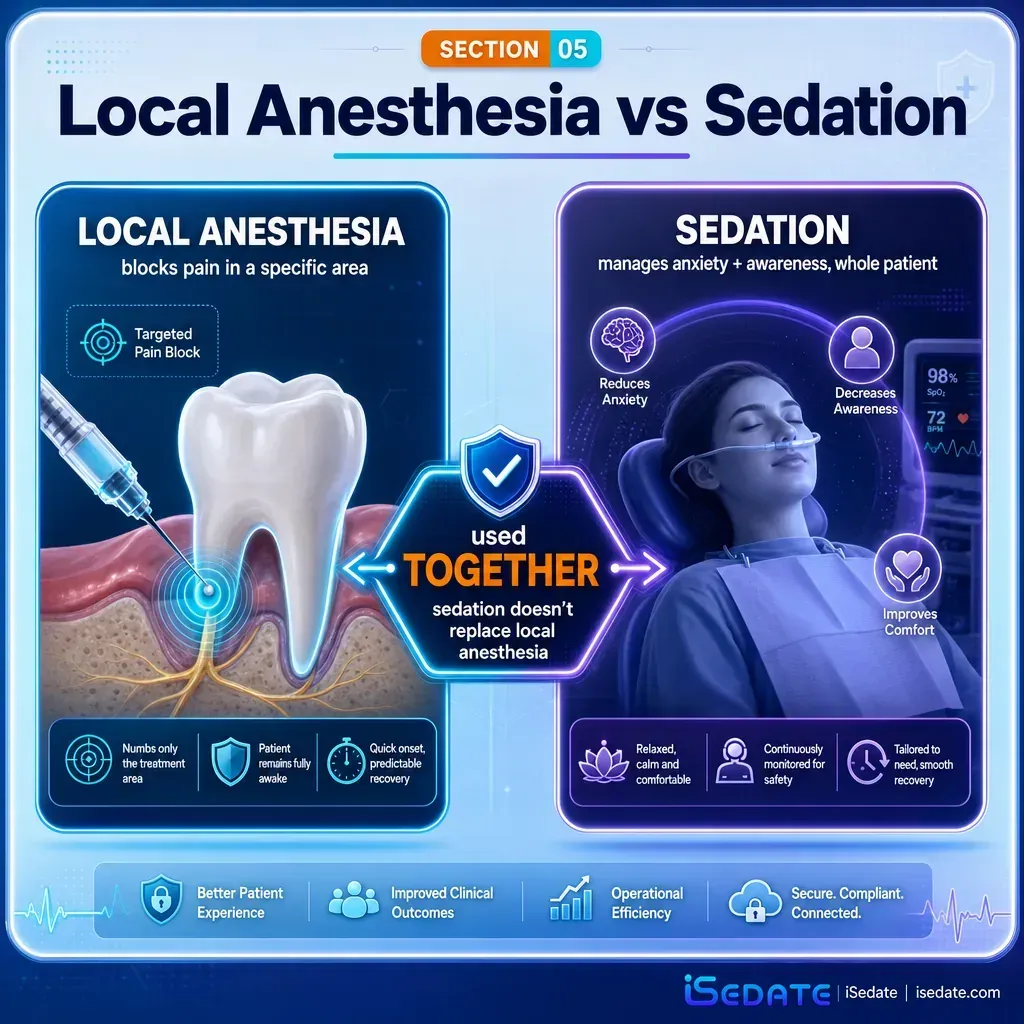
Sedation is not one thing. The American Society of Anesthesiologists defines a continuum: minimal sedation (anxiolysis), moderate sedation, deep sedation, and general anesthesia. Coverage tends to rise with the depth and clinical justification of the sedation, and with the complexity of the underlying procedure.
Carrier medical policies from major insurers converge on similar medical-necessity criteria for general anesthesia in dental care. Common qualifying conditions include patients with physical, intellectual, or medically compromising conditions, cases where local anesthesia is ineffective due to infection or anatomy, extensive surgical needs such as six or more teeth requiring extraction, very young children, and patients whose anxiety or behavior prevents safe treatment by other means.
iSedate Analysis: The documentation dependency
Every medical-necessity criterion, age, number of teeth, ineffective local anesthesia, a qualifying condition, is a documented fact. None of them is a judgment call the payer makes independently; each depends on what the clinical record establishes. Where carrier policies and state statutes list criteria such as "six or more teeth to be extracted" or "a documented reason" a patient cannot be treated otherwise, the coverage decision reduces to whether the record proves the criterion. Sedation coverage is, in practice, a documentation test as much as a clinical one.
Formula: Coverage approval requires meeting at least one defined medical-necessity criterion (carrier policy and state statute), and each criterion is verifiable only through the clinical record, making complete documentation the controlling variable in the coverage decision.
Calculation and interpretation original to iSedate.
Source: Aetna Dental Clinical Policy Bulletin | Maine Title 24-A Section 2760
Explore SedationVault, the Sedation Intelligence System
3 Medical vs Dental Benefit
A crucial and often misunderstood point: qualifying sedation is frequently paid under the medical plan, not the dental plan. Where the claim lands determines the coverage rules that apply.
Carrier policies are explicit that coverage of medically necessary anesthesia is generally available in connection with underlying services covered under the medical benefits plan. When general anesthesia is rendered by a provider other than the treating dentist, such as an anesthesiologist or certified registered nurse anesthetist, it can be eligible for separate reimbursement under the medical or surgical benefit, along with associated facility charges.
The benefit distinction matters financially because of annual maximums. Dental plans typically cap total annual benefits near 1,000 to 2,000 dollars, which a single sedation case can quickly exhaust. Medical plans carry much higher limits, often 5,000 to 10,000 dollars or more, so routing qualifying anesthesia through the medical benefit can mean the difference between meaningful coverage and hitting a dental cap.
For oral surgeons and sedation providers, this means a single case can involve two payers with two sets of rules. A complex extraction might bill the surgical procedure to the dental plan and the general anesthesia and facility charges to the medical plan, each with its own authorization, documentation, and appeal process. Coordinating those claims accurately is a real administrative burden, and errors in which benefit gets billed are a common source of denials.
Source: Aetna Dental Clinical Policy Bulletin | BCBS Medical Policy: Dental General Anesthesia
How oral surgeons document IV sedation and anesthesia cases
4 What Sedation Costs Patients
When coverage falls short, the patient pays. Sedation is often the line item that turns a manageable dental bill into a large one, and the amounts vary widely by modality and region.
Cost scales with the depth of sedation. Nitrous oxide commonly adds roughly 50 to 100 dollars, IV sedation about 250 to 500 dollars, and general anesthesia anywhere from 300 to more than 1,200 dollars depending on duration and complexity. In-office general anesthesia is often quoted around 400 to 600 dollars per hour, inclusive of drugs and recovery time.
Typical Added Cost of Sedation by Modality (illustrative ranges)
In the context of a full procedure, these add up. For wisdom teeth removal, dental plans typically cover 50 to 80 percent of a medically necessary extraction, but the sedation portion is frequently where out-of-pocket exposure concentrates, especially once a patient nears the dental plan's annual maximum.
Cost figures are ranges, not fixed prices
Sedation and anesthesia pricing varies substantially by region, provider type, case complexity, and duration. The figures here are drawn from ADA CDT fee survey data and carrier and provider estimates and are presented as typical ranges rather than fixed prices. Oral surgeons generally charge more than general dentists for comparable work, and major metro areas run well above rural averages. Patients should request an itemized written estimate that separates the extraction fee, sedation charge, and imaging rather than a single lump sum.
Source: ADA CDT fee survey data via CareCredit | Sedation coverage overview
Compare SedationVault plans and pricing
5 Why Sedation Claims Get Denied
Even when sedation is clinically appropriate, coverage is far from automatic. The denial patterns for sedation claims are specific and, in most cases, addressable.
The most frequent reason sedation is denied is that the payer classifies it as elective rather than medically necessary. Peer-reviewed commentary has long noted that the "not medically necessary" label is poorly defined and varies from payer to payer, which is precisely why documentation of a qualifying reason is decisive. Insurers also deny for missing prior authorization, which most anesthesia mandates permit them to require, and for claims billed under the wrong benefit.
The good news is that these are largely documentation and process failures, not clinical disputes, which means they are preventable. A claim that clearly establishes the qualifying medical-necessity criterion, secures prior authorization where required, and bills the correct benefit removes the most common grounds for denial before they arise.
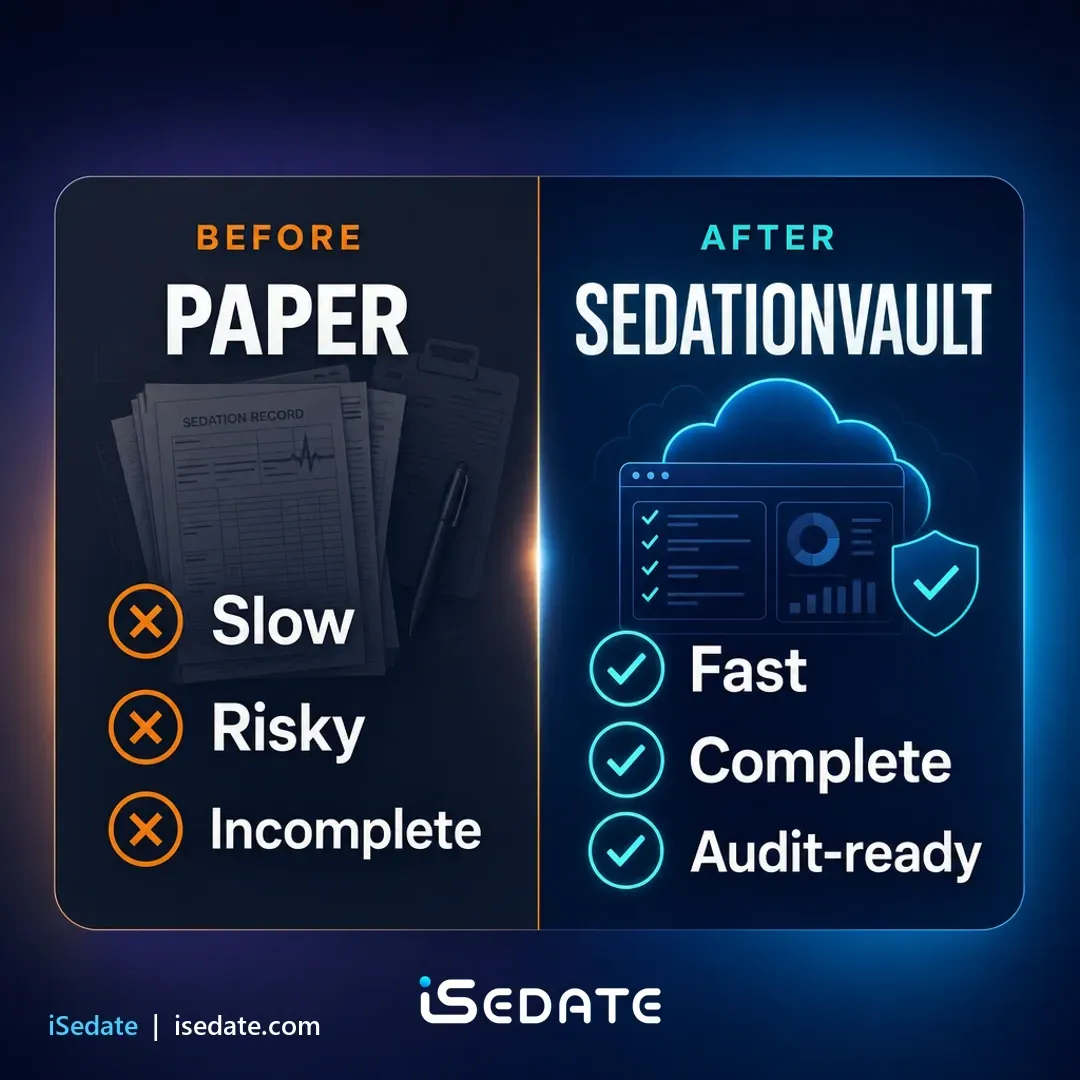
This is where sedation coverage connects directly to charting. The criteria that determine coverage, patient age, number of teeth, ineffective local anesthesia, a documented condition preventing safe treatment, all live in the clinical record. A sedation record that captures these facts completely and produces an audit-ready report gives the practice its strongest position both at initial submission and on appeal. For a modality where "not medically necessary" is the default denial, provable documentation is the practice's most direct lever.
Source: Journal commentary on medical necessity of dental sedation | Aetna Dental Clinical Policy Bulletin
Summary Table: All the Numbers
| Statistic | Figure | Source | Year |
|---|---|---|---|
| States plus Puerto Rico mandating dental GA coverage | 35 + PR | AAPD | 2025 |
| Year AAPD anesthesia coverage advocacy began | 1995 | AAPD | 1995 |
| ASA-defined sedation levels | 4 | ASA | Current |
| Common GA medical-necessity age threshold | Under 7 | Carrier policy | 2026 |
| Common extraction threshold, older patients | 6+ teeth | Carrier policy | 2026 |
| Nitrous oxide typical added cost | $50-$100 | Fee/carrier data | 2026 |
| IV sedation typical added cost | $250-$500 | ADA CDT fee data | 2026 |
| General anesthesia typical added cost | $300-$1,200 | Fee/carrier data | 2026 |
| In-office GA hourly estimate | $400-$600/hr | Provider estimate | 2024 |
| Wisdom teeth all-four total (with IV sedation) | $1,800-$3,400 | ADA CDT fee survey | 2026 |
| Typical dental plan coverage of necessary extraction | 50-80% | Carrier data | 2026 |
| Typical dental plan annual maximum | $1,000-$2,000 | NADP/carrier | 2024 |
| Typical medical plan annual maximum | $5,000-$10,000+ | Carrier data | 2026 |
| Most common sedation denial label | "Elective" | Carrier policy | 2026 |
| Texas dental GA anti-exclusion law | SB 527 | ADA | 2025 |
| Dental insurance reform laws passed (context) | 37 (18 states) | ADA | 2025 |
Frequently Asked Questions
Does insurance cover dental sedation?
How many states require insurance to cover dental general anesthesia?
What makes dental sedation medically necessary for insurance?
How much does dental sedation cost out of pocket?
Why do sedation claims get denied?
Methodology and Sources
State mandate figures are from the American Academy of Pediatric Dentistry (AAPD), which tracks state general anesthesia coverage legislation. Medical-necessity criteria and the medical-versus-dental benefit structure are drawn from published carrier medical and dental clinical policy bulletins (Aetna, Cigna, Blue Cross Blue Shield of Michigan) and state statutes such as Maine Title 24-A Section 2760. Sedation-level definitions are from the American Society of Anesthesiologists (ASA). Cost figures are drawn from ADA CDT fee survey data as reported by CareCredit and from carrier and provider estimates, and are presented as typical ranges. Reform legislation figures, including Texas SB 527, are from ADA advocacy reporting. The medical-necessity definitional issue is documented in peer-reviewed commentary.
Two limitations apply. First, coverage rules vary by plan, state, and whether a plan is state-regulated or a self-funded ERISA plan governed by federal law, so no single rule applies universally. Second, cost figures for sedation and anesthesia vary substantially by region, provider, and case complexity and should be treated as typical ranges rather than fixed prices; the ADA CDT fee survey is the primary origin for procedure fee data.
Media and press: Journalists and researchers are welcome to cite these statistics with attribution to iSedate and a link to this page. Each figure includes its original Tier 1 source for independent verification.