







Sedation Dentistry Statistics (2026): Market Size, Demand, and Growth
The global dental sedation and anesthesia service market was valued near $5.56 billion in 2025 and is forecast to reach roughly $9.59 billion by 2032, while roughly 40% of patients report interest in sedation for their visits. Sedation is the fastest-growing slice of dental anesthesia, driven more by patient demand for comfort than by strict clinical need. The data below covers the market size, the demand behind it, and the segments driving growth.
- The global dental sedation and anesthesia service market was about $5.56 billion in 2025, forecast to reach roughly $9.59 billion by 2032 at an 8.1% CAGR.
- The broader dental anesthesia market (including local anesthetics) is commonly estimated at $2.2 to $2.5 billion for 2025.
- Sedation is the fastest-growing anesthesia type, with one firm reporting a 6.1% CAGR for the sedation segment.
- About 40% of patients report interest in sedation, and over 60% report some level of dental fear.
- Strict clinical need is narrower: roughly 5% of attending patients will need sedation, rising to about 6.9% if anxious non-attenders are included.
- North America leads with roughly a 40% share; Asia-Pacific is the fastest-growing region.
- Estimates vary by firm and definition, so all figures are best read as ranges, not fixed values.
What's in This Guide
01 The Market Size
Sedation dentistry can be measured a few different ways, and the figure you get depends on whether you count the sedation service itself, the anesthesia drugs and devices, or the whole category. Seeing the main anchors side by side is more honest than picking one.
One report from QYResearch valued the dental sedation and anesthesia service market at about $5.56 billion in 2025, projecting $9.59 billion by 2032. Separately, the dental anesthesia market, which bundles in local anesthetics used for routine fillings and extractions, is estimated by various firms between roughly $2.2 billion and $2.5 billion for 2025, reaching $3.1 billion to $3.7 billion over the following 5 to 10 years. The gap between these numbers is not a contradiction, it reflects what each report chooses to count. The consistent theme is a multi-billion-dollar market growing steadily.
There is not. A "dental sedation service" market, a "dental anesthesia" market that includes local anesthetics, and a "dental anesthesia devices" market are three different measurements, and each firm defines and dates them differently. Treat any single dollar figure as one estimate within a range. What matters for understanding the sector is the direction, which is consistently upward, and the relative growth of sedation within it.

Source: QYResearch via OpenPR | SNS Insider (dental anesthesia market)
See SedationVault
02 Growth: Sedation Outpaces the Rest
The most consistent finding across market reports is not the exact size but the trajectory: within dental anesthesia, sedation is repeatedly singled out as the fastest-growing type, outpacing the much larger local-anesthesia segment.
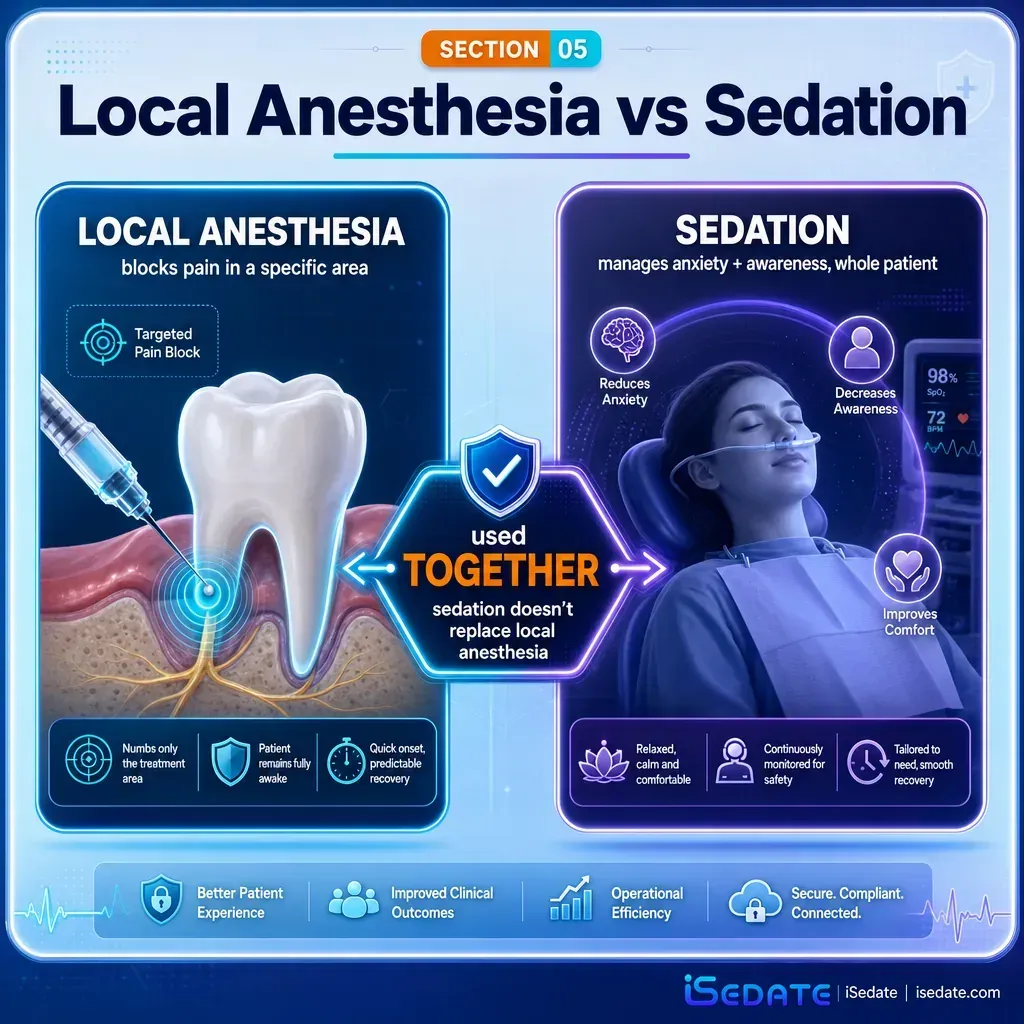
In one segmentation, local anesthesia held about 53% of the dental anesthesia market in 2025 but grew more slowly, while sedation was flagged as the fastest-growing type at a 6.1% CAGR. That pattern, a large and stable local-anesthesia base with sedation growing faster on top of it, appears across multiple reports. The dedicated sedation and anesthesia service market's 8.1% forecast growth reinforces the same story. Sedation is not replacing local anesthesia, it is expanding the category by bringing in patients and procedures that would not otherwise happen comfortably.
A segment growing faster than the market it sits in is gaining share every year. Sedation's faster CAGR relative to local anesthesia means that, over time, a larger portion of dental anesthesia spending and activity shifts toward sedation. For a practice or a software platform serving sedation providers specifically, that is the tailwind: the sub-sector is not just large, it is the part of the market pulling ahead.

Source: SNS Insider (segment CAGRs) | QYResearch (service market CAGR)
See how SedationVault supports sedation practices
03 Demand vs Clinical Need
Behind the market numbers sits patient demand, and here the data reveals an important distinction: interest in sedation is far larger than strict clinical need for it. Both numbers matter, and they tell different parts of the story.
On the demand side, an industry estimate reports that roughly 40% of patients are interested in sedation, and over 60% report some level of dental fear. A national Canadian survey found 12.4% of adults were definitely interested in sedation or general anesthesia, with another 42.3% interested depending on cost, and among highly fearful patients that definite interest jumped to 31.1%. On the need side, English research estimated that only about 5% of attending patients will actually need sedation services, rising to roughly 6.9% if highly anxious people who avoid the dentist entirely were included. The distance between roughly 40% interested and roughly 5% clinically needing is the addressable growth space: patients who could benefit from and would choose sedation if it were offered, priced, and normalized.
Put the two figures together: around 40% of patients express interest in sedation, while only about 5% strictly need it clinically. That roughly eightfold gap is not a discrepancy to explain away, it is the demand runway. Clinical need sets a floor, but patient preference for comfort sets the ceiling, and the market's steady growth reflects practices meeting that elective demand. Cost is the main gate, given how many patients say their interest depends on price, which points to convenience, efficiency, and trust as the levers that convert interest into cases.
Sources: DOCS Education patient-demand estimate; Canadian national sedation survey; English IOSN sedation-need research. Calculation and interpretation original to iSedate.

Source: DOCS Education (patient demand) | Canadian national sedation survey (NCBI) | Estimating the need for dental sedation (PubMed)
See how dentists use SedationVault
04 Segments and Regions
The market data breaks down by application, end user, and region in ways that show where sedation activity concentrates, which matters for anyone serving the sector.
By region, North America leads with roughly 40% of the dental anesthesia market, supported by mature infrastructure and high procedure volumes, while Asia-Pacific is repeatedly named the fastest-growing region. By application, oral surgery led in 2025 at about 38%, reflecting the complex extractions, implants, and corrective procedures that most often call for sedation, with periodontal surgery flagged as a fast-growing application. By end user, dental clinics dominate at roughly 60%, though hospitals are cited as a faster-growing segment. The takeaway for office-based sedation is that the activity is concentrated exactly where iSedate's audience works: clinics and oral surgery practices in North America.

Source: SNS Insider (segment shares) | ReAnIn (regional analysis)
See how oral surgeons use SedationVault
05 What's Driving the Growth
Across nearly every market report, the same handful of drivers appear. They are worth naming because they explain why the growth is durable rather than a passing trend.
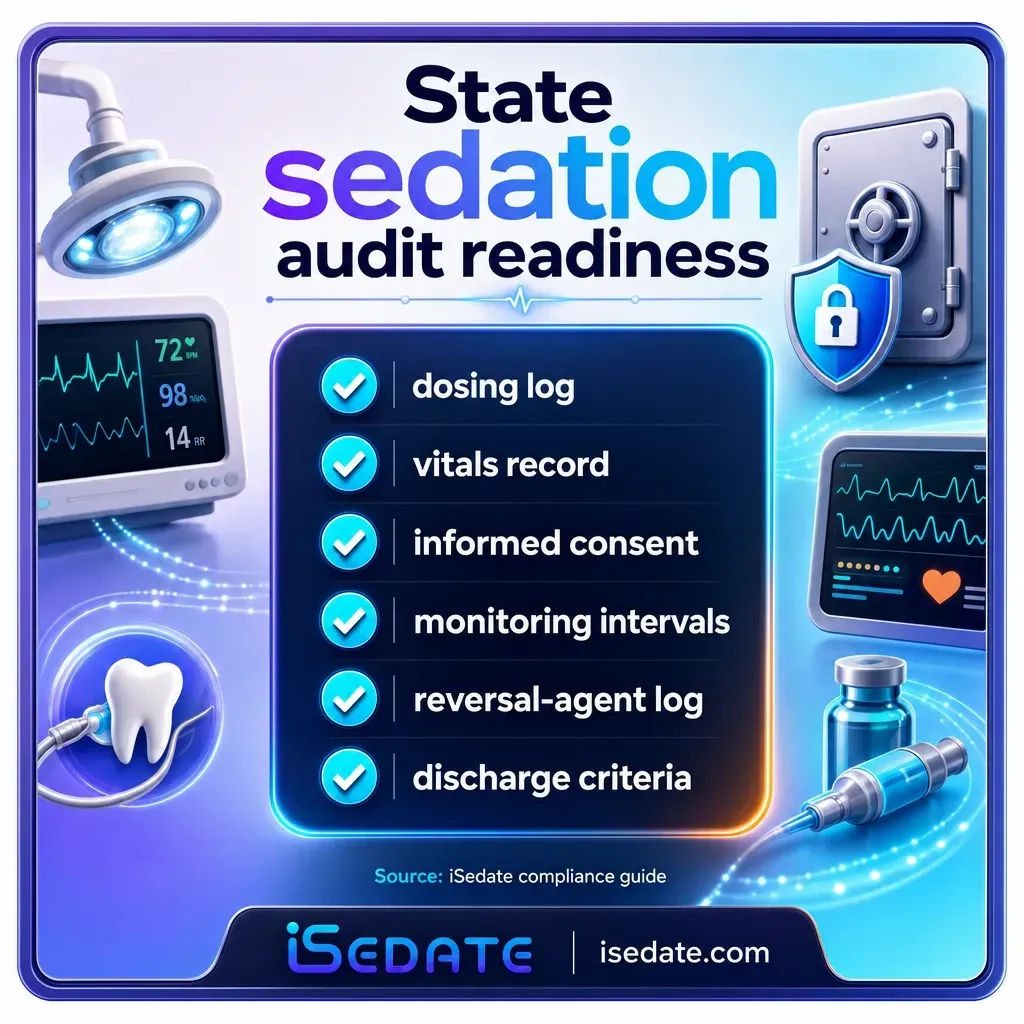
The consistently cited drivers are patient demand for comfort and pain-free care, rising volumes of complex and cosmetic procedures, an aging population with more dental needs, growing oral-health awareness, and advances in delivery and monitoring technology that make sedation safer and more accessible. Regulatory frameworks and safety standards are also tightening, which raises the bar for documentation and monitoring rather than dampening demand. That combination, more patients wanting sedation and stricter expectations for how it is delivered and recorded, is precisely the environment sedation software is built for.
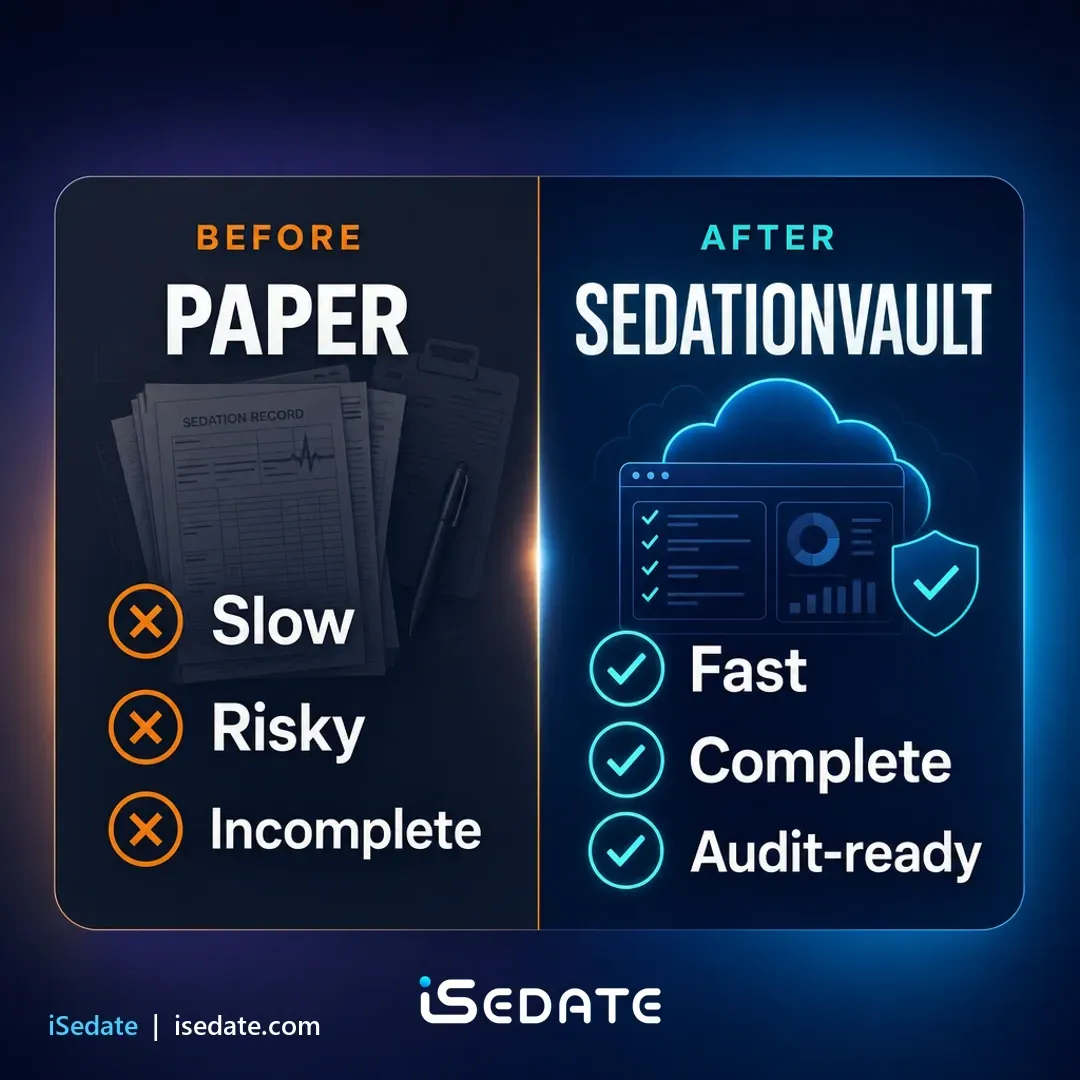
As sedation volume grows and safety standards tighten, the operational burden on providers rises with it: more cases to chart, more monitoring to record, more compliance to demonstrate. iSedate's SedationVault is built for exactly this moment, capturing live vitals from compatible monitors, including Edan, MindRay, Criticare, and more (the Edan X10 is a common example), building the sedation record as the case proceeds, and producing a one-click, audit-ready PDF. A growing market rewards the practices that can scale sedation without scaling paperwork.

Source: Market Research Future (growth drivers) | Medi-Tech Insights (market drivers)
Book a Demo
06 Summary Table: Every Statistic
| Statistic | Figure | Source | Year |
|---|---|---|---|
| Dental sedation & anesthesia service market | $5.56B | QYResearch | 2025 |
| Service market forecast | $9.59B by 2032 | QYResearch | 2032 |
| Service market CAGR | 8.1% | QYResearch | 2026-2032 |
| Dental anesthesia market (broader) | $2.2 - $2.5B | SNS Insider / MarketsandMarkets / MRFR | 2025 |
| Sedation segment CAGR (fastest type) | 6.1% | SNS Insider | 2026-2033 |
| Local anesthesia market share | ~53% | SNS Insider | 2025 |
| Patients interested in sedation | ~40% | DOCS Education / Workforce Dental Staffing | 2026 |
| Patients reporting some dental fear | >60% | DOCS Education | 2026 |
| Canadian adults definitely interested in sedation/GA | 12.4% | Canadian national survey (NCBI) | survey |
| Canadian adults interested depending on cost | 42.3% | Canadian national survey (NCBI) | survey |
| Attending patients needing sedation | ~5% | English IOSN research (PubMed) | 2011 |
| Need including anxious non-attenders | ~6.9% | English IOSN research (PubMed) | 2011 |
| North America market share | ~40% | SNS Insider / ReAnIn | 2025 |
| Oral surgery application share | ~38% | SNS Insider | 2025 |
| Dental clinic end-user share | ~60% | SNS Insider | 2025 |
| NHS England sedation episodes per year | ~137,000 | NHS BSA analysis (NCBI) | 2012-2014 |
07 Frequently Asked Questions
How big is the sedation dentistry market?
How fast is sedation dentistry growing?
How many patients want sedation dentistry?
What share of dental patients actually need sedation?
Which region leads the sedation dentistry market?
All figures come from published market-research reports and peer-reviewed demand surveys. Market figures are modeled estimates that vary by firm, scope, and base year, and are presented as ranges. Demand and need figures come from national surveys and are specific to the populations studied. Sources include:
- QYResearch, "Dental Sedation and Anesthesia Service - Global Market" (via OpenPR)
- SNS Insider, "Dental Anesthesia Market" (segment and regional data)
- MarketsandMarkets, Market Research Future, ReAnIn, Medi-Tech Insights, and Towards Healthcare dental anesthesia market reports
- DOCS Education, "Patient Demand for Dental Sedation Could Boost ROI in 2026"
- "Need and Demand for Sedation or General Anesthesia in Dentistry: A National Survey of the Canadian Population" (NCBI)
- "Estimating the need for dental sedation" (British Dental Journal / PubMed)
- NHS Business Services Authority conscious sedation provision analysis (NCBI)
A growing sedation market rewards practices that can scale comfortably and document every case. iSedate's SedationVault captures live vitals, builds the sedation record automatically, and produces audit-ready documentation for every procedure. To see how it works in your practice, book a demo.