






Vital Signs Monitoring and Sedation Safety Statistics (2026): What the Standards and Data Say
Abnormal vital signs can appear in up to 60% of patients as much as four hours before a serious adverse event, yet intermittent spot-checks miss most of them. Sedation safety depends on which physiologic signals you track, how continuously you track them, and which standard you follow. The data below covers the required parameters, the monitoring standards, and what continuous vitals actually catch.
- Standard sedation monitoring covers blood pressure, respiratory rate, oxygen saturation, heart rate, and depth of sedation, with ECG for higher-risk and deep-sedation cases.
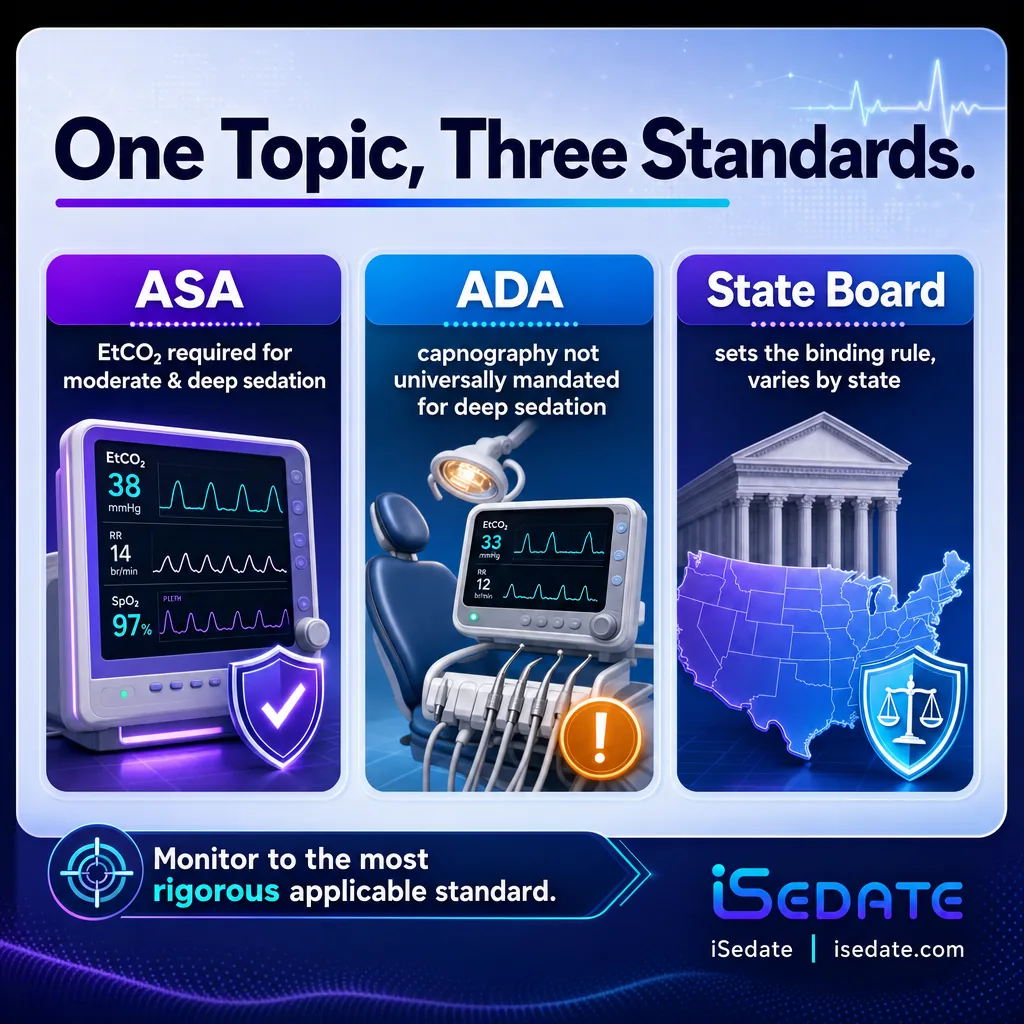
- Current ASA standards call for end-tidal CO2 (capnography) during moderate and deep sedation, and multiple societies strongly recommend it for procedural sedation.
- A documented gap exists between ASA and ADA standards on capnography for deep sedation in the dental office.
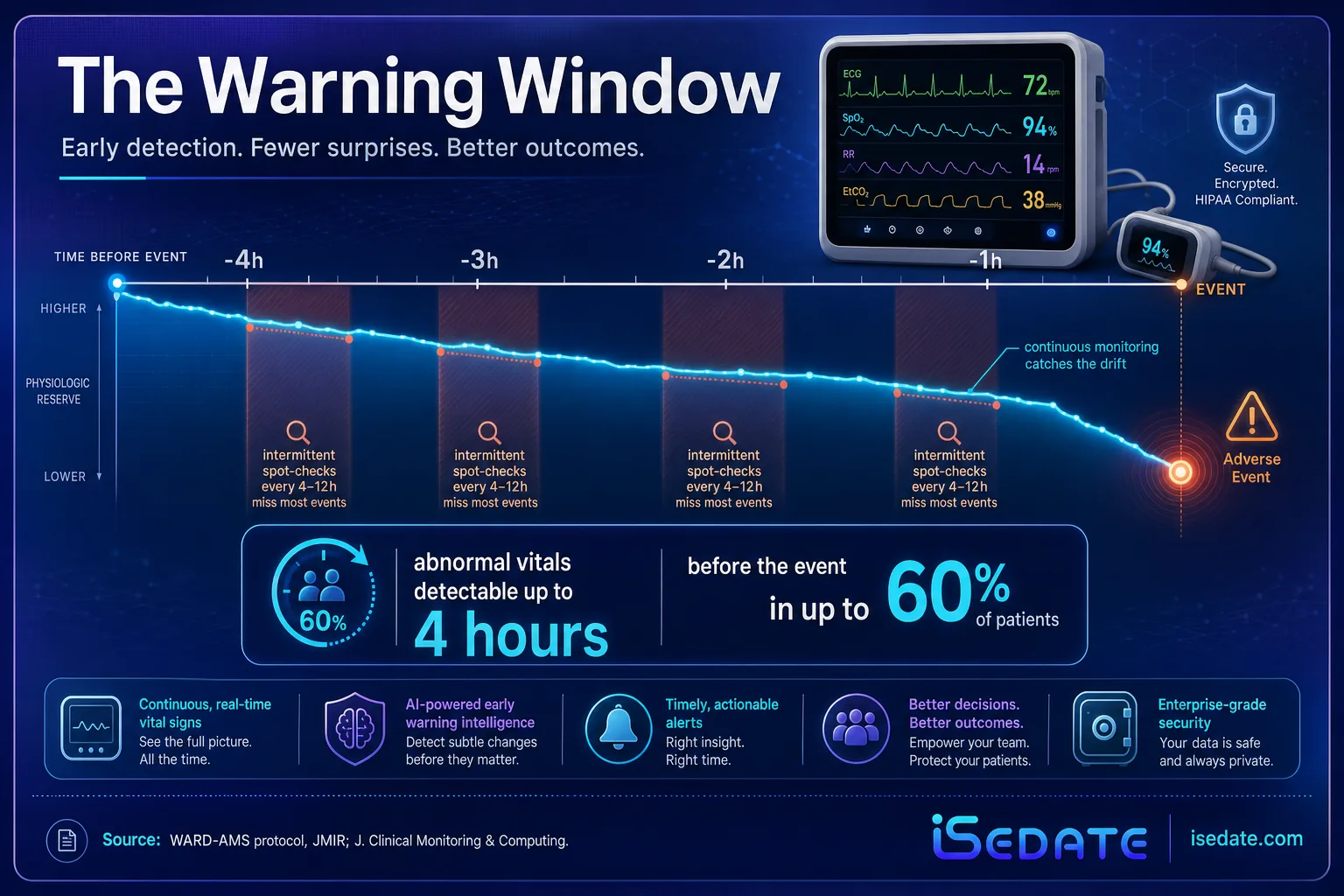
- Abnormal vital signs are detectable in up to 60% of patients up to 4 hours before a serious adverse event.
- Intermittent spot-checks performed every 4 to 12 hours miss most hypoxemic and hypotensive events.
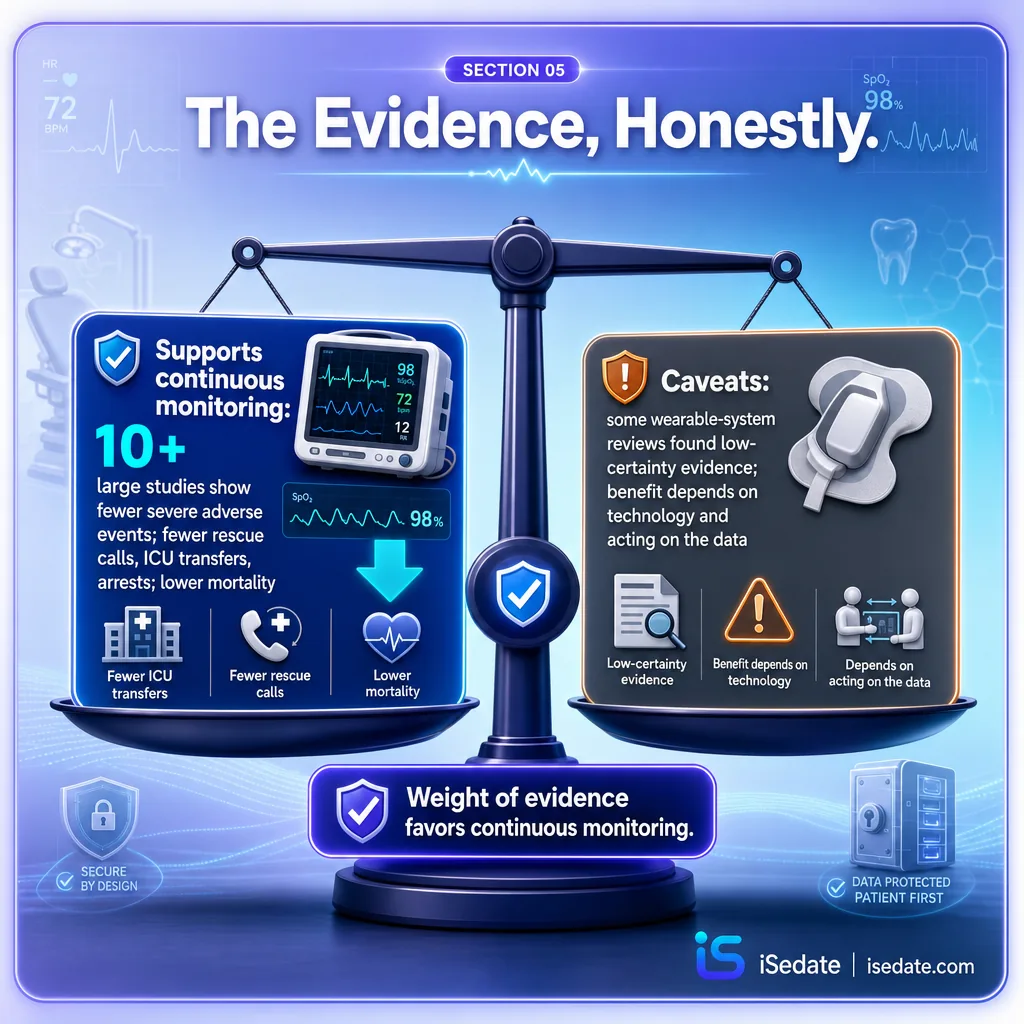
- At least 10 large studies show significant reductions in severe adverse events with continuous vital signs monitoring, though some wearable-specific reviews found low-certainty evidence.
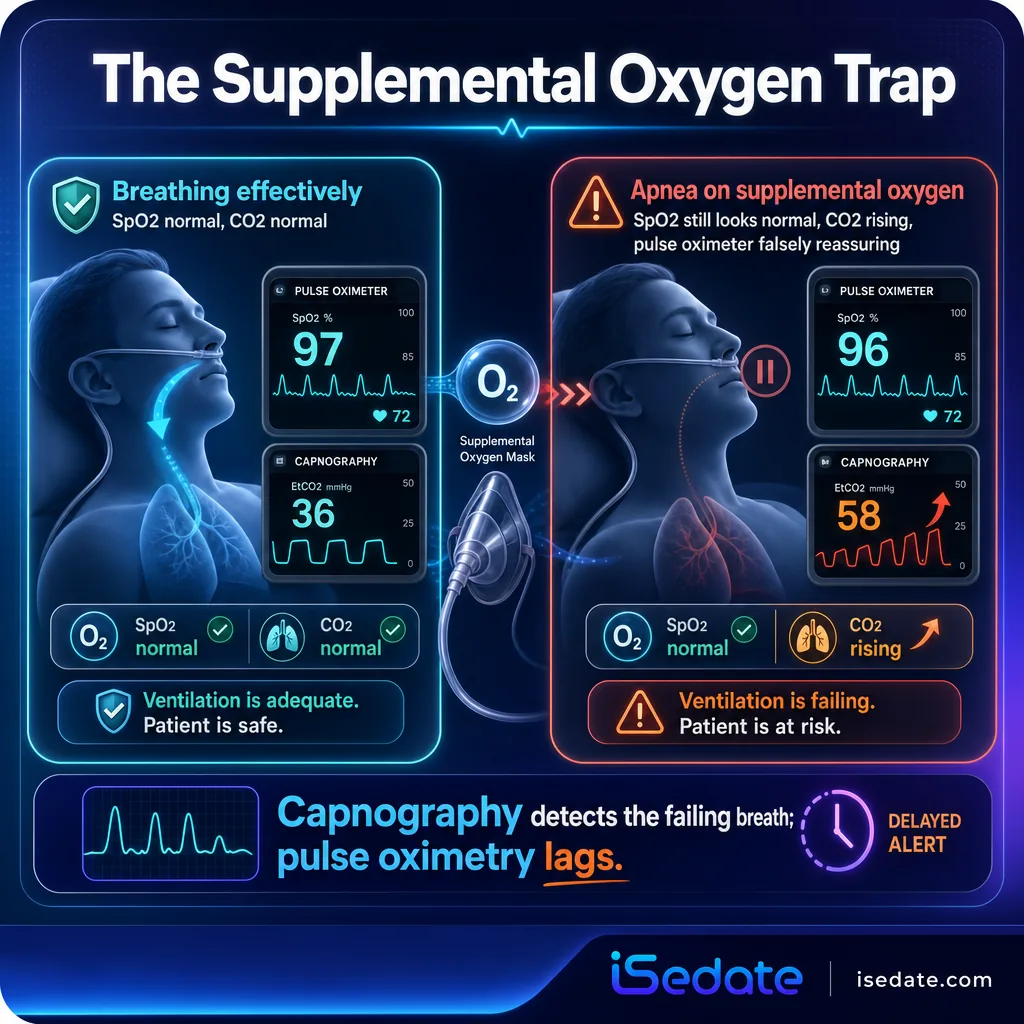
- Supplemental oxygen can mask apnea on pulse oximetry, which is why capnography is superior for detecting hypoventilation in oxygenated patients.
What's in This Guide
01 The Vital Signs That Must Be Monitored
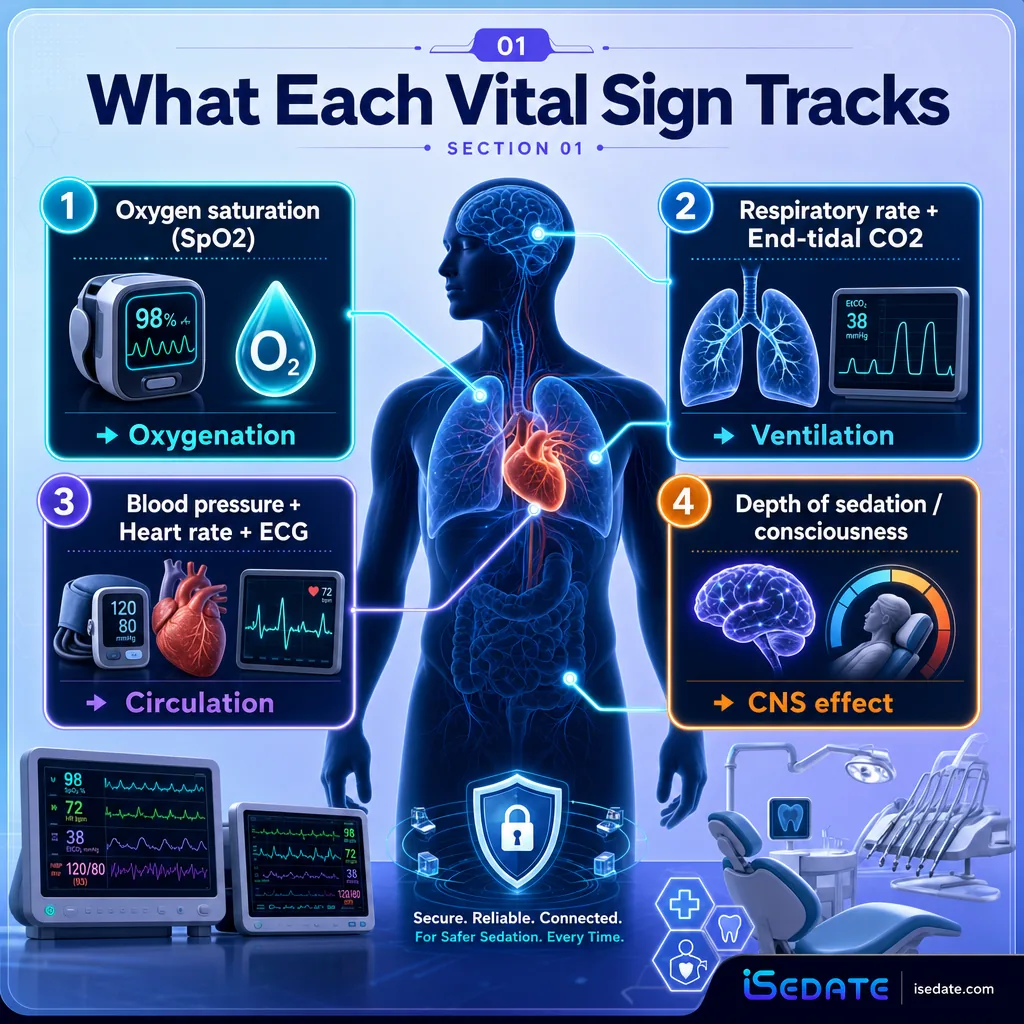
Sedation monitoring is built on a defined set of physiologic variables, each chosen because it reflects a different failure mode. The ASA's framework for monitoring during moderate sedation lists the core parameters explicitly, and they map directly to the systems most likely to be depressed by sedative drugs.
Each signal answers a specific question. Oxygen saturation by pulse oximetry tracks oxygenation. Respiratory rate and end-tidal CO2 track ventilation. Blood pressure and heart rate, supported by ECG when indicated, track circulation. Depth of sedation, assessed against the ASA definitions of moderate and deep sedation, tracks the central nervous system effect that drives everything else. Level of consciousness and response to stimulation round out the picture, because a patient drifting deeper is the upstream cause of most respiratory and cardiovascular trouble.
It is easy to think of vital signs as purely numeric, but depth of sedation is a monitored parameter in its own right. Because sedation is a continuum, a patient can slip from moderate to deep sedation, and the required monitoring intensifies as they do. A provider permitted only for moderate sedation is expected to recognize and reverse that drift, which is why level of consciousness is tracked alongside the numbers.
Source: ASA Statement on Moderate Sedation monitoring | Procedural Sedation overview (Medscape)
See vitals capture in the anesthesia record
02 The Standards: ASA, ADA, and the Gap
Here the picture gets more nuanced, because there is no single national rulebook. The ASA standards for basic anesthetic monitoring are the most rigorous reference point, and they were strengthened to address ventilation specifically.
Under the ASA standards, blood oxygenation is assessed with pulse oximetry with an audible alarm, and during moderate and deep sedation the adequacy of ventilation is evaluated by continual observation plus end-tidal CO2 monitoring. Multiple societies echo this, describing capnography as strongly recommended for procedural sedation. But a documented tension exists: because the ASA regards all dentists as nonanesthesiologists, and the ADA guidelines historically did not mandate capnography for deep sedation in the private oral surgery office, the standard a provider is held to can differ by professional body and, ultimately, by state board. This is not a reason to do less; it is a reason to know exactly which standard applies to you.
There isn't. The ASA, the ADA, and individual state boards can specify different monitoring requirements, particularly around capnography for deep sedation. A provider following one body's guideline may not automatically meet another's, and it is the state board's rule that is legally binding. The safe posture is to monitor to the most rigorous applicable standard and document all of it, rather than to the minimum any one body allows.
Source: ASA Standards for Basic Anesthetic Monitoring | The ASA CO2 Monitoring Mandate for Sedation (NCBI)
See how SedationVault documents to standard
03 Continuous vs Intermittent Monitoring
The single most important finding in the vital signs literature is not about which parameter matters most, but about how often it is measured. Patients rarely crash without warning. Their vitals drift first, and whether anyone sees that drift depends on whether monitoring is continuous or intermittent.
Research on hospital wards found abnormal vital signs detectable in up to 60% of patients as long as four hours before a serious adverse event. Because most deterioration is gradual, the gap between spot-checks is where events hide. Prospective studies using blinded continuous monitoring consistently show that routine intermittent checks miss most hypoxemic and hypotensive events. While ward data is not identical to a sedation appointment, the principle transfers directly: sedation is a period of expected physiologic depression, and the whole point of continuous monitoring is to compress the time between a change and its recognition.
Two findings from ward monitoring research combine into a clear principle for sedation. First, abnormal vitals precede serious events by up to 4 hours in up to 60% of patients. Second, intermittent spot-checks miss most hypoxemic and hypotensive events. During active sedation, physiologic change happens faster than on a ward, which compresses the available warning window and makes the case for continuous, automatically recorded vitals stronger, not weaker, than in the ward studies where these findings originate.
Sources: Journal of Clinical Monitoring and Computing; continuous vital sign monitoring narrative review (British Journal of Anaesthesia). Calculation and interpretation original to iSedate.
Source: Early detection of clinical deterioration (Journal of Clinical Monitoring and Computing) | WARD-AMS continuous monitoring protocol (JMIR)
See SedationVault
04 The Supplemental Oxygen Trap
One monitoring pitfall deserves its own section because it is both common and counterintuitive. Supplemental oxygen, given routinely during many sedations, can make pulse oximetry look reassuring while a patient has actually stopped ventilating adequately.
The physiology is straightforward. Pulse oximetry measures oxygen saturation, not breathing. When a patient breathes supplemental oxygen, their blood can stay well-saturated for a time even after effective ventilation stops, so the oximeter reads normal while carbon dioxide climbs. Society guidelines are explicit that the use of supplemental oxygen during procedural sedation may prolong the recognition of apnea, and that capnography, which tracks exhaled CO2 in real time, is superior to pulse oximetry for assessing hypoventilation in these patients. This is the core clinical argument for adding ventilation monitoring to oxygenation monitoring rather than relying on saturation alone.
Source: Clinical Society Guidelines on Capnography Monitoring | Integrated Pulmonary Index monitoring study (NCBI)
See IV sedation charting with live vitals
05 What the Outcome Evidence Shows
It would be easy to claim continuous monitoring uniformly saves lives, but the honest evidence is strong and mixed, and saying so makes the real case more convincing. The weight of evidence favors continuous monitoring while acknowledging that not every study of every device shows a benefit.
On the positive side, at least 10 large clinical studies have demonstrated significant reductions in severe adverse events when heart rate, blood pressure, oxygen saturation, or respiratory rate are continuously monitored, and narrative reviews report fewer rescue calls, fewer ICU transfers, lower cardiac arrest rates, and reduced postoperative mortality. On the cautious side, a Making Healthcare Safer review found no strong evidence that certain wearable systems improve outcomes, and a Cochrane review found low-certainty evidence that early warning scores and rapid response systems may have little to no impact on some outcomes. The reconciliation is that the benefit is real but depends on the technology, the alarm strategy, and crucially on whether the data is acted upon.
The mixed ward evidence concerns detecting slow deterioration over hours. Active sedation is a different, higher-intensity context where physiologic change is faster and the monitored window is short, which is why continuous monitoring during sedation rests on both the outcome literature and the direct detection advantage of capnography over pulse oximetry. iSedate's SedationVault captures live vitals from compatible monitors, including Edan, MindRay, Criticare, and more (the Edan X10 is a common example), recording every parameter continuously and producing a one-click, audit-ready PDF of the case.
Source: Continuous vital sign monitoring narrative review (British Journal of Anaesthesia) | Patient Monitoring Systems to Prevent Failure to Rescue (NCBI)
Book a Demo
06 Summary Table: Every Statistic
| Statistic | Figure | Source | Year |
|---|---|---|---|
| Core monitored sedation parameters | BP, RR, SpO2, HR, depth | ASA moderate sedation statement | 2025 |
| ECG monitoring | High-risk / deep / prolonged | Procedural sedation overview (Medscape) | 2025 |
| End-tidal CO2 under ASA standards | Moderate & deep sedation | ASA basic anesthetic monitoring | 2025 |
| ADA capnography stance for deep sedation | Not universally mandated | ASA CO2 mandate analysis (NCBI) | 2011 |
| Patients with abnormal vitals before an event | Up to 60% | WARD-AMS protocol (JMIR) | 2025 |
| Lead time of abnormal vitals before event | Up to 4 hours | WARD-AMS protocol (JMIR) | 2025 |
| Typical spot-check interval | 4-12 hours | Corsano / J. Clinical Monitoring & Computing | 2024 |
| Events missed by intermittent spot-checks | Most hypoxemic/hypotensive | J. Clinical Monitoring & Computing | 2024 |
| Large studies showing reduced adverse events | At least 10 | J. Clinical Monitoring & Computing | 2024 |
| Postoperative in-hospital mortality on general wards | >70% | WARD-AMS protocol (JMIR) | 2025 |
| Outcomes improved with continuous monitoring | Fewer RRT, ICU, arrests | British Journal of Anaesthesia review | 2025 |
| Wearable-system outcome evidence | Low certainty (some reviews) | Making Healthcare Safer IV (NCBI) | 2021 |
| Supplemental oxygen effect on apnea recognition | May prolong recognition | Clinical Society Guidelines (capnography) | 2017 |
| Capnography vs pulse oximetry for hypoventilation | Superior | Clinical Society Guidelines (capnography) | 2017 |
| Nurse time on intermittent monitoring per patient/day | Median 14 min | British Journal of Anaesthesia review | 2025 |
07 Frequently Asked Questions
What vital signs must be monitored during sedation?
Is capnography required for sedation?
How much earlier does continuous monitoring detect problems?
Why is supplemental oxygen a monitoring challenge?
Does continuous vital signs monitoring reduce adverse events?
All figures trace to primary or peer-reviewed sources. Some outcome data comes from hospital-ward monitoring research and is applied to sedation by analogy, which is noted where relevant. Sources include:
- ASA, "Standards for Basic Anesthetic Monitoring" and moderate sedation statements
- "The Latest ASA Mandate: CO2 Monitoring for Moderate and Deep Sedation" (NCBI)
- Clinical Society Guidelines on Capnography Monitoring (multi-society ebook)
- WARD-AMS continuous vital sign monitoring protocol (JMIR Research Protocols, 2025)
- "New sensors for the early detection of clinical deterioration" (Journal of Clinical Monitoring and Computing, 2024)
- "Continuous vital sign monitoring of patients recovering from surgery: a narrative review" (British Journal of Anaesthesia, 2025)
- "Patient Monitoring Systems to Prevent Failure to Rescue," Making Healthcare Safer IV (NCBI)
- Procedural Sedation overview (Medscape) and Integrated Pulmonary Index study (NCBI)
Sedation safety starts with capturing the right parameters continuously and recording them. iSedate's SedationVault pulls live vitals from compatible monitors, builds the record as the case proceeds, and produces audit-ready documentation for every procedure. To see how it works in your practice, book a demo.