







What Is Oral Sedation? How It Works, Types, and What to Expect
Oral sedation is medication you take by mouth, as a pill or liquid, to stay calm and relaxed during a dental or medical procedure. You remain awake and able to respond, just drowsy and far less anxious, which is why it is often called a form of conscious sedation. It sits between laughing gas and IV sedation: stronger and longer-lasting than nitrous oxide, but without the needle, line, or deeper effect of sedation given into a vein.
- Oral sedation is a sedative taken by mouth before a procedure to ease anxiety while you stay awake and responsive.
- The medicines are almost always benzodiazepines, and the dose sets the depth: minimal (lightly relaxed) or moderate ("conscious sedation").
- It is slower to start and harder to fine-tune than IV sedation, because once a pill is swallowed the dose cannot be dialed back.
- Expect to fast beforehand, bring a driver, and plan on about a full day to recover.
- Safe sedation depends on monitoring your heart rate, blood pressure, and oxygen, and on recording the drug, dose, and timing accurately.

What's in This Guide
- What Oral Sedation Is
- How Oral Sedation Works
- The Levels of Sedation, and Where Oral Fits
- The Types of Oral Sedation
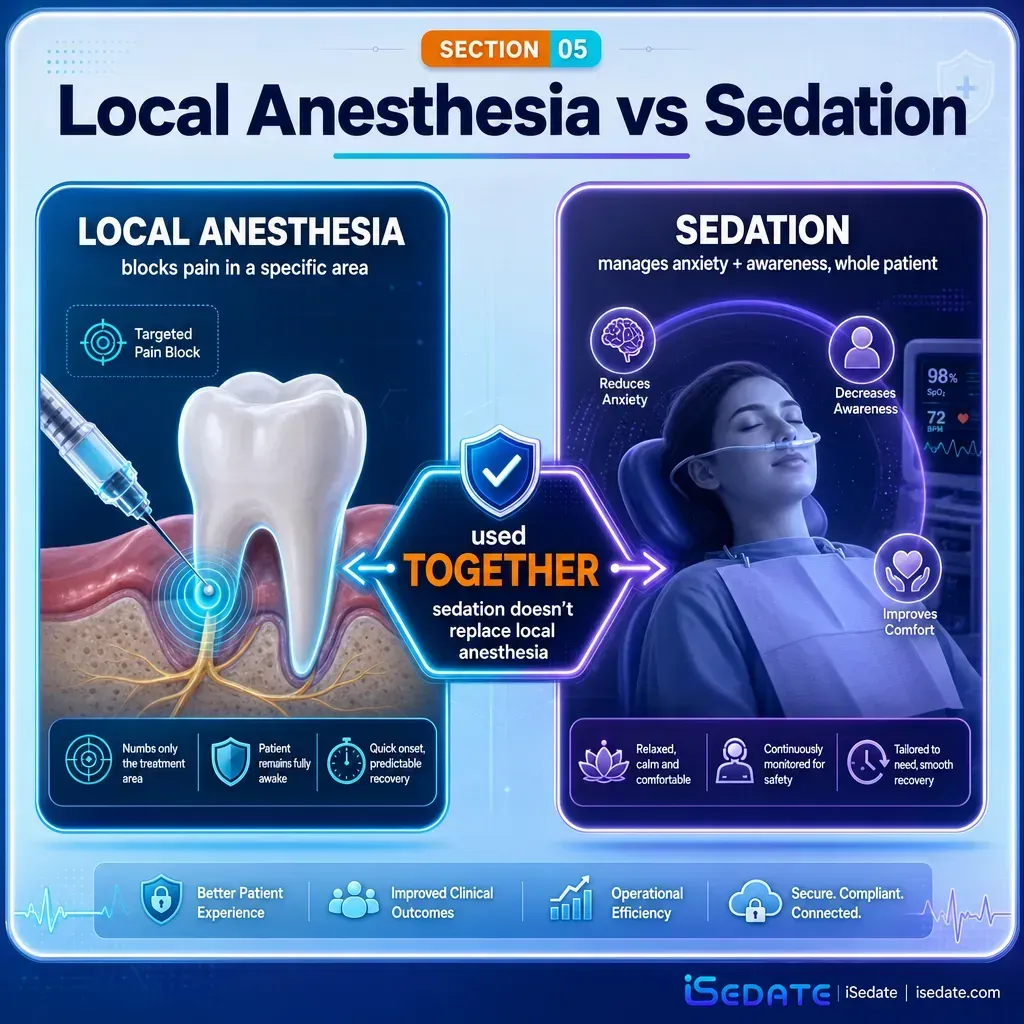
- Oral Sedation vs. Nitrous, IV, and General Anesthesia
- Why Patients Choose Oral Sedation
- What to Expect: Before, During, and After
- Is Oral Sedation Safe?
- For Providers: Documenting Oral Sedation Safely
- Frequently Asked Questions
- Related Reading
What Oral Sedation Is
"Oral" just means the medicine is taken by mouth, swallowed as a tablet or a liquid, rather than breathed in or injected. The goal is not to knock you out. It is to take the edge off, relax your body, and quiet the anxiety that keeps many people out of the dental chair altogether.
Definition. Oral sedation is a form of conscious sedation in which a patient takes a sedative by mouth, as a pill or liquid, before a dental or medical procedure. It eases anxiety and keeps the patient relaxed and drowsy but awake and able to respond, without the needle or intravenous line of IV sedation.
Because it is swallowed, oral sedation is sometimes called enteral sedation (through the gut) to separate it from parenteral sedation given by injection or into a vein. It is the most common way to provide moderate sedation in a dental office, largely because it needs no needle and no special delivery equipment: the patient takes a prescribed pill, and the medicine does the rest.
Source: American Society of Anesthesiologists: Continuum of Depth of Sedation
How Oral Sedation Works
The medicines used for oral sedation are almost always benzodiazepines, the same drug family used to treat anxiety. Common choices in dentistry include triazolam, diazepam, lorazepam, and midazolam. They calm the central nervous system, which lowers anxiety, relaxes the muscles, and often blurs the memory of the appointment, so the visit feels shorter and less stressful than it was.
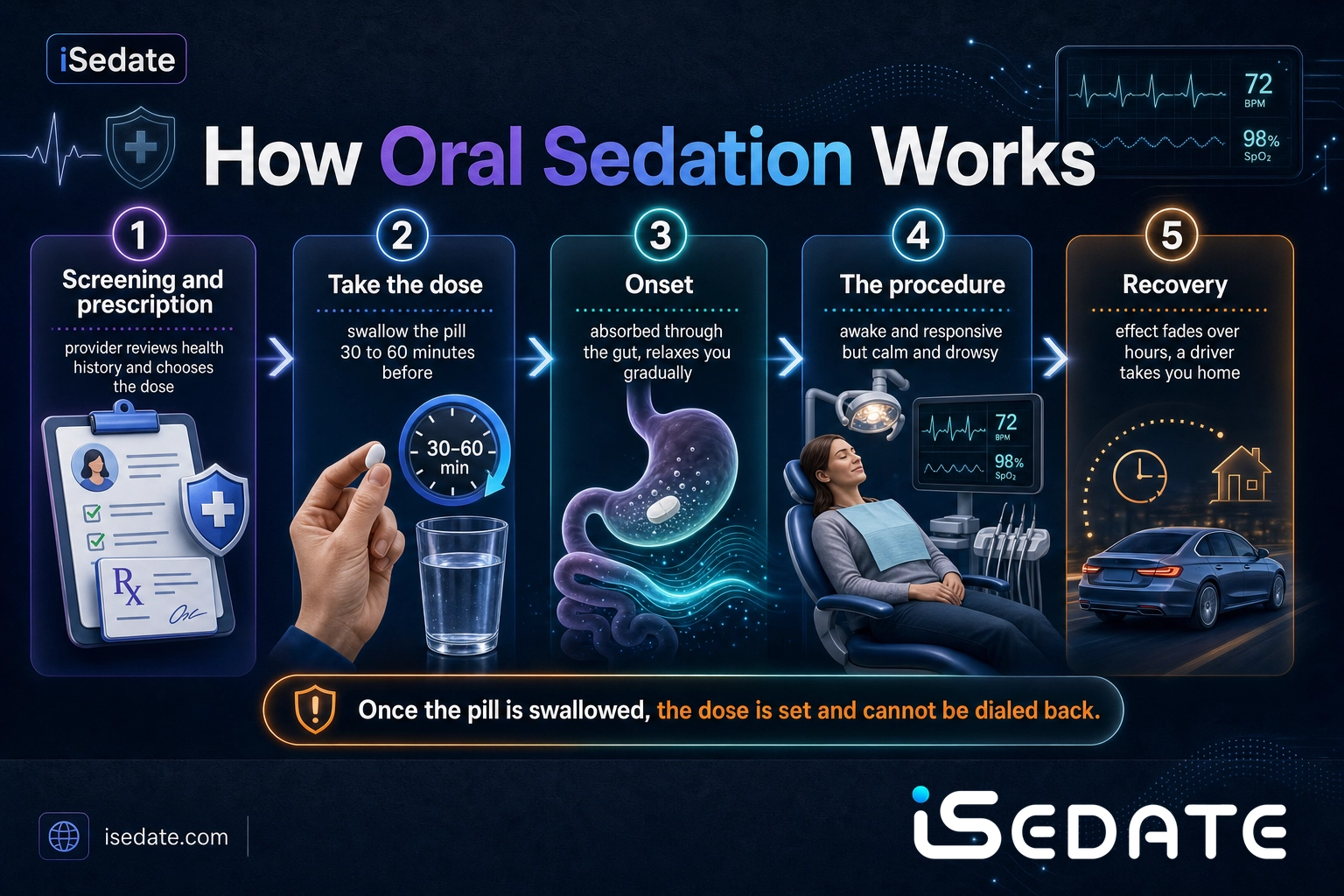
In practice, it follows a simple sequence:
- Screening and prescription. The provider reviews your health history, current medications, and allergies, then selects a drug and dose matched to you and the procedure.
- Taking the dose. You take the sedative by mouth, usually about 30 to 60 minutes before the appointment. For very anxious patients, a provider sometimes prescribes a dose the night before to help with sleep as well.
- Onset. The medicine is absorbed through the stomach and gut, so it takes effect gradually rather than instantly. Over the next half hour or so, you feel increasingly relaxed and drowsy.
- The procedure. You stay awake and can answer questions and follow instructions, but you feel calm and detached. The team monitors you and carries out the treatment.
- Recovery. The effect fades slowly over the following hours. Because it lingers, someone else drives you home and stays with you.
The single most important thing to understand about oral sedation is that its biggest strength is also its biggest limitation: once a pill is swallowed, the dose is set. A provider cannot reach in and reduce it the way they can taper a medicine delivered into a vein. That is why careful screening, correct dosing, and steady monitoring matter so much, and why the record of exactly what was given, and when, is part of the safety picture rather than an afterthought.
Source: Cleveland Clinic: Sedation Dentistry | American Society of Anesthesiologists
The Levels of Sedation, and Where Oral Fits
Sedation is not a single on-or-off state. It is a continuum, and the American Society of Anesthesiologists defines four points along it by how you respond, whether your airway and breathing need help, and how your heart is doing. Oral sedation usually lands in the first two: minimal and moderate.
| Level | How you respond | Airway and breathing | Where oral sedation fits |
|---|---|---|---|
| Minimal (anxiolysis) | Normal response to speech | Unaffected | A single low dose; you are relaxed but fully with it |
| Moderate ("conscious sedation") | Purposeful response to voice or light touch | No help needed; breathing adequate | A higher or repeated dose; drowsy, often little memory |
| Deep | Responds only to repeated or painful stimulation | May need help; breathing may be inadequate | Not the usual target for oral sedation |
| General anesthesia | Cannot be roused, even by pain | Help often required; breathing frequently inadequate | A different technique entirely, not oral sedation |
"Conscious sedation" is just the everyday name for moderate sedation: you are conscious and can respond, and you feel very relaxed. The dividing line matters because sedation levels can drift deeper than planned. A dose meant to be minimal can tip a patient into moderate sedation, which is exactly why the provider watches your responsiveness and vital signs rather than assuming the level stays put.
Source: American Society of Anesthesiologists: Continuum of Depth of Sedation
The Types of Oral Sedation
People use "oral sedation" as one phrase, but there are a few distinct ways it is delivered. They differ mainly in dose and in whether anything else is added.
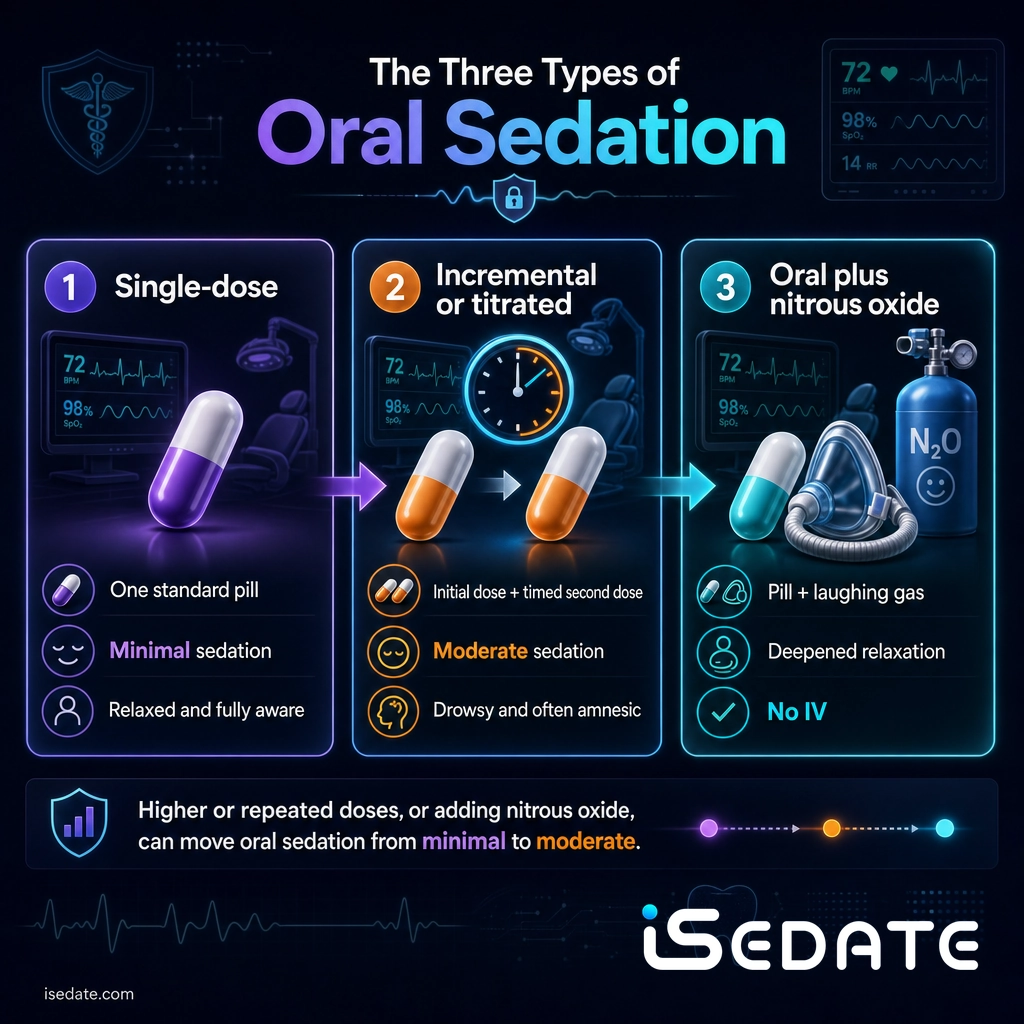
| Type | What it involves | Typical depth |
|---|---|---|
| Single-dose (minimal) | One standard dose of a sedative pill before the visit | Minimal: relaxed, fully aware |
| Incremental or titrated | An initial dose, then a carefully timed second dose if needed | Moderate: drowsy, often amnesic |
| Oral plus nitrous oxide | A sedative pill combined with inhaled laughing gas | Minimal to moderate, deepened by the gas |
The dental guidelines draw a clear line here. The American Dental Association ties the level to dose: a sedative given by mouth within the FDA maximum recommended dose is treated as minimal sedation, while a higher dose, repeated dosing, or combining an oral drug with laughing gas can cross into moderate sedation, which carries stricter monitoring requirements. The widely used dental version that pairs a pill with nitrous oxide is often called oral conscious sedation, and it is popular precisely because the two together produce reliable relaxation without an IV.
Oral sedation is also one of several options a practice offers. If you are weighing it against laughing gas or IV sedation, our guide to the types of sedation dentistry lays out the full menu side by side.
Source: American Dental Association: Guidelines for the Use of Sedation and General Anesthesia by Dentists
Oral Sedation vs. Nitrous, IV, and General Anesthesia
The fastest way to understand oral sedation is to see it next to the alternatives. Each option trades speed and control for convenience in a different way.
| Option | How it is given | Onset and control | Recovery |
|---|---|---|---|
| Nitrous oxide (laughing gas) | Inhaled through a nose mask | Fast, adjusted breath by breath | Clears in about 15 to 30 minutes; you can usually drive home |
| Oral sedation | Swallowed pill or liquid | Gradual; dose is fixed once taken | Lingers; plan on about a full day and a driver |
| IV sedation | Into a vein | Near-immediate; adjustable dose by dose | Lingers; a driver and a recovery day are required |
| General anesthesia | IV or inhaled, by an anesthesia provider | Fully unconscious; most controlled | Longest; dedicated recovery and monitoring |
In short, nitrous is the lightest and quickest to leave your system, general anesthesia is the deepest, and oral and IV sedation sit in the middle. The practical difference between the two middle options is control: with IV sedation a provider can fine-tune the depth in real time, while oral sedation is set the moment the pill goes down. If you want the full breakdown of the deepest end, see how conscious sedation and general anesthesia differ.
Source: Cleveland Clinic: Sedation Dentistry
Why Patients Choose Oral Sedation
Dental fear is common, and for many people it is the reason care gets delayed for years. A 2021 systematic review and meta-analysis of 31 studies, covering more than 72,000 adults, estimated that about 15 percent of adults experience dental fear and anxiety, with roughly 3 percent experiencing it severely. Oral sedation exists to make treatment possible for exactly those patients.
Beyond anxiety, oral sedation helps with several common situations:
- Dental anxiety or phobia, where fear alone keeps someone from getting needed care. If that is you, these strategies to manage dental anxiety pair well with sedation.
- A strong gag reflex that makes routine work difficult or impossible.
- Long or complex appointments, where staying relaxed in the chair for an extended time is hard.
- Difficulty getting numb or a low pain threshold.
- A preference to avoid needles, since oral sedation needs no IV to start.
What to Expect: Before, During, and After
Oral sedation is routine, but it is still a medicated procedure, so a little preparation makes it go smoothly. Here is the arc of a typical visit.
Before
Your provider will give specific instructions, which usually include fasting for a set number of hours, pausing or adjusting certain medications, and arranging a responsible adult to drive you to and from the appointment. You take the prescribed dose on the schedule they give you, commonly about an hour before treatment.
During
Once the sedative takes hold, you feel calm and drowsy but remain able to respond. The team monitors your vital signs throughout, typically tracking heart rate, blood pressure, and blood-oxygen level, and keeps you comfortable while they work. Many patients remember little of the appointment afterward, which is a normal and intended effect.
After
The medicine wears off slowly. The Cleveland Clinic advises that full recovery from oral or IV sedation generally takes about 24 hours, and that patients should wait a full day before driving, returning to work or school, or making important decisions.
While the sedative is still in your system you may feel groggy, unsteady, or forgetful. Do not drive, operate machinery, drink alcohol, or sign anything important until the next day, and have someone stay with you for the first several hours. Follow your provider's instructions over any general timeline, since individual responses vary.
Source: Cleveland Clinic: Sedation Dentistry
Is Oral Sedation Safe?
For healthy patients who are properly screened and monitored, oral sedation is widely regarded as safe. The main risk is that the medicine can slow your breathing, which is why a trained team watches your oxygen level and breathing the entire time and is prepared to respond if either dips. Allergic reactions are possible but uncommon, and most people feel nothing worse than drowsiness afterward.
Myth: oral sedation is risk-free because it is "just a pill."
Reality: a swallowed sedative is a real medication with real effects on breathing and alertness. Its safety comes from screening, correct dosing, and continuous monitoring, not from the fact that it is taken by mouth. A pill is harder to adjust than an IV, not safer by default.
Some patients are not good candidates, or need extra caution. Sedation dentistry is generally not recommended during pregnancy, because some sedatives can affect fetal development, and conditions that affect the heart, lungs, or airway call for careful review first. An honest health history is the most important safety step you can take, so tell your provider about every medication, supplement, and condition before the appointment.
Source: Cleveland Clinic: Sedation Dentistry | American Society of Anesthesiologists
For Providers: Documenting Oral Sedation Safely
From the patient's chair, oral sedation is a comfort question. From behind the chair, it is a documentation question. Because the dose is fixed the moment the pill is swallowed and cannot be dialed back, the record of exactly which drug was given, at what dose, at what time, alongside the vital signs captured throughout, is the backbone of a safe, defensible sedation visit.
The level of sedation can drift deeper than intended, and the safe maximum dose changes when a local anesthetic is layered on top. That makes real-time charting of the agent, dose, timing, and vitals a safety control, not paperwork. A clean, timestamped record answers a patient's question today and protects the practice if a board or malpractice carrier ever asks tomorrow.
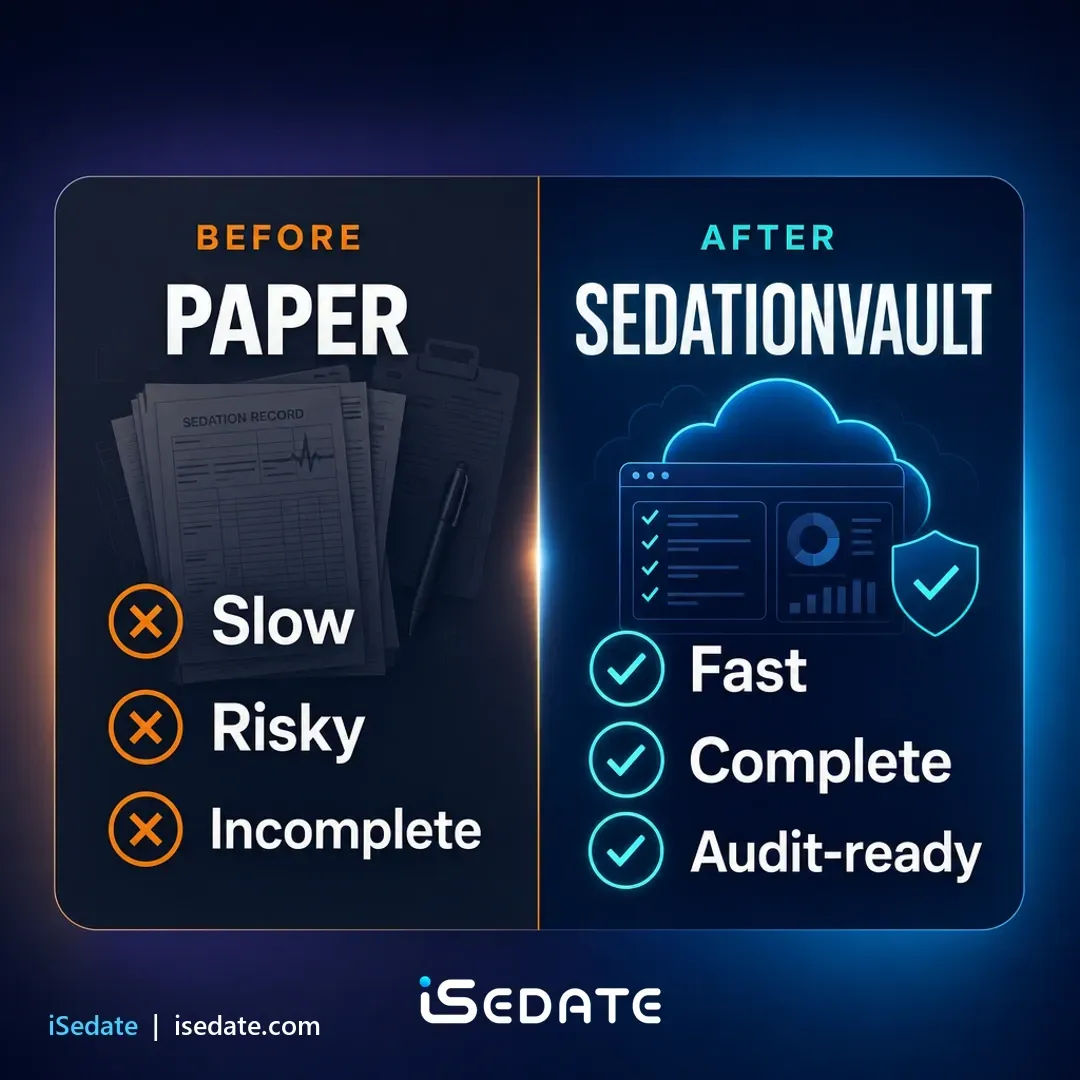
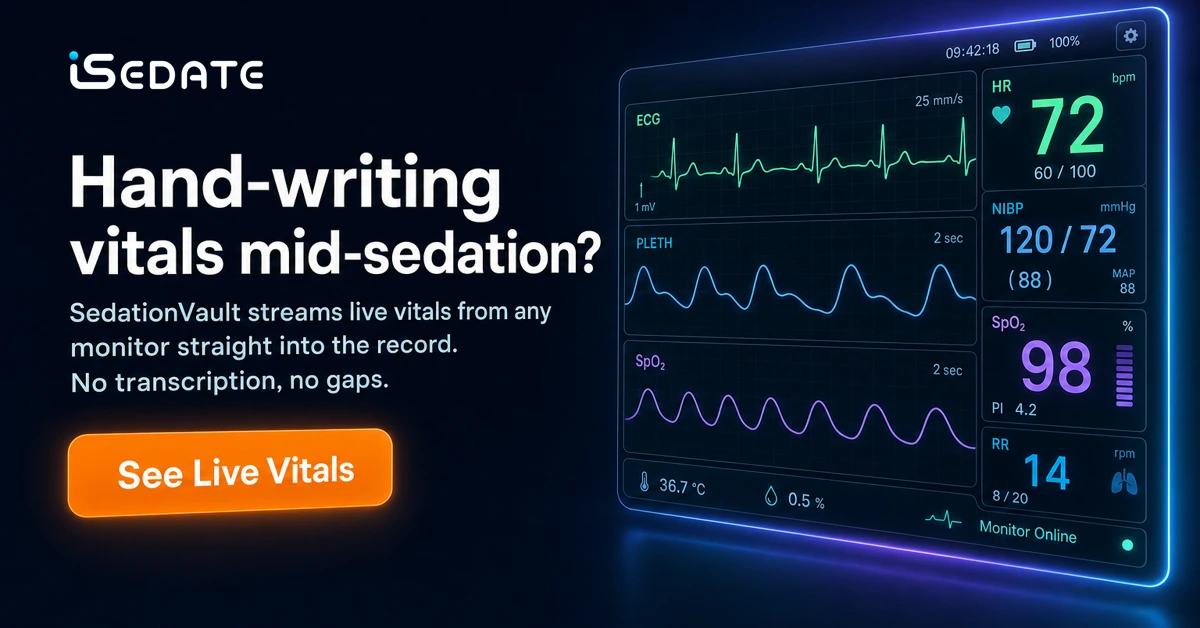
That is the job iSedate's SedationVault was built for. It captures the full sedation visit in real time, integrates with the vitals monitor already in the operatory, tracks dosage and the drug log, and produces an audit-ready PDF, so the sedation a patient received is never reconstructed from memory after the fact.
See how SedationVault charts the sedation visit
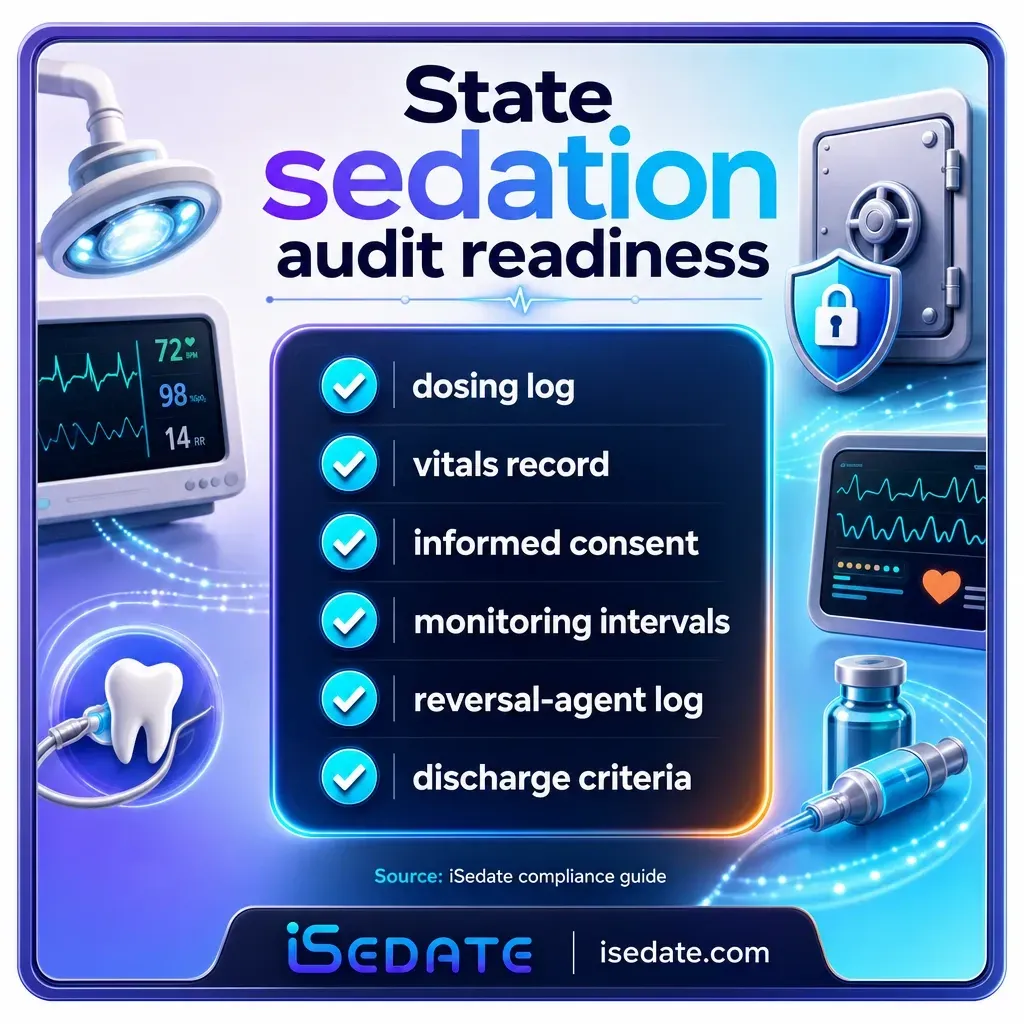
It pairs purpose-built charting for the oral sedation record with the broader sedation visit record and dental sedation compliance, all in one system that stays ready for a state audit.
Book a demo to see audit-ready sedation records
Frequently Asked Questions
What is oral sedation?
Does oral sedation put you to sleep?
How long does oral sedation take to wear off?
Is oral sedation safe?
What is the difference between oral sedation and IV sedation?
Related Reading
- More oral sedation guides for patients and providers.
- The full sedation dentistry blog, covering oral, IV, and local anesthesia.
- IV sedation guides, for the deeper, adjustable option.
Methodology and sources. The definitions of the four sedation levels, including minimal and moderate ("conscious") sedation, come from the American Society of Anesthesiologists' Continuum of Depth of Sedation statement. The dose-based dividing line for enteral (oral) minimal versus moderate sedation comes from the American Dental Association's Guidelines for the Use of Sedation and General Anesthesia by Dentists. Recovery timing, monitoring, and candidacy guidance come from the Cleveland Clinic's sedation dentistry patient resource. The dental-fear prevalence figure is the pooled estimate from a 2021 systematic review and meta-analysis published in the Journal of Dentistry. All timings and effects are typical ranges; individual results vary with the drug, dose, and patient. This article is general information, not medical advice; follow the guidance of your own dentist, surgeon, or anesthesia provider.
Sources: American Society of Anesthesiologists: Continuum of Depth of Sedation | American Dental Association: Guidelines for the Use of Sedation and General Anesthesia by Dentists | Cleveland Clinic: Sedation Dentistry | Journal of Dentistry (2021): Estimated prevalence of dental fear in adults