







Aetna Dental Insurance Reviews: Ratings, Complaints & Is It Worth It?
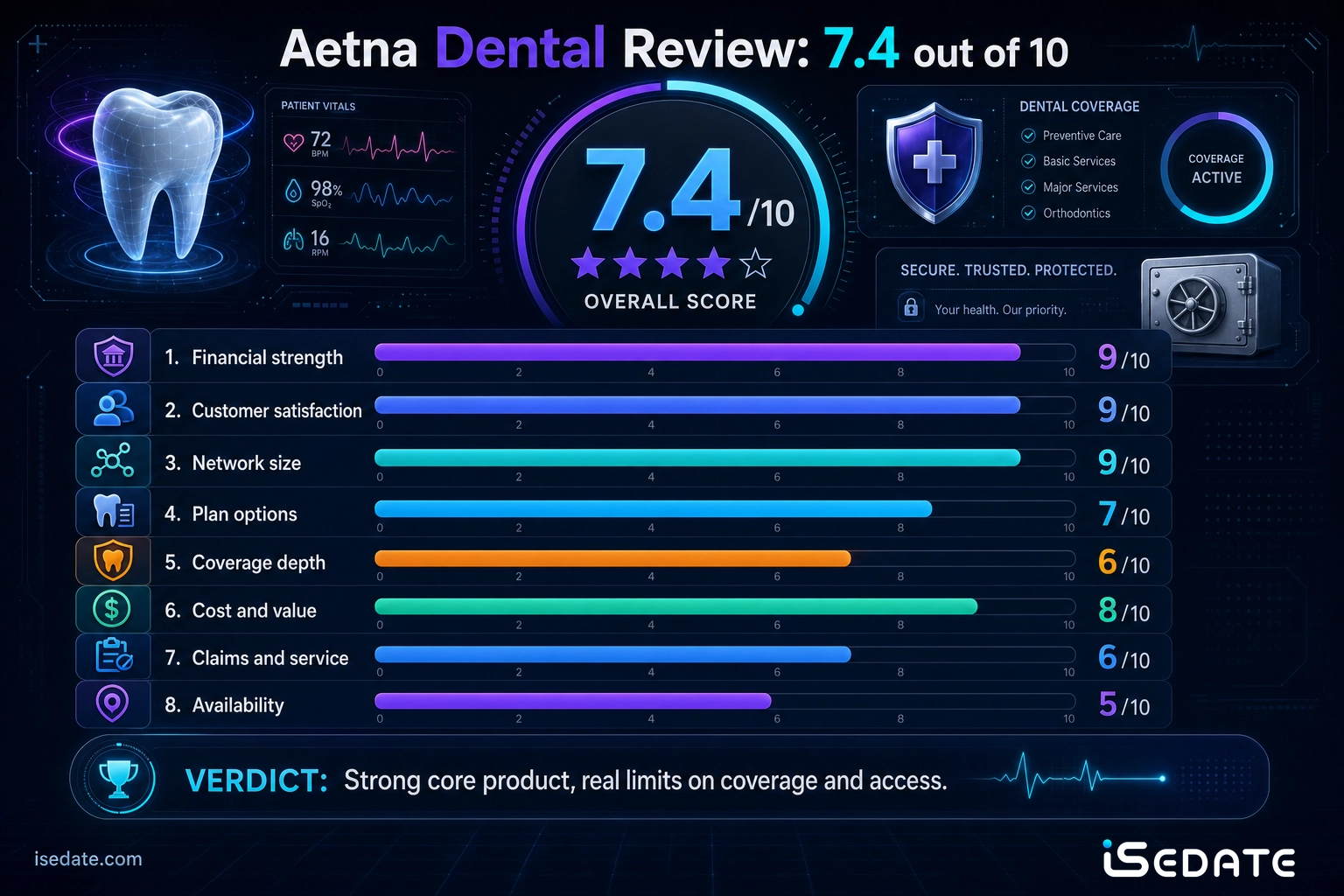
Aetna dental insurance is a solid, mainstream choice for most people: it ranked first in the 2023 J.D. Power U.S. Dental Plan Satisfaction Study, its parent insurer carries an A (Excellent) financial strength rating from AM Best, and its PPO network covers more than 600,000 dentist locations. The honest catch is that individual plans cap annual benefits at $1,000 to $2,000, skip orthodontia and implants, and draw steady complaints about claim handling. Our overall verdict: 7.4 out of 10.
- Ranked #1 in customer satisfaction in the 2023 J.D. Power U.S. Dental Plan Satisfaction Study, scoring 816 out of 1,000 (J.D. Power).
- Backed by an A (Excellent) AM Best rating, affirmed for Aetna Life Insurance Company in June 2026.
- Individual plans start at $17 per month (DMO) and run up to a $2,000 annual maximum on the Preferred 2000 PPO (Aetna).
- Preventive care is covered 100% with no deductible on the PPO plans; major work is covered 50% after a 12-month wait (Aetna).
- No orthodontia or implant coverage on the individual Direct plans, and availability is limited by state (Aetna).
- Common complaints center on claim denials, customer service, and waiting periods, the same claims-and-reimbursement pain point that scores lowest industry-wide.
What's in This Review
- Is Aetna Dental Good? The Short Answer
- What Is Aetna Dental Insurance?
- How We Evaluated Aetna Dental
- Aetna Dental Scorecard
- Aetna Dental Plans and Coverage
- What Aetna Dental Costs
- Satisfaction and Financial Strength
- Aetna Dental Complaints: What Customers Say
- Aetna vs Cigna Dental
- What It Means for Dental Practices and Big Procedures
- Who Aetna Dental Is Best For
- Final Verdict: Is It Worth It?
- Frequently Asked Questions
Is Aetna Dental Good? The Short Answer
Yes, for most shoppers Aetna dental is worth considering, as long as the plan you want is sold in your state and your dentist is in network. It earns its reputation on three things that are genuinely hard to fake: an independent satisfaction ranking, a strong financial backbone, and one of the largest dentist networks in the country.
Where Aetna is a weaker fit is for people who need extensive or specialty work. Individual Direct plans do not cover orthodontia or implants, major services are reimbursed at 50 percent after a one-year wait, and annual benefit caps of $1,000 to $2,000 run out quickly once a crown or two is involved. If that describes your situation, read the coverage limits carefully before you buy.
What Is Aetna Dental Insurance?
Aetna is one of the largest health insurers in the United States and a CVS Health company. Its dental arm sells individual and family dental plans (marketed as Dental Direct), along with the employer-group and Medicare Advantage dental coverage that many members get through work or a Medicare plan. This review focuses on the individual Dental Direct plans, since those are what most people mean when they search for Aetna dental reviews.
Aetna offers two plan structures. The PPO (preferred provider organization) plans let you see any licensed dentist and pay less in network, with the familiar deductible-and-coinsurance model. The DMO (dental maintenance organization) plan uses a primary care dentist, fixed copays, and no annual maximum, but only covers in-network care. Aetna says its PPO network includes more than 600,000 dentist locations nationwide, which is a real advantage when you want to keep your current dentist.
Source: Aetna individual dental plans
How We Evaluated Aetna Dental
A word on method, because it shapes how much weight to give this review. iSedate builds sedation charting and compliance software for dental and oral surgery practices; we are not a plan buyer and we did not purchase and clinically use an Aetna policy. So this is an evidence-based review, not a hands-on test. Every rating below is drawn from independent, verifiable sources rather than a single personal experience.
We weighed four categories of evidence:
- Independent satisfaction data: the J.D. Power U.S. Dental Plan Satisfaction Study, which surveys actual plan members.
- Financial strength ratings: AM Best, the insurance industry's primary ratings agency, which measures an insurer's ability to pay claims.
- Official plan documents: Aetna's own published premiums, annual maximums, deductibles, coverage percentages, and waiting periods.
- Aggregated customer feedback and complaint resources: consumer review themes and public complaint channels such as the Better Business Bureau and the NAIC Consumer Information Source.
Our scoring rubric rates Aetna on financial strength, customer satisfaction, network size, plan options, coverage depth, cost and value, claims and service, and availability. Each is scored out of 10, and the overall figure is a holistic read of the evidence rather than a strict average.
Aetna Dental Scorecard
Here is how Aetna's individual dental coverage scores across our rubric, with the evidence behind each mark.
| Category | Score | Why |
|---|---|---|
| Financial strength | 9/10 | AM Best A (Excellent), affirmed June 2026 |
| Customer satisfaction | 9/10 | #1 in the 2023 J.D. Power dental study (816/1,000) |
| Network size | 9/10 | 600,000+ dentist locations in the PPO network |
| Plan options | 7/10 | Three PPO tiers plus a DMO, but tiers vary by region |
| Coverage depth | 6/10 | $1,000 to $2,000 maximums; no ortho or implants on Direct plans |
| Cost and value | 8/10 | From $17/month; preventive care covered 100% |
| Claims and service | 6/10 | Recurring denial and service complaints in consumer reviews |
| Availability | 5/10 | Individual plans are not sold in every state or region |
| Overall | 7.4/10 | Strong core product, real limits on coverage and access |
Source: J.D. Power 2023 U.S. Dental Plan Satisfaction Study | AM Best rating action, June 2026
Aetna Dental Plans and Coverage
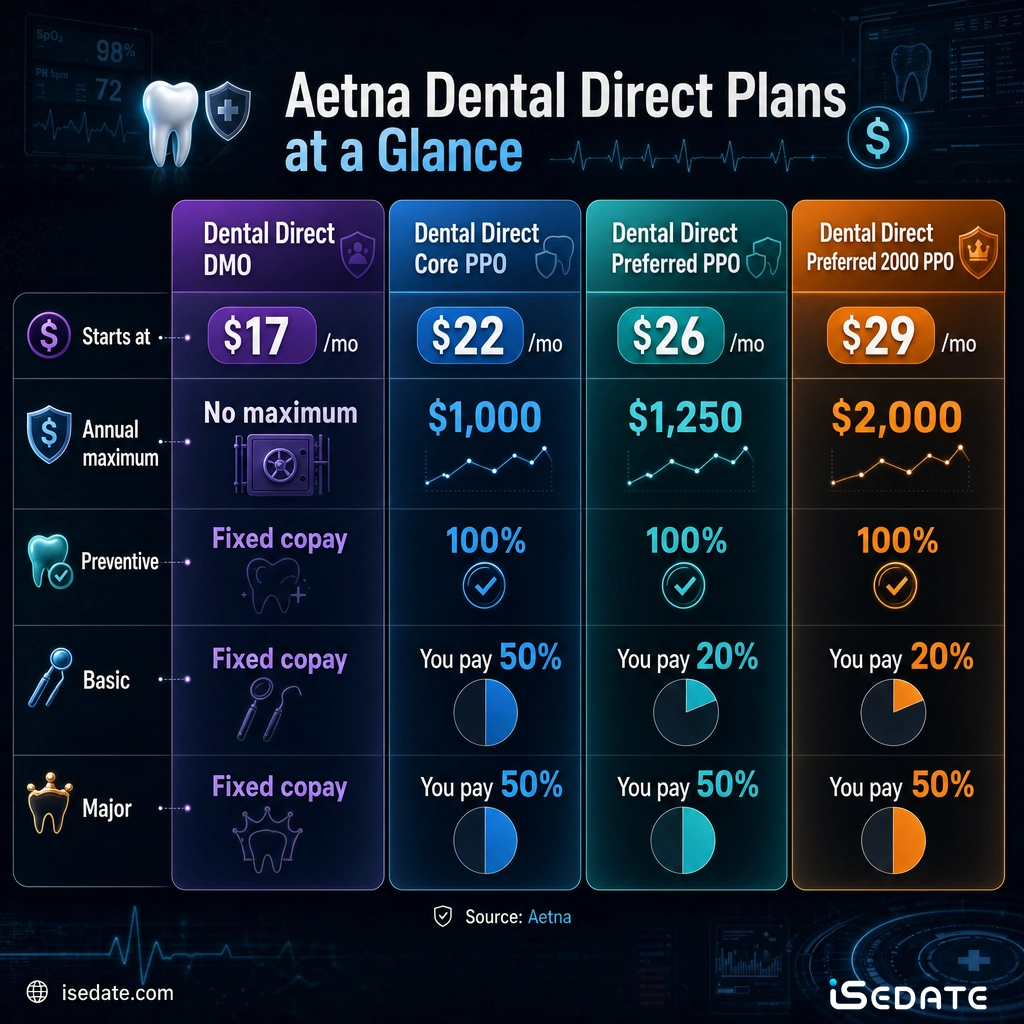
Aetna publishes four individual Dental Direct plans. The three PPO tiers share the same $50 individual deductible ($150 family) and the same coverage structure; they differ mainly in premium and annual maximum. The DMO trades flexibility for fixed copays and no benefit cap.
| Plan | Starts at | Annual max | Preventive | Basic | Major |
|---|---|---|---|---|---|
| Dental Direct Preferred 2000 PPO | $29/mo | $2,000 | 100% | You pay 20% | You pay 50% |
| Dental Direct Preferred PPO | $26/mo | $1,250 | 100% | You pay 20% | You pay 50% |
| Dental Direct Core PPO | $22/mo | $1,000 | 100% | You pay 50% | You pay 50% |
| Dental Direct DMO | $17/mo | No maximum | Fixed copay | Fixed copay | Fixed copay |
Preventive care (checkups, cleanings, and routine X-rays) is covered at 100 percent in network on the PPO plans, with the deductible waived. Basic services like fillings are covered at 80 percent on the two Preferred tiers and 50 percent on the Core tier. Major services such as crowns and root canals are covered at 50 percent across the board. Those percentages apply up to the plan's annual maximum, after which you pay the full cost.
Waiting periods matter here. On the PPO plans, preventive care has no wait, basic services have a 6-month wait, and major services have a 12-month wait. Aetna waives all waiting periods if every person on the plan had continuous dental coverage in the 90 days before the new plan starts. The DMO has no waiting periods at all.
Aetna Individual PPO Annual Maximums (In-Network)
Individual Direct plans do not cover orthodontia or implants
This trips up a lot of buyers. Aetna's individual Dental Direct PPO plans exclude orthodontia (braces) and dental implants entirely. Some employer-sponsored Aetna plans and the federal FEDVIP program do include orthodontia or implant benefits, so coverage you had through a job does not carry over to an individual Direct plan. If braces or implants are on your horizon, confirm the exact plan's summary of benefits before enrolling, and compare a carrier whose individual plan includes an orthodontia benefit.
Source: Aetna individual dental plans and pricing
What Aetna Dental Costs
Aetna's advertised starting premiums are among the lower end for name-brand carriers, which is a real part of its appeal. The published floors are $17 per month for the DMO, $22 for the Core PPO, $26 for the Preferred PPO, and $29 for the Preferred 2000 PPO.
Treat those numbers as floors, not typical costs. Aetna notes that the figures are examples of the lowest rates and that your real premium varies by plan, state, age, and the number of people covered. The value question is less about the premium and more about the math behind it: a $29 plan with a $2,000 maximum and 80 percent basic coverage can be worth far more than a $17 plan if you actually use basic and major services. For someone who only needs cleanings and checkups, the cheapest plan that covers preventive care at 100 percent is usually the best value.
iSedate Analysis: when the top tier pays for itself
Compared with the Core PPO, the Preferred 2000 PPO costs about $7 more per month, or roughly $84 more per year, and it raises basic coverage from 50 to 80 percent and doubles the annual maximum from $1,000 to $2,000. A single filling billed at $250 recovers much of that premium difference through the higher basic coinsurance alone, and the larger cap matters the moment a crown enters the picture. The upgrade tends to pay off for anyone expecting more than routine cleanings in the plan year.
Formula: premium gap ($29 minus $22 per month, Aetna) weighed against the coverage delta (basic 80% vs 50%; annual maximum $2,000 vs $1,000, Aetna).
Calculation and interpretation original to iSedate.
Source: Aetna individual dental pricing
Satisfaction and Financial Strength
Two independent signals carry the most weight in any insurance review: how satisfied members are, and whether the insurer can reliably pay claims. Aetna performs well on both.
In the most recent J.D. Power U.S. Dental Plan Satisfaction Study, published in 2023, Aetna Dental ranked first with a score of 816 out of 1,000, up from 777 the prior year. The study scores plans on five factors in order of importance: cost, plan coverage, communication, customer service, and claims and reimbursement. It drew on responses from 1,411 dental plan members.
2023 J.D. Power U.S. Dental Plan Satisfaction (out of 1,000)
On financial strength, AM Best affirmed an A (Excellent) Financial Strength Rating for Aetna Life Insurance Company in June 2026, with a stable outlook and the top financial size category. AM Best described the group's balance sheet strength as very strong, with strong operating performance. In plain terms, Aetna has the capital to pay the claims it owes, which is the baseline you want from any insurer.
One caveat on the satisfaction data: the J.D. Power dental study is published periodically rather than every year, and the figures above are from its 2023 edition, the most recent available at the time of writing. A top ranking from 2023 is a strong positive signal, but it is a snapshot, not a live scoreboard.
Source: J.D. Power 2023 U.S. Dental Plan Satisfaction Study | AM Best rating action, June 2026

Aetna Dental Complaints: What Customers Say
A fair review has to weigh the negatives honestly, and Aetna dental does draw consistent complaints. The themes are worth knowing before you buy, even if your own experience ends up smooth.
Across consumer review sites, the most common grievances cluster around four issues: claims that get denied or delayed, long waits and friction when reaching customer service, confusion over which individual plans are actually sold in a given state, and surprise at the waiting periods for major work. The Better Business Bureau lists Aetna with an A- rating, which is a moderately positive letter grade that still reflects a history of resolved and unresolved complaints on the company's profile.
Myth: a denied claim is the final word
Many members treat a denial as the end of the road, but a large share of denied claims are administrative, not clinical, and a meaningful fraction of appealed denials are overturned. If a claim is denied, request the explanation of benefits, confirm the procedure codes and documentation, and file an appeal rather than writing it off. See our dental insurance claim denial statistics for how often denials are reversed on appeal.
Context matters on the service complaints. In the J.D. Power study, claims and reimbursement is the lowest-weighted and typically the lowest-scoring of the five factors across the entire dental insurance industry, so denial and reimbursement frustration is not unique to Aetna. That does not excuse a bad experience, but it does mean these complaints should be read against the category, not in isolation.
For objective, state-level complaint data rather than self-selected reviews, check the National Association of Insurance Commissioners Consumer Information Source and your state's department of insurance, which publish complaint counts and complaint indices by company.
Source: NAIC Consumer Information Source | J.D. Power 2023 dental study factors
Aetna vs Cigna Dental
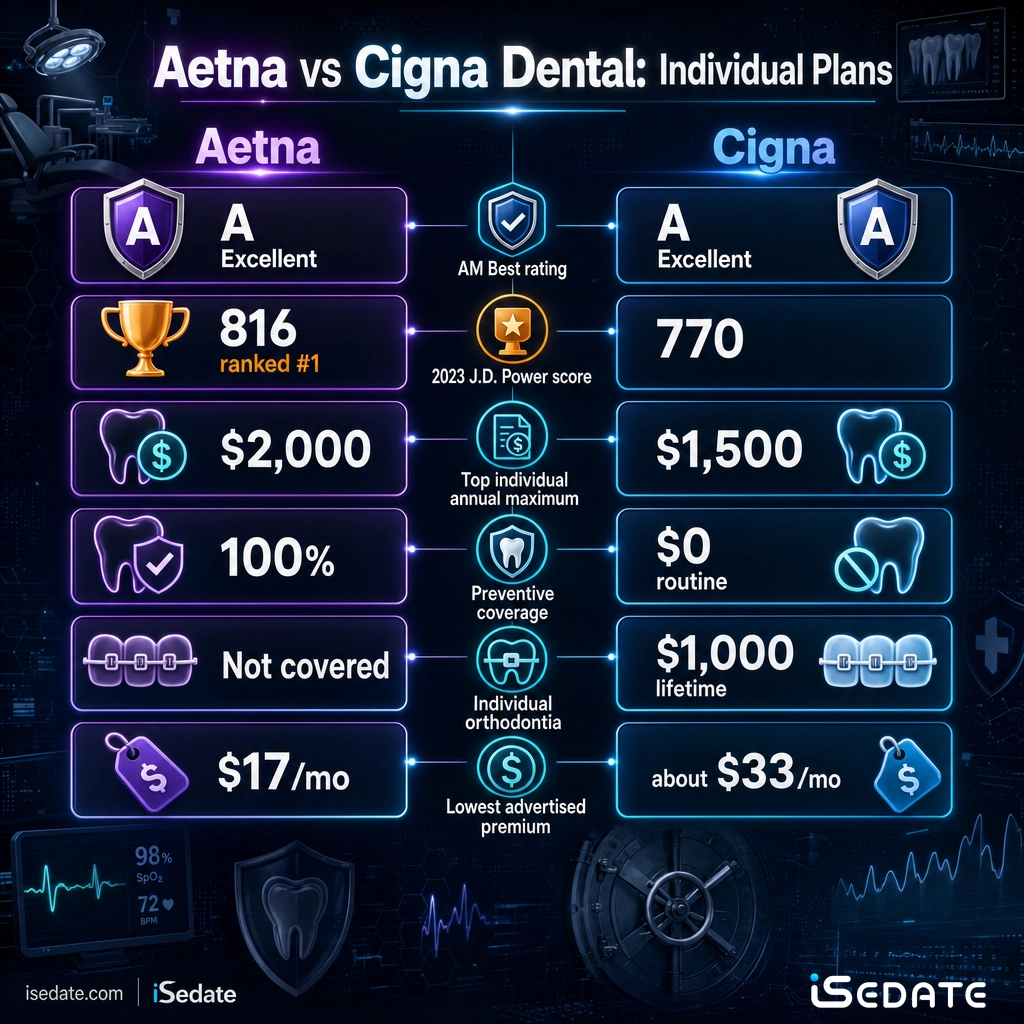
Cigna is the carrier shoppers most often compare against Aetna, so here is a direct head-to-head on the individual plans. Both are financially strong, national, and structured similarly, which makes the differences in coverage and satisfaction the deciding factors.
| Factor | Aetna (Dental Direct) | Cigna (individual dental) |
|---|---|---|
| AM Best rating | A (Excellent) | A (Excellent) |
| 2023 J.D. Power score | 816 (ranked #1) | 770 |
| Plan structures | PPO + DMO | DPPO + DHMO |
| Top individual annual max | $2,000 (Preferred 2000) | $1,500 (Dental 1500); up to $3,000 on higher tier |
| Preventive coverage | 100%, deductible waived | Routine cleanings and exams at $0 |
| Orthodontia (individual) | Not covered on Direct plans | $1,000 lifetime max on Dental 1500 |
| Lowest advertised premium | $17/mo (DMO) | About $33/mo (Dental 1000) |
The short version: Aetna edges Cigna on measured satisfaction and lists a higher top annual maximum, while Cigna's individual Dental 1500 plan includes an orthodontia benefit that Aetna's individual Direct plans lack. If braces are a factor, Cigna's individual lineup has the edge; if you want the highest member-satisfaction track record and the biggest cap, Aetna leads. As always, the single most important check is whether your dentist is in each carrier's network. For the full breakdown, read our Cigna dental insurance review.
Source: Cigna Dental 1500 plan | J.D. Power 2023 dental study
What It Means for Dental Practices and Big Procedures
If you are a dental or oral surgery practice rather than a patient shopping for coverage, Aetna's plan structure has direct implications for how you verify benefits, set expectations, and get paid, especially on larger cases that involve sedation.
Three plan features shape the conversation at the front desk. First, major services sit at 50 percent coinsurance with a 12-month waiting period, so a patient who just enrolled cannot assume a crown or surgical extraction is well covered. Second, annual maximums of $1,000 to $2,000 are easy to exhaust once restorative or surgical work begins, which affects treatment sequencing and financing discussions. Third, because Aetna's individual Direct plans exclude implants and orthodontia, those case types are typically out-of-pocket unless the patient has an employer or FEDVIP plan.
The claims side is where documentation pays off. Since the most common complaints and the most common denials are administrative rather than clinical, clean records are the practice's best defense. For sedation and anesthesia cases in particular, a complete, time-stamped record of the visit, the monitored vitals, and the consent is what supports a defensible claim and a faster reimbursement. That is the problem iSedate's software is built to solve.
See how audit-ready sedation reports support clean claim submission
Office managers who verify benefits, track annual maximums, and manage appeals across many payers feel this friction most. Standardizing sedation documentation and reporting is one of the most reliable ways to cut preventable denials and the rework that follows.
How office managers streamline documentation and reporting
For the wider view of how carriers handle claims and how practices can cut denials, our dental insurance directory collects carrier reviews and contact guides in one place.
Who Aetna Dental Is Best For
No dental plan is right for everyone. Here is where Aetna fits and where it does not.
Aetna dental is a good fit for
- People who want a large network and plan to keep their current dentist.
- Preventive-focused buyers who mainly need cleanings, checkups, and the occasional filling, all well covered at low premiums.
- Shoppers who value financial stability and a proven satisfaction record over the lowest possible price.
- Anyone who had continuous coverage in the last 90 days and can waive the waiting periods immediately.
Look elsewhere if you
- Need orthodontia or implants on an individual plan, which the Direct plans do not cover.
- Expect heavy major work that will blow past a $1,000 to $2,000 annual cap.
- Live where Aetna does not sell individual plans, since availability is limited by state and region.
- Want to start major treatment immediately without prior coverage, given the 12-month major-services wait.
Final Verdict: Is Aetna Dental Worth It?
Aetna dental earns a 7.4 out of 10. It is a genuinely strong core product: the top satisfaction ranking in the most recent J.D. Power study, an A (Excellent) financial backbone, a huge network, and preventive care covered at 100 percent for a low monthly premium. For the large group of people who want reliable coverage for cleanings, checkups, and occasional basic work, it is an easy recommendation, provided it is sold in their state.
It loses points for real, specific reasons rather than vague ones: modest annual maximums, no orthodontia or implant coverage on the individual plans, state-by-state availability gaps, and the recurring claim-and-service complaints that pull its real-world experience below its ratings. For patients facing major, orthodontic, or implant work, the limits matter enough to compare carriers carefully before committing.
If you run a practice, the takeaway is different but related: understand where Aetna's coverage stops so you can set patient expectations early, and keep documentation airtight so administrative denials never cost you reimbursement you earned.
Explore SedationVault, the sedation documentation and compliance platform
Frequently Asked Questions
Is Aetna dental insurance good?
How much does Aetna dental insurance cost?
What is the annual maximum on Aetna dental plans?
Does Aetna dental have a waiting period?
Is Aetna or Cigna dental better?
Does Aetna dental cover major work like crowns and implants?
Why do people complain about Aetna dental?
Methodology and Sources
This review is evidence-based rather than a hands-on test. iSedate publishes sedation documentation and compliance software for dental and oral surgery practices and did not purchase or clinically use an Aetna policy. Ratings were assembled from independent, verifiable sources. Member satisfaction figures are from the J.D. Power 2023 U.S. Dental Plan Satisfaction Study, released June 13, 2023, which surveyed 1,411 dental plan members on cost, plan coverage, communication, customer service, and claims and reimbursement. Financial strength ratings are from AM Best's affirmation of Aetna Life Insurance Company, dated June 2026, and of The Cigna Group's key U.S. life and health subsidiaries, dated March 2026. Plan premiums, annual maximums, deductibles, coverage percentages, and waiting periods are from Aetna's and Cigna's own published individual dental plan pages. Complaint context references the Better Business Bureau letter grade and the NAIC Consumer Information Source.
Limitations: the J.D. Power dental study is published periodically rather than annually, so the 2023 edition is the most recent available and represents a point in time. Premiums shown are advertised lowest rates and vary by state, age, plan, and household size. Individual plan terms differ from employer-sponsored and Medicare Advantage dental plans, which are outside the scope of this review. Readers should confirm the exact summary of benefits for any plan before enrolling.
Media and press: Journalists and researchers are welcome to cite this review with attribution to iSedate and a link to this page. Each figure includes its original source for independent verification.