






Cloud Healthcare Software Adoption Statistics (2026): Adoption Rates, Security & the Migration Barrier
About 81% of healthcare leaders have already moved most or all of their business to the cloud, and roughly 70% of health IT professionals have implemented cloud software. The debate is effectively over. Yet one myth persists that keeps small practices on aging local servers: the belief that the cloud is less secure. The data, and the CIOs living it, say the opposite.
- About 81% of healthcare leaders have adopted the cloud in most or all of their business (PwC 2023).
- Roughly 70% of health IT professionals have implemented cloud-based solutions, with another 20% planning migration within two years (Market.us).
- Hospital and health-system cloud adoption sits between 70% and 80% across surveys (NetSuite; industry data).
- SaaS is the dominant cloud model in healthcare, at roughly 64 to 70% of the market (DataM Intelligence; Mordor Intelligence).
- The top adoption barrier is a shortage of skilled IT staff, cited by about 46% of respondents (Market.us).
- Healthcare CIOs report cloud solutions are frequently more secure than what they could build in-house (HealthTech Magazine).
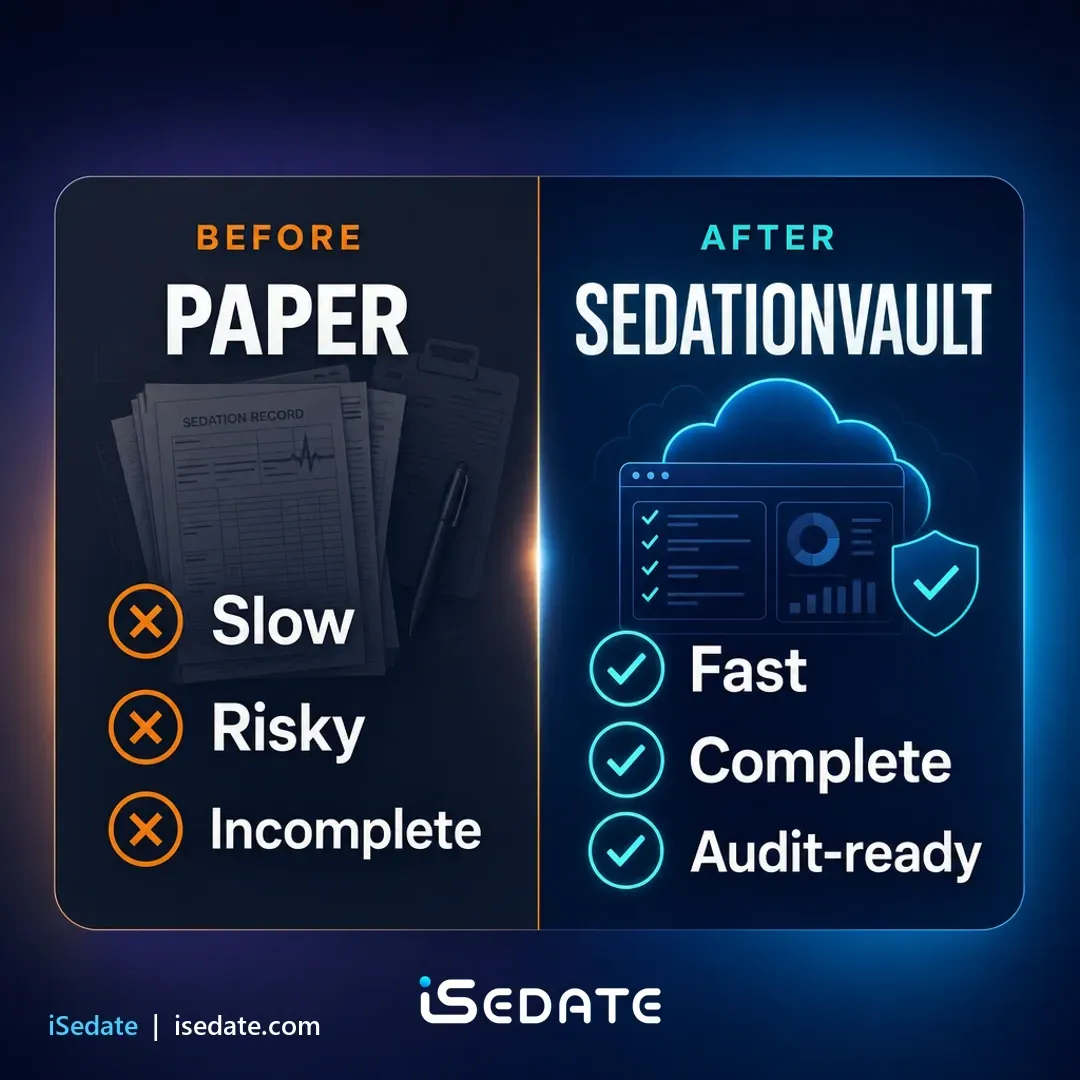
- Cloud is what makes automated, HIPAA-compliant, audit-ready sedation records viable for small practices, the model behind iSedate's SedationVault.
What's in This Guide
1 Cloud Adoption Rates in Healthcare
The question is no longer whether healthcare runs on the cloud, but how completely. Multiple independent surveys converge on the same answer: adoption is high, broad, and still climbing.
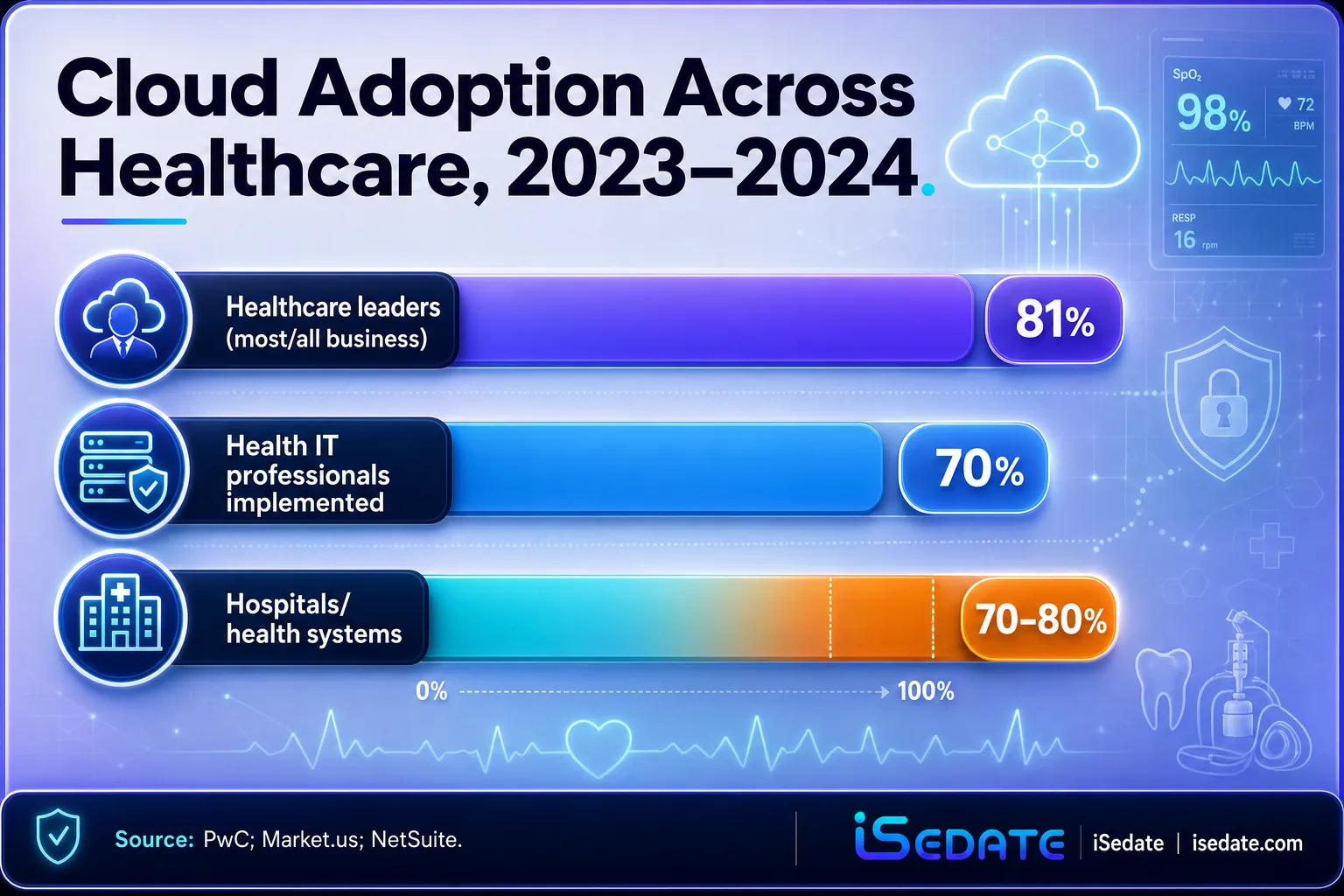
Add the 70% already implemented to the 20% planning migration within two years, and roughly nine in ten health IT organizations are either on the cloud or moving there imminently. This is the tail end of a technology transition, not the beginning. For a small practice still weighing the decision, the relevant fact is that the industry has already decided, and the infrastructure, security certifications, and vendor maturity that come with a settled market are all now in place.
Source: HealthTech Magazine on healthcare cloud adoption | NetSuite healthcare cloud overview
See HIPAA-compliant cloud records2 The Security Misconception
The single most persistent objection to cloud software in healthcare is security, and it is largely backwards. The professionals responsible for protecting patient data have reached a clear conclusion.
From a health-system CIO: A common misconception is that security in the cloud is weaker. Healthcare leaders report the opposite, that many cloud-delivered solutions are more secure than what an individual organization could provide for itself, which is why systems increasingly begin their cloud journey with disaster recovery and security specifically.
The logic is straightforward once stated. A certified cloud provider invests in enterprise-grade encryption, continuous patching, identity management, network segmentation, and 24/7 monitoring across its entire customer base. A single small practice, or even a mid-sized hospital, cannot match that on its own budget and staff. Regulatory bodies now explicitly recognize that certified cloud providers can meet HIPAA and GDPR security mandates, and network segmentation, a core security control, is actually easier to implement in the cloud than on-premise.
Myth: "Keeping data on our own server is safer than the cloud." For the overwhelming majority of practices, the opposite is true. A local server depends on one organization's patching discipline, physical security, and backup habits, the exact things small offices struggle to maintain. Cloud security is not automatic, an organization still has to configure it well, but a certified provider's baseline typically exceeds what a dental or oral surgery practice can achieve alone. The riskier choice is usually the server in the closet.
This matters enormously for the highest-sensitivity records a practice holds, sedation and anesthesia documentation among them. The instinct to "keep it in-house for safety" often increases risk rather than reducing it.
Source: HealthTech Magazine / 2024 CDW Cloud Computing Research Report
See iSedate's SedationVault3 The Real Barriers to Migration
If security is a misconception, what actually slows cloud adoption? The genuine barriers are practical, and for small practices, most of them dissolve under the right software model.
The IT-skills shortage tops the list, followed by data-privacy and regulatory complexity around HIPAA, cost and security concerns, and the underestimated difficulty of migrating legacy on-premise data. Notice the pattern: these are barriers for organizations building and managing their own cloud infrastructure. They are far smaller for a practice adopting a fully managed, single-purpose SaaS application.
iSedate Analysis: The IT-skills barrier barely applies to purpose-built SaaS
The top barrier, a 46% IT-skills shortage, is a problem for a hospital migrating its entire data center, not for a dental practice adopting one focused sedation application. A managed SaaS platform ships the security configuration, patching, backups, and compliance framework as part of the product, so the practice needs no cloud engineer to benefit. In other words, the biggest obstacle to healthcare cloud adoption is one that office-based sedation providers can largely skip by choosing purpose-built software over do-it-yourself infrastructure.
Calculation and interpretation original to iSedate.
Source: Market.us on cloud adoption barriers | NetSuite on migration challenges
Book a SedationVault demo4 Why SaaS Won
Within healthcare cloud, one delivery model has pulled decisively ahead, and understanding why explains the economics that make modern sedation software possible.
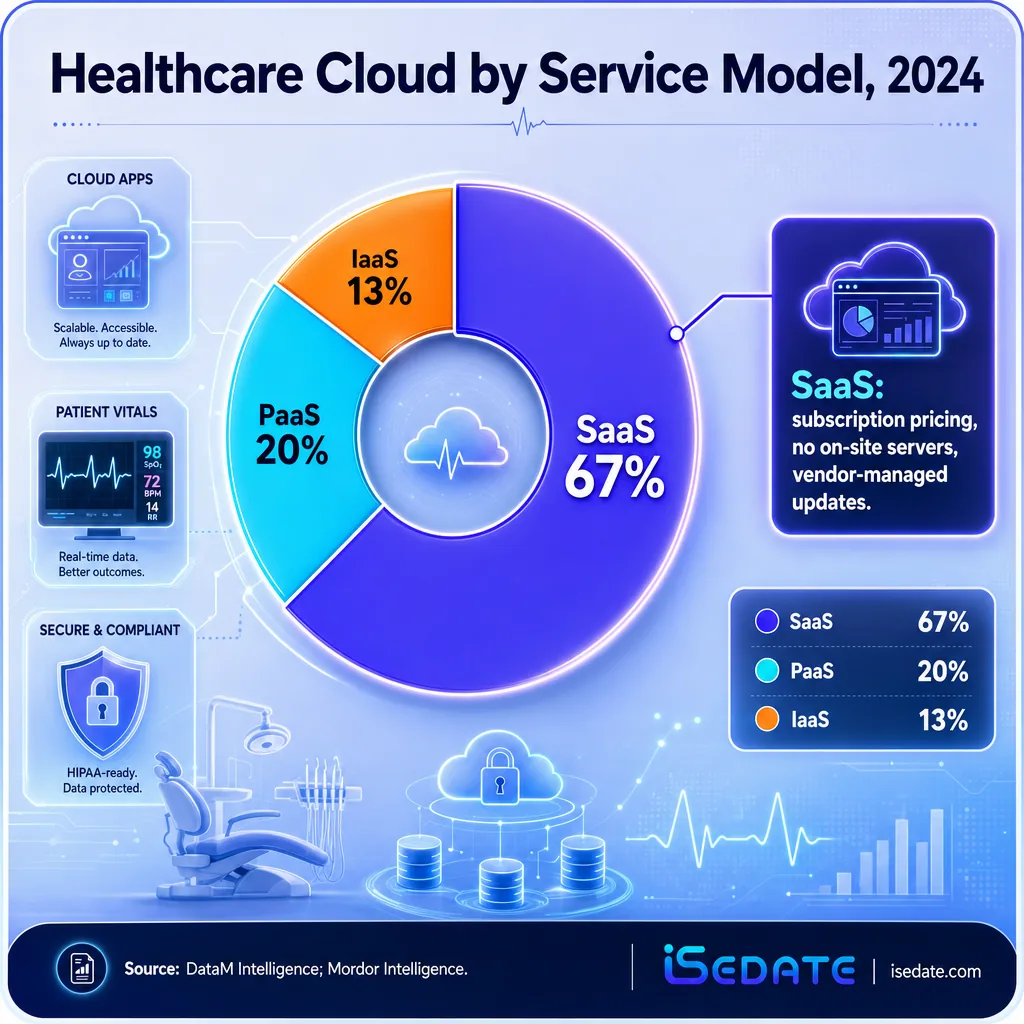
SaaS won for reasons that map perfectly onto a small practice's constraints. It converts high capital expenditure into predictable operating expense through subscription pricing, letting organizations, especially small and mid-sized ones, avoid large upfront hardware and license costs. It ships fast, deploying in days rather than the months an on-premise install requires. And it removes the maintenance burden entirely: the vendor handles hosting, patching, backups, and regulatory updates, so when a rule changes, the fix arrives without on-site work.
This is the same economic shift that transformed anesthesia software. For decades, hospital-grade documentation systems required six-figure on-premise installs that only large institutions could justify. SaaS breaks that barrier: the capability that once demanded a data center now arrives as a subscription, which is precisely how purpose-built sedation documentation becomes affordable for an office-based practice.
Source: DataM Intelligence on healthcare SaaS share | Mordor Intelligence service-model analysis
See SedationVault subscription pricing5 What This Means for Sedation Records
Every thread in this article ties to a single decision an office-based sedation provider faces: where should the sedation record live? The data answers clearly.
Adoption says the industry has chosen cloud (81% of leaders, 70% of IT professionals). Security says cloud is typically safer than a local server for a small practice, not riskier. Barriers say the main obstacle, IT skills, is one that managed SaaS removes. And economics say SaaS is what makes hospital-grade documentation affordable at practice scale. There is no remaining data-driven argument for keeping the highest-liability record in the building on a local machine or on paper.
iSedate Analysis: The cloud case for the sedation record
For sedation specifically, cloud delivers three things a local setup cannot. First, retrievability: an audit-ready record stays accessible for the full retention period, which for a sedation event can be a decade or more, regardless of hardware failures. Second, security: HIPAA-compliant cloud storage exceeds what most practices can build in-house, protecting the most sensitive record they hold. Third, real-time capture: cloud is what lets vitals recorded automatically from a monitor during a procedure become instantly available in a board-audit report months later. iSedate's SedationVault is built cloud-native and HIPAA-compliant for exactly these reasons, capturing vitals from compatible monitors such as Edan, MindRay, and Criticare, then exporting a clean PDF into whatever chart the practice already keeps, whether Dentrix, Eaglesoft, or Open Dental. Reference figures for the founders' own practice reflect thousands of documented sedation procedures, a practice-level dataset, not a nationwide claim.
Calculation and interpretation original to iSedate.
Treated as a cloud-native Sedation Intelligence System, the sedation record gains what the whole healthcare industry moved to the cloud to get: security, resilience, and instant availability, applied to the one record where those qualities matter most.
Source: Mordor Intelligence healthcare cloud analysis | HealthTech Magazine on cloud security and disaster recovery
See audit-ready anesthesia reports6 Summary Table: Every Statistic at a Glance
| Statistic | Figure | Source | Year |
|---|---|---|---|
| Healthcare leaders adopting cloud in most/all business | 81% | PwC | 2023 |
| Health IT professionals who implemented cloud | ~70% | Market.us | 2024 |
| Additional professionals planning migration (2 yrs) | ~20% | Market.us | 2024 |
| Hospitals/health systems adopting cloud | 70-80% | NetSuite; industry data | 2025 |
| SaaS share of healthcare cloud market | 64-70% | DataM; Mordor | 2024 |
| Top barrier: IT-skills shortage | 45.6% | Market.us | 2024 |
| Cloud security vs in-house | Often more secure | HealthTech Mag / CDW | 2024 |
| No-show reduction linked to cloud adoption | ~30% | Market.us | 2024 |
| Patient wait-time reduction linked to cloud | ~25% | Market.us | 2024 |
| Private cloud share (provider preference) | ~55% | Mordor Intelligence | 2024 |
| Provider end-user share of healthcare cloud | ~72% | Mordor Intelligence | 2024 |
| Projected healthcare cloud economic value by 2030 | ~USD 140B | McKinsey, via Market.us | 2030 |
| North America share of healthcare cloud market | ~39-49% | Multiple firms | 2024 |
Frequently Asked Questions
What percentage of healthcare organizations use cloud software?
Is cloud-based healthcare software secure?
What are the biggest barriers to cloud adoption in healthcare?
What is SaaS in healthcare software?
Should sedation records be stored in the cloud?
Methodology & Sources
Adoption and survey sources: PwC (2023 cloud adoption, via HealthTech Magazine), Market.us (health IT adoption and barriers), NetSuite (hospital adoption range), and the 2024 CDW Cloud Computing Research Report (security findings, via HealthTech Magazine). Market and segment data: Mordor Intelligence and DataM Intelligence (SaaS share, deployment, and end-user segmentation). Supporting projection: McKinsey (cloud economic value, via Market.us).
Note on market-size variance: healthcare cloud computing market-size estimates range very widely (roughly USD 18 billion to USD 54 billion for 2024) because "cloud computing" is a far broader category than "cloud software," spanning infrastructure, platform, and services. For this reason, this article leads with adoption rates and segment shares, which are consistent across sources, rather than a single market-size figure. This post covers broad healthcare cloud adoption; for dental-specific and compliance software data, see the companion reports in this series. Statistics reflect the most recent available data as of 2026 and will be refreshed annually.
Media & press usage: Journalists and researchers are welcome to cite these statistics with attribution to iSedate and a link to this page. The iSedate Analysis boxes contain original interpretation unique to this article.