






Deep vs Moderate Sedation Risk Statistics (2026): What the Data Shows
Deeper sedation raises the probability of respiratory events, but the outcome gap between moderate and deep sedation is smaller than many assume when both are properly monitored. In a study of 17,634 oral surgery sedations, moderate and deep sedation complication rates were 0.5% and 0.9%, a difference that was not statistically significant. Depth changes the monitoring burden more than the headline risk.
Key Takeaways
- The gap is modest. Moderate sedation 0.5% vs deep/GA 0.9% across 17,634 oral surgery sedations, not statistically significant after adjustment.
- Endoscopy agrees. Propofol deep sedation 0.60% vs moderate sedation 1%, no significant difference.
- Probability rises with depth. Desaturation, hypotension, and bradycardia become more likely as sedation deepens.
- Deep sedation raises satisfaction but significantly lengthens recovery time.
- Sedation is a continuum. A patient can drift deeper than intended, so providers must monitor and rescue one level deeper than the target.
- Zero deaths occurred across the 17,634-sedation oral surgery cohort.
What's in This Guide
1 Head-to-Head Complication Rates
The best dental-specific comparison comes from a prospective study of the Oral and Maxillofacial Surgery Outcomes System covering adolescent third molar extractions. Patients in the moderate sedation group had a complication rate of 0.5%, and patients in the deep sedation or general anesthesia group had a rate of 0.9%. Critically, after adjustment, deep sedation and general anesthesia did not pose a significantly increased risk, with an adjusted odds ratio of 1.63 and a confidence interval of 0.95 to 2.81.
A parallel finding comes from gastroenterology, where sedation depth is studied intensively. In a study of 1,000 endoscopic ultrasound procedures, propofol deep sedation under monitored anesthesia care carried a 0.60% complication rate, compared with 1% for a historical moderate sedation group using meperidine and midazolam. The authors concluded there was no significant difference between the two. Across both dental and endoscopic data, the message is consistent: depth alone does not sharply separate outcomes when monitoring is adequate.
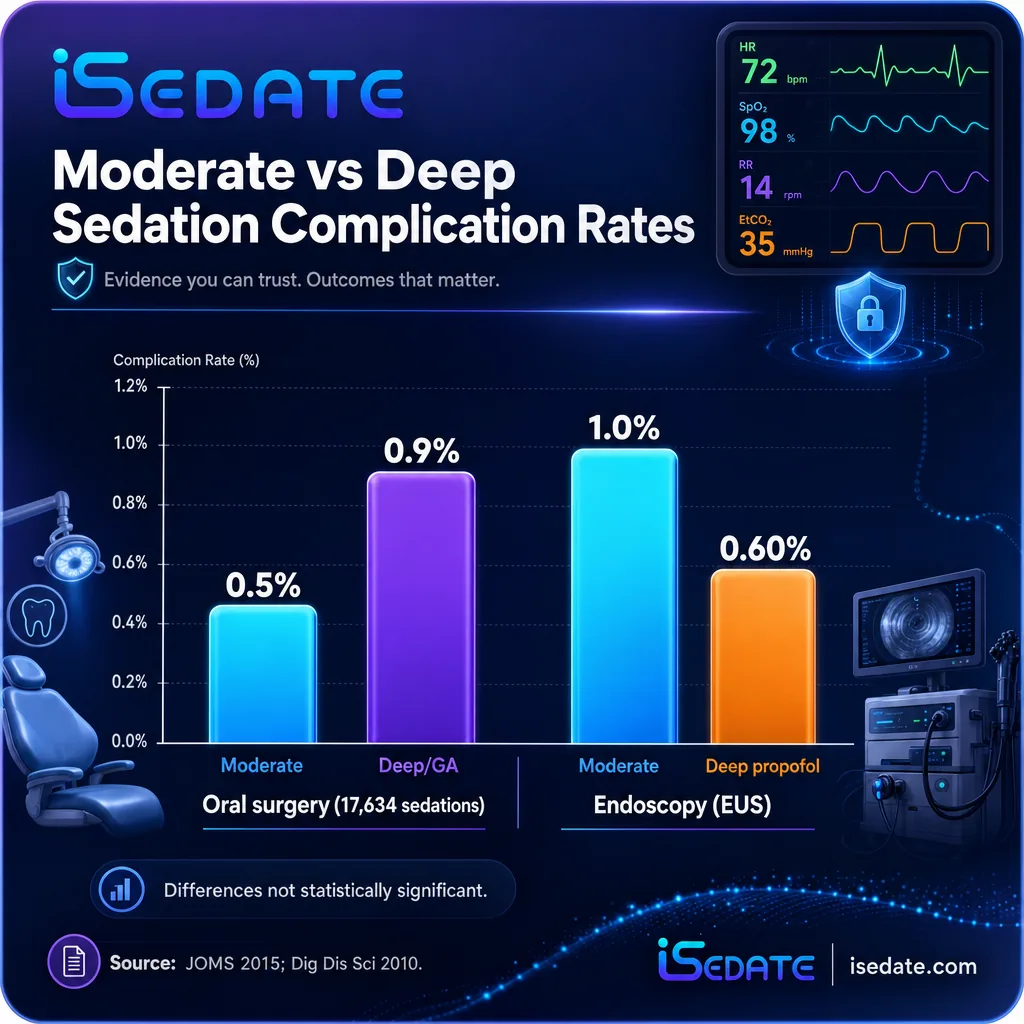
Source: Complications of Moderate Sedation Versus Deep Sedation/General Anesthesia (Journal of Oral and Maxillofacial Surgery) | Comparison of Propofol Deep Sedation Versus Moderate Sedation During Endosonography (PubMed)
See sedation compliance documentation2 The Depth-Risk Gradient
While head-to-head complication rates are close, the underlying physiology follows a clear gradient: as sedation deepens, the probability of an adverse event rises. Reviews are explicit that the probability of desaturation, hypotension, or bradycardia increases as the depth of anesthesia increases. The absolute rates stay low, but the direction is unambiguous.
These figures illustrate the ordering of risk within deeper sedation: respiratory events like desaturation lead, followed by cardiovascular events like hypotension, with bradycardia less common. The reason depth matters is that deeper sedation suppresses the same protective reflexes that keep breathing and circulation stable, so the further a patient moves along the continuum, the thinner the physiologic safety margin becomes.
Myth: Moderate sedation carries no meaningful risk
Moderate sedation is genuinely safer than deep sedation, but "safer" is not "risk-free." The 0.5% complication rate in the oral surgery study is low, not zero, and moderate sedation can unintentionally deepen into the deep sedation range in a patient who is more sensitive than expected. This is precisely why guidelines require the same monitoring standard for moderate sedation as for deeper levels: the risk of moderate sedation is largely the risk of it becoming deep sedation without anyone noticing.
Source: Patient Satisfaction With Deep Versus Light/Moderate Sedation: Meta-Analysis (PMC) | Complications of Moderate vs Deep Sedation (ScienceDirect)
See continuous depth-aware monitoring3 Respiratory Events by Depth
Because respiratory depression is the leading path to serious harm, the respiratory event data is where depth matters most. In adult procedural sedation, systematic reviews place hypoxia as the most common adverse event, with pooled estimates ranging from about 40 to 136 events per 1,000 sedations depending on the population and how hypoxia is defined. The wide range reflects differing thresholds, but hypoxia consistently tops the list.
The reassuring counterpoint is that the events requiring emergent intervention stay rare even as depth increases. Across large meta-analyses, severe adverse events such as intubation, laryngospasm, and aspiration were exceedingly rare, and one review of nearly 10,000 emergency-department sedations found no reported deaths. Hypoxia, while common, is often a late indicator of respiratory depression, which is exactly why continuous monitoring that catches earlier signs matters as sedation deepens.
| Event (adult procedural sedation) | Pooled incidence per 1,000 | Source |
|---|---|---|
| Hypoxia | 40.2 to 136 | ED procedural sedation meta-analyses |
| Apnea | 12.4 to 51 | ED procedural sedation meta-analyses |
| Hypotension | 15.2 to 28.1 | ED procedural sedation meta-analyses |
| Vomiting | 15.6 to 16.4 | ED procedural sedation meta-analyses |
| Bradycardia/dysrhythmia | 16.7 to 30 | ED procedural sedation meta-analyses |
| Intubation | 1.6 to 10.8 | ED procedural sedation meta-analyses |
| Laryngospasm | 2.9 to 4.2 | ED procedural sedation meta-analyses |
| Aspiration | 1.2 to 2.7 | ED procedural sedation meta-analyses |
Source: Incidence of Adverse Events in Adults Undergoing Procedural Sedation in the ED: Meta-Analysis (PMC) | Safety of Procedural Sedation in Adults: Systematic Review of RCTs (PubMed)
Explore anesthesia record software4 Recovery and Satisfaction Trade-Offs
Choosing a sedation level is not only a safety decision; it is a trade-off between patient experience and recovery burden. A meta-analysis found that patient satisfaction was significantly higher with deep sedation than with light or moderate sedation, with a relative risk of 1.12. Importantly, there was no significant difference in oxygen saturation, systolic blood pressure, or heart rate between deep and light or moderate sedation in that analysis.
The cost of that higher satisfaction is time. Recovery was significantly prolonged under deep sedation, which extends the highest-risk monitoring window and increases the chance of a post-procedure event going unnoticed if observation relaxes. The meta-analysis authors concluded that deep sedation improves satisfaction but that respiration and circulation should be carefully monitored both intraoperatively and postoperatively, tying the satisfaction benefit directly to monitoring discipline.
iSedate Analysis: The satisfaction-safety equivalence condition
Two meta-analytic findings define the condition under which deeper sedation is worth it. First, deep sedation raised satisfaction (RR 1.12) with no measured difference in vital signs versus lighter sedation. Second, that vital-sign equivalence held only under careful intra- and postoperative monitoring, and recovery was longer. Combined, they mean deep sedation's satisfaction advantage is safely realized only when the longer recovery window is monitored as rigorously as the procedure itself.
Interpretation: the satisfaction gain from deeper sedation is conditional on continuous monitoring that extends through a longer recovery, so any practice choosing deeper sedation should treat post-procedure monitoring as non-optional rather than a courtesy. Sources: deep-vs-light satisfaction meta-analysis; oral surgery complication study. Calculation and interpretation original to iSedate.
Source: Patient Satisfaction With Deep Versus Light/Moderate Sedation: Meta-Analysis (PMC) | Effect of Level of Sedation on Outcomes in Critically Ill Adults (PMC)
Match sedation plan to patient risk5 The Continuum and Monitoring Standards
The most important concept in sedation depth is that it is a continuum, not a set of fixed boxes. A patient targeted for moderate sedation can slide into deep sedation, and a patient targeted for deep sedation can approach general anesthesia. This is why professional guidance holds that a provider must be able to monitor and rescue a patient at one level deeper than the intended target.
In critically ill patients, a separate systematic review found no evidence that lighter versus deeper sedation changed all-cause mortality, serious adverse events, or delirium, reinforcing that in monitored settings, depth is not the dominant determinant of the worst outcomes. What determines outcomes is whether the depth actually achieved is recognized in real time and responded to, which is a monitoring and documentation question more than a depth question.
Why the achieved depth, not the planned depth, is what matters
Sedation records that document only the intended level miss the point: the risk lives in the gap between planned and achieved depth. Continuous vitals capture reveals when a patient has drifted deeper than intended, before that drift becomes a desaturation event, and a timestamped record shows exactly when depth changed and how the team responded. Whether a practice offers moderate or deep sedation, the safety-critical capability is the same: seeing the real depth as it happens and documenting it.
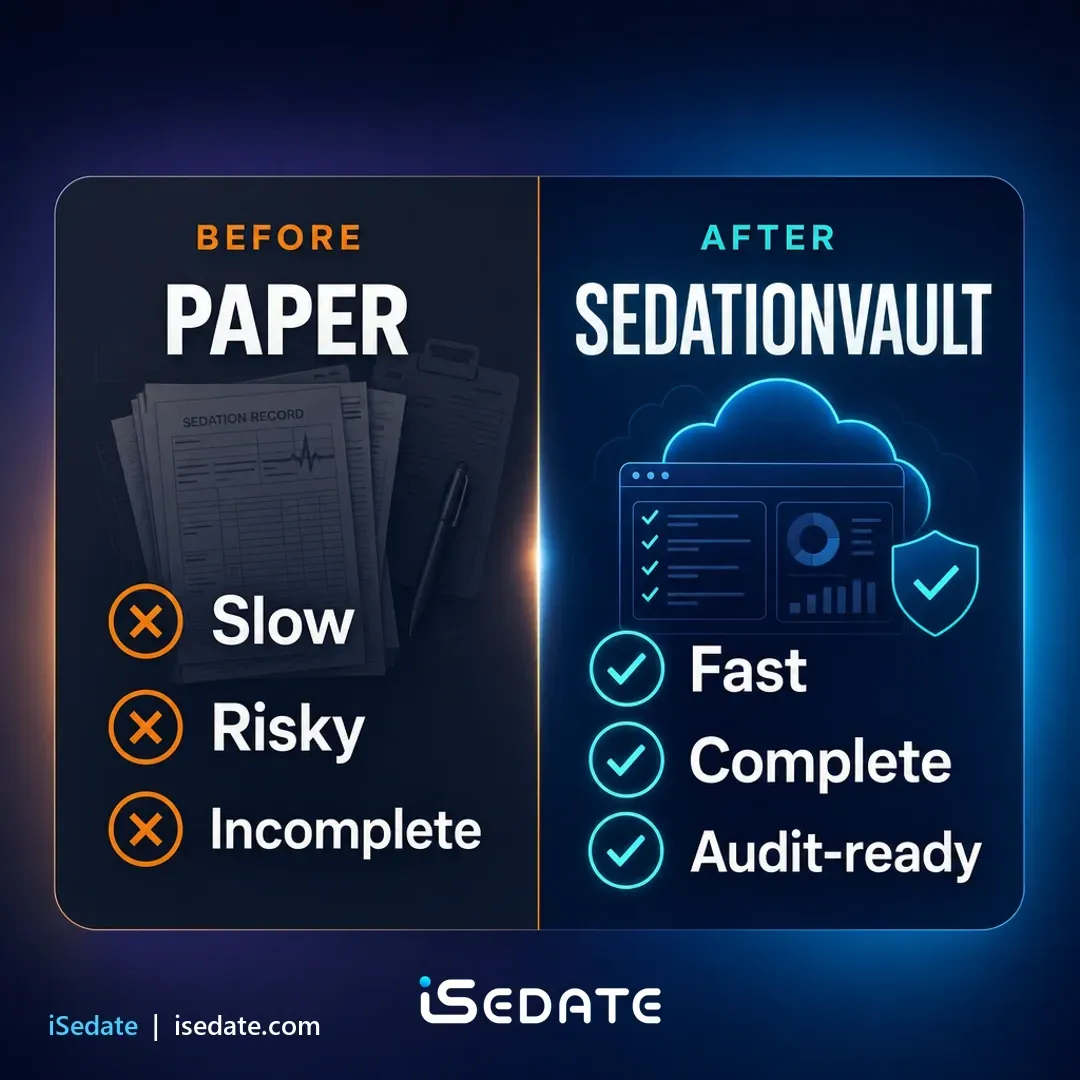
iSedate's SedationVault is built for that reality. SedationVault pulls live vitals from compatible monitors including Edan, MindRay, Criticare, and more into a continuous, timestamped record that spans the procedure and recovery, logs every drug and dose, and produces one-click audit-ready PDF reports. That gives providers a real-time view of the depth a patient has actually reached and a defensible record of the response, addressing the exact monitoring standard the depth literature keeps returning to.
Source: Effect of Level of Sedation on Outcomes in Critically Ill Adults (eClinicalMedicine) | Complications of Moderate vs Deep Sedation (ScienceDirect)
Book a DemoDeep vs Moderate Sedation Risk Statistics: Summary Table
| Statistic | Figure | Source | Year |
|---|---|---|---|
| Moderate sedation complication rate (oral surgery) | 0.5% | OMFS Outcomes System study | 2015 |
| Deep sedation/GA complication rate (oral surgery) | 0.9% | OMFS Outcomes System study | 2015 |
| Adjusted odds ratio, deep vs moderate | 1.63 (CI 0.95 to 2.81, P=.077) | OMFS Outcomes System study | 2015 |
| Total sedations analyzed / deaths | 17,634 / 0 | OMFS Outcomes System study | 2015 |
| Overall AE rate in that cohort | 0.1% (16 of 17,634) | OMFS Outcomes System study | 2015 |
| Propofol deep sedation complication rate (EUS) | 0.60% | Endosonography comparison study | 2010 |
| Moderate sedation complication rate (EUS) | 1% | Endosonography comparison study | 2010 |
| Desaturation, moderate-to-deep cohort | 4.6% | Koers et al. via satisfaction meta-analysis | 2021 |
| Hypotension, moderate-to-deep cohort | 2.8% | Koers et al. via satisfaction meta-analysis | 2021 |
| Bradycardia, moderate-to-deep cohort | 0.4% | Koers et al. via satisfaction meta-analysis | 2021 |
| Hypoxia incidence, adult procedural sedation | 40.2 to 136 per 1,000 | ED procedural sedation meta-analyses | 2016-2026 |
| Intubation incidence, adult procedural sedation | 1.6 to 10.8 per 1,000 | ED procedural sedation meta-analyses | 2016-2024 |
| Patient satisfaction, deep vs light/moderate | RR 1.12 (CI 1.04 to 1.20) | Satisfaction meta-analysis | 2021 |
| Recovery time, deep vs moderate | Significantly longer under deep | Satisfaction meta-analysis | 2021 |
| Vital-sign difference, deep vs light/moderate | No significant difference | Satisfaction meta-analysis | 2021 |
| All-cause mortality, lighter vs deeper (ICU) | RR 0.94, no significant difference | Critically ill sedation-level review | 2024 |
| Serious adverse events, lighter vs deeper (ICU) | RR 0.99, no significant difference | Critically ill sedation-level review | 2024 |
| Procedural success rate | ~92% | ED procedural sedation meta-analysis | 2026 |
Frequently Asked Questions
Is deep sedation riskier than moderate sedation?
How much do complication rates differ by sedation depth?
What is the main risk of deeper sedation?
Does deep sedation improve patient outcomes or satisfaction?
Why does sedation depth matter for monitoring?
Methodology & Sources
Figures in this article are drawn from peer-reviewed prospective cohort studies, comparative trials, and systematic reviews with meta-analysis rather than secondary aggregators. Complication and event definitions vary between studies, particularly for hypoxia and desaturation thresholds, so event-rate ranges are reported with their source datasets rather than merged into single values. Data from adjacent fields such as endoscopy and critical care is included where it directly compares sedation depth, and labeled by setting, because it substantially expands the head-to-head evidence base beyond dentistry alone.
Primary sources: Complications of Moderate Sedation Versus Deep Sedation/General Anesthesia for Adolescent Third Molar Extraction, OMFS Outcomes System (Journal of Oral and Maxillofacial Surgery, 2015); Comparison of Propofol Deep Sedation Versus Moderate Sedation During Endosonography (Digestive Diseases and Sciences / PubMed, 2010); Patient Satisfaction With Deep Versus Light/Moderate Sedation, meta-analysis (PMC, 2021); Incidence of Adverse Events in Adults Undergoing Procedural Sedation in the Emergency Department, meta-analysis (PMC, 2016); Safety of Procedural Sedation in Emergency Department Settings Among Adults, systematic review of RCTs (PubMed, 2024); Procedural Sedation in Emergency Departments, systematic review (PubMed, 2026); Effect of Level of Sedation on Outcomes in Critically Ill Adult Patients (eClinicalMedicine, 2024). Event-rate ranges reflect differing definitions across reviews and are labeled by year and setting.
Media & Press Use
Journalists, researchers, and educators are welcome to cite these statistics with attribution to iSedate and a link to this page. For the iSedate Analysis figure, please credit the calculation as original to iSedate. For interviews or additional data on sedation depth monitoring and documentation, contact iSedate at [email protected].