






Dental EHR Market Statistics (2026): Market Size, Interoperability & the Certification Squeeze
The share of U.S. dental practices able to send structured treatment plans to a medical EHR jumped from 12% in 2022 to 68% by mid-2025. Dental records are being pulled into the wider medical system fast, driven by interoperability mandates and certification pressure. But one record is not making the trip: sedation and anesthesia documentation, which general dental EHRs still do not capture.
- Narrow dentistry-EMR-software market estimates run near USD 360 million (2025), rising to about USD 950 million by 2033 at ~13% CAGR (Future Market Report).
- Broader dental EMR definitions place the market at roughly USD 2.1 billion (2023) to USD 2.8 billion (2026) (DataHorizzon; MarkWide Research).
- Cloud-based deployment leads dental EMR at roughly 54% of the market (Future Market Report).
- U.S. dental practices able to transmit structured treatment plans to medical EHRs rose from 12% (2022) to 68% (mid-2025) (Mordor Intelligence).
- ONC certification and 21st Century Cures Act compliance are accelerating replacement of uncertified legacy systems (MarkWide; Mordor).
- Clinical-coding friction persists: only 340 of 875 CDT codes map cleanly to ICD-10-CM, and fewer than 30% of practices had adopted SNODENT by mid-2025 (Mordor Intelligence).
- Sedation and anesthesia records remain outside general dental EHRs, the gap iSedate's SedationVault closes.
What's in This Guide
1 Dental EHR Market Size: Reading the Definitions
The dental EHR market, also called the dentistry EMR or electronic dental record (EDR) market, is distinct from the broader dental practice management software market, though the two overlap. Where practice management software is defined by scheduling and billing, the EHR category is defined by the clinical record itself: patient history, diagnoses, treatment plans, allergies, and increasingly the ability to exchange that record with the wider medical system.
As with most healthcare software categories, market-size estimates depend heavily on how the analyst draws the boundary.
The spread, roughly USD 360 million to USD 2.8 billion depending on definition, is not a contradiction. The narrow figure counts dedicated dentistry-EMR software; the broader figures fold in adjacent clinical and administrative functions. What every estimate agrees on: the category is growing at a healthy clip, cloud is winning, and interoperability is the frontier. For the reader, the takeaway is to match the figure to the question, and to treat any single number as one analyst's boundary rather than a settled fact.
Source: Future Market Report dentistry EMR software market | DataHorizzon dentistry EMR market
See iSedate's SedationVault2 EDR Adoption & Who's Ahead
Underneath the market figures sits an adoption pattern that has held for over a decade: dentistry digitized its records early, unevenly, and largely without the federal incentives that drove medical EHR adoption.
A striking historical detail: electronic dental record adoption in U.S. dental offices was actually higher in 2012 than electronic health record adoption in medical offices, and it happened without the HITECH Act incentives that powered medical EHR uptake, because most dental practices did not meet the program's requirements. Dentistry went digital on its own economic logic.
The adoption gradient is consistent across every source. Uptake runs higher among younger dentists, those fewer than 15 years in practice, and group practices, and lower among solo and older practices. This is the same size-and-generation divide that shapes the broader dental software market, applied to the clinical record specifically.
iSedate Analysis: Early to charts, late to sedation
Dentistry's early EDR adoption makes the sedation gap more striking, not less. These practices were ahead of medicine on digitizing the clinical chart, yet the sedation record, arguably the highest-liability document they produce, remained on paper because EDRs were built for charting and imaging, not time-based vitals capture. A profession that digitized early still left its riskiest record analog, which is exactly the gap a purpose-built sedation system addresses.
Calculation and interpretation original to iSedate.
Source: Harmony Healthcare IT on EDR adoption
See SedationVault for dentists3 The Interoperability Leap
The single most dramatic statistic in the dental EHR space right now is not market size, it is interoperability, and how fast it is moving.
U.S. Dental Practices Able to Transmit Structured Treatment Plans to Medical EHRs
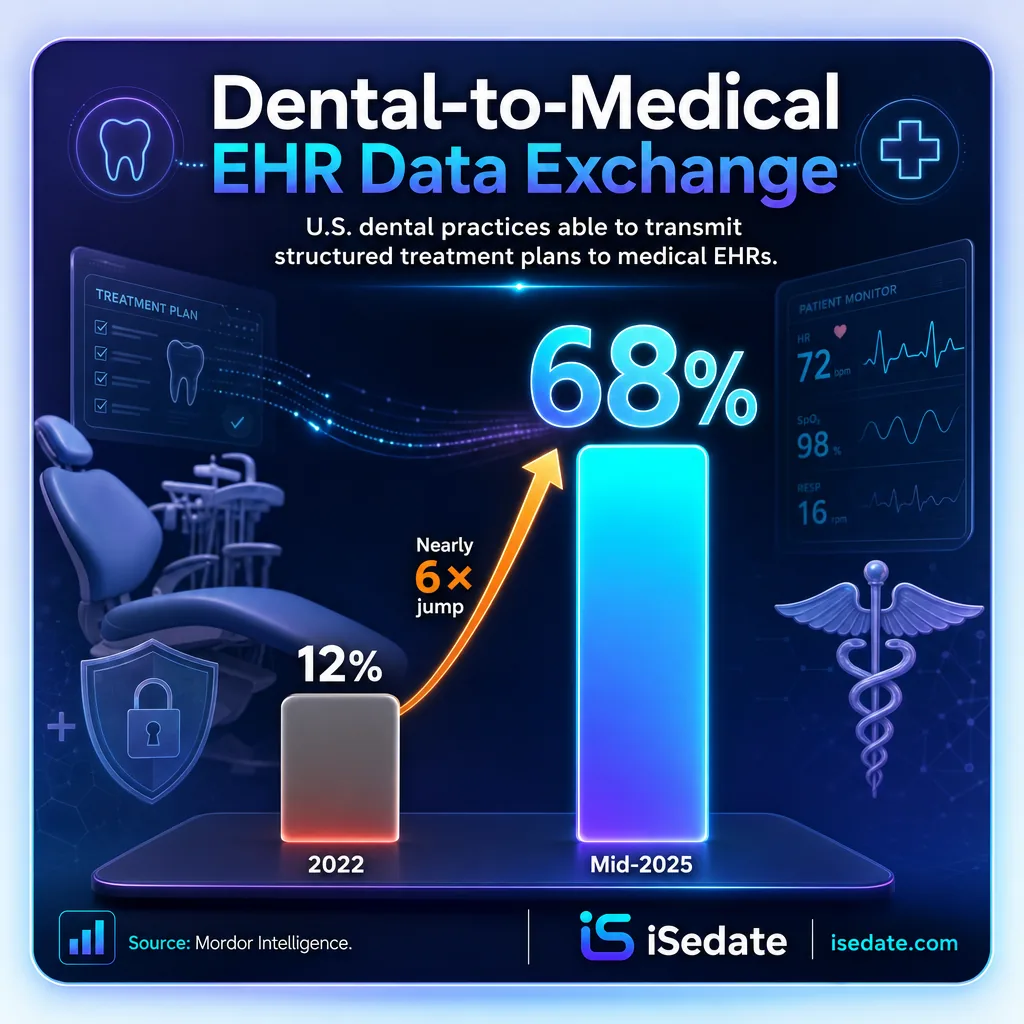
A near-sixfold rise in three years is not organic; it is policy-driven. Civil penalties for information blocking took effect, interoperability standards like HL7 FHIR became the vendor baseline, and the medical-dental divide that kept dental records siloed began to close. The direction is clear: the dental record is becoming part of the patient's whole-health record, not a separate island.
Friction remains, though, and it is worth understanding. Clinical coding is the sticking point: only 340 of 875 CDT dental procedure codes map cleanly to ICD-10-CM, and fewer than 30% of practices had adopted SNODENT terminology by mid-2025, with dual-coding adding up to 20% to charting time. Interoperability is advancing fast at the transport layer while the language layer catches up.
Source: Mordor Intelligence interoperability data
See how SedationVault fits your records4 The Certification Squeeze
Running alongside interoperability is a certification and compliance squeeze that is reshaping which vendors survive and how fast practices upgrade.
ONC certification and 21st Century Cures Act compliance are now effectively required for U.S. dental software procurement, accelerating the replacement of uncertified legacy systems. The compliance stack is real and expanding: HIPAA privacy enforcement by the Office for Civil Rights, FDA oversight of software-as-medical-device classifications, and draft guidance requiring multi-factor authentication and six-year audit logs for diagnostic software.
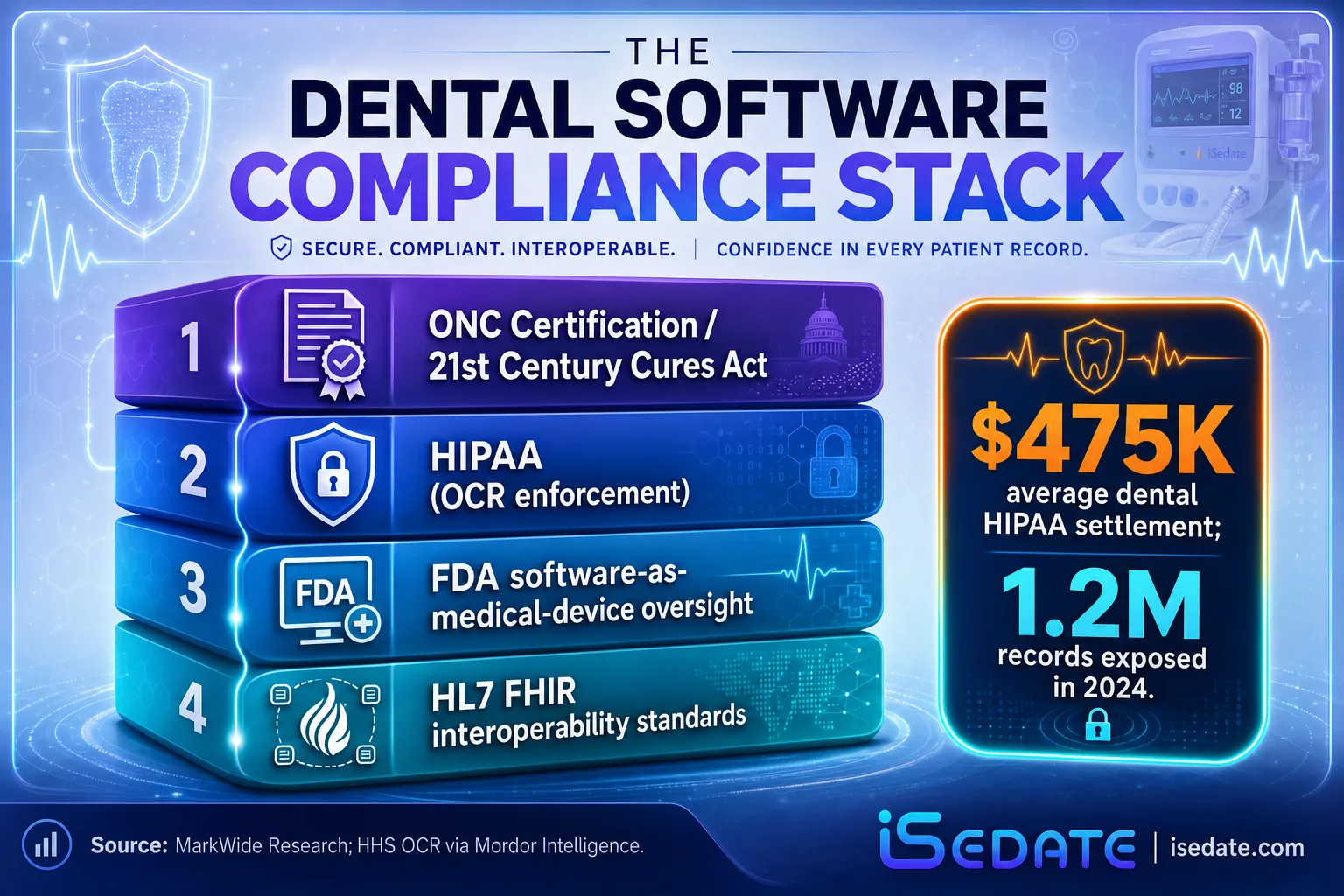
The effect is a flight to certified, cloud-based, interoperable platforms, and a squeeze on small vendors without security-engineering depth. For practices, it means upgrade cycles are compressing and the cost of running an aging, non-compliant system is rising, not from license fees, but from breach-liability exposure that disproportionately burdens small practices without dedicated security staff.
Why this matters for sedation records specifically. The same compliance forces raising the bar for dental EHRs apply squarely to sedation documentation, which is among the most sensitive and most-audited records a practice holds. A sedation record kept on paper or in an uncertified tool is a compliance and liability exposure. HIPAA-compliant, cloud-based, audit-ready capture is not a nice-to-have for sedation, it is where the regulatory trend is heading.
Source: MarkWide Research on certification mandates | Mordor Intelligence on breach exposure
See HIPAA-compliant sedation records5 The Record the EHR Doesn't Capture
Follow the dental EHR market's momentum to its logical edge and the sedation gap comes into focus. Dental EHRs are getting better at what they do, richer clinical charting, imaging integration, medical-record interoperability, certification compliance. But the list of what they do has never included time-based sedation and anesthesia documentation.
That is not a flaw in dental EHRs; it is a scope boundary. Capturing vital signs from a monitor every few minutes during an active sedation case, logging drug administration in real time, and producing a board-ready anesthesia report is a fundamentally different task from maintaining a clinical chart. So as the dental record gets pulled into the whole-health record and wrapped in certification, sedation documentation sits just outside the frame.
iSedate Analysis: Interoperability makes the gap more visible, not less
Here is the counterintuitive part. As dental EHRs become more interoperable, 68% now reaching medical systems, the absence of the sedation record becomes more conspicuous. A patient's whole-health record can increasingly show their dental treatment plan, but not the sedation event that carried the most clinical risk during it. iSedate's SedationVault fills that specific gap: it captures sedation vitals from compatible monitors such as Edan, MindRay, and Criticare, logs drugs, and produces an audit-ready report, then exports a clean PDF into the chart the practice already keeps, whether Dentrix, Eaglesoft, or Open Dental. Reference figures for the founders' own practice reflect thousands of documented sedation procedures, a practice-level dataset, not a nationwide claim.
Calculation and interpretation original to iSedate.
Positioned correctly, this is not a competitor to the dental EHR, it is the specialized record the EHR was never built to hold. Treated as a Sedation Intelligence System, drug inventory, license and certification tracking, emergency-equipment oversight, and audit-ready board reporting, it completes the picture the interoperable dental record is otherwise missing.
Source: Future Market Report on dental EMR scope | Mordor Intelligence on interoperability
Book a SedationVault demo6 Summary Table: Every Statistic at a Glance
| Statistic | Figure | Source | Year |
|---|---|---|---|
| Dentistry EMR software market (narrow) | ~USD 360M | Future Market Report | 2025 |
| Dentistry EMR market projection (narrow) | ~USD 950M by 2033 | Future Market Report | 2033 |
| Narrow dentistry EMR CAGR | ~12.9% | Future Market Report | 2026-2033 |
| Dentistry EMR market (broad) | ~USD 2.1B | DataHorizzon | 2023 |
| Dentistry EMR market (broad) | ~USD 2.8B | MarkWide Research | 2026 |
| Cloud-based dental EMR deployment share | ~54% | Future Market Report | 2025 |
| EDR adoption for clinical support | ~52% | Harmony Healthcare IT | 2024 |
| Practices transmitting plans to medical EHRs | 12% | Mordor Intelligence | 2022 |
| Practices transmitting plans to medical EHRs | 68% | Mordor Intelligence | mid-2025 |
| CDT codes mapping cleanly to ICD-10-CM | 340 of 875 | Mordor Intelligence | 2025 |
| Practices adopting SNODENT | <30% | Mordor Intelligence | mid-2025 |
| Dental records exposed in breaches | 1.2M | HHS OCR | 2024 |
| Average dental HIPAA settlement | ~USD 475K | HHS OCR | 2024 |
| Sedation records in general dental EHRs | Not captured | iSedate analysis | 2026 |
Frequently Asked Questions
How big is the dental EHR market?
What percentage of dental practices use electronic dental records?
Can dental EHRs share data with medical systems?
How is ONC certification affecting dental software?
Do dental EHRs capture sedation records?
Methodology & Sources
Market research sources: Future Market Report (narrow dentistry-EMR-software figures), DataHorizzon Research and MarkWide Research (broader dentistry EMR definitions), and Mordor Intelligence (interoperability, coding, and breach data). Adoption and historical context: Harmony Healthcare IT and Office of the National Coordinator for Health Information Technology (ONC). Regulatory and breach data: HHS Office for Civil Rights, cited via market research.
Note on definitional variance: dental EHR/EMR market-size figures range widely (roughly USD 360 million to USD 2.8 billion) because analysts draw category boundaries differently, some counting only dedicated dentistry-EMR software, others folding in practice management, imaging, and communication. We present the range and label the definition rather than picking a single figure. This article is scoped to the dental EHR/EDR category, interoperability, and certification; for the broader dental software market and adoption behavior, see the companion reports in this series. Statistics reflect the most recent available data as of 2026 and will be refreshed annually.
Media & press usage: Journalists and researchers are welcome to cite these statistics with attribution to iSedate and a link to this page. The iSedate Analysis boxes contain original interpretation unique to this article.