







Dental HIPAA Breach Statistics (2026): Notification Rules, Vendor Risk & What Practices Must Report
When a dental practice discovers a breach of patient data, a 60-day clock starts, and the rules that follow depend on a single number: whether 500 patients were affected. Most dental breach coverage focuses on the attack itself, but the obligations that actually trip up practices are the notification rules and the vendor relationships behind them. Getting those wrong turns a manageable incident into a second, separate violation.
- A dental practice must notify affected individuals of a breach of unsecured PHI within 60 days of discovery, per the HIPAA Breach Notification Rule (HHS; ADA).
- Breaches affecting 500+ people require HHS and media notification and appear on the public HHS breach portal; smaller breaches can be reported annually (HHS).
- When a vendor (business associate) has a breach, it must notify the dental practice, usually within 60 days but often within 24 hours by contract (HIPAA Journal; ADA).
- Unless the agreement says otherwise, the dental practice, not the vendor, must notify patients, HHS, and media (ADA).
- OCR settled with a dental software vendor (MMG Fusion) over an unreported incident that exposed PHI on the dark web (Medcurity).
- Dental practices have been penalized from about $3,500 for a solo practitioner up to six figures; Dental Associates paid $10,000 in 2016 (Medcurity; Patient Protect).
- Failure to notify is a separate violation on top of the breach, which is why documentation and audit-ready records matter, as in iSedate's SedationVault.
What's in This Guide
1 What Counts as a Dental HIPAA Breach
Before the deadlines, a practice has to know what actually triggers them. The definition is broader than most dentists assume, and it starts from a presumption that works against the practice.
A breach is presumed unless you can prove otherwise. Under the Breach Notification Rule, any impermissible use or disclosure of unsecured PHI is presumed to be a breach, and therefore reportable, unless the practice can demonstrate through a documented risk assessment that there is a low probability the information was compromised. The burden is on the practice to prove it was not a breach, not on the regulator to prove it was. That reversal is why documentation matters from the very first hour.
That risk assessment weighs at least four factors: the nature and extent of the PHI involved and the likelihood of re-identification, who accessed or received the information, whether the information was actually acquired or viewed, and the extent to which the risk has been mitigated. Common dental examples that typically meet the breach threshold include a stolen unencrypted laptop with patient data, a misdirected email containing diagnoses or record numbers, ransomware that exfiltrates ePHI, unauthorized staff access to records, and PHI exposed by a software vendor. Importantly, dental images, X-rays, panoramic images, CBCT scans, intraoral photos, and digital impressions, are all PHI when linked to a patient, so a breach involving imaging counts fully.
There are three narrow exceptions, mostly covering good-faith, unintentional internal access by authorized workforce members where the information is not further disclosed. These are genuinely narrow and should never be assumed without a documented analysis.
Source: HHS Breach Notification Rule | ADA on the dental Breach Notification Rule
See HIPAA-compliant records2 The Notification Deadlines
Once a breach is confirmed, or cannot be ruled out, the deadlines are firm. Missing them creates a second violation independent of the breach itself.
The core obligations for a covered dental practice are consistent: notify affected individuals in writing (by first-class mail, or email if the patient agreed to electronic notice) without unreasonable delay and no later than 60 days after discovery; notify HHS; and, in defined cases, notify the media. The notice itself must describe the breach, the types of information involved, the steps individuals can take, what the practice is doing to investigate and mitigate, and how to get more information. And crucially, "discovery" is defined broadly, the clock starts when any workforce member knows, or reasonably should have known, of the breach, including on weekends and holidays.
"Without unreasonable delay" can be shorter than 60 days. The 60-day figure is an outer limit, not a target. Regulators have made clear that unnecessarily delaying notification, even within the 60-day window, can itself violate the rule. Some state laws impose shorter deadlines, and business associate agreements frequently require notice in 24 hours. Treating 60 days as a comfortable deadline is a common and costly misreading.
Source: HIPAA Journal on breach notification requirements
See instant record retrieval3 The 500-Patient Threshold
A single number reshapes the entire reporting process: whether the breach affected 500 or more individuals. This threshold is the pivot point of the whole rule.
| Requirement | Breach affecting 500+ | Breach affecting <500 |
|---|---|---|
| Notify affected individuals | Within 60 days | Within 60 days |
| Notify HHS | Within 60 days (contemporaneous) | Annually, within 60 days of year-end |
| Notify prominent media | Required (within 60 days) | Not required |
| Public HHS breach portal listing | Yes | No |
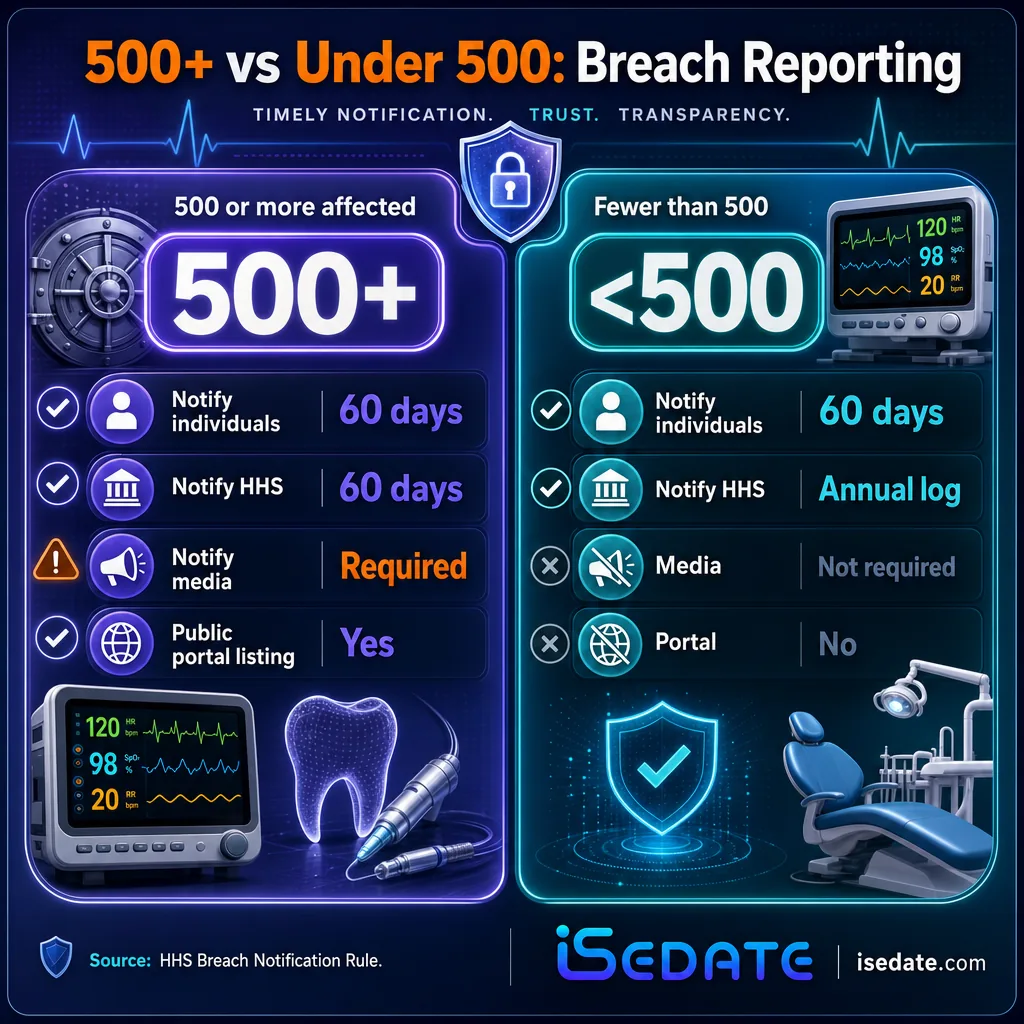
For a breach affecting 500 or more people in a state or jurisdiction, the practice must notify individuals, report to HHS contemporaneously, and notify prominent local media outlets, and the breach becomes publicly listed on the HHS breach portal, the source of most published dental breach counts. For breaches under 500, the practice still notifies affected individuals within 60 days, but may maintain a log and report those smaller breaches to HHS once a year, within 60 days after the calendar year ends. Most dental breaches are smaller-scale, which means the annual-log obligation is the one that quietly catches practices that never realized they had a reporting duty at all.
iSedate Analysis: The small-breach blind spot
The under-500 category is where many dental practices unknowingly fall out of compliance. A breach affecting a handful of patients, a lost thumb drive, a misdirected email, still requires individual notification within 60 days and an entry in the annual HHS log. Because these incidents do not trigger media coverage or portal listing, practices often assume, wrongly, that nothing needs to be reported. The result is a quiet compliance gap that surfaces only during an audit or a later, larger investigation. Knowing that even small incidents carry firm obligations is half of managing them.
Calculation and interpretation original to iSedate.
Source: Censinet on the 500-individual threshold | HHS reporting requirements
See sedation compliance documentation4 The Business Associate Problem
Here is the dimension most dental practices underestimate: a large share of dental breaches originate not inside the practice, but at a vendor, and the practice can still carry the notification burden.
A business associate is any outside entity handling PHI for the practice: practice-management and imaging software vendors, billing companies, cloud hosts, IT providers, and dental labs that receive patient-identifiable information. When a business associate discovers a breach of the practice's unsecured PHI, it must notify the practice without unreasonable delay and no later than 60 days after discovery. Then, unless the business associate agreement specifically assigns notification to the vendor, the dental practice must issue the required notifications to individuals, OCR, and media. In effect, a vendor's security failure becomes the practice's notification problem.
Your vendor's breach is your obligation, and your risk. The lesson from real cases is blunt: your software vendors' HIPAA failures become your breach-notification problem. This is why a signed, current business associate agreement with every vendor that touches PHI is not paperwork, it is the mechanism that defines who notifies whom and how fast. A practice sharing ePHI with a vendor that has no BAA on file is exposed on two fronts at once, the breach and the missing agreement.
The MMG Fusion case makes it concrete: a dental practice-management and marketing software vendor, a business associate, settled with OCR over an unreported security incident in which PHI was posted on the dark web. OCR cited impermissible disclosure, failure to conduct a risk analysis, and failure to notify the affected covered entities, the dental practices relying on it. Every practice using that vendor inherited a notification situation it did not create.
Source: Medcurity on dental vendor breach risk | Accountable on business associate notification
See iSedate's SedationVault5 Dental-Specific Enforcement
The question dentists most often ask, whether OCR really pursues small dental offices, has a clear, documented answer.
OCR investigates dental practices through three pathways: random audits, patient complaints, and breach notifications. When it opens an investigation, it typically requests the practice's written Security Risk Analysis and Risk Management Plan, evidence the risk analysis has been kept current rather than done once, and Business Associate Agreements for all applicable vendors. Notice what this means: a breach notification is itself an invitation to a broader compliance review. The Dental Associates settlement began exactly this way, a breach notification led OCR to find the practice had never done an adequate risk analysis or written policies. The penalty followed not just from the breach, but from what the breach investigation uncovered.
iSedate Analysis: Why the breach report opens the whole file
The most important strategic insight in dental HIPAA enforcement is that a breach notification does not stay contained to the breach. It triggers a documentation review, and OCR asks for the same things every time: a current, documented risk analysis, written policies, and vendor agreements. Practices that keep these current and can produce them on request tend to resolve investigations far better than those scrambling to assemble them after the fact. This rewards a mindset of continuous documentation over event-driven panic, the same mindset that produces good sedation records. A practice that documents as a habit is ready for scrutiny it did not schedule.
Calculation and interpretation original to iSedate.
Source: Patient Protect on dental HIPAA enforcement | Medcurity on small-practice penalties
See SedationVault for dentists6 Reducing Notification Risk
The encouraging part: dental breach and notification risk is highly manageable, and the biggest single lever is one the rule itself hands to practices.
The single most powerful risk-reducer is encryption. The Breach Notification Rule only applies to unsecured PHI, information not rendered unreadable through encryption or destruction. PHI encrypted to HHS-specified standards is generally not "unsecured," so its exposure may not trigger notification at all. Beyond encryption, the practical playbook is consistent across every dental HIPAA source: a current, documented Security Risk Analysis; signed BAAs with every vendor touching PHI; unique logins for each staff member (shared passwords are themselves a violation); audit controls logging access to ePHI; multi-factor authentication; and a pre-built incident-response plan so at least two people know exactly what to do when a breach is suspected.
iSedate Analysis: How secure record systems shrink notification risk
Two levers in the notification rule reward the right record system directly. First, encryption: PHI held in encrypted, HIPAA-compliant storage may fall outside the "unsecured" definition that triggers notification in the first place. Second, audit controls: when OCR opens a breach investigation, the ability to show exactly who accessed a record and when is precisely what an investigation demands. iSedate's SedationVault keeps sedation records in HIPAA-compliant cloud storage with access controls and audit trails, and captures vitals automatically from compatible monitors such as Edan, MindRay, and Criticare, then exports a clean PDF into whatever chart the practice already keeps, whether Dentrix, Eaglesoft, or Open Dental. It handles the sedation record specifically, not a practice's entire HIPAA program, no single tool does that, but it addresses that high-sensitivity record the way the notification rule rewards: encrypted and access-logged. Reference figures for the founders' own practice reflect thousands of documented sedation procedures, a practice-level dataset, not a nationwide claim.
Calculation and interpretation original to iSedate.
For the broader dental breach landscape, including attack methods and the largest dental breaches, see the companion report on dental practice cybersecurity, and for HIPAA fines and penalty tiers, see the HIPAA fine statistics report.
Book a SedationVault demo7 Summary Table: Every Statistic at a Glance
| Statistic / Requirement | Figure | Source | Year |
|---|---|---|---|
| Individual notification deadline | 60 days from discovery | HHS / 45 CFR 164.400-414 | 2026 |
| HHS notification (500+ breach) | Within 60 days | HHS | 2026 |
| HHS notification (<500 breach) | Annually, 60 days after year-end | HHS | 2026 |
| Media notification threshold | 500+ in a state | HHS | 2026 |
| Business associate notice to practice | ≤60 days (often 24 hrs by BAA) | HIPAA Journal; Accountable | 2026 |
| Documentation retention period | 6 years | ADA | 2026 |
| Breach risk-assessment factors | 4 factors | HHS | 2026 |
| Exceptions to breach definition | 3 exceptions | HHS | 2026 |
| Breach presumption standard | Presumed unless low-probability shown | HHS | 2026 |
| Dental Associates settlement | $10,000 | Patient Protect / OCR | 2016 |
| Low end of small-practice penalties | ~$3,500 | Medcurity | 2026 |
| Dental software vendor OCR settlement | MMG Fusion (BA) | Medcurity / OCR | 2025 |
| Breach-notification cost per patient | $50-$150 | Medcurity | 2026 |
| Proposed 2025 rule vulnerability scans | Every 6 months | Medcurity (proposed) | 2025 |
| Proposed penetration testing cost | $3,000-$8,000 | Medcurity (proposed) | 2025 |
Frequently Asked Questions
What must a dental practice do after a HIPAA breach?
What is the 500-patient threshold for HIPAA breaches?
Is a dental practice responsible for its vendor's breach?
Are dental practices actually investigated for HIPAA breaches?
What counts as a HIPAA breach in a dental practice?
Methodology & Sources
Primary and institutional sources: the HHS HIPAA Breach Notification Rule (45 CFR §§ 164.400-414) and the American Dental Association's HIPAA breach-notification and compliance guidance. Supporting analysis: HIPAA Journal, Censinet, Keragon, Accountable, Patient Protect, and Medcurity for notification mechanics, business associate obligations, dental enforcement examples, and cost figures.
Note on scope: this article focuses specifically on the dental Breach Notification Rule, reporting deadlines, the 500-individual threshold, and business associate and vendor obligations. For dental cyberattack methods and the largest dental breaches, see the companion report on dental practice cybersecurity; for HIPAA violation types and causes, and for penalty tiers and fine amounts, see the HIPAA violation and HIPAA fine reports in this series. Some 2025 to 2026 Security Rule provisions described here derive from a Notice of Proposed Rulemaking that was not finalized as of mid-2026 and are labeled as proposed; practices should confirm current requirements. This is general information, not legal advice; consult qualified HIPAA counsel for your practice's obligations. Statistics reflect the most recent available data as of 2026.
Media & press usage: Journalists and researchers are welcome to cite these statistics with attribution to iSedate and a link to this page. The iSedate Analysis boxes contain original interpretation unique to this article.