






Emergency Drug & Equipment Readiness Statistics (2026): Dental Office Data
Dental office emergency preparedness has a consistent weak spot: the plan often exists on paper, but the drugs, AED, oxygen, and drills behind it frequently do not. Emergency drug kits appear in anywhere from 24% to 85% of offices, AEDs in fewer than 5% to 18%, and only about 13% of practices run regular drills. Readiness is a documentation and maintenance problem more than an equipment-cost one.
Key Takeaways
- Kit availability is uneven. Emergency drug kits are present in 24% to 85% of offices depending on region and specialty.
- AEDs are rare. Under 5% of European and 15% to 18% of surveyed offices have an AED, versus over 10% in the U.S.
- Oxygen is not universal. Availability ranges from about 21% to 70% across countries, despite being the most-needed emergency drug.
- Drills are uncommon. Only 12.9% of offices ran periodic mock drills; 20% had a written emergency protocol.
- Checking lags stocking. Only 55% of offices with a kit actually check it, and mean drug availability scored 35 of 100.
- Confidence is low. A third of dentists were unsure how to use their emergency drugs.
What's in This Guide
1 Emergency Drug Kit Availability
Whether a dental office has an emergency drug kit at all depends heavily on where it is and what it does. Across surveys, kit availability ranges from about 24% in one study to 72.7%, 74.3%, and 85% in others. The wide spread reflects differing regulations, specialties, and survey populations, but the low end is concerning: a meaningful share of offices have no emergency drug kit despite the near-certainty of an emergency over a career.
Availability is only half the story; maintenance is the other half. In one survey, 85% of offices reported having an emergency drug kit, but only 55% actually checked it. A separate preparedness study scored mean drug availability at just 35 out of 100 and equipment at 19 out of 100. An unchecked kit is a false sense of security: expired drugs, missing items, or a depleted oxygen cylinder all defeat the purpose exactly when it matters most.

Regulatory context shapes these numbers. The ADA Policy on Emergency Drugs and Equipment and state dental board regulations set expectations for a minimum emergency drug kit, a functional AED, and trained staff, with documented inspection of supplies. Where regulation is stronger, availability tends to be higher, which is why the same drug can be near-universal in one region and scarce in another.
Source: Are Dental Professionals Ready to Deal With Medical Emergencies? (PMC) | Evaluation of Preparedness for Medical Emergencies at Dental Offices (PMC)
See documented readiness and compliance2 Which Drugs Are Actually Stocked
Among offices that do have a kit, the drugs inside follow a clear hierarchy. The basics, oxygen, adrenaline or epinephrine, and glucose, are the most consistently stocked. In one Indian survey, the most available drugs were adrenaline at 88%, diazepam at 85%, oral glucose at 81.4%, ammonia inhalant at 78.3%, and epinephrine at 71.6%. Regional surveys vary in which drug leads, but the top tier is stable.
The picture weakens sharply below the top tier. In one dental-student and intern survey, adrenaline was the most cited drug at just 38.6%, followed by antihistamines at 23.4%, with atropine the least available at 13.8%, and 58.6% of participants reported a lack of emergency drugs in their practice settings. The drugs most likely to be missing are often the ones needed for the rarest, most dangerous events, which is precisely the wrong direction for a safety net.
Myth: Having a kit means being prepared
A stocked kit is necessary but not sufficient. Surveys repeatedly find that a third of dentists were either not confident or did not know how to use the emergency drugs in their kit, and only about a quarter felt confident using emergency drugs at all. Preparedness is the intersection of three things: the drug is present, it is not expired, and someone knows how and when to use it. A kit satisfies only the first. The other two require training, maintenance, and documentation.
Source: Evaluation of Preparedness for Medical Emergencies at Dental Offices (PMC) | How Prepared Are Dental Students to Manage Medical Emergencies? (PMC)
See drug and equipment tracking in SedationVault3 AED and Oxygen Availability
Two pieces of equipment matter most for life-threatening events, and both are underrepresented. Automated external defibrillators are strikingly rare: an AED is present in fewer than 5% of dental offices in Europe, versus more than 10% in the United States. Individual surveys found AEDs in 15.5% of Slovenian and 17.9% of Polish offices. Because most countries do not mandate an AED in dental practice, availability tracks regulation closely.
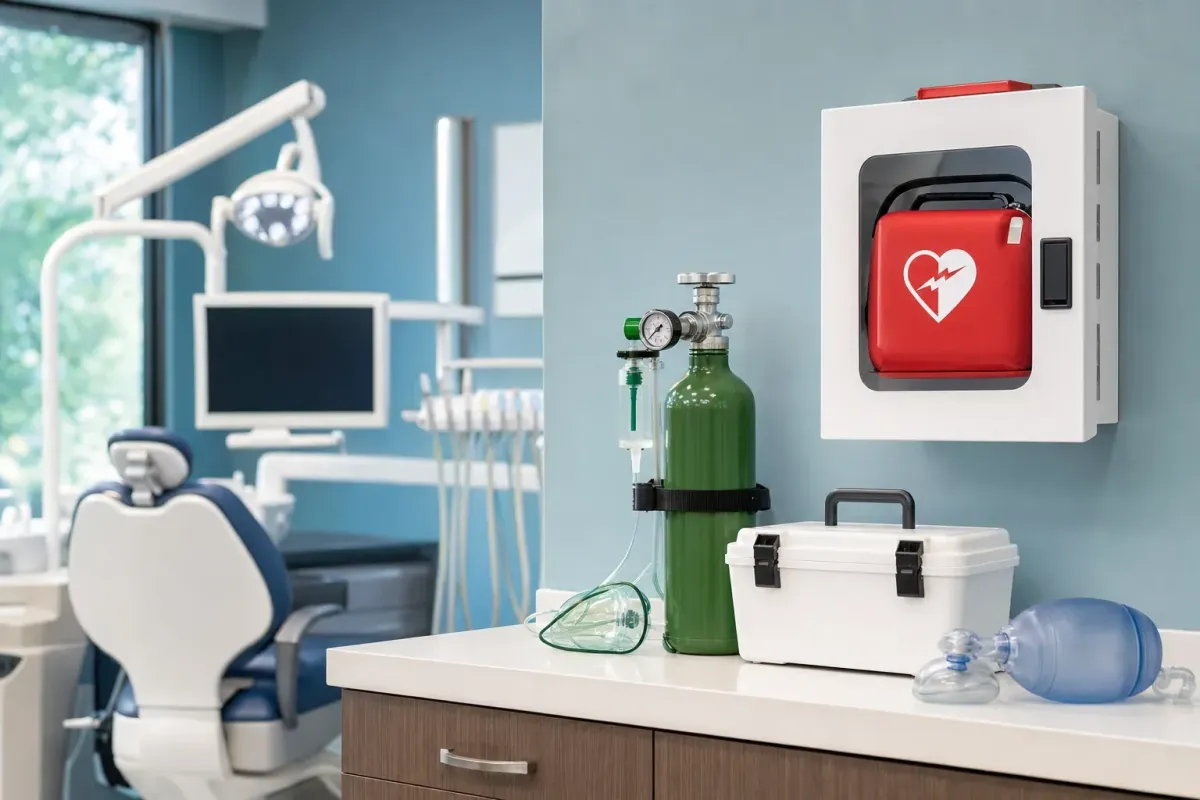
Oxygen is the more fundamental gap because it is needed in nearly every dental emergency except hyperventilation. Availability ranges widely: roughly 21% in one Polish survey, 49% in Slovenia, 52% to 57% in Saudi surveys, 63% in Australia, and 70% in Germany. The recommended setup is a portable E-size cylinder that can deliver more than 90% oxygen at 5 liters per minute for at least 60 minutes, with masks for spontaneous breathing and a bag-valve mask for the apneic patient.
Regulation is closing the AED gap in the United States. Several states, including New York since January 2012, along with Massachusetts and Mississippi, now require an AED or other defibrillator in every dental office. As sudden cardiac events remain a leading cause of preventable death, this equipment is increasingly treated as mandatory rather than optional.
| Equipment / Drug | Availability | Region / Survey |
|---|---|---|
| AED | Under 5% | Europe (general) |
| AED | Over 10% | United States |
| AED | 15.5% | Slovenia |
| AED / defibrillator | 17.9% | Poland |
| Oxygen source | 21.5% | Poland |
| Oxygen source | 49.1% | Slovenia |
| Oxygen | 63% | Australia |
| Oxygen | 70% | Germany |
| Self-inflating bag resuscitator | 82.3% | Poland |
| Supraglottic airway device | 35.8% | Poland |
Source: Preparedness and Attitudes Towards Medical Emergencies Among Polish Dentists (PMC) | Emergency Equipment for Dental Offices (dentalcare.com CE)
See compliant records for equipment logs4 Airway and Monitoring Equipment
Airway management equipment shows the same pattern of partial readiness. In the Polish survey, a self-inflating bag resuscitator was available in 82.3% of offices, a supraglottic airway device in 35.8%, but an oxygen source in only 21.5%. In Slovenia, 58.1% had a self-inflating bag, 60.6% a pocket mask, 40.1% an oropharyngeal airway, and 40.1% a blood pressure monitor. The pieces are often present individually but rarely complete as a set.
Monitoring equipment is where sedating offices separate from the rest. Pulse oximeters are usually found in dental offices where sedation and general anesthesia are administered, and they are also useful for monitoring the effectiveness of CPR. For offices that sedate, pulse oximetry is not optional equipment; it is the tool that detects the respiratory depression that drives serious sedation events. Yet across general dental surveys, blood pressure monitors and pulse oximeters are far from universal.
iSedate Analysis: The completeness gap
Combining the equipment sub-rates reveals a structural problem: readiness is not additive when any single link is missing. In the Polish data, self-inflating bags were present in 82.3% of offices but oxygen in only 21.5%, meaning a large share of offices have the bag to ventilate but not the oxygen to ventilate with. A bag-valve mask without an oxygen source, or an AED without trained staff, is a chain with a broken link.
Interpretation: because emergency response is a sequence, the effective readiness rate is closer to the lowest-availability essential item (oxygen at roughly 21% to 70%) than to the highest (self-inflating bag at 82%). Whole-kit readiness, verified as a complete set, is the metric that matters, not individual item counts. Sources: Polish and Slovenian preparedness surveys. Calculation and interpretation original to iSedate.
Source: Preparedness and Attitudes Towards Medical Emergencies Among Polish Dentists (PMC) | Emergency Equipment for Dental Offices (dentalcare.com CE)
See continuous monitoring records5 Drills, Protocols, and Maintenance
The final and largest gap is behavioral, not material. Even a fully stocked office is unprepared if staff never practice. In a survey of 70 dental practices, only 12.9% reported performing periodic mock drills for medical emergencies, and just 20% had a written protocol and flow chart available to office personnel. Equipment without rehearsal and protocols is equipment no one is trained to deploy under pressure.
Competence data reinforces the point. In one survey, only 34.5% of dentists considered themselves competent with CPR and 28.8% were confident using emergency drugs. The recommended standard, regular documented inspection of supplies plus periodic drills, exists precisely because both the equipment and the skills decay without maintenance. Expired drugs, dead AED batteries, and forgotten protocols are the predictable result of stock-and-forget.
Why documented maintenance is the real readiness metric
The compliance standard is not "have a kit," it is documented inspection of emergency supplies to ensure readiness. That word, documented, is the difference between real and theoretical preparedness. A dated log of kit checks, drug expiration dates, AED battery status, and completed drills is what proves an office is ready, and it is exactly what a board audit or a malpractice defense will ask for. Readiness that cannot be shown on paper is readiness that cannot be defended.
iSedate's SedationVault supports this discipline for sedating practices. Alongside its continuous, timestamped vitals capture from compatible monitors including Edan, MindRay, Criticare, and more, SedationVault's Sedation Intelligence System tracks drug inventory, logs, license and certification tracking, and emergency-equipment oversight, and produces one-click audit-ready PDF reports. That turns stock-and-forget into a documented, maintainable record of exactly the readiness these surveys keep finding absent.
Source: Preparedness of Private Dental Offices for Medical Emergencies (Saudi Medical Journal) | Are Dental Professionals Ready to Deal With Medical Emergencies? (PMC)
Book a DemoEmergency Drug & Equipment Readiness Statistics: Summary Table
| Statistic | Figure | Source | Year |
|---|---|---|---|
| Offices with an emergency drug kit | 24% to 85% | Multiple preparedness surveys | 2014-2022 |
| Offices that check their kit | 55% | Riyadh OMFS survey | 2022 |
| Mean drug-availability preparedness score | 35 / 100 | Preparedness study | 2022 |
| Mean equipment preparedness score | 19 / 100 | Preparedness study | 2022 |
| Adrenaline availability (top-tier drug) | Up to 88% | India survey | 2015 |
| Diazepam availability | 85% | India survey | 2015 |
| Oral glucose availability | 42.7% to 81.4% | Regional surveys | 2015-2022 |
| Atropine availability (bottom-tier) | 13.8% | Dental student/intern survey | 2025 |
| Respondents lacking emergency drugs | 58.6% | Dental student/intern survey | 2025 |
| AED availability, Europe | Under 5% | European review | 2022 |
| AED availability, United States | Over 10% | U.S. review | 2022 |
| AED availability, Slovenia / Poland | 15.5% / 17.9% | Slovenian and Polish surveys | 2022 |
| Oxygen availability range | 21% to 70% | Poland, Slovenia, Saudi, Australia, Germany | 2015-2022 |
| Self-inflating bag resuscitator | 58.1% to 82.3% | Poland / Slovenia surveys | 2022 |
| Supraglottic airway device | 35.8% | Poland survey | 2022 |
| Blood pressure monitor | 40.1% | Slovenia survey | 2022 |
| Offices running periodic drills | 12.9% | Saudi 70-practice survey | 2015 |
| Offices with a written emergency protocol | 20% | Saudi 70-practice survey | 2015 |
| Dentists competent with CPR | 34.5% | University hospital survey | 2022 |
Frequently Asked Questions
How many dental offices have an emergency drug kit?
How common is an AED in dental offices?
Do most dental offices have emergency oxygen?
How often do dental offices run emergency drills?
What emergency equipment should every dental office have?
Methodology & Sources
Figures in this article are drawn from peer-reviewed preparedness surveys, professional continuing-education references, and association policy rather than secondary aggregators. Availability rates vary substantially by country, specialty, and survey year because emergency-equipment requirements depend on local regulations, so figures are reported as ranges with their source region and dataset rather than merged into single values. Where a single survey is cited for a specific figure, its country and year are named.
Primary sources: Preparedness and Attitudes Towards Medical Emergencies in the Dental Office Among Polish Dentists (PMC, 2022), including comparative Slovenian, German, and Australian data; Are Dental Professionals Ready to Deal With Medical Emergencies? survey of university hospitals (PMC, 2022); Evaluation of Preparedness for Medical Emergencies at Dental Offices (PMC, 2014-2015); The Preparedness of Private Dental Offices and Polyclinics for Medical Emergencies (Saudi Medical Journal, 2015); How Prepared Are Dental Students to Manage Medical Emergencies (PMC, 2025); Emergency Equipment, Management of Pediatric Medical Emergencies in the Dental Office (dentalcare.com continuing education); ADA Policy on Emergency Drugs and Equipment. Older data is labeled by year and region.
Media & Press Use
Journalists, researchers, and educators are welcome to cite these statistics with attribution to iSedate and a link to this page. For the iSedate Analysis figure, please credit the calculation as original to iSedate. For interviews or additional data on emergency-equipment tracking and documentation, contact iSedate at [email protected].