






Hawaii Sedation Dentistry Licensing & Permit Requirements
In Hawaii, your dental license alone does not let you sedate a patient once you move past the lightest level. Any dentist who administers moderate (conscious) sedation, deep sedation, or general anesthesia must first hold the matching permit from the Hawaii Board of Dentistry, required by Hawaii Revised Statutes section 448-29 and the anesthesia rules in Haw. Admin. R. Chapter 16-79. Getting the permit means meeting the Board's training and certification requirements for your depth. Keeping it means renewing on time, passing a facility inspection, administering sedation consistent with the ADA standard the rule adopts, and filing a report within 30 days if a serious adverse event ever occurs. This guide walks both halves: how a Hawaii dentist gets a sedation permit, and what it takes to keep it.
Recent Updates
Last UpdatedNovember 16, 2026
- Re-verified every permit requirement against Hawaii Revised Statutes section 448-29 and the Hawaii Board of Dentistry's current application, renewal, and inspection materials.
- Added the statutory moderate-sedation training path: a 60-hour postgraduate program with at least 20 supervised patients (HRS 448-29(d)(1)(B)).
- Added the biennial renewal cycle, the facility-inspection-at-renewal rule, the lapsed-permit rule, and the current anesthesia-privilege renewal fee.
- Replaced third-party statute copies with links to Hawaii's own official statute and Board of Dentistry sources.
Key Takeaways
- Hawaii requires no permit for nitrous oxide plus a single oral sedative (Haw. Admin. R. §16-79-77); moderate (conscious) sedation, deep sedation, and general anesthesia each require a Board permit (HRS 448-29; §16-79-78).
- The moderate-sedation path is a 60-hour postgraduate program with at least 20 supervised patients plus ACLS; general anesthesia and deep sedation require a CODA-accredited advanced program (HRS 448-29(d)).
- The permit is issued by the Hawaii Board of Dentistry under the Department of Commerce and Consumer Affairs, not by any national body.
- Permits renew biennially with a resuscitation-plan proof and a facility inspection; a lapsed permit cannot be renewed and requires a new application (HRS 448-29(e)).
- Hawaii adopts the ADA sedation guidelines (and AAP/AAPD for children) as the minimum standard of care, and a serious adverse event triggers a 30-day report under §16-79-79 that can cost the permit if missed.
What This Guide Covers
- Who issues sedation permits in Hawaii
- The Hawaii permit structure, by depth
- How to get or upgrade a permit
- What the permit requires you to monitor
- Reporting obligations tied to your permit
- Renewal, fees, and recertification
- Facility inspections and record reviews
- Keeping the permit: audit-ready records
- Frequently asked questions
- Sources
Who issues sedation permits in Hawaii
Sedation dentistry in Hawaii is regulated by the Hawaii Board of Dentistry, which operates under the Department of Commerce and Consumer Affairs (DCCA), Professional and Vocational Licensing Division. The Board, not any national association, decides who may sedate, issues the written authorization or permit, inspects the facility, and takes disciplinary action under the enabling statute, Hawaii Revised Statutes Chapter 448. The core requirement lives in HRS section 448-29, and the operative anesthesia rules are in the Hawaii Administrative Rules, Title 16, Chapter 79, Subchapter 8.
You apply to the Board through its own process under the DCCA Professional and Vocational Licensing Division. The Board publishes its application forms, fees, and instructions on its Board of Dentistry application forms and publications page, and it answers questions at (808) 586-2702 or [email protected]. Because forms, fees, and permit titles change periodically, confirm the current documents with the Board before you file rather than relying on a figure from a continuing-education provider's page.
Important
The ADA writes the standard; the Board writes the law. The American Dental Association publishes sedation guidelines that Hawaii leans on heavily, to the point that §16-79-78 adopts the current ADA guidelines as the minimum standard of care. But the ADA is a professional association, not a government agency. It does not license you, inspect you, or discipline you. Your permit, your facility inspection, and any sanction all come from the Hawaii Board of Dentistry. Treat the ADA guidelines as the standard you are measured against, and the Board as the body that measures you. The federal layers that do apply are separate: the DEA for controlled-substance records, and HIPAA for patient data.
Source: Hawaii Revised Statutes §448-29 | Hawaii Board of Dentistry application forms and publications
The Hawaii permit structure, by depth
Hawaii does not number its permits the way some states do. Its rules draw the line by sedation depth: first, whether what you administer needs a Board permit at all, and then by how deeply the patient is sedated. The level reflects the depth of sedation, not merely which drug or route you use.
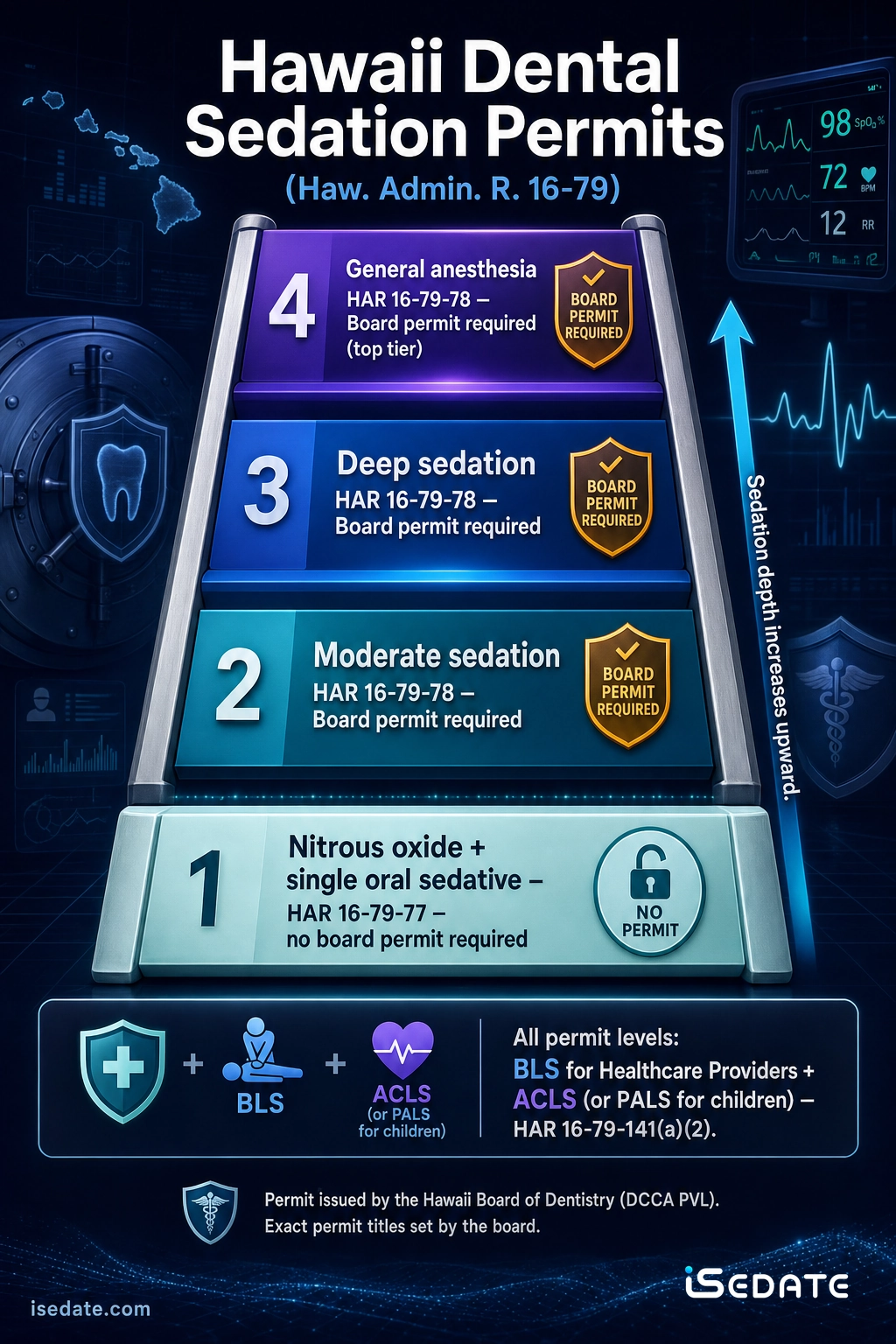
No permit: nitrous oxide plus a single oral sedative (§16-79-77). Under Haw. Admin. R. §16-79-77, administering nitrous oxide along with a single oral sedative at an appropriate dose to reduce anxiety does not require a Board permit. This is the entry point most general practices use for simple anxiety control, where the patient stays responsive and keeps their own airway.
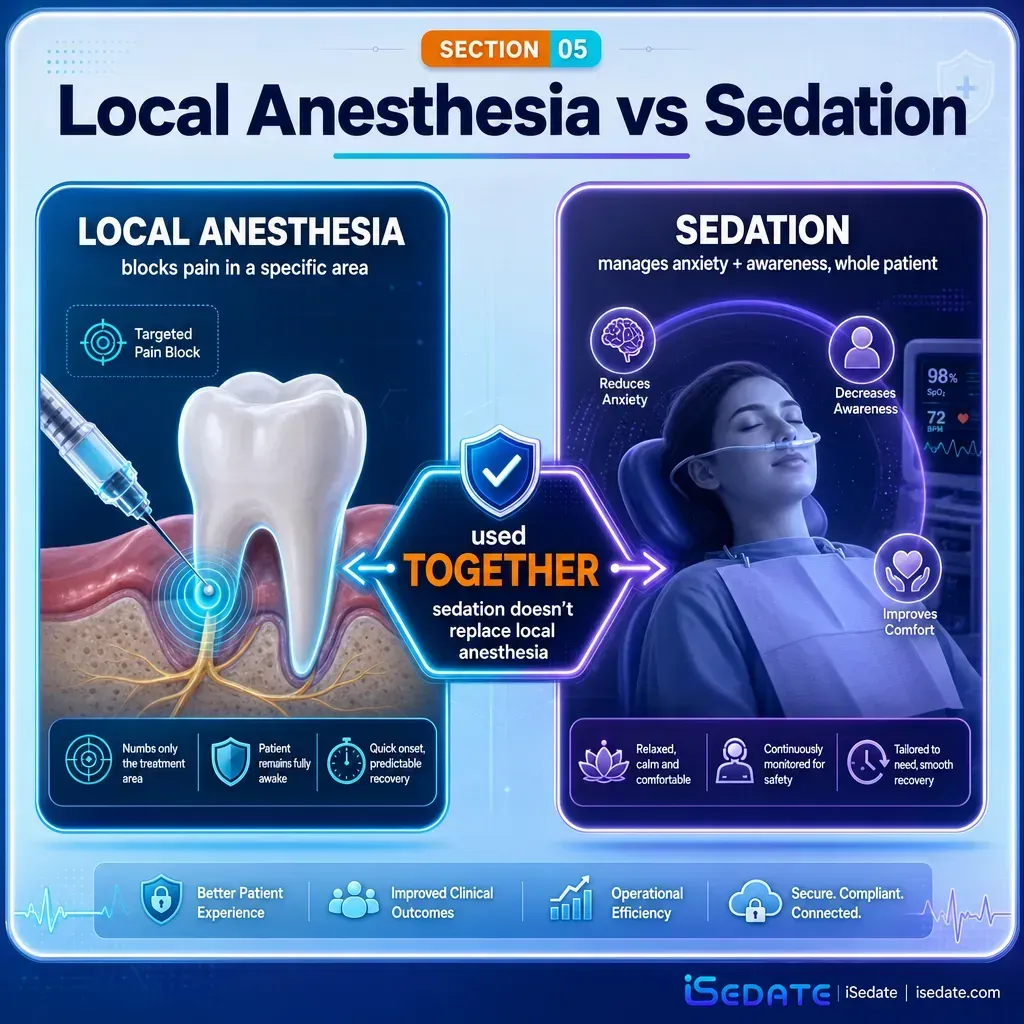
Permit required: moderate (conscious) sedation (HRS 448-29; §16-79-78). Moderate sedation, long called Conscious Sedation, is the level at which the patient still responds purposefully to verbal or tactile stimulation and maintains their own airway. It requires a written authorization or permit from the Board, and it is the workhorse level for dentists who provide real sedation, including by the IV route.
Permit required: deep sedation (HRS 448-29; §16-79-78). Deep sedation, where the patient is not easily aroused and may need airway support, sits above moderate sedation and requires a Board permit. It carries heavier monitoring and training expectations.
Permit required: general anesthesia (HRS 448-29; §16-79-78). General anesthesia, where the patient is unconscious and often needs airway support, is the top tier and requires a Board permit. For general dentists it is largely out of scope; it is the province of dental anesthesiologists and oral and maxillofacial surgeons. The exact permit titles and the precise scope for each depth are set by the Board, so if you are pursuing deep sedation or general anesthesia, work directly with the Hawaii Board of Dentistry to confirm the permit that applies.
Source: HRS §448-29(b) | Haw. Admin. R. Chapter 16-79 (§§16-79-77, 16-79-78)
How to get or upgrade a permit
To hold a permit for moderate sedation, deep sedation, or general anesthesia, you meet the Board's credentialing requirements for that depth, apply to the Board, pay the application fee, and submit proof of your training, facility, and team. Hawaii's statute spells out the training paths with unusual specificity, so there is less guesswork here than in many states.
State Law
Moderate (conscious) sedation. Under HRS §448-29(d)(1)(B), the moderate-sedation path requires a postgraduate program of at least 60 hours of instruction that includes the supervised management of at least 20 patients, together with current Advanced Cardiac Life Support (ACLS), or Pediatric Advanced Life Support (PALS) for providers who treat children. Hawaii-approved continuing-education providers such as DOCS Education's Hawaii sedation courses are structured around this 60-hour, 20-patient path; confirm that any course you take is accepted by the Board before you enroll.
Deep sedation and general anesthesia. For the deeper permits, HRS §448-29(d)(1)(A) requires completion of an advanced dental education program accredited by the Commission on Dental Accreditation (CODA) and approved by the Board. Being a diplomate of the American Board of Oral and Maxillofacial Surgery, or completing an accredited residency in oral and maxillofacial surgery or dental anesthesiology, qualifies. This is why these levels sit largely with oral surgeons and dental anesthesiologists.
State Law
The resuscitation floor. Across every permit level, Haw. Admin. R. §16-79-141(a)(2) requires documented current BLS for Healthcare Providers plus ACLS, or PALS for providers who treat pediatric patients. That floor reflects the deeper point of the whole permit scheme: a permit holder must be able to rescue a patient whose sedation becomes deeper than intended, a duty HRS §448-29(c) states directly.
The alternative path. A dentist who does not personally hold the deeper training can instead show, under HRS §448-29(d)(2), that they employ or work with an anesthesiologist or certified registered nurse anesthetist who remains on the premises until the patient is fully recovered and discharged. Either way, your facility and your team are reviewed as part of the application. For the clinical side of what a permit obligates you to chart, see the companion guide on Hawaii sedation vitals monitoring, charting, and reporting requirements.
Source: HRS §448-29(d) | Haw. Admin. R. §16-79-141(a)(2)
What the permit requires you to monitor
A permit is permission plus obligation. Hawaii does not write its own itemized monitoring parameters into the rule. Instead, §16-79-78 requires permit-level sedation and anesthesia to be administered consistent with the current ADA guidelines (and the AAP/AAPD guidelines for pediatric patients) and adopts those guidelines, along with the AAOMS Office Anesthesia Evaluation Manual, as the minimum standard of care. So once you hold a moderate sedation permit, what you must monitor is what that incorporated standard requires:
- Consciousness: level of consciousness and responsiveness assessed continually.
- Oxygenation: oxygen saturation monitored continuously by pulse oximetry.
- Ventilation: ventilation evaluated continually, with end-tidal carbon dioxide at deeper levels.
- Circulation: blood pressure and heart rate evaluated continually, with continuous ECG expected at deep sedation and general anesthesia.
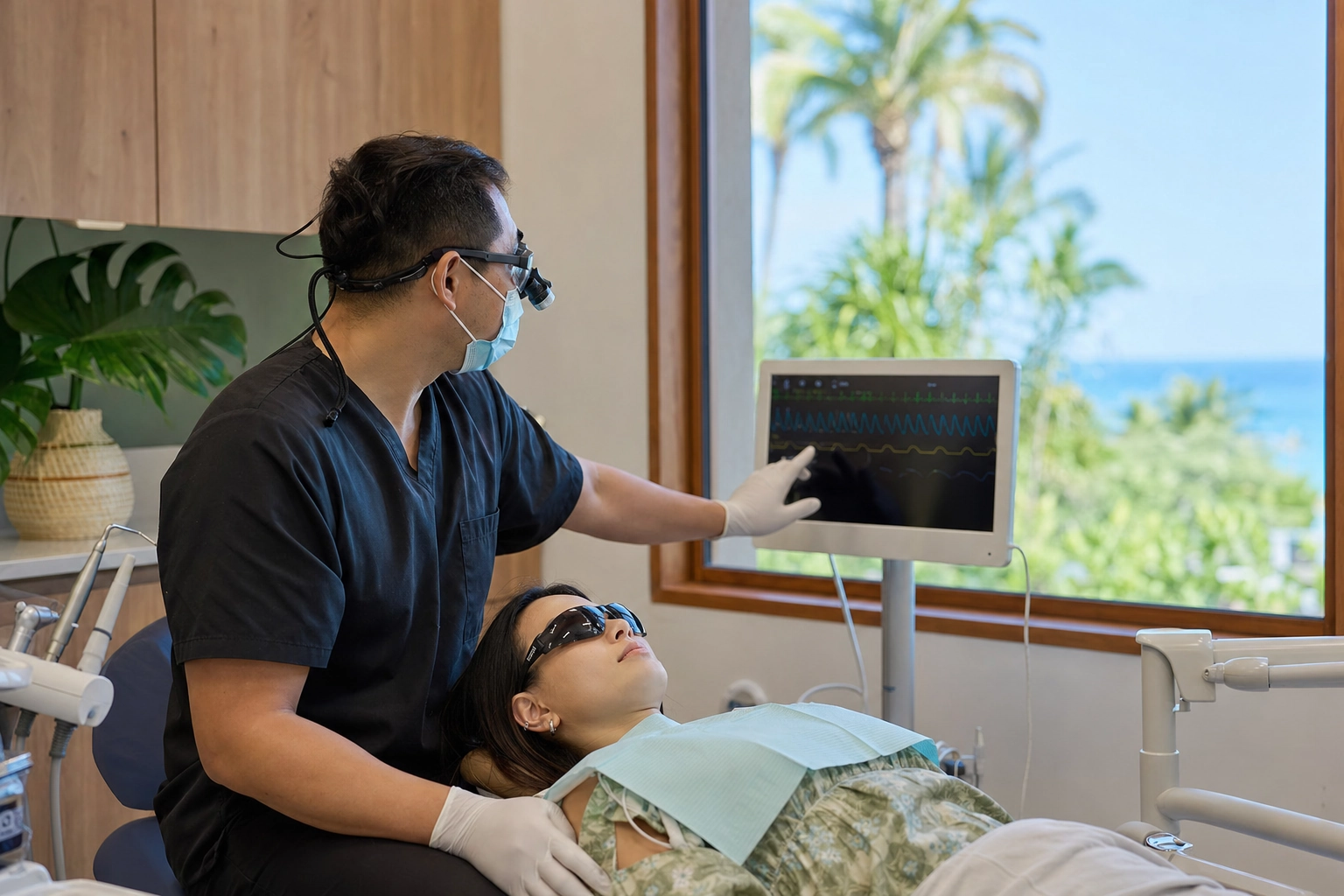
Because Hawaii measures you against an incorporated clinical standard rather than a Hawaii-specific vitals interval, the practical test is whether your contemporaneous record shows those parameters recorded continually. For the full clinical breakdown of what to chart at each depth, see the companion guide on Hawaii sedation charting and reporting requirements, and the national overview in our Sedation Dentistry Licensing & Permit Requirements by State hub.
Source: Haw. Admin. R. §16-79-78(a), (b)(3) | HRS §448-29(a)
Reporting obligations tied to your permit
Holding a Hawaii permit means holding a set of documentation and reporting duties, and these are exactly what the Board examines.
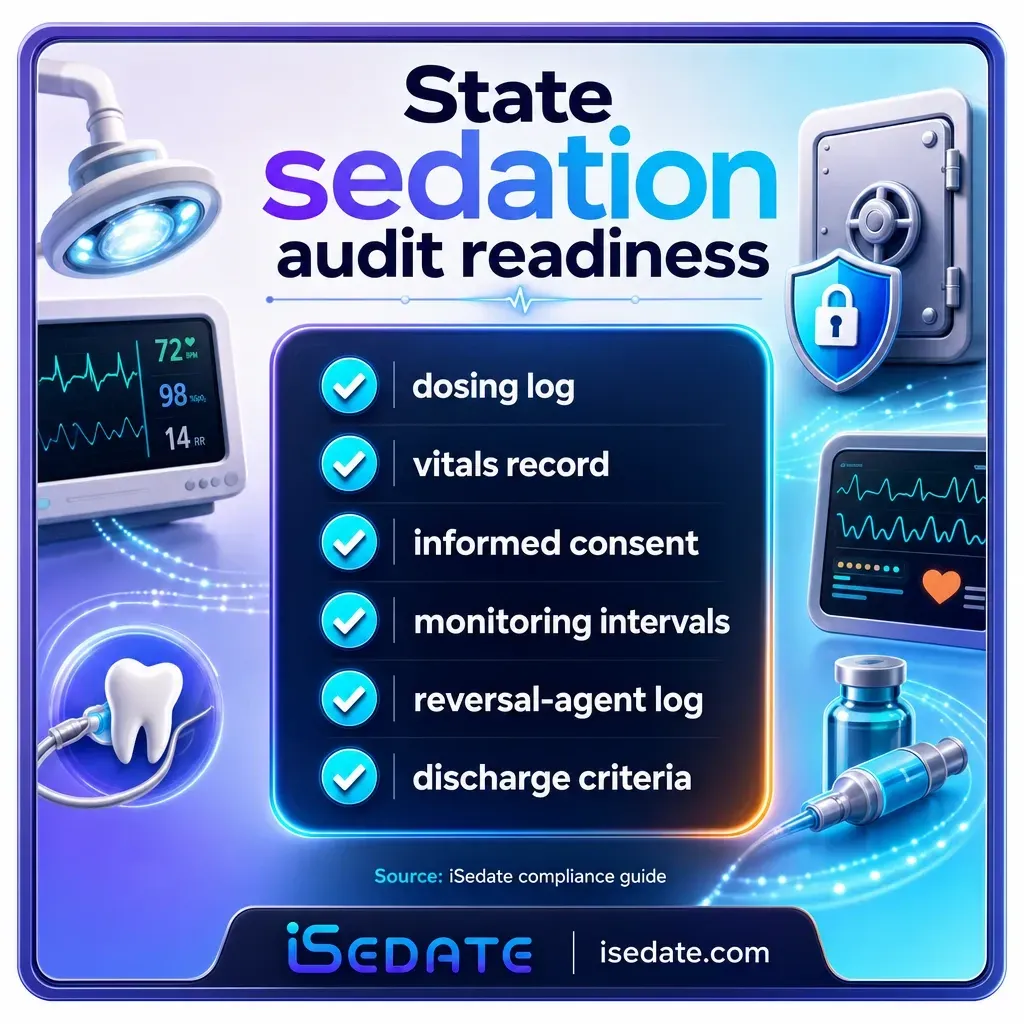
The anesthetic record. Because §16-79-78 adopts the ADA guidelines as the minimum standard of care, a permit holder administering moderate sedation must maintain the time-oriented anesthetic record that standard requires, listing all drugs, doses, and times, with pulse oximetry, heart rate, respiratory rate, blood pressure, and level of consciousness recorded continually. Hawaii does not publish its own standalone sedation-record statute, but it holds you to this incorporated record.
The 30-day adverse-occurrence report. The one express, itemized reporting duty Hawaii writes out itself is in Haw. Admin. R. §16-79-79. Within 30 days of any mortality, or any injury requiring hospitalization, during or as a direct result of anesthesia, the dentist must submit a report to the Board that includes a description of the procedure, the patient's physical condition (unless ASA Class I), a list of drugs and dosage administered, a detailed description of the techniques used, a description of the adverse occurrence, and a description of the patient's condition on termination of the procedure.
State Law
This report is tied directly to your permit. For permit holders administering general anesthesia, deep sedation, or moderate sedation, noncompliance with the §16-79-79 reporting requirement can result in the loss of the written authorization or permit. The material the report demands, drugs and dosage, techniques, and the patient's condition on termination, is precisely what a complete sedation record already contains, which is why the record and the permit are inseparable.
Source: Haw. Admin. R. §16-79-79 | HRS §448-29
Renewal, fees, and recertification
Your sedation permit is tied to your Hawaii dental license, and keeping it current is a scheduled, recurring obligation, not a one-time milestone. Under HRS §448-29(e), the permit renews biennially, and renewal requires both a fee and proof of a current resuscitation plan.
Board Fee
Two renewal details catch practices off guard. First, renewal is not a paperwork formality: it involves a facility inspection unless the Board grants an extension, so your operatory, equipment, and emergency readiness are re-checked on the renewal cycle, not just at first application. Second, a permit that is allowed to lapse cannot simply be renewed; it requires a brand-new application, which means repeating the full credentialing and inspection process. The exact continuing-education hours tied to each permit depth are set by Board rule and updated periodically, so confirm your current renewal cycle, CE hours, and resuscitation-certification requirements directly with the Board's 2025 anesthesia permit renewal and inspection FAQs so your permit never lapses at renewal.
Myth, Busted
Myth: Once you pass your sedation course and get the permit, the hard part is over.
Fact: The permit renews every two years with a facility inspection, and a permit you let lapse cannot be renewed; it forces a full new application, per the Board's 2025 renewal and inspection FAQs.
Treat the permit as a standing obligation with a recurring inspection, not a one-time credential, and calendar the renewal well ahead of the deadline.
Source: HRS §448-29(e) | Hawaii Board of Dentistry fee schedule and forms

Facility inspections and record reviews
This is where a permit is kept or lost. As part of the original application, consultants appointed by the Board under HRS §448-30 determine whether your facility is adequately equipped and whether your anesthesia team is competent to handle emergencies. That review repeats at renewal, and the Board may reevaluate your credentials, facility, equipment, personnel, and procedures at any time under HRS §448-29(f). If you are found no longer qualified, the Board can revoke or refuse to renew the permit, but only after a hearing.
When a reviewer opens your file, they are checking the record, not your intentions. Hawaii measures your sedation record against the ADA standard it has adopted, and it measures your adverse-event response against the itemized §16-79-79 report. A permit holder can deliver flawless sedation and still be exposed if the contemporaneous record is thin, because the record is the proof. A review, like a malpractice claim, turns on whether your time-oriented anesthetic record is complete and contemporaneous.
Source: Hawaii Board of Dentistry 2025 renewal and inspection FAQs | HRS §448-29(f)
Keeping the permit: audit-ready records
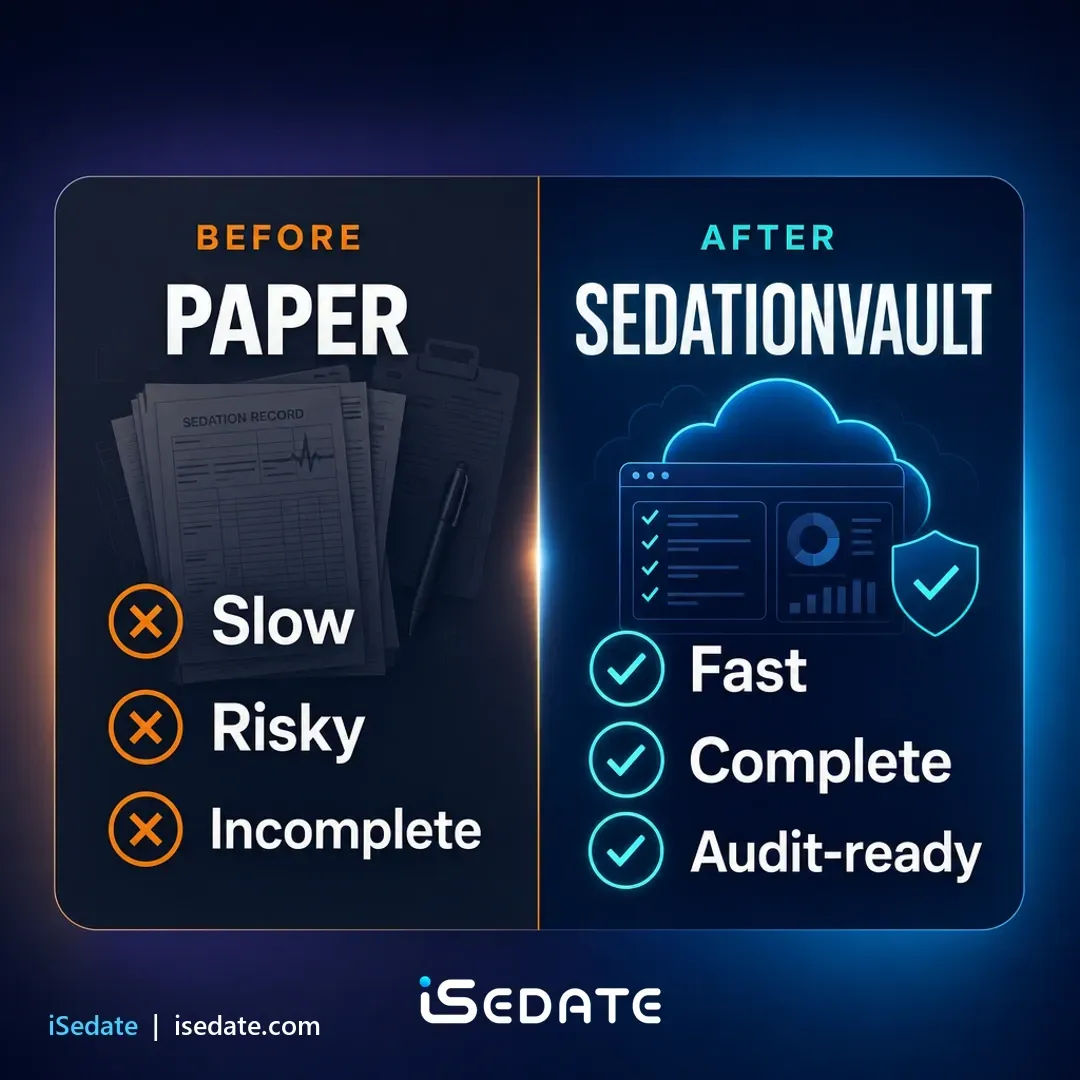
Everything above points to one truth: getting the permit is a one-time hurdle, but keeping it is a daily documentation discipline. A vitals log kept by hand, reading after reading, between titrating a drug and watching an airway, is exactly where records go incomplete, and incomplete records are what a renewal inspection, a board review, and a malpractice claim all attack. The same gaps also make the mandatory §16-79-79 report hard to file accurately if a serious event ever happens.
SedationVault removes that failure point. It captures live patient vitals and the drug log automatically into a time-oriented, audit-ready anesthetic record, recording vitals continually the way the ADA standard Hawaii adopts expects, so the record writes itself while you focus on the patient. When the Board asks for the file at an inspection, or when you need to assemble a §16-79-79 report, a complete record is a one-click export, not a scramble through paper. See how it maps to the rules on the dental sedation compliance and anesthesia record software pages.
Book a Demo of SedationVault See SedationVault PricingFrequently asked questions
What sedation permits does Hawaii require?
What training do you need for a Hawaii moderate sedation permit?
How often do you renew a Hawaii sedation permit?
Does nitrous oxide require a permit in Hawaii?
Who regulates dental sedation permits in Hawaii?
Sources
Sources and How We Verified Them
Every requirement on this page was traced to Hawaii's own official statute, administrative rules, and Board of Dentistry materials, and each external link was checked to resolve before publishing.
- Hawaii Revised Statutes §448-29: General anesthesia and sedation permits (permit requirement, training paths, ACLS/PALS, biennial renewal, reevaluation)
- Haw. Admin. R. Chapter 16-79 (DCCA compiled text) (§16-79-77 nitrous and single oral sedative; §16-79-78 administration of general anesthesia and sedation; §16-79-79 adverse-occurrence report; §16-79-141 credentialing)
- Hawaii Board of Dentistry application forms, requirements, fees, and instructions (application forms, fee schedule, hard-copy renewal)
- Hawaii Board of Dentistry 2025 anesthesia permit renewal and inspection FAQs (facility inspection at renewal, lapsed-permit rule, assistant certification)
- Hawaii Board of Dentistry notice: Permit to Administer Moderate Sedation and Deep Sedation
- DOCS Education Hawaii sedation training courses (one approved provider for the required class; verify acceptance with the Board)
- ADA Guidelines for the Use of Sedation and General Anesthesia by Dentists (incorporated as a minimum standard of care by §16-79-78)
This guide summarizes Hawaii sedation permit rules for general information and is not legal advice. The permit structure, training paths, resuscitation requirement, monitoring standard, biennial renewal, and the 30-day adverse-occurrence report are drawn from HRS §448-29 and the Hawaii Administrative Rules, Chapter 16-79, as cited. Exact permit titles per depth, current application forms and fees, continuing-education hours, and the facility-inspection schedule are set by the Hawaii Board of Dentistry and are updated periodically, so confirm them directly with the Board at (808) 586-2702 or [email protected] before you act.