






Sedation Dentistry Licensing & Permit Requirements by State
There is no single national sedation license in the United States. A dentist who sedates patients does not get permission from Washington or from the American Dental Association. They get it from their state dental board, one board at a time, under that state's own rules. The American Dental Association writes the professional standard that most states lean on, but the permit in your drawer, the inspector at your door, and the review of your records all come from the state. This guide maps the national picture: the permit tiers states share, the training and resuscitation path for each level, the federal DEA layer that sits on top, and a 50-state table of which board governs sedation in your state and under which rule. From there, follow the link to your state's own licensing guide for the exact hours, counts, and citations.
Recent Updates
Last UpdatedNovember 16, 2026
- Rebuilt this hub to link to a dedicated licensing guide for all 50 states, in both the state list and the comparison table.
- Added a permit-level training path at a glance (route, resuscitation, and who typically holds each permit).
- Aligned the documentation standard with the ADA sedation guidelines update adopted in October 2025.
- Sedation permits are issued state by state, not federally and not by the ADA. Each state dental board sets its own permit tiers, training hours, facility inspection, and renewal rules.
- Most states follow the same depth model the ADA defines: minimal sedation, moderate sedation, and deep sedation or general anesthesia, with separate nitrous oxide authority at the bottom.
- The jump from oral to IV is the biggest step. Many states set their moderate parenteral bar near 60 didactic hours and roughly 20 managed live patients, plus current ACLS.
- A federal DEA registration under the Controlled Substances Act is a separate requirement for the controlled drugs used in sedation. The state permit and the DEA registration are two different credentials.
- For moderate and deeper sedation, most states require an on-site facility evaluation, and in many states it repeats on a cycle as a standing condition of the permit.
- A sedation permit does not transfer across a state line. Move, and you apply again under the new board's rules.
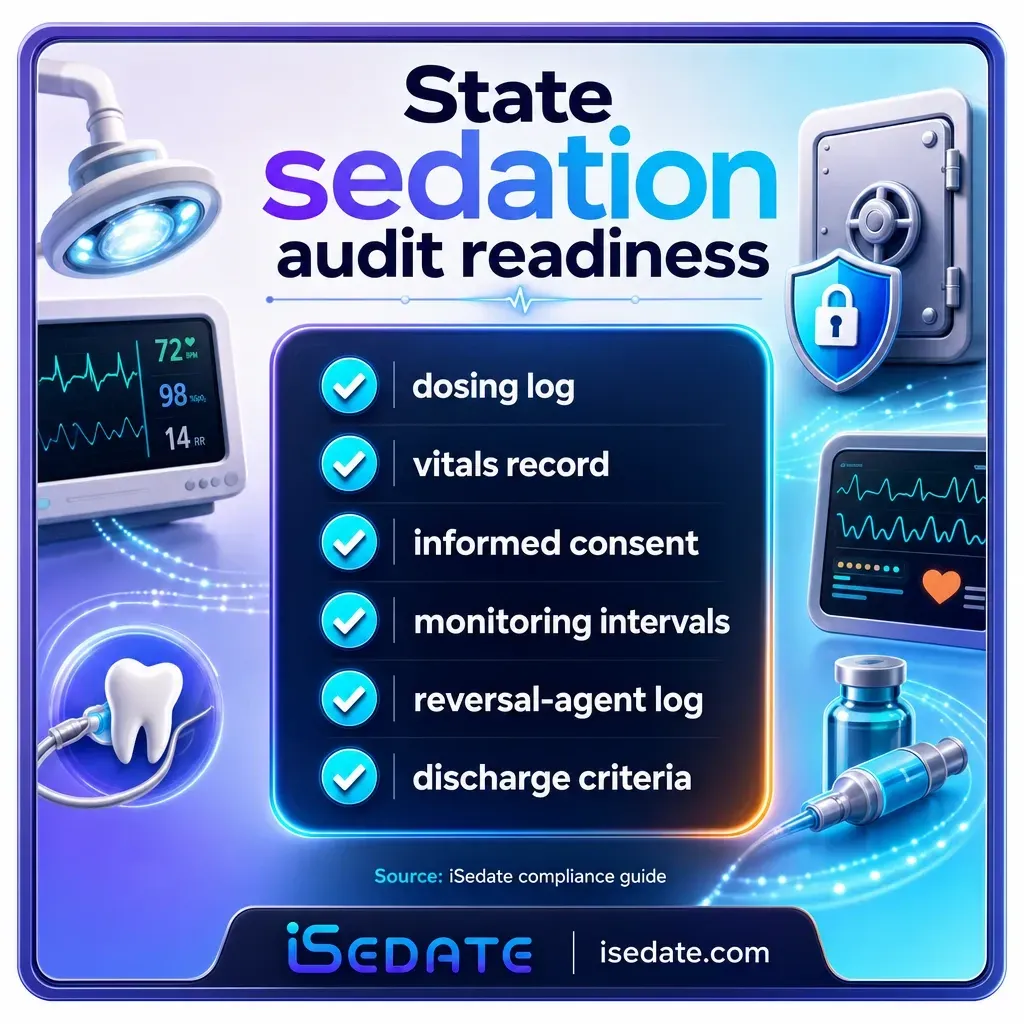
- Getting the permit is a one-time hurdle. Keeping it is a documentation discipline: most states require a time-oriented record of drugs and vitals, and that record is what a board review examines.

What This Guide Covers
- Who issues sedation permits (and who does not)
- The national baseline: the ADA permit-tier model
- The training path: what each permit level takes
- The federal layer: DEA registration
- Sedation dentistry permits by state: the 50-state table
- Find your state: all 50 licensing guides
- After the permit: keeping it inspection-ready
- What to do next
- Frequently asked questions
- Sources
Who issues sedation permits (and who does not)
Dental sedation in the United States is regulated at the state level. Every state has a dental board or an equivalent licensing authority, and that board, not any federal agency and not any professional association, decides who may sedate a patient and at what depth. The board writes the permit rules, issues the permits, inspects the offices, reviews the records, and takes disciplinary action when a rule is broken. There are fifty of these authorities, and while they share a common shape, no two are identical in their permit names, training thresholds, or inspection schedules.
That shared shape is why this guide exists. Read the national model once, here, and you can read almost any state's rules quickly, because the state is usually adapting the model rather than inventing a new one. What changes from state to state is the detail: the name on the permit, the number of hours, the count of live patients, the inspection cycle, and the statute it all lives in. Those specifics belong in each state's own guide, which is why every state below links to one.
State Law, Not Guidance
The ADA writes the standard; your state board writes the law. The American Dental Association publishes the sedation and anesthesia guidelines that most state boards reference or incorporate. Those guidelines define the depth levels and the documentation and monitoring expectations that run through nearly every state's rules. But the ADA is a professional association. It does not license you, inspect your operatory, or discipline you. Treat the ADA guidelines as the national best practice and your state board's rule as the law you are actually held to.
This distinction matters most when a dentist moves, opens a second location across a state line, or buys a practice in a new state. A sedation permit does not travel with the license the way a diploma does. The permit is a state instrument. A dentist permitted for IV moderate sedation in one state must meet, and apply under, the next state's rules before sedating a single patient there. The permit names may differ, the hour counts may differ, and the inspection regime may differ. The only safe assumption when you cross a state line is that you start over with that board.
Source: American Dental Association, Anesthesia and Sedation
The national baseline: the ADA permit-tier model
Although each state writes its own rules, almost all of them build on the same framework the ADA defines. The framework has two moving parts: the depth of sedation, and the route the drug takes to get there. Understanding both lets you place any state's permit names onto a common ladder, even when the labels differ.
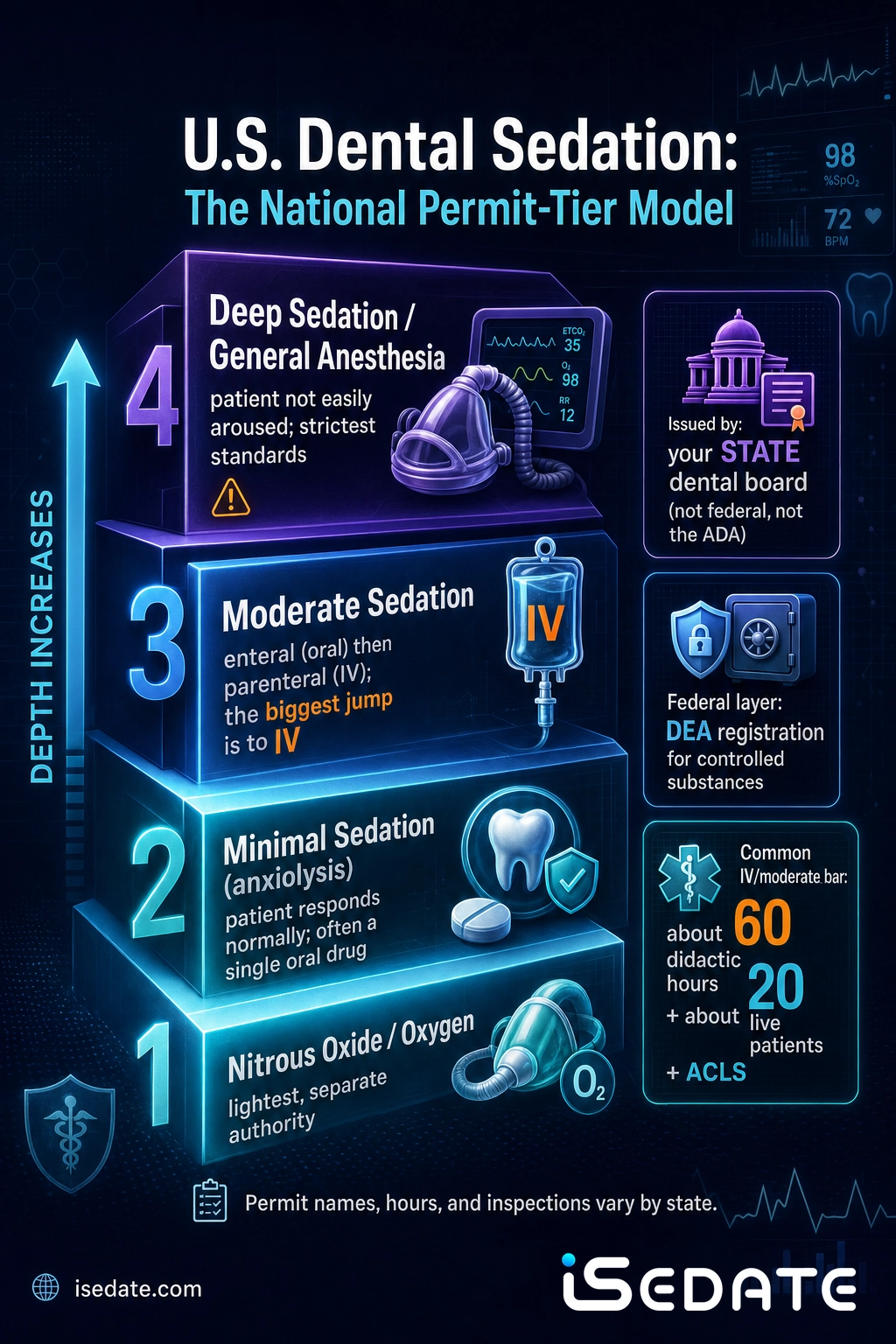
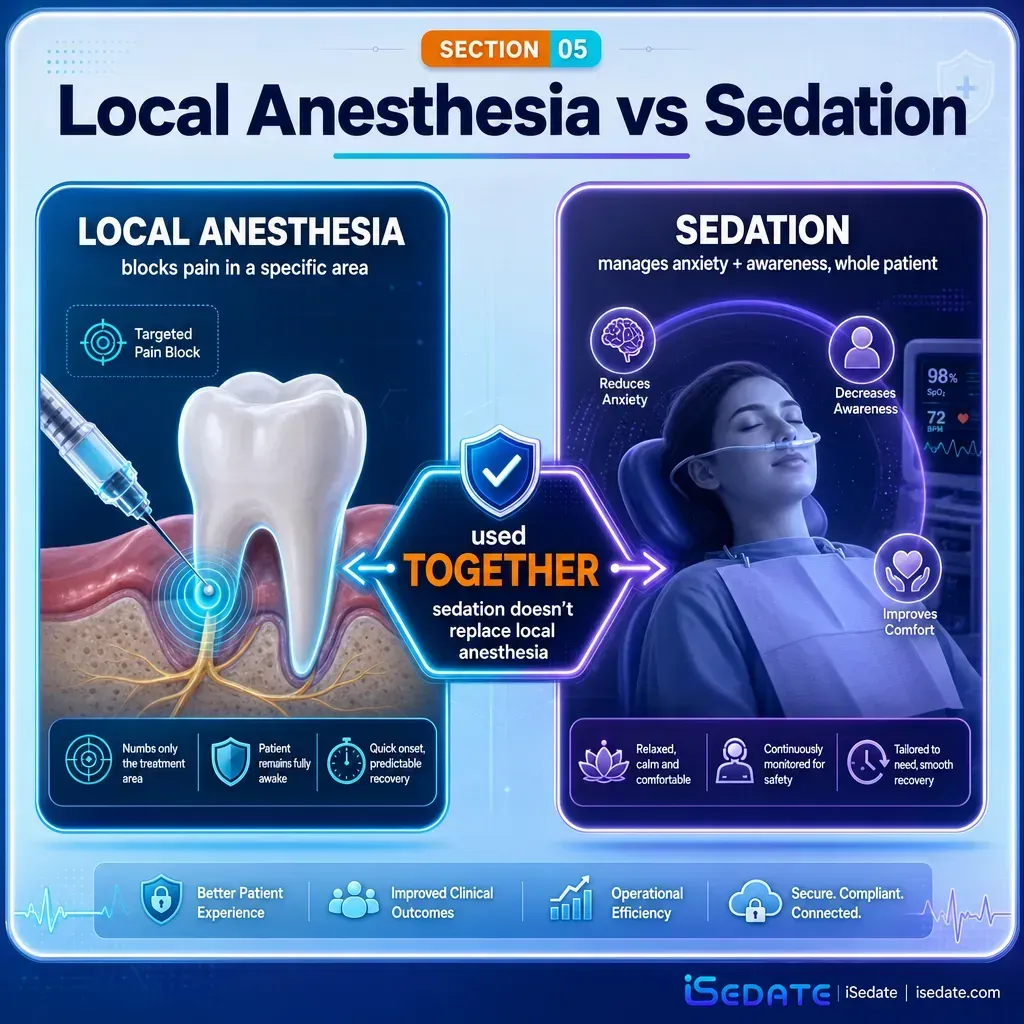
Sedation is defined by depth, not by drug. The ADA classifies sedation by how deeply the patient is sedated, independent of which agent or route is used. There are three depth levels, plus a separate authority for nitrous oxide at the bottom.
- Minimal sedation, or anxiolysis. The patient responds normally to verbal command, and airway and cardiovascular function are unaffected. This is typically a single oral drug and is the common entry point for a general practice adding light sedation.
- Moderate sedation. Often called Conscious Sedation. The patient responds purposefully to verbal or tactile stimulation and keeps their own airway. Moderate sedation splits in most states into an enteral route, meaning oral and other non-injection routes, and a parenteral route that includes IV. The move from enteral to parenteral is the single biggest jump on the ladder.
- Deep sedation and general anesthesia. The patient is not easily aroused or is unconscious and may need airway support. This top tier is largely the province of dental anesthesiologists and oral and maxillofacial surgeons, and it carries the heaviest training and monitoring requirements.
Route matters as much as depth. A permit does not just say how deep you may go. It usually says how you may get there. Enteral routes, where a drug is swallowed and absorbed, are more forgiving, because the dose cannot be increased instantly. Parenteral routes, where a drug is injected or given intravenously, act fast and can deepen sedation quickly, so they sit a full tier higher in training and monitoring even at the same nominal depth. That is why so many states draw their hardest line not between moderate and deep sedation, but between oral moderate sedation and IV moderate sedation.
The facility is part of the permit. For moderate and deeper sedation, most states require an on-site facility evaluation or inspection: a board-approved reviewer confirms the operatory has the monitoring equipment, emergency drugs, and trained staff the permit level demands. In many states that evaluation repeats on a cycle, and failing it can suspend the permit. In those states the facility is not a one-time check. It is a standing condition of holding the permit, which is why the equipment you buy and the drills you run matter as much as the course you took.
Documentation is the thread that ties it together. The 2025 update to the ADA guidelines, adopted by the ADA House of Delegates in October 2025, tightened the documentation expectation to a time-oriented record of drugs and vitals for essentially every sedation level. Most state codes echo this: a written, time-stamped anesthetic record listing every drug and dose, the people present, and the patient's vital signs recorded at set intervals. The interval and the exact fields vary by state, but the duty is nearly universal, and it is the single thing a board review scrutinizes most closely. We return to that record near the end of this guide, because it is where a permit is most often challenged.
Source: American Dental Association, Anesthesia and Sedation
The training path: what each permit level takes
Every state turns those depth levels into permits, and each permit has a bar to clear: a number of didactic training hours, a resuscitation certification, and, for moderate and deeper sedation, a count of managed live clinical patients. The bar rises with the depth and with the route. The table below describes the common national pattern across state boards. It is not a substitute for any one state's numbers, which are set by that board and change periodically, so treat it as a map of the shape, then read your state's guide for the exact figures.
| Permit level | Typical route | Common training and resuscitation pattern | Who typically holds it |
|---|---|---|---|
| Nitrous oxide / oxygen | Inhalation | Short course; basic life support (BLS). Often no facility inspection. Not a federally scheduled drug. | General dentists |
| Minimal sedation (anxiolysis) | Enteral (oral) | Introductory course; BLS. The common entry point for light oral sedation. | General dentists |
| Moderate sedation, enteral | Oral / non-injection | Roughly a couple dozen didactic hours plus a handful of managed live cases; advanced cardiac life support (ACLS). Facility review in many states. | General dentists with added training |
| Moderate sedation, parenteral (IV) | Intravenous | Commonly near 60 didactic hours plus about 20 managed live patients; current ACLS and BLS. Facility inspection common. The biggest jump on the ladder. | General dentists with IV training; oral surgeons |
| Deep sedation / general anesthesia | Any, including IV and inhalation | Formal advanced training measured in years, not hours; strictest facility, monitoring, and emergency standards; on-site evaluation. | Dental anesthesiologists; oral and maxillofacial surgeons |
Figures are a common pattern, not a universal rule. Each board sets its own exact hours, live-patient counts, resuscitation certifications, and inspection schedule. Confirm your state's numbers in its guide below and with the board.
iSedate Pro Tip
Plan the resuscitation certification before the course, not after. Moderate and deeper permits generally require current ACLS, and a lapsed card can stall an otherwise-complete application. Keep ACLS and BLS renewals on the same calendar you track CE and permit renewal, so the credential that is easiest to let expire is never the one holding up your permit.
Renewal is its own discipline. Most boards tie a sedation permit to a renewal cycle with continuing education specific to sedation and anesthesia, and many now expect written office emergency protocols and periodic emergency drills as a condition of keeping the permit. Because the renewal rules, the CE hours, and the drill expectations are set per state and updated periodically, they live in each state's guide rather than in this overview. The point to carry from here is that a sedation permit is a standing obligation, not a one-time license.

The federal layer: DEA registration
The state permit is not the only credential a sedating practice needs. Sitting on top of it is a federal layer: the Drug Enforcement Administration (DEA) registration. Under the federal Controlled Substances Act, any practitioner who administers, dispenses, or stores controlled substances must hold a current DEA registration. The sedation and anesthesia agents used at the moderate and deeper levels are generally controlled substances, so a practice offering oral or IV sedation almost always needs an active DEA registration in addition to the state permit.
Two points keep this honest. First, the DEA registration and the state sedation permit are separate credentials from separate authorities. One does not substitute for the other, and holding a DEA number does not authorize you to sedate without the matching state permit. Second, nitrous oxide is not a federally scheduled controlled substance, so a nitrous-only practice may not need a DEA registration on that basis alone, though the state permit still applies. Many states also require a separate state controlled-substance registration layered on top of the federal one. The specifics of scheduling, storage, and recordkeeping for controlled substances are set by federal and state law and are updated periodically, so confirm your controlled-substance obligations with the DEA and your state board rather than assuming the sedation permit covers them.
Myth, Busted
Myth: If I hold a DEA registration, I am cleared to provide sedation.
Fact: The DEA registration only covers controlled substances federally. It does not grant the state sedation permit, which is a separate credential from your dental board, and sedating without that permit is a board violation even with a valid DEA number.
The two are often confused because both are required at once for an IV practice. They answer different questions: the DEA asks whether you may handle the drug, the board asks whether you may sedate the patient.
Source: U.S. Drug Enforcement Administration, Diversion Control Division
Sedation dentistry permits by state: the 50-state table
The table below is the national map. For each state it links to that state's own licensing guide, names the dental board that governs sedation, describes the shape of that state's permit structure in the state's own terms, and gives the primary governing citation. The permit names are the state's own: some states use numbered levels, some use lettered classes, some use named permits like Restricted or Specialty. Training hours, live-patient counts, resuscitation requirements, CE cycles, fees, and inspection schedules are set by each board and change periodically, and they live in each state's own guide rather than in this overview. None of the cells below are fabricated: each board and citation is drawn from the state-by-state research cited in the sources.
| State (licensing guide) | Dental board / authority | Permit structure (state's own terms) | Governing citation |
|---|---|---|---|
| Alabama Sedation Dentistry Licensing & Permit Requirements | Board of Dental Examiners of Alabama | Oral conscious sedation permits (adult and pediatric); general anesthesia and parenteral sedation | Ala. Admin. Code r. 270-X-2 |
| Alaska Sedation Dentistry Licensing & Permit Requirements | Alaska Board of Dental Examiners | Moderate sedation permit; parenteral/IV and GA permits | 12 AAC 28 |
| Arizona Sedation Dentistry Licensing & Permit Requirements | Arizona State Board of Dental Examiners | Parenteral permit (Section 1302); general anesthesia / deep sedation permit (Section 1301) | A.A.C. R4-11-1301 and 1302 |
| Arkansas Sedation Dentistry Licensing & Permit Requirements | Arkansas State Board of Dental Examiners | Moderate sedation (Article XIII); facility permit for deep sedation and GA | Ark. Admin. Code 115-1302 and 115-1304 |
| California Sedation Dentistry Licensing & Permit Requirements | Dental Board of California | Moderate Sedation Permit; General Anesthesia Permit | Bus. and Prof. Code SS 1647; 16 CCR Art. 5 |
| Colorado Sedation Dentistry Licensing & Permit Requirements | Colorado Dental Board | Minimal, moderate, and deep sedation / GA permits (Rule 1.14) | 3 CCR 709-1 Rule 1.14 |
| Connecticut Sedation Dentistry Licensing & Permit Requirements | Connecticut Dept. of Public Health (Dental) | General Anesthesia and Conscious Sedation permit | RCSA SS 20-123b-1 to -9 |
| Delaware Sedation Dentistry Licensing & Permit Requirements | Delaware Board of Dentistry and Dental Hygiene | Restricted permits (Restricted I = IV conscious sedation); GA permit | 24 Del. Admin. Code 1100 |
| Florida Sedation Dentistry Licensing & Permit Requirements | Florida Board of Dentistry (DOH) | Nitrous; Moderate Sedation; General Anesthesia permits | Fla. Admin. Code R. 64B5-14 |
| Georgia Sedation Dentistry Licensing & Permit Requirements | Georgia Board of Dentistry | Enteral and parenteral conscious sedation; general anesthesia permits | Ga. Comp. R. and Regs. 150-13-.01 |
| Hawaii Sedation Dentistry Licensing & Permit Requirements | Hawaii Board of Dentistry | Moderate, deep, and general anesthesia sedation permits | Haw. Admin. R. 16-79-78 and -79 |
| Idaho Sedation Dentistry Licensing & Permit Requirements | Idaho State Board of Dentistry | Moderate and deep sedation permits | IDAPA 24.31.01 SS 200 |
| Illinois Sedation Dentistry Licensing & Permit Requirements | Illinois Dept. of Financial and Professional Regulation (Dental) | Permit A (moderate sedation); deep sedation / GA permit | 68 Ill. Adm. Code 1220 |
| Indiana Sedation Dentistry Licensing & Permit Requirements | Indiana State Board of Dentistry | Conscious sedation (including light parenteral) and GA permits | 828 IAC 3-1-6.5 |
| Iowa Sedation Dentistry Licensing & Permit Requirements | Iowa Dental Board | Moderate sedation and general anesthesia permits | Iowa Admin. Code 650-29 |
| Kansas Sedation Dentistry Licensing & Permit Requirements | Kansas Dental Board | Level I (oral); Level II (parenteral/IV) | K.A.R. 71-5-10 and 71-5-11 |
| Kentucky Sedation Dentistry Licensing & Permit Requirements | Kentucky Board of Dentistry | Moderate sedation (Sec. 5); deep sedation / GA (Sec. 6) | 201 KAR 8:550 |
| Louisiana Sedation Dentistry Licensing & Permit Requirements | Louisiana State Board of Dentistry | Minimal and moderate sedation permits (oral and IV) | LAC 46:XXXIII.1500 et seq. |
| Maine Sedation Dentistry Licensing & Permit Requirements | Maine Board of Dental Practice | Level I (enteral); Level II (parenteral); deeper levels | 02-313 C.M.R. Ch. 14 |
| Maryland Sedation Dentistry Licensing & Permit Requirements | Maryland State Board of Dental Examiners | Class I, II, and III anesthesia permits | COMAR 10.44.12 |
| Massachusetts Sedation Dentistry Licensing & Permit Requirements | Massachusetts Board of Registration in Dentistry | Permit B-1 (moderate); deep sedation / GA permits | 234 CMR 6 |
| Michigan Sedation Dentistry Licensing & Permit Requirements | Michigan Board of Dentistry (LARA) | IV conscious sedation and general anesthesia permits | Mich. Admin. Code R 338.11603 |
| Minnesota Sedation Dentistry Licensing & Permit Requirements | Minnesota Board of Dentistry | Moderate, deep, and general anesthesia permits / certificates | Minn. R. 3100.3600 |
| Mississippi Sedation Dentistry Licensing & Permit Requirements | Mississippi State Board of Dental Examiners | Oral and parenteral moderate sedation; GA permits | 30 Miss. Admin. Code Pt. 2301 R. 1.30 |
| Missouri Sedation Dentistry Licensing & Permit Requirements | Missouri Dental Board | Moderate sedation permit; deep sedation / GA site certificate | 20 CSR 2110-4.030 |
| Montana Sedation Dentistry Licensing & Permit Requirements | Montana Board of Dentistry | Minimal, moderate, and deep sedation / GA permits | ARM 24.138.3221 et seq. |
| Nebraska Sedation Dentistry Licensing & Permit Requirements | Nebraska Board of Dentistry | Minimal, moderate, and general/deep permits | 172 NAC 56 |
| Nevada Sedation Dentistry Licensing & Permit Requirements | Nevada State Board of Dental Examiners | Moderate sedation and general anesthesia permits | NAC 631.2213 and 631.2229 |
| New Hampshire Sedation Dentistry Licensing & Permit Requirements | New Hampshire Board of Dental Examiners | Minimal, moderate, and deep sedation permits | N.H. Admin. Code Den 304 |
| New Jersey Sedation Dentistry Licensing & Permit Requirements | New Jersey State Board of Dentistry | Oral conscious sedation; parenteral (IV) conscious sedation; GA permits | N.J.A.C. 13:30-8.2 |
| New Mexico Sedation Dentistry Licensing & Permit Requirements | New Mexico Board of Dental Health Care | Minimal, moderate, and deep sedation permits | 16.5.15 NMAC |
| New York Sedation Dentistry Licensing & Permit Requirements | New York State Education Dept. (Office of the Professions) | Conscious sedation; deep sedation / general anesthesia certification | 8 NYCRR 61.10 |
| North Carolina Sedation Dentistry Licensing & Permit Requirements | North Carolina State Board of Dental Examiners | Minimal, moderate, and deep sedation / GA permits | 21 NCAC 16Q |
| North Dakota Sedation Dentistry Licensing & Permit Requirements | North Dakota State Board of Dental Examiners | Moderate and deep sedation / GA permits | N.D. Admin. Code 20-02-01 |
| Ohio Sedation Dentistry Licensing & Permit Requirements | Ohio State Dental Board | Moderate sedation and general anesthesia permits | OAC 4715-5 |
| Oklahoma Sedation Dentistry Licensing & Permit Requirements | Oklahoma Board of Dentistry | Parenteral and general anesthesia permits | OAC 195:20-1 |
| Oregon Sedation Dentistry Licensing & Permit Requirements | Oregon Board of Dentistry | Moderate sedation (oral and IV); deep sedation / GA permits | OAR 818-026 |
| Pennsylvania Sedation Dentistry Licensing & Permit Requirements | Pennsylvania State Board of Dentistry | Conscious sedation; general anesthesia / deep sedation permits | 49 Pa. Code Ch. 33 |
| Rhode Island Sedation Dentistry Licensing & Permit Requirements | Rhode Island Dept. of Health | Minimal and moderate sedation permits | 216-RICR-40-05-2 |
| South Carolina Sedation Dentistry Licensing & Permit Requirements | South Carolina Board of Dentistry | Moderate enteral and parenteral sedation; GA permits | S.C. Code SS 40-15-410, -450 |
| South Dakota Sedation Dentistry Licensing & Permit Requirements | South Dakota Board of Dentistry | Moderate sedation and deep sedation / GA permits | ARSD 20:43:09 and 20:43:11 |
| Tennessee Sedation Dentistry Licensing & Permit Requirements | Tennessee Board of Dentistry | Limited and comprehensive conscious sedation; deep sedation / GA | Tenn. Comp. R. and Regs. 0460-02-.07 |
| Texas Sedation Dentistry Licensing & Permit Requirements | Texas State Board of Dental Examiners (TSBDE) | Nitrous; Level 1 minimal; Level 2 and 3 moderate; Level 4 deep / GA | 22 TAC Chapter 110 |
| Utah Sedation Dentistry Licensing & Permit Requirements | Utah Div. of Professional Licensing (DOPL) | Minimal, moderate, and deep sedation permits | Utah Admin. Code R156-69 |
| Vermont Sedation Dentistry Licensing & Permit Requirements | Vermont Board of Dental Examiners (OPR) | Moderate sedation and deep sedation / GA specialty endorsements | Vt. Admin. rules Part 8-6 |
| Virginia Sedation Dentistry Licensing & Permit Requirements | Virginia Board of Dentistry | Moderate sedation permit; deep sedation / general anesthesia permit | 18VAC60-21-260 et seq. |
| Washington Sedation Dentistry Licensing & Permit Requirements | Washington Dental Quality Assurance Commission (DOH) | Moderate (enteral and parenteral) and general anesthesia permits | WAC 246-817 |
| West Virginia Sedation Dentistry Licensing & Permit Requirements | West Virginia Board of Dentistry | Class 2 (minimal); Class 3 (parenteral moderate); deep / GA classes | W. Va. Code SS 30-4A |
| Wisconsin Sedation Dentistry Licensing & Permit Requirements | Wisconsin Dentistry Examining Board (DSPS) | Class 2 (enteral); Class 3 (parenteral moderate); Class 4 (deep / GA) | Wis. Admin. Code DE 11 |
| Wyoming Sedation Dentistry Licensing & Permit Requirements | Wyoming Board of Dental Examiners | Moderate / IV sedation; deep sedation / GA permits | Wyo. Board of Dental Examiners Rules Ch. 5 |
Source: state-by-state dental board rules and governing citations as listed in the sources below. Confirm any training hours, live-patient counts, fees, CE cycles, and inspection schedules directly with the relevant board.
Find your state: all 50 licensing guides
Each state has its own deep guide covering that board's exact permit levels, training hours, live-patient requirements, monitoring rules, inspection schedule, and the citation behind each. Pick your state below.
Sedation Licensing Guides by State
- Alabama Sedation Dentistry Licensing & Permit Requirements
- Alaska Sedation Dentistry Licensing & Permit Requirements
- Arizona Sedation Dentistry Licensing & Permit Requirements
- Arkansas Sedation Dentistry Licensing & Permit Requirements
- California Sedation Dentistry Licensing & Permit Requirements
- Colorado Sedation Dentistry Licensing & Permit Requirements
- Connecticut Sedation Dentistry Licensing & Permit Requirements
- Delaware Sedation Dentistry Licensing & Permit Requirements
- Florida Sedation Dentistry Licensing & Permit Requirements
- Georgia Sedation Dentistry Licensing & Permit Requirements
- Hawaii Sedation Dentistry Licensing & Permit Requirements
- Idaho Sedation Dentistry Licensing & Permit Requirements
- Illinois Sedation Dentistry Licensing & Permit Requirements
- Indiana Sedation Dentistry Licensing & Permit Requirements
- Iowa Sedation Dentistry Licensing & Permit Requirements
- Kansas Sedation Dentistry Licensing & Permit Requirements
- Kentucky Sedation Dentistry Licensing & Permit Requirements
- Louisiana Sedation Dentistry Licensing & Permit Requirements
- Maine Sedation Dentistry Licensing & Permit Requirements
- Maryland Sedation Dentistry Licensing & Permit Requirements
- Massachusetts Sedation Dentistry Licensing & Permit Requirements
- Michigan Sedation Dentistry Licensing & Permit Requirements
- Minnesota Sedation Dentistry Licensing & Permit Requirements
- Mississippi Sedation Dentistry Licensing & Permit Requirements
- Missouri Sedation Dentistry Licensing & Permit Requirements
- Montana Sedation Dentistry Licensing & Permit Requirements
- Nebraska Sedation Dentistry Licensing & Permit Requirements
- Nevada Sedation Dentistry Licensing & Permit Requirements
- New Hampshire Sedation Dentistry Licensing & Permit Requirements
- New Jersey Sedation Dentistry Licensing & Permit Requirements
- New Mexico Sedation Dentistry Licensing & Permit Requirements
- New York Sedation Dentistry Licensing & Permit Requirements
- North Carolina Sedation Dentistry Licensing & Permit Requirements
- North Dakota Sedation Dentistry Licensing & Permit Requirements
- Ohio Sedation Dentistry Licensing & Permit Requirements
- Oklahoma Sedation Dentistry Licensing & Permit Requirements
- Oregon Sedation Dentistry Licensing & Permit Requirements
- Pennsylvania Sedation Dentistry Licensing & Permit Requirements
- Rhode Island Sedation Dentistry Licensing & Permit Requirements
- South Carolina Sedation Dentistry Licensing & Permit Requirements
- South Dakota Sedation Dentistry Licensing & Permit Requirements
- Tennessee Sedation Dentistry Licensing & Permit Requirements
- Texas Sedation Dentistry Licensing & Permit Requirements
- Utah Sedation Dentistry Licensing & Permit Requirements
- Vermont Sedation Dentistry Licensing & Permit Requirements
- Virginia Sedation Dentistry Licensing & Permit Requirements
- Washington Sedation Dentistry Licensing & Permit Requirements
- West Virginia Sedation Dentistry Licensing & Permit Requirements
- Wisconsin Sedation Dentistry Licensing & Permit Requirements
- Wyoming Sedation Dentistry Licensing & Permit Requirements
This hub is written for dental practices first, since the permit framework above is the dental model. The same state-by-state structure extends to other sedation specialties, and those are covered as the hub grows. For the companion view focused on what you must chart and report once permitted, see the Dental Sedation Vitals, Charting & Reporting Requirements by State hub.
After the permit: keeping it inspection-ready
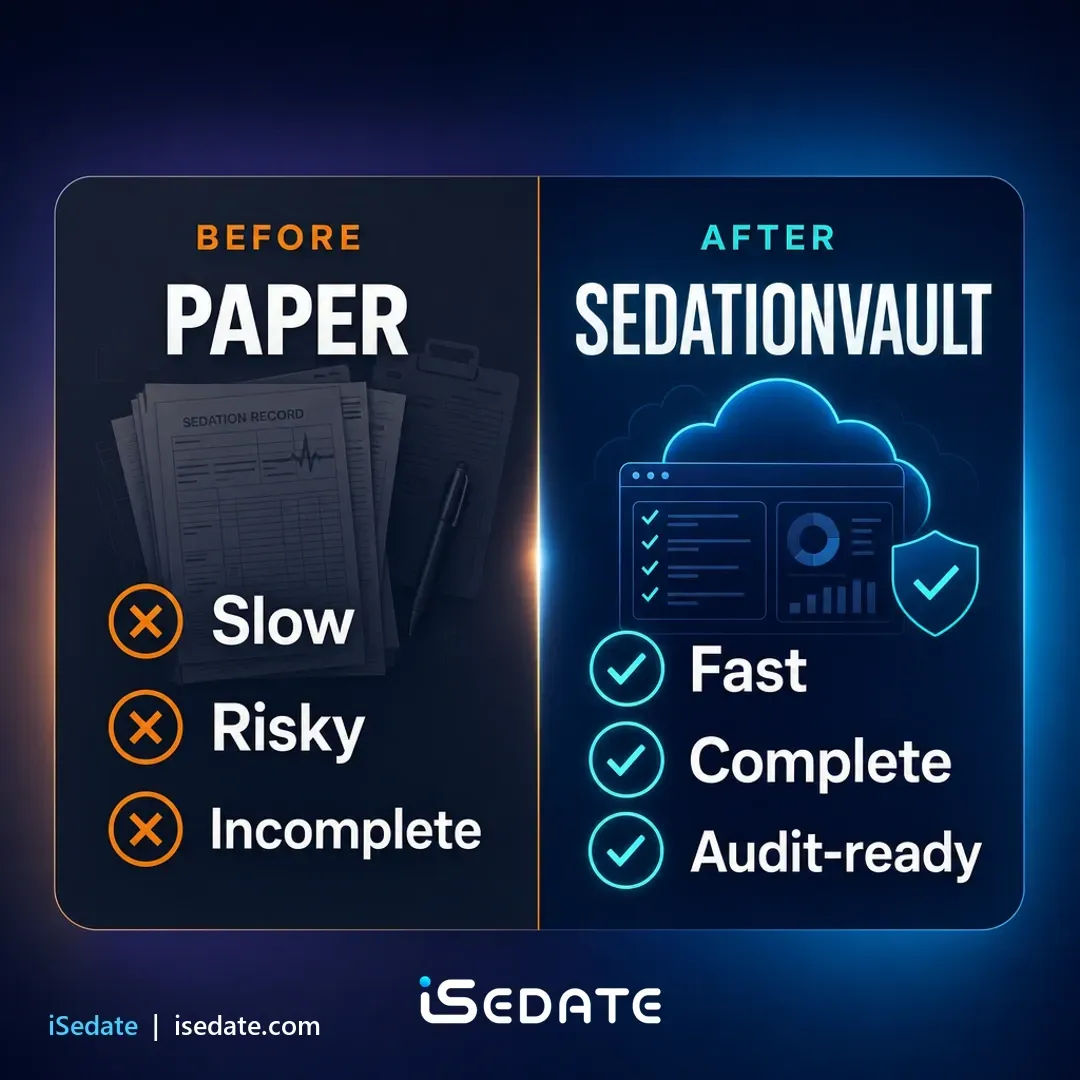
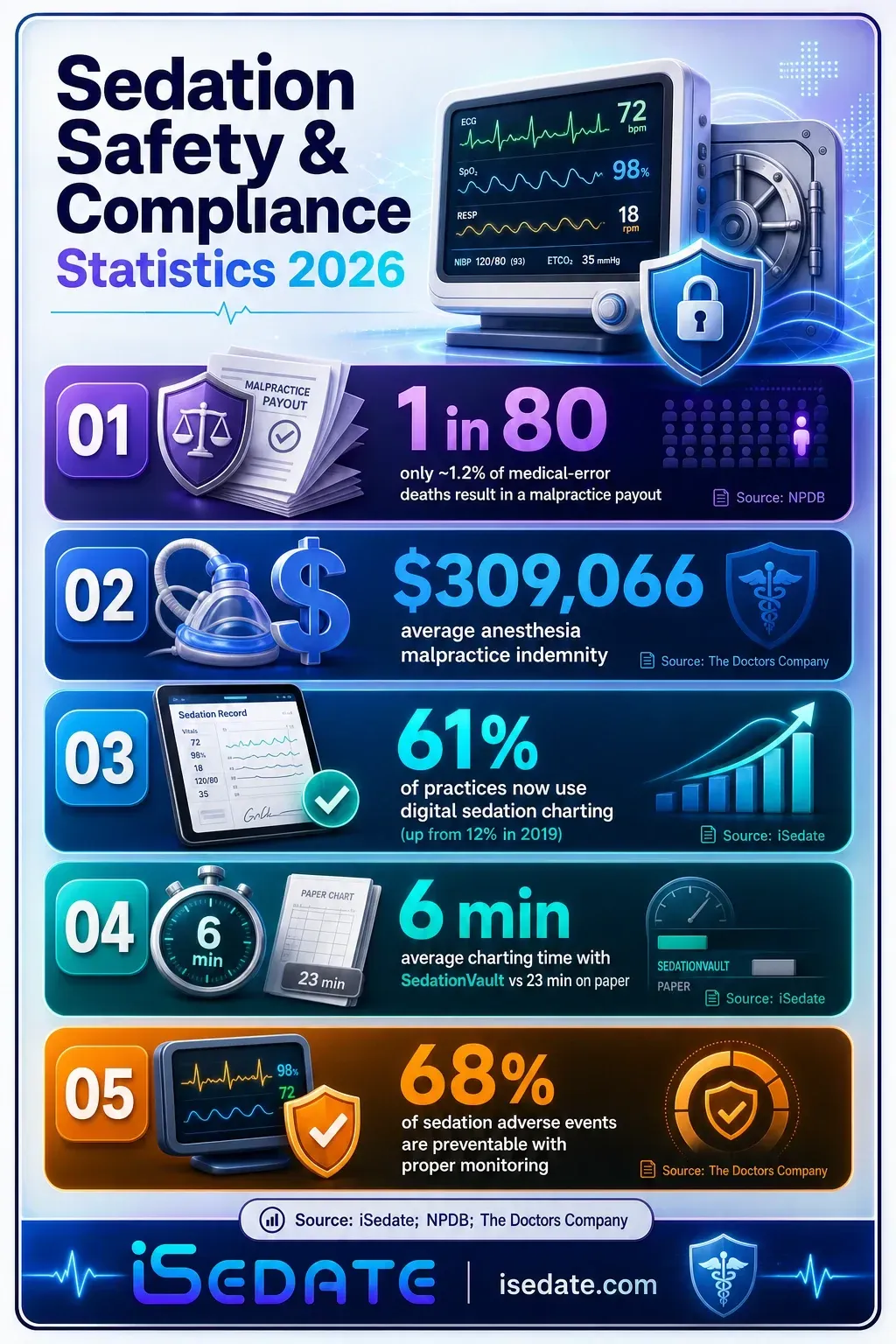
Everything above points to one truth. Getting the permit is a one-time hurdle of hours, cases, and a facility check. Keeping it is a daily discipline, and the discipline is the record. Across the great majority of states, a permit holder must maintain a time-oriented anesthetic record: every drug and dose, the people present, and the patient's vital signs captured at set intervals through the procedure and recovery. When a board opens your file, it is not judging whether the sedation went well. It is judging whether the record is complete, contemporaneous, and intervaled correctly. That is where permits are challenged, and it is the same record a malpractice claim attacks.
A manual vitals log, written by hand every few minutes between titrating a drug and watching an airway, is exactly where that record goes incomplete. A single missed interval, a start or stop time that was never written down, and the paperwork fails even when the care did not. This is the problem iSedate built SedationVault to remove. It captures live patient vitals and the drug log automatically into a time-oriented anesthetic record, holding your state's required interval without a clinician stopping to write, so the record builds itself while the team focuses on the patient. When a board or an insurer asks for the file, a complete record is a one-click export rather than a scramble through paper. See how it maps to each state's rules on the dental sedation compliance page, or the underlying anesthesia record software that produces the record.
Book a demo of SedationVault See SedationVault pricingWhat to do next
If you are adding sedation, renewing a permit, or moving a permitted practice across a state line, the path is the same five moves in the same order. The table turns the national picture above into a checklist, with the state-specific detail routed to your state's own guide.
| Step | Action | Priority | Where the detail lives |
|---|---|---|---|
| 1 | Confirm which permit level and route you actually need (nitrous, minimal, moderate enteral, moderate IV, deep / GA) | First | The ADA model above; your state's guide |
| 2 | Check your state board's exact training hours, live-patient count, and resuscitation certification for that level | First | Your state's licensing guide |
| 3 | Verify your DEA registration and any separate state controlled-substance registration are current | High | DEA Diversion Control; your state board |
| 4 | Prepare the operatory for the facility evaluation: monitoring equipment, emergency drugs, trained staff, written emergency protocols | High | Your state's guide and inspection form |
| 5 | Stand up the time-oriented anesthetic record you will keep at every case, at your state's required interval | Ongoing | iSedate dental sedation compliance |
Frequently asked questions
Who issues sedation permits for dentists, the ADA or the state?
Do I need a DEA registration to offer sedation in my dental practice?
Does my sedation permit transfer if I move to another state?
What is the difference between minimal, moderate, and deep sedation?
How much training does an IV moderate sedation permit require?
Is the sedation facility inspected before a permit is issued?
What records does a sedation permit holder have to keep?
Related Reading: The Data Behind These Rules
The requirements on this page are the law. These research roundups are the data that explains why they exist and what happens when a practice gets charting or permitting wrong:
Sources & Methodology
- American Dental Association, Anesthesia and Sedation, Guidelines for the Use of Sedation and General Anesthesia by Dentists (sedation depth levels, monitoring and documentation standard; guidelines update adopted October 2025)
- U.S. Drug Enforcement Administration, Diversion Control Division, practitioner registration under the Controlled Substances Act
- State dental board rules and governing citations for all 50 states, as listed in the table above (for example, 22 TAC Chapter 110 (Texas), 16 CCR Art. 5 and Bus. and Prof. Code SS 1647 (California), 8 NYCRR 61.10 (New York), and the equivalent rule for each state)
This guide is a national overview for general information and is not legal advice. Sedation and anesthesia permits are governed by each state's dental board, and the specific training hours, live-patient counts, resuscitation requirements, fees, continuing-education cycles, inspection schedules, and penalty provisions are set by each board and updated periodically. Confirm the current requirements for your state directly with its dental board, and confirm controlled-substance obligations with the DEA, before you act. Where this guide could not verify a state-specific figure, that figure is left to the state's own guide and the board rather than stated here.