






Indiana Sedation Dentistry Licensing & Permit Requirements
In Indiana, your dental license alone does not let you sedate a patient once you move past the lightest techniques. Before you administer general anesthesia, deep sedation, or light parenteral (IV) conscious sedation, you must hold the matching permit from the Indiana State Board of Dentistry, issued under 828 Indiana Administrative Code 3, "Anesthesia and Sedation." Minimal oral sedation and nitrous oxide need no permit. This guide covers both halves of the job: how an Indiana dentist gets the right sedation or anesthesia permit, and what it takes to keep it through renewal and a board review.
Recent Updates
Last UpdatedNovember 16, 2026
- Rebuilt directly from the verbatim text of 828 IAC 3-1-1 through 3-1-11 in the Indiana State Board of Dentistry's own permit materials, replacing third-party aggregator sources with the board's official documents.
- Added the exact application (State Form 46159), the $50 fee, where to submit, and the full "what to submit" checklist.
- Added the verified training paths: one year of postdoctoral training for general anesthesia and deep sedation, and the 60-hour, 10-patient postdoctoral path for light parenteral conscious sedation.
- Added renewal specifics (biennial, March 1 of even years), the 5-hour anesthesia CE rule, the office emergency-equipment lists, and the controlled-substance (CSR and DEA) step.
- Indiana regulates dental sedation under 828 IAC 3, enforced by the Indiana State Board of Dentistry within the Indiana Professional Licensing Agency.
- There are two permits: the Light Parenteral Conscious Sedation Permit (828 IAC 3-1-4) and the General Anesthesia and Deep Sedation Permit (828 IAC 3-1-2). The latter also covers light parenteral conscious sedation, so no separate permit is needed.
- Minimal oral sedation and nitrous oxide require no permit, but dosage limits and the general standard of care still apply.
- The parenteral permit's postdoctoral path requires 60 hours of training, management of at least 10 patients, and ACLS; the general anesthesia permit requires one year of advanced postdoctoral training.
- Permits renew biennially (expiring March 1 of even years) with 5 CE hours in anesthesia, and the general anesthesia tier requires a separate anesthetic record for each anesthetic. Incomplete records are where permits get challenged.
What This Guide Covers
- Who issues sedation permits in Indiana
- Indiana's two sedation permits
- How to qualify for each permit
- The application, fee, and what to submit
- Emergency equipment your office must have
- What your permit requires you to monitor and record
- Renewal, continuing education, and reinstatement
- Display, extra offices, and the cost of skipping the permit
- Controlled substances: your CSR and DEA registration
- Keeping the permit: audit-ready records
- Related guides and neighboring states
- Frequently asked questions
- Sources and how we verified them
Who issues sedation permits in Indiana
Dental sedation in Indiana is regulated by the Indiana State Board of Dentistry, which operates within the Indiana Professional Licensing Agency (IPLA). The board licenses dentists, issues the sedation and anesthesia permits, enforces the standard of care, and takes disciplinary action. The rules live in 828 Indiana Administrative Code 3, "Anesthesia and Sedation," adopted under the authority of Indiana Code 25-14-1-3.1 and 25-14-1-13. Every requirement in this guide traces to a numbered section of that article, which you can read in full in the board's official permit information and instruction packet.
Who Actually Holds You Accountable
The board writes the law; the ADA only writes guidelines. The American Dental Association publishes sedation guidelines that Indiana and most states lean on, but the ADA is a professional association, not a government agency. It does not license you, inspect you, or discipline you. Your permit, your record reviews, and any sanctions all come from the Indiana State Board of Dentistry under 828 IAC 3. The real federal layers that sit on top of state law are the DEA (controlled-substance registration and drug logs) and HIPAA, not the ADA.
Indiana law draws the line by depth and route, not by brand names. Under Indiana Code 25-14-1-3.1, a dentist must hold a board permit before administering general anesthesia, deep sedation, or moderate sedation given by a parenteral route. The board's rules call that parenteral tier "light parenteral conscious sedation." They describe the same thing: sedation deep enough or delivered by a route risky enough that the state wants proof of training before you begin.
Indiana's two sedation permits
Indiana does not use a "Level 1 through 4" numbering system. It issues two named permits, plus a no-permit tier for the lightest techniques. The obligation rises with the depth of sedation, not just the drug or the route.
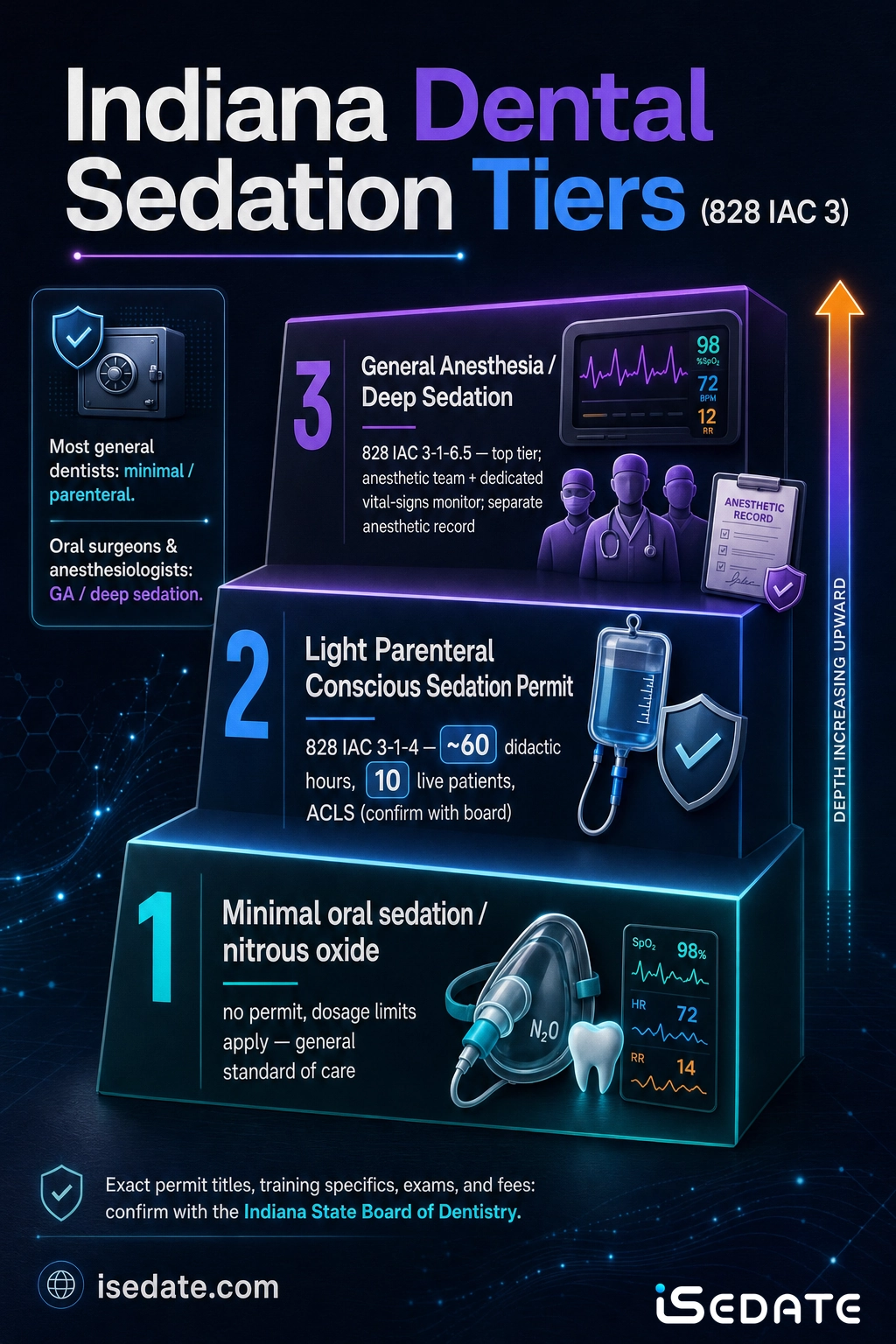
Minimal oral sedation and nitrous oxide (no permit)
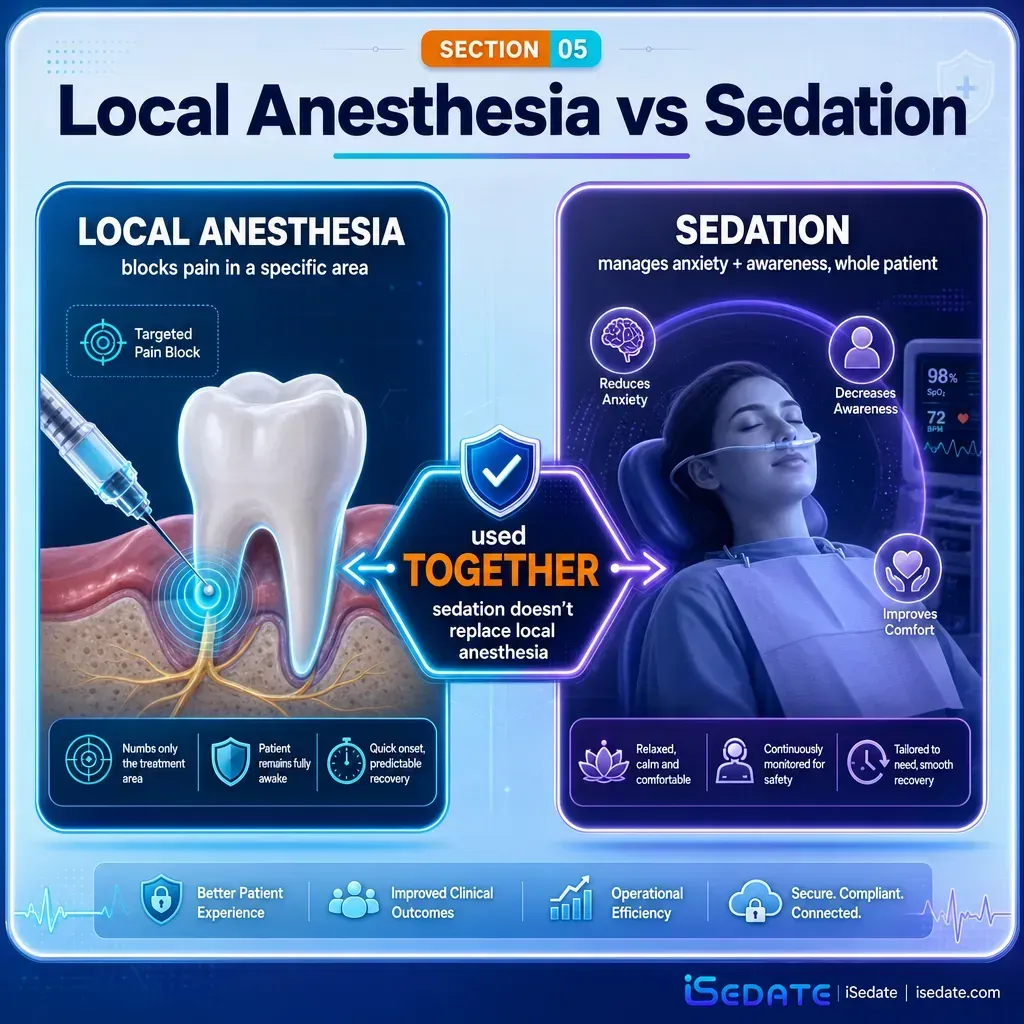
The lightest techniques, where the patient stays fully responsive. Indiana does not require a separate sedation permit for minimal oral sedation or nitrous oxide. Dosage limits apply, and the general standard of care still governs how you evaluate, chart, and monitor. This is the common starting point for a general practice offering light anxiety control.
Light Parenteral Conscious Sedation Permit (828 IAC 3-1-4)
This is the first tier that requires a board permit. It authorizes light parenteral Conscious Sedation, which includes the intramuscular, intravenous, submucosal, and subcutaneous routes, where the patient responds purposefully and keeps their own airway. Because the parenteral route carries faster onset and higher risk than an oral pill, this permit carries real training, monitoring, and record requirements, with its standard of care set out in 828 IAC 3-1-6.1. It is the workhorse permit for a general dentist who provides genuine IV or parenteral conscious sedation.
General Anesthesia and Deep Sedation Permit (828 IAC 3-1-2)
The top tier, covering deep sedation and general anesthesia, where the patient is not easily aroused or is unconscious and may need airway support. Its standard of care in 828 IAC 3-1-6.5 is the most detailed in the article: it requires a trained anesthetic team, one member whose sole job is monitoring vital signs and the airway, a separate anesthetic record for each anesthetic, and defined discharge criteria. This tier is largely the province of dental anesthesiologists and oral and maxillofacial surgeons. One efficiency built into the rule: a dentist who holds the general anesthesia and deep sedation permit may administer light parenteral conscious sedation without obtaining a separate permit (828 IAC 3-1-1).
Myth, Busted
Myth: You need to apply for the parenteral permit separately even if you already hold the general anesthesia permit.
Fact: Under 828 IAC 3-1-1(c) and 3-1-4(a), a dentist granted the general anesthesia and deep sedation permit may administer light parenteral conscious sedation without a separate permit.
The two permits are a ladder, not a checklist. The higher permit absorbs the lower technique, so a provider credentialed for general anesthesia is not double-permitted for IV sedation.
Source: Indiana State Board of Dentistry: 828 IAC 3 permit materials
How to qualify for each permit
Each permit has its own education and training bar, plus ACLS and current licensure. You move up the ladder by meeting the next permit's requirements and applying to the board. Here is how the two paths compare.
| Permit | Route / depth | Training required | Patients managed | Resuscitation |
|---|---|---|---|---|
| Minimal oral / nitrous oxide (no permit) | Lightest; patient fully responsive | No board permit; dosage limits and general standard of care apply | Not applicable | Not specified for a permit |
| Light Parenteral Conscious Sedation (828 IAC 3-1-4) | Parenteral, including IV | Predoctoral conscious-sedation training at an approved school, or a 60-hour postdoctoral program (828 IAC 3-1-5) | At least 10 patients | ACLS |
| General Anesthesia & Deep Sedation (828 IAC 3-1-2) | Deep sedation / general anesthesia | Minimum 1 year of advanced postdoctoral training in anesthesiology or oral surgery (828 IAC 3-1-3) | Daily scheduled OR anesthesia in residency | ACLS |
The Light Parenteral Conscious Sedation path
To qualify for the parenteral permit, 828 IAC 3-1-4 gives an applicant two routes. Either you graduated from a board-approved dental school whose predoctoral curriculum included conscious sedation training meeting 828 IAC 3-1-5, or you completed an intensive postdoctoral training program in light parenteral conscious sedation that meets the same section. The postdoctoral program standard is specific: a minimum of 60 hours of instruction and management of at least 10 patients, covering patient evaluation, venipuncture, pharmacology, physiologic monitoring, recordkeeping, and the recognition and management of complications, including ACLS.
The live-patient component exists because IV titration demands hands-on competence a classroom cannot replicate. The board accepts a notarized certificate of completion, an official transcript from a board-approved school, or a certificate from a qualifying continuing education program signed by its director.
The General Anesthesia and Deep Sedation path
This permit is a bigger commitment. Under 828 IAC 3-1-2 and 3-1-3, an applicant must show a minimum of one year of advanced (postdoctoral) training in anesthesiology and related academic subjects, beyond dental school, in a full-time residency in anesthesiology or oral and maxillofacial surgery. The residency must be a joint effort of the institution's anesthesiology and dentistry departments, cover preanesthetic evaluation through postanesthetic management and emergency call, include inhalation and intravenous techniques, and require successful completion of an ACLS course. The same level of training covers both deep sedation and general anesthesia.
Every applicant, at either tier, must also submit proof of current ACLS training (or ACLS instructor certification) and hold a current Indiana dental license. Want to take an approved course? Providers such as DOCS Education's Indiana program page list sedation courses built to these standards, though the board, not the course provider, is the authority on whether a given program qualifies.
Source: 828 IAC 3-1-2, 3-1-3, 3-1-4, and 3-1-5 (Indiana State Board of Dentistry)

The application, fee, and what to submit
Indiana uses one application for both permits. You download State Form 46159, Application for Permit to Administer Anesthesia and Sedation, select the permit you want, and mail the completed application with supporting documents and fee to the board. Under 828 IAC 3-1-1, the board issues the permit once every requirement is met.
What to Submit With Your Application
- The application form: complete and legible State Form 46159, selecting general anesthesia and deep sedation or light parenteral conscious sedation.
- Proof of current Indiana dental licensure.
- Evidence of training: a notarized certificate of completion or an official transcript showing you met the education standard for your tier.
- ACLS proof: a copy of your current advanced cardiac life support card, or proof of ACLS instructor certification.
- Emergency equipment affidavit: a notarized affidavit that each office meets the equipment rules of 828 IAC 3-1-10 (general anesthesia) or 3-1-11 (light parenteral).
- The fee: a $50 application fee, non-refundable, payable to the Indiana Professional Licensing Agency.
- Where it goes: IPLA, Attn: State Board of Dentistry, 402 West Washington Street, Room W072, Indianapolis, IN 46204.
iSedate Filing Tip
Submit all your supporting documents in one package. If an applicant does not provide every requirement within one year of filing, 828 IAC 3-1-1 treats the application as abandoned, and a later submission starts over as a brand-new application. A missing ACLS card or equipment affidavit is the usual culprit, so build the packet before you mail it.
Source: State Form 46159 (Indiana Professional Licensing Agency) | 828 IAC 3-1-1 application requirements
Emergency equipment your office must have
A permit is tied to your room, not just your resume. Before the board issues a permit, you sign an affidavit that each office where you will sedate meets the equipment minimums, and you must do the same for any additional office.
For general anesthesia and deep sedation, 828 IAC 3-1-10 requires a positive-pressure high-flow oxygen system, an emergency power source, suction, an electrocardiograph, a laryngoscope with assorted blades, endotracheal tubes, ACLS drugs, IV infusion equipment, a stethoscope, a temperature device, a defibrillator, a pulse oximeter, and a sphygmomanometer. For light parenteral conscious sedation, 828 IAC 3-1-11 requires a similar core set, scaled to the lighter tier (oxygen system, suction, laryngoscope and tubes, life-support drugs, IV equipment, stethoscope, temperature device, pulse oximeter, and sphygmomanometer).
Source: 828 IAC 3-1-10 and 3-1-11 (Indiana State Board of Dentistry)
What your permit requires you to monitor and record
A permit is permission plus obligation. Once you hold it, the standard of care for your tier dictates what you must watch and write down during every case. This is also exactly what a board review examines.
Light parenteral conscious sedation (828 IAC 3-1-6.1)
The parenteral standard of care requires a completed and dated medical history, a dentist's review of it, physical evaluation and pretreatment vital signs recorded on the chart, and at least one additional person trained in basic life support present during the procedure. The patient must be monitored by pulse oximeter throughout, with blood pressure taken periodically and oxygenation watched continuously. Before discharge, vital signs must be stable, the patient appropriately responsive, and written postoperative instructions given to the patient and a responsible adult.
General anesthesia and deep sedation (828 IAC 3-1-6.5)
The general anesthesia standard is the strictest. It defines an "anesthetic team" of at least one permit-holding, ACLS-competent dentist plus at least two BLS-competent staff. One assistant's sole responsibility is to monitor vital signs and maintain the airway. Monitoring is continuous and broad: the reservoir bag, skin and mucosa color, pulse oximetry, peripheral pulse, periodic blood pressure, and a continuously displayed electrocardiogram until the patient leaves the operating area. The documentation duties are the part that most often decides a review.
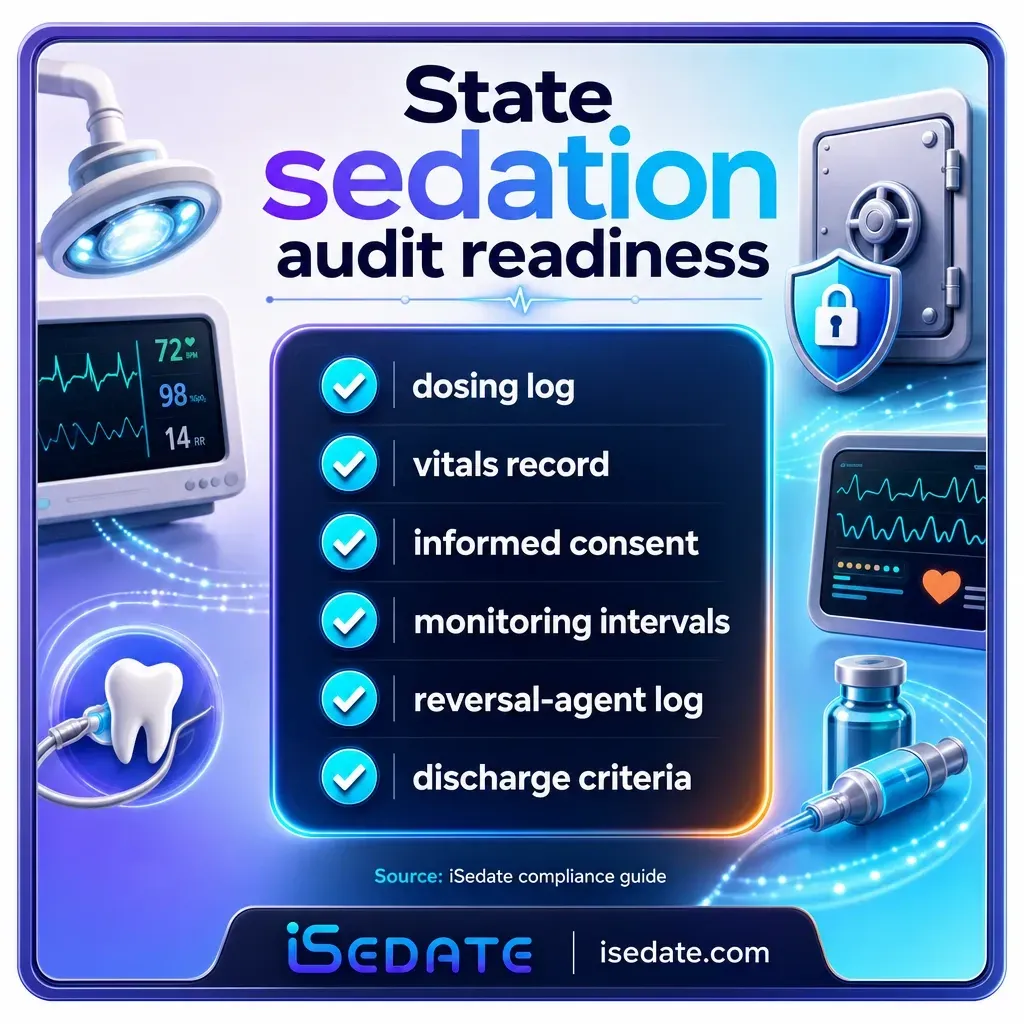
Under 828 IAC 3-1-6.5, you must keep a separate anesthetic record for each anesthetic, record physical evaluation and pretreatment vital signs on the chart, and document the presence and identity of every anesthetic team member throughout the case. For the full clinical breakdown of what to chart at each depth, including the time-oriented drug and vitals log that proves the record is contemporaneous, see our companion guide on Indiana Sedation Vitals Monitoring, Charting & Reporting Requirements. For how other states compare, start at the Sedation Dentistry Licensing & Permit Requirements by State hub.
Source: 828 IAC 3-1-6.1 and 3-1-6.5 (Indiana State Board of Dentistry)
Renewal, continuing education, and reinstatement
Your sedation permit renews with your dental license, not on its own clock. Under 828 IAC 3-1-7, permits renew biennially and expire on March 1 of even-numbered years. Miss the renewal date and the permit expires automatically, with no action by the board.
Under 828 IAC 3-1-7.5, each renewal requires 5 hours of continuing education in the area of anesthesia per license period. That CE may include an advanced cardiac resuscitation course, and it counts toward your overall dental CE. One catch worth repeating: courses in basic cardiac life support (BLS) do not count toward these 5 hours. If a permit lapses, 828 IAC 3-1-7 lets the board reinstate it within three years on payment of a penalty plus past-due fees; beyond three years, you must file an original application again.
Source: 828 IAC 3-1-7 and 3-1-7.5 (Indiana State Board of Dentistry)
Display, extra offices, and the cost of skipping the permit
Once issued, 828 IAC 3-1-9 requires you to post the permit conspicuously, in plain sight of patients, in each dental office where you practice. If you add an office or hospital where you intend to sedate, you submit a written request, a new emergency equipment affidavit for that location, and a $25 fee per additional site.
The Real Cost of Skipping the Permit
Sedating without the right permit is a severe disciplinary matter, not a paperwork slip. Under 828 IAC 3-1-9(d), administering general anesthesia, deep sedation, or light parenteral conscious sedation without the appropriate permit, or with an expired, voided, revoked, or suspended permit, subjects the dentist to severe disciplinary penalties under IC 25-1-9-9. The same is true, in practice, when the sedation was fine but the record cannot prove it: a board review turns on whether your anesthetic record, pretreatment vitals, team documentation, and discharge assessment are complete and contemporaneous.
Source: 828 IAC 3-1-9 (Indiana State Board of Dentistry)
Controlled substances: your CSR and DEA registration
The permit authorizes the technique, but the drugs come with their own registrations. To prescribe, administer, or dispense the controlled substances used in sedation, an Indiana dentist needs a state Controlled Substance Registration (CSR) from the IPLA and a separate federal DEA registration. A CSR requires an active Indiana dental license and a street practice address, and a separate registration is required for each practice location where you physically possess controlled substances to administer or dispense. These are the real layers that sit alongside your sedation permit, and a board review of a sedation case can touch all three.
Source: Indiana State Board of Dentistry CSR and DEA guidance
Keeping the permit: audit-ready records
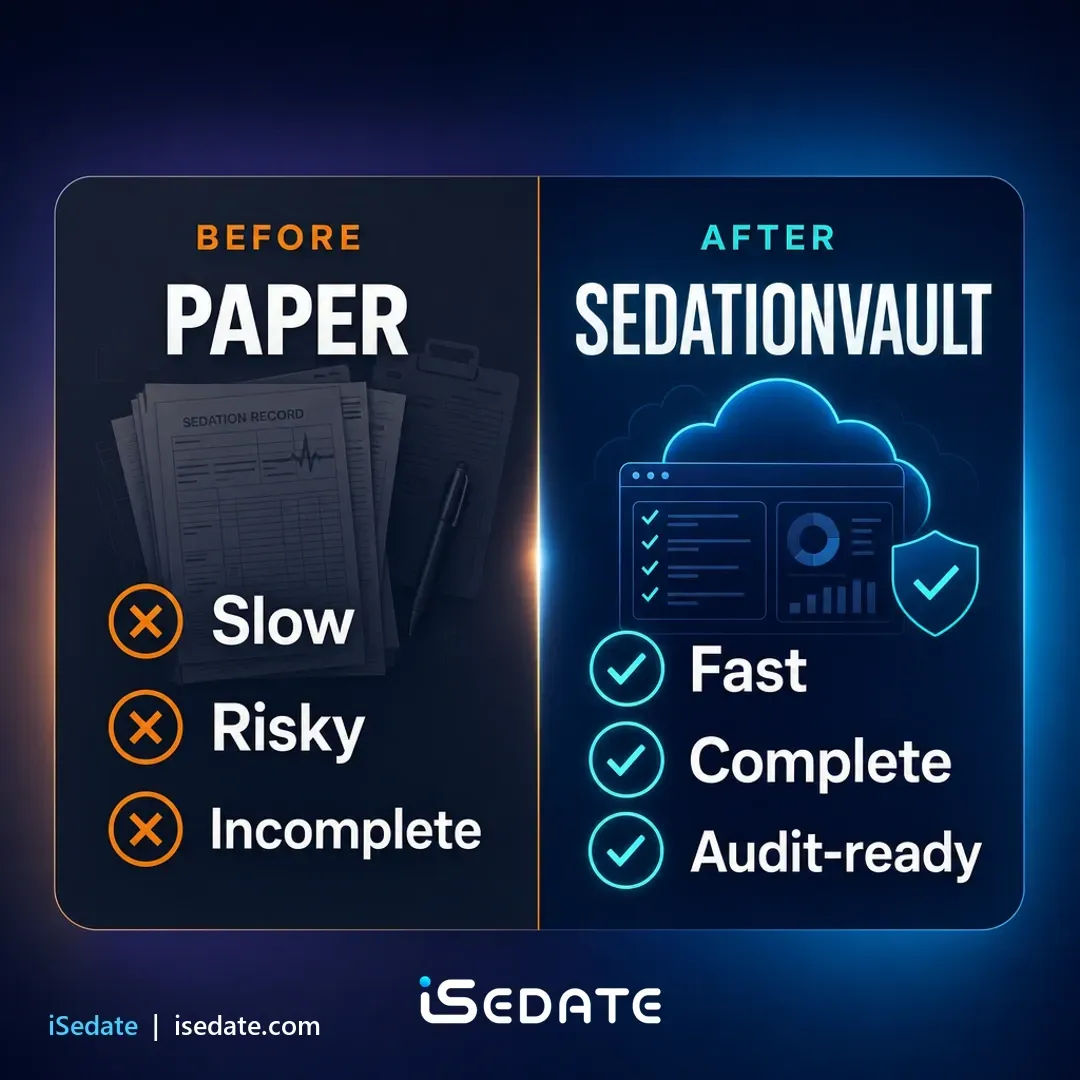
Everything above points to one truth. Getting the permit is a one-time hurdle; keeping it is a daily documentation discipline. A separate anesthetic record built by hand during a live case, between titrating a drug and watching an airway, is exactly where records go incomplete, and incomplete records are what a board review and a malpractice claim both attack.
SedationVault by iSedate removes that failure point. It captures live patient vitals and the drug log automatically into a separate, time-oriented anesthetic record for each case, carrying the pretreatment vitals, the drugs and times, the team present, and the discharge assessment that 828 IAC 3-1-6.5 and the ADA standard both expect, so the record writes itself while you focus on the patient. When the board asks for the file, a complete record is a one-click export, not a scramble through paper. See how it maps to Indiana's duties on the dental sedation compliance feature page.
Book a demo of SedationVault See SedationVault pricingRelated guides and neighboring states
Licensed in a neighboring state, or comparing requirements across the region? These same-silo guides cover each state's permit tiers and training rules, and the national hub maps all fifty:
- Illinois Sedation Dentistry Licensing & Permit Requirements
- Kentucky Sedation Dentistry Licensing & Permit Requirements
- Michigan Sedation Dentistry Licensing & Permit Requirements
- Ohio Sedation Dentistry Licensing & Permit Requirements
- Sedation Dentistry Licensing & Permit Requirements by State (all 50)
Related Research: The Data Behind These Rules
The requirements on this page are the law. These research roundups are the data that explains why they exist and what a practice risks when permitting or charting goes wrong:
Frequently asked questions
What sedation permits does Indiana require?
Does a general dentist need a permit for nitrous oxide or oral sedation in Indiana?
How many training hours do you need for the Light Parenteral Conscious Sedation Permit in Indiana?
What training does the General Anesthesia and Deep Sedation Permit require?
How much is the Indiana sedation permit application fee, and where do you apply?
How often do you renew an Indiana sedation permit, and how much CE is required?
What happens if you administer sedation without the permit in Indiana?
Sources and how we verified them
How We Sourced and Fact-Checked This Guide
Every requirement here traces to the verbatim text of 828 IAC 3 (Anesthesia and Sedation) and the Indiana State Board of Dentistry's own permit materials, read directly from the board's official documents rather than from third-party aggregators.
- Indiana State Board of Dentistry: Permit to Administer Anesthesia and Sedation, information and instructions (reproduces 828 IAC 3-1-1 through 3-1-11 verbatim)
- State Form 46159: Application for Permit to Administer Anesthesia and Sedation (Indiana Professional Licensing Agency)
- 828 IAC 3-1-1: application and general requirements
- 828 IAC 3-1-2 and 3-1-3: general anesthesia and deep sedation permit and training programs
- 828 IAC 3-1-4 and 3-1-5: light parenteral conscious sedation permit and training programs
- 828 IAC 3-1-6.1 and 3-1-6.5: standard of care, light parenteral and general anesthesia/deep sedation
- 828 IAC 3-1-7 and 3-1-7.5: renewal, reinstatement, and continuing education
- 828 IAC 3-1-9, 3-1-10, and 3-1-11: display, violations, and required emergency equipment
- Enabling statute: Indiana Code 25-14-1-3.1 and 25-14-1-13
- DOCS Education: Indiana sedation course provider (listed as a training provider only, not as the statute)
This guide summarizes Indiana sedation permit rules for general information and is not legal advice. Requirements are current as of November 2026, drawn from 828 IAC 3 as cited. The $50 fee reflects 828 IAC 0.5-2-3 and the current application form; the board sets fees, form revisions, and any procedural details and updates them periodically, so verify the current amounts and the latest form directly with the Indiana State Board of Dentistry before you file.