






Illinois Sedation Dentistry Licensing & Permit Requirements
In Illinois, your dental license alone does not let you provide moderate or deeper sedation. A dentist who administers moderate sedation (conscious sedation), deep sedation, or general anesthesia must first hold the matching permit from the Illinois Department of Financial and Professional Regulation (IDFPR), issued under 68 Illinois Administrative Code, Part 1220, Subpart E. Earning the permit means meeting training, certification, controlled-substance, and live-patient requirements for your level. Keeping it means your sedation records survive an IDFPR review. This guide walks both halves, with every requirement traced to its section of Part 1220 and linked to the official source.
Recent Updates
Last UpdatedNovember 16, 2026
- Verified every requirement against the current text of 68 Ill. Adm. Code 1220.510, 1220.520 and 1220.505 (1220.510 current as amended at 47 Ill. Reg. 1672, effective January 23, 2023).
- Added the verified 75-hour training minimum, the sedation-case logbook duty (1220.510(n)), and the Illinois Controlled Substances License and DEA registration requirement (1220.510(o)).
- Replaced aggregator citations with the original Illinois General Assembly administrative-code pages and the IDFPR dental-professions page.
- Added verified Permit B detail: a minimum of 2 years of advanced anesthesiology training under 1220.520.
Key Takeaways
- Illinois issues sedation permits by letter under 68 Ill. Adm. Code 1220, Subpart E: Permit A for moderate sedation (conscious sedation) and Permit B for deep sedation or general anesthesia. Minimal sedation and nitrous oxide need no permit.
- Permits come from IDFPR, through its Division of Professional Regulation and the Illinois State Board of Dentistry, not a standalone dental board.
- Permit A (1220.510) requires at least 75 hours of didactic and clinical study in one organized sequence completed in under a year, supervised experience with 20 or more moderate-sedation patients, current ACLS or PALS, team BLS, a signed facility affidavit, and the fee.
- A Permit A holder must also hold an active Illinois Controlled Substances License and current federal DEA registration, and must keep a sedation-case logbook.
- Keeping Permit A current means 9 CE hours per renewal cycle in sedation techniques, plus ACLS/PALS maintenance, and a time-based anesthetic record plus drug log (1220.510(h)). Incomplete records are where permits get challenged.

What This Guide Covers
- Who issues sedation permits in Illinois
- The Illinois permit tiers
- How to get a moderate sedation permit (Permit A)
- Controlled-substance license and DEA registration
- What the permit requires you to monitor
- Recordkeeping and reporting duties
- CE and renewal
- Record reviews and how permits are lost
- Permit B: deep sedation and general anesthesia
- Keeping the permit: audit-ready records
- Frequently asked questions
- Licensed in a neighboring state?
- Sources
Who issues sedation permits in Illinois
Sedation dentistry in Illinois is regulated by the IDFPR dental professions division, the state body that licenses dentists and issues every sedation and anesthesia permit. State this plainly, because it trips people up: Illinois does not have a standalone dental board that issues permits on its own. The Illinois State Board of Dentistry sits inside IDFPR's Division of Professional Regulation, and it is IDFPR that decides who may sedate, reviews records, and takes disciplinary action. The rules live in 68 Illinois Administrative Code, Part 1220, Subpart E, "Anesthesia Permits," under the Illinois Dental Practice Act (225 ILCS 25), and every requirement below traces to a numbered section of that rule.
Myth, Busted
Myth: The ADA is a federal agency, so meeting the ADA sedation guidelines is what keeps you compliant.
Fact: The American Dental Association is a private professional association, not a government body. In Illinois it is IDFPR under 68 Ill. Adm. Code 1220 that licenses you, reviews your records, and disciplines you.
Illinois, like most states, leans on the ADA guidelines as the clinical standard of care, and the state rule mirrors them closely. But your permit, your record reviews, and any sanction all run through IDFPR and Part 1220, so treat the ADA guidelines as best practice and the administrative code as the law you answer to.
You apply through IDFPR's own licensing system. A signed facility affidavit is part of the Permit A packet under 1220.510(b)(2), attesting that your office meets the recovery-area and equipment requirements in 1220.510(g). Application forms and the current fee are set by IDFPR and change periodically, and the fee itself is required under 1220.415, so confirm the exact forms and current amount on the IDFPR dental page before you file.
Source: IDFPR Dental Professions | 68 Ill. Adm. Code 1220.510
The Illinois permit tiers
Illinois names its permits by letter, and the tier reflects how deeply the patient is sedated, not simply which drug or route is used. Here is the full ladder, each rung with its governing section of Part 1220.
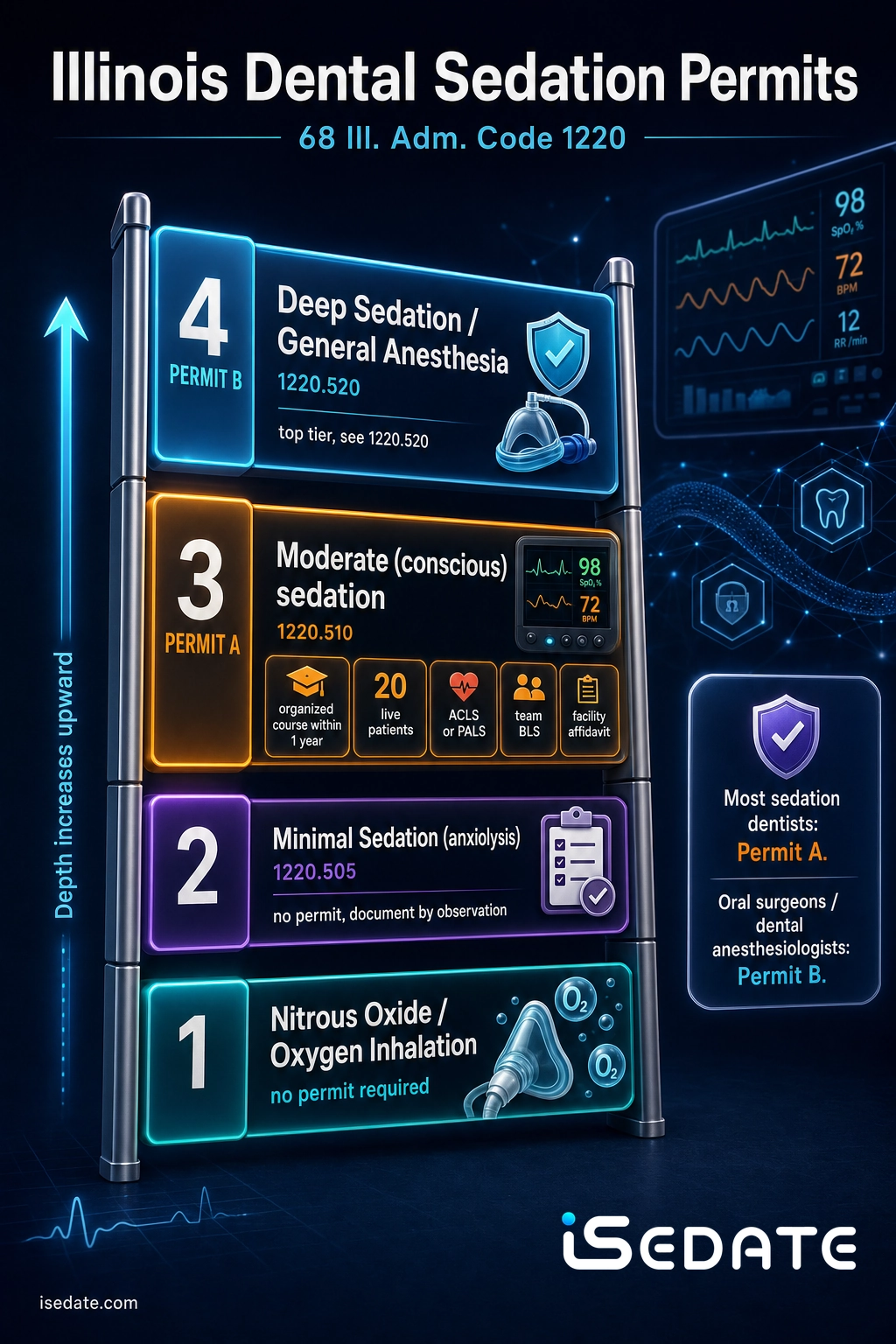
Nitrous oxide / oxygen inhalation: no permit required. Nitrous oxide and oxygen inhalation sedation carries no separate anesthesia permit under Subpart E. It remains the most accessible form of sedation a general practice can offer.
Minimal sedation (anxiolysis): no permit required, 1220.505. Minimal sedation, the lightest form of anxiety control where the patient stays fully responsive, needs no anesthesia permit in Illinois under 68 Ill. Adm. Code 1220.505. It must still be documented in the patient record through clinical observation.
Permit A, moderate sedation (conscious sedation), 1220.510. This is the workhorse permit for sedation dentists. It authorizes moderate, or conscious, sedation, where the patient responds purposefully to stimulation and commands and keeps their own airway. Permit A carries the full training, monitoring, facility, controlled-substance, and recordkeeping requirements that the rest of this guide details.
Permit B, deep sedation or general anesthesia, 1220.520. The top tier. It authorizes deep sedation and general anesthesia, where the patient is not easily aroused or is unconscious and may need airway support. Permit B is largely the province of dental anesthesiologists and oral and maxillofacial surgeons, and a Permit B holder may also administer moderate sedation without separately holding Permit A (1220.510(e)). Its requirements sit in 1220.520, covered in brief below.
| Level | Permit | Governing section | Core training | Live patients | Resuscitation |
|---|---|---|---|---|---|
| Nitrous oxide / oxygen | None required | Subpart E | Not required | Not required | Not specified here |
| Minimal (anxiolysis) | None required | 1220.505 | Not required | Not required | Not specified here |
| Moderate (conscious sedation) | Permit A | 1220.510 | 75+ hours, organized sequence under 1 year | 20 or more patients | ACLS or PALS (dentist); BLS (team) |
| Deep sedation / general anesthesia | Permit B | 1220.520 | Minimum 2 years advanced anesthesiology training | See 1220.520 | ACLS or PALS (dentist); BLS (team) |
Source: 68 Ill. Adm. Code 1220.505 | 68 Ill. Adm. Code 1220.510 | 68 Ill. Adm. Code 1220.520
How to get a moderate sedation permit (Permit A)
Permit A is the permit most sedation dentists pursue, and 1220.510 spells out exactly what it takes. The requirements below come straight from the rule.
The training sequence: 75 hours, one organized program
Permit A requires certification of an anesthesiology training program that includes a minimum of 75 hours of didactic and clinical study, covering moderate sedation (conscious sedation), physical evaluation, venipuncture, advanced airway management, technical administration, the recognition and management of complications and emergencies, and patient monitoring (1220.510(b)(1)(A)). The program has to be an organized sequence operated by one entity and completed in less than one calendar year (1220.510(b)(1)(B)). This is a structured course, not a weekend add-on, and a string of unrelated CE days does not satisfy it.
The live-patient requirement
Classroom hours are not enough on their own. The same program must include additionally supervised experience providing moderate sedation to 20 or more patients, so the dentist builds hands-on competence in titration and monitoring that a lecture cannot replicate.
Certification, team, and facility
The dentist must submit proof of current ACLS or PALS certification (1220.510(b)(3)). The office has to meet the facility standard in 1220.510(g), which calls for a recovery area with oxygen, lighting, suction, and electrical capacity, plus a pulse oximeter, an oxygen delivery system, suction, and emergency drugs and equipment appropriate to the medications used. For each sedation patient, the anesthesia team must include at least three people: the Permit A dentist, one hygienist or assistant trained under 1220.240(f) or 1220.245(c)(2), and one additional hygienist or assistant. Every team member must stay current in BLS, and the rule is explicit that the dentist's BLS is in addition to, not part of, the required CE.
Illinois Permit A Requirements at a Glance
- Training: 75+ hours of didactic and clinical study, one organized sequence, completed in under one calendar year.
- Live patients: supervised moderate sedation for 20 or more patients.
- Resuscitation: dentist holds current ACLS or PALS; full team current in BLS.
- Facility: affidavit certifying a recovery area with oxygen, lighting, suction, a pulse oximeter, and emergency drugs and equipment.
- Credentials: active Illinois Controlled Substances License and current federal DEA registration.
- Fee: the application fee required under 1220.415 (confirm the current amount with IDFPR).
For every tier, the application form, the current fee, and any exam requirement are set by IDFPR and updated periodically. Do not rely on a figure you read on a course provider's page. Confirm the exact forms and current fee on the IDFPR dental licensing page before you file.
Source: 68 Ill. Adm. Code 1220.510
Controlled-substance license and DEA registration
One Permit A requirement is easy to overlook because it sits near the end of the rule, and missing it can stall your whole sedation program. Under 1220.510(o), a dentist holding Permit A must also hold an active Illinois Controlled Substances License and a current federal Drug Enforcement Administration (DEA) registration. The sedation permit authorizes the technique; the controlled-substance credentials authorize you to obtain, store, and administer the scheduled drugs that moderate sedation relies on. Keep both current and aligned with your permit, since a lapse in either can interrupt your ability to sedate even while your Permit A is technically in good standing.
Source: 68 Ill. Adm. Code 1220.510(o) | DEA Diversion Control, practitioner registration

What the permit requires you to monitor
A permit is permission plus obligation. Once you hold Permit A, 1220.510(h)(2) requires you to monitor the patient and document the vitals at each phase of the case. For moderate sedation (conscious sedation), the four parameters are blood pressure, pulse, respiration, and oxygen saturation, each recorded preoperatively, intraoperatively, and pre-discharge, and the rule is specific that a time-based record of these must be entered into the patient's chart.
- Blood pressure, preoperatively, intraoperatively, and pre-discharge.
- Pulse, preoperatively, intraoperatively, and pre-discharge.
- Respiration, preoperatively, intraoperatively, and pre-discharge.
- Oxygen saturation, preoperatively, intraoperatively, and pre-discharge.
The facility and team rules sit on top of the monitoring. Under 1220.510(g), the Permit A holder must remain immediately available to the patient after treatment, and a hygienist or assistant trained to monitor a sedated patient must stay with that patient until they are no longer sedated. For the full clinical breakdown of what to chart and how, see the companion guide on Illinois sedation vitals monitoring, charting and reporting requirements.
Source: 68 Ill. Adm. Code 1220.510(g), (h)
Recordkeeping and reporting duties
Holding a permit means holding a set of documentation duties, and these are exactly what an IDFPR review examines.
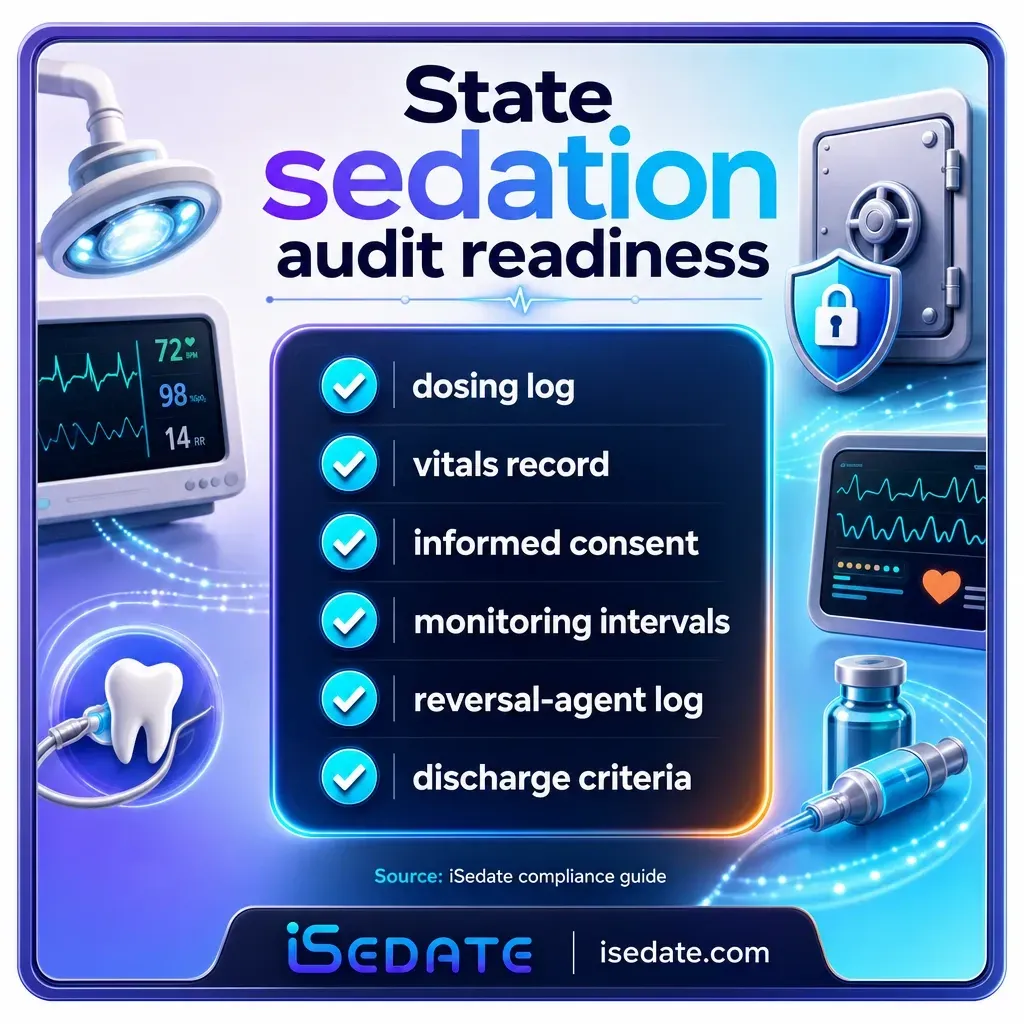
The anesthetic record (1220.510(h)). A Permit A holder must keep the patient's medical history and anesthesia consent obtained before any procedure, a time-based chart record of preoperative, intraoperative and pre-discharge blood pressure, pulse, respiration and oxygen saturation, and a drug log listing each drug and dosage, the person administering it, and the times of administration over the course of the procedure.
The sedation logbook (1220.510(n)). Separately from the per-case anesthetic record, the Permit A holder must maintain a logbook of the sedation cases performed. The log must include the patient name, date, route of sedation administration, drug name and dosage, and the names of the anesthesia team members assisting, and it must be supplied to the Division on request.
Adverse-occurrence reporting. An adverse occurrence connected to the sedation must be reported to the Division as set out in 1220.405. Rule violations, including recordkeeping violations, can lead to IDFPR disciplinary action under the Illinois Dental Practice Act (225 ILCS 25). The specific penalty schedule is set by IDFPR, so confirm the current reporting triggers and timelines with the Department.
Source: 68 Ill. Adm. Code 1220.510(h), (n), (i)
CE and renewal
Your sedation permit is tied to your Illinois dental license, and IDFPR expects Permit A holders to stay current in both continuing education and resuscitation certification. Under 1220.510(k), renewal of Permit A requires proof of 9 hours of continuing education per renewal cycle in sedation techniques, including medications and the recognition and management of complications and emergencies. Keeping ACLS or PALS current is a separate obligation under 1220.510(m), and the rule states plainly that this certification counts in addition to the 9 CE hours, not toward them.
The exact renewal cycle length and the way these hours are reported are set by IDFPR and updated periodically, so confirm your current cycle and CE reporting on the IDFPR dental renewal page so your permit never lapses at renewal.
Source: 68 Ill. Adm. Code 1220.510(k), (m)
Record reviews and how permits are lost
This is where a permit is kept or lost. Permit A and Permit B authorize the deepest sedation and carry the heaviest scrutiny, because that is where the risk is. By signing the facility affidavit, you attest that your office meets the equipment and recovery standards of 1220.510(g), and IDFPR's authority to review a permit holder's records flows from the Dental Practice Act. A routine office-inspection cadence, if any, is not detailed in the sedation rule and is administered by IDFPR, so confirm the current program with the Department rather than assuming one way or the other.
iSedate Pro Tip
Reconcile your logbook and anesthetic records before renewal, not after a request lands. A reviewer opening your file checks the record, not your intentions: whether the time-based anesthetic record, the drug log, and the sedation logbook are complete, contemporaneous, and present for each phase of every case. A dentist can perform the sedation flawlessly and still lose on the paperwork.
Source: 68 Ill. Adm. Code 1220.510(g), (h), (n)
Permit B: deep sedation and general anesthesia
Permit B is a different credential for a different depth of care, and most general dentists never pursue it. Under 1220.520, deep sedation or general anesthesia authority requires completion of a minimum of 2 years of advanced training in anesthesiology, which in practice means a hospital-based residency or an equivalent accredited program, well beyond the 75-hour course that qualifies a dentist for Permit A. Permit B holders also submit proof of current ACLS or PALS, carry 9 CE hours per renewal cycle under 1220.520(h), and keep their own records subsection for deep sedation and general anesthesia.
Because Permit B sits with dental anesthesiologists and oral and maxillofacial surgeons rather than general dentists, and a Permit B holder may administer moderate sedation without a separate Permit A, most sedation dentists operate at nitrous and Permit A. If you are pursuing Permit B, work directly from 1220.520 with IDFPR, since its facility, team, and record specifics go beyond the scope of this Permit A guide.
Source: 68 Ill. Adm. Code 1220.520
Keeping the permit: audit-ready records
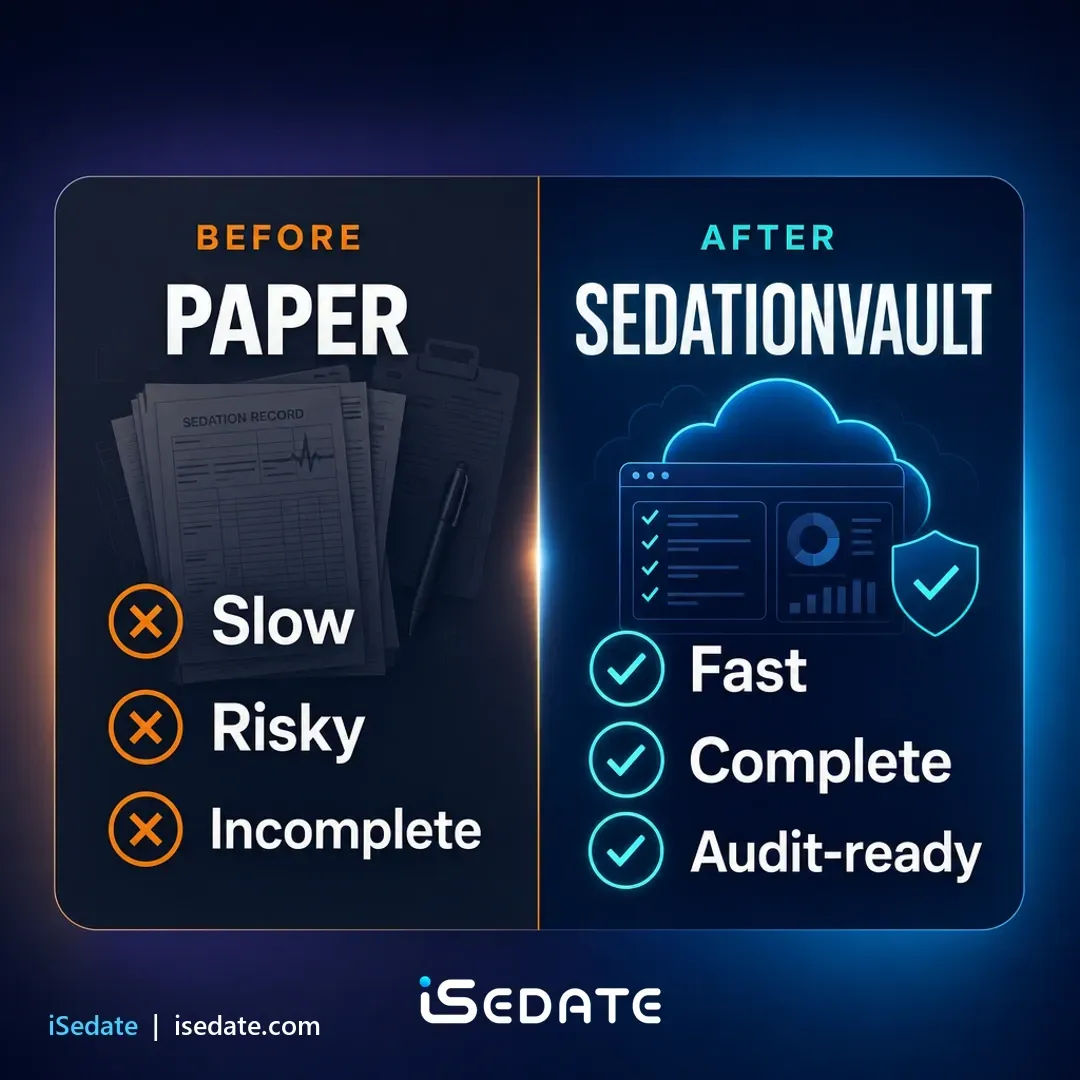
Everything above points to one truth: earning the permit is a one-time hurdle, but keeping it is a daily documentation discipline. A time-based vitals log, a drug log, and a sedation logbook kept by hand during a live case, between titrating a drug and watching an airway, is exactly where records go incomplete, and incomplete records are what an IDFPR review and a malpractice claim both attack.
SedationVault removes that failure point. It captures live patient vitals and the drug log automatically into a time-based, Illinois-aligned anesthetic record, holding the preoperative, intraoperative and pre-discharge entries that 1220.510(h) demands, so the record builds itself while you focus on the patient. When IDFPR asks for the file, a complete record is a one-click export, not a scramble through paper. See how it maps to the Illinois rules on the dental sedation compliance and anesthesia record software pages.
Book a Demo of SedationVault See SedationVault PricingFrequently asked questions
What sedation permits does Illinois require?
How do you get a moderate (conscious) sedation permit (Permit A) in Illinois?
How many live patients are required for an Illinois Permit A?
How many CE hours are required to keep an Illinois sedation permit?
Do you need a permit for nitrous oxide or minimal sedation in Illinois?
What records must an Illinois Permit A holder keep?
Licensed in a neighboring state?
Sedation permit rules change at every state line. If you practice near the border or hold licenses in more than one state, check the matching guide for each, and see the full national overview in our Sedation Dentistry Licensing & Permit Requirements by State hub.
- Indiana Sedation Dentistry Licensing & Permit Requirements
- Iowa Sedation Dentistry Licensing & Permit Requirements
- Kentucky Sedation Dentistry Licensing & Permit Requirements
- Missouri Sedation Dentistry Licensing & Permit Requirements
- Wisconsin Sedation Dentistry Licensing & Permit Requirements
Sources
- IDFPR Dental Professions: licensing, the Dental Sedation Permit application, laws and rules, and renewal
- 68 Ill. Adm. Code 1220.510: Moderate (conscious) sedation, Permit A (training, live patients, ACLS/PALS, facility, records, CE, controlled substances)
- 68 Ill. Adm. Code 1220.520: Deep sedation and general anesthesia, Permit B
- 68 Ill. Adm. Code 1220.505: Minimal sedation in the dental office setting
- DEA Diversion Control Division: practitioner registration
This guide summarizes Illinois sedation permit rules for general information and is not legal advice. Training hours, the live-patient count, ACLS/PALS, monitoring, recordkeeping, the logbook, the controlled-substance and DEA requirement, and CE hours are drawn from 68 Ill. Adm. Code 1220.510 as cited (current as amended at 47 Ill. Reg. 1672, effective January 23, 2023); Permit B detail is drawn from 1220.520. Application forms, the fee amount, any routine inspection schedule, the exact renewal-cycle length, and the penalty schedule are set by IDFPR and should be confirmed directly with the Department before you act. Requirements current as of November 2026.