







Kentucky Sedation Dentistry Licensing & Permit Requirements
In Kentucky, your dental license alone does not let you administer moderate or deeper sedation. A dentist who provides moderate sedation, deep sedation, or general anesthesia must first hold the matching permit from the Kentucky Board of Dentistry, issued under 201 KAR 8:550. Minimal sedation and nitrous oxide need no permit. Getting a permit means meeting the board's training, life-support, and facility requirements for your level. Keeping it means your records survive a board review. This guide walks both halves: how a Kentucky dentist gets a sedation or anesthesia permit, and what it takes to keep it.
Recent Updates
Last UpdatedNovember 16, 2026
- Re-verified every permit, monitoring, CE, and facility-certificate rule against the live text of 201 KAR 8:550 on the Kentucky Legislature site.
- Replaced third-party legal-aggregator citations with the original Kentucky statute and the Kentucky Board of Dentistry's own sedation and anesthesia pages.
- Added the board's per-level certification requirements (BLS, ACLS, and PALS) and the application, facility-certificate, and location-change forms.
- Kentucky issues two sedation permits under 201 KAR 8:550: a Moderate Sedation Permit (Section 5) and a Deep Sedation and General Anesthesia Permit (Section 6), each for adult and/or pediatric patients.
- Minimal sedation (Section 4(1)) and nitrous oxide (Section 3) require no permit for a Kentucky-licensed dentist, which makes the moderate permit the main entry point for permitted sedation.
- Both permits require a CODA-approved or ADA-guideline moderate or deep sedation training program, documented live-patient experience, and current life support: BLS plus ACLS for an adult permit, BLS plus PALS for a pediatric permit.
- A practice that provides moderate or deeper sedation must also hold an Anesthesia or Sedation Facility Certificate (Section 10). Permits and certificates both expire December 31 of odd-numbered years.
- For moderate sedation, Kentucky requires a time-oriented anesthesia record with vitals recorded at least every five minutes (Section 5(10)). Incomplete records are where permits get challenged.

What This Guide Covers
- Who issues sedation permits in Kentucky
- The Kentucky permit structure
- How to get a Kentucky sedation permit
- What the permit requires you to monitor
- Recordkeeping obligations tied to your permit
- CE and renewal
- Facility certificate and record reviews
- Keeping the permit: audit-ready records
- Related guides and neighboring states
- Frequently asked questions
- Sources
Who issues sedation permits in Kentucky
Sedation dentistry in Kentucky is regulated by the Kentucky Board of Dentistry, the state agency that licenses dentists and issues every sedation and anesthesia permit. The board, not any national body, decides who may sedate, certifies the facilities where sedation is provided, and takes disciplinary action. The rules live in 201 KAR 8:550, "Anesthesia and sedation related to dentistry", and every requirement below traces to a section of that regulation. The board publishes the practical side of the process, including forms and the application portal, on its own sedation and anesthesia page.
Myth, Busted
Myth: Once you have ADA-recognized sedation training, you are cleared to sedate patients in Kentucky.
Fact: The American Dental Association is a private professional association, not a government agency. It writes guidelines that Kentucky leans on, but it does not license you, certify your facility, or discipline you. Your permit, your facility certificate, and any sanctions all come from the Kentucky Board of Dentistry under 201 KAR 8:550.
Treat the ADA guidelines as the best-practice standard and 201 KAR 8:550 as the law you are actually held to. The federal layers that do apply, such as DEA controlled-substance logging and HIPAA, sit on top of the state rule, not in place of it.
To apply, you work through the board's own process and meet the requirements for your level. The exact forms and the current fee schedule are set by the board and change periodically, so confirm them directly on the board's site before you file.
Source: Kentucky Board of Dentistry, Sedation and Anesthesia | 201 KAR 8:550
The Kentucky permit structure
Kentucky names its tiers by depth of sedation, and the depth reflects how the patient responds, not just which drug or route is used. Unlike states with a five-permit ladder, Kentucky requires a permit only for the two deeper tiers. Here is the full structure, each with its governing section of 201 KAR 8:550.
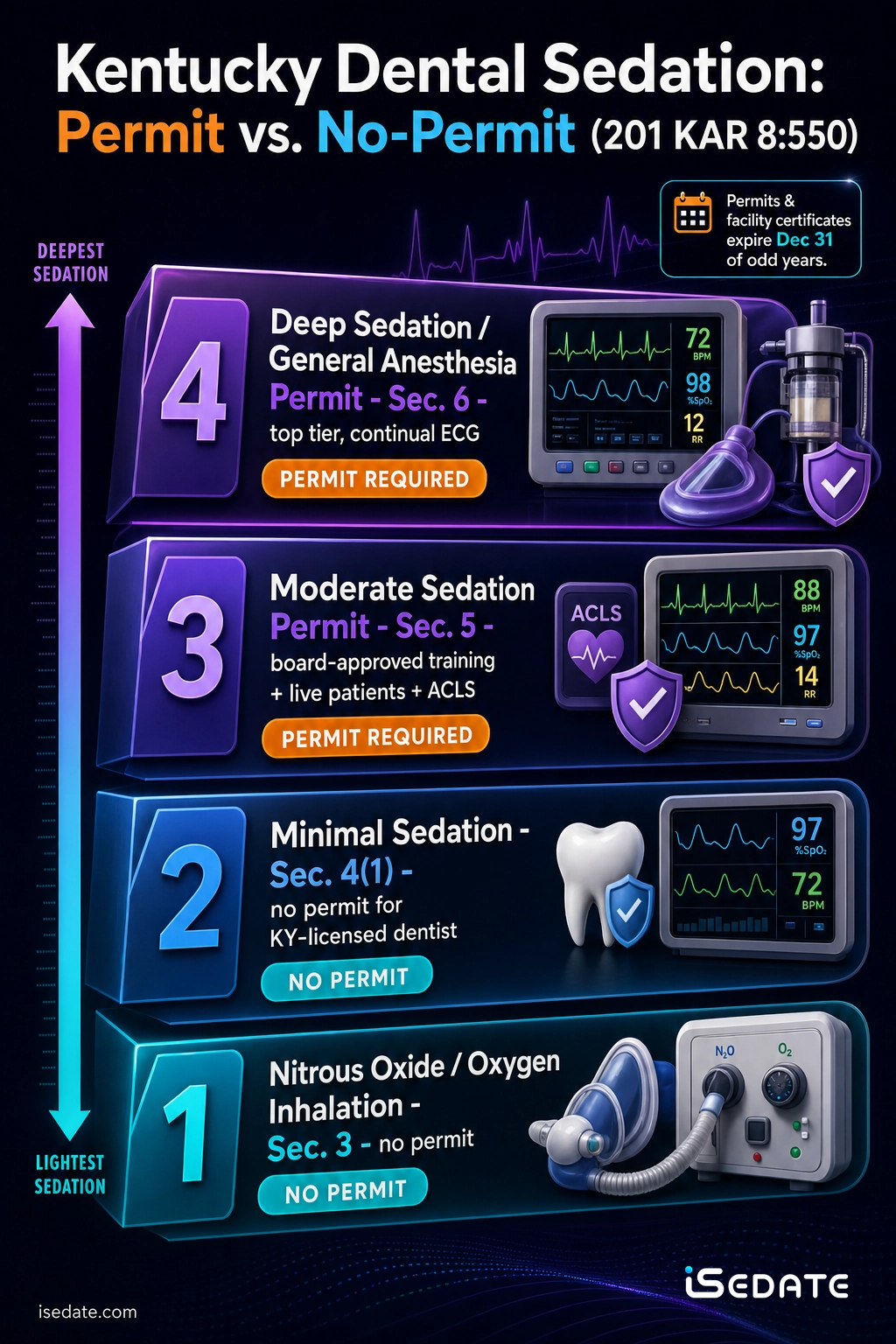
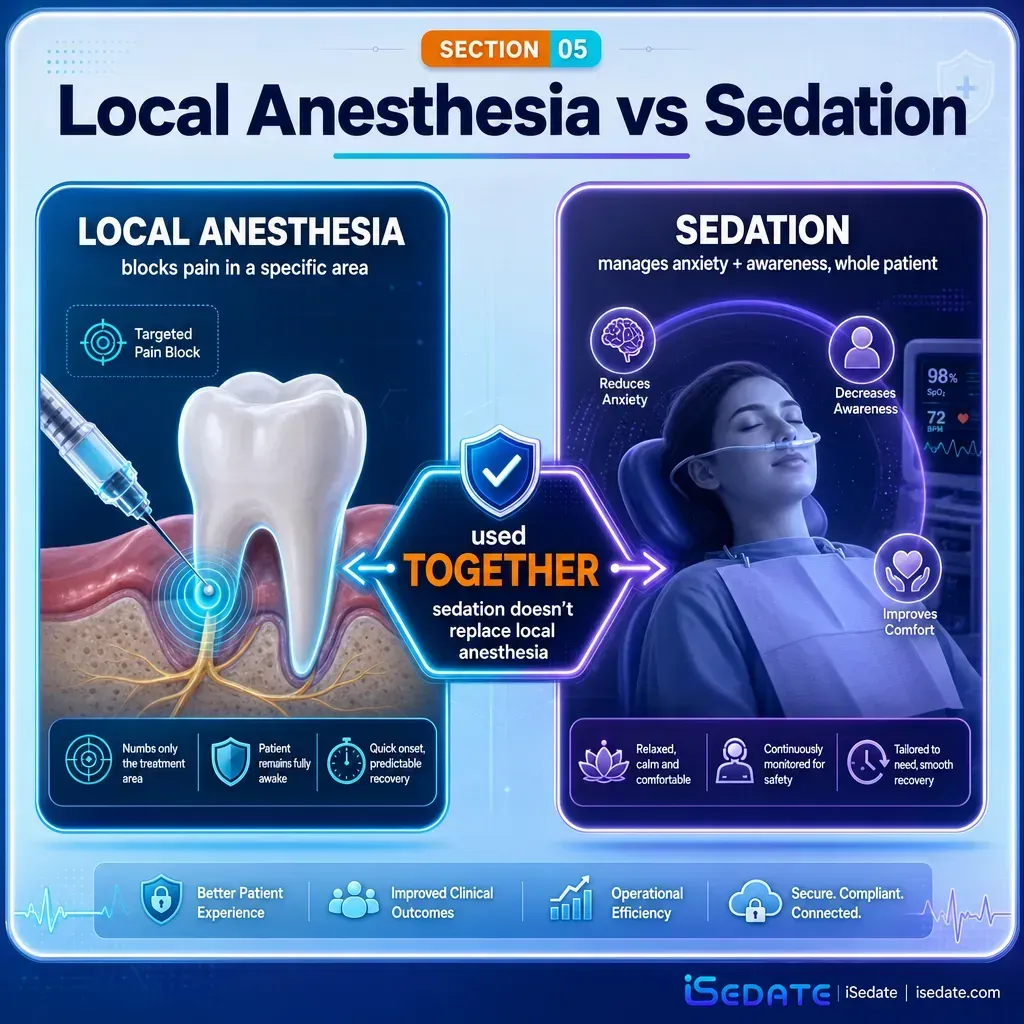
Nitrous oxide / oxygen inhalation (Section 3). The lightest form of anxiety control, where the patient stays fully responsive. Kentucky addresses it in its own section and does not require a sedation permit for a Kentucky-licensed dentist to provide it.
Minimal sedation (Section 4). Minimal sedation, or anxiolysis, is typically a single oral drug, where the patient responds normally to verbal command and airway and cardiovascular function are unaffected. Section 4(1) states plainly that a sedation permit is not required for a Kentucky-licensed dentist to provide minimal sedation, though the monitoring and sedative-record duties in Section 4(10) still apply.
Moderate Sedation Permit (Section 5). Required. This permit authorizes moderate sedation, commonly called Conscious Sedation, where the patient responds purposefully to verbal or tactile stimulation and keeps their own airway. This is the workhorse permit for a general practice doing real conscious sedation, including the IV route, and it carries the full monitoring and time-oriented recordkeeping standard in Section 5(10). It is issued for adult and/or pediatric patients.
Deep Sedation and General Anesthesia Permit (Section 6). The top tier. It authorizes deep sedation and general anesthesia, where the patient is not easily aroused or is unconscious and may need airway support. Section 6 adds continual electrocardiogram monitoring and a readily available temperature-measuring device on top of the moderate-sedation standard. This permit is largely the province of dental anesthesiologists and oral and maxillofacial surgeons; a general dentist rarely holds it. If you are pursuing it, work directly from Section 6 with the board, as its specifics run beyond the scope of this guide.
Source: 201 KAR 8:550 Sections 3-6
How to get a Kentucky sedation permit
Each permit has its own bar to clear. For both the Moderate Sedation Permit (Section 5) and the Deep Sedation and General Anesthesia Permit (Section 6), the board requires a comprehensive training program, documented live-patient experience, and current life-support certification matched to the level and to the patient population you treat.
Training and certification by level
The Kentucky Board of Dentistry sets training around nationally recognized programs rather than a single in-state course. For a moderate sedation permit, the board requires a comprehensive moderate sedation training program that is approved by the Commission on Dental Accreditation (CODA) or meets the ADA guidelines. The deep sedation and general anesthesia permit requires a CODA-approved deep sedation or general anesthesia program. Life-support certification then depends on whether the permit is for adults or children.
| Tier | Permit? | Training basis | Life support |
|---|---|---|---|
| Nitrous oxide (Section 3) | No permit | Education to standard of care | BLS (standard of care) |
| Minimal sedation (Section 4) | No permit | Education to standard of care | BLS (standard of care) |
| Moderate Sedation Permit (Section 5) | Yes | CODA-approved or ADA-guideline moderate sedation program | BLS + ACLS (adult); BLS + PALS (pediatric) |
| Deep Sedation / GA Permit (Section 6) | Yes | CODA-approved deep sedation or general anesthesia program | BLS + ACLS (adult); BLS + PALS (pediatric) |
Source: Kentucky Board of Dentistry, permit requirements by level
Minimal sedation and nitrous oxide
Because Kentucky requires no permit for minimal sedation (Section 4(1)) or nitrous oxide (Section 3), these are the most accessible tiers and the usual first step for a general practice adding light anxiety control. Even without a permit, the monitoring duties and the sedative-record requirement still apply, so the clinical and documentation obligations do not disappear just because a permit is not needed.
The Moderate Sedation Permit, including IV
The Moderate Sedation Permit is the main credential for a dentist offering genuine conscious sedation, and it covers the IV route. Beyond the CODA or ADA-guideline training program and current ACLS, the board expects documented management of live clinical patients. Continuing-education providers' materials for the IV moderate pathway indicate roughly 60 hours of didactic training and at least 20 live-patient cases plus ACLS, but because those figures come from a training provider's course page rather than the regulation text, treat them as a planning estimate and confirm the exact hour and patient counts and the current pathway directly with the board before you rely on them.
Filing the application
You apply to the board either online through its Application Portal or on paper by submitting the notarized sedation and anesthesia permit application with your training and education records. The permit is marked for adult and/or pediatric patients, and a dentist qualified for more than one level can mark all levels on one application without paying extra application fees (Section 7). Because fees and form versions change, pull the current sedation and anesthesia permit application and the board's current fee schedule from the board site rather than a number you read elsewhere.
Source: 201 KAR 8:550 Sections 5-7 | Kentucky Board of Dentistry, how to apply

What the permit requires you to monitor
A permit is permission plus obligation. Once you hold a Moderate Sedation Permit, Section 5(10) requires the dentist to continually assess the level of sedation and to monitor the patient's vital signs throughout the case, watching and logging:
- Oxygenation: oxygen saturation by pulse oximetry, monitored continually.
- Ventilation: end-tidal CO2, monitored continually.
- Circulation: heart rate and blood pressure, monitored continually, with circulation data noted in the time-oriented anesthesia record.
- Consciousness: level of consciousness, continually assessed.
For deep sedation and general anesthesia, Section 6(7) adds continual electrocardiogram monitoring of heart rate and rhythm and a readily available temperature-measuring device. For the full clinical breakdown of what to monitor and chart at each depth, see the companion guide on Kentucky sedation vitals monitoring, charting, and reporting requirements.
Source: 201 KAR 8:550 Sections 5(10), 6(7)
Recordkeeping obligations tied to your permit
Holding a permit also means holding a set of documentation duties, and these are exactly what a board review examines.
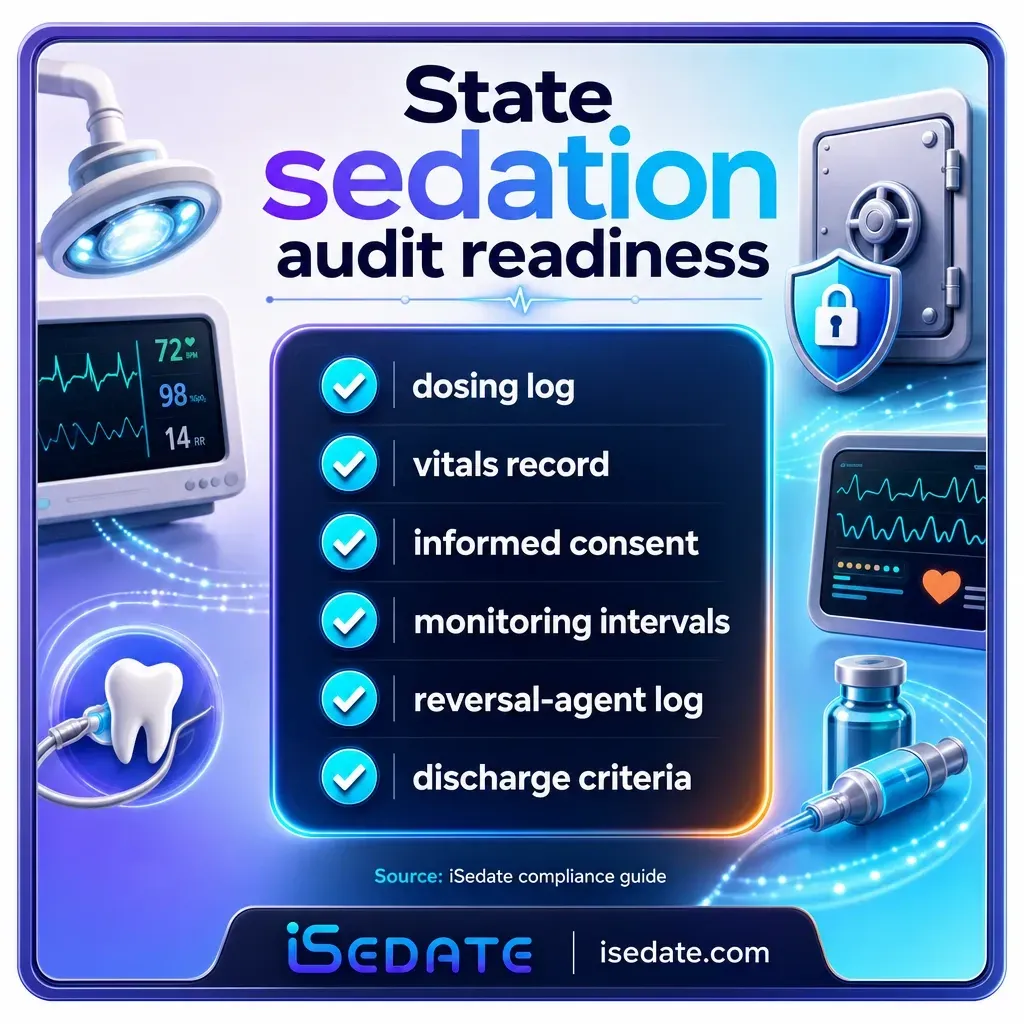
The anesthesia record. Under Section 5(10), a time-oriented anesthesia record must be maintained for moderate sedation. Pulse oximetry, heart rate, end-tidal CO2, blood pressure, and level of consciousness must be monitored continually and recorded at least every five minutes.
The sedative record and baseline vitals. Under Section 4(10)(c)(3)(b), a sedative record must list the names of all drugs administered, including local anesthetics, with the time, route, dosage, and monitored physiological parameters. Under Section 4(10)(b)(3), baseline vital signs (body weight, height, blood pressure, and pulse rate) must be obtained before the case, and for deep sedation or general anesthesia, Section 6(5)(c) adds baseline blood oxygen saturation.
Facility records. Under Section 10(5), a certified facility must maintain, for at least seven years and available for board inspection, the name and license number of each dentist or qualified anesthesia provider who administered anesthesia or moderate sedation at the location.
Why This Matters
A board reviewer checks the record, not your intentions. The dentist can run the sedation flawlessly and still lose on the paperwork if the time-oriented anesthesia record has a gap, the baseline vitals are missing, or the facility cannot produce its seven-year provider log. Compliance is a documentation discipline, not just a clinical one.
Source: 201 KAR 8:550 Sections 4(10), 5(10), 10
CE and renewal
Your sedation permit is tied to your Kentucky dental license, and the board expects permit holders to stay current. Under Section 8(1)(c), each two-year permit term requires at least four hours of classroom-based clinical continuing education related to sedation or anesthesia. Permits expire on December 31 of odd-numbered years unless renewed, under Section 8(3), and the sedation permit renewal and its fee are in addition to the dental license renewal.
Permit holders must also notify the board of a change in the location where they administer sedation within ten business days, using the board's location-notification form. Keep your sedation-specific CE and your life-support certifications current so the permit never lapses at renewal, and confirm the exact renewal steps, CE verification, and current fees directly with the Kentucky Board of Dentistry.
Source: 201 KAR 8:550 Section 8
Facility certificate and record reviews
This is where a permit is kept or lost. Kentucky ties sedation oversight to the place as well as the provider. Under Section 10(1), the owner or operator of a facility where moderate or deeper sedation is administered must obtain an Anesthesia or Sedation Facility Certificate from the board; a location that provides only minimal sedation or nitrous does not trigger this. Facility certificates expire on December 31 of odd-numbered years under Section 11(1), and the certificate is what gives the board authority to inspect the facility and its records.
When a reviewer opens your file, they are checking whether your time-oriented anesthesia record is complete, contemporaneous, and intervaled correctly, whether your baseline vitals were captured, and whether the facility can produce the provider records Section 10(5) requires it to retain for seven years. The board also holds disciplinary authority, and non-compliance with the permit, monitoring, or facility rules is grounds for action; the specific penalty subsection should be confirmed directly with the board, as it is administered by the board and can change.
Source: 201 KAR 8:550 Sections 10-11
Keeping the permit: audit-ready records
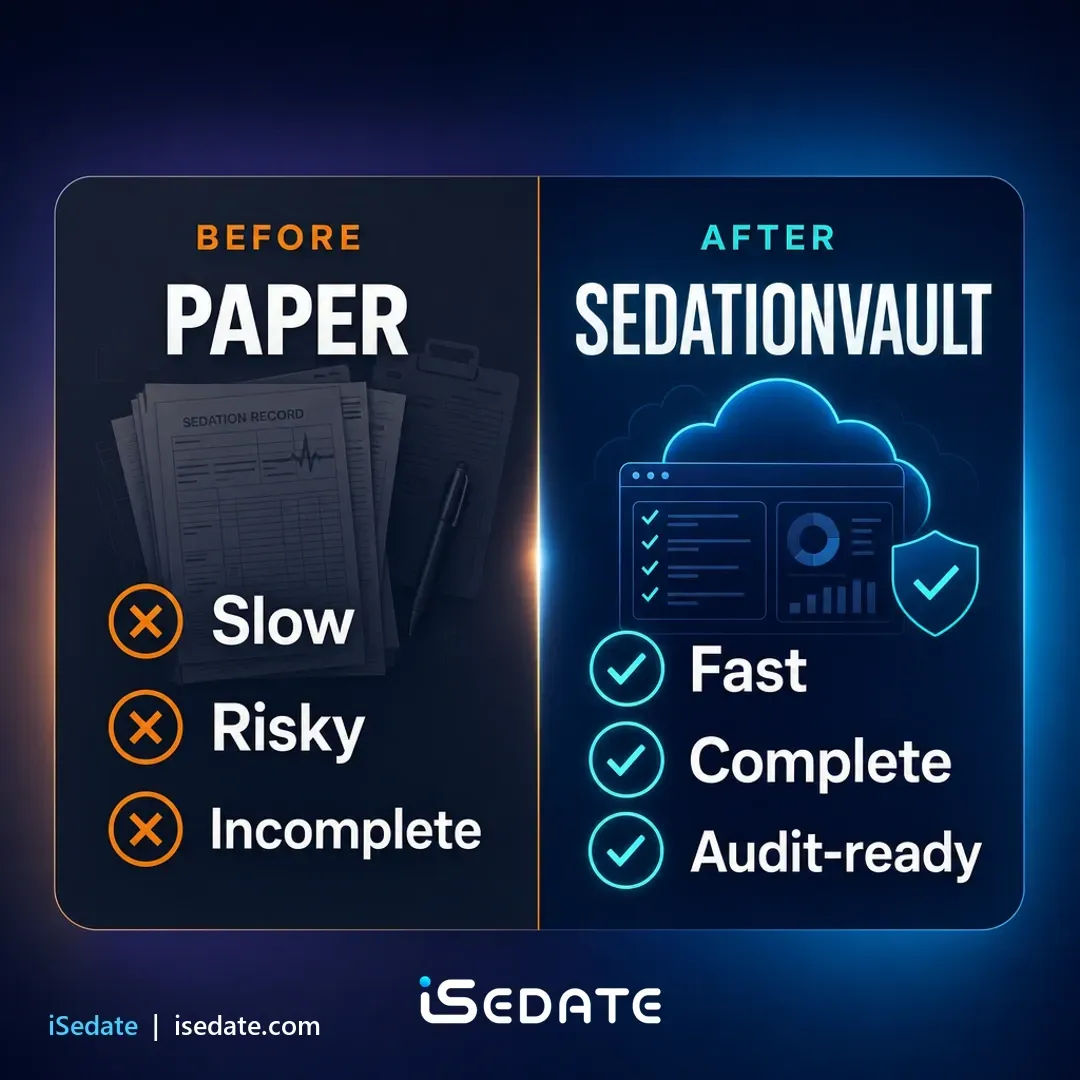
Everything above points to one truth: getting the permit is a one-time hurdle, but keeping it is a daily documentation discipline. A manual vitals log written every five minutes by hand, between titrating a drug and watching an airway, is exactly where records go incomplete, and incomplete records are what a board review and a malpractice claim both attack.
SedationVault removes that failure point. It captures live patient vitals and the drug log automatically into a time-oriented, Kentucky-ready anesthesia record, holding the five-minute interval that Section 5(10) demands, so the record builds itself while you focus on the patient. When the board asks for the file, a complete record is a one-click export, not a scramble through paper. See how it maps to Kentucky rules on the dental sedation compliance and anesthesia record software pages.
Book a Demo of SedationVault See SedationVault PricingRelated guides and neighboring states
Licensed in more than one state, or planning to be? Sedation permit rules change at every border. Start with the national overview, then compare Kentucky against the states around it:
- Sedation Dentistry Licensing & Permit Requirements by State (the all-50 hub)
- Illinois Sedation Dentistry Licensing & Permit Requirements
- Indiana Sedation Dentistry Licensing & Permit Requirements
- Missouri Sedation Dentistry Licensing & Permit Requirements
- Ohio Sedation Dentistry Licensing & Permit Requirements
- Tennessee Sedation Dentistry Licensing & Permit Requirements
- Virginia Sedation Dentistry Licensing & Permit Requirements
- West Virginia Sedation Dentistry Licensing & Permit Requirements
Frequently asked questions
What sedation permits does Kentucky require?
Do you need a permit for minimal sedation or nitrous oxide in Kentucky?
What training does a Kentucky Moderate Sedation Permit require?
How do you apply for a Kentucky sedation permit?
Does Kentucky require a facility certificate for sedation?
How often do you renew a Kentucky sedation permit?
What to Read Next
The requirements on this page are the law. These research roundups are the data behind them, showing why the rules exist and what happens when a practice gets charting or permitting wrong:
Sources
- 201 KAR 8:550, "Anesthesia and sedation related to dentistry" (Kentucky Legislature, full text)
- Kentucky Board of Dentistry, Sedation and Anesthesia (permit types, certifications, application portal)
- Kentucky Board of Dentistry, Sedation and Anesthesia Permit Application
- Kentucky IV moderate sedation training overview (DOCS Education, course provider)
This guide summarizes Kentucky sedation permit rules for general information and is not legal advice. The permit structure, monitoring, recordkeeping, facility-certificate, and renewal requirements are drawn from the current text of 201 KAR 8:550 as cited. The per-level certification requirements (BLS, ACLS, PALS), the application and facility-certificate forms, and the application portal are drawn from the Kentucky Board of Dentistry's own sedation and anesthesia page. Specific training-hour and live-patient counts indicated by a course provider, the current fee amounts, the exact penalty subsection, and routine inspection cadence are set or administered by the Kentucky Board of Dentistry and should be confirmed directly with the board before you act. Requirements current as of November 2026; verify with the Kentucky Board of Dentistry before applying.