







Healthcare Audit & Compliance Statistics (2026): Program Effectiveness, Audit Readiness & the Seven Elements
Healthcare audit teams rate their own effectiveness at about 7.42 out of 10, yet most still run on spreadsheets and manual work, and few feel truly ready for a regulator's audit. The gap between having a compliance program and being able to prove it works is where risk concentrates. Understanding what a functioning program actually requires, and how it is evaluated, is the difference between paper compliance and real protection.
- The HHS Office of Inspector General defines seven core elements every healthcare compliance program should have (HHS-OIG General Compliance Program Guidance).
- Healthcare audit teams rated their own program effectiveness at about 7.42 out of 10 in 2025, but many remain heavily manual (Healthicity 2025 Auditing Checkup Report).
- Compliance officers' top three concerns in 2025: keeping pace with new laws, HIPAA and cybersecurity, and claims-processing accuracy (SAI360 / Strategic Management 2025 Benchmark Survey).
- Only a minority of organizations feel "very confident" they could pass an OCR audit or breach investigation (HIPAA Journal 2025 Annual Survey).
- Regulators now evaluate whether programs actually function, not just whether they exist; paper programs offer little protection (HHS-OIG).
- Compliance documentation, including audit work papers and risk assessments, must generally be retained for at least six years (ADA; HIPAA).
- Documentation and audit-ready records are the core of a defensible program, the same principle behind iSedate's SedationVault.
What's in This Guide
1 The OIG Seven Elements
Every healthcare compliance program, from a hospital system to a solo dental practice, is built on the same foundation: the seven core elements defined by the HHS Office of Inspector General.
| # | OIG Core Element |
|---|---|
| 1 | Written policies and procedures (and a code of conduct) |
| 2 | Compliance leadership and oversight |
| 3 | Training and education |
| 4 | Effective lines of communication |
| 5 | Monitoring and auditing |
| 6 | Enforcement and discipline |
| 7 | Response and corrective action |

These elements come from the OIG's General Compliance Program Guidance, which is voluntary and nonbinding but functions as the recognized standard against which programs are judged. Element five, monitoring and auditing, is the engine: it is the mechanism by which a program catches problems before a regulator does. Notably, the OIG framework treats auditing and the resulting corrective action (element seven) as a loop, findings must lead to root-cause analysis and documented fixes, not just a report that gets filed. A program that audits but never acts on findings is missing half the cycle.
Source: HHS-OIG General Compliance Program Guidance
See provable sedation compliance2 Paper vs. Functioning Programs
The single most important shift in how compliance is judged is captured in one distinction: regulators no longer care whether a program exists on paper, they care whether it works in practice.
Checkbox compliance offers little protection. Prosecutors and regulators now evaluate not just whether compliance programs exist but how effectively they function, examining whether compliance officers have genuine authority, whether training reaches every staff member, whether auditing catches problems proactively, and whether corrective actions address root causes. Paper programs offering mere checkbox compliance provide little protection, while robust, operational programs can be the difference between a civil resolution and criminal prosecution. A binder on a shelf is not a compliance program.
This "does it actually function" standard reframes the entire exercise. It means the value of a compliance program is not in the documents themselves but in the evidence that the documents are lived: training completion records, audit findings that led to changes, corrective action plans with owners and deadlines, and a trail showing problems were caught and fixed. The proof of a working program is a documentary trail of activity, which is precisely why record-keeping sits at the center of compliance.
iSedate Analysis: "Functioning, not existing" is the provable-compliance principle, again
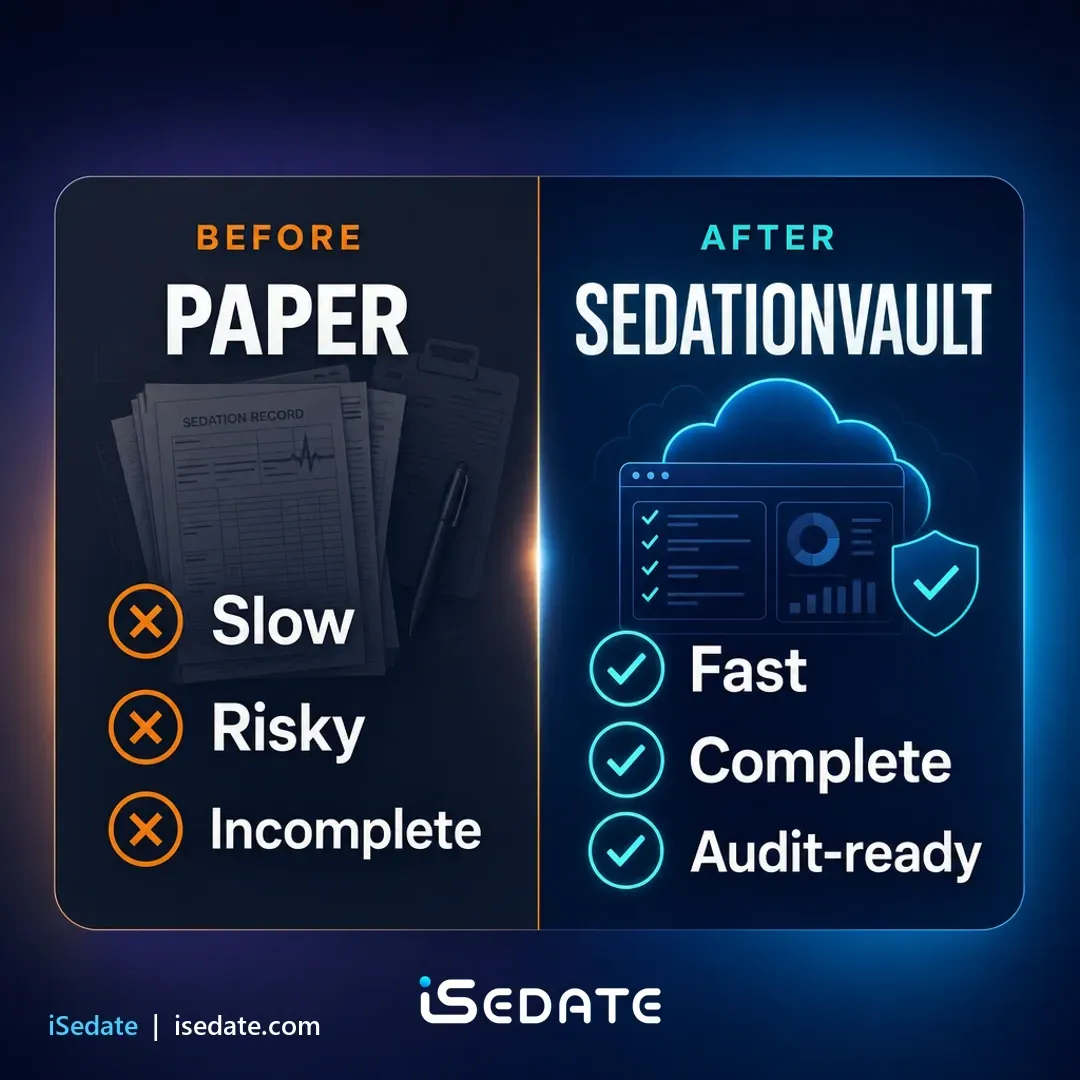
The regulatory shift from "do you have a program" to "does it demonstrably work" is the same logic that governs good clinical documentation. A sedation protocol that exists only as a policy is worth little; a sedation record showing the protocol was followed, vitals monitored, drugs logged, equipment checked, is worth a great deal. In both compliance and clinical care, the protection lives in the provable trail, not the stated intention. Organizations that internalize this build systems that generate evidence automatically, rather than scrambling to reconstruct it when a regulator or a plaintiff comes asking.
Calculation and interpretation original to iSedate.
Source: DoctorsManagement on OIG program-effectiveness scrutiny
See iSedate's SedationVault3 Audit Program Effectiveness
How well are healthcare audit programs actually performing? Industry benchmark data gives a candid, mixed picture: solid foundations undercut by manual, under-resourced operations.
The confidence in foundational structures is real, but the same survey data reveals a major caveat: many audit teams remain heavily manual, relying on spreadsheets with limited automation, staffing constraints, and growing pressure from documentation demands, AI adoption, and evolving payer expectations. Meanwhile, the financial stakes of weak auditing are rising, with hospital outpatient denials up 14% and inpatient up 12% in 2025, and pre-bill audits rising 30%. The clear industry direction is that organizations adopting continuous risk monitoring and automated analytics outperform those relying on manual processes.
iSedate Analysis: The automation gap is an opportunity for small practices
The audit-effectiveness data carries a useful signal even for practices far smaller than the hospitals surveyed. The industry's biggest weakness, heavy manual work and low automation, is exactly where a small practice can leapfrog by choosing systems that generate audit-ready documentation automatically as a byproduct of normal work. For a sedation practice, a record system that captures vitals, drugs, and consent automatically and produces an audit-ready report on demand is doing continuous monitoring at the record level, without a dedicated audit team. The lesson from the benchmark data is to let the system do the manual work the industry is still struggling to automate.
Calculation and interpretation original to iSedate.
Source: Healthicity 2025 Auditing Checkup Report | MDaudit 2025 Benchmark Report on denials
See audit-ready reports4 What Compliance Officers Worry About
Knowing what keeps compliance professionals up at night is a useful guide to where risk actually sits, because these are the people who see enforcement patterns firsthand.
| Rank | Top Compliance Officer Concern (2025) |
|---|---|
| 1 | Keeping pace with new federal and state laws |
| 2 | HIPAA and cybersecurity |
| 3 | Ensuring accuracy in claims processing |
The top concern, keeping up with rapidly changing regulations, weighs most heavily on organizations with very limited staff, exactly the position a small dental or oral surgery practice is in. HIPAA and cybersecurity ranking second is unsurprising given that data breaches and failures to protect health information are among the most common compliance problems organizations face. The third, claims accuracy, ties compliance directly to revenue. For 2026, compliance leaders are also increasingly focused on emerging areas like AI governance and vendor oversight, both of which stem from the same root challenge: keeping controls current as the environment changes faster than small teams can track.
Source: SAI360 / Strategic Management 2025 Compliance Benchmark Survey
See HIPAA-compliant records5 The Audit-Readiness Gap
The most sobering statistic in compliance surveys is about confidence: even organizations with programs in place often doubt they could survive regulatory scrutiny.
This confidence gap has a specific, identifiable cause. Surveys find that while most organizations have policies covering basic requirements, many lack written documentation for more complex or emerging risks, and that absence undermines their ability to demonstrate compliance during an audit or investigation. In other words, the readiness problem is largely a documentation problem. When OCR opens an investigation, it asks for specific proof: a current risk analysis, written policies, training records, and corrective action plans. Organizations that cannot quickly produce these feel unready because they genuinely are.
Readiness is a documentation state, not a feeling. "Are we ready for an audit?" reduces to a concrete question: can you produce, on demand, current documentation proving each element of your program is functioning? The organizations that feel confident are the ones that can. Readiness is not achieved by intending to comply; it is achieved by maintaining a retrievable, current documentary trail, so that an audit request is a matter of pulling files rather than reconstructing history under pressure.
Source: HIPAA Journal 2025 Annual Survey
Book a SedationVault demo6 Scaling Compliance for Small Practices
The seven elements can look overwhelming to a small practice without a compliance department. The reassuring reality is that OIG explicitly endorses scaling them to the size of the organization.
Scaled compliance for a small practice focuses on the essentials: designate a compliance contact person, implement basic policies covering key risk areas, conduct annual training on high-risk topics, establish a simple reporting mechanism, perform targeted auditing of problem areas, and document compliance activities. OIG offers free resources and templates, and small practices can share compliance officers, join specialty-society programs, or leverage technology for automation to keep costs manageable. The recurring theme is that small investments in prevention avoid large penalties later, and that documentation and targeted auditing matter more than sheer program size.
iSedate Analysis: Where a sedation record system fits the seven elements
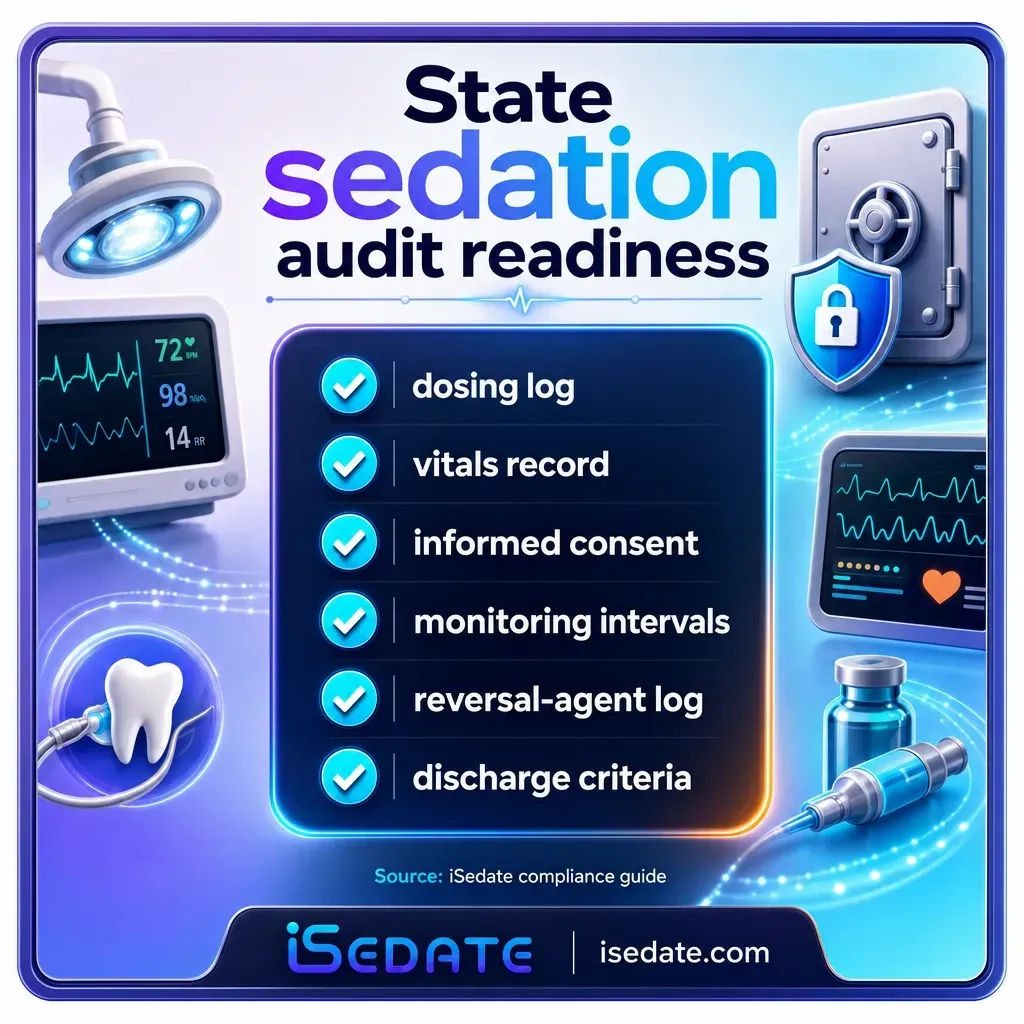
A record system cannot be a practice's whole compliance program, but for a sedation practice it directly supports several of the seven elements at once. It contributes to monitoring and auditing (element five) by generating an audit-ready record of every sedation case; to response and corrective action (element seven) by making it possible to review what happened and identify patterns; and to the documentation trail that proves the program functions. iSedate's SedationVault keeps sedation records in HIPAA-compliant cloud storage with access controls and audit trails, captures vitals automatically from compatible monitors such as Edan, MindRay, and Criticare, and exports a clean PDF into whatever chart the practice already keeps, whether Dentrix, Eaglesoft, or Open Dental. It handles the sedation slice of compliance well so a small team can focus its limited compliance energy elsewhere. Reference figures for the founders' own practice reflect thousands of documented sedation procedures, a practice-level dataset, not a nationwide claim.
Calculation and interpretation original to iSedate.
For the specific violations these programs are designed to prevent, see the companion report on HIPAA violation statistics; for what failures cost, see the HIPAA fine statistics report.
See SedationVault for dentists7 Summary Table: Every Statistic at a Glance
| Statistic / Fact | Figure | Source | Year |
|---|---|---|---|
| OIG core compliance elements | 7 | HHS-OIG | 2026 |
| Audit program self-rated effectiveness | 7.42/10 | Healthicity | 2025 |
| Audit teams relying on manual/spreadsheet work | Many/most | Healthicity | 2025 |
| Top compliance officer concern | Keeping pace with new laws | SAI360 / Strategic Mgmt | 2025 |
| Second concern | HIPAA & cybersecurity | SAI360 / Strategic Mgmt | 2025 |
| Third concern | Claims-processing accuracy | SAI360 / Strategic Mgmt | 2025 |
| Feel "very confident" passing an OCR audit | Minority | HIPAA Journal | 2025 |
| Hospital outpatient denial growth | 14% | MDaudit | 2025 |
| Hospital inpatient denial growth | 12% | MDaudit | 2025 |
| Pre-bill audit increase | 30% | MDaudit | 2025 |
| Compliance effectiveness survey cadence | Every 1-2 years | Strategic Management | 2025 |
| Risk assessment / work plan cadence | At least annually | OIG guidance | 2026 |
| Documentation retention period | 6 years | ADA / HIPAA | 2026 |
| Full effectiveness assessment report length | 50-75 pages | Strategic Management | 2025 |
Frequently Asked Questions
What are the seven elements of a healthcare compliance program?
How effective are healthcare audit programs?
What are compliance officers most worried about?
How often should a compliance program be audited?
Does a compliance program need to be documented?
Methodology & Sources
Primary and institutional sources: HHS Office of Inspector General (OIG) General Compliance Program Guidance (the seven core elements and program-effectiveness expectations). Industry benchmark and survey sources: the Healthicity 2025 Auditing Checkup Report (audit effectiveness and automation), the SAI360 / Strategic Management Services 2025 Compliance Benchmark Survey (compliance officer concerns and cadence), the HIPAA Journal 2025 Annual Survey (audit readiness), and the MDaudit 2025 Benchmark Report (denials and audit volume).
Note on scope: this article covers healthcare compliance programs and auditing, the framework, effectiveness, and readiness, as distinct from specific HIPAA violation types, fines, and breach-notification rules, which are covered in companion reports in this series. OIG's General Compliance Program Guidance is voluntary and nonbinding but is the recognized standard for program design. Benchmark figures are self-reported survey data and reflect participating organizations, which skew larger than a typical dental practice; they are presented as directional industry indicators. This is general information, not legal or compliance advice; consult qualified compliance professionals for your organization. Statistics reflect the most recent available data as of 2026.
Media & press usage: Journalists and researchers are welcome to cite these statistics with attribution to iSedate and a link to this page. The iSedate Analysis boxes contain original interpretation unique to this article.