






Virginia Sedation Dentistry Licensing & Permit Requirements
In Virginia, your dental license alone does not let you provide moderate sedation. A dentist who administers moderate sedation, deep sedation, or general anesthesia must first hold the matching permit from the Virginia Board of Dentistry, issued under 18VAC60-21, Part VII. Getting the permit means meeting the training, certification, and live-patient requirements for your level, and passing an office inspection. Keeping it means your continuing education stays current and your sedation records survive a board review, measured against a record standard Virginia writes into the code itself. This guide walks both halves: how a Virginia dentist gets a sedation permit, and what it takes to keep it.
Recent Updates
Last UpdatedNovember 16, 2026
- Reviewed every citation against 18VAC60-21 on Virginia's official Administrative Code, and confirmed the deep sedation/general anesthesia permit under 18VAC60-21-300.
- Added the verified permit fees (18VAC60-21-40), the annual continuing-education cycle (18VAC60-21-250), and the pre-permit office inspection (18VAC60-21-290).
- Replaced the general board homepage links with Virginia's specific Board of Dentistry sedation-permit, applications, and laws pages.
Key Takeaways
- Virginia requires no permit for nitrous oxide or minimal sedation (18VAC60-21-280), but a Moderate Sedation Permit is required for moderate (Conscious Sedation) sedation, and deep sedation and general anesthesia require their own permit under 18VAC60-21-300.
- The Moderate Sedation Permit calls for at least 60 hours of didactic instruction and management of at least 20 patients, plus current ACLS or PALS, under 18VAC60-21-290, and the office is inspected before the permit issues.
- Permit fees are fixed in code: $100 to apply and $100 to renew each year (18VAC60-21-40).
- Virginia itemizes the sedation record directly in 18VAC60-21-260 D: each drug's name, dose, strength, and route with the time administered, plus all vital signs recorded continually.
- Keeping the permit turns on two things: annual continuing education, including 4 sedation hours every two years (18VAC60-21-250), and a record the board can review, retained at least six years (18VAC60-21-90).

What This Guide Covers
- Who issues sedation permits in Virginia
- The Virginia permit tiers
- How to get or upgrade each permit
- The application process, forms, and fees
- What the permit requires you to monitor
- Record and reporting obligations tied to your permit
- Continuing education and renewal
- Keeping the permit: audit-ready records
- Frequently asked questions
- Sources
Who issues sedation permits in Virginia
Sedation dentistry in Virginia is regulated by the Virginia Board of Dentistry, part of the Virginia Department of Health Professions. The board, not any national body, licenses dentists, issues sedation permits, inspects offices, runs record reviews, and takes disciplinary action. The rules live in 18 Virginia Administrative Code, Agency 60, Chapter 21 (18VAC60-21), with the anesthesia and sedation provisions gathered in Part VII. Every requirement below traces to a section of that chapter.
Myth, Busted
Myth: The ADA is the federal authority behind Virginia's sedation rules, so meeting its guidelines is what keeps you compliant.
Fact: Your permit, inspections, and any discipline all come from the Virginia Board of Dentistry under 18VAC60-21, which itemizes the sedation record elements directly at 18VAC60-21-260 D.
The American Dental Association publishes sedation guidelines that most states lean on, but it is a professional association, not a government agency. It does not license you, audit you, or discipline you. The real federal layers that sit alongside Virginia's rule are different: DEA registration for the controlled substances you use, and HIPAA for how you store the records.
To apply for a permit, you work through the board's own process, starting from the board's sedation permit application page. Application forms and the fee schedule are set by board rule and updated periodically, so confirm the exact forms and current fees before you file. The board can be reached at [email protected].
Source: Virginia Board of Dentistry sedation permit page | 18VAC60-21, Part VII
The Virginia permit tiers
Virginia organizes its sedation rules by the depth of sedation, not just by the drug or route used. Two of the tiers need no separate permit; the other two do. Here is the full ladder, each with its governing section of 18VAC60-21.
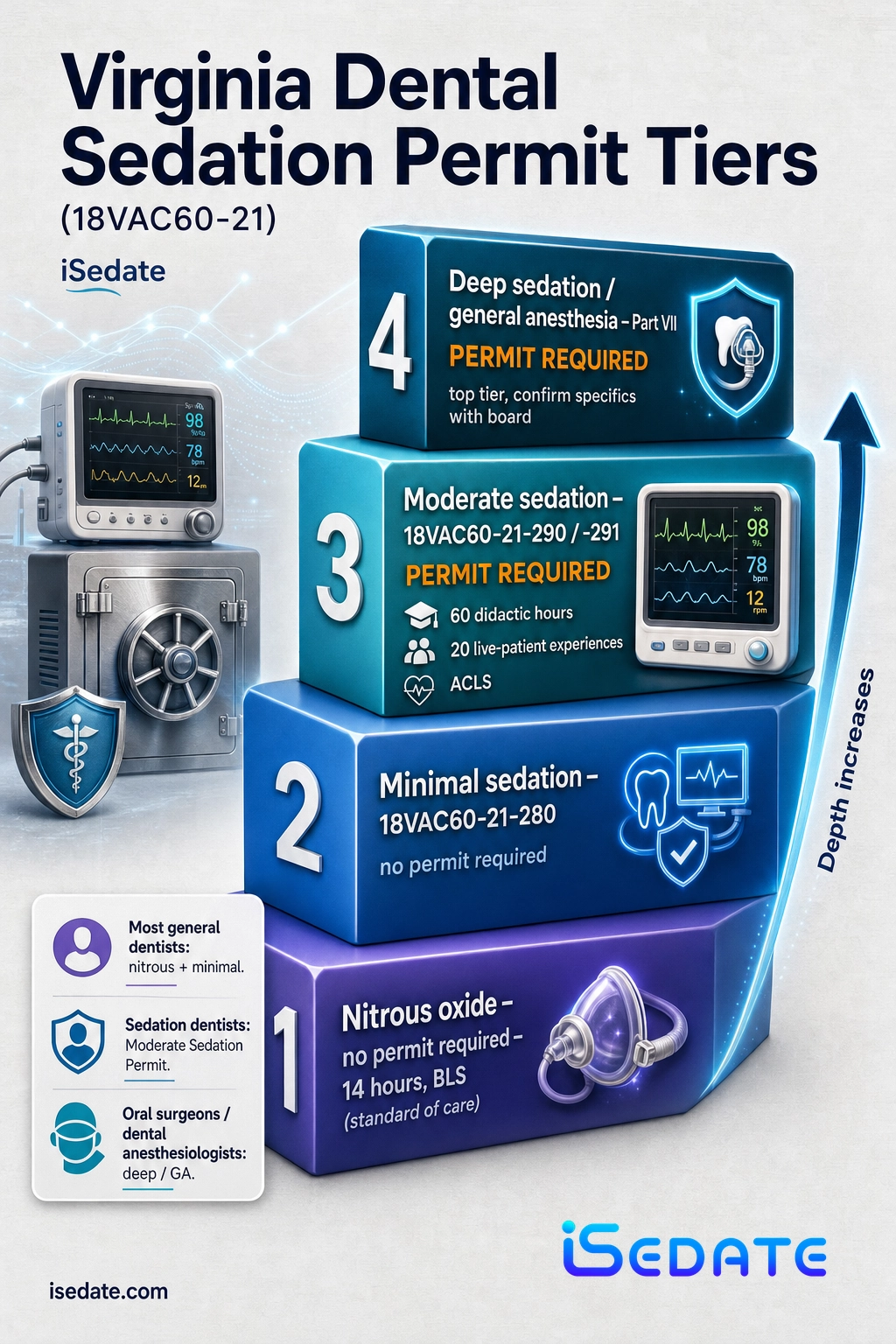
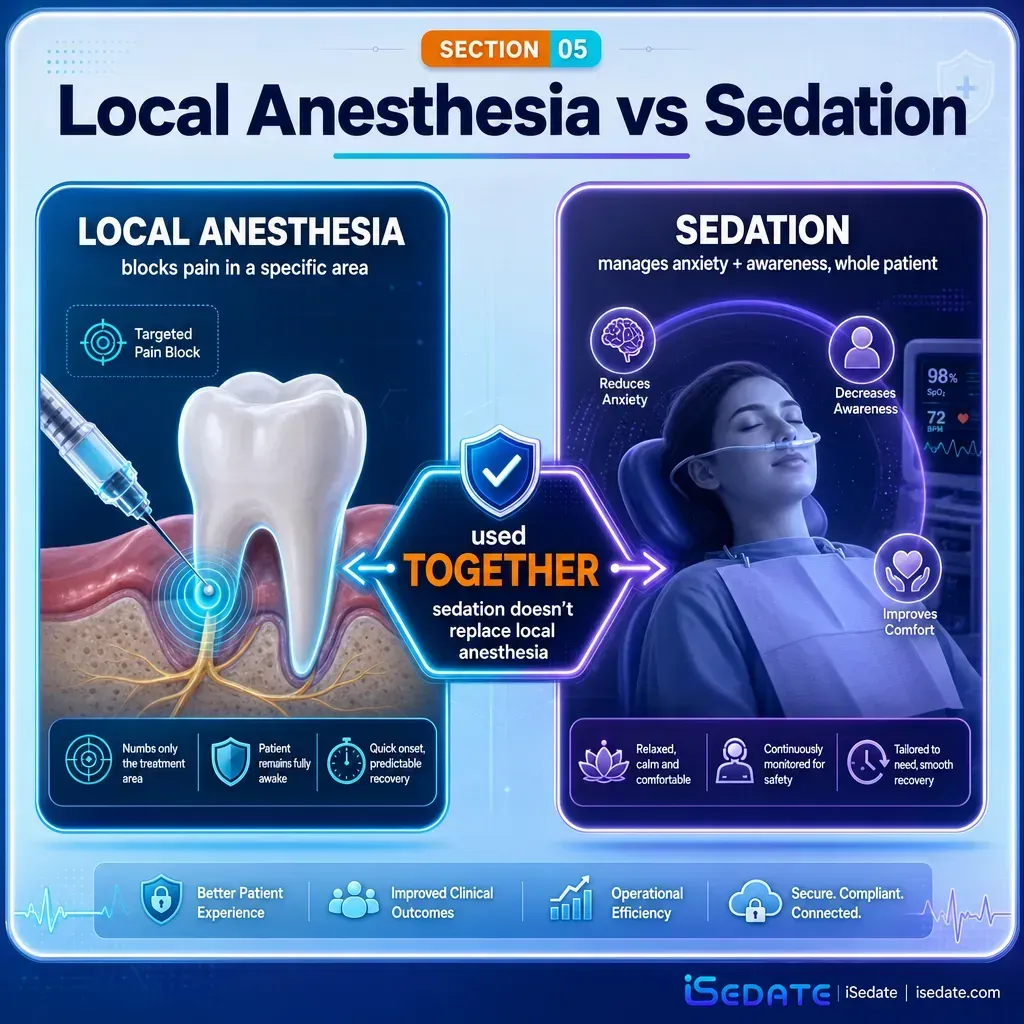
Nitrous oxide. The lightest form of anxiety control, where the patient stays fully responsive. Virginia requires no separate sedation permit for nitrous oxide, and the code does not fix a training-hour count for it, though a recognized certification course plus current basic life support is treated as the standard of care.
Minimal sedation (18VAC60-21-280). Minimal sedation (anxiolysis), where the patient responds normally to verbal command and airway and cardiovascular function are unaffected. No separate permit is required, but 18VAC60-21-280 requires the dentist to have training in and knowledge of the medications used and their dosages and complications, the physiological effects of minimal sedation, and the use and maintenance of the required equipment.
Moderate Sedation Permit (18VAC60-21-290 and -291). The workhorse permit for sedation dentists. A Moderate Sedation Permit is required to provide moderate sedation, commonly called Conscious Sedation, where the patient responds purposefully to verbal or tactile stimulation and maintains their own airway. The qualifications are set in 18VAC60-21-290 and the administration, monitoring, and discharge standard in 18VAC60-21-291. When moderate sedation is given parenterally or by titration, 18VAC60-21-291 adds a continuous ECG requirement on top of the standard monitoring.
Deep sedation/general anesthesia permit (18VAC60-21-300). The top tier, where the patient is not easily aroused or is unconscious and may need airway support. Deep sedation and general anesthesia require their own permit under 18VAC60-21-300, within Part VII. This level is largely the province of dental anesthesiologists and oral and maxillofacial surgeons, because the rule requires a minimum of one calendar year of advanced anesthesia training. If you are pursuing it, work directly from 18VAC60-21-300 with the board, as its specifics run beyond the scope of this guide.
In Plain Terms
Most general dentists operate at the top of the no-permit zone: nitrous oxide and minimal sedation. The Moderate Sedation Permit is the credential a general practice earns to offer real oral or IV conscious sedation, and it is where the board's inspection and record review bite hardest. Deep sedation and general anesthesia sit a full level above that, with a year of advanced anesthesia training behind them, and are largely out of scope for a general dentist. Match your permit to what you actually administer, and confirm the exact tier on your application with the board.
Source: 18VAC60-21-280 | 18VAC60-21-290 | 18VAC60-21-300
How to get or upgrade each permit
Each tier has its own bar to clear: a set of training, resuscitation certification, and, for moderate sedation, a count of managed patients and an office inspection. You move up the ladder by meeting the next level's requirements and applying to the board. The qualifications below are drawn from 18VAC60-21; where a figure is treated as a standard of care rather than fixed in the rule, this guide says so.
| Tier | Permit | Training / qualifications | Resuscitation |
|---|---|---|---|
| Nitrous oxide | No permit required | No state-mandated hours; a nitrous certification course is the standard of care | BLS (standard of care) |
| Minimal sedation (18VAC60-21-280) | No permit required | Training in and knowledge of the drugs, physiological effects, and equipment; no hour count fixed in the rule | Confirm with the board |
| Moderate sedation (18VAC60-21-290 / -291) | Moderate Sedation Permit | At least 60 didactic hours, management of at least 20 patients, office inspection before issuance | ACLS or PALS |
| Deep sedation / general anesthesia (18VAC60-21-300) | Deep sedation/general anesthesia permit | At least one calendar year of advanced anesthesia training (or a comparable accredited residency) | ACLS or PALS |
Nitrous oxide and minimal sedation
Neither nitrous oxide nor minimal sedation requires a separate sedation permit in Virginia. For nitrous oxide, the code fixes no hour count; practices typically complete a recognized nitrous oxide/oxygen analgesia certification course, commonly around 14 hours, and keep current BLS, treated as the standard of care. For minimal sedation, 18VAC60-21-280 does not set a permit or a specific hour count either, but it does require the dentist to have training in and knowledge of the drugs and dosages and their complications, the physiological effects of minimal sedation, and the use and maintenance of the required equipment. These are the most accessible tiers and the usual first step for a general practice adding light anxiety control.
The Moderate Sedation Permit
Stepping up to a Moderate Sedation Permit is the biggest move a general dentist makes in Virginia. Under 18VAC60-21-290, the qualifying course must include at least 60 hours of didactic instruction and the management of at least 20 patients per participant, and the dentist must hold current advanced resuscitation certification with hands-on simulated airway and megacode training, such as ACLS or PALS. On top of the training, no dentist may administer moderate sedation in a dental office until the office has been inspected and the board has issued the permit. The patient-management requirement is the heart of it, because safe titration demands hands-on competence a classroom cannot replicate.
Deep sedation and general anesthesia
At the top of the ladder, the deep sedation/general anesthesia permit requires a minimum of one calendar year of advanced training in anesthesia beyond dental school, or a completed accredited residency with a comparable year of full-time clinical anesthesia training, under 18VAC60-21-300, along with current ACLS or PALS. This is the permit dental anesthesiologists and oral surgeons carry, and it is largely out of scope for a general dentist.
The application process, forms, and fees
For a sedation permit, you apply through the Virginia Board of Dentistry and attach the credentials that prove you meet the standard for your level. Start from the board's own pages so you are working from the current forms rather than a provider's marketing sheet.
How to apply in Virginia
- Begin at the board's sedation permit application page, which carries the current moderate and deep sedation/general anesthesia application forms.
- Find every current form on the board's applications and forms page, and the governing rules on the laws and regulations page.
- Attach proof of your training hours, managed patients, and current resuscitation certification, and schedule the required office inspection for moderate sedation.
- Pay the fee set in 18VAC60-21-40; it is $100 to apply and $100 for each annual renewal.
The fee schedule in 18VAC60-21-40 also sets a $100 annual renewal, a $35 late fee, and a $150 reinstatement fee for each sedation permit. Fees and forms are set by board rule and change periodically, so confirm the current schedule on the board's pages before you file.
Source: Virginia Board of Dentistry sedation permit application | 18VAC60-21-40

What the permit requires you to monitor
A permit is permission plus obligation. Once you hold a Moderate Sedation Permit, 18VAC60-21-291 sets the monitoring standard across the whole case:
- Baseline: baseline vital signs, to include temperature and oxygen saturation, must be taken and recorded before any controlled drug is given.
- During: vital signs, to include oxygen saturation and end-tidal carbon dioxide, must be monitored continually and recorded, which is why a capnograph is part of the required equipment.
- Continuity: monitoring continues through the procedure and recovery, and the provider must remain on the premises until the patient is evaluated and discharged.
- ECG and reversal: an ECG monitor is required for parenteral or titrated sedation, and longer-than-usual monitoring is required after a pharmacological reversal agent.
Virginia also ties the equipment to the permit: under 18VAC60-21-260, monitoring equipment must be readily available and in good working order before treatment, and the level of sedation must be documented. For the full clinical breakdown of what to monitor and chart at each depth, see the companion guide on Virginia Sedation Vitals Monitoring, Charting & Reporting Requirements. For how Virginia compares with the rest of the country, the all-50-state hub is linked at the end of this guide.
Source: 18VAC60-21-291 | 18VAC60-21-260
Record and reporting obligations tied to your permit
Holding a permit also means holding a set of documentation duties, and these are exactly what a board review examines.
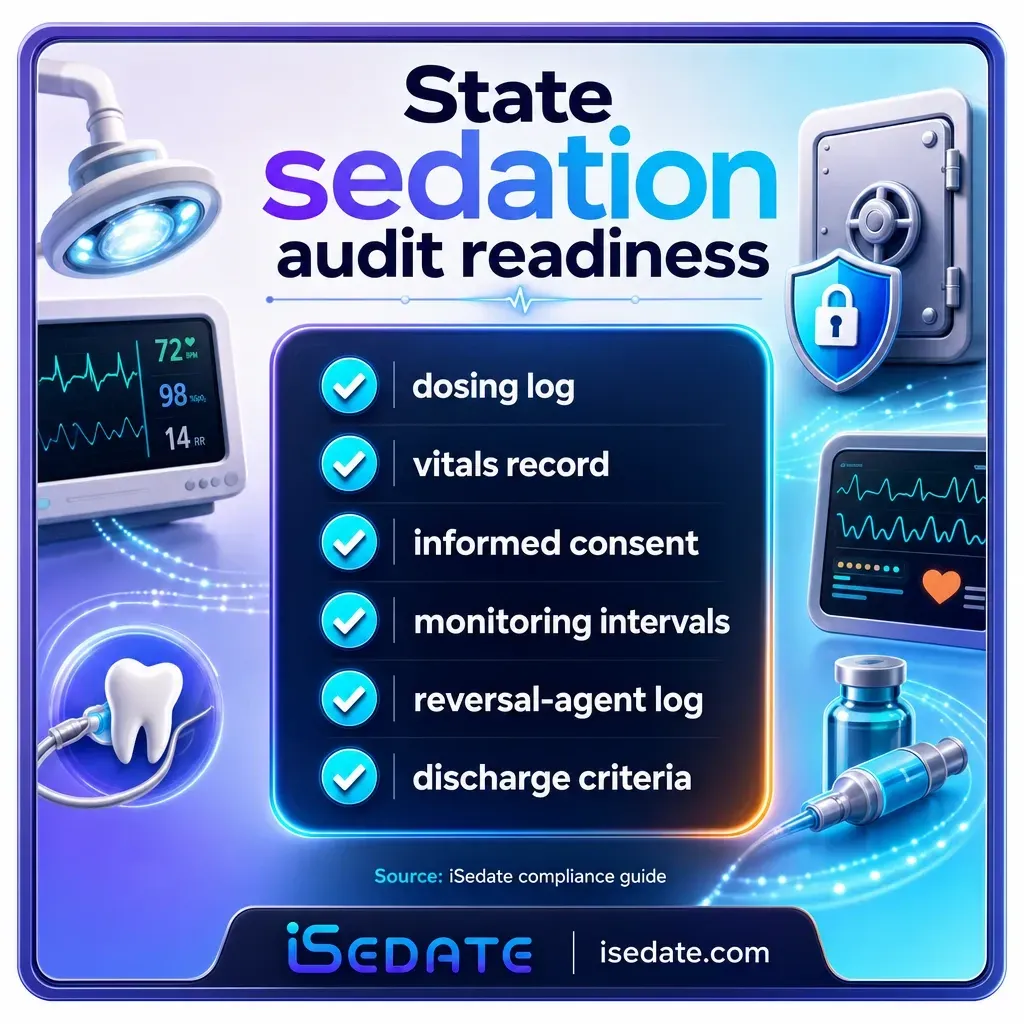
The itemized anesthetic record. Under 18VAC60-21-260 D, the record for moderate sedation, deep sedation, or general anesthesia must include the ASA classification, medical history with weight and height or BMI, written informed consent for both the sedation and the dental procedure, preoperative vital signs, the name, dose, and strength of each drug and its route with the time it was administered, all vital signs recorded continually, and every person participating in administration, treatment, and monitoring. Virginia is one of the states that spells this out in the code itself, rather than leaning on an adopted national guideline to supply the fields.
Discharge documentation. Under 18VAC60-21-291, before discharge the practitioner must find consciousness, oxygenation, ventilation, blood pressure, and heart rate satisfactory and confirm that vital signs have been taken and recorded, and postoperative instructions must be given verbally and in writing and documented in the chart.
Record retention and staff documentation. Under 18VAC60-21-90, the full patient record, including the list of drugs administered with the route, quantity, dose, and strength, must be kept not less than six years. Under 18VAC60-21-260, a dentist who uses ancillary personnel to assist in administration or monitoring must maintain documentation of those personnel's qualifications. The board's disciplinary authority backs all of it; confirm current adverse-event reporting triggers and the penalty schedule directly with the Virginia Board of Dentistry.
Source: 18VAC60-21-260 | 18VAC60-21-90
Continuing education and renewal
Your sedation permit is tied to your Virginia dental license, and both renew annually. Under 18VAC60-21-250, a dentist completes at least 15 hours of continuing education for each annual renewal. On top of that general requirement, a dentist who administers or monitors moderate sedation, deep sedation, or general anesthesia carries a sedation-specific obligation that is spelled out in the rule rather than left vague.
Those 4 hours every two years must be approved continuing education specific to administering and monitoring sedation and anesthesia, and they count toward your 15 annual hours rather than sitting on top of them. Keep current in ACLS or PALS at the moderate and deeper levels, and keep the certificates with your license file so your permit never lapses at renewal. The exact renewal date is set by board rule, so confirm your cycle on the board's laws and regulations resources.
Source: 18VAC60-21-250
Keeping the permit: audit-ready records
Everything above points to one truth: getting the permit is a one-time hurdle, but keeping it is a daily documentation discipline. A vitals and drug log kept by hand during a live case, between titrating a drug and watching an airway, is exactly where a continual-record rule springs holes, and incomplete records are what a board review and a malpractice claim both attack.
Why This Matters
A reviewer checks the record, not your intentions. Because Virginia itemizes the required record elements in 18VAC60-21-260 D, a reviewer has an exact checklist to measure you against: is each drug logged with its dose, strength, route, and time; are the vitals recorded continually from baseline through discharge; is there written consent for the sedation itself, not just the procedure. A dentist can run the sedation correctly and still lose on the paperwork. It is easy to assume Virginia asks for less than it does. It does not.
SedationVault removes that failure point. It captures live patient vitals and the drug log automatically into a time-oriented, Virginia-compliant anesthetic record, holding the continual-record standard that 18VAC60-21-260 D demands and capturing each drug's name, dose, strength, route, and time, so the record writes itself while you focus on the patient. When the board asks for the file, a complete record, retained well past the six-year minimum, is a one-click export rather than a scramble through paper. See how it maps to Virginia's rules on the dental sedation compliance and anesthesia record software pages.
Book a demo of SedationVault See SedationVault pricingFrequently asked questions
What sedation permits does Virginia require?
What does a Virginia moderate sedation permit require?
How much does a Virginia sedation permit cost?
How often do you renew a Virginia sedation permit?
Is the ADA a federal agency that regulates Virginia sedation?
Do you need a permit for nitrous oxide in Virginia?
What to Read Next
Licensed in a neighboring state, or comparing Virginia against the region? These same-silo guides break down the permit rules state by state:
- Kentucky Sedation Dentistry Licensing & Permit Requirements
- Maryland Sedation Dentistry Licensing & Permit Requirements
- North Carolina Sedation Dentistry Licensing & Permit Requirements
- Tennessee Sedation Dentistry Licensing & Permit Requirements
- West Virginia Sedation Dentistry Licensing & Permit Requirements
- Sedation Dentistry Licensing & Permit Requirements by State (all 50 states)
Sources
- Virginia Board of Dentistry: sedation permit application (moderate and deep sedation/general anesthesia application forms)
- Virginia Board of Dentistry: applications and forms
- Virginia Board of Dentistry: laws and regulations
- 18VAC60-21: Regulations Governing the Practice of Dentistry (patient records 18VAC60-21-90; fees 18VAC60-21-40; CE 18VAC60-21-250)
- 18VAC60-21, Part VII: Anesthesia and Sedation
- 18VAC60-21-280: Administration of minimal sedation
- 18VAC60-21-290: Requirements for a moderate sedation permit
- 18VAC60-21-291: Administration of moderate sedation
- 18VAC60-21-300: Requirements for a deep sedation/general anesthesia permit
- 18VAC60-21-260: Additional patient records for sedation and anesthesia
This guide summarizes Virginia sedation permit rules for general information and is not legal advice. The permit tiers, the moderate-sedation requirement of at least 60 didactic hours and management of at least 20 patients, the one-year advanced-training path for deep sedation and general anesthesia, the $100 fees, resuscitation certifications, monitoring duties, continuing education, and record elements are drawn from 18VAC60-21 as cited. Application forms, exact fee updates, the routine office-inspection schedule, the current moderate-sedation operatory team size, adverse-event reporting triggers, and the full penalty schedule are set by the Virginia Board of Dentistry and should be confirmed directly with the board before you act.