








Virginia Sedation Vitals Monitoring, Charting & Reporting Requirements
If you administer moderate sedation in Virginia, the law is unusually specific about what has to be written down. Virginia does not simply point at a professional guideline and leave the record to your judgment. It itemizes the anesthetic record in the administrative code itself: every drug with its dose, strength, and route, the time each was administered, all vital signs recorded continually, the ASA classification, consent, and the name and duties of every person in the room. That list lives in 18VAC60-21-260 D, it is enforced by the Virginia Board of Dentistry, and it is the first thing a record review examines. This guide breaks down what Virginia requires you to monitor and record at each sedation level, what a compliant record actually looks like on the page, and how to make it audit-ready instead of a liability.
Recent Updates
Last UpdatedNovember 16, 2026
- Re-verified every rule citation against the current official text of 18VAC60-21 on the Virginia Law Library (law.lis.virginia.gov).
- Replaced third-party legal-aggregator source links with Virginia's own official administrative code pages and the Virginia Board of Dentistry site.
- Added a sample time-oriented anesthetic record showing what a continually documented sedation chart looks like.
See full history of updates to this post
UpdatedOctober 2024
- Incorporated the current effective versions of 18VAC60-21-260 and 18VAC60-21-291 (both effective October 24, 2024) governing the sedation record and moderate sedation administration.
- The core rule: Virginia itemizes the sedation record in code at 18VAC60-21-260 D, requiring each drug's name, dose, strength, and route with the time it was administered, plus all vital signs recorded continually.
- What Virginia watches: under 18VAC60-21-291, baseline temperature and oxygen saturation before any controlled drug, then oxygen saturation and end-tidal carbon dioxide monitored continually, with an ECG added when sedation is parenteral or titrated.
- Continually, not occasionally: the record must reflect vital signs captured throughout the case, not a single start-and-stop reading. This is the standard most practices fall short on.
- Who enforces it: the Virginia Board of Dentistry, within the Department of Health Professions, under 18VAC60-21, Part VII.
- Keep it six years: under 18VAC60-21-90 the full patient record, including the itemized drug list and route, must be retained not less than six years from the last date of service.

What This Guide Covers
- Who regulates sedation in Virginia
- The Virginia sedation permit levels
- What you must monitor at each level
- What you must record: the compliance core
- What a compliant record looks like on the page
- How Virginia reviews records
- Why a thin record is the real exposure
- Penalties and adverse-event reporting
- The easy button: an audit-ready record
- Frequently asked questions
- Sources and citations
Who regulates sedation in Virginia
Sedation and anesthesia in a Virginia dental office are regulated by the Virginia Board of Dentistry, which sits within the Virginia Department of Health Professions and issues sedation permits, reviews records, and takes disciplinary action. The rules are not scattered across general dental law. They sit in one place: 18 Virginia Administrative Code, Agency 60, Chapter 21 (18VAC60-21), with the sedation and anesthesia provisions gathered in Part VII.
That distinction matters for compliance, because it means your recordkeeping obligation is a named administrative rule with an exact citation, not a vague standard of care. When a reviewer asks whether your sedation record meets the requirement, the answer is measured against the specific sections of 18VAC60-21 below. Moderate sedation, the level most sedation dentists are permitted for, is also commonly called Conscious Sedation, and the terms describe the same depth of drug-induced relaxation during which a patient can still respond to verbal command.
Setting the Record Straight
Myth: The ADA sets federal sedation law that overrides whatever the state says.
Fact: The American Dental Association publishes a national professional standard, not law. In Virginia, the binding authority is 18VAC60-21, enforced by the Virginia Board of Dentistry's laws and regulations.
Virginia does incorporate the 2016 ADA teaching guidelines by reference, so the clinical substance overlaps. But Virginia goes further than most states: it writes the record elements into the code itself at 18VAC60-21-260 D rather than leaning on the ADA document to define them. The real federal layers that do apply are separate: DEA controlled-substance logs, HIPAA, and CMS or accreditation standards where relevant.
For the clinical reasoning behind these requirements and a national comparison, see our hub guide on Dental Sedation Vitals, Charting & Reporting Requirements by State.
Source: Virginia Board of Dentistry (Department of Health Professions) | 18VAC60-21, Part VII
The Virginia sedation permit levels
Virginia uses its own permit structure, and which permit you hold tells you which monitoring and recordkeeping rules apply. The ladder is defined by the depth of sedation, not by the drug or route alone. These are the categories as Virginia law defines them:
| Virginia level | Permit | Governing citation |
|---|---|---|
| Nitrous oxide / oxygen | No permit required | 18VAC60-21, Part VII |
| Minimal sedation | No permit required | 18VAC60-21-280 |
| Moderate sedation (conscious sedation) | Moderate Sedation Permit required | 18VAC60-21-290 (qualifications) / -291 (administration) |
| Deep sedation / general anesthesia | Permit required | 18VAC60-21, Part VII (confirm exact permit name with the board) |
Nitrous oxide and minimal sedation do not require a separate sedation permit in Virginia, though minimal sedation is still governed by its own rule, 18VAC60-21-280. The moment a patient reaches moderate sedation, a Moderate Sedation Permit is required and the full administration standard in 18VAC60-21-291 applies. Deep sedation and general anesthesia sit higher in Part VII and carry stricter monitoring; the exact permit name and its specific rules are set within Part VII, so confirm those directly with the board. This guide focuses on the moderate sedation standard in 18VAC60-21-291 and the record elements in 18VAC60-21-260, because that is the level most sedation dentists are permitted for and the level whose record requirements are spelled out most explicitly. If you are working out which permit to apply for, the training hours, or how to upgrade, that belongs in a separate process, covered in our guide to Virginia Sedation Dentistry Licensing & Permit Requirements.
Source: 18VAC60-21-280 (minimal sedation) | 18VAC60-21-290 (moderate sedation qualifications)
What you must monitor at each level
In Virginia, what you are required to monitor is what you are required to write down. The code makes the two inseparable: 18VAC60-21-10 defines "monitoring" as observing, interpreting, assessing, and recording appropriate physiologic functions during sedation and anesthesia. Recording is not a separate step after monitoring. It is part of the monitoring duty itself. For moderate sedation under 18VAC60-21-291, the standard covers three phases:
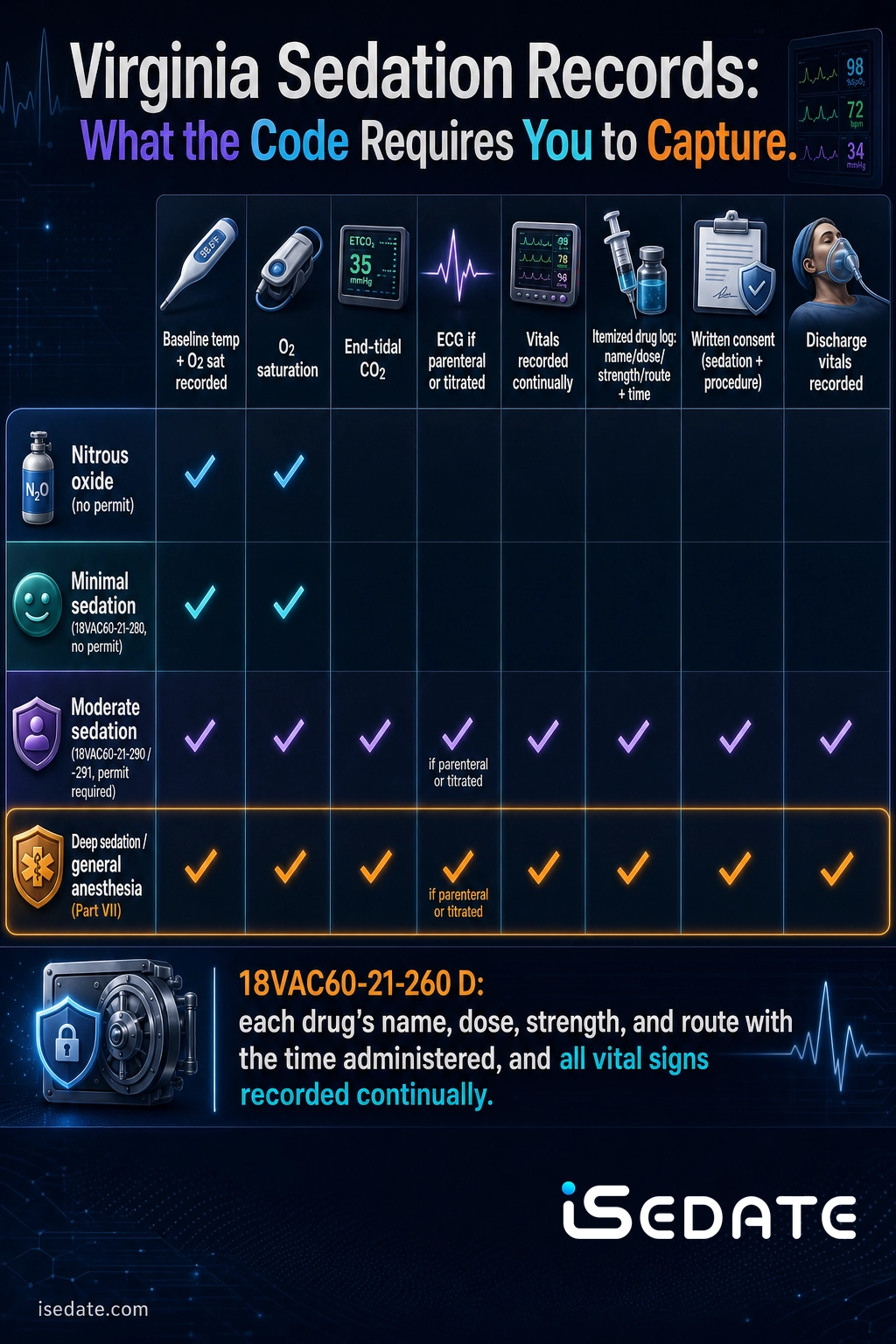
- Baseline: under 18VAC60-21-291 D.1, baseline vital signs, to include temperature and oxygen saturation, must be taken and recorded before any controlled drug is administered.
- During the procedure: under 18VAC60-21-291 D.2, vital signs, to include oxygen saturation and end-tidal carbon dioxide, must be monitored continually and recorded, unless precluded or invalidated by the nature of the patient, procedure, or equipment.
- Continuity: monitoring begins before sedation and continues through the procedure and recovery, and the provider must remain on the premises until the patient is evaluated and discharged.
Two equipment-driven rules sit on top of that. Under 18VAC60-21-291 B.11, an electrocardiographic (ECG) monitor is required when sedation is administered parenterally or when titration is used, which is the point at which the monitoring load increases most. And after a pharmacological reversal agent has been given, longer-than-usual monitoring is required, because a patient can re-sedate as the reversal wears off. The deeper and more invasive the route, the more parameters you are both watching and logging.
Myth, Busted
Myth: Nitrous or a single oral pill is light, so there is not much to chart.
Fact: The depth of sedation, not the route or the drug, drives the requirement. The moment a patient reaches moderate sedation, the full 18VAC60-21-291 monitoring standard and the itemized 18VAC60-21-260 D record both apply.
Sedation levels are defined by patient response, and patients can reach a deeper level than intended. Minimal sedation and nitrous carry the lightest obligations, but if a patient crosses into moderate sedation, the full standard applies no matter how the drug was delivered.
Source: 18VAC60-21-291 (monitoring) | 18VAC60-21-10 (definition of monitoring)
What you must record: the compliance core
This is the section a reviewer reads first. Virginia layers two rules. The general patient record lives in 18VAC60-21-90, and whenever moderate sedation, deep sedation, or general anesthesia is given, 18VAC60-21-260 D adds a specific, itemized sedation record on top of it.
1. The itemized sedation record in 18VAC60-21-260 D
Under 18VAC60-21-260 D, the patient record for moderate sedation, deep sedation, or general anesthesia must include seven elements: the ASA classification; the medical history with weight and height or BMI; written informed consent for both the sedation or anesthesia and the dental procedure; preoperative vital signs; the name, dose, and strength of each drug and its route of administration, including local anesthetics, with notations of the time sedation and anesthesia were administered; all required vital signs and physiological measures recorded continually; and each person participating in administration, treatment, and monitoring, by name, position, and assigned duties. A note that a patient "tolerated sedation well" is not this record. A timeline of drugs, doses, strengths, routes, times, continually recorded vitals, and the people in the room is.
2. Vitals recorded continually, not at intervals
Virginia does not set a fixed numeric interval the way some states do. It uses a stricter standard of practice: 18VAC60-21-260 D requires vital signs and physiological measures to be recorded continually, and 18VAC60-21-291 D.2 requires oxygen saturation and end-tidal carbon dioxide to be monitored continually and recorded. This is the standard that catches practices out. Monitoring continuously but only writing a reading at the start and end of the case does not satisfy a continual-record rule. The documentation itself has to track the case as it runs.
3. Discharge, post-op instructions, and six-year retention
Recovery has its own documentation duty. Under 18VAC60-21-291 E, before discharge the responsible practitioner must find the patient's consciousness, oxygenation, ventilation, blood pressure, and heart rate satisfactory and must confirm that vital signs have been taken and recorded. Postoperative instructions must be given verbally and in writing and documented in the patient's chart. Finally, under 18VAC60-21-90, the full patient record, which includes a list of drugs prescribed, administered, or dispensed with the route of administration, quantity, dose, and strength, must be retained not less than six years from the last date of service (for minors, until age 18 or emancipation, and at least six years).
What Virginia's Moderate Sedation Record Must Contain
- The patient's ASA classification
- Medical history with weight and height or BMI
- Written informed consent for both the sedation and the dental procedure
- Preoperative (baseline) vital signs, including temperature and oxygen saturation
- The name, dose, and strength of each drug and its route, including local anesthetics, with the time administered
- All required vital signs and physiological measures recorded continually
- Each person participating in administration, treatment, and monitoring, by name, position, and duties
- Retention of the full record for not less than six years (18VAC60-21-90)
Source: 18VAC60-21-260 | 18VAC60-21-291
See how a time-oriented anesthesia record is built automaticallyWhat a compliant record looks like on the page
Knowing the rule and passing a review are two different things, and the gap between them is almost always the continually recorded vitals log. Because Virginia requires the record to track the case continually rather than at a fixed interval, a compliant chart shows closely spaced, time-stamped readings from baseline through discharge, each line carrying the monitored parameters. The simplified example below shows that cadence: a baseline reading before any drug, frequent readings while the patient is sedated, and a discharge reading in recovery. (Values are illustrative only, not a real patient record.)
| Time / interval | BP | HR | SpO2 | EtCO2 | Drug / event |
|---|---|---|---|---|---|
| Baseline (pre-drug) | 126/80 | 74 | 99% | 38 | Temp 98.4; consent on file |
| 09:02 | 120/76 | 72 | 98% | 40 | Midazolam, dose/route logged |
| 09:06 | 118/74 | 70 | 98% | 41 | Monitoring continually |
| 09:10 | 116/74 | 69 | 98% | 40 | Procedure underway |
| Discharge (recovery) | 122/78 | 73 | 99% | 39 | Discharge criteria met; instructions given |
A real case runs longer and carries more readings, and the full drug log, the consent for both the sedation and the procedure, and the staff roster sit alongside this grid. But the shape is the point: a reviewer can look at a record like this and see, line by line, that the patient was monitored and that the monitoring was documented as the case ran. A record with a single pre-op reading and a single post-op reading, and nothing in between, fails a continual-record standard no matter how carefully the case was actually monitored.
iSedate Insight
The difference between a defensible chart and a vulnerable one is rarely clinical skill. It is whether the contemporaneous record proves, moment by moment, what was monitored. Virginia's itemized 18VAC60-21-260 D list cuts both ways: it tells you exactly what to capture, and it hands a reviewer an exact checklist to measure you against. The practices that pass reviews build the record as the case runs, not from memory afterward.
How Virginia reviews records
A sedation record in Virginia can be requested in two very different situations, and both turn on the same document. First, the board. The Virginia Board of Dentistry can review a permit holder's records, and 18VAC60-21-260 adds a standing operational duty: monitoring equipment must be readily available and in good working order prior to treatment, and the level of sedation must be documented. Dentists who use ancillary personnel to assist in administration or monitoring must also maintain documentation of those personnel's qualifications. Second, any complaint, adverse event, or malpractice claim puts the contemporaneous record in front of a reviewer who was not in the room.

Here is where dentists get burned. It is rarely the clinical care that fails a review. It is the record: a drug given but not logged with its time, a stretch of the case where vitals were watched but not continually recorded, a consent that covered the procedure but not the sedation, a discharge that was never documented. The exact inspection cadence and current review procedure are administered by the board and can change, so confirm the current process directly with the Virginia Board of Dentistry before relying on it.
Record each drug with its dose, strength, route, and time, and keep the vitals recorded continually from baseline through discharge. A reviewer does not grade your sedation on how the patient did. They grade it on whether the contemporaneous record proves what you did and when. If the itemized 18VAC60-21-260 D record has gaps, the default assumption on review is that the monitoring had gaps too.
Source: 18VAC60-21-260 | Virginia Board of Dentistry
Why a thin record is the real exposure
An incomplete sedation record is not a filing technicality. It is the evidence a board weighs when deciding whether the standard of care was met, and the same gaps that fail a record review are the gaps a plaintiff's attorney looks for in a malpractice claim. In both a board review and a lawsuit, the contemporaneous sedation record is the first thing requested and the hardest thing to reconstruct after the fact. When the chart does not prove continuous monitoring, the provider is left arguing memory against a document, and the document wins.
The data behind why these rules exist, and what a documentation failure actually costs when a case goes sideways, lives in our research roundups:
The Data Behind the Rule
Penalties and adverse-event reporting
18VAC60-21 is backed by the disciplinary authority of the Virginia Board of Dentistry and the Department of Health Professions. Incomplete sedation records are not a filing technicality. They are the evidence a board weighs when deciding whether the standard of care was met, and the same gaps that fail a record review are the gaps a plaintiff's attorney looks for in a malpractice claim.
The exact disciplinary schedule, any routine office-inspection cadence for permit holders, the precise penalty amounts, and the specific adverse-event reporting triggers and timelines are administered by the board and can change, so confirm current details directly with the Virginia Board of Dentistry's laws and regulations rather than relying on a figure that may be out of date. What does not change is the exposure created by a thin record: in both a board review and a lawsuit, the contemporaneous sedation record is the first thing requested and the hardest thing to reconstruct after the fact.
Source: 18VAC60-21, Part VII | Virginia Board of Dentistry laws and regulations
The easy button: an audit-ready record
The gap between knowing the rule and passing a review is almost always the same thing: a continually updated vitals and drug log kept by hand during a live sedation case. When a team is managing an airway and an anxious patient, a record that is supposed to track the case continually is exactly where holes develop, a missing time on a drug, a stretch of recovery with no readings, a dose logged later from memory.
That is the problem SedationVault by iSedate was built to remove. It connects wirelessly to the vitals monitor already in your operatory and captures oxygen saturation, end-tidal carbon dioxide, heart rate, and blood pressure live, on the clock, alongside the drug log, so the time-oriented anesthetic record writes itself as the case runs rather than being reconstructed afterward. When the Virginia Board of Dentistry or a reviewer asks for the chart, it exports as a one-click, audit-ready sedation visit report that already carries the baseline vitals, the drug names, doses, strengths, routes and times, the continually recorded vitals, and the discharge assessment the rule asks for. The point is not fancier charting. It is turning the exact items 18VAC60-21-260 D requires into something the software guarantees are present and time-stamped, which is also what dental sedation compliance turns on.
Book a demo and see your Virginia sedation record build itselfFrequently asked questions
Does Virginia require a written sedation record?
How often must vitals be recorded during sedation in Virginia?
What vital signs must Virginia dentists monitor during moderate sedation?
Who reviews sedation records in Virginia?
Does Virginia require a discharge note after sedation?
Related guides and neighboring states
Licensed in more than one state, or practicing near the Virginia line? Documentation rules vary by state, so confirm the requirements where you provide sedation. See our same-silo guides for neighboring states:
- Kentucky Sedation Vitals Monitoring, Charting & Reporting Requirements
- Maryland Sedation Vitals Monitoring, Charting & Reporting Requirements
- North Carolina Sedation Vitals Monitoring, Charting & Reporting Requirements
- Tennessee Sedation Vitals Monitoring, Charting & Reporting Requirements
- West Virginia Sedation Vitals Monitoring, Charting & Reporting Requirements
- All 50 states: Dental Sedation Vitals, Charting & Reporting Requirements by State
Sources and citations
This guide cites Virginia's primary regulatory sources directly. Rule text is drawn from 18 Virginia Administrative Code, Agency 60, Chapter 21 (18VAC60-21) as published by the Virginia Law Library (law.lis.virginia.gov), and the regulator is the Virginia Board of Dentistry within the Department of Health Professions. The current effective versions of 18VAC60-21-260 and 18VAC60-21-291 (both effective October 24, 2024) were re-verified against the official text. Where a detail, such as the current penalty schedule, inspection cadence, board contact information, the exact deep sedation or general anesthesia permit name, permit fees, or reporting timelines, is administered by the board and subject to change, confirm it directly with the Virginia Board of Dentistry before relying on it. This guide is general information, not legal advice.
- Virginia Board of Dentistry (Department of Health Professions)
- Virginia Board of Dentistry: Laws & Regulations
- 18VAC60-21, Part VII: Anesthesia and Sedation
- 18VAC60-21-90: Patient information and records (six-year retention)
- 18VAC60-21-260: Additional requirements for patient records for sedation and anesthesia
- 18VAC60-21-291: Requirements for administration of moderate sedation (monitoring and discharge)
- 18VAC60-21-290: Moderate sedation qualifications
- 18VAC60-21-280: Minimal sedation
- 18VAC60-21-10: Definitions (including "monitoring")















