







North Carolina Sedation Vitals Monitoring, Charting & Reporting Requirements
If you administer sedation in North Carolina, the record is where compliance is won or lost. State rule requires that a patient's baseline vital signs be taken and recorded, that the moderate Conscious Sedation record capture blood pressure, oxygen saturation, and end-tidal carbon dioxide, and that a dedicated staff member monitor and chart those vitals through recovery. For pediatric moderate sedation, the rule goes further and names an exact interval: pulse and respiration recorded in real time every 15 minutes. All of it lives in 21 NCAC Chapter 16, Subchapter 16Q, it is enforced by the North Carolina State Board of Dental Examiners, and it is the first thing a reviewer examines. This guide breaks down what North Carolina requires you to monitor and record at each level, shows what a compliant record actually looks like, and explains how to make yours review-ready.
Recent Updates
Last UpdatedNovember 16, 2026
- Re-verified every rule citation against 21 NCAC Subchapter 16Q and confirmed the recordkeeping sections (.0302 and .0405) were not amended in the Board's December 1, 2025 rulemaking cycle.
- Replaced third-party citations with the North Carolina governing statute and the Board's own anesthesia and adopted-rules pages.
- Added a section on what compliant documentation looks like (oral vs. IV, required equipment, and a sample charting cadence) and a sourced breakdown of what a records gap costs in a malpractice claim.
- The core rule: under 21 NCAC 16Q .0302(5), the moderate Conscious Sedation record must capture baseline vital signs, blood pressure, oxygen saturation, and end-tidal carbon dioxide where capnography is used, with a dedicated monitor through recovery.
- Baseline vitals are mandatory: 21 NCAC 16Q .0103(4) requires temperature, SPO2, blood pressure, and pulse to be taken and recorded before sedation.
- Pediatric has an exact interval: 21 NCAC 16Q .0405(A) requires pulse and respiration rates recorded in real time at 15-minute intervals for moderate pediatric conscious sedation.
- Who enforces it: the North Carolina State Board of Dental Examiners, through Subchapter 16Q, with site inspections as part of permitting.
- Retention: pediatric sedation records are kept at least 10 years (.0405), and mobile sedation inspection records 10 years (.0304).

What This North Carolina Charting Guide Covers
- Who regulates sedation in North Carolina
- North Carolina's sedation permit levels
- What you must monitor at each level
- What the sedation record must contain
- What compliant documentation looks like
- Record retention and the dedicated monitor
- How North Carolina reviews sedation records
- Why a complete record matters: the malpractice math
- Penalties and the currency of the rules
- The easy button: a review-ready record
- Licensed in a neighboring state?
- Frequently asked questions
- Sources and citations
Who regulates sedation in North Carolina
Sedation and anesthesia in a North Carolina dental office are regulated by the North Carolina State Board of Dental Examiners, the state agency that issues sedation permits, inspects offices, and takes disciplinary action. Its authority comes from a specific statute, North Carolina General Statute 90-30.1, which lets the Board set a permit process and standards for general anesthesia and enteral and parenteral sedation by dentists. The detailed rules then live in one place: 21 NCAC Chapter 16, Subchapter 16Q, titled "Sedation and Anesthesia," published on the Board's own anesthesia and sedation permit page.
That matters for compliance because your recordkeeping obligation is a named administrative rule with an exact citation, not a vague standard of care. When a reviewer asks whether your sedation record meets the requirement, the answer is measured against the specific sections of Subchapter 16Q below. It is also worth being precise about what the American Dental Association is here. The ADA publishes national sedation guidelines that most boards lean on, and its 2025 update tightened the documentation expectation toward a time-oriented record of drugs and vitals. But the ADA is a private professional association, not a federal agency, and its guidelines are a professional standard, not law. The federal layers that do apply are different ones: the DEA for controlled-substance logs and HIPAA for records privacy. In North Carolina, the law that governs your sedation chart is Subchapter 16Q, and the body that enforces it is the North Carolina State Board of Dental Examiners. For the clinical "what and why" behind these rules across every state, see our hub, Dental Sedation Vitals, Charting & Reporting Requirements by State.
Source: N.C. General Statute 90-30.1 | N.C. State Board of Dental Examiners anesthesia page
North Carolina's sedation permit levels
North Carolina structures its permits by depth of sedation, and the recordkeeping obligations escalate with each level. North Carolina is also one of the states that treats pediatric moderate sedation as its own category, with its own rule. Knowing which permit you hold tells you which monitoring and charting rules apply.
| North Carolina permit | What it covers | Rule |
|---|---|---|
| Minimal Sedation | Minimal sedation (anxiolysis); credentialing recodified | 21 NCAC 16Q .0504 |
| Moderate Conscious Sedation (adult) | Moderate conscious sedation, records and monitoring | 21 NCAC 16Q .0301, .0302 |
| Moderate Pediatric Conscious Sedation | Moderate conscious sedation of pediatric patients | 21 NCAC 16Q .0405 |
| General Anesthesia / Deep Sedation | Deep sedation or general anesthesia (the top tier) | 21 NCAC 16Q (higher tier) |
A single-dose anxiolysis prescription using a minor psychosedative, with or without nitrous oxide, does not require a sedation permit in North Carolina. Once a patient reaches moderate Conscious Sedation, the full monitoring and recordkeeping standard in .0302 applies, and the separate pediatric rule, .0405, adds its own real-time interval requirement. This guide focuses on the moderate conscious sedation record, because that is the level most sedation dentists are permitted for and the one whose record requirements are spelled out most explicitly. If you are working out which permit to apply for or how to upgrade, that belongs in a separate process, covered in our guide to North Carolina Sedation Dentistry Licensing & Permit Requirements.
Source: N.C. State Board of Dental Examiners anesthesia page
What you must monitor at each level
In North Carolina, what you are required to monitor is what you are required to write down. The starting point applies to every sedation case. Under 21 NCAC 16Q .0103(4), the permit holder must ensure the patient's baseline vital signs are taken and recorded, including temperature, SPO2, blood pressure, and pulse. That baseline is the anchor the rest of the record is measured against.
For moderate Conscious Sedation, the monitoring load increases and a dedicated staff member is assigned to it. The parameters the rule names are:
- Baseline vital signs: temperature, SPO2, blood pressure, and pulse, taken and recorded before sedation begins (.0103(4)).
- Blood pressure: documented in the sedation record, unless the patient's behavior prevents recording (.0302(5)).
- Oxygenation: oxygen saturation captured in the sedation record (.0302(5)).
- Ventilation: end-tidal carbon dioxide recorded where capnography is utilized (.0302(5)).
- Pulse and respiration (pediatric): for moderate pediatric conscious sedation, pulse and respiration rates recorded in real time at 15-minute intervals (.0405(A)).
A dedicated monitor sits on top of that. Under 21 NCAC 16Q .0302(a)(6)(A), moderate conscious sedation requires at least two BLS-certified auxiliaries, with one of them dedicated to monitoring the patient and recording sedation data throughout the procedure. The Board has confirmed that reading in a published interpretive statement on sedation auxiliaries. The deeper the sedation, the more parameters you are both watching and logging, and the clearer the rule is that a specific person owns the record.
Myth, Busted
Myth: A single oral pill is light, so I do not really need to chart it closely.
Fact: The depth of sedation, not the route or the drug, drives the requirement. The moment a patient reaches moderate Conscious Sedation, the full .0302 monitoring and recording standard applies no matter how the drug was delivered, and a dedicated auxiliary must be assigned to record the data. See the Board's anesthesia and sedation requirements.
Oral sedation is the route that most often drifts deeper than intended. A patient you dosed for anxiolysis can reach moderate sedation, and the obligation follows the patient's actual depth, not your plan for it.
Source: N.C. State Board of Dental Examiners anesthesia page | N.C. Board interpretive statement on sedation auxiliaries
What the sedation record must contain
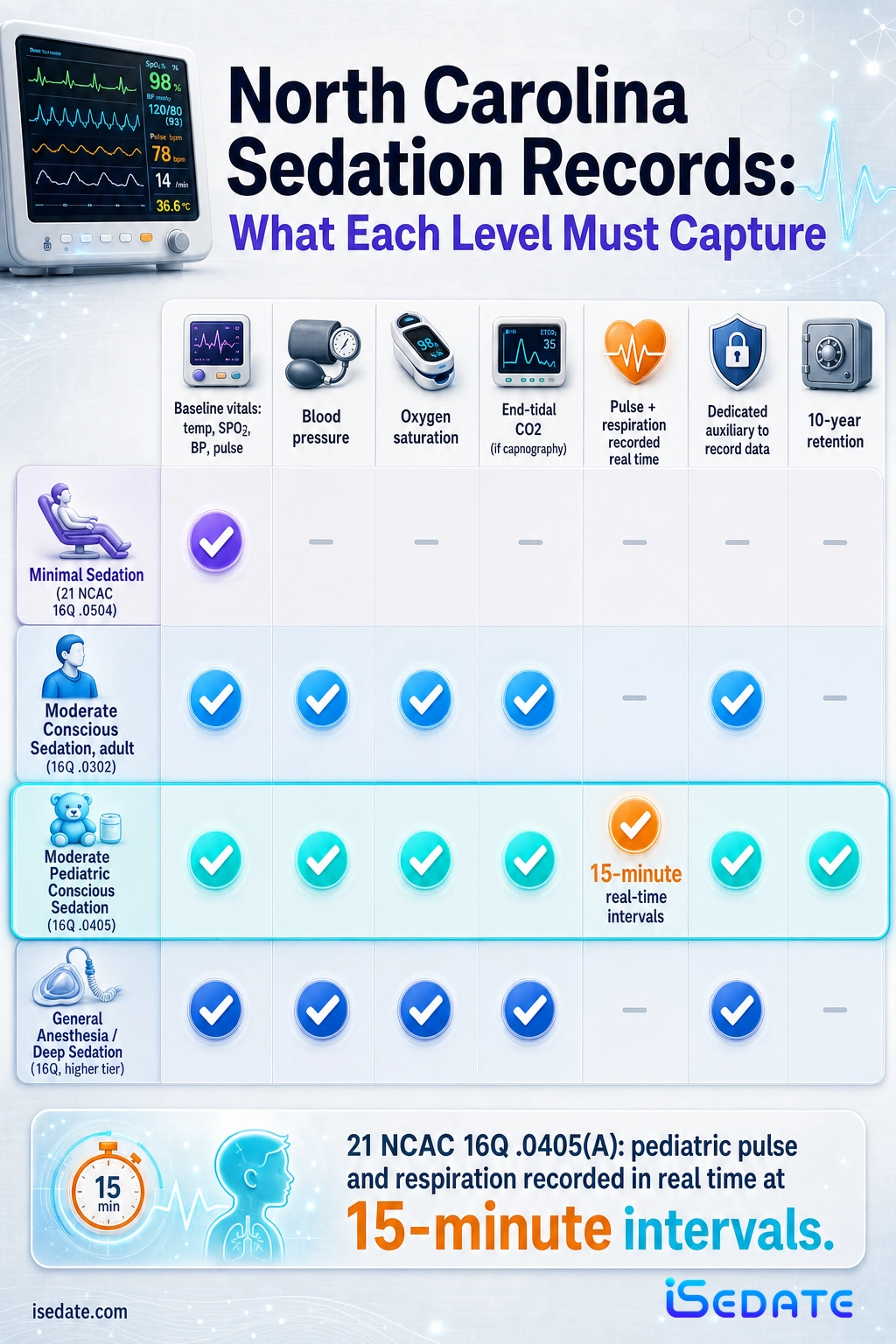
This is the section a reviewer reads first. For moderate Conscious Sedation, 21 NCAC 16Q .0302(5) spells out what the sedation record must contain, and the pediatric rule at .0405(A) adds the explicit interval. The infographic below maps how the requirements stack up as the sedation deepens.
1. Baseline vital signs, taken and recorded
Under 21 NCAC 16Q .0103(4), the permit holder must ensure the patient's baseline vital signs are taken and recorded, including temperature, SPO2, blood pressure, and pulse. This is not a formality. The baseline is the reference point a reviewer uses to judge every later reading, and a record that begins without it starts with a gap.
2. The sedation record: blood pressure, oxygen saturation, and ETCO2
Under 21 NCAC 16Q .0302(5), the moderate conscious sedation record must include baseline vital signs, blood pressure (unless patient behavior prevents recording), oxygen saturation, and end-tidal carbon dioxide where capnography is utilized. A note that a patient "tolerated sedation well" is not this record. A documented set of vitals, captured as the case runs and carried through recovery, is.
3. Pediatric: pulse and respiration every 15 minutes
North Carolina is explicit about interval timing in one place: the pediatric rule. Under 21 NCAC 16Q .0405(A), for moderate pediatric conscious sedation the record must include baseline vital signs, blood pressure, oxygen saturation, ETCO2 where capnography is used, and pulse and respiration rates recorded in real time at 15-minute intervals. That real-time, 15-minute cadence is the pediatric standard, and it is the kind of interval that catches practices out when the reading is taken but not written down on time.
The adult moderate conscious sedation rule, .0302(5), names the record contents and requires continuous monitoring through recovery by the dedicated auxiliary, but the rule text does not state a single numeric interval the way the pediatric rule does. Because board rules are the authority on this detail and can be updated, confirm the exact adult documentation interval directly with the North Carolina State Board of Dental Examiners rather than assuming the pediatric figure applies to adults.
Source: N.C. State Board of Dental Examiners anesthesia page
What compliant documentation looks like
Knowing the rule is one thing. Producing a record that satisfies it on a live case is another. Here is what a reviewer wants to see on the page, how it differs by route, and the equipment the record implies.
The sedation record, line by line
A compliant moderate Conscious Sedation record in North Carolina is a single, contemporaneous document, not a scatter of notes. At minimum it carries:
What a Review-Ready Sedation Record Contains
- Pre-sedation baseline: temperature, SPO2, blood pressure, and pulse, timestamped before the first dose (.0103(4)).
- The drug log: each agent, dose, route, and the exact time it was given.
- Intra-operative vitals: blood pressure, oxygen saturation, and, where capnography is used, end-tidal carbon dioxide, charted on a running timeline through the case and into recovery (.0302(5)).
- Pediatric interval readings: pulse and respiration entered in real time every 15 minutes for moderate pediatric conscious sedation (.0405(A)).
- The dedicated monitor: the identity of the assigned BLS-certified auxiliary who recorded the data (.0302(a)(6)(A)).
- Consent and discharge: the informed-consent record and a documented discharge assessment showing the patient met recovery criteria before release.
Oral vs. IV: same record, different cadence of reality
The documentation standard keys off depth, not route, so an oral and an IV case at the same depth owe the same record. The practical difference is onset and control. An IV case titrates in minutes and lets you capture a tight, predictable timeline. An oral case has a slower, less predictable onset, which is exactly why a patient dosed for light sedation can drift into moderate Conscious Sedation and why the record has to reflect the depth the patient actually reached. If the chart shows oral dosing but the vitals pattern reads as moderate sedation, the record, not the plan, is what the Board evaluates.
The equipment the record assumes
You cannot chart oxygen saturation and end-tidal carbon dioxide without the monitors that produce them. North Carolina's equipment and personnel requirements sit in 21 NCAC 16Q .0103, and the recordkeeping rule presumes a pulse oximeter, a blood-pressure monitor, and, where capnography is used, an end-tidal CO2 monitor are in the room and feeding the record. Confirm the full required equipment list for your permit level with the Board, because the monitoring parameters in the record are only as good as the devices capturing them.
iSedate Charting Advice
Chart the reading at the moment it is taken, not from memory at the end of the case. The single most common documentation failure on a sedation chart is a value that was watched on the monitor but written down late or not at all. A reviewer cannot tell a missed reading from an unrecorded one, and both read as a gap in monitoring.
Source: N.C. State Board of Dental Examiners anesthesia page

Record retention and the dedicated monitor
Two obligations wrap around the record itself in North Carolina, and both are easy to overlook until a review.
Keep the record for a decade. Moderate pediatric conscious sedation records must be kept for at least 10 years under 21 NCAC 16Q .0405. For practices that provide mobile dental sedation, 21 NCAC 16Q .0304 requires inspection and compliance records to be retained for 10 years and provided to the board on request. A 10-year horizon means the record has to survive staff turnover, software changes, and a move between systems, which is exactly where paper and ad hoc files get lost.
Name the person who charts. Under 21 NCAC 16Q .0302(a)(6)(A), moderate conscious sedation requires at least two BLS-certified auxiliaries, one of whom is dedicated to monitoring the patient and recording sedation data throughout the procedure. The point for the record is simple: North Carolina does not treat charting as a background task. It requires a named person whose job during the case is to watch and write.
Source: N.C. State Board of Dental Examiners anesthesia page | N.C. Board interpretive statement on sedation auxiliaries
How North Carolina reviews sedation records
Record reviews in North Carolina run through the Board and its inspection regime. Site inspections are part of 16Q permitting, and for mobile sedation the compliance and inspection records must be retained for 10 years and furnished to the Board on request under .0304. Holding a moderate or deeper sedation permit comes with a standing expectation that your sedation records are reviewable, and the Board's inspection teams grade an office as pass or fail on compliance.
What a Reviewer Actually Grades
A reviewer does not grade your sedation on how the patient did. They grade it on whether the contemporaneous record proves what you did and when. If the baseline vitals are missing, an interval has a gap, or the pediatric 15-minute readings are not on the page in real time, the default assumption on review is that the monitoring had gaps too. Record the baseline, assign the dedicated monitor, and keep the readings landing on time.
It is rarely the clinical care that fails a review. It is the record: a missing baseline, a blood pressure never charted without a documented reason, a pediatric interval that stretched past 15 minutes, an oxygen-saturation value that was watched but never written. The care can be flawless and the record can still fail.
Source: N.C. State Board of Dental Examiners anesthesia page
Why a complete record matters: the malpractice math
A sedation chart is not only a board document. It is the first exhibit in a malpractice claim, and the national data on documentation is blunt about how much the record drives outcomes. These figures are not North Carolina rules; they are the reason the rules exist.
Across all dental claims where procedural sedation was administered, the average total incurred was $248,821 over that same 2020 to 2024 period, and a sedation-related injury or death pushes that average to $437,116. When a claim turns on whether monitoring was adequate, the contemporaneous sedation record is the evidence, and a missing baseline or a late pediatric interval is the gap a plaintiff's attorney builds the case around. The research roundups below unpack the pattern in depth:
The Data Behind the Rules
Source: CNA / Dentist's Advantage Dental Professional Liability Claim Report (2025) | CRICO/Candello, For the Record (2024)
Penalties and the currency of the rules
Subchapter 16Q is backed by the Board's disciplinary authority over permits, and incomplete sedation records are not a filing technicality. They are the evidence a board weighs when deciding whether the standard of care was met, and the same gaps that fail a review are the gaps a plaintiff's attorney looks for in a malpractice claim. Noncompliance found on inspection can lead to suspension or revocation of the permit or the dentist's license.
The specific current penalty schedule is set by the Board and can change, so confirm current disciplinary and penalty details directly with the North Carolina State Board of Dental Examiners rather than relying on a figure that may be out of date. On currency: the recordkeeping sections .0302 and .0405 were not amended in the Board's December 2025 rulemaking cycle, which adopted a new update course (.0105) and amended the credentials rule (.0301). The recordkeeping text cited here remains current, but because the Board revises Subchapter 16Q periodically, check the Board's adopted rules published through the N.C. Office of Administrative Hearings for the latest version before you rely on a detail.
Source: N.C. Board adopted rules via N.C. OAH (published 40:03 NCR 311, eff. Dec. 1, 2025)
The easy button: a review-ready record
The gap between knowing the rule and passing a review is almost always the same thing: a timed vitals log kept by hand during a live sedation case. When a team is managing an airway and an anxious patient, a baseline that gets skipped, a blood pressure logged late, or a pediatric reading that lands two minutes past the 15-minute mark is exactly where the record develops holes, and a 10-year retention requirement means that hole can resurface years later.
That is the problem SedationVault by iSedate was built to remove. It connects to the vitals monitor already in your operatory and captures oxygen saturation, blood pressure, pulse, respiration, and end-tidal carbon dioxide live, on the clock, alongside the drug log, so the sedation record .0302(5) describes writes itself as the case runs rather than being reconstructed afterward, and the pediatric 15-minute interval is captured in real time by design. When the Board asks for the chart, it exports as a one-click, review-ready sedation visit report that already carries the baseline vitals, the readings, the dedicated-monitor data, and the discharge assessment the rule asks for, ready to retain for the full 10 years. The point is not fancier charting. It is turning the exact items Subchapter 16Q requires into something the software guarantees are present and time-stamped, which is also what dental sedation compliance turns on.
Book a demo and see your North Carolina sedation record build itselfLicensed in a neighboring state?
Sedation recordkeeping rules are set state by state, and a provider licensed across a border works to a different code. If you practice in or near North Carolina, our same-silo guides cover the charting and reporting requirements next door:
- Georgia Sedation Vitals Monitoring, Charting & Reporting Requirements
- South Carolina Sedation Vitals Monitoring, Charting & Reporting Requirements
- Tennessee Sedation Vitals Monitoring, Charting & Reporting Requirements
- Virginia Sedation Vitals Monitoring, Charting & Reporting Requirements
- The all-50-state sedation charting and reporting hub
Frequently asked questions
Does North Carolina require a written sedation record?
How often must sedation vitals be recorded in North Carolina?
How long must North Carolina dental sedation records be kept?
Who reviews sedation records in North Carolina?
What vital signs must a North Carolina sedation record include?
Sources and citations
Our Sourcing & Fact-Checking Process
This guide cites North Carolina's primary regulatory sources. The governing statute is N.C. General Statute 90-30.1, the detailed rules are 21 NCAC Chapter 16, Subchapter 16Q as published by the North Carolina State Board of Dental Examiners, and the currency check is against the Board's adopted rules published through the North Carolina Office of Administrative Hearings. The malpractice figures come from the CNA and Dentist's Advantage dental closed-claims report and the CRICO/Candello documentation study. Where a detail (the current penalty schedule, the exact adult documentation interval, board phone, or application fees) is administered by the Board and subject to change, confirm it directly with the North Carolina State Board of Dental Examiners before relying on it. This article is general information, not legal advice.
- N.C. General Statute 90-30.1: Standards for general anesthesia and enteral and parenteral sedation
- North Carolina State Board of Dental Examiners: Anesthesia and Sedation (21 NCAC Subchapter 16Q)
- N.C. State Board of Dental Examiners: Interpretive Statement on Sedation Auxiliaries
- N.C. Board adopted rules via N.C. Office of Administrative Hearings (published 40:03 NCR 311, eff. Dec. 1, 2025)
- CNA / Dentist's Advantage: Dental Professional Liability Claim Report (2025, claims 2020–2024)
- CRICO/Candello: For the Record (2024)















