







Medical Records Documentation Error Statistics (2026): Charting Errors, Patient Safety & Defensibility
About one in five malpractice cases involves a documentation failure, and those failures more than double the odds of a payout. The clinical record is not just where care is described, it is where care is defended. When documentation is missing, inaccurate, or sloppy, patients are harmed and providers are exposed, and for high-stakes procedures like sedation, the record is often the entire defense.
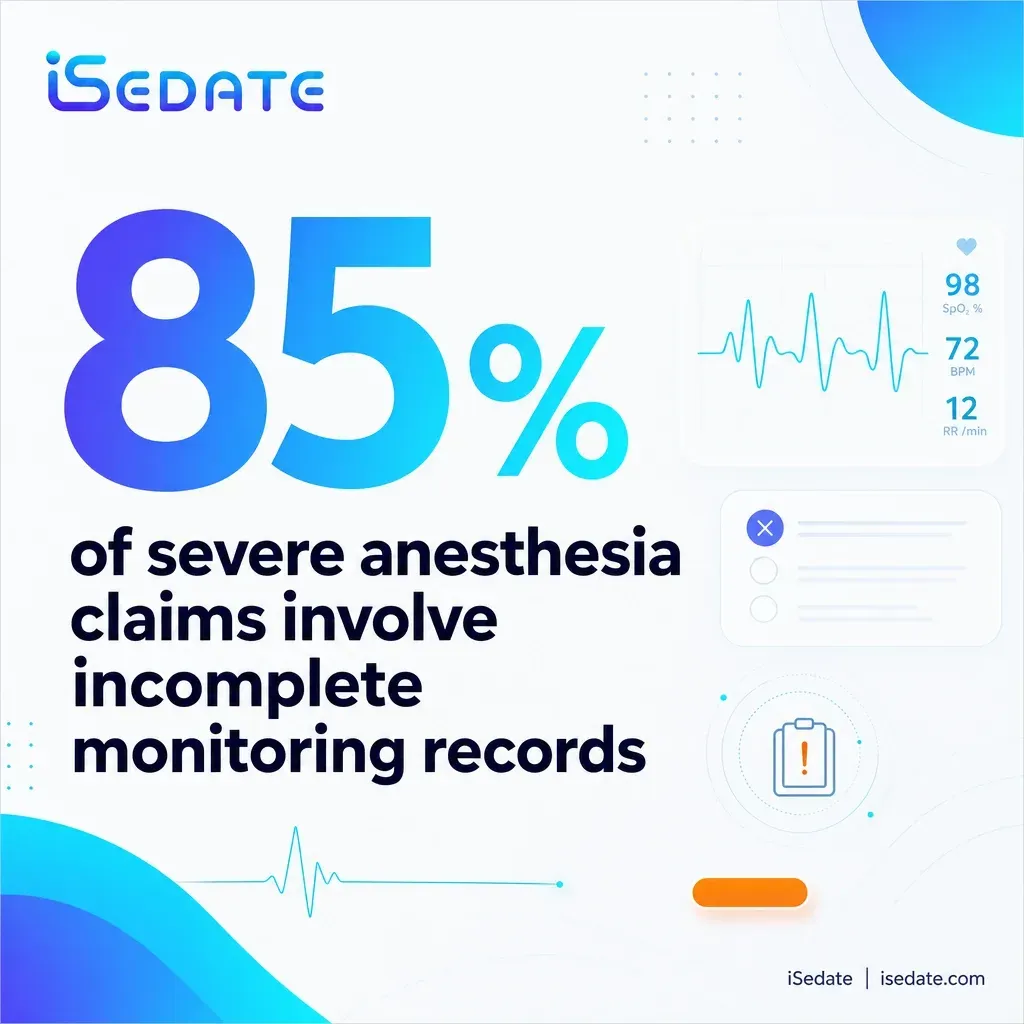
- About 20% of medical malpractice cases involve at least one documentation failure, per a Candello analysis of 65,000+ closed cases (Candello / CRICO, 2024).
- Documentation issues more than double the odds that a malpractice case closes with an indemnity payment (Candello / CRICO, 2024).
- Peer-reviewed research puts documentation issues in 10 to 20% of malpractice lawsuits (West J Emerg Med, 2022).
- Among documentation-related cases, the most common problems are missing documentation (~70%), inaccurate content (~22%), and poor mechanics (~18%) (West J Emerg Med, 2022).
- Speech-recognition transcription has been found to introduce error rates above 7% in clinical documents (published study).
- Up to a third of US discharge summaries are deficient in vital patient information, risking care continuity (peer-reviewed literature).
- Structured, complete sedation records reduce the errors that cause the most harm, the core of iSedate's SedationVault.
What's in This Guide
1 How Common Documentation Errors Are
The scale of the documentation problem is best captured by the largest malpractice databases, which see the consequences of charting failures play out in court.
The Candello report, drawn from a database holding roughly one-third of all US medical malpractice claims, analyzed more than 65,000 cases closed between 2014 and 2023 and found documentation failures in about one in five. Independent peer-reviewed work using a separate legal database reached a consistent range of 10 to 20%. The convergence of two very different data sources on the same range is significant: documentation failure is not a rare edge case but a routine feature of malpractice litigation. And notably, researchers emphasize that despite this frequency, physicians receive very little education or feedback on their documentation, a gap between how much documentation matters and how little attention it gets.
Source: Candello / CRICO For the Record report | West J Emerg Med charting practices study
See structured anesthesia records2 The Defensibility Multiplier
The most consequential finding in the documentation research is not how often errors occur, but how much they change the outcome when they do.
This is the statistic every provider should sit with. Inconsistent entries or missing clinical rationales were associated with more than doubled odds of a case closing with a payout. The mechanism is straightforward: when a case goes to court, a plaintiff's attorney does not only look for a medical error, they look for documentation gaps, because a gap is where a defense falls apart. A clinically sound decision that is poorly documented can look, in hindsight and in front of a jury, like negligence. The record is the evidence that the right thing was done, and without it, being right may not be enough.
iSedate Analysis: The record decides the case as often as the care does
The doubling of payout odds reframes documentation from an administrative chore into a core risk-management activity. Two providers can deliver identical, appropriate care; the one whose record is complete and consistent is substantially more defensible than the one whose record has gaps, even though the care was the same. This means documentation quality is, in effect, a second axis of malpractice risk running parallel to clinical quality. For procedures where adverse events are more likely to be scrutinized, sedation among them, investing in the record is investing directly in defensibility. The provable trail is the defense.
Calculation and interpretation original to iSedate.
Source: Sermo on documentation and defensibility
See defensible sedation documentation3 The Most Common Error Types
Not all documentation failures are the same. Knowing which types dominate points directly to what a record system should prevent.
| Error Type | Share of Documentation Cases | Examples |
|---|---|---|
| Missing documentation | ~70% | Omitted findings, absent entries, no rationale recorded |
| Inaccurate content | ~22% | Wrong values, contradictory entries, copy-paste errors |
| Poor mechanics | ~18% | Illegible entries, transcription errors, delayed entries |

In documentation-related malpractice cases, missing documentation is by far the largest category at around 70%, meaning the single most common failure is simply that something important was never recorded. Inaccurate content accounts for roughly 22%, and poor mechanics, illegible entries, errors in transcribed orders, and delays in charting, for about 18% (categories overlap, so shares exceed 100%). This distribution is instructive: the dominant problem is omission, not error. A system that ensures required fields are captured, so that nothing important can simply be left blank, addresses the largest slice of documentation risk directly.
The biggest documentation risk is the blank space, not the wrong entry. Because missing documentation dwarfs the other categories, the highest-leverage improvement is not better handwriting or more careful typing, it is structure that prevents omission. When a record format prompts for each required element, vitals at each interval, medications and doses, times, assessments, the most common failure mode, "it was never charted," becomes much harder to commit. Free-text notes leave room for gaps; structured capture closes them.
Source: West J Emerg Med documentation case analysis
See structured sedation records4 Transcription & Technology Errors
Technology was supposed to eliminate documentation errors. In some ways it has helped, but it has also introduced new error modes of its own.
Speech-recognition software can reduce the documentation burden, but one study found an error rate above 7% in the clinical documents it generated, and researchers have flagged potentially significant error rates in software-transcribed records. Electronic health records have introduced their own failure modes as well, including copy-paste propagation of outdated information and templated notes that read as generic. The lesson is not that technology fails, but that automation without structure and verification can move errors around rather than remove them. The systems that reduce documentation error are those that capture data directly and in a structured form at the point of care, rather than reconstructing it later through transcription.
iSedate Analysis: Capture beats transcription
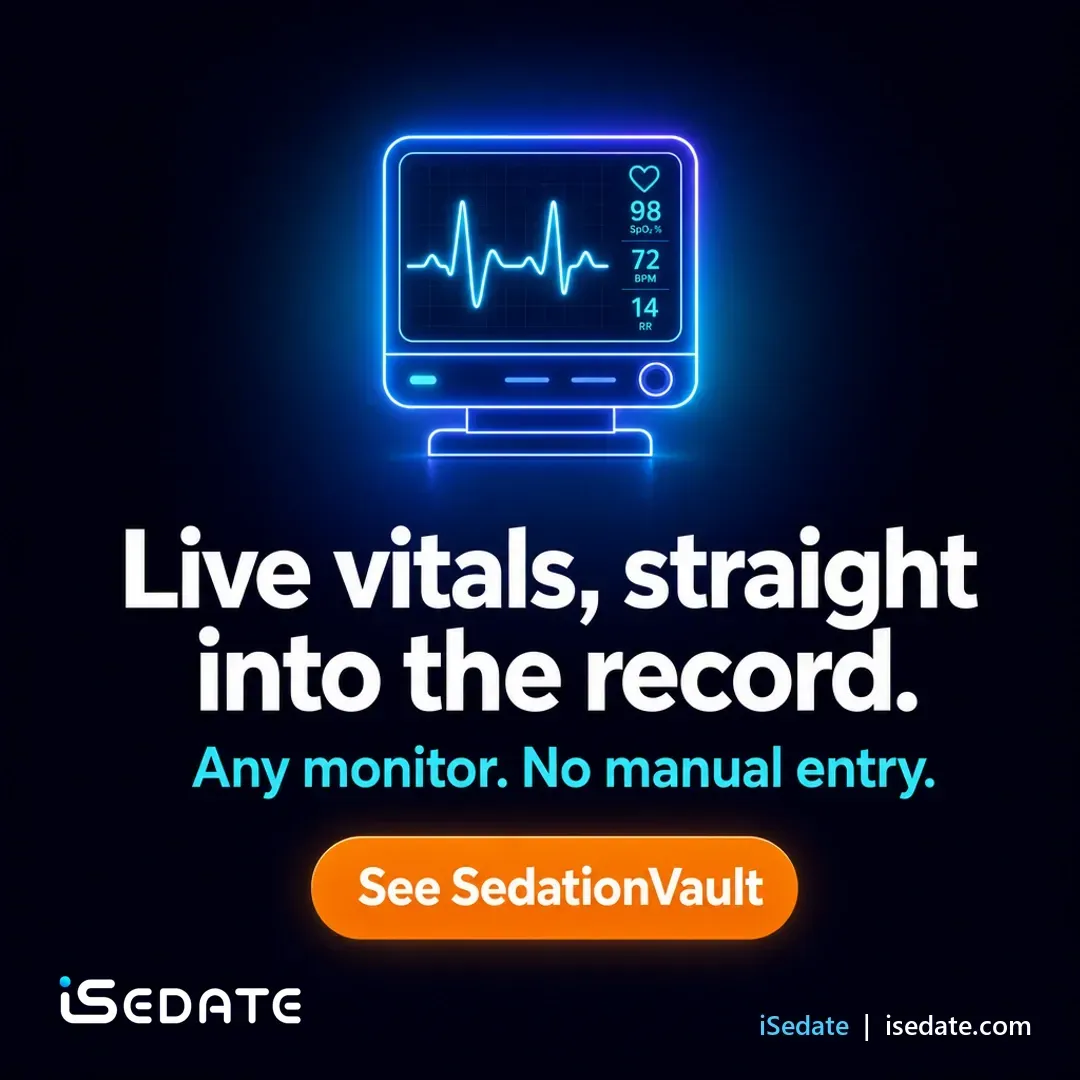
The transcription-error data points to a clear design principle: the most reliable record is one where the data never has to be re-entered or dictated. Every transcription step, whether a human typing from notes or software converting speech, is an opportunity for error. When a value is captured directly at its source, a vital sign read straight from the monitor rather than eyeballed and typed, the transcription error class is eliminated at that point. For sedation, where vitals change minute to minute and accuracy is safety-critical, direct capture is both more accurate and more defensible than after-the-fact charting from memory.
Calculation and interpretation original to iSedate.
Source: Analysis of speech-recognition documentation errors
See iSedate's SedationVault5 The Patient-Safety Cost
Documentation errors are not only a legal problem. Before they ever reach a courtroom, they harm patients, because care depends on the record being right.
Medical records guide clinical decisions, document history, and ensure continuity between providers, so when they are incomplete or inaccurate, the results can be serious. Studies have found up to a third of US discharge summaries deficient in vital information, with even higher figures reported elsewhere, and such gaps are linked to higher rehospitalization risk, medication errors, and increased morbidity. Missing histories, omitted lab results, and unclear entries all break the chain of information the next clinician relies on. Communication and documentation failures are consistently among the most frequently cited contributing factors in serious patient-safety events, including incomplete records and failures to convey critical patient details at handoff.
Source: Discharge documentation quality study | Analysis of 2024 sentinel-event contributing factors
See continuous sedation records6 Why Sedation Records Are High-Stakes
Every point in this article intensifies when the procedure is sedation. The sedation record is one of the highest-stakes documents a dental or oral surgery practice produces.
Sedation care generates exactly the kind of time-sensitive, detail-dense record where documentation errors are most consequential: vital signs at frequent intervals, medications and precise doses with times, the patient's response, and the recovery course. An omission here, a missing vitals reading during a critical window, an undocumented dose, is both a patient-safety risk in the moment and a defensibility gap later. And because adverse sedation events attract intense scrutiny from boards and malpractice carriers, the sedation record is precisely the document a plaintiff's attorney will examine line by line for the gaps that, per the data, more than double payout odds.
iSedate Analysis: Designing out the most common errors for sedation
The documentation-error data amounts to a design brief for a sedation record system: prevent omission (the ~70% category) with structured, prompted capture; eliminate transcription error by pulling vitals directly from the monitor; and produce a complete, timestamped, retrievable record that defends the provider if care is ever questioned. iSedate's SedationVault is built around exactly this: it captures vitals automatically from compatible monitors such as Edan, MindRay, and Criticare rather than relying on manual transcription, structures the sedation record so required elements are prompted rather than left blank, stores it in HIPAA-compliant cloud storage with access controls and audit trails, and exports a clean, complete PDF into whatever chart the practice already keeps, whether Dentrix, Eaglesoft, or Open Dental. It targets the specific error types the data says cause the most harm. Reference figures for the founders' own practice reflect thousands of documented sedation procedures, a practice-level dataset, not a nationwide claim.
Calculation and interpretation original to iSedate.
Treated this way, the sedation record stops being a liability waiting to happen and becomes what good documentation should be: a complete account that protects the patient in the moment and the provider afterward. For the compliance framework that surrounds these records, see the companion report on healthcare audit and compliance; for the consent that opens the record, see the digital consent report.
Book a SedationVault demo7 Summary Table: Every Statistic at a Glance
| Statistic / Fact | Figure | Source | Year |
|---|---|---|---|
| Malpractice cases involving documentation failure | ~20% | Candello / CRICO | 2024 |
| Malpractice cases analyzed | 65,000+ | Candello / CRICO | 2024 |
| Peer-reviewed documentation-issue range | 10-20% | West J Emerg Med | 2022 |
| Effect on odds of indemnity payment | More than doubled | Candello / CRICO | 2024 |
| Missing documentation (share of cases) | ~70% | West J Emerg Med | 2022 |
| Inaccurate content (share of cases) | ~22% | West J Emerg Med | 2022 |
| Poor mechanics (share of cases) | ~18% | West J Emerg Med | 2022 |
| Speech-recognition clinical error rate | 7%+ | Clinical documentation study | 2023 |
| US discharge summaries deficient | Up to 33% | Peer-reviewed literature | 2024 |
| European discharge summaries deficient | Up to 40% | Peer-reviewed literature | 2024 |
| Physician education on documentation | Very little | West J Emerg Med | 2022 |
| Candello share of US malpractice claims | ~one-third | Candello / CRICO | 2024 |
| Admin time spent searching records | 30-40% | Record-review analysis | 2023 |
| Documentation timing standard | During or ASAP after service | Medicare Claims Processing Manual | 2024 |
Frequently Asked Questions
How common are documentation errors in malpractice cases?
Do documentation errors affect malpractice outcomes?
What are the most common types of documentation errors?
How do documentation errors harm patients?
How does good documentation protect a sedation provider?
Methodology & Sources
Primary and peer-reviewed sources: the Candello / CRICO benchmarking report "For the Record" (analysis of more than 65,000 malpractice cases, 2014 to 2023) and peer-reviewed research in the Western Journal of Emergency Medicine (documentation-related malpractice case analysis, error-type distribution) and discharge-documentation quality literature. Supporting analysis: published studies on speech-recognition documentation error rates, medico-legal analyses of documentation and defensibility, and 2024 sentinel-event contributing-factor data.
Note on scope and interpretation: this article addresses the accuracy and completeness of the clinical record itself, distinct from HIPAA privacy, breach, and compliance-program topics covered in companion reports in this series. Error-type shares are drawn from documentation-related malpractice cases and overlap (a single case may involve more than one type), so shares can exceed 100%. Much of the strongest data comes from general medical and emergency-medicine malpractice settings; it is applied to the sedation context by analogy and labeled as iSedate interpretation where relevant. This is general information, not legal or clinical advice. Statistics reflect the most recent available data as of 2026.
Media & press usage: Journalists and researchers are welcome to cite these statistics with attribution to iSedate and a link to this page. The iSedate Analysis boxes contain original interpretation unique to this article.