










Sedation Documentation & Malpractice Statistics 2026: How Charting Affects Case Outcomes
In a sedation malpractice case, the record often matters as much as the care. Closed-claims data from the largest malpractice databases in the country shows that documentation failures appear in about one in five cases and more than double the odds of paying out. For sedation providers, whose every case generates a detailed anesthesia record, the quality of that chart can decide whether a defensible case is successfully defended.
Key Takeaways
- About 20% of malpractice cases involve at least one documentation failure (CRICO/Candello, 65,000+ closed claims).
- Documentation issues more than double the odds a case closes with an indemnity payment.
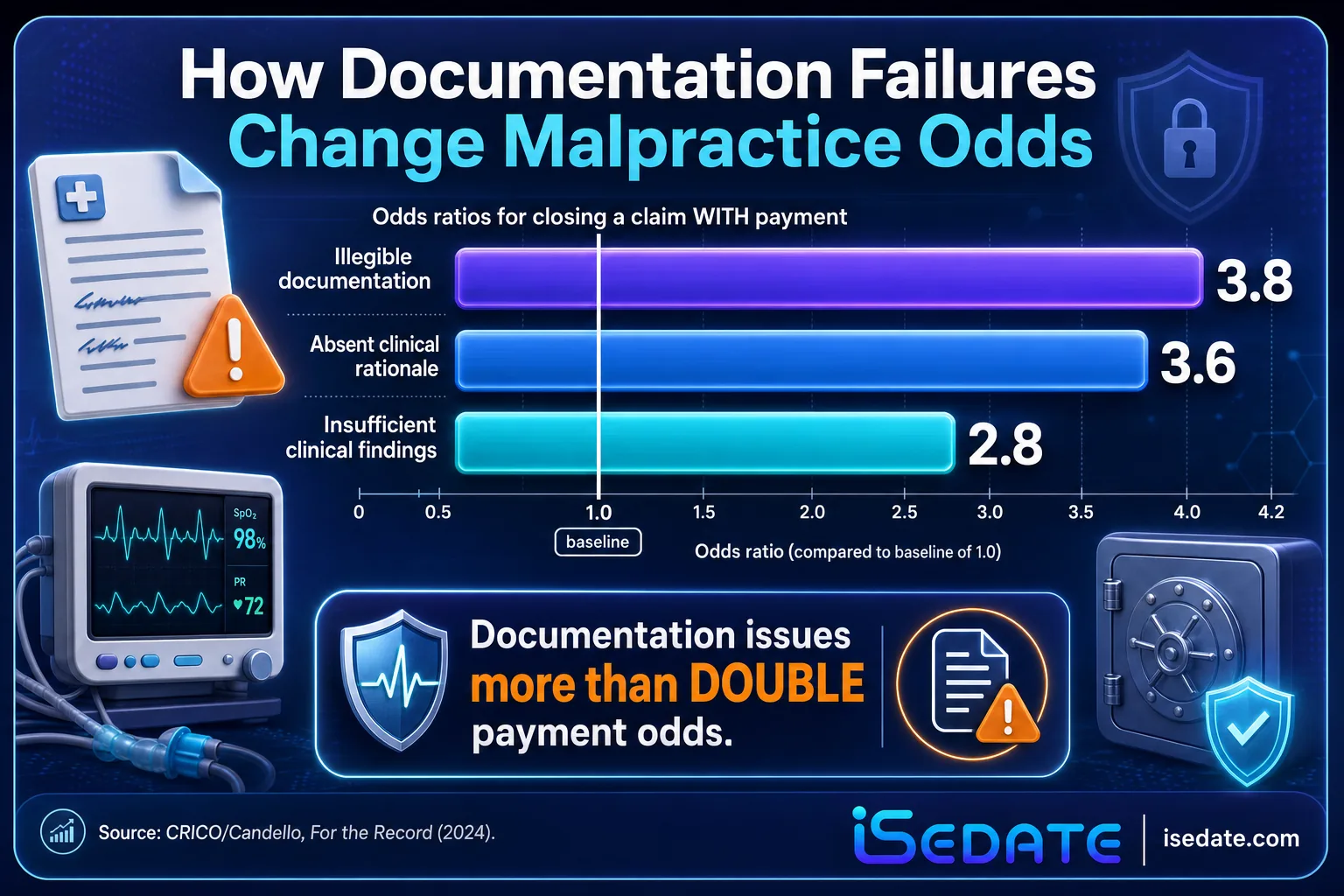
- High-risk documentation problems by odds ratio: illegible records 3.8, absent clinical rationale 3.6, insufficient clinical findings 2.8.
- Documentation-related malpractice cases most often involve missing documentation (70%), inaccurate content (22%), or poor mechanics (18%).
- The anesthesia record is central to determining the standard of care; expert witnesses rely on it to reconstruct events.
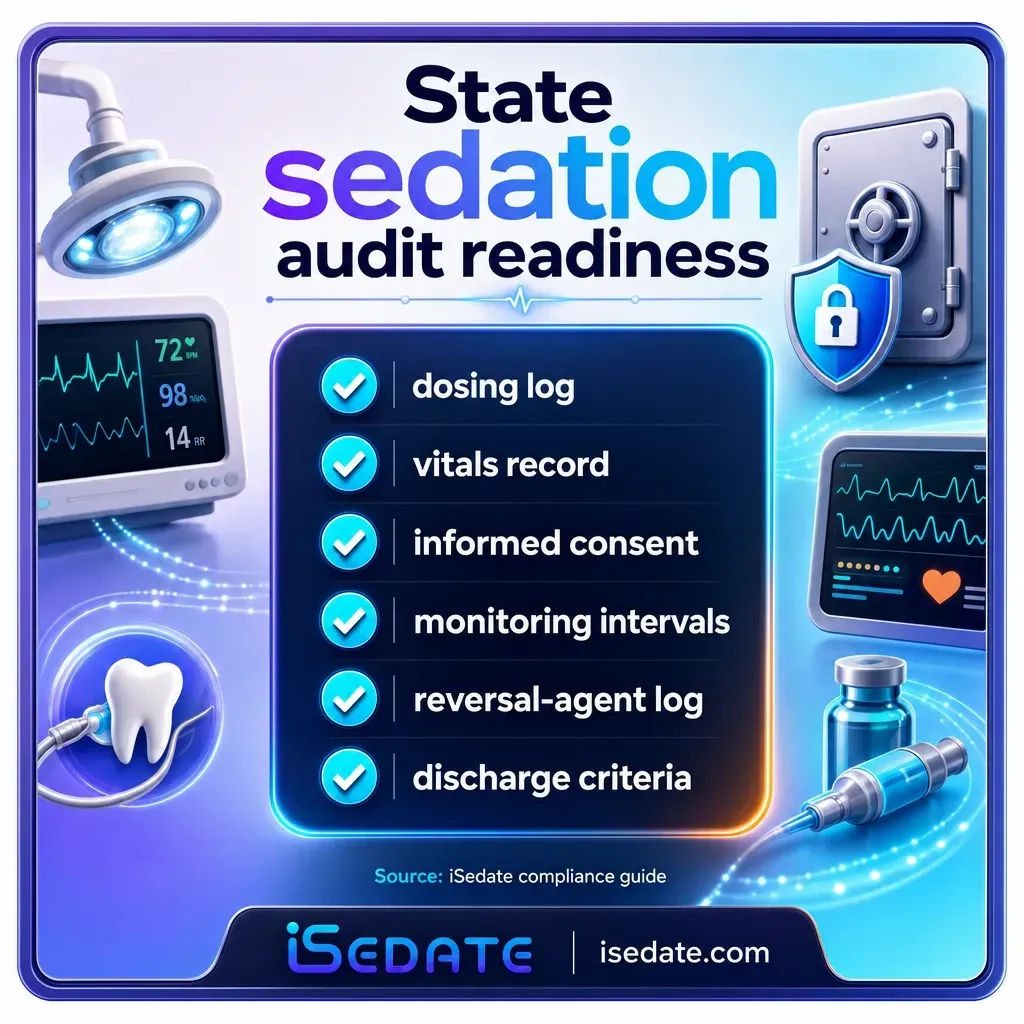
- ADA and AAPD guidance require vitals recorded at defined intervals (often every 5 to 15 minutes) plus drugs, doses, times, and discharge criteria.
- Plaintiff attorneys often decide whether to take a case based largely on documentation quality.
What's in This Guide
- How Often Documentation Fails in Claims
- How Documentation Changes Case Outcomes
- The Types of Documentation Failure
- The Record as the Standard of Care
- What a Defensible Sedation Record Requires
- Documentation as Claim Deterrence
- An iSedate Analysis: The Documentation Multiplier
- Frequently Asked Questions
How Often Documentation Fails in Claims
The starting point is prevalence: how frequently do documentation problems show up when malpractice claims are analyzed at scale? The answer, drawn from the two largest closed-claims datasets in the United States, is remarkably consistent.
The most authoritative figure comes from CRICO's Candello division, whose data collaborative contains roughly one-third of all medical malpractice claims in the United States. In its benchmarking report "For the Record: The Effect of Documentation on Defensibility and Patient Safety," Candello analyzed more than 65,000 malpractice cases closed between 2014 and 2023 and found that about 20% of medical malpractice cases involve at least one documentation failure. That figure is independently corroborated by MedPro Group, one of the largest professional liability insurers in the country, whose closed-claims data from 2015 to 2024 found documentation issues in roughly 1 in 5 diagnosis-related cases. Earlier peer-reviewed analysis of malpractice cases reached the same neighborhood, estimating that documentation issues play a role in 10% to 20% of lawsuits. When three separate large datasets converge on the same one-in-five figure, it stops being an estimate and becomes a benchmark.
For sedation and anesthesia providers, this prevalence carries particular weight. Sedation is a documentation-dense activity by its nature, every case produces a time-stamped record of vital signs, drug administration, and physiologic status. That means a sedation provider has more documentation surface area than most clinicians, and therefore more opportunity for a gap to become the vulnerability a plaintiff exploits.
Source: CRICO/Candello, "For the Record" (2024) | MedPro Group closed-claims data (2015-2024)
Anesthesia record errors and litigation statisticsHow Documentation Changes Case Outcomes
Prevalence tells you how often the problem appears; the more consequential question is what it does to the outcome. Here the data is stark, and it is expressed in odds ratios, the statistical measure of how much a factor increases the likelihood of a given result.
The headline finding from CRICO/Candello is that documentation issues more than double the odds that a case will close with an indemnity payment, meaning a payout to the plaintiff. Beneath that summary sit specific, quantified problems. Illegible documentation carried the highest odds ratio at 3.8, though it appeared in fewer than 5% of documentation cases. Failure to document clinical rationale, the reasoning behind a clinical decision, carried an odds ratio of 3.6 and appeared in a little over 10% of claims. Insufficient documentation of clinical findings was the most common problem, present in about 30% of documentation cases, and carried an odds ratio of 2.8. In plain terms: when the record fails to show what was found, why a decision was made, or is simply unreadable, the case becomes dramatically more likely to end in a payment.
There is a second, subtler financial finding. Candello identified a statistically significant increase in expense costs even for claims that had documentation issues but resulted in no indemnity payment. In other words, poor documentation costs money even when the defense ultimately wins, because defense attorneys must spend additional time and resources reconstructing what the record should have shown on its own. Documentation failure is expensive whether or not the plaintiff prevails.
Myth: "The care was good, so the documentation does not really matter." The data refutes this directly. A case can be clinically defensible and still be lost, or settled, because the record cannot demonstrate that the care met the standard. Documentation issues more than double payment odds independent of the underlying quality of care. The record is not a bureaucratic afterthought to the clinical work; in the courtroom, it frequently is the clinical work, because it is the only contemporaneous evidence of what took place.
Source: CRICO/Candello analysis (odds ratios)
Expert witness and chart review statisticsThe Types of Documentation Failure
Not all documentation failures are the same, and understanding the categories reveals where the risk truly concentrates. The research consistently sorts these problems into a small number of recurring patterns.
A peer-reviewed case series using the Westlaw legal database analyzed malpractice cases related to documentation and found that they most commonly revolve around missing documentation (70%), inaccurate content (22%), and poor mechanics (18%), a category that includes illegible entries, errors in transcribed orders, and delays in documentation. MedPro similarly groups documentation problems into three buckets: insufficient or absent documentation, content decisions, and mechanics. The dominant theme across every dataset is absence, the single largest source of documentation-related liability is not the wrong thing being written but the right thing never being written at all. For a sedation provider, the highest-frequency failure mode is a monitoring interval that was performed but not charted, a drug time left blank, or a discharge assessment that happened but was never recorded.
This matters because absence is the failure mode most amenable to a systems fix. Inaccurate content and poor clinical reasoning are harder problems, but missing entries are, at root, a workflow gap: the interval passed, the reading was taken, and it simply never made it onto the record in a structured, time-stamped way. A charting system that captures readings as they happen, rather than relying on a clinician to reconstruct them afterward, attacks the exact category that accounts for the majority of documentation liability.
Source: Charting Practices to Protect Against Malpractice (peer-reviewed case series)
Anesthesia closed claims statisticsThe Record as the Standard of Care
Beyond the statistics on outcomes lies a more fundamental legal reality: in a sedation case, the anesthesia record is not merely evidence about the standard of care. It is frequently the primary instrument for determining it.
As clinical and legal references put it plainly, the anesthesia record is critical to the determination of the standard of care given to any patient, and expert witnesses use it to reconstruct the sedation event and judge whether care was appropriate. This creates a documentation standard distinct from ordinary charting. The record must be contemporaneous, made during the care rather than reconstructed afterward, because a contemporaneous record is far more credible to a jury than a narrative assembled after an adverse event. It must be unaltered: the accepted practice for correcting a genuine error is a single line through the original entry, left legible, with the correction initialed, timed, and dated, precisely because obscuring or overwriting an entry "would only increase suspicion." A record that appears altered can transform a defensible case into an indefensible one, regardless of the underlying care.
This is where the standard-of-care analysis and the documentation analysis merge. When an expert witness reviews a sedation case, the completeness and integrity of the record is the lens through which every clinical decision is evaluated. A gap in the vital-signs record is not just a missing data point; it is an interval during which the expert, and the jury, cannot confirm that the patient was monitored to the standard the guidelines require. The chart review and the standard-of-care judgment are, in practice, the same exercise.
Myth: "I can fill in the record after the case if something was missed." This is one of the most dangerous misconceptions in sedation practice. Late additions to a record are not inherently improper if they are clearly dated and timed as such, but altering the appearance of a contemporaneous entry, or back-filling gaps to look as though they were recorded in real time, is the single fastest way to convert a survivable claim into a lost one. Plaintiff experts and forensic document examiners are specifically trained to detect this. The only safe record is the one created as the care happens.
Source: The anesthesia record and standard of care (clinical reference)
Dental board disciplinary action statisticsWhat a Defensible Sedation Record Requires
If documentation is this consequential, the practical question becomes concrete: what must a sedation record contain to be defensible? Here the guidelines are specific, and they are effectively identical across the major bodies.
The ADA's Guidelines for the Use of Sedation and General Anesthesia by Dentists, the AAPD's pediatric monitoring guidelines, and state administrative codes all converge on the same required elements. A complete sedative record must include baseline vital signs (typically weight, height, blood pressure, pulse, and respiration); the name, dose, time, and route of every drug administered; vital signs recorded at defined intervals; continuous pulse oximetry with oxygenation and ventilation monitoring; any adverse events; and a documented confirmation that consciousness, oxygenation, ventilation, and circulation were satisfactory and discharge criteria were met before the patient left. The AAPD specifies vital signs recorded at intervals such as every 10 to 15 minutes, with continuous oxygen-saturation and heart-rate monitoring until discharge criteria are met; many state permit rules require interval recording as tight as every 5 minutes for deeper sedation.
The recurring failure points regulators and templates flag are instructive because they map directly onto the odds-ratio data above. Common documented errors include monitoring logs filled in only at the end of the visit rather than at the required interval during sedation; oxygen administration captured in narrative notes but not in the structured medication and events section; pre-sedation assessments left incomplete with blank baselines; and recovery vitals noted as "stable" without showing that discharge criteria were met. Each of these is a missing or misplaced structured entry, the exact 70%-of-cases failure mode identified in the case-series data. State oversight bodies, such as the Texas OIG, conduct record reviews specifically to verify that sedation and anesthesia documentation complies with board rules and the applicable standard of care, meaning the record is scrutinized not only in litigation but in routine regulatory audit.
Source: ADA sedation recordkeeping requirements | AAPD monitoring and management guidelines
SedationVault anesthesia record reportsDocumentation as Claim Deterrence
The final piece of the picture is preventive: strong documentation does not only help win cases that are filed. It influences whether a case is filed at all.
Plaintiff attorneys work on contingency, which means they invest only in cases they believe they can win. The peer-reviewed literature is direct on this point: malpractice lawyers often decide whether to pursue a case based largely on the quality of the documentation. A complete, internally consistent, contemporaneous sedation record signals to a screening attorney that the case will be hard to win, because the defense can demonstrate exactly what was monitored, administered, and assessed at every step. A record full of gaps signals the opposite, that the provider will struggle to prove the standard was met, making the case attractive to take. In this sense the anesthesia record functions as a deterrent before litigation ever begins, screening out the marginal claims that strong documentation would doom.
None of this means documentation can defeat a genuine negligence claim, and it should not be understood as a way to obscure a real lapse in care. The value is narrower and honest: where the care met the standard, robust documentation ensures that reality can be proven, and removes the record itself as an independent source of vulnerability. For sedation providers, who face heightened scrutiny precisely because sedation carries real risk, that is a meaningful and legitimate protection.
Source: Documentation and attorney case selection (peer-reviewed)
Medical board anesthesia investigation statisticsAn iSedate Analysis: The Documentation Multiplier
To make the odds-ratio data concrete for a sedation practice, we can combine two of the figures above into a single illustrative measure of how much documentation quality moves the needle.
Consider the most common serious documentation failure identified by CRICO/Candello: insufficient documentation of clinical findings, which appeared in roughly 30% of documentation cases and carried an odds ratio of 2.8 for closing with a payment. Combine that with the prevalence data: documentation failures appear in about 20% of all malpractice cases. Multiplying these gives a rough sense of exposure, roughly 6% of all malpractice cases (30% of the 20%) feature this single specific failure, each carrying nearly triple the baseline odds of a payout. Put differently, one avoidable documentation habit, failing to fully record clinical findings, is implicated in a measurable share of all paid claims, and it is precisely the habit that structured, interval-driven charting is designed to eliminate.
The formula is simple: exposure share = (prevalence of documentation failure in claims) x (share of documentation cases with insufficient-findings failure) = 20% x 30% = 6% of all malpractice cases, each carrying a 2.8x payment-odds multiplier. This is an illustrative combination of two independently reported CRICO/Candello figures, not a direct measurement, and it is offered to size the opportunity, not to predict any individual outcome. The point it makes is durable: the single most common documentation failure is also the most preventable, and prevention is a charting-workflow question, not a clinical-skill question.
Calculation original to iSedate. Inputs: CRICO/Candello "For the Record" (2024), documentation failures present in ~20% of malpractice cases; insufficient documentation of clinical findings present in ~30% of documentation cases with an odds ratio of 2.8. Derived exposure share = 20% x 30% = 6% of all malpractice cases. This is an illustrative combination of two reported figures to convey scale, not a measured joint statistic, and does not predict individual case outcomes.
Source: CRICO/Candello (component figures)
See how SedationVault structures the recordWhere SedationVault Fits the Documentation Problem
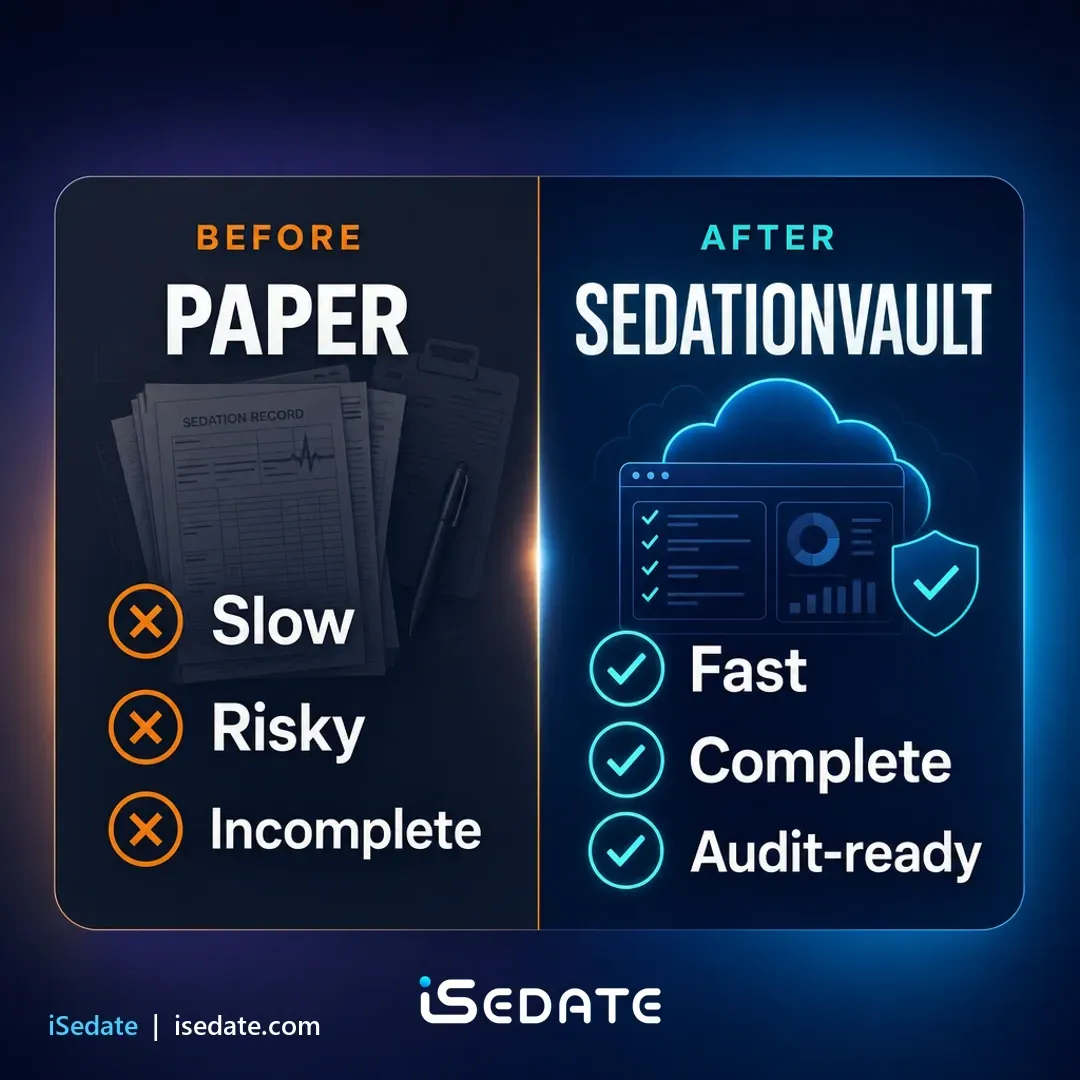
The data across every section points to one conclusion: the majority of documentation liability is the liability of absence, intervals performed but not charted, findings observed but not recorded, discharge assessments done but not documented. iSedate's SedationVault is built to close that gap at the source. It feeds live vital signs from compatible monitors (Edan, MindRay, Criticare, and more) into a time-stamped sedation record as the case happens, captures digital intake and consent, logs drugs with doses, times, and routes, and produces a one-click, audit-ready PDF report of the complete encounter. Because the record is generated contemporaneously rather than reconstructed afterward, it directly targets the missing-documentation failure mode that accounts for roughly 70% of documentation-related cases.
Two honest boundaries define what SedationVault does. First, it is a documentation and charting system, not a monitoring or rescue device: it records the vital signs that compatible monitors measure, and it does not itself monitor the patient or perform any clinical intervention. The clinician and the monitoring equipment remain fully responsible for patient safety. Second, documentation cannot substitute for care that meets the standard; it ensures that care meeting the standard can be proven. Within those boundaries, a contemporaneous, structured, tamper-evident record is exactly the asset the closed-claims data says sedation providers need, and producing that record reliably is what SedationVault is for. That is the practical meaning of provable safety: not a claim that care is safer, but the ability to demonstrate, from a complete record, that it was.
Book a SedationVault demoSedation Documentation & Malpractice Statistics: Summary Table
| Statistic | Figure | Source | Year |
|---|---|---|---|
| Malpractice cases with a documentation failure | ~20% | CRICO/Candello | 2024 |
| Closed claims analyzed in "For the Record" | 65,000+ | CRICO/Candello | 2014-2023 |
| Candello share of all US malpractice claims | ~one-third | CRICO/Candello | 2024 |
| Diagnosis-related cases with documentation issues | ~1 in 5 | MedPro Group | 2015-2024 |
| Lawsuits where documentation plays a role | 10%-20% | Peer-reviewed (Westlaw series) | 2022 |
| Effect of documentation issues on payment odds | more than 2x | CRICO/Candello | 2024 |
| Odds ratio: illegible documentation | 3.8 | CRICO/Candello | 2024 |
| Odds ratio: absent clinical rationale | 3.6 | CRICO/Candello | 2024 |
| Odds ratio: insufficient clinical findings | 2.8 | CRICO/Candello | 2024 |
| Documentation cases with insufficient findings | ~30% | CRICO/Candello | 2024 |
| Illegible documentation share of doc cases | under 5% | CRICO/Candello | 2024 |
| Documentation cases: missing documentation | 70% | Peer-reviewed (Westlaw series) | 2022 |
| Documentation cases: inaccurate content | 22% | Peer-reviewed (Westlaw series) | 2022 |
| Documentation cases: poor mechanics | 18% | Peer-reviewed (Westlaw series) | 2022 |
| Guideline interval for recording vitals | every 5-15 min | ADA / AAPD / state codes | 2024 |
| Pediatric vitals recording interval | every 10-15 min | AAPD | 2024 |
| Derived exposure: insufficient-findings failure | ~6% of all claims | iSedate Analysis | 2026 |
Frequently Asked Questions
How often do documentation problems appear in malpractice cases?
Does poor documentation increase the odds of paying a malpractice claim?
Why is the anesthesia record so important in a malpractice case?
What does a defensible sedation record need to include?
Can good documentation prevent a lawsuit from being filed?
Methodology & Sources
The central documentation-failure and odds-ratio figures are from CRICO/Candello's 2024 benchmarking report "For the Record: The Effect of Documentation on Defensibility and Patient Safety," based on more than 65,000 malpractice cases closed between 2014 and 2023; the Candello collaborative holds approximately one-third of all U.S. malpractice claims, making it a primary national dataset. The 1-in-5 diagnosis-related figure is from MedPro Group closed-claims data (2015-2024). The failure-type breakdown (missing 70%, inaccurate 22%, mechanics 18%) and the attorney-case-selection point are from a peer-reviewed case series using the Westlaw legal database. Recordkeeping requirements are from the ADA Guidelines for the Use of Sedation and General Anesthesia by Dentists, the AAPD monitoring guidelines, and state administrative codes (including Texas and Kentucky); the standard-of-care role of the anesthesia record is drawn from clinical reference literature. The iSedate Analysis combines two independently reported CRICO/Candello figures for illustration and is labeled as derived, not measured. U.S. data is used throughout as primary. All figures are informational and do not constitute legal advice; providers should consult their own counsel and their state board's current rules.
Media and press usage: Journalists and researchers are welcome to cite the statistics in this article with attribution to the original primary sources named above (primarily CRICO/Candello, MedPro Group, the ADA, and the AAPD). A link back to this page is appreciated.