










Anesthesia Record Errors & Litigation Statistics 2026: Missing & Incomplete Charts
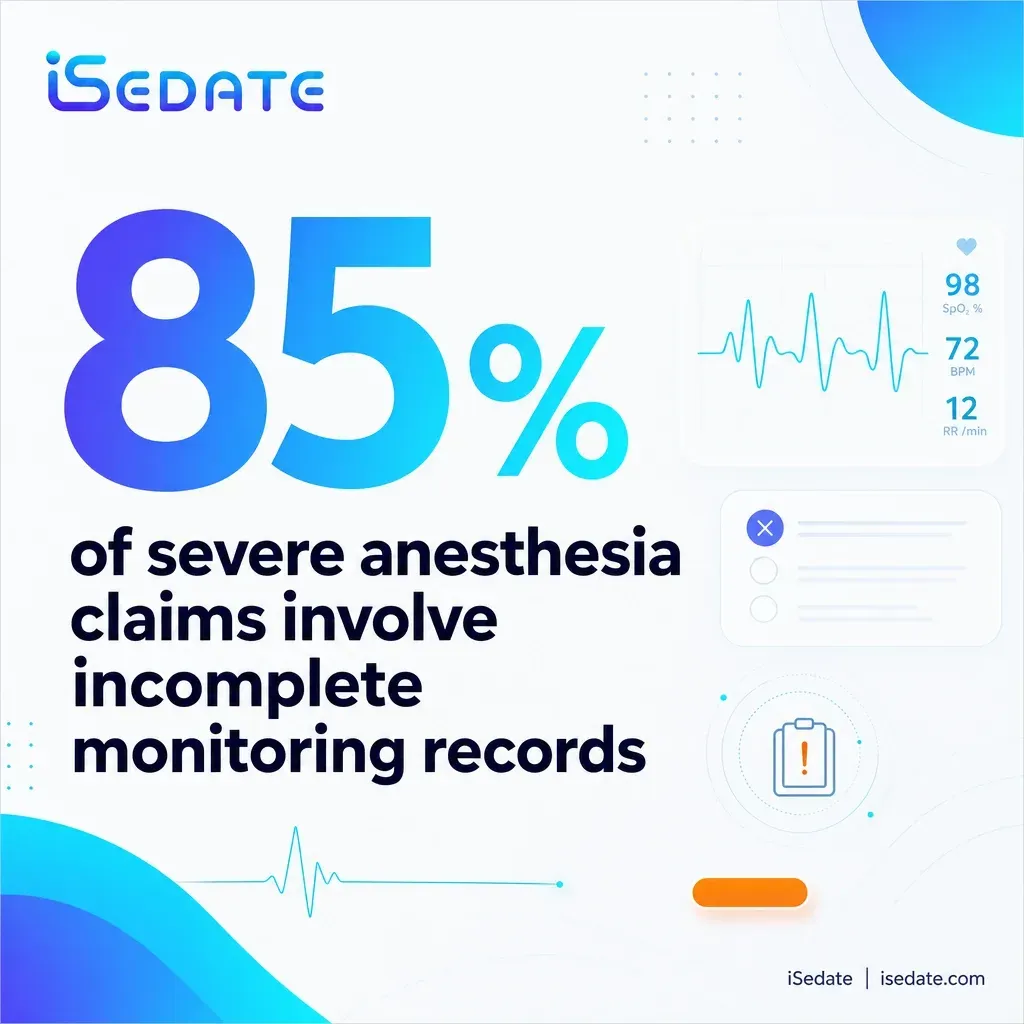
The anesthesia record is meant to be a minute-by-minute account of a patient's physiologic status, yet peer-reviewed studies repeatedly find these records riddled with gaps, missing vital signs, unrecorded events, blank baselines, and undocumented drugs. When one of those cases becomes a lawsuit, the incomplete chart is projected in the courtroom, and the missing data becomes the plaintiff's argument.
Key Takeaways
- Anesthesia charting completeness has been measured below 37% in one study; IV access was documented in just 17% of records in another.
- In one analysis, only 11% (7 of 65) of well-defined intraoperative events were correctly reported in the record.
- Basic preoperative history was documented in under 80% of records in a multi-center study; key fields like weight were missing in most.
- Even electronic anesthesia records are frequently incomplete; system design and free-text reliance drive omissions.
- The leading cause is provider workload, especially during adverse events when attention is on the patient, not the chart.
- The anesthesia record is often projected in the courtroom; omissions and write-overs imply carelessness.
- Automated capture of vital signs directly targets the most common gap: missed or reconstructed entries.
What's in This Guide
How Incomplete Anesthesia Records Really Are
The natural assumption is that anesthesia records, being highly structured clinical documents, are largely complete. Peer-reviewed research says otherwise, and the numbers are worse than most providers expect.
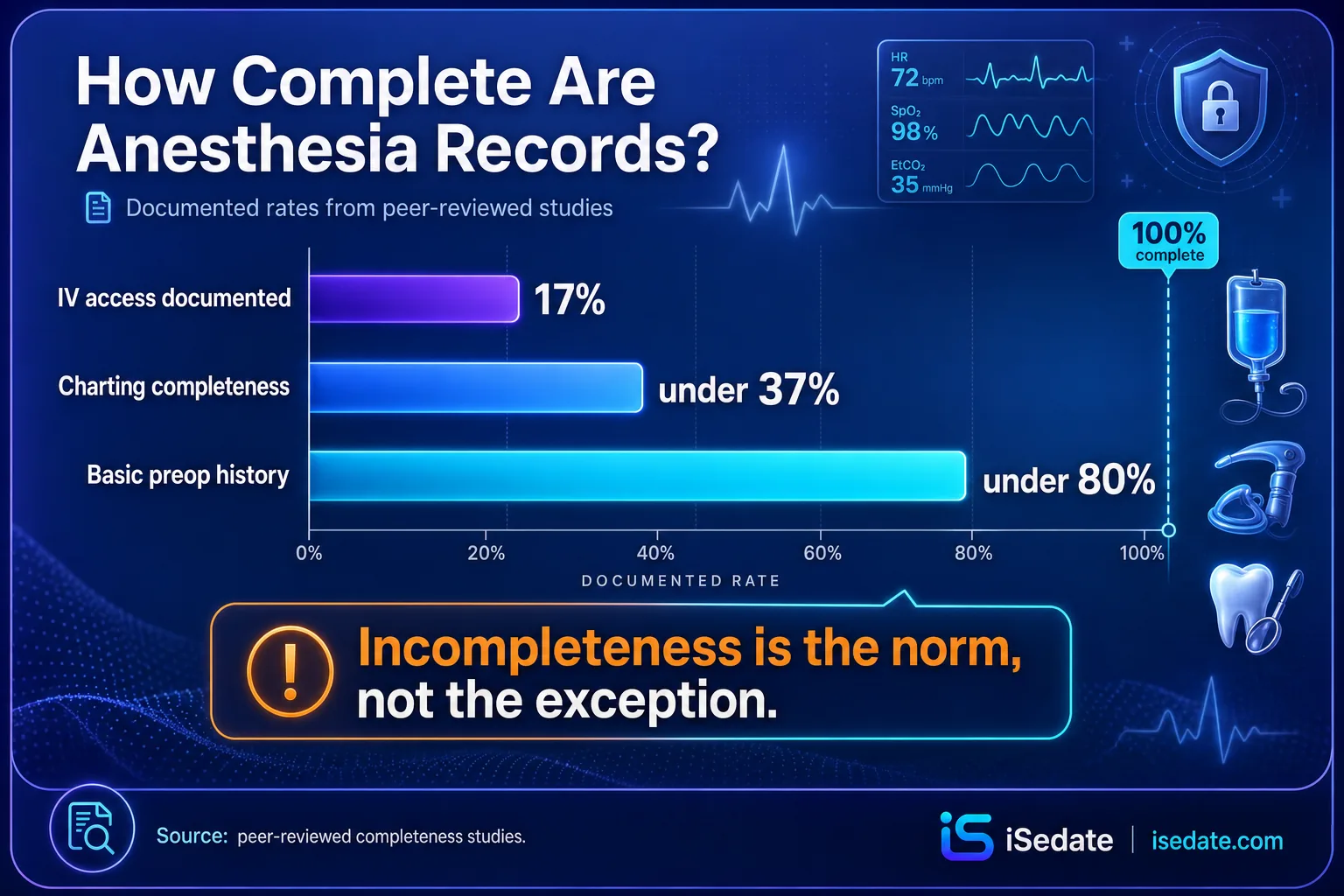
Multiple peer-reviewed studies have measured anesthesia record completeness directly, and the results are consistent in their concern. A Canadian study found that the completeness of anesthesia charting remained low, below 37%. A review at Massachusetts General Hospital of 2,384 records found that any documentation of IV access appeared in only 17% of records. A multi-center observational study assessing 420 perioperative anesthetic records found that basic preoperative history was documented in fewer than 80% of record sheets, and that completeness for preoperative physical examination and basic investigations fell below 75%. These are not fringe findings from poorly resourced settings alone; the pattern of incompleteness appears across countries, institutions, and both handwritten and electronic systems. The consistent conclusion of this literature is that the anesthesia record, despite its structured format, is frequently an incomplete account of the care it is supposed to document.
The relevance to litigation is direct. As established in the broader documentation-and-defensibility data, missing documentation is the single largest category of documentation-related malpractice liability. Anesthesia records, precisely because they demand so many time-stamped entries across three phases of care, present an unusually large number of opportunities for a gap to form, and each gap is a place where the defense later cannot prove what happened.
Source: Perioperative anesthesia record completeness (multi-center observational study)
Sedation documentation and malpractice statisticsThe Underreporting of Intraoperative Events
The most consequential category of anesthesia record error is not a blank field, it is an event that occurred and was managed but was never recorded. This underreporting of intraoperative events is both well-documented and, from a legal standpoint, especially dangerous.
In a pilot analysis of 50 anesthesia cases, researchers identified 65 well-defined intraoperative events in the electronic records, comprising 19 hypotensive, 31 bradycardic, 14 tachycardic, and 1 hypoxic event, but found that only 7 of them, about 11%, had been correctly reported in the documentation. The remaining 89% of clinically significant events occurred and were visible in the underlying monitoring data, yet were not properly captured in the record. The peer-reviewed literature describes underreporting of intraoperative events as well-known and a persistent compromise to documentation quality. This is the gap that matters most in a courtroom: a hypotensive or hypoxic episode that was recognized and treated appropriately, but not documented, looks in retrospect like an episode that was either missed or mishandled, because the record shows no evidence of the recognition or the response.
Myth: "If nothing went permanently wrong, an unrecorded event does not matter." The opposite is true. An intraoperative event that was competently managed but never documented is a latent liability. If the case is later reviewed, the treated-but-unrecorded event becomes indistinguishable from a missed one, and the provider's correct, life-protecting response leaves no trace to point to. The events most important to document are precisely the ones that occur during the busiest, most stressful moments, which is exactly when manual charting is most likely to be deferred and then forgotten.
Source: Perceived barriers to quality documentation during anaesthesia (survey study)
Anesthesia awareness and monitoring litigationThe Most Common Missing Data Points
When researchers and malpractice insurers catalog what is missing from anesthesia records, the same specific data points recur. Knowing which fields are most often blank shows exactly where the defensibility risk concentrates.
The recurring missing elements identified across anesthesia-documentation analyses fall into a consistent set. First and most common are vital-sign entries: providers may miss one or more interval notations of blood pressure, heart rate, and oxygen saturation when they become busy with patient care or an adverse event. Second is the timing and detail of interventions during adverse events, the steps taken and roughly when they occurred, which are difficult to reconstruct accurately after the fact if the timing of the patient's vital changes is unknown. Third are preoperative baselines: in the multi-center completeness study, critical fields such as patient weight were recorded in only a small fraction of records. Additional recurring gaps include incomplete drug and time documentation, missing informed-consent notation for the anesthetic plan, undocumented phone calls and interactions, and recovery documentation that asserts the patient was stable without showing that discharge criteria were met.
Each of these maps onto a specific litigation vulnerability. A missing vital-sign interval is an unmonitored window. An imprecisely timed adverse-event response cannot demonstrate that intervention was prompt. A blank weight undercuts the defensibility of a weight-based drug dose. The pattern is that the missing data points are not random, they cluster in exactly the areas an expert witness examines first when evaluating whether the standard of care was met.
Source: Pre-anesthetic record completeness (missing weight, vitals, diagnoses)
Expert witness and chart review statisticsWhy Electronic Records Still Fail
A common assumption is that switching from paper to electronic records solves the completeness problem. The evidence shows that electronic systems help, but do not eliminate the gaps, and can introduce new ones.
An observational study of anesthesia record completeness using an anesthesia information management system reached a pointed conclusion: electronic clinical anesthesia documentation was often incomplete. The researchers found that dependence on free-text remarks, and the record-keeping system's inability to automatically present entries in logical sequences consistent with clinical workflow, were associated with incomplete data entry. In other words, an electronic system that simply digitizes a blank form, requiring the provider to remember to type each entry, inherits the same omission problem as paper. The study concluded that the user interface for data entry and the logic a system uses to prevent omissions and inconsistencies merit further development to produce clinically useful documentation. The lesson is that the benefit of electronic records comes not from the screen itself but from automation, specifically, a system that captures physiologic data directly from monitoring equipment rather than depending on manual entry.
This distinction is critical. Anesthesia-documentation experts note directly that a system automating the recording of vital signs can help prevent gaps in documentation, because it collects readings at defined intervals regardless of whether the provider is occupied with the patient. The completeness problem is fundamentally a manual-entry problem, and it is solved to the degree that entry is automated rather than remembered.
Source: Observational study of anesthesia record completeness using an AIMS (Anesthesia & Analgesia)
SedationVault anesthesia record softwareWhy the Errors Happen
Understanding the root causes of anesthesia record errors is what separates a blaming response from a systemic one. The research is clear that these are not primarily failures of diligence but of competing demands.
The barriers survey of anesthesia staff, in which 81% of a department's physicians and nurse anesthetists participated, points to overload and workflow as the dominant causes. When a provider is managing an unstable patient, entering documentation is deferred, and quality-defining events that occur late in a case, during emergence, for example, may go unrecorded if data entry was completed before the anesthetic ended. Researchers note the paradox candidly: the claim that providers have enough time for data entry is not very credible given the competing clinical demands, and participants appear to have time for incomplete rather than appropriate data collection. Additional barriers identified in the incident-reporting literature include fear of legal consequences, lack of feedback about the data, and unsatisfactory working conditions, the fear factor is especially perverse, because avoiding documentation of an event out of legal anxiety is precisely what creates the later legal exposure.
The common thread is that anesthesia record errors are structural, not attitudinal. Providers are not careless; they are managing a patient with their hands and attention fully occupied, while a parallel documentation obligation runs on a clock they cannot always meet. Any durable solution has to reduce the manual burden at exactly the moments it peaks, rather than exhorting already-overloaded clinicians to chart more diligently.
Myth: "Record errors mean the provider was negligent." This is both unfair and inaccurate. The completeness studies show incompleteness is the norm across skilled providers, driven by workload and system design, not by substandard clinicians. Treating a documentation gap as evidence of a bad provider misdiagnoses the problem and points to the wrong fix. The realistic remedy is not to demand more from clinicians during their busiest moments but to automate the capture that competes with patient care, so the record fills itself when the provider cannot.
Source: Barriers to anesthesia documentation (survey analysis)
Anesthesia closed claims statisticsThe Record in the Courtroom
All of these errors converge in a single high-stakes setting: the courtroom, where the anesthesia record ceases to be a clinical tool and becomes the central piece of evidence, examined line by line.
Clinical-legal references describe the courtroom reality bluntly: the anesthesia record is the main document of the intraoperative course, it is the record of what happened many years after an incident, and it can be a provider's best ally or worst enemy. Some or all of the record is likely to be blown up or projected for viewing by the jury, and omissions of important data, write-overs, and inaccuracies may be damaging even if only as an implication of carelessness, a sloppily completed record suggests a sloppy provider, even when that is untrue. The most concrete example the literature offers is telling: in documented cases of patient awareness during surgery, the anesthesiologist sometimes never documented that an inhalation anesthetic was being delivered at the time of the alleged awareness, leaving no record to rebut the claim. The undocumented fact, however true, cannot defend the case.
This is the destination that every earlier statistic leads to. The 17% IV-documentation rate, the 11% event-reporting rate, the sub-37% completeness, each becomes, in a specific lawsuit, a blank space projected on a screen that the plaintiff's attorney invites the jury to interpret. The defense's task is then to explain the absence rather than to point to the record. A complete, contemporaneous, automatically captured record removes that vulnerability at its source, which is the entire practical argument for building the record differently.
Source: The anesthesia record in the courtroom (clinical-legal reference) | ASA Statement on Documentation of Anesthesia Care
Dental board disciplinary action statisticsAn iSedate Analysis: The Event-Capture Gap
To quantify the specific risk that automated capture addresses, we can turn the intraoperative-event underreporting finding into a simple measure of the gap between what happens and what gets recorded.
Start from the reported figures: 65 well-defined intraoperative events were identified across 50 cases, and only 7 were correctly reported. That is an 89% underreporting rate, and it implies roughly 1.3 clinically significant events per case in that sample (65 divided by 50). Combining these, the average case in that sample generated more than one significant event, and the record captured only about one in nine of them. The events themselves were visible in the monitoring data; what failed was the transfer of that data into the documented record. This is precisely the gap that automated vital-sign capture is designed to close: when readings flow from the monitor into a time-stamped record continuously, a hypotensive or bradycardic episode is recorded as it occurs, whether or not the provider has a free hand to note it. The recognition-to-record gap, the space between the clinician seeing the event and the event appearing in the chart, is where the 89% is lost, and it is a workflow gap, not a clinical one.
Calculation original to iSedate. Inputs: pilot analysis reporting 65 well-defined intraoperative events across 50 cases, of which 7 were correctly reported. Derived: underreporting rate = (65 - 7) / 65 = 89%; events per case = 65 / 50 = 1.3. These are arithmetic restatements of the study's reported counts to illustrate the recognition-to-record gap; the sample is small (50 cases) and the figures are not generalizable population estimates.
Source: Intraoperative event reporting data (component figures)
See how SedationVault captures eventsWhere SedationVault Fits
The through-line of the anesthesia-record-error research is that the errors are overwhelmingly errors of manual capture: entries missed because a clinician was occupied, events recognized but not transferred to the record, baselines skipped under time pressure. iSedate's SedationVault is built to attack that specific failure mode. It feeds live vital signs from compatible monitors (Edan, MindRay, Criticare, and more) into a time-stamped sedation record as the case unfolds, so interval readings and physiologic changes are captured continuously rather than depending on the provider to pause and type them. It logs drugs with doses, times, and routes, captures digital intake and consent, and produces a one-click, audit-ready PDF report of the full encounter. Because the record is built as care happens, it directly targets the recognition-to-record gap that the underreporting studies quantify.
The honest boundaries are the same ones the data demands. SedationVault is a documentation and charting system, not a monitoring or rescue device: it records the vital signs that compatible monitors measure and does not itself monitor the patient, detect events, or perform any clinical intervention. The clinician and the monitoring equipment remain solely responsible for recognizing and managing events; SedationVault's role is to ensure that what the monitors show and the clinician does is reliably captured in a defensible record. It does not make care safer; it makes care documentable, which, as the litigation data shows, is a distinct and substantial value in its own right.
Book a SedationVault demoAnesthesia Record Errors & Litigation Statistics: Summary Table
| Statistic | Figure | Source | Year |
|---|---|---|---|
| Anesthesia charting completeness (Canada) | under 37% | Peer-reviewed (cited in multi-center study) | 2022 |
| Records documenting IV access (Mass General) | 17% | Peer-reviewed (2,384 records) | 2022 |
| Records with complete basic preop history | under 80% | Multi-center observational study | 2022 |
| Preop physical exam / investigation completeness | under 75% | Multi-center observational study | 2022 |
| Perioperative records analyzed (multi-center) | 420 | Multi-center observational study | 2022 |
| Intraoperative events correctly reported | 11% (7 of 65) | Anesthesia quality pilot analysis | 2011 |
| Intraoperative events identified in sample | 65 (in 50 cases) | Anesthesia quality pilot analysis | 2011 |
| Underreporting rate of intraoperative events | 89% | iSedate Analysis (derived) | 2026 |
| Preop weight documented (pre-anesthetic study) | 2.5% | Peer-reviewed (pre-anesthetic completeness) | 2025 |
| Preop vital signs documented (same study) | 0.8% | Peer-reviewed (pre-anesthetic completeness) | 2025 |
| Barriers-survey staff participation | 81% (55 of ~68) | Peer-reviewed barriers survey | 2015 |
| Electronic records still incomplete | Confirmed | Anesthesia & Analgesia (AIMS study) | 2007 |
| Phases of anesthesia care requiring documentation | 3 | ASA Statement | 2024 |
| Record likely projected in courtroom | Yes | Clinical-legal reference | 2024 |
| Leading cause of record errors | Provider workload | Peer-reviewed barriers survey | 2015 |
| Primary remedy identified | Automated vitals capture | Anesthesia documentation experts | 2024 |
| Events per case in event-reporting sample | 1.3 | iSedate Analysis (derived) | 2026 |
Frequently Asked Questions
How often are anesthesia records incomplete?
What are the most common anesthesia documentation errors?
Why do anesthesia record errors happen?
Do anesthesia providers underreport intraoperative events?
How do anesthesia record errors affect a malpractice case?
Methodology & Sources
Record-completeness figures are from peer-reviewed studies: a multi-center observational study of 420 perioperative anesthetic records (basic preoperative history under 80%, physical exam and investigations under 75%), which also cites a Massachusetts General Hospital review (IV access documented in 17% of 2,384 records) and a Canadian study (charting completeness under 37%); and a separate pre-anesthetic record completeness study reporting weight documented in 2.5% and preoperative vital signs in 0.8% of its sample. Intraoperative-event underreporting figures (7 of 65 events correctly reported) are from a cited anesthesia quality pilot analysis. Electronic-record incompleteness is from an observational study using an anesthesia information management system published in Anesthesia & Analgesia. Barriers to documentation are from a peer-reviewed survey of anesthesia staff. Documentation standards are from the American Society of Anesthesiologists Statement on Documentation of Anesthesia Care, and the courtroom role of the record is from clinical-legal reference literature. Some completeness studies were conducted outside the United States and are used to illustrate a consistent international pattern; U.S. sources (Mass General, ASA, U.S. clinical-legal references) anchor the U.S.-specific points. The two iSedate Analysis figures are arithmetic restatements of reported study counts, labeled as derived and drawn from a small sample. All figures are informational and do not constitute legal advice.
Media and press usage: Journalists and researchers are welcome to cite the statistics in this article with attribution to the original primary sources named above (primarily Anesthesia & Analgesia, the ASA, and the peer-reviewed completeness studies). A link back to this page is appreciated.