







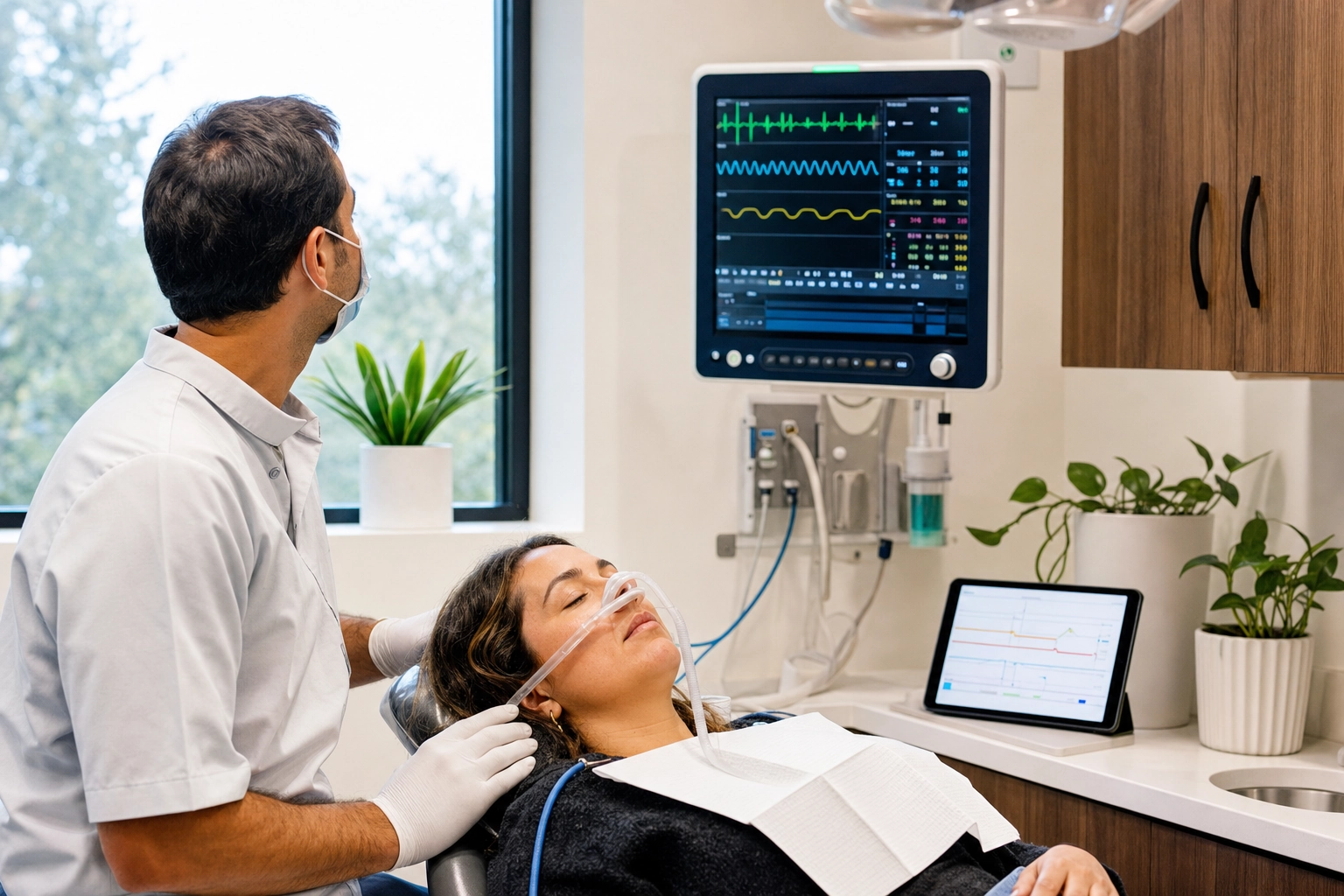
Dental Sedation Vitals, Charting & Reporting Requirements by State
If you sedate patients, the single document a dental board or payer asks for first is your sedation record: a time-oriented chart of every drug and dose, the vital signs you monitored, and a documented discharge. What that record must contain is not set by one national rule. It is set by your state dental board, and it changes at the state line. Some states itemize the record down to a five-minute vitals interval; others lean on the American Dental Association's national guidelines without spelling out a list. This hub maps the whole picture: the ADA standard that forms the clinical spine, what a time-oriented anesthetic record actually contains, the federal layers that touch it, how a board audit reads it, and a 50-state comparison that links to a dedicated guide for every state. It is written for dental practices first, and the same charting and reporting logic extends to the other sedation specialties covered elsewhere on this site.
Recent Updates
Last UpdatedNovember 16, 2026
- Rewrote the national clinical core: added full sections on what a time-oriented anesthetic record contains and on how board audits and inspections read it.
- Rebuilt the 50-state comparison into a linked at-a-glance table and added a dedicated guide link for all 50 states.
- Added verified vitals-interval and record-retention columns for the states that publish them, with a neutral "see your state's guide" where a value is not stated in code.
- Re-verified the governing board, record basis, and citation for every state against current board rules; confirmed the 37 explicit / 13 ADA-incorporated split.
Key Takeaways
- Charting law is a 50-state patchwork. Your state dental board, not a federal agency, defines what the sedation record must contain, issues the permits, and runs the audits.
- The ADA sets the clinical spine. The ADA sedation guidelines (adopted October 2025) call for a time-oriented anesthetic record of drugs, doses, times, and continually monitored vitals, but they are a professional standard, not law.
- 37 states itemize an explicit record in their own code; 13 incorporate the ADA standard or a monitoring-equipment mandate instead. Both create a real documentation duty.
- The four core vitals are charted at every moderate case: pulse oximetry, heart rate, respiratory rate, and blood pressure, plus level of consciousness; deep sedation and general anesthesia add capnography and continuous ECG.
- The vitals interval is the trap. Explicit states most often require documentation at least every five minutes; Texas allows up to ten and Missouri fifteen. Writing readings only at the start and end does not satisfy the rule.
- Federal layers touch the record: the DEA requires accurate controlled-substance logging for sedation drugs, and HIPAA governs how the record is stored and shared, though retention length is a state rule, not HIPAA.
- The record, not the care, is what gets flagged. A board audit reads the time-oriented chart line by line, so an incomplete or non-contemporaneous record is the most common reason a safe case still ends in a citation.

What This Guide Covers
- Why sedation charting is a 50-state patchwork
- The national baseline: the ADA time-oriented record
- What a time-oriented anesthetic record contains
- The federal layers: DEA and HIPAA
- Audits, inspections, and why the record gets flagged
- The 50-state charting and reporting comparison
- Find your state: the 50 charting guides
- How SedationVault builds the record every state wants
- Frequently asked questions
- Sources and citations
Why sedation charting is a 50-state patchwork
There is no single federal statute that tells a dentist what to chart during sedation. Instead, the practice of dentistry, sedation and anesthesia included, is regulated state by state, each by its own dental board or health department. That board issues the anesthesia permits, writes the recordkeeping rule, reviews records, and takes disciplinary action. The practical effect is that a moderate-sedation record that is airtight in one state can have a documented gap in the state next door, because the required vitals interval, the list of fields, and the discharge standard are all set locally.
This is why a practice cannot rely on a memory of "the rule." The rule has 50 versions. What stays constant across all of them is the shape of the obligation: monitor the patient, write down what you monitored on a contemporaneous record, log every drug and dose, and document that the patient was safe to discharge. What changes is the detail, the citation, and how aggressively each state spells it out. A handful of states, Florida and Illinois among them, write the record out in granular detail with a fixed interval. Others, such as Delaware and Ohio, keep their own code sparse and point instead to the ADA sedation guidelines, which pulls the same clinical expectations in by reference.
Because the audience for this hub is national, the goal here is to give you the national spine first, in enough depth that your state guide does not have to repeat it, and then hand you to your own state. Read this page for the framework that every state shares, then open your state's dedicated guide for the exact rule text, the interval, the retention period, and the reporting duties that apply where you practice.
The national baseline: the ADA time-oriented record
The clinical backbone that nearly every state leans on is the American Dental Association Guidelines for the Use of Sedation and General Anesthesia by Dentists, most recently adopted by the ADA House of Delegates in October 2025. It is worth being precise about what these guidelines are: a professional standard, not a law in themselves. Dentists are bound by their state board's rules. But because so many state rules mirror or directly incorporate the ADA definitions and documentation expectations, this is the framework that explains why the state rules look the way they do.
The guidelines define sedation by depth, independent of the route the drug was given, because a drug taken orally and a drug given intravenously can each reach the same clinical depth:
- Minimal sedation (anxiolysis): the patient responds normally to verbal command; the airway and cardiovascular function are unaffected.
- Moderate sedation (commonly called conscious sedation): the patient responds purposefully to verbal or tactile stimulation and maintains the airway independently.
- Deep sedation and general anesthesia: the patient is not easily aroused or is unconscious, and airway support is often required.
The documentation expectation rises with depth. For moderate sedation, the standard is a time-oriented anesthetic record capturing all drugs, their doses, administration times, and local anesthetics, alongside the monitored parameters: pulse oximetry, heart rate, respiratory rate, blood pressure, and level of consciousness recorded continually. For deep sedation and general anesthesia, the same time-oriented record applies, with the addition of end-tidal carbon dioxide (capnography), continuous ECG unless precluded, and temperature capability. Recovery has its own duty: the dentist must determine and document that consciousness, oxygenation, ventilation, and circulation are satisfactory before the patient is discharged.
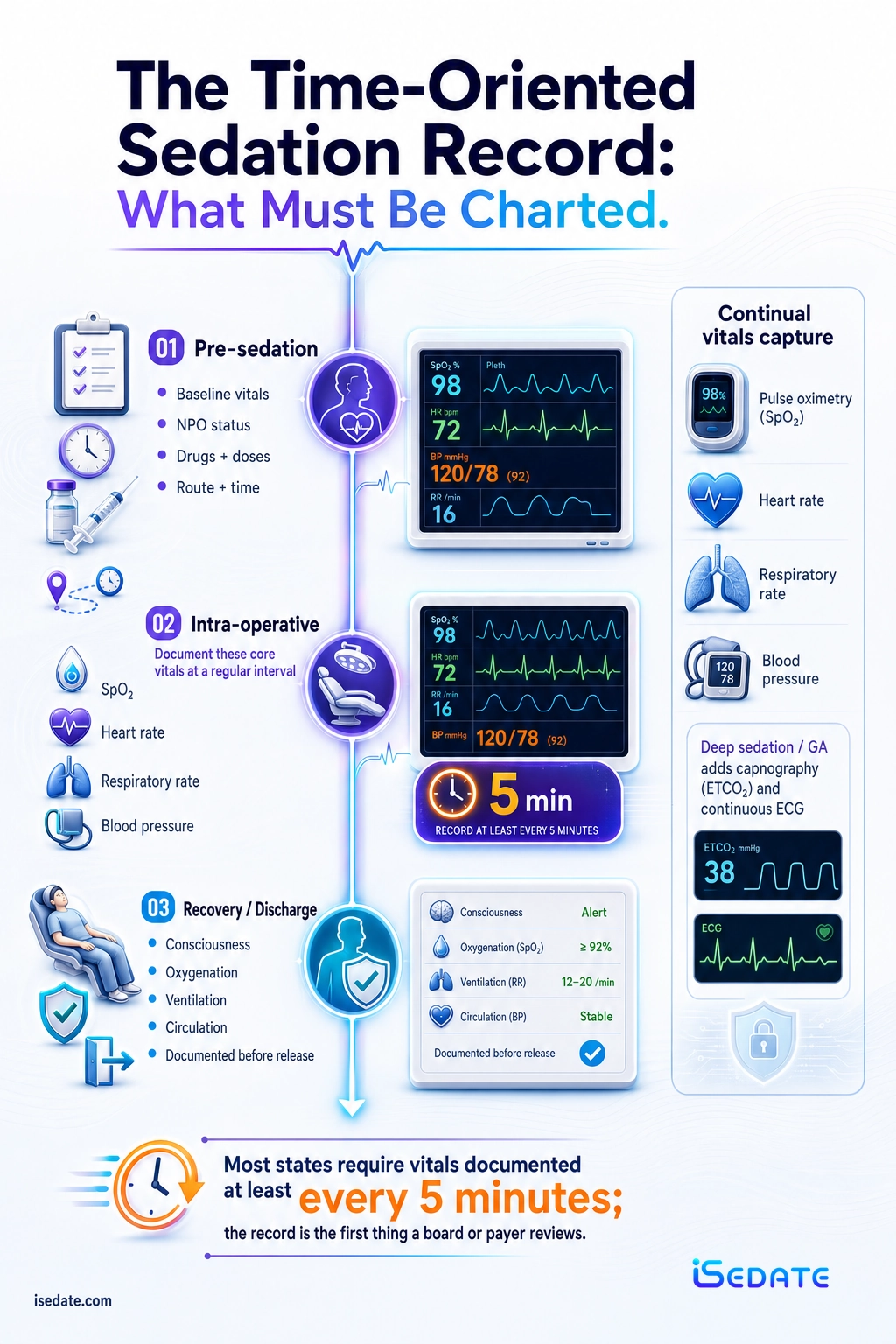
The through-line is that every one of these parameters is a "must be recorded" item. Monitoring and charting are inseparable in the standard: what you are required to watch is what you are required to write down, on the clock, as the case runs. That is the burden the state rules below enforce, and it is the burden a board audit or a malpractice claim examines line by line.
iSedate Insight
Read all 50 state rules side by side and the common denominator is not the interval or the field list, which differ. It is the contemporaneous, time-oriented record itself. Whether a state spells out a five-minute cadence or simply incorporates the ADA standard, the document that proves compliance is the same, and the thing that fails a review is almost never the clinical care. It is the record: the interval that stretched too far, the dose logged later from memory, the discharge note that was never written.
Source: ADA Guidelines for the Use of Sedation and General Anesthesia by Dentists (adopted October 2025)
What a time-oriented anesthetic record contains
Because this is the document every state audit turns on, it is worth going through what a complete record actually holds. A time-oriented anesthetic record is organized against the clock, and it has three phases: before sedation, during the case, and recovery through discharge. A record that is strong in one phase and thin in another is exactly the kind of chart a reviewer flags.
Before sedation: the baseline
The record opens with a baseline that establishes the patient was fit for sedation and that you knew where to start. That includes the pre-sedation vital signs, the patient's ASA physical status classification, confirmation of fasting (NPO) status, and the planned drugs with their routes. The 2025 ADA update also brought body mass index into the baseline vital signs and tightened documentation for weight-based dosing, which matters most in pediatric and smaller-patient cases where dose is calculated against weight. The baseline is what a later reading is compared against, so a case that never recorded a starting blood pressure or heart rate has a gap before the sedation even begins.
During the case: the four core vitals, on an interval
Through the procedure, the four core vital signs are documented on the clock: pulse oximetry (oxygen saturation), heart rate, respiratory rate, and blood pressure, alongside the patient's level of consciousness. Every drug and dose is entered with the time it was given, including local anesthetics. This is the heart of the record and the single most common place a chart falls short, because the interval is the detail that is easy to let slip during a busy case or an airway event, which is precisely when the readings matter most. Deep sedation and general anesthesia add end-tidal carbon dioxide (capnography) and continuous ECG to the parameters that must be captured.
Recovery and discharge: the assessment that is easy to skip
The record does not end when the procedure does. Before the patient leaves, the dentist must determine and document that consciousness, oxygenation, ventilation, and circulation are satisfactory. Many states layer a formal discharge assessment on top of this, and a documented discharge is one of the most frequently missing elements in an otherwise complete chart. The patient walking out safely is not the same as a recorded, defensible decision that they were safe to leave, and in an audit only the second one counts.
The Interval Trap
Readings at the start and end are not a record. The most common documentation failure is charting a vital sign when the case begins and again when it ends, with nothing in between. A rule that requires documentation "at least every five minutes" means a continuous series of time-stamped readings through the entire case, not two endpoints. On paper or in a clumsy EHR this depends on a team member remembering to write a number during the exact minutes they are busiest, which is why the interval is where otherwise careful practices get cited.
Source: ADA Guidelines for the Use of Sedation and General Anesthesia by Dentists (adopted October 2025)
See how a time-oriented anesthesia record builds automaticallyThe federal layers: DEA and HIPAA
Although the charting standard itself is set by the states, two federal frameworks sit on top of the sedation record and are worth framing honestly, because they are often misunderstood as the source of the charting rule, which they are not.
Controlled-substance logging (DEA). Many of the agents used in dental sedation, such as the benzodiazepines and opioids given for moderate and deeper sedation, are scheduled controlled substances. Under the federal Controlled Substances Act, administered by the DEA Diversion Control Division, a practitioner who orders, stocks, and administers those drugs is required to keep complete and accurate records of them. In a sedation practice this drug log and the clinical sedation record are two views of the same event: the dose that appears on the time-oriented anesthetic record also has to be accounted for in the controlled-substance records. A mismatch between the two is exactly the kind of discrepancy an inspection looks for.
Record handling and privacy (HIPAA). The sedation record is protected health information, so its storage, access, and disclosure are governed by HIPAA, enforced by the U.S. Department of Health and Human Services. One clarification matters here, because it is a common source of confusion: HIPAA governs how the record is protected and shared, but it does not set the sedation-specific retention period. How long you must keep the chart is a function of your state dental-records rule, not HIPAA, and those periods vary, from five years in some states to ten in others. Treat HIPAA as the rule for safeguarding the record, and your state board's rule for how long to hold it. If your systems need to demonstrate both at once, that is the territory of dental sedation compliance tooling rather than any single federal statute.
Myth, Busted
Myth: "My sedation drugs are logged, so my charting is covered."
Fact: The controlled-substance log and the clinical sedation record answer different questions, and a board reviewer wants the second one.
The drug log proves you accounted for the scheduled substance. The time-oriented anesthetic record proves what you monitored, when, and that the patient was safe to discharge, with the vitals on the clock. A payer and a board want the clinical record, not just the pharmacy count. You need both, and they need to agree.
Source: DEA Diversion Control Division | U.S. HHS, HIPAA
Audits, inspections, and why the record gets flagged
Understanding how a sedation record is reviewed is the fastest way to understand why the charting rules read the way they do. Boards reach a sedation record through two routes. The first is a complaint or an adverse event, after which the board requests the chart. The second, which catches practices by surprise, is a routine review: a permit renewal, a facility inspection, or a records audit that pulls files that were never the subject of any complaint. Several states run scheduled office inspections or chart audits as a condition of holding an anesthesia permit, and in those states the record is being read on a clean, ordinary case, not only after something went wrong.
Whichever route it comes through, the reviewer is comparing your record against the state's rule field by field. The findings cluster in a short list: a vitals interval that stretched past the required cadence, a drug or dose entered after the fact rather than contemporaneously, a missing discharge assessment, a baseline that was never recorded, or a disagreement between the controlled-substance log and the clinical chart. Notice what is not on that list: the sedation itself. In the large majority of cases the clinical care was appropriate, and the citation is about the documentation of that care.
Separate from the audit of the record is the duty to report certain events. Many states require that a sedation-related adverse event, such as an unexpected hospital transfer or a death, be reported to the board within a fixed window, commonly thirty days. That reporting duty is distinct from the charting duty, it is set by each state, and it is one of the specifics covered in each state's dedicated guide rather than generalized here, because the triggering events and the deadline differ by state.
iSedate Charting Advice
Set the interval before the case, not during it. Find your state's required vitals cadence in your state's guide, then make the record capture at that interval the default your operatory runs on, rather than something a team member has to remember mid-case. The practices that pass audits cleanly are the ones for which a complete, contemporaneous record is automatic, not an act of discipline during the busiest minutes of the appointment.

The 50-state charting and reporting comparison
The table below lists, for every state, the governing dental board or agency, whether the state spells out an explicit record in its own code or incorporates the ADA standard, the verified vitals interval and record-retention period where the state publishes one, and the citation to look up. Of the 50 states, 37 itemize an explicit drugs-and-vitals record and 13 incorporate the ADA sedation guidelines or a monitoring-equipment mandate instead. Both impose a real documentation duty; the difference is how precisely the state writes it down. Where a column reads "See guide," that value is not stated as a single number in the state's own code and is detailed, with context, in the state's dedicated guide, rather than guessed at here. Each state name links straight to its full guide.
| State guide | Governing board | Record standard | Vitals interval (moderate) | Record retention | Citation |
|---|---|---|---|---|---|
| Alabama Sedation Vitals Monitoring, Charting & Reporting Requirements | Board of Dental Examiners of Alabama | Explicit record rule | 5 min or less | See guide | Ala. Admin. Code r. 270-X-2-.21(8) |
| Alaska Sedation Vitals Monitoring, Charting & Reporting Requirements | Alaska Board of Dental Examiners | Explicit record rule | See guide | See guide | 12 AAC 28.060(d)(3) & 28.061 |
| Arizona Sedation Vitals Monitoring, Charting & Reporting Requirements | Arizona State Board of Dental Examiners | Explicit record rule | See guide | See guide | A.A.C. R4-11-1301(E) |
| Arkansas Sedation Vitals Monitoring, Charting & Reporting Requirements | Arkansas State Board of Dental Examiners | Explicit record rule | Continual (no set interval) | See guide | Ark. Admin. Code 115-1304 (Art. XIII) |
| California Sedation Vitals Monitoring, Charting & Reporting Requirements | Dental Board of California | Explicit record rule | About every 5 min | See guide | Bus. & Prof. Code §1647.6; 16 CCR Art. 5 |
| Colorado Sedation Vitals Monitoring, Charting & Reporting Requirements | Colorado Dental Board | Explicit record rule | 5 min or less | See guide | 3 CCR 709-1 Rule 1.14(O) |
| Connecticut Sedation Vitals Monitoring, Charting & Reporting Requirements | Connecticut Dept. of Public Health (Dental) | Explicit record rule | See guide | See guide | RCSA §20-123b-9(d) |
| Delaware Sedation Vitals Monitoring, Charting & Reporting Requirements | Delaware Board of Dentistry & Dental Hygiene | Incorporates ADA standard | Continual (ADA) | See guide | 24 Del. Admin. Code 1100 §§7.4.3.1 & 7.5.1 |
| Florida Sedation Vitals Monitoring, Charting & Reporting Requirements | Florida Board of Dentistry (DOH) | Explicit record rule | 5 min or less | See guide | Fla. Admin. Code R. 64B5-14.009(7)(d) |
| Georgia Sedation Vitals Monitoring, Charting & Reporting Requirements | Georgia Board of Dentistry | Incorporates ADA standard | See guide | See guide | Ga. Comp. R. & Regs. 150-13-.01(6) & (15)(a) |
| Hawaii Sedation Vitals Monitoring, Charting & Reporting Requirements | Hawaii Board of Dentistry | Incorporates ADA standard | Continual (ADA) | See guide | Haw. Admin. R. §§16-79-78 & 16-79-79 |
| Idaho Sedation Vitals Monitoring, Charting & Reporting Requirements | Idaho State Board of Dentistry | Incorporates ADA standard | Continual (ADA) | See guide | IDAPA 24.31.01 §200.14 |
| Illinois Sedation Vitals Monitoring, Charting & Reporting Requirements | Illinois Dept. of Financial & Professional Regulation (Dental) | Explicit record rule | Pre, intra, and pre-discharge | See guide | 68 Ill. Adm. Code 1220.510(h) |
| Indiana Sedation Vitals Monitoring, Charting & Reporting Requirements | Indiana State Board of Dentistry | Incorporates ADA standard | See guide | See guide | 828 IAC 3-1-6.5(c) |
| Iowa Sedation Vitals Monitoring, Charting & Reporting Requirements | Iowa Dental Board | Explicit record rule | Continual | See guide | Iowa Admin. Code 650-29.4(2) & 29.5(9) |
| Kansas Sedation Vitals Monitoring, Charting & Reporting Requirements | Kansas Dental Board | Explicit record rule | Every 5 min | 10 years | K.A.R. 71-5-11(f) |
| Kentucky Sedation Vitals Monitoring, Charting & Reporting Requirements | Kentucky Board of Dentistry | Explicit record rule | 5 min or less | See guide | 201 KAR 8:550 Sec. 5(10)/6(7) |
| Louisiana Sedation Vitals Monitoring, Charting & Reporting Requirements | Louisiana State Board of Dentistry | Incorporates ADA standard | See guide | See guide | LAC 46:XXXIII.1510.A.3 |
| Maine Sedation Vitals Monitoring, Charting & Reporting Requirements | Maine Board of Dental Practice | Explicit record rule | 5 min or less | See guide | 02-313 C.M.R. Ch. 14 |
| Maryland Sedation Vitals Monitoring, Charting & Reporting Requirements | Maryland State Board of Dental Examiners | Explicit record rule | Continual | See guide | COMAR 10.44.12.11(12) |
| Massachusetts Sedation Vitals Monitoring, Charting & Reporting Requirements | Massachusetts Board of Registration in Dentistry | Explicit record rule | See guide | See guide | 234 CMR 6.12 & 6.13 |
| Michigan Sedation Vitals Monitoring, Charting & Reporting Requirements | Michigan Board of Dentistry (LARA) | Incorporates ADA standard | Continual (ADA) | 10 years | Mich. Admin. Code R 338.11603(3) |
| Minnesota Sedation Vitals Monitoring, Charting & Reporting Requirements | Minnesota Board of Dentistry | Incorporates ADA standard | Continual (ADA) | See guide | Minn. R. 3100.3600 subp.22.A.2 |
| Mississippi Sedation Vitals Monitoring, Charting & Reporting Requirements | Mississippi State Board of Dental Examiners | Incorporates ADA standard | See guide | See guide | 30 Miss. Admin. Code Pt.2301 R.1.30 §17 |
| Missouri Sedation Vitals Monitoring, Charting & Reporting Requirements | Missouri Dental Board | Explicit record rule | 15 min or more | See guide | 20 CSR 2110-4.030 §6 & §7 |
| Montana Sedation Vitals Monitoring, Charting & Reporting Requirements | Montana Board of Dentistry | Explicit record rule | 5 min or less | See guide | ARM 24.138.3223 / 3227 / 3231 |
| Nebraska Sedation Vitals Monitoring, Charting & Reporting Requirements | Nebraska Board of Dentistry | Explicit record rule | See guide | See guide | 172 NAC 56 §009.04(E) |
| Nevada Sedation Vitals Monitoring, Charting & Reporting Requirements | Nevada State Board of Dental Examiners | Explicit record rule | See guide | See guide | NAC 631.2229 |
| New Hampshire Sedation Vitals Monitoring, Charting & Reporting Requirements | New Hampshire Board of Dental Examiners | Explicit record rule | Continual (ADA) | See guide | N.H. Admin. Code Den 304.09 |
| New Jersey Sedation Vitals Monitoring, Charting & Reporting Requirements | New Jersey State Board of Dentistry | Explicit record rule | See guide | 7 years | N.J.A.C. 13:30-8.2 |
| New Mexico Sedation Vitals Monitoring, Charting & Reporting Requirements | New Mexico Board of Dental Health Care | Explicit record rule | See guide | See guide | 16.5.15 NMAC |
| New York Sedation Vitals Monitoring, Charting & Reporting Requirements | NY State Education Dept. (Office of the Professions) | Explicit record rule | See guide | See guide | 8 NYCRR 61.10; Education Law §6605-a |
| North Carolina Sedation Vitals Monitoring, Charting & Reporting Requirements | North Carolina State Board of Dental Examiners | Explicit record rule | See guide | 10 years | 21 NCAC 16Q .0302(5) & .0405(A) |
| North Dakota Sedation Vitals Monitoring, Charting & Reporting Requirements | North Dakota State Board of Dental Examiners | Explicit record rule | Every 5 min | 6 years | N.D. Admin. Code 20-02-01-05 |
| Ohio Sedation Vitals Monitoring, Charting & Reporting Requirements | Ohio State Dental Board | Incorporates ADA standard | Continual (ADA) | See guide | OAC 4715-5-07(B)(3) |
| Oklahoma Sedation Vitals Monitoring, Charting & Reporting Requirements | Oklahoma Board of Dentistry | Explicit record rule | See guide | See guide | OAC 195:20-1-7 |
| Oregon Sedation Vitals Monitoring, Charting & Reporting Requirements | Oregon Board of Dentistry | Explicit record rule | See guide | See guide | OAR 818-026-0050 et seq. |
| Pennsylvania Sedation Vitals Monitoring, Charting & Reporting Requirements | Pennsylvania State Board of Dentistry | Explicit record rule | Continual (ADA) | 5 years | 49 Pa. Code §33.209 |
| Rhode Island Sedation Vitals Monitoring, Charting & Reporting Requirements | Rhode Island Dept. of Health | Explicit record rule | See guide | See guide | 216-RICR-40-05-2.11 |
| South Carolina Sedation Vitals Monitoring, Charting & Reporting Requirements | South Carolina Board of Dentistry | Explicit record rule | See guide | See guide | S.C. Code §40-15-450(D) |
| South Dakota Sedation Vitals Monitoring, Charting & Reporting Requirements | South Dakota Board of Dentistry | Incorporates ADA standard | See guide | See guide | ARSD 20:43:11:01 (+ 20:43:09:14) |
| Tennessee Sedation Vitals Monitoring, Charting & Reporting Requirements | Tennessee Board of Dentistry | Explicit record rule | At set intervals | See guide | Tenn. Comp. R. & Regs. 0460-02-.07(6)/(7) |
| Texas Sedation Vitals Monitoring, Charting & Reporting Requirements | Texas State Board of Dental Examiners (TSBDE) | Explicit record rule | 10 min or less | See guide | 22 TAC §110.5(c)(5) |
| Utah Sedation Vitals Monitoring, Charting & Reporting Requirements | Utah Div. of Professional Licensing (DOPL) | Incorporates ADA standard | Continual (ADA) | 7 years | Utah Admin. Code R156-69-301a & R156-69-502 |
| Vermont Sedation Vitals Monitoring, Charting & Reporting Requirements | Vermont Board of Dental Examiners (OPR) | Incorporates ADA standard | Continual (ADA) | See guide | Vt. Admin. rules Part 8-6 |
| Virginia Sedation Vitals Monitoring, Charting & Reporting Requirements | Virginia Board of Dentistry | Explicit record rule | Continual | See guide | 18VAC60-21-260 D |
| Washington Sedation Vitals Monitoring, Charting & Reporting Requirements | Washington Dental Quality Assurance Commission (DOH) | Explicit record rule | At consistent intervals | See guide | WAC 246-817-724 |
| West Virginia Sedation Vitals Monitoring, Charting & Reporting Requirements | West Virginia Board of Dentistry | Explicit record rule | Every 5 min | See guide | W. Va. Code §30-4A-7(e),(f)(1) |
| Wisconsin Sedation Vitals Monitoring, Charting & Reporting Requirements | Wisconsin Dentistry Examining Board (DSPS) | Explicit record rule | Every 5 min | See guide | Wis. Admin. Code DE 11.09(9) |
| Wyoming Sedation Vitals Monitoring, Charting & Reporting Requirements | Wyoming Board of Dental Examiners | Explicit record rule | 5 min or less | See guide | Wyo. Board of Dental Examiners Rules Ch. 5 §5-6(c) |
Source: per-state dental board rules as cited above; see each state's guide for verbatim rule text. ADA baseline per the ADA sedation guidelines (adopted October 2025).
Find your state: the 50 charting guides
Each state has its own dedicated guide with the full rule text, the exact vitals interval, the discharge and reporting duties, the retention period, and the permit levels that map to each requirement. Jump straight to yours, grouped by region:
Northeast
- Connecticut Sedation Vitals Monitoring, Charting & Reporting Requirements
- Maine Sedation Vitals Monitoring, Charting & Reporting Requirements
- Massachusetts Sedation Vitals Monitoring, Charting & Reporting Requirements
- New Hampshire Sedation Vitals Monitoring, Charting & Reporting Requirements
- New Jersey Sedation Vitals Monitoring, Charting & Reporting Requirements
- New York Sedation Vitals Monitoring, Charting & Reporting Requirements
- Pennsylvania Sedation Vitals Monitoring, Charting & Reporting Requirements
- Rhode Island Sedation Vitals Monitoring, Charting & Reporting Requirements
- Vermont Sedation Vitals Monitoring, Charting & Reporting Requirements
South
- Alabama Sedation Vitals Monitoring, Charting & Reporting Requirements
- Arkansas Sedation Vitals Monitoring, Charting & Reporting Requirements
- Delaware Sedation Vitals Monitoring, Charting & Reporting Requirements
- Florida Sedation Vitals Monitoring, Charting & Reporting Requirements
- Georgia Sedation Vitals Monitoring, Charting & Reporting Requirements
- Kentucky Sedation Vitals Monitoring, Charting & Reporting Requirements
- Louisiana Sedation Vitals Monitoring, Charting & Reporting Requirements
- Maryland Sedation Vitals Monitoring, Charting & Reporting Requirements
- Mississippi Sedation Vitals Monitoring, Charting & Reporting Requirements
- North Carolina Sedation Vitals Monitoring, Charting & Reporting Requirements
- Oklahoma Sedation Vitals Monitoring, Charting & Reporting Requirements
- South Carolina Sedation Vitals Monitoring, Charting & Reporting Requirements
- Tennessee Sedation Vitals Monitoring, Charting & Reporting Requirements
- Texas Sedation Vitals Monitoring, Charting & Reporting Requirements
- Virginia Sedation Vitals Monitoring, Charting & Reporting Requirements
- West Virginia Sedation Vitals Monitoring, Charting & Reporting Requirements
Midwest
- Illinois Sedation Vitals Monitoring, Charting & Reporting Requirements
- Indiana Sedation Vitals Monitoring, Charting & Reporting Requirements
- Iowa Sedation Vitals Monitoring, Charting & Reporting Requirements
- Kansas Sedation Vitals Monitoring, Charting & Reporting Requirements
- Michigan Sedation Vitals Monitoring, Charting & Reporting Requirements
- Minnesota Sedation Vitals Monitoring, Charting & Reporting Requirements
- Missouri Sedation Vitals Monitoring, Charting & Reporting Requirements
- Nebraska Sedation Vitals Monitoring, Charting & Reporting Requirements
- North Dakota Sedation Vitals Monitoring, Charting & Reporting Requirements
- Ohio Sedation Vitals Monitoring, Charting & Reporting Requirements
- South Dakota Sedation Vitals Monitoring, Charting & Reporting Requirements
- Wisconsin Sedation Vitals Monitoring, Charting & Reporting Requirements
West
- Alaska Sedation Vitals Monitoring, Charting & Reporting Requirements
- Arizona Sedation Vitals Monitoring, Charting & Reporting Requirements
- California Sedation Vitals Monitoring, Charting & Reporting Requirements
- Colorado Sedation Vitals Monitoring, Charting & Reporting Requirements
- Hawaii Sedation Vitals Monitoring, Charting & Reporting Requirements
- Idaho Sedation Vitals Monitoring, Charting & Reporting Requirements
- Montana Sedation Vitals Monitoring, Charting & Reporting Requirements
- Nevada Sedation Vitals Monitoring, Charting & Reporting Requirements
- New Mexico Sedation Vitals Monitoring, Charting & Reporting Requirements
- Oregon Sedation Vitals Monitoring, Charting & Reporting Requirements
- Utah Sedation Vitals Monitoring, Charting & Reporting Requirements
- Washington Sedation Vitals Monitoring, Charting & Reporting Requirements
- Wyoming Sedation Vitals Monitoring, Charting & Reporting Requirements
Working out which permit you need, or how to upgrade, is a separate process. For that, start with the companion hub on Sedation Dentistry Licensing & Permit Requirements by State, which maps the permit levels and their application steps the same way this hub maps the charting duty.
How SedationVault builds the record every state wants
Look across all 50 rules and the common denominator is the same document: a contemporaneous, time-oriented record of vitals and drugs that proves what you monitored, when, and that the patient was safe to discharge. Whether your state spells out a five-minute interval, a ten-minute interval like Texas, a fifteen-minute interval like Missouri, or simply incorporates the ADA standard, the thing that fails a review is almost never the clinical care. It is the record, the interval that stretched too far, the dose logged later from memory, the discharge note that was never written.
That is the exact problem SedationVault by iSedate was built to remove. It connects wirelessly to the vitals monitor already in your operatory and captures pulse oximetry, heart rate, respiratory rate, and blood pressure live, on the clock, alongside the drug log, so the time-oriented anesthetic record writes itself as the case runs rather than being reconstructed afterward. Because the capture is automatic and time-stamped, the interval your state requires is met by the software rather than by a team member remembering to write a number during an airway event. When a board or payer asks for the chart, it exports as a one-click, audit-ready sedation visit report that already carries the start and stop times, the dosages, the staff present, and the discharge assessment. One record standard, 50 states, built the same way every time, which is why it suits a practice in a five-minute-interval state and a practice that simply follows the ADA guidelines equally well.
If you are weighing the cost of doing this by hand against the cost of getting it wrong in an audit, the SedationVault pricing page lays out the plans, and the fastest way to see the record build itself is a live demo on your own workflow.
Book a demo and watch your sedation record build itselfFrequently asked questions
Is dental sedation charting regulated by federal law or state law?
What is a time-oriented anesthetic record?
How often do states require sedation vitals to be documented?
Do all states require an explicit written sedation record?
Does the ADA sedation guideline count as law?
How long must a dental sedation record be kept?
What gets a sedation practice flagged in a board audit?
Related Reading: The Data Behind These Rules
The requirements on this page are the law. These research roundups are the data that explains why they exist and what happens when a practice gets charting or permitting wrong:
Sources and citations
Our Research and Verification Process
This guide draws its national baseline from the ADA Guidelines for the Use of Sedation and General Anesthesia by Dentists (adopted by the ADA House of Delegates, October 2025), and its federal framing from the DEA Diversion Control Division and the U.S. Department of Health and Human Services. The 50-state comparison cites each state's own dental board rule; the governing body, record basis, citation, and the published vitals-interval and retention values for every state are drawn from our verified per-state research, and the verbatim rule text and full reporting duties are detailed in each state's dedicated guide. The split of 37 states with an explicit itemized record and 13 that incorporate the ADA standard reflects that verified review. Where a column reads "See guide," the state's own code does not state that value as a single number, so it is covered with context in the state guide rather than reduced to a figure here. Where a detail such as a current fee, inspection cadence, or amendment date is administered by a state board and subject to change, confirm it directly with that board before relying on it. Last updated: November 2026.
- American Dental Association: Guidelines for the Use of Sedation and General Anesthesia by Dentists (adopted October 2025)
- U.S. DEA Diversion Control Division (Controlled Substances Act recordkeeping)
- U.S. Department of Health and Human Services: HIPAA
- Each state's dental board rule as cited in the comparison table above (see the state's dedicated charting and reporting guide for verbatim text).















