








Oklahoma Sedation Vitals Monitoring, Charting & Reporting Requirements
If you provide sedation in an Oklahoma dental office, the state is specific about what has to be written down: a time-oriented anesthesia record that documents every procedure, drug, and agent, kept while you continuously monitor the patient's oxygenation, ventilation, and circulation. That duty appears, word for word, in three separate rules of Oklahoma Administrative Code Title 195, Chapter 20, it is enforced by the Oklahoma Board of Dentistry, and it is the first thing a board review or a plaintiff's attorney asks to see. This guide breaks down what Oklahoma requires you to monitor and record at each sedation level, what the required monitoring equipment is, how the Board reviews records, and how to make your charting audit-ready.
Recent Updates
Last UpdatedNovember 16, 2026
- Re-verified every rule citation against the Oklahoma Board of Dentistry's official Title 195 anesthesia rules.
- Added the required monitoring equipment for each sedation level (enteral, parenteral, general anesthesia).
- Added official links to the Title 195 rules, the Oklahoma Dental Act, and the Board's anesthesia permit applications.
- Added the Board's inspection cycle, permit renewal, and adverse-occurrence reporting timelines.
- The core rule: during conscious sedation, Oklahoma requires continuous monitoring of oxygenation, ventilation, and circulation, with all procedures, drugs, and agents documented on a time-oriented anesthesia record, for each patient.
- It applies at every level: the same record duty is written into 195:20-1-7 (enteral), 195:20-1-8 (parenteral), and 195:20-1-9 (general anesthesia and deep sedation).
- The equipment rises with the level: blood pressure cuff and pulse oximeter for enteral, plus an ECG for parenteral, plus end-tidal CO2, temperature, and a defibrillator for general anesthesia.
- Who enforces it: the Oklahoma Board of Dentistry, through OAC Title 195, Chapter 20, with re-inspection of every permit holder at least every five years.
- No fixed numeric interval is published, so the standard is a genuinely contemporaneous, time-oriented record, not a start-and-end summary.

What This Guide Covers
- Who regulates sedation in Oklahoma
- Oklahoma's sedation categories and permits
- What you must monitor and the required equipment
- What the record must contain: the compliance core
- How Oklahoma reviews records: inspections and reporting
- Why your documentation is your defense
- Build an audit-ready record automatically
- Related guides and neighboring states
- Frequently asked questions
- Sources and citations
Who regulates sedation in Oklahoma
Sedation and anesthesia in an Oklahoma dental office are regulated by the Oklahoma Board of Dentistry, the state agency that issues sedation permits, inspects facilities, and takes disciplinary action. The rules are not scattered across general dental law. They sit together in Oklahoma Administrative Code Title 195, Chapter 20, the chapter titled "Rules Governing the Administration of Anesthesia," which runs from 195:20-1-1 through 195:20-1-14 and defines every term, permit, and standard below.
That matters for compliance, because it means your recordkeeping obligation is a named administrative rule with an exact citation, not a vague standard of care. When a reviewer asks whether your sedation record meets the requirement, the answer is measured against the specific sections of Chapter 20. It is worth being precise about what the ADA is here: the American Dental Association publishes the guidelines and definitions that Chapter 20 adopts by reference, but those guidelines are a professional standard, not a federal law and not a government agency. In Oklahoma, the law is Title 195, Chapter 20 and the Oklahoma Dental Act in Title 59, and the body that enforces it is the Oklahoma Board of Dentistry. (For the clinical "what and why" behind these duties across every state, see our Dental Sedation Vitals, Charting & Reporting Requirements by State hub.)
Source: Oklahoma Board of Dentistry, Title 195 rules (OAR 195, full text) | Oklahoma State Dental Act (Title 59) on OSCN
Oklahoma's sedation categories and permits
Oklahoma does not use a single ladder of numbered "Levels." Instead, Chapter 20 names each modality by how the drug is delivered and attaches a permit to the deeper ones. Knowing which category you work in tells you which monitoring, equipment, and recordkeeping rules apply. The chapter defines "enteral" as oral, rectal, or sublingual administration, and "parenteral" as any route that bypasses the gastrointestinal tract, including IV, IM, intranasal, submucosal, subcutaneous, and intraocular.
| Oklahoma category | Permit required? | Minimal-standards rule |
|---|---|---|
| Nitrous oxide and oxygen | No permit required | Exempt (195:20-1-3.1(h)) |
| Enteral conscious sedation (oral, rectal, sublingual), ages 13+ | No permit, but standards apply | OAC 195:20-1-7 |
| Pediatric enteral conscious sedation, ages 12 and under | Permit required | OAC 195:20-1-3.1 |
| Parenteral (IV) conscious sedation | Permit required | OAC 195:20-1-8 |
| General anesthesia / deep sedation | Permit required | OAC 195:20-1-9 |
Most general dentists work in nitrous oxide and oral conscious sedation. Nitrous oxide and oxygen carry no sedation permit, and enteral conscious sedation for patients thirteen and older carries no permit either, but under 195:20-1-3.1(h) the minimum standards in 195:20-1-7, including the time-oriented record, still apply. Pediatric enteral conscious sedation for patients twelve and under adds a permit and training requirements under 195:20-1-3.1. The parenteral (IV) route and general anesthesia require a permit under 195:20-1-10, which you apply for on the Board's prescribed form. If you are working out which permit to apply for or how to upgrade, that process lives in our companion guide to Oklahoma Sedation Dentistry Licensing & Permit Requirements.
Source: OAC Title 195, Chapter 20 (definitions and permit rules) | Oklahoma Board of Dentistry anesthesia applications and forms
What you must monitor and the required equipment
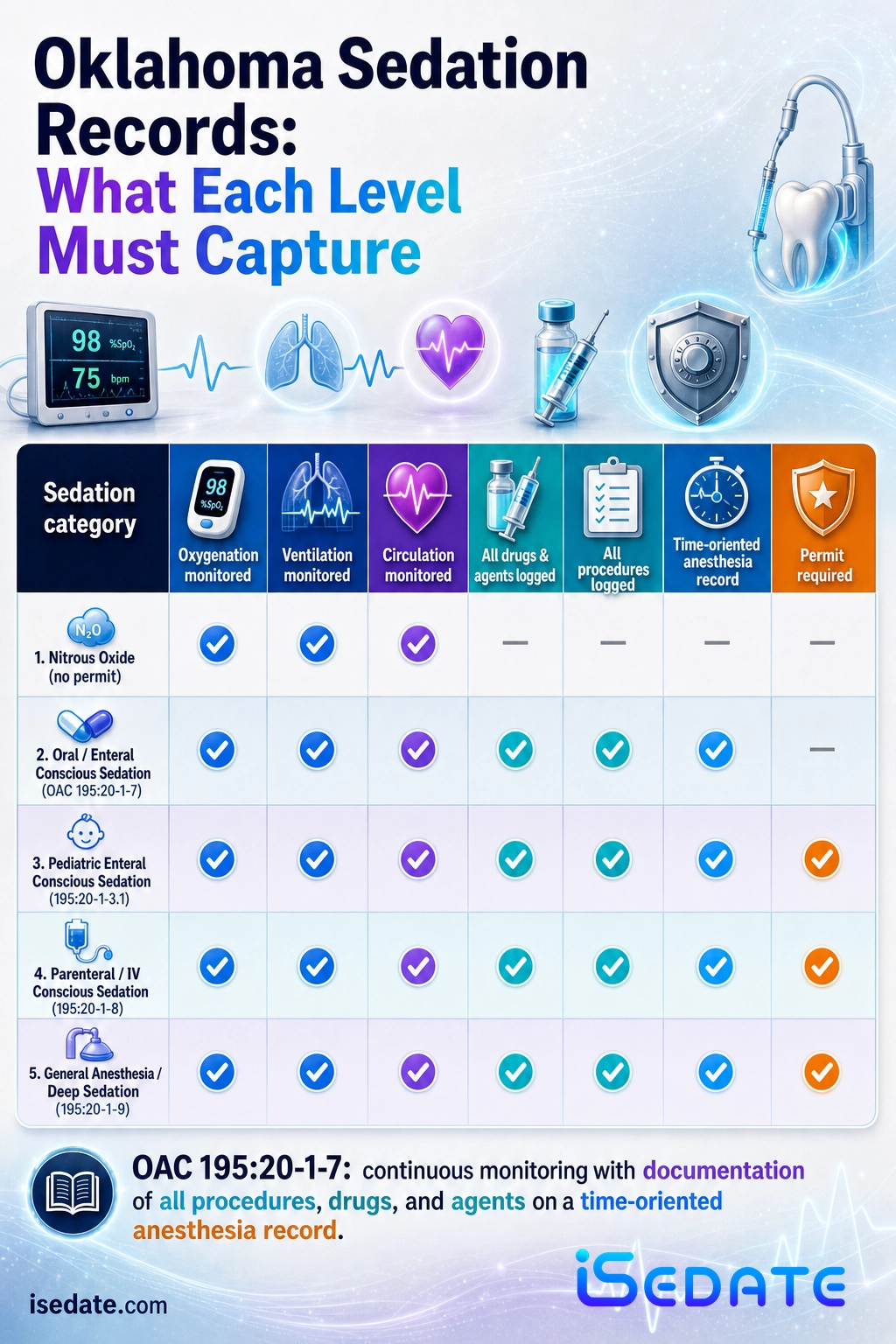
In Oklahoma, what you are required to monitor is what you are required to write down. The two are inseparable: the same sentence that names the systems you must watch also requires them to be documented. For every level of sedation, Chapter 20 requires continuous monitoring of three systems for each patient:
- Oxygenation is monitored continuously throughout the procedure, confirmed by the pulse oximeter every level requires.
- Ventilation is monitored continuously to confirm the patient is moving air.
- Circulation is monitored continuously, which in practice means tracking blood pressure and heart rate across the case.
What changes as the sedation deepens is the equipment. Chapter 20 sets a specific minimum-equipment list for each level, and a reviewer expects both the equipment to be present and its readings to appear on the record.
Minimum Monitoring Equipment by Level
- Enteral conscious sedation (195:20-1-7): blood pressure apparatus (manual or automatic) and a pulse oximeter.
- Parenteral conscious sedation (195:20-1-8): blood pressure apparatus, pulse oximeter, and an electrocardiograph for adult patients, with a defibrillator recommended per ACLS protocol.
- General anesthesia / deep sedation (195:20-1-9): blood pressure apparatus, pulse oximeter, end-tidal carbon dioxide monitor for intubated patients, temperature monitor, electrocardiograph, and a defibrillator.
General anesthesia adds one more wrinkle worth charting carefully: a device capable of measuring body temperature must be readily available, and when agents implicated in malignant hyperthermia are used, continual temperature monitoring is required. At every level, the provider must also have immediate access to pharmacologic antagonists and appropriately sized equipment to establish an airway and deliver positive-pressure ventilation with oxygen.
Myth, Busted
Myth: Nitrous or a single oral pill is light sedation, so the full monitoring and charting rules do not really apply.
Fact: The depth of sedation, not the route or the drug, drives the duty. The moment a patient reaches conscious sedation, the full 195:20-1-7 monitoring, equipment, and documentation standard applies, no matter how the agent was delivered, per the Oklahoma Title 195 anesthesia rules.
Chapter 20 defines conscious sedation by the patient's response, not the dose on your prescription pad, and patients can reach a deeper level than you intended.
Source: OAC 195:20-1-7, 195:20-1-8, and 195:20-1-9 (minimal standards)

What the record must contain: the compliance core
This is the section a reviewer reads first. Across enteral, parenteral, and general anesthesia, Oklahoma states the record duty in one repeated sentence: continuous monitoring of oxygenation, ventilation, and circulation, with documentation of all procedures, drugs, and agents on an appropriate time-oriented anesthesia record, completed for each patient. It has three parts worth knowing by heart.
1. A time-oriented anesthesia record
"Time-oriented" is the operative phrase. The record is organized against the clock, not written as a single end-of-visit summary. A note that a patient "tolerated sedation well" is not this record. A timeline of drugs, agents, doses, and procedures, kept alongside the physiologic data you were monitoring, is. Because Oklahoma does not publish a fixed numeric interval the way some states do, the standard is the genuine meaning of time-oriented: a contemporaneous record kept as the case runs, not reconstructed from memory afterward.
2. Every drug, agent, and procedure, logged against the clock
The rule names three things that must appear on the record: all procedures, all drugs, and all agents, each tied to when it happened. That is the full picture of the anesthetic encounter. Alongside those, the record should carry the monitoring your level requires, so the physiologic readings and the drug timeline sit on the same clock.
3. What compliant documentation looks like
A record that would survive a board review reads as a continuous story of the case. In practice, that means capturing:
- Pre-sedation: patient evaluation, airway assessment, baseline vitals, and the informed consent the rule requires before any sedation begins.
- Each drug and agent: name, dose, route, and the exact time given, including nitrous concentrations and any reversal agents.
- Monitoring over time: timed oxygenation, heart rate, and blood pressure entries across the case, plus end-tidal CO2 and temperature where the level requires them.
- Each procedure and event: what was done, and when, through the working phase of the case.
- Recovery and discharge: supervised recovery, a complete evaluation, and discharge to a responsible adult, which Chapter 20 requires at every level.
iSedate Charting Advice
Two Chapter 20 duties are easy to satisfy and easy to forget on paper: the dentist performing the sedation must be in the patient's presence at all times, and no provider may have more than one patient under any form of sedation at a time, exclusive of recovery. Both are the kind of operational fact a contemporaneous record should make obvious at a glance.
Oral versus IV changes the equipment and the acuity, not the record's shape. An enteral case still needs the timed drug-and-monitoring log on a blood pressure cuff and pulse oximeter; a parenteral case layers an ECG tracing for adults on top; general anesthesia adds capnography and temperature. The record grows with the case, but the compliance core, a time-oriented log of drugs, agents, procedures, and vitals, is identical at every level.
Source: OAC 195:20-1-7 through 195:20-1-9 | Oklahoma Administrative Code (Secretary of State rules database)
How Oklahoma reviews records: inspections and reporting
When the Oklahoma Board of Dentistry opens your file, it is checking the record, not your intentions. The sedation can be clinically flawless and the record can still fail, because a reviewer grades what the contemporaneous chart proves you did, and when. Chapter 20 gives the Board several structured ways in.
Permits to administer parenteral conscious sedation or general anesthesia are issued under 195:20-1-10, which also sets the review cadence: the Board re-inspects every permit holder at least once every five years, and permits are renewed annually on payment of the renewal fee. If an application or evaluation is unsatisfactory, the Board sends a written explanation of the deficiencies and suggested remedies within twenty-one days. Adverse occurrences have their own duty under 195:20-1-12: any fatality during the practice of dentistry, or the death of a patient causally related to it, must be reported to the Board within thirty days.
Here is where dentists get burned. It is rarely the clinical care that fails a review. It is the record: a drug given but not logged, an agent missing from the timeline, a procedure noted with no time attached, a monitored parameter that was watched but never written down. The care can be perfect and the record can still read as incomplete.
What a Reviewer Actually Grades
A reviewer does not grade your sedation on how the patient did. They grade it on whether the contemporaneous record proves what you did and when. If the time-oriented record has gaps, the default assumption on review is that the monitoring had gaps too. Document every drug, agent, procedure, and vital reading against the clock, for every phase of the case.
Source: OAC 195:20-1-10, 195:20-1-12, and 195:20-1-13
Why your documentation is your defense
The incomplete sedation record is not a filing technicality. It is the evidence a board weighs when deciding whether the standard of care was met, and the same gaps that fail an inspection are the gaps a plaintiff's attorney looks for in a malpractice claim. In both a board review and a lawsuit, the contemporaneous sedation record is the first thing requested and the hardest thing to reconstruct after the fact. A complete, time-stamped record is, in the most literal sense, your defense.
That is why the data behind these rules is worth reading alongside them. These research roundups cover how charting quality affects case outcomes, what the monitoring evidence shows about sedation safety, and how documentation errors undermine a chart's defensibility:
Where to Read Next
The through-line in all three is the same point Chapter 20 makes: the record is the thing that proves the care. When it is thorough and contemporaneous, it protects you. When it has holes, it works against you, no matter how good the clinical outcome was.
Build an audit-ready record automatically
The gap between knowing the rule and passing a review is almost always the same thing: a time-oriented log kept by hand during a live Conscious Sedation case. When a team is managing an airway and an anxious patient, a chart written in snatched moments is exactly where the record develops holes, a procedure logged late, an agent given in the moment and written from memory, a monitored reading never transcribed.
That is the problem SedationVault by iSedate was built to remove. It connects wirelessly to the vitals monitor already in your operatory and captures oxygenation, heart rate, blood pressure, and the other physiologic data live, on the clock, right beside the drug and agent log, so the time-oriented anesthesia record builds itself as the case runs rather than being reconstructed afterward. When the Oklahoma Board of Dentistry asks for the chart, it exports as a one-click, audit-ready sedation visit report that already carries the procedures, the drugs and agents, the times, and the monitoring the rule asks for. The point is not fancier charting. It is turning the exact items Chapter 20 requires into something the software guarantees are present and time-stamped, which is also what dental sedation compliance turns on.
Book a demo and see your Oklahoma sedation record build itselfRelated guides and neighboring states
Licensed in a neighboring state, or practicing across the region? The documentation duties and monitoring equipment differ by state, so start with the guide for the state you are working in:
- Oklahoma Sedation Dentistry Licensing & Permit Requirements (the permit and training companion to this guide)
- Texas Sedation Vitals Monitoring, Charting & Reporting Requirements
- Arkansas Sedation Vitals Monitoring, Charting & Reporting Requirements
- Kansas Sedation Vitals Monitoring, Charting & Reporting Requirements
- Missouri Sedation Vitals Monitoring, Charting & Reporting Requirements
- Colorado Sedation Vitals Monitoring, Charting & Reporting Requirements
- New Mexico Sedation Vitals Monitoring, Charting & Reporting Requirements
- See all 50 states: Dental Sedation Vitals, Charting & Reporting Requirements by State
Frequently asked questions
Does Oklahoma require a written sedation record?
How often must vitals be recorded during sedation in Oklahoma?
What monitoring equipment does Oklahoma require for sedation?
Who regulates sedation records in Oklahoma, and how often are offices inspected?
Do oral sedation and nitrous oxide need a permit in Oklahoma?
Sources and citations
Our Sources & Verification
This guide cites Oklahoma's primary regulatory sources, verified against the Oklahoma Board of Dentistry's own published rules. Rule text is drawn from Oklahoma Administrative Code Title 195, Chapter 20 (minimal standards in 195:20-1-7, 195:20-1-8, and 195:20-1-9; permits in 195:20-1-10; adverse occurrences in 195:20-1-12; inspections in 195:20-1-13), with the governing Oklahoma State Dental Act in Title 59. The regulator is the Oklahoma Board of Dentistry. Where a detail is administered by the Board and can change (current fee amounts, facility-evaluation specifics, or any documentation cadence a reviewer applies), confirm it directly with the Board before relying on it. This guide is general information for dental providers, not legal advice.
- Oklahoma Board of Dentistry: Title 195 anesthesia rules (OAR 195, full text)
- Oklahoma Administrative Code, Title 195 (Secretary of State rules database, official current text)
- Oklahoma Board of Dentistry: Statutes & Rules
- Oklahoma Board of Dentistry: anesthesia permit applications and inspection checklists
- Oklahoma State Dental Act, Title 59 (OSCN official statutes)
- DOCS Education: Oklahoma sedation training and CE courses (training provider, not a legal source)















