







Oklahoma Sedation Dentistry Licensing & Permit Requirements
In Oklahoma, your dental license alone does not let you provide deeper sedation. Pediatric enteral conscious sedation, parenteral or IV conscious sedation, and general anesthesia or deep sedation each require a matching permit from the Oklahoma Board of Dentistry, all issued under Oklahoma Administrative Code Title 195, Chapter 20. Adult oral Conscious Sedation needs no separate permit but still has to meet the board's minimal standards, and the old nitrous oxide rule has been revoked. Getting a permit means clearing the training, application, demonstration, and facility requirements for your category. Keeping it means your sedation records survive a board inspection. This guide walks both halves, with the exact rule section behind every requirement and a direct link to the board pages and forms you will actually need.
Recent Updates
Last UpdatedNovember 16, 2026
- Fact-checked every citation against the current Oklahoma Board of Dentistry rules and forms. Corrected the permit sections: the parenteral permit is 195:20-1-4 (not 195:20-1-8) and the general anesthesia permit is 195:20-1-5 (not 195:20-1-9); sections 195:20-1-7, 195:20-1-8, and 195:20-1-9 are the matching minimal-standards rules.
- Noted that the nitrous oxide analgesia rule (195:20-1-3) and the fatalities rule (195:20-1-6) have been revoked, and clarified that adult oral conscious sedation needs no separate permit.
- Added the verified $100 application fee, the evaluation-team demonstration, the facility permit, the five-year re-inspection, the hospital and ambulatory-surgery-unit exemption, and temporary permits.
- Replaced aggregator citations with the original official sources: the Oklahoma Board of Dentistry's own statutes and rules and forms pages, the state statute on OSCN, and the board's published rule text.
- Oklahoma regulates dental sedation under OAC Title 195, Chapter 20, administered by the Oklahoma Board of Dentistry, not the ADA.
- Three permits exist: pediatric enteral conscious sedation (195:20-1-3.1), parenteral or IV conscious sedation (195:20-1-4), and general anesthesia or deep sedation (195:20-1-5). Adult oral conscious sedation needs no permit but must meet 195:20-1-7.
- The parenteral permit takes 60 hours of parenteral training (or an existing general anesthesia permit), a $100 application, BLS and ACLS, a facility permit, and a live demonstration before an evaluation team.
- For conscious sedation, the board requires continuous monitoring of oxygenation, ventilation, and circulation, documented on a time-oriented anesthesia record for each patient (195:20-1-7).
- The board re-inspects permit holders on a recurring cycle (reported as five years), and incomplete sedation records are where permits get challenged.

What This Guide Covers
- Who issues sedation permits in Oklahoma
- Oklahoma's sedation categories and permits
- What the permit requires you to monitor
- How to get or upgrade each permit: training, forms, fees
- Who may administer anesthesia
- Inspections, records, and keeping the permit
- CE, renewal, and staying current
- Frequently asked questions
- Sources
Who issues sedation permits in Oklahoma
Sedation dentistry in Oklahoma is regulated by the Oklahoma Board of Dentistry, the state agency that licenses dentists and issues every dental sedation and anesthesia permit. The board, not any national body, decides who may sedate at each level, inspects the facility, reviews the records, and takes disciplinary action. The rules live in Oklahoma Administrative Code Title 195, Chapter 20, the chapter governing the administration of anesthesia, and every requirement below traces to a section of that chapter or to the governing statute. The board publishes the exact rule text and the Dental Act on its statutes and rules page.
Myth, Busted
Myth: Federal ADA law sets the sedation rules that override whatever the state says.
Fact: The ADA is a private professional association, not a government agency. In Oklahoma, your permit, your inspection, and any sanction come from the Oklahoma Board of Dentistry under Title 195, Chapter 20.
Oklahoma incorporates the ADA sedation and anesthesia guidelines by reference for the deeper categories, such as general anesthesia, but the law you are held to, and audited against, is the state rule. Separate federal layers, the DEA controlled-substance logs and HIPAA, apply on top of it, not instead of it.
Applications for the sedation and facility permits are made on the board's prescribed forms and submitted to the board office with the fee. The board lists its anesthesia application packets on its applications and forms page, and the board can be reached at (405) 522-4844 to confirm the current forms before you file.
Source: Oklahoma Board of Dentistry: Statutes & Rules | Oklahoma Board of Dentistry: Applications & Forms
Oklahoma's sedation categories and permits
Oklahoma names its sedation categories by the route and depth rather than stacking them into numbered "Levels," and a permit attaches to the deeper categories. The requirements rise as the patient is taken deeper. Here is the full ladder, each with its governing section of Chapter 20.
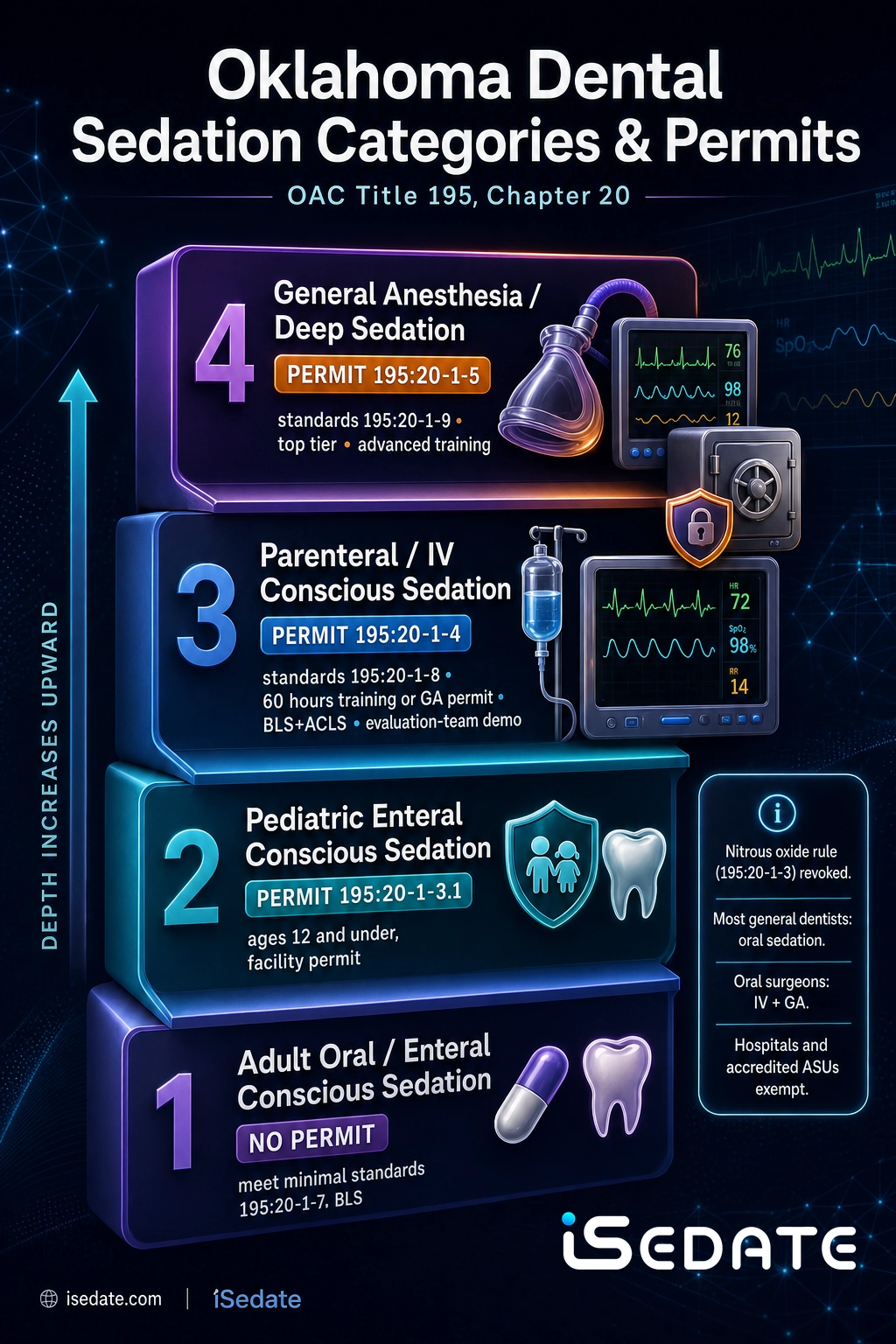
Oklahoma Dental Sedation Permit Snapshot
- Nitrous oxide analgesia (195:20-1-3, REVOKED): no dedicated permit rule; follow general standards of care.
- Adult oral / enteral conscious sedation: no separate permit; must meet minimal standards (195:20-1-7).
- Pediatric enteral conscious sedation (195:20-1-3.1): permit required; ages 12 and under.
- Parenteral / IV conscious sedation (195:20-1-4): permit required; standards in 195:20-1-8; facility permit.
- General anesthesia / deep sedation (195:20-1-5): permit required; standards in 195:20-1-9; top tier.
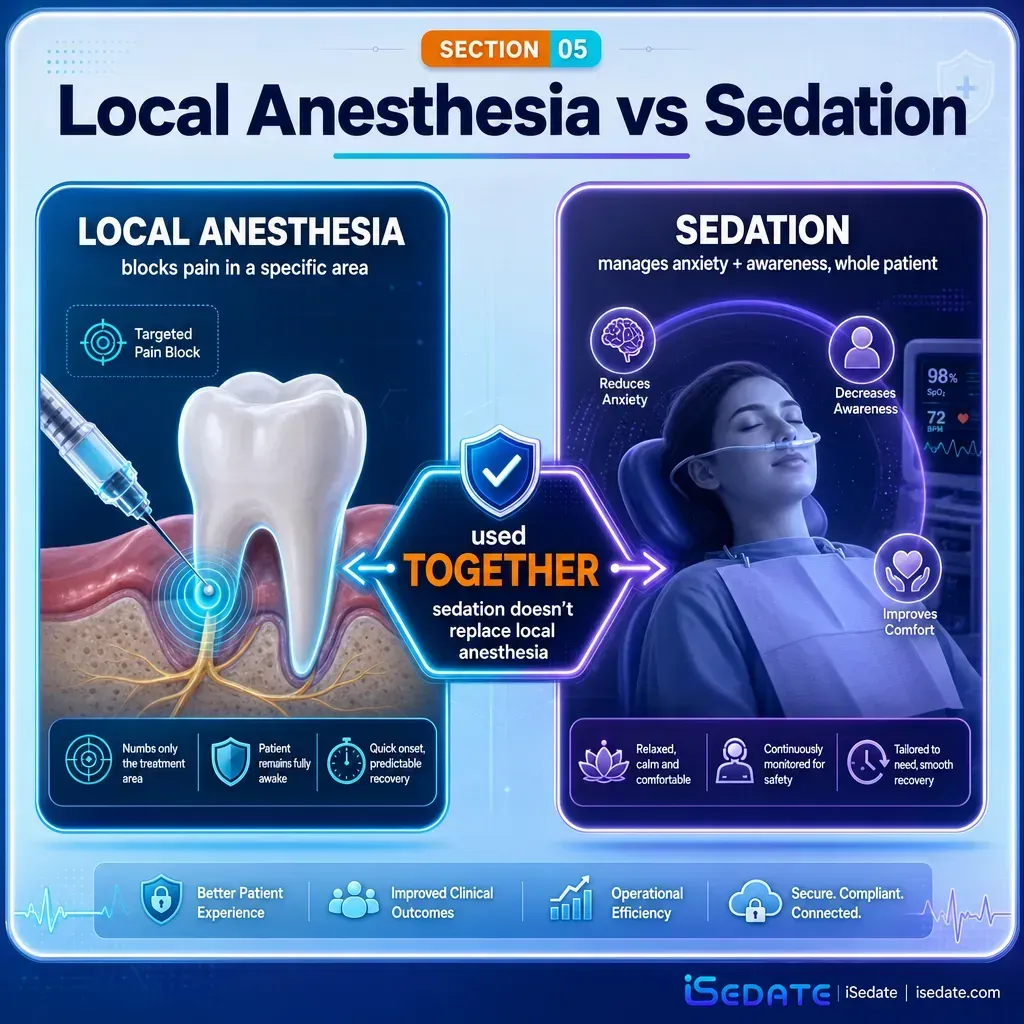
Nitrous oxide analgesia. The lightest form of anxiety control, where the patient stays fully responsive. Oklahoma's dedicated nitrous oxide rule (195:20-1-3) has been revoked, so there is no separate nitrous permit; a dentist using nitrous oxide follows the board's general standards of care.
Adult oral / enteral conscious sedation. Oral Conscious Sedation produced with an enteral sedative, where the patient still responds to verbal command, does not require a separate Oklahoma permit. It does, however, have to meet the board's minimal standards for enteral conscious sedation in 195:20-1-7, including the monitoring and time-oriented record duty covered below. This is the workhorse modality for general dentists, and "no permit" does not mean "no obligations."
Pediatric enteral conscious sedation permit (195:20-1-3.1). Oklahoma requires a dedicated permit for enteral conscious sedation, by oral, rectal, or sublingual routes, of pediatric patients age 12 and under, reflecting the narrower safety margin in children. The permit, its standards, and its application are set in 195:20-1-3.1.
Parenteral (IV) conscious sedation permit (195:20-1-4). The parenteral route, meaning IV, intramuscular, and other injected routes, carries its own permit under 195:20-1-4, with the matching minimal standards in 195:20-1-8. Because IV sedation has a faster onset and a higher risk, this category sits above oral sedation and carries heavier training, monitoring, and facility requirements. This is where oral surgeons and sedation-trained dentists typically operate.
General anesthesia / deep sedation permit (195:20-1-5). The top tier. Under 195:20-1-5, with standards in 195:20-1-9, the dentist is responsible for all aspects of the anesthetic as outlined in the ADA guidelines. General anesthesia and deep sedation are largely the province of dental anesthesiologists and oral and maxillofacial surgeons and are generally out of scope for the typical general dentist. If you are pursuing this level, work directly from 195:20-1-5 and 195:20-1-9 with the board, as its full training and facility specifics run beyond the scope of this guide.
Source: OAC Title 195, Chapter 20 (195:20-1-3.1, 195:20-1-4, 195:20-1-5)
What the permit requires you to monitor
A permit is permission plus obligation. Once you provide conscious sedation, the board's minimal standards require continuous monitoring, documented on the record. For enteral conscious sedation, 195:20-1-7 requires continuous monitoring of three systems for each patient:
- Oxygenation: monitored continuously throughout the procedure.
- Ventilation: monitored continuously, confirming the patient is moving air.
- Circulation: monitored continuously, tracking heart rate and perfusion.
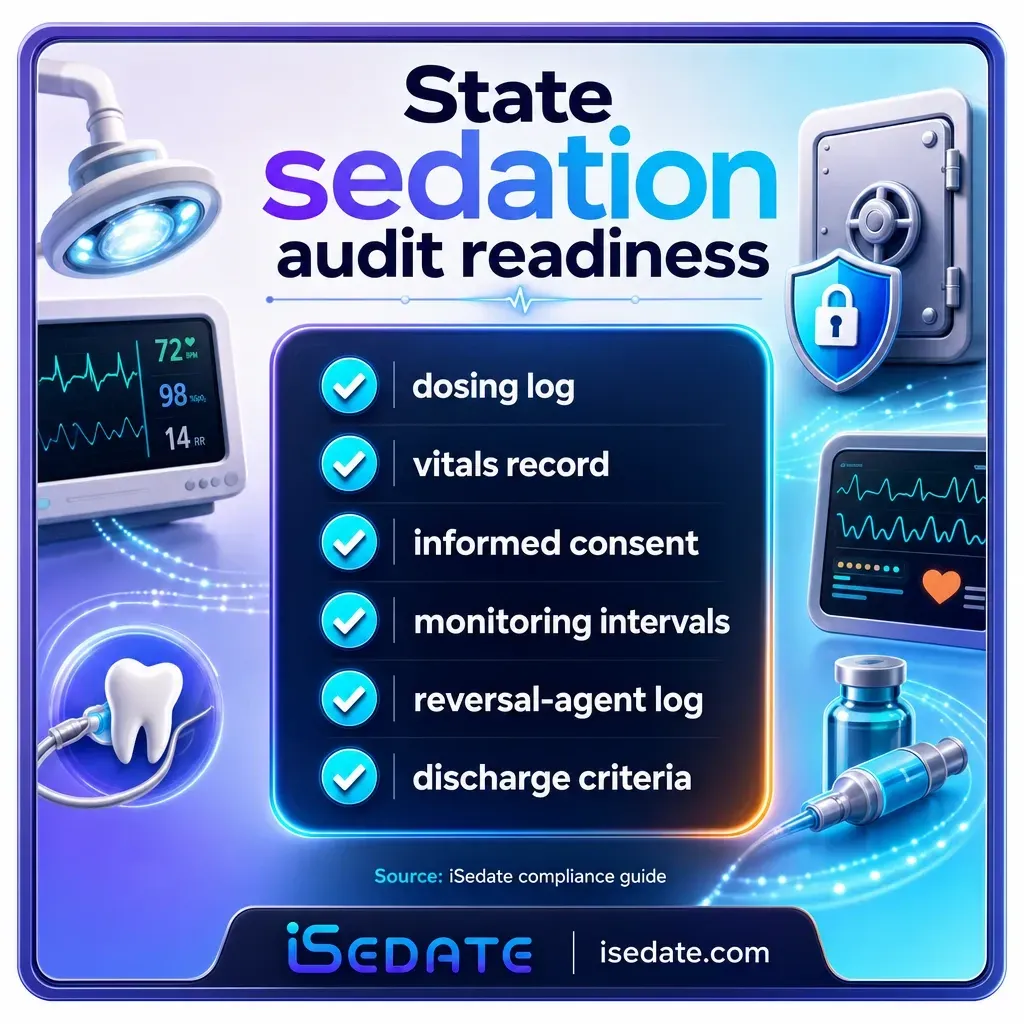
The same rule requires that all procedures, drugs, and agents be documented on an appropriate time-oriented anesthesia record for each patient. The parenteral standards (195:20-1-8) and the general anesthesia standards (195:20-1-9) carry parallel, and for the deeper categories heavier, monitoring and recording duties, and the general anesthesia rule holds the dentist responsible for all aspects of the anesthetic per the ADA guidelines. For the full clinical breakdown of what to monitor and chart at each depth, see the companion guide on Oklahoma Sedation Vitals Monitoring, Charting & Reporting Requirements, and the national overview in our Sedation Dentistry Licensing & Permit Requirements by State hub.
Source: OAC Title 195, Chapter 20 (195:20-1-7, 195:20-1-8, 195:20-1-9)
How to get or upgrade each permit: training, forms, fees
Each permitted category has its own bar to clear, and you move up by meeting the next category's requirements and applying to the board. The table below separates what the board states plainly from what you confirm against the current application packet, so no figure here is a guess.
| Category | Permit? | Rule | Training / standards | Resuscitation |
|---|---|---|---|---|
| Nitrous oxide analgesia | No permit (rule revoked) | 195:20-1-3 (revoked) | General standards of care | BLS |
| Adult oral / enteral conscious sedation | No permit; standards apply | 195:20-1-7 | Minimal standards; confirm with board | BLS |
| Pediatric enteral conscious sedation | Permit required | 195:20-1-3.1 | Per pediatric application checklist | BLS (PALS where applicable) |
| Parenteral / IV conscious sedation | Permit required | 195:20-1-4 (standards 195:20-1-8) | 60 hours parenteral training, or an existing GA permit | BLS + ACLS |
| General anesthesia / deep sedation | Permit required | 195:20-1-5 (standards 195:20-1-9) | Advanced anesthesia training; confirm with board | BLS + ACLS |
Oral conscious sedation and pediatric enteral sedation
Adult oral Conscious Sedation is the usual first step for a general practice adding light sedation, and it needs no separate Oklahoma permit, only compliance with the minimal standards in 195:20-1-7. Sedating children enterally is different: it requires the pediatric enteral conscious sedation permit (195:20-1-3.1), because the pediatric safety margin is narrower. Apply for the pediatric permit on the board's Pediatric Application and Checklist, which lists the training, certification, and facility requirements the board verifies.
Parenteral (IV) conscious sedation
Adding IV sedation is the biggest step a general dentist or oral surgeon takes in Oklahoma. Under the parenteral standards (195:20-1-8) and the board's current parenteral form, a dentist qualifies by completing at least 60 hours of training in parenteral conscious sedation techniques, or by already holding an Oklahoma general anesthesia permit. A new applicant must then demonstrate the administration of parenteral sedation to a patient before a board evaluation team, hold current BLS and ACLS, and obtain a facility permit after a facility inspection. The live demonstration exists because IV titration demands hands-on competence a classroom cannot replicate.
Applications, fees, and the facility permit
Every permitted category is applied for on the board's prescribed form, with the fee, and the board schedules an evaluation and facility inspection before issuing the permit. The board lists the Parenteral, General Anesthesia, Pediatric, and Facility application checklists on its forms page, and the current provider and facility application fee is listed at $100, non-refundable, with cash not accepted. Sedation or anesthesia a dentist provides in a state-licensed hospital or an accredited ambulatory surgery unit is exempt from the permit requirement. Fees and forms change periodically, so verify the current amounts and packets with the board before you file.
Source: Oklahoma Board of Dentistry: Applications & Forms | OAC Title 195, Chapter 20

Who may administer anesthesia
Oklahoma also sets a statutory limit on who may deliver the anesthetic. Administering sedation and assessing the patient's level of sedation is reserved to the dentist, oral and maxillofacial surgeon, pediatric dentist, anesthesiologist, or CRNA, and under the Oral Maxillofacial Surgery Expanded Duty Permit statute (59 O.S. Section 328.25), a dental assistant may not administer anesthesia care. An assistant may perform delegated tasks under supervision, such as starting and discontinuing IV lines, preparing medications, adjusting IV fluid rates, and recording vital signs, but only the surgeon or dentist may select and administer the anesthetic drugs and assess the depth of sedation.
The practical takeaway: the duty stays with the permit holder. In a dental office, the dentist must hold the matching Oklahoma permit for the category of sedation being provided, and that responsibility, including the responsibility for the record, cannot be delegated to an assistant.
Source: 59 O.S. Section 328.25
Inspections, records, and keeping the permit
This is where a permit is kept or lost. Before a sedation or facility permit is issued, the board inspects the facility, and after that it re-inspects permit holders on a recurring cycle, which the board reports as every five years (195:20-1-13). The categories that authorize deeper sedation, pediatric enteral, parenteral, and general anesthesia, carry the heaviest scrutiny, because that is where the risk is.
Where Permits Actually Get Challenged
When a reviewer opens your file, they check the record, not your intentions. A board review turns on whether your time-oriented anesthesia record is complete, contemporaneous, and documents every procedure, drug, and agent alongside the monitored vitals. The sedation can be clinically correct and the permit can still be challenged on the paperwork, because the record is the only proof of what you monitored and when. An adverse occurrence connected to sedation also triggers reporting duties to the board (195:20-1-12), and the record is the first thing the board asks to see.
That is the failure point worth engineering out. A manual anesthesia log written in snatched moments, between titrating a drug and watching an airway, is exactly where records go incomplete, and incomplete records are what a board inspection and a malpractice claim both attack. SedationVault captures live patient vitals and the drug and agent log automatically into a time-oriented, Oklahoma-ready anesthesia record built around the monitoring the board's standards demand, so the record writes itself while you focus on the patient. When the board asks for the file, a complete record is a one-click export, not a scramble through paper. See how it maps to Oklahoma's rules on the dental sedation compliance and anesthesia record software pages.
Book a Demo of SedationVault See SedationVault PricingCE, renewal, and staying current
Your sedation permit is tied to your Oklahoma dental license, and the board expects permit holders to stay current in the resuscitation certifications and continuing education appropriate to their category. The parenteral permit, for example, is renewed on the board's cycle with the required fee. The exact renewal cycle, the number of sedation-specific continuing-education hours required for each category, and the current resuscitation-certification requirements are set by board rule and updated periodically, and they are not reproduced here to avoid stating a figure that may be out of date. Confirm your current renewal cycle, CE hours, and certification requirements on the board's applications and forms page or by calling (405) 522-4844, so your permit never lapses at renewal.
Frequently asked questions
Do you need a permit to sedate patients in Oklahoma?
How do you qualify for an Oklahoma IV sedation permit?
Who may administer general anesthesia in an Oklahoma dental office?
How often does Oklahoma inspect a dental sedation office?
Does Oklahoma still require a nitrous oxide permit?
Related guides and neighboring states
Licensed in a neighboring state, or mapping requirements across your region? See our companion guides:
- Arkansas Sedation Dentistry Licensing & Permit Requirements
- Colorado Sedation Dentistry Licensing & Permit Requirements
- Kansas Sedation Dentistry Licensing & Permit Requirements
- Missouri Sedation Dentistry Licensing & Permit Requirements
- New Mexico Sedation Dentistry Licensing & Permit Requirements
- Texas Sedation Dentistry Licensing & Permit Requirements
- Sedation Dentistry Licensing & Permit Requirements by State (all 50)
Sources
- Oklahoma Board of Dentistry: Statutes & Rules (official rule and statute text, including OAC Title 195, Chapter 20)
- Oklahoma Board of Dentistry: Applications & Forms (parenteral, general anesthesia, pediatric, and facility application checklists)
- Oklahoma Board of Dentistry (official board home and contact)
- 59 O.S. Section 328.25: Oral Maxillofacial Surgery Expanded Duty Permit (who may administer and monitor anesthesia)
- Oklahoma Secretary of State: Oklahoma Administrative Code (Title 195 rules)
This guide summarizes Oklahoma dental sedation permit rules for general information and is not legal advice. The permit structure, the parenteral training and demonstration requirement, the facility permit, the monitoring and record duties, the inspection cycle, and the hospital and ambulatory-surgery-unit exemption are drawn from OAC Title 195, Chapter 20 and the Oklahoma Board of Dentistry's application materials, and 59 O.S. Section 328.25, as cited. Specific fees, renewal cycles, continuing-education hours, resuscitation-certification specifics, general-anesthesia training details, the exact inspection schedule, and the penalty and reporting specifics are set by the Oklahoma Board of Dentistry and should be confirmed directly with the board at (405) 522-4844 before you act.