






New Mexico Sedation Dentistry Licensing & Permit Requirements
In New Mexico, your dental license alone does not let you sedate a patient. Minimal sedation, moderate sedation (historically called Conscious Sedation), and deep sedation or general anesthesia each require a matching permit from the New Mexico Board of Dental Health Care, and nitrous oxide requires a separate registration, all under 16.5.15 NMAC. Getting the permit means meeting the training, application, fee, and facility requirements for your level. Keeping it means your sedation records and your separate drug log survive a board inspection. This guide walks both halves, with the exact rule section behind every requirement and a direct link to each board page you will need.
Recent Updates
Last UpdatedNovember 16, 2026
- Fact-checked every requirement against the primary rule text (16.5.15 NMAC and the 16.5.5 NMAC fee schedule) on the state's own publisher.
- Corrected the structure: nitrous oxide is a board registration (16.5.15.12) and enteral anxiolysis alone needs no permit (16.5.15.11); the three true permits are minimal, moderate, and deep sedation.
- Added the verified permit fees ($25 / $25 / $300 / $300), the facility-permit and relocation rule, the application procedure, and the CRNA requirements.
- Replaced aggregator citations with the original official sources: the New Mexico Administrative Code and the New Mexico Board of Dental Health Care's own pages.
- Three permit levels (minimal, moderate, deep/general anesthesia) plus a separate nitrous registration are governed by 16.5.15 NMAC; enteral anxiolysis alone needs no permit.
- The minimal sedation pathway requires 16 hours of course time with clinically oriented patient experiences (16.5.15.13); moderate and deep require advanced anesthesia training per the current ADA guidelines.
- Current permit fees are $25 nitrous, $25 minimal, $300 moderate, and $300 deep/general anesthesia (16.5.5.8(H) NMAC).
- Moderate and deep permits are tied to one approved facility; relocating requires a new facility permit and fee (16.5.15.14, 16.5.15.15, 16.5.15.20).
- A separate drug log is required for minimal, moderate, and deep sedation, and your records are subject to inspection, scheduled or unannounced.
What This Guide Covers
- Who issues sedation permits in New Mexico
- The New Mexico sedation ladder: one registration, three permits
- What each level requires you to monitor
- How to get or upgrade each permit: training, application, fees
- Facility permits and relocation
- Using a CRNA for office anesthesia
- Records and reporting tied to your permit
- Inspections and keeping the permit
- CE, renewal, and staying current
- Frequently asked questions
- Sources
Who issues sedation permits in New Mexico
Sedation dentistry in New Mexico is regulated by the New Mexico Board of Dental Health Care, a board within the state's Regulation and Licensing Department. The board, not any national body, decides who may sedate, evaluates the dentist and the facility, runs the record inspections, and takes disciplinary action. The rules live in 16.5.15 NMAC, the part of the New Mexico Administrative Code titled for sedation, anesthesia, and analgesia, and every requirement below traces to a section of that part.
Myth, Busted
Myth: Federal ADA law sets sedation rules that override whatever the state says.
Fact: The ADA is a private professional association, not a government agency. In New Mexico, your permit, your inspection, and any sanction come from the Board of Dental Health Care under 16.5.15 NMAC.
New Mexico incorporates the current ADA sedation guidelines by reference for parts of the rule, such as advanced training and recovery and discharge, but the law you are held to, and audited against, is the state rule. Separate federal layers (DEA controlled-substance logs, HIPAA) apply on top of it, not instead of it.
Applications for the sedation permits are obtained from the board office and submitted through the department's online licensing system, and the completed application and fee are forwarded to the board's anesthesia committee for review (16.5.15.19 NMAC). You can reach the board's licensing resources on its Licensing, Registration, and Renewal page or apply through the department's online services portal. The board can be reached by phone at (505) 476-4622 to confirm current forms before you file.
Source: New Mexico Board of Dental Health Care | 16.5.15 NMAC
The New Mexico sedation ladder: one registration, three permits
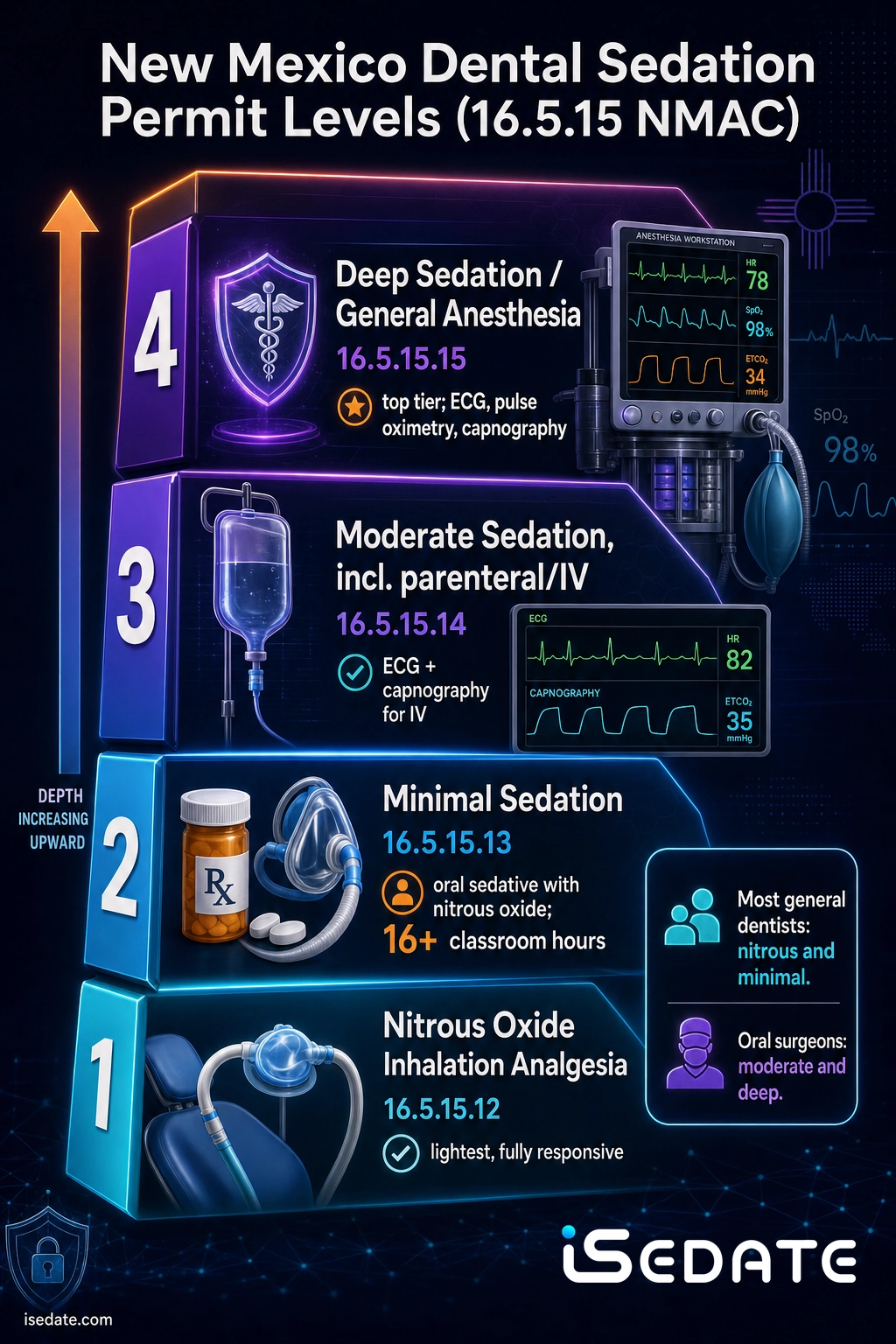
New Mexico does not number its authorizations "Level 1 through 4." It separates them by the type and depth of sedation, and the requirements rise as the patient is taken deeper. One route needs only a registration, three need a permit, and the lightest route needs neither. Here is the full ladder, each with its governing section of 16.5.15 NMAC.
New Mexico Sedation Permit Snapshot
- Enteral anxiolysis, no nitrous (16.5.15.11): no permit or registration required.
- Nitrous oxide inhalation analgesia (16.5.15.12): registration required; a non-expiring certificate is issued.
- Minimal sedation (16.5.15.13): permit required; 16 hours of course time.
- Moderate sedation, incl. parenteral/IV (16.5.15.14): permit required; facility-specific; advanced training.
- Deep sedation / general anesthesia (16.5.15.15): permit required; facility-specific; top tier.
Enteral anxiolysis (16.5.15.11 NMAC). The lightest route. A single dose of an oral anti-anxiety medication intended only to relieve anxiety, with no nitrous oxide, does not require a sedation permit. The patient stays fully responsive. The rule still asks that you note the medication, the release time, and whether a driver accompanied the patient.
Nitrous oxide inhalation analgesia (16.5.15.12 NMAC). The entry authorization. To administer nitrous oxide and oxygen, a dentist must be registered with the board rather than permitted, and the board issues a certificate that does not expire. The record must note the nitrous dose percentage, the time of administration, and the time the patient is released.
Minimal sedation permit (16.5.15.13 NMAC). This permit covers minimal sedation produced with an oral sedative combined with nitrous oxide, where the patient still responds normally to verbal command. It is the common starting point for a general practice adding light oral sedation with nitrous. The office must have adequate equipment to monitor the patient's vital signs.
Moderate sedation permit (16.5.15.14 NMAC). Moderate sedation, historically known as Conscious Sedation, is a single level in New Mexico that includes the parenteral route, meaning IV and other injected routes, rather than splitting enteral and IV into separate numbered permits. The patient responds purposefully to verbal or tactile stimulation and keeps their own airway. Because the parenteral route carries faster onset and higher risk, this level adds heavier monitoring and is tied to a specific approved facility. This is where oral surgeons and sedation-trained dentists typically operate.
Deep sedation or general anesthesia permit (16.5.15.15 NMAC). The top tier. It authorizes deep sedation and general anesthesia, where the patient is not easily aroused or is unconscious and may need airway support. Deep sedation and general anesthesia is largely the province of dental anesthesiologists and oral and maxillofacial surgeons, and it is generally out of scope for the typical general dentist. If you are pursuing this level, work directly from 16.5.15.15 NMAC with the board, as its full training and facility specifics run beyond the scope of this guide.
Source: 16.5.15 NMAC | 16.5.15 NMAC (full part, PDF)
What each level requires you to monitor
A permit is permission plus obligation. Under 16.5.15.7 NMAC, to "monitor" means to constantly watch or check on the condition of the patient, and the monitoring duties escalate with your level:
- Nitrous oxide (16.5.15.12): the record must reflect monitoring of blood pressure, pulse, and respiratory rate, plus the nitrous dose percentage and the administration and release times.
- Minimal sedation (16.5.15.13): the office must have adequate equipment to monitor vital signs, and the record must reflect blood pressure, pulse, pulse oximetry, and respiratory rate, plus the effect of the medication.
- Moderate sedation (16.5.15.14): the record must reflect the pre-operative evaluation including ASA class, pulse oximetry, and blood pressure, with ECG required for parenteral administration and ETCO2 capnography or a precordial stethoscope required for moderate parenteral sedation.
- Deep sedation / general anesthesia (16.5.15.15): the record must reflect ECG, pulse oximetry, blood pressure, and ETCO2 capnography.
For the full clinical breakdown of what to chart at each depth, including the separate drug log New Mexico requires, see the companion guide on New Mexico Sedation Vitals Monitoring, Charting & Reporting Requirements, and the national overview in our Sedation Dentistry Licensing & Permit Requirements by State hub.
Source: 16.5.15 NMAC
How to get or upgrade each permit: training, application, fees
Each permit has its own bar to clear, and you move up the ladder by meeting the next level's requirements and applying to the board. New Mexico spells out the minimal sedation training pathway explicitly. For moderate and deep sedation, the rule requires completion of an advanced training program in anesthesia beyond the undergraduate dental curriculum that satisfies the most current ADA sedation and general anesthesia guidelines, rather than publishing a fixed New Mexico hour count. The table below separates what the rule states plainly from what you confirm with the board, so no figure here is a guess.
| Authorization | Route / depth | Training (per rule) | Fee (16.5.5.8(H)) |
|---|---|---|---|
| Nitrous oxide (16.5.15.12) | Inhalation analgesia, lightest | Registration; board-approved nitrous course | $25 |
| Minimal sedation (16.5.15.13) | Oral sedative with nitrous oxide | 16 hours of course time with clinical patient experiences | $25 |
| Moderate sedation (16.5.15.14) | Includes parenteral / IV | Advanced anesthesia training per current ADA guidelines | $300 |
| Deep sedation / GA (16.5.15.15) | Deep sedation / general anesthesia | Advanced anesthesia training per current ADA guidelines | $300 |
Nitrous oxide and minimal sedation
The minimal sedation pathway is the one New Mexico states plainly: 16 hours of course time that includes clinically oriented patient experiences demonstrating competency, for minimal sedation using an oral sedative with nitrous oxide (16.5.15.13 NMAC). Nitrous oxide alone is the lighter, entry-level route and requires only registration. These are the most accessible authorizations and the usual first step for a general practice adding light sedation.
Moderate and deep sedation
Upgrading to moderate sedation (16.5.15.14 NMAC), which in New Mexico includes the parenteral and IV route, is the biggest step a general dentist or oral surgeon takes, because IV titration demands hands-on competence a classroom cannot replicate, and it brings ECG and capnography obligations with it. Deep sedation and general anesthesia (16.5.15.15 NMAC) sits above that. For both, the rule points to completion of an advanced training program in anesthesia that satisfies the current ADA guidelines, and the board or its anesthesia committee may require an examination of the practitioner and the facility. Reliable, New Mexico-specific figures for hours, resuscitation certifications, and any live-patient counts should come straight from the board's application materials, not a CE provider's marketing page.
Application, fees, and the board's review
You obtain the application from the board office and submit it with the fee; the board forwards it to the anesthesia committee, which evaluates your credentials and, for the higher levels, your facility, and recommends a decision to the full board (16.5.15.19 NMAC). The permit fees are set in the board's fee rule: $25 for nitrous oxide, $25 for minimal sedation, and $300 each for moderate and deep sedation or general anesthesia (16.5.5.8(H) NMAC). Fee rules change periodically, so verify the current amounts and any facility or renewal fees on the board's Licensing, Registration, and Renewal page before you file. For the required coursework, the board publishes its own list of sedation educational programs.
Source: 16.5.5 NMAC (fee schedule) | 16.5.15 NMAC
Facility permits and relocation
For the higher levels, the permit is tied to the room it was approved in, not just to you. A moderate sedation permit is valid only at the facility approved on the permit (16.5.15.14 NMAC), and deep sedation and general anesthesia permits are likewise issued for a specific facility (16.5.15.15 NMAC). The board evaluates the facility, its equipment, and its personnel as part of granting the permit.
That has a practical consequence many dentists miss: if you relocate your practice, you need a new facility permit, based on re-examination or an affidavit of compliance, and a new fee applies (16.5.15.20 NMAC). Opening a second location, or moving across town, is not automatic. Plan the re-approval before you schedule sedation cases at the new address.

Using a CRNA for office anesthesia
Some practices bring in a Certified Registered Nurse Anesthetist to deliver the anesthesia while the dentist operates. New Mexico allows this within limits (16.5.15.16 NMAC). The CRNA may administer sedation only up to the permit level held by the operating dentist and approved for the facility. The CRNA must be licensed in New Mexico and be a member in good standing of the staff of an accredited New Mexico hospital in the community where the anesthesia is given. The operating dentist stays responsible for the facility, its equipment, and helping manage any emergency, and must notify the board's anesthesia committee of every anesthetist used.
Source: 16.5.15 NMAC
Records and reporting tied to your permit
Holding a permit also means holding a set of documentation duties, and these are exactly what a board inspection examines.
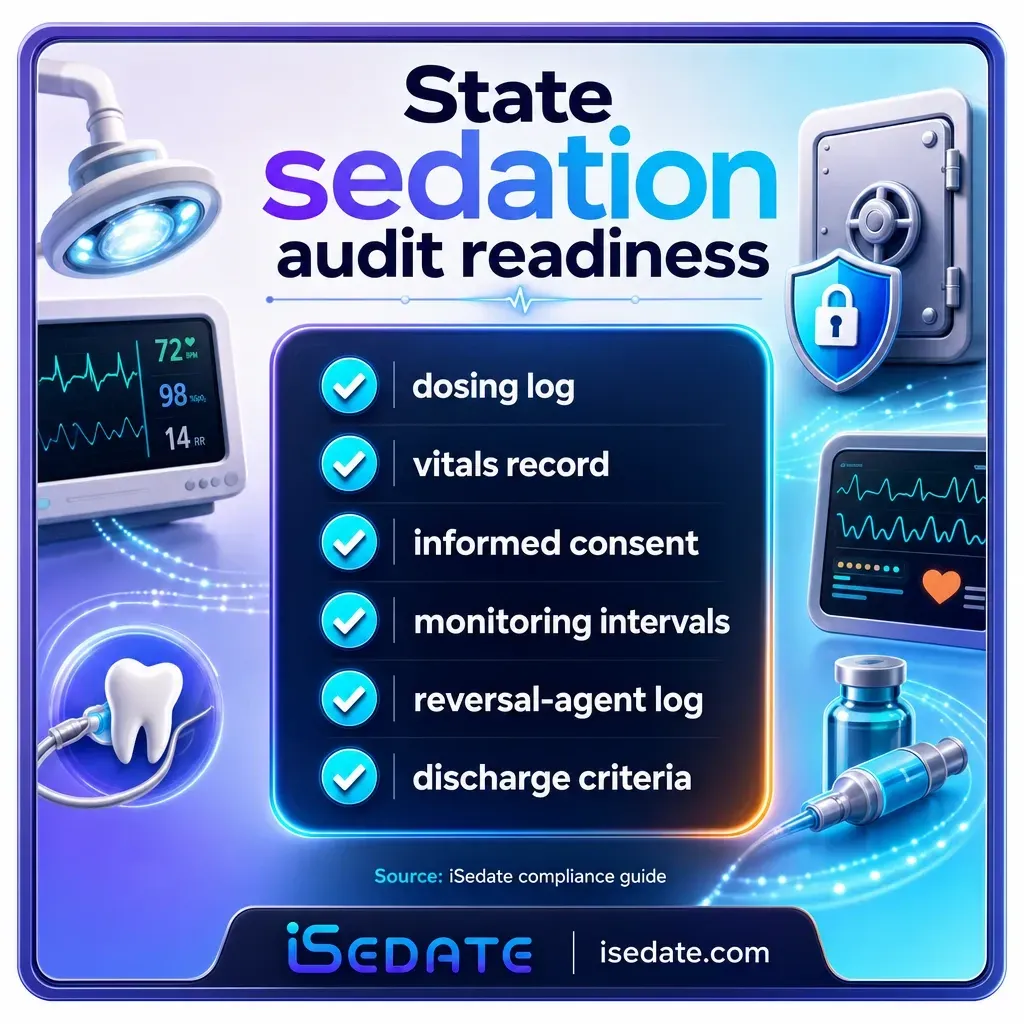
The patient record. For each level, the patient record must reflect the vital-sign monitoring required above, the ASA physical-status classification, and the patient's informed consent. For nitrous oxide, the record must note the dose percentage, the time of administration, and the time of release.
The separate drug log. This is a New Mexico-specific duty. For minimal, moderate, and deep sedation (16.5.15.13, 16.5.15.14, and 16.5.15.15 NMAC), the dentist must keep a log, separate from the patient record, that lists the drugs used, the dose or amount, and the date of administration.
Recovery and discharge. For moderate sedation and for deep sedation or general anesthesia, recovery and discharge must be performed and documented per the current ADA guidelines (16.5.15.14 and 16.5.15.15 NMAC). For minimal sedation, the dentist must verify the patient has transportation home.
Enforcement. Under 16.5.16 NMAC and the state's Uniform Licensing Act, rule violations can lead to board disciplinary action, including revocation of the sedation or anesthesia permit. The specific penalty schedule and any reporting triggers are set by the board; confirm current details directly with the New Mexico Board of Dental Health Care.
Source: 16.5.15 NMAC
Inspections and keeping the permit
This is where a permit is kept or lost. Holding a New Mexico sedation permit comes with a standing agreement to be inspected. The board's sedation affidavit provides that all aspects of the facility and provider that pertain to the use of anesthesia, including previous sedation records, are subject to inspection, scheduled or unannounced. An inspector can arrive without notice, and the records you produce are the records exactly as they stand that day.
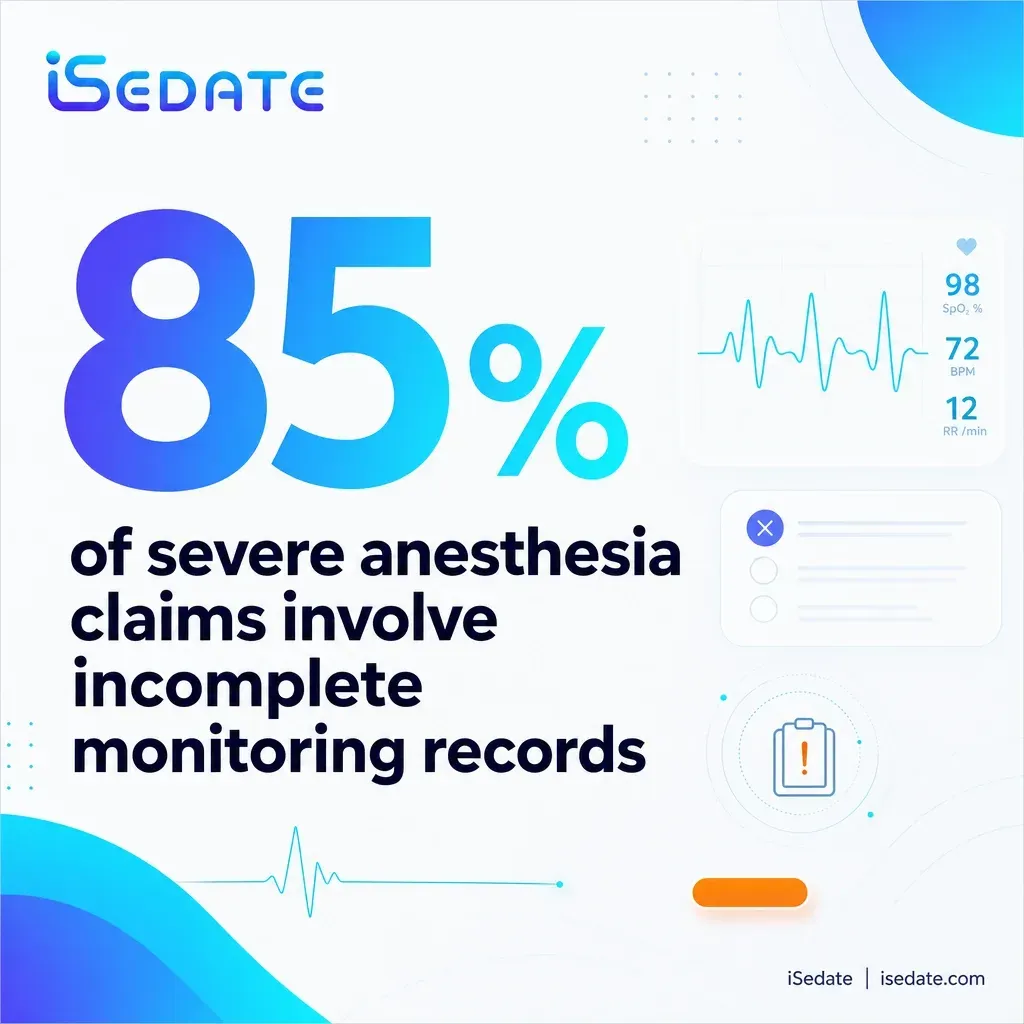
When a reviewer opens your file, they check the record, not your intentions. It is rarely the clinical care that fails a review. It is the paperwork: a missing separate drug log, a chart that does not reflect the monitored vitals the level required, an ASA class that was assigned but never written, a nitrous case without its administration and release times. The dentist did the sedation correctly but lost on the documentation.
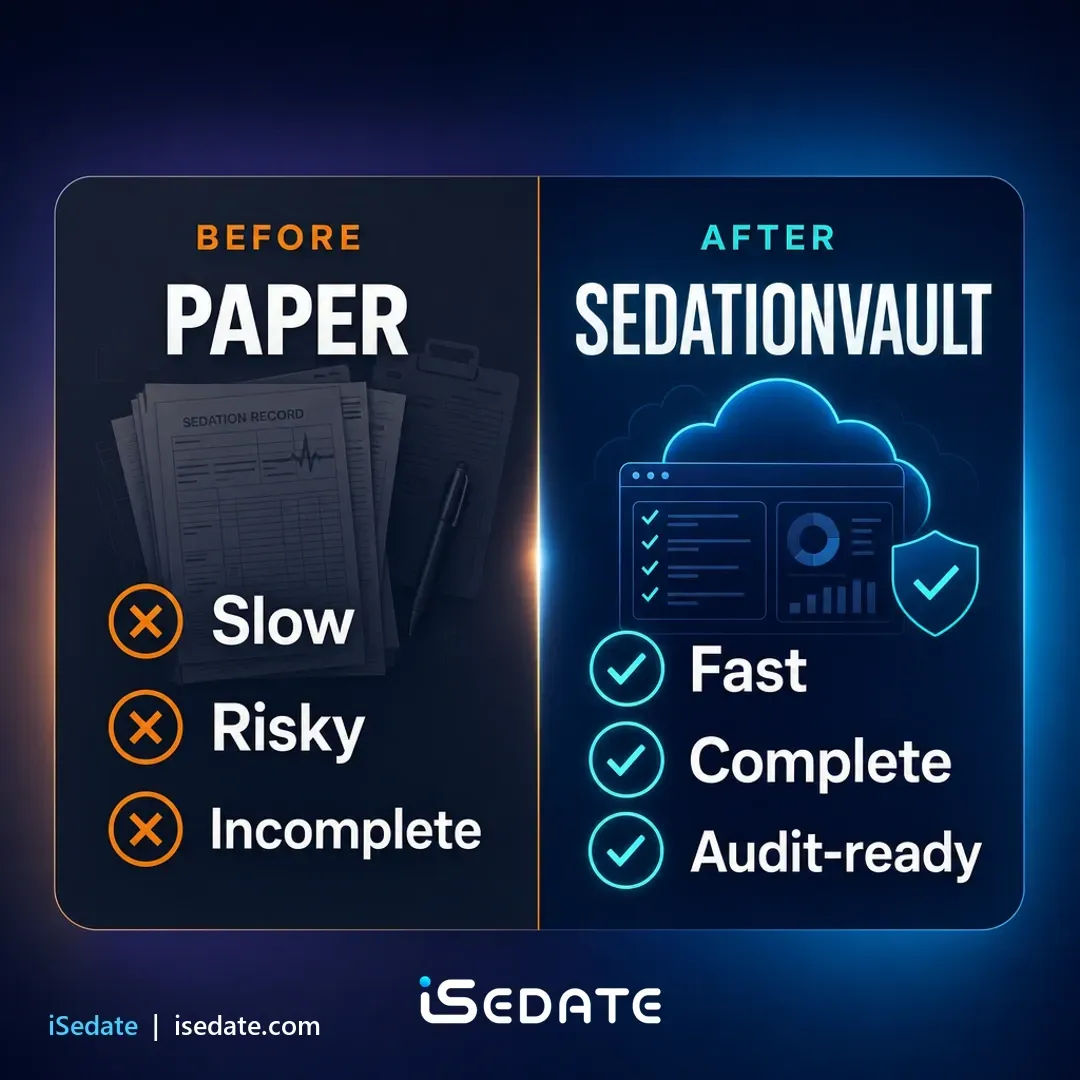
That is the failure point worth engineering out. A vitals log and a separate drug log kept by hand, between titrating a drug and watching an airway, are exactly where records go incomplete, and incomplete records are what a board inspection and a malpractice claim both attack. SedationVault captures live patient vitals automatically into a time-oriented record and maintains the separate drug log alongside it, so both of the documents New Mexico requires are built while you focus on the patient, not reconstructed after the case. When the board asks for the file, a complete record and drug log are a one-click export. See how it maps to New Mexico's rules on the dental sedation compliance and anesthesia record software pages.
Book a Demo of SedationVault See SedationVault PricingCE, renewal, and staying current
Your sedation permit is tied to your New Mexico dental license, and the board expects permit holders to stay current in the resuscitation certifications and continuing education appropriate to their level. The nitrous registration and nitrous permit do not expire, but the sedation permits renew on the board's cycle, and relocation triggers a fresh facility review as covered above. The exact renewal cycle, the number of sedation-specific CE hours, and the current resuscitation-certification requirements are set by board rule and updated periodically, so confirm them directly on the board's Licensing, Registration, and Renewal page so your permit never lapses at renewal.
Frequently asked questions
Do you need a permit to sedate patients in New Mexico?
Does New Mexico have a separate IV sedation permit?
What are the New Mexico dental sedation permit fees?
Is a New Mexico moderate or deep sedation permit tied to a specific office?
Can a CRNA give the anesthesia in my dental office?
How do you keep a New Mexico sedation permit in good standing?
Related guides and neighboring states
Licensed in a neighboring state, or mapping requirements across your region? See our companion guides:
- Arizona Sedation Dentistry Licensing & Permit Requirements
- Colorado Sedation Dentistry Licensing & Permit Requirements
- Oklahoma Sedation Dentistry Licensing & Permit Requirements
- Texas Sedation Dentistry Licensing & Permit Requirements
- Sedation Dentistry Licensing & Permit Requirements by State (all 50)
Sources
- 16.5.15 NMAC: Sedation, Anesthesia, and Analgesia (rule text)
- 16.5.15 NMAC (full part, PDF)
- 16.5.5 NMAC: Fees (anesthesia permit fee schedule)
- New Mexico Board of Dental Health Care (official board page)
- New Mexico Board of Dental Health Care: Licensing, Registration, and Renewal
- New Mexico sedation affidavit (inspection authority)
- New Mexico Board of Dental Health Care: sedation educational programs
This guide summarizes New Mexico dental sedation permit rules for general information and is not legal advice. The permit structure, the minimal sedation training pathway, the fee schedule, the facility and relocation rules, the monitoring parameters, and the record and drug-log duties are drawn from 16.5.15 NMAC and 16.5.5 NMAC as cited. Fee amounts, renewal cycles, continuing-education hours, resuscitation-certification specifics, moderate and deep training hours, any live-patient counts, and the current application forms are set by the New Mexico Board of Dental Health Care and should be confirmed directly with the board (505) 476-4622 before you act.