






Texas Sedation Dentistry Licensing & Permit Requirements
In Texas, your dental license alone does not let you sedate a patient. Any dentist or oral surgeon who administers nitrous oxide, oral sedation, IV sedation, or general anesthesia must first hold the matching permit from the Texas State Board of Dental Examiners, issued under 22 Texas Administrative Code, Chapter 110. Getting the permit means clearing training, certification, and live-patient requirements for your level. Keeping it means your sedation records survive a Board review and a facility inspection. This guide walks both halves: how a Texas dentist gets a sedation or anesthesia permit, and exactly what it takes to keep it.
Recent Updates
Last UpdatedNovember 16, 2026
- Added the Board's current continuing-education and renewal requirements (6 hours for Level 1, 8 for Levels 2 and 3, 12 for Level 4, every two years), confirmed on the TSBDE anesthesia renewal page.
- Added the facility-inspection rule under 22 TAC Section 110.18 (new Level 2 through 4 permits inspected within one year) and the Board's current anesthesia contact ([email protected]).
- Replaced third-party citations with the Board's own official pages for applications, renewal, forms, and rules.
- Texas issues five sedation and anesthesia permits under 22 TAC Chapter 110, from Nitrous Oxide up to Level 4 Deep Sedation / General Anesthesia.
- Most general dentists work at Level 1 (minimal) or Level 2 (moderate, enteral, oral Conscious Sedation); oral surgeons and sedation-trained dentists add Level 3 (moderate, including IV). Level 4 is the top tier.
- The jump to IV is real: Level 2 needs at least 24 training hours and 3 live patients; Level 3 needs at least 60 didactic hours and 10 live patients, plus ACLS and BLS.
- New Level 2 through 4 permit holders are inspected within one year (22 TAC Section 110.18), and the permit renews with your dental license plus level-based CE.
- For moderate sedation, Texas requires a written time-oriented anesthetic record with vitals documented at intervals of no more than 10 minutes. Incomplete records are where permits get challenged.
What This Guide Covers
- Who issues sedation permits in Texas
- The five Texas permit levels
- How to get or upgrade each permit
- How the application actually works
- What the permit requires you to monitor
- Reporting and recordkeeping obligations
- Renewal and continuing education
- Inspections and record reviews
- Keeping the permit: audit-ready records
- Licensed in a neighboring state?
- Frequently asked questions
Who issues sedation permits in Texas
Sedation dentistry in Texas is regulated by the Texas State Board of Dental Examiners (TSBDE), the state agency that licenses dentists and issues every sedation and anesthesia permit. The Board, not any national body, decides who may sedate, runs the facility inspections and record reviews, and takes disciplinary action. The rules live in the Board's own Dental Practice Act and TSBDE Rules, specifically 22 Texas Administrative Code, Title 22, Part 5, Chapter 110, "Sedation and Anesthesia." Every requirement below traces to a section of that chapter.
Myth, Busted
Myth: Federal ADA law sets sedation rules and overrides the state, so meeting the ADA guidelines is enough.
Fact: The American Dental Association is a private professional association, not a government agency. It does not license, inspect, or discipline anyone. Your permit, your inspections, and any sanctions come from the TSBDE under its Chapter 110 rules.
Texas, like many states, leans on the ADA's sedation guidelines as a baseline, and Chapter 110 mirrors much of it. Treat the ADA guidelines as best practice and Chapter 110 as the law you are actually held to. The federal layers that do apply are different ones: DEA controlled-substance records, HIPAA, and payer rules.
Source: TSBDE Anesthesia Privileges and Applications | TSBDE Rules (22 TAC Chapter 110)
The five Texas permit levels
Texas names its permits by level, and the level reflects how deeply the patient is sedated, not just which drug or route is used. Here is the full ladder, each rung with its governing section of Chapter 110.
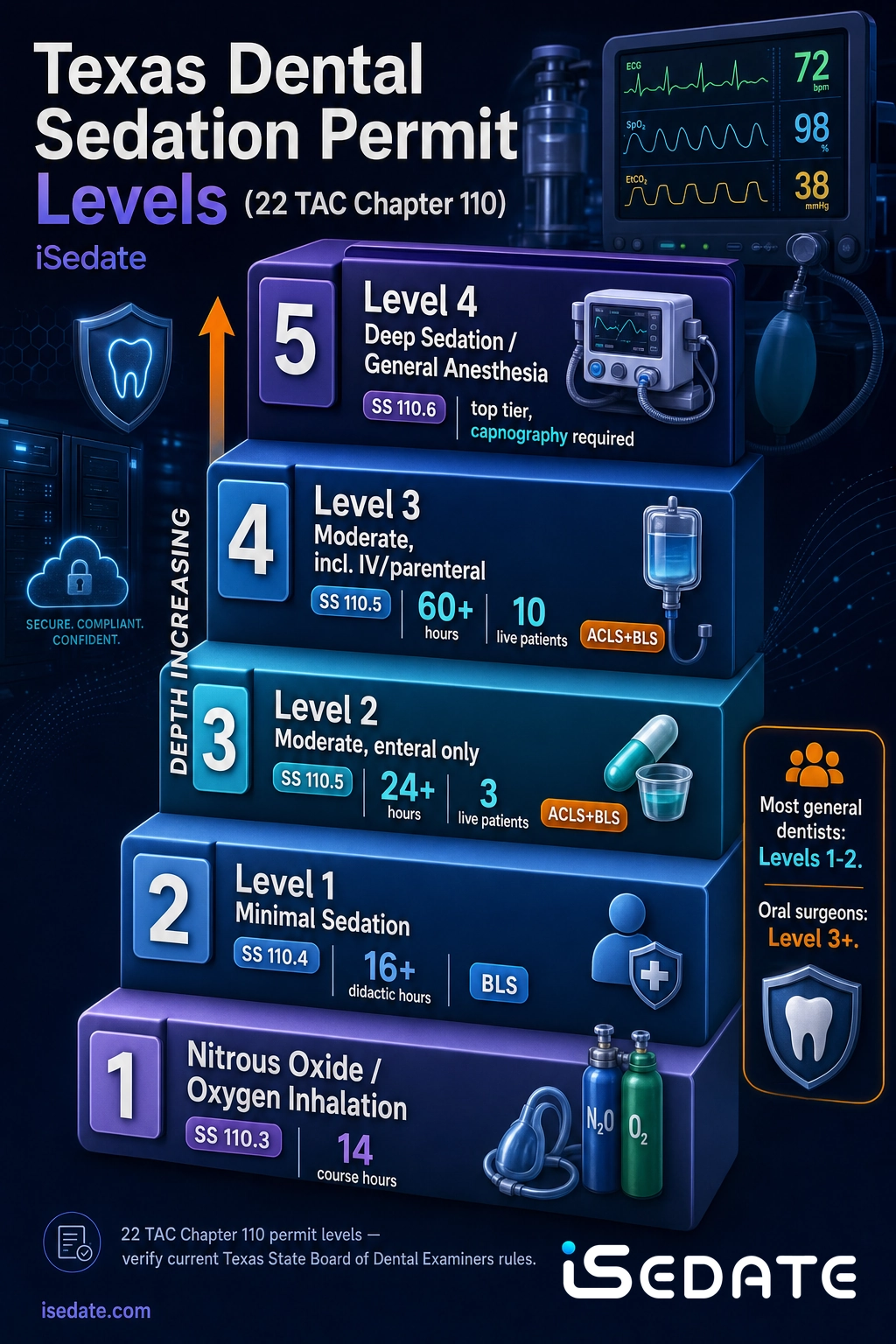
Nitrous Oxide/Oxygen Inhalation Sedation permit (22 TAC Section 110.3). The entry permit. It authorizes nitrous oxide and oxygen inhalation sedation, the lightest form of anxiety control, where the patient stays fully responsive.
Level 1 Minimal Sedation permit (22 TAC Section 110.4). Authorizes minimal sedation (anxiolysis), typically a single oral drug, where the patient responds normally to verbal command and airway and cardiovascular function are unaffected. This is the common starting point for general dentists who offer light oral sedation.
Level 2 Moderate Sedation permit, enteral only (22 TAC Section 110.5). Authorizes moderate Conscious Sedation by the enteral route only, meaning oral or other non-injection routes. The patient responds purposefully to verbal or tactile stimulation and keeps their own airway. This is the workhorse permit for dentists doing genuine oral conscious sedation.
Level 3 Moderate Sedation permit, including parenteral/IV (22 TAC Section 110.5). Authorizes moderate sedation that includes the parenteral route, that is, IV sedation and other injected routes. Because IV sedation carries a higher risk and a faster onset, Level 3 sits above Level 2 and carries heavier training, monitoring, and record requirements. This is where oral surgeons and sedation-trained dentists typically operate.
Level 4 Deep Sedation or General Anesthesia permit (22 TAC Section 110.6). The top tier. It authorizes deep sedation and general anesthesia, where the patient is not easily aroused or is unconscious and may need airway support. Level 4 is largely the province of dental anesthesiologists and oral and maxillofacial surgeons and sits beyond the scope of most general practices. Its full training and monitoring rules live in Section 110.6; if you are pursuing it, work directly from that section with the Board.
Source: TSBDE Rules, 22 TAC Chapter 110 | TSBDE Anesthesia Privileges and Applications
How to get or upgrade each permit
Each permit has its own bar to clear: a set number of training hours, resuscitation certification, and, for moderate sedation, a count of managed live patients. You move up the ladder by meeting the next level's requirements and applying to the Board. The figures below come straight from Chapter 110.
| Permit | Route / depth | Training | Live patients | Resuscitation |
|---|---|---|---|---|
| Nitrous Oxide (Section 110.3) | Inhalation, lightest | 14 course hours incl. clinical competency | Not specified | BLS at renewal |
| Level 1 Minimal (Section 110.4) | Minimal / anxiolysis | At least 16 didactic hours | Not specified | BLS |
| Level 2 Moderate (Section 110.5) | Enteral (oral) only | At least 24 hours | 3 live patients | ACLS + BLS |
| Level 3 Moderate (Section 110.5) | Parenteral / IV | At least 60 didactic hours | 10 live clinical patients | ACLS + BLS |
| Level 4 Deep / GA (Section 110.6) | Deep sedation / general anesthesia | See Section 110.6 (confirm with Board) | See Section 110.6 | ACLS + BLS; capnography required |
The nitrous and minimal permits
The Nitrous Oxide permit requires 14 course hours that include demonstrated clinical competency (Section 110.3). The Level 1 Minimal Sedation permit requires at least 16 hours of didactic training plus current BLS (Section 110.4). These are the most accessible permits and the usual first step for a general practice adding light sedation. Formal coursework for these levels is offered by continuing-education providers such as DOCS Education's Texas sedation courses; the Board accepts the course once the provider emails your completion certificate directly to its anesthesia office.
Level 2: oral conscious sedation
To hold a Level 2 Moderate Sedation permit (enteral only), you need at least 24 hours of training, current ACLS and BLS certification, and documented management of 3 live patients under Section 110.5. This permit lets you provide genuine oral Conscious Sedation but stops short of IV.
Level 3: adding IV sedation
Upgrading to a Level 3 Moderate Sedation permit (parenteral/IV) is the biggest step a general dentist or oral surgeon takes. Level 3 requires at least 60 hours of didactic training, management of 10 live clinical patients, and current ACLS and BLS under Section 110.5. The live-patient count more than triples because IV titration demands hands-on competence a classroom cannot replicate.
For every level, the application, the current fee schedule, and any exam requirement are set by the Board and updated periodically. Do not rely on a number you read on a CE provider's page. Confirm the exact steps and current fees with the Board's anesthesia applications page before you file.
Source: TSBDE Rules, 22 TAC Section 110.5 | TSBDE Licensing Forms
How the application actually works
Texas runs anesthesia permits through its online licensing system, so the process is the same whether you are adding your first nitrous permit or stepping up to IV.
- Hold an active Texas dental license in good standing. You must already be licensed by the TSBDE and not under suspension before you apply for any sedation privilege.
- Complete the required training for the level you want, and have your course provider email the official completion certificate to the Board's anesthesia office at [email protected].
- Apply online. In the licensing system you choose either "Add Anesthesia N2O Lvl 1" or "Add Anesthesia Lvl 2 3 4." Approval of the Level 2/3/4 application also grants any lower levels you do not yet hold, so you are not filing five separate applications.
- Wait for the letter. Processing runs about 7 to 10 business days, and approval arrives as a letter in your online account. The Board no longer mails a paper permit; your anesthesia privileges show on your renewal certificate.
The Board's own paperwork includes the Level 2-4 Anesthesia Affidavit, which you sign to attest to your training and to authorize the Board to review records it deems pertinent. Treating high-risk or pediatric patients requires separate authorizations under the Board's rules. Application fees are set by the Board and are not reproduced here; confirm the current amount before you file.
Source: TSBDE Anesthesia Privileges and Applications
What the permit requires you to monitor
A permit is permission plus obligation. Once you hold a moderate sedation permit, Section 110.5 requires the dentist to remain in the operatory and monitor the patient continuously until recovery criteria are met, watching four systems:
- Consciousness: level of consciousness and responsiveness to verbal command, continually assessed.
- Oxygenation: color of mucosa, skin, and blood evaluated continually, with oxygen saturation monitored continuously by pulse oximetry.
- Ventilation: chest excursions observed continually, and ventilation evaluated by auscultation, end-tidal CO2, or verbal communication.
- Circulation: blood pressure and heart rate evaluated continually, with continuous EKG required for moderate parenteral (IV) sedation.
The Board's emergency standard in Section 110.15 requires a pulse oximeter wherever the Level 1 through Level 4 rules apply, and Level 4 permit holders must use capnography. For the full clinical breakdown of what to monitor and chart at each depth, see the companion Texas Sedation Vitals Monitoring, Charting & Reporting Requirements guide, and the national overview in our Sedation Dentistry Licensing & Permit Requirements by State hub.
Source: TSBDE Rules, 22 TAC Sections 110.5 and 110.15
Reporting and recordkeeping obligations
Holding a permit also means holding a set of documentation and reporting duties, and these are exactly what a Board review examines.
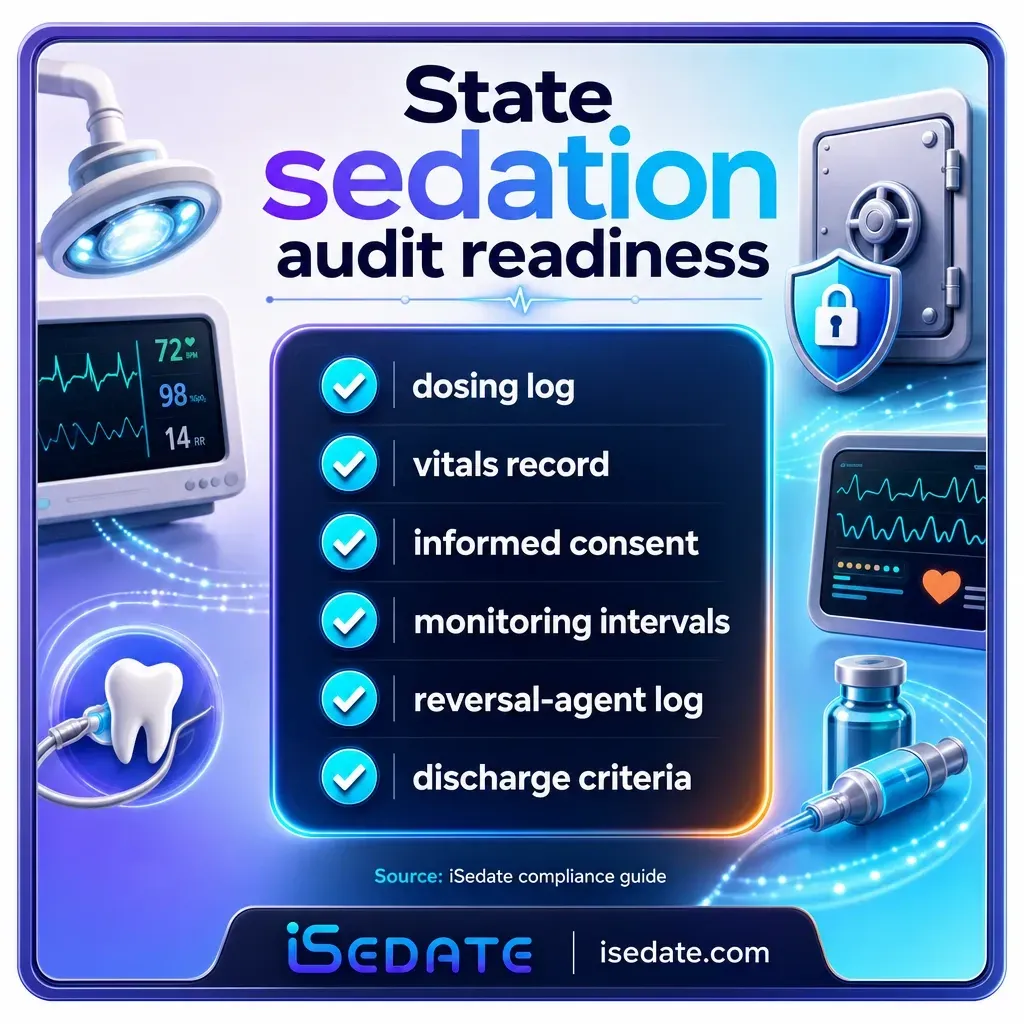
The anesthetic record. Under Section 110.5, a written time-oriented anesthetic record must be maintained for moderate sedation. It must include the names and dosages of all drugs administered and the names of the individuals present when the drugs were given. Pulse oximetry, heart rate, respiratory rate, and blood pressure must be continually monitored and documented at intervals of no more than 10 minutes.
Discharge documentation. Also under Section 110.5, the dentist or qualified staff must continually monitor blood pressure, heart rate, oxygenation, and level of consciousness during recovery, and the dentist must determine and document that consciousness, oxygenation, ventilation, and circulation are satisfactory before discharge.
Preoperative checklist. Under Section 110.13, any dentist administering nitrous oxide or Level 1 through Level 4 sedation must create and keep a preoperative checklist in the patient's dental record, which also must comply with the Board's general dental-records rules.
Adverse-event reporting. Serious adverse events, such as a patient death or hospitalization connected to care, trigger reporting obligations under the Board's rules, and violations can lead to disciplinary action. The specific penalty schedule is set by the Board; confirm the current reporting triggers and timelines directly with the TSBDE.
Source: TSBDE Rules, 22 TAC Sections 110.5 and 110.13
Renewal and continuing education
Your sedation permit is tied to your Texas dental license and renews at the same time the license does. There is no separate anesthesia renewal cycle to track, but there are level-based continuing-education and certification requirements you must keep current, or your privileges lapse at renewal.
| Highest permit level | Sedation CE (every 2 years) | Emergency-management certification |
|---|---|---|
| Nitrous Oxide | Per Board rule | BLS |
| Level 1 Minimal | 6 hours | BLS |
| Level 2 and Level 3 Moderate | 8 hours | BLS plus ACLS (or PALS for pediatric patients) |
| Level 4 Deep / GA | 12 hours | BLS plus ACLS (and PALS when treating children under 13) |
The continuing education must be on the highest level of sedation you are permitted for, or on its associated medical emergencies. Because renewal rides on your license renewal, a lapse in your CE or your ACLS, BLS, or PALS cards can hold up the whole renewal, so track the cards' expiration dates alongside your license.
Source: TSBDE Anesthesia Permit Renewal Requirements

Inspections and record reviews
This is where a permit is kept or lost. The permits that authorize moderate and deeper sedation, Levels 2, 3, and 4, carry the heaviest scrutiny, because that is where the risk is.
Facility inspection. Under Section 110.18, all Level 2, 3, and 4 permit holders who received their initial permit after March 1, 2018 must be inspected within one year of receiving the permit. The inspection checks that your operatory, equipment, emergency drugs, and monitoring match the level you hold, so a practice that upgrades to IV should expect an inspector, not just a permit letter.
Record reviews. By signing the Board's anesthesia affidavit you authorize the Board to review records it deems pertinent. When a reviewer opens your file, they are checking the record, not your intentions. The Texas Health and Human Services Office of Inspector General reviews sedation and anesthesia records on Medicaid dental providers and lists "failure to document start and stop times for nitrous oxide or oxygen inhalation and all levels of sedation" among its common errors. In other words, the dentist did the sedation correctly but lost on the paperwork. A Board review turns on whether your time-oriented anesthetic record is complete, contemporaneous, and intervaled correctly.
Source: Texas HHS Office of Inspector General, Common Errors in Dental Sedation | TSBDE Anesthesia Privileges and Applications
Keeping the permit: audit-ready records
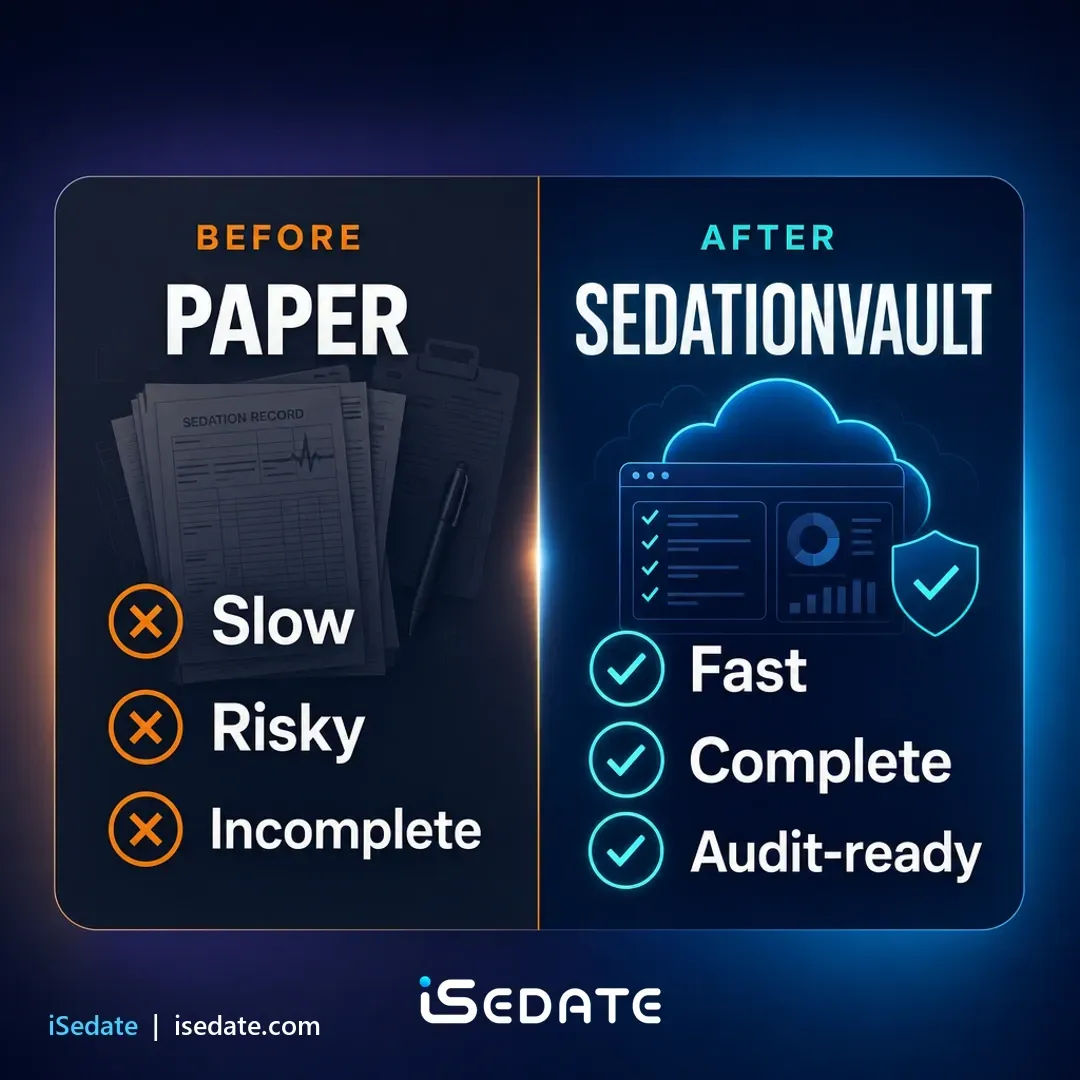
Everything above points to one truth: getting the permit is a one-time hurdle, but keeping it is a daily documentation discipline. A manual vitals log written every few minutes by hand, between titrating a drug and watching an airway, is exactly where records go incomplete, and incomplete records are what a Board review and a malpractice claim both attack.
iSedate Insight
Across Texas permit rules, the Board almost never loses a case on the clinical care itself. It loses, and dentists lose, on the record: a missing start time, a vitals gap longer than 10 minutes, an undocumented discharge assessment. The permit is earned once in a classroom, but it is defended on every single sedation visit, in writing.
SedationVault removes that failure point. It captures live patient vitals and the drug log automatically into a time-oriented, Texas-compliant anesthetic record, holding the under-10-minute interval that Section 110.5 demands, so the record writes itself while you focus on the patient. When the Board asks for the file, a complete record is a one-click export, not a scramble through paper. See how it maps to Texas rules on the dental sedation compliance and anesthesia record software pages.
Book a Demo of SedationVault See SedationVault PricingLicensed in a neighboring state?
Sedation permit rules are set state by state, so a permit good in Texas does not travel. If you practice across a state line, or you are comparing requirements, see our same-silo guides for the neighboring states, and the national hub for all fifty:
- Arkansas Sedation Dentistry Licensing & Permit Requirements
- Louisiana Sedation Dentistry Licensing & Permit Requirements
- New Mexico Sedation Dentistry Licensing & Permit Requirements
- Oklahoma Sedation Dentistry Licensing & Permit Requirements
- Sedation Dentistry Licensing & Permit Requirements by State (all 50)
Frequently asked questions
What sedation permits does Texas offer?
How many hours do you need for an IV sedation permit in Texas?
How often do you renew a Texas sedation permit?
Does a Texas sedation practice get inspected?
Can a general dentist do IV sedation in Texas?
Sources and How We Verified This Guide
- TSBDE, Anesthesia Privileges and Applications (levels, how to apply, inspection under Section 110.18, contact)
- TSBDE, Anesthesia Permit Renewal Requirements (renewal, CE hours, emergency-management certification)
- TSBDE, Dental Practice Act and TSBDE Rules (22 TAC Chapter 110, "Sedation and Anesthesia")
- TSBDE, Licensing Forms (anesthesia affidavits)
- Texas HHS Office of Inspector General, Common Errors in Dental Sedation (record-review findings)
- DOCS Education, Texas sedation courses (where to take qualifying coursework, not a legal source)
Permit levels, training hours, live-patient counts, monitoring, and recordkeeping are drawn from 22 TAC Chapter 110 as published by the TSBDE. Renewal, continuing-education hours, emergency-management certification, and the facility-inspection rule were confirmed on the Board's own anesthesia pages in November 2026. Application fees, the exact penalty schedule, and the full Level 4 (Section 110.6) training specifics are set by the Board and change periodically; confirm them directly with the TSBDE before you act. This guide summarizes Texas sedation permit rules for general information and is not legal advice.