






Texas Sedation Vitals Monitoring, Charting & Reporting Requirements
If you administer moderate sedation in Texas, the law is specific about what has to be written down: a time-oriented anesthetic record of every drug and dose, the staff in the room, and your patient's vital signs documented at intervals no greater than 10 minutes. That rule lives in 22 Texas Administrative Code Chapter 110, it is enforced by the Texas State Board of Dental Examiners, and it is the first thing a board inspector or a Medicaid reviewer reads. This guide walks through exactly what Texas requires you to monitor and record at each sedation level, shows what a compliant sedation record actually looks like, and explains where dentists most often fall short.
Recent Updates
Last UpdatedNovember 16, 2026
- Reviewed every Chapter 110 citation against the Texas State Board of Dental Examiners and the Texas HHS Office of Inspector General for accuracy.
- Added the Texas inspection timeline for new permit holders: Level 2, 3, and 4 permits issued after March 1, 2018 must be inspected within one year (22 TAC Section 110.18).
- Added a sample 10-minute charting cadence that shows what a compliant Texas sedation record looks like line by line.
- Expanded the audit section with the specific documentation errors Texas reviewers flag most.
- The core rule: Texas moderate sedation requires a written, time-oriented anesthetic record under 22 TAC Section 110.5(c)(5), with pulse oximetry, heart rate, respiratory rate, and blood pressure documented at least every 10 minutes.
- Who enforces it: the Texas State Board of Dental Examiners through Chapter 110, plus the Texas HHS Office of Inspector General for Medicaid providers.
- The record must name every drug and dosage given and every individual present when drugs were administered, and it must include a documented discharge assessment.
- Inspections are real: Level 2, 3, and 4 permit holders with an initial permit issued after March 1, 2018 are inspected within a year (22 TAC Section 110.18).
- The most common failure is a documentation gap, and reviewers specifically flag missing start and stop times and unrecorded staff.

What This Guide Covers
- Who regulates sedation in Texas
- The Texas sedation permit levels
- What you must monitor at each level
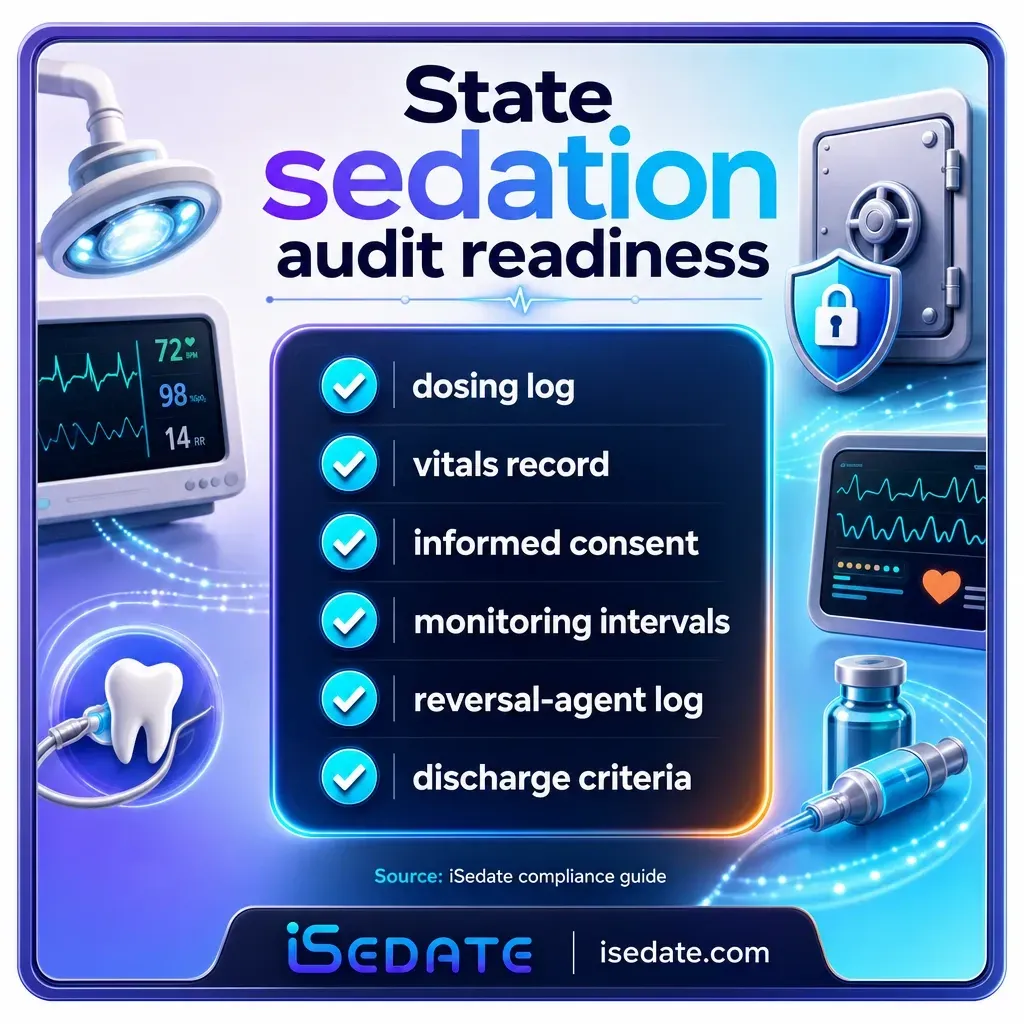
- What the record must contain
- What a compliant record actually looks like
- How Texas inspects and audits records
- Penalties, reporting, and retention
- Why complete documentation matters
- The easy button: an audit-ready record
- Frequently asked questions
- Sources and citations
Who regulates sedation in Texas
Sedation and anesthesia in a Texas dental office are regulated by the Texas State Board of Dental Examiners (TSBDE), the state agency that issues anesthesia permits, inspects providers, reviews records, and takes disciplinary action. The rules are not scattered across general dental law. They sit in one place: 22 Texas Administrative Code, Title 22, Part 5, Chapter 110, titled "Sedation and Anesthesia," published by the Texas Secretary of State and adopted by the TSBDE.
That matters for compliance because your recordkeeping obligation is a named administrative rule with an exact citation, not a vague standard of care. When a reviewer asks whether your sedation record meets the requirement, the answer is measured against the specific subsections of Chapter 110 below.
Setting the Record Straight
Myth: Federal ADA law overrides the Texas sedation rules, so following the ADA guideline is enough.
Fact: The American Dental Association is a private professional body, not a federal agency, and its sedation and anesthesia guidelines are a national standard that boards may adopt, not law. In Texas, the binding rule is 22 TAC Chapter 110, enforced by the Texas State Board of Dental Examiners.
Separate federal layers still apply on top of state law, including DEA controlled-substance records for the drugs you administer and HIPAA for the chart itself. They do not replace Chapter 110; they stack with it.
For the clinical "what and why" behind these requirements across every state, see our hub guide, Dental Sedation Vitals, Charting & Reporting Requirements by State.
Source: Texas State Board of Dental Examiners, anesthesia privileges and applications
The Texas sedation permit levels
Texas uses its own permit structure, and the requirements escalate with each level. Knowing which permit you hold tells you which monitoring and recordkeeping rules apply. These are the levels as Chapter 110 defines them.
| Texas permit | What it covers | Citation |
|---|---|---|
| Nitrous Oxide/Oxygen Inhalation | Inhaled nitrous oxide sedation | 22 TAC Section 110.3 |
| Level 1 Minimal Sedation | Minimal sedation (anxiolysis) | 22 TAC Section 110.4 |
| Level 2 Moderate Sedation | Moderate sedation, limited to the enteral (oral) route | 22 TAC Section 110.5 |
| Level 3 Moderate Sedation | Moderate sedation, inclusive of parenteral and IV routes | 22 TAC Section 110.5 |
| Level 4 Deep Sedation / General Anesthesia | Deep sedation or general anesthesia (the top tier) | 22 TAC Section 110.6 |
Most general dentists work at Levels 1 and 2, with Level 3 adding the parenteral and IV route. Level 4, deep sedation and general anesthesia, is the top tier, carried most often by oral and maxillofacial surgeons, and it sits under its own section, 110.6, with stricter monitoring. This guide focuses on the moderate-sedation recordkeeping standard in 110.5, because that is the level most sedation dentists are permitted for and the level whose record requirements are spelled out most explicitly. A Level 4 record carries the same time-oriented standard with additional monitoring layered on top. If you are working out which permit to apply for or how to upgrade, that belongs in a separate process, covered in our guide to Texas Sedation Dentistry Licensing & Permit Requirements.
State Law
Source: Texas State Board of Dental Examiners, anesthesia privileges and applications
What you must monitor at each level
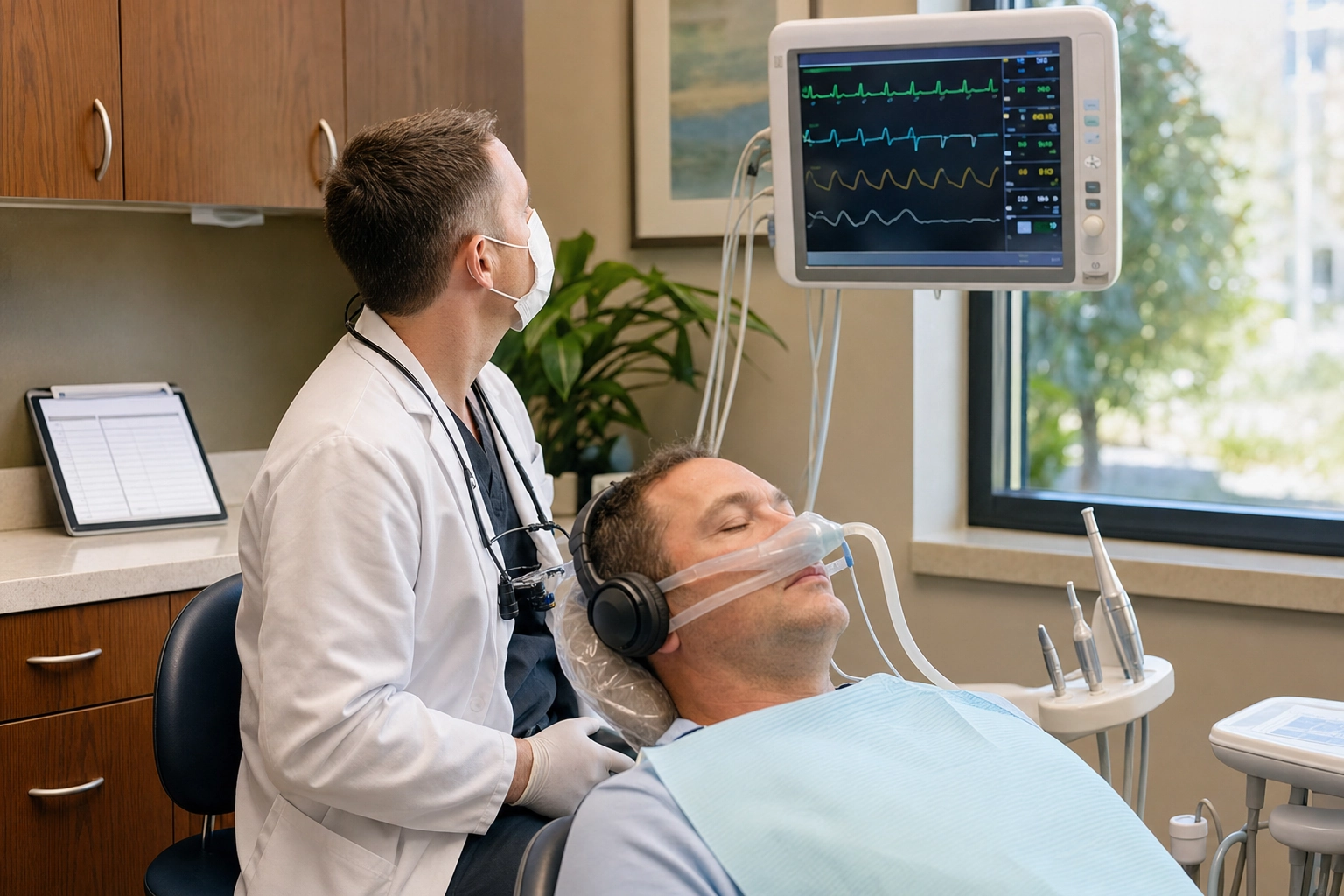
In Texas, what you are required to monitor is what you are required to write down. The two are inseparable: the monitoring standard in 110.5(c)(4) and the emergency-equipment standard in 110.15 define the physiological parameters, and the recordkeeping rule in 110.5(c)(5) requires them to be documented. For moderate sedation (Levels 2 and 3), the dentist must remain in the operatory and monitor the patient continuously until recovery criteria are met, watching four systems:
- Consciousness: the patient's level of consciousness and responsiveness to verbal command is continually assessed.
- Oxygenation: the color of mucosa, skin, or blood is evaluated continually, and oxygen saturation is measured continuously by pulse oximetry.
- Ventilation: chest excursions are continually observed, and ventilation is continually evaluated by auscultation, end-tidal carbon dioxide, or verbal communication with the patient.
- Circulation: blood pressure and heart rate are continually evaluated, and continuous EKG is required for moderate parenteral (IV) sedation.
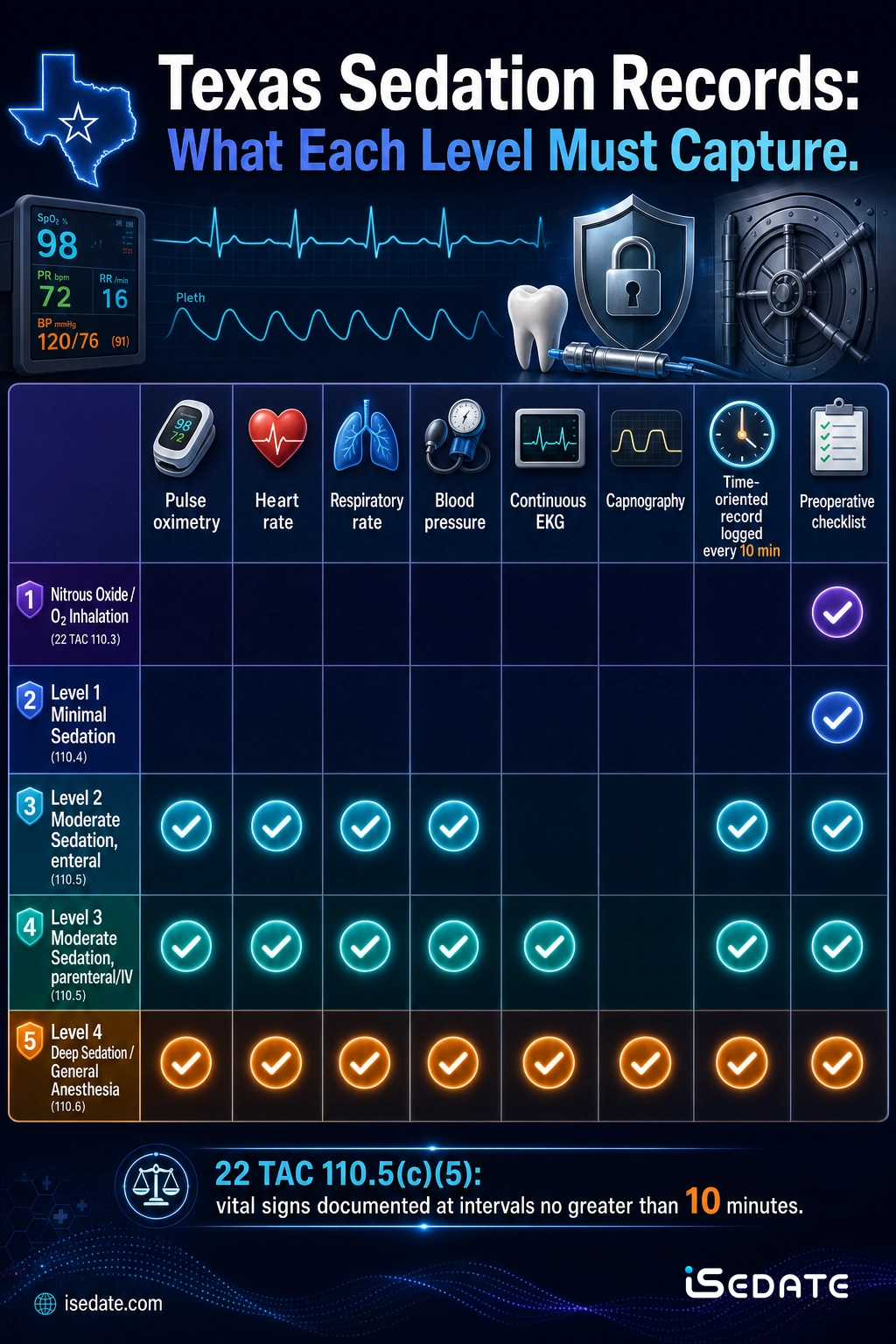
Two equipment rules sit on top of that. Under 110.15, a pulse oximeter is required wherever Sections 110.4, 110.5, and 110.6 call for one, and Level 4 permit holders must use capnography. The jump from Level 2 (enteral) to Level 3 (parenteral/IV) is where the monitoring load increases, because the IV route adds continuous EKG. The deeper the sedation, the more parameters you are both watching and logging.
Oral vs. IV: What Changes
The record format is identical for enteral (oral) and parenteral (IV) moderate sedation: a written, time-oriented anesthetic record with vitals documented at least every 10 minutes. What changes with the IV route is the monitoring data feeding that record. A Level 3 IV case adds continuous EKG, so the heart-rhythm trace becomes part of the contemporaneous record, and an IV drug log typically has more entries (titration, redosing) that each need a time stamp.
Myth, Busted
Myth: Nitrous or a single oral pill is light, so full monitoring and charting are not really required.
Fact: The depth of sedation, not the route or the drug, drives the requirement. The moment a patient reaches moderate sedation, the full 110.5 monitoring and recording standard applies, no matter how the drug was delivered.
Sedation levels are defined by patient response, and patients can reach a deeper level than intended from an oral dose, which is exactly why the rule attaches to the depth achieved rather than the technique planned.
Source: Texas State Board of Dental Examiners, Chapter 110 monitoring and emergency standards
What the record must contain
This is the section a reviewer reads first. For moderate sedation, 22 TAC Section 110.5(c)(5) spells out exactly what the record must contain, and it has three parts worth knowing by heart.
A written, time-oriented anesthetic record
Under 110.5(c)(5)(B), a written time-oriented anesthetic record must be maintained. "Time-oriented" is the operative phrase: the record is organized against the clock, not as a single end-of-visit summary. It must include the names and dosages of all drugs administered and the names of the individuals present when the drugs were given. A note that a patient "tolerated conscious sedation well" is not this record. A timeline of drugs, doses, times, and the people in the room is.
Vitals documented at least every 10 minutes
Under 110.5(c)(5)(C), pulse oximetry, heart rate, respiratory rate, and blood pressure must be continually monitored and documented at appropriate intervals of no more than ten minutes. This is the interval that catches practices out. Monitoring continuously but only writing a reading at the start and end of the case does not satisfy the rule. The documentation itself has to land on the page at least every 10 minutes.
State Law
A documented discharge assessment, plus the records rules
Recovery has its own documentation duty. Under 110.5(c)(6), the dentist or qualified staff continually monitor blood pressure, heart rate, oxygenation, and level of consciousness during recovery, and the dentist must determine and document that consciousness, oxygenation, ventilation, and circulation are satisfactory for discharge. The whole sedation record must also comply with the Board's general dental-records rules, Sections 108.7 and 108.8, which govern what the chart must contain and how it is kept.
One more requirement wraps around every level. Under 22 TAC Section 110.13, a dentist administering nitrous oxide or Level 1 through Level 4 sedation or anesthesia must create, maintain, and include a preoperative checklist in the patient's dental records required by Section 108.8. That checklist is not optional and not level-specific: it applies from nitrous all the way up.
Texas Moderate-Sedation Record Elements
- A written, time-oriented anesthetic record organized against the clock.
- The name and dosage of every drug administered.
- The names of every individual present when drugs were given.
- Pulse oximetry, heart rate, respiratory rate, and blood pressure documented at intervals of no more than 10 minutes.
- A documented recovery and discharge assessment under 110.5(c)(6).
- A preoperative checklist retained in the patient record under 110.13.
- Compliance with the general dental-records rules, 108.7 and 108.8.
What a compliant record actually looks like
Knowing the rule is one thing. Seeing what it produces on the page is another. The example below is an illustrative Level 3 (IV moderate sedation) record fragment, not a clinical template, showing the cadence Section 110.5(c)(5) asks for: a time stamp roughly every 10 minutes, the four vitals on each line, and the drug log and staff captured against the clock rather than summarized at the end.
| Time | SpO2 | HR | RR | BP | Drugs / events (staff present) |
|---|---|---|---|---|---|
| 9:00 | 99% | 74 | 16 | 124/78 | Baseline recorded. Dr. and assistant present. |
| 9:08 | 99% | 72 | 15 | 120/76 | IV midazolam administered, dose and time logged. |
| 9:18 | 98% | 70 | 14 | 118/74 | Procedure start. Continuous EKG in place. |
| 9:28 | 98% | 71 | 14 | 119/75 | Interval vitals. No redose. |
| 9:38 | 99% | 73 | 15 | 121/77 | Procedure complete. Recovery begins. |
| 9:52 | 99% | 75 | 16 | 123/79 | Discharge criteria met and documented. |
The point of the example is the rhythm. Every row carries a time and the required vitals, every drug is logged in the moment with the staff named, and the discharge line proves the recovery assessment happened. A real chart has gaps exactly where this one does not: a reading written at 9:00 and then not again until 9:40, a drug given at 9:08 but logged from memory afterward, a discharge that was never written down.
iSedate Charting Advice
Build the record so the time stamps are automatic, not a task someone remembers between airway checks. The single most reliable way to pass a Texas review is to make the 10-minute cadence a property of the chart itself, so an interval cannot quietly stretch to 15 minutes while the team is focused on the patient.
Source: Texas HHS Office of Inspector General, common errors in dental sedation

How Texas inspects and audits records
Two different reviewers can ask to see your sedation records in Texas, and both are looking at the same document.
First, the TSBDE itself. Under 22 TAC Section 110.18, the Board inspects sedation and anesthesia providers, and the inspection reviews the records required by Chapter 110. This is not only complaint-driven: Level 2, 3, and 4 permit holders whose initial permit was issued after March 1, 2018 must be inspected within a year of receiving the permit, and an inspector may select a record from before the inspection notice, judged under the rules in effect when the patient was treated.
State Law
Second, for practices that bill Medicaid, the Texas HHS Office of Inspector General conducts reviews that examine sedation and anesthesia records for compliance with TSBDE rules. In its published guidance on common errors in dental sedation, the OIG lists the specific findings that recur, and they are overwhelmingly documentation failures, not clinical ones:
- Failure to document vital signs as required by TSBDE rules.
- Failure to document start and stop times for nitrous oxide and all levels of sedation.
- Failure to document who administered the medication and the names of all staff present during administration.
It is rarely the clinical care that fails a review. It is the record: a missing time stamp, an interval that stretched past 10 minutes, a drug given but not logged with the staff present, a discharge that was never documented. The care can be flawless and the record can still fail.
Important
A reviewer does not grade your sedation on how the patient did. They grade it on whether the contemporaneous record proves what you did and when. Document start and stop times for every drug and every phase of the case. If the time-oriented record has gaps, the default assumption on review is that the monitoring had gaps too.
Source: Texas HHS Office of Inspector General, common errors in dental sedation | TSBDE anesthesia permit affidavit (Levels 2, 3, 4)
Penalties, reporting, and retention
Chapter 110 is backed by enforcement. Adverse-event reporting is mandatory: a patient death or hospitalization connected to sedation triggers reporting obligations under Chapter 108, and the Board can take disciplinary action for rule violations, including recordkeeping violations. Incomplete sedation records are not a filing technicality. They are the evidence a board weighs when deciding whether the standard of care was met, and the same gaps that fail an audit are the gaps a plaintiff's attorney looks for in a malpractice claim.
Retention follows the general dental-records rules at Sections 108.7 and 108.8, since the sedation record is part of the patient's dental record. The exact disciplinary schedule, any routine inspection cadence beyond the first-year inspection above, the precise penalty amounts, and the current retention period are administered by the TSBDE and can change, so confirm current details directly with the Texas State Board of Dental Examiners rather than relying on a figure that may be out of date. What does not change is the exposure created by a thin record: in both a board review and a lawsuit, the contemporaneous sedation record is the first thing requested and the hardest thing to reconstruct after the fact.
Source: Texas State Board of Dental Examiners, Chapter 110 and general dental-records rules
Why complete documentation matters
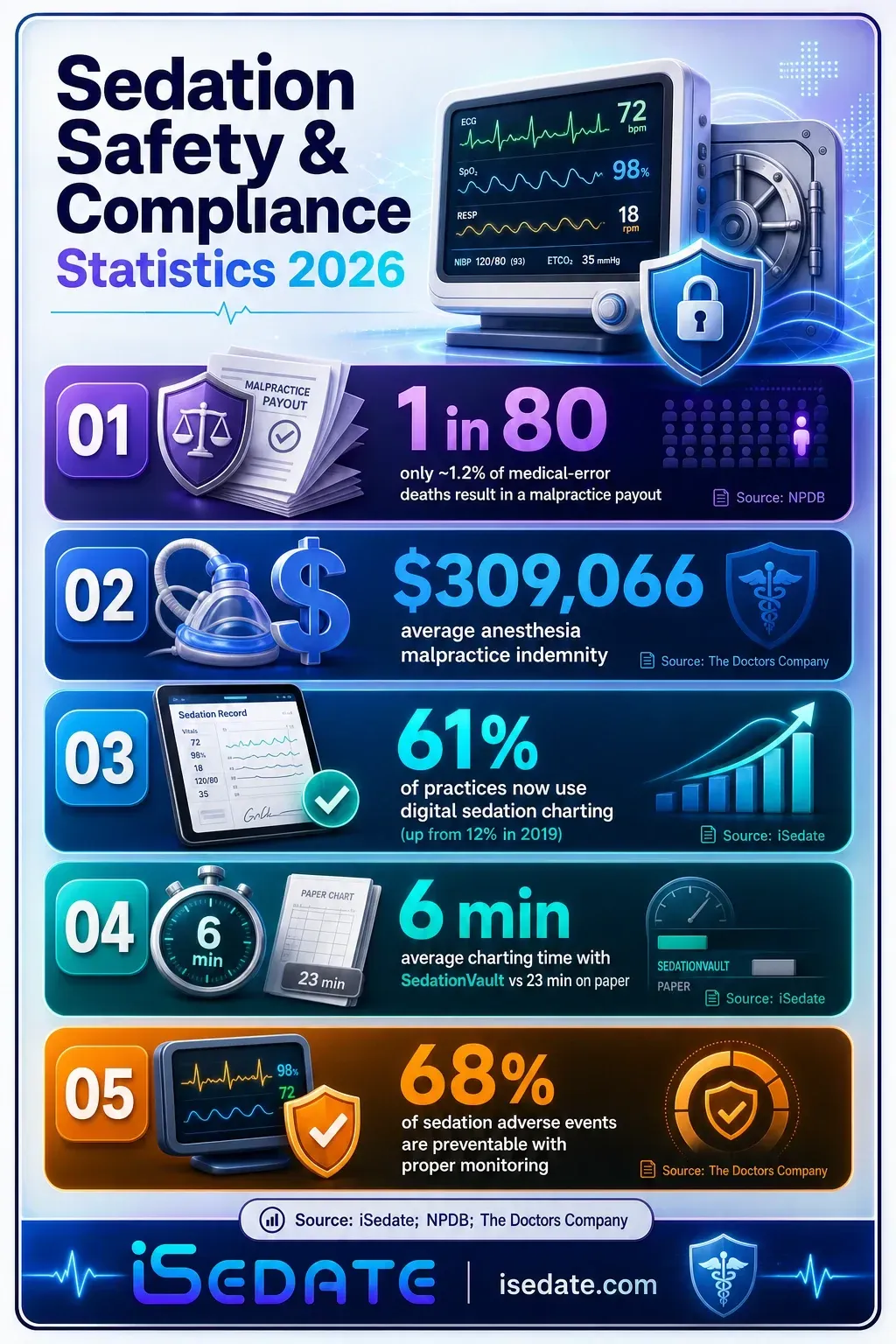
The requirements on this page are the law. The reason the law is this exact is that the sedation record is the single document that proves, after the fact, that monitoring actually happened. When a review or a claim arises, the chart is not supporting evidence. It is the evidence. These research roundups cover the data behind that reality:
Further Reading: The Data
The easy button: an audit-ready record
The gap between knowing the rule and passing a review is almost always the same thing: a 10-minute interval log kept by hand during a live sedation case. When a team is managing an airway and an anxious patient, a vitals reading written every 10 minutes on paper is exactly where the record develops holes, a skipped interval here, a missing time stamp there, a drug given in the moment and logged later from memory.
That is the problem SedationVault by iSedate was built to remove. It connects to the vitals monitor already in your operatory and captures pulse oximetry, heart rate, respiratory rate, and blood pressure live, on the clock, alongside the drug log, so the time-oriented anesthetic record writes itself as the conscious sedation case runs rather than being reconstructed afterward. When the TSBDE or a Medicaid reviewer asks for the chart, it exports as a one-click, audit-ready sedation visit report that already carries the start and stop times, the dosages, the staff present, and the discharge assessment the rule asks for. The point is not fancier charting. It is turning the exact items Section 110.5(c)(5) requires into something the software guarantees are present and time-stamped, which is also what dental sedation compliance turns on.
Book a demo and see your Texas sedation record build itselfFrequently asked questions
Does Texas require a written sedation record?
How often must vitals be recorded during sedation in Texas?
Who audits dental sedation records in Texas?
What are the Texas dental sedation permit levels?
Does Texas require a discharge note after sedation?
Is the ADA sedation guideline the law in Texas?
How long must Texas dental sedation records be kept?
Informational Only
This guide is for informational purposes and does not constitute legal or compliance advice. Regulations change. Confirm the current text of 22 TAC Chapter 110 and any inspection, penalty, or retention details directly with the Texas State Board of Dental Examiners before relying on them for your practice.
Related guides and neighboring states
Licensed in a neighboring state, or practicing across state lines? Sedation charting and reporting rules are set state by state. See our guides for Arkansas Sedation Vitals Monitoring, Charting & Reporting Requirements, Louisiana Sedation Vitals Monitoring, Charting & Reporting Requirements, New Mexico Sedation Vitals Monitoring, Charting & Reporting Requirements, and Oklahoma Sedation Vitals Monitoring, Charting & Reporting Requirements, or start from the full Dental Sedation Vitals, Charting & Reporting Requirements by State hub.
Our Sources & Fact-Checking
This guide cites Texas's primary regulatory sources. The governing rules are 22 Texas Administrative Code Chapter 110, "Sedation and Anesthesia," adopted by the Texas State Board of Dental Examiners and published in the Texas Administrative Code by the Texas Secretary of State. The permit structure, inspection timeline, and recordkeeping standard are drawn from the TSBDE's own anesthesia pages and affidavit; the audit findings are from the Texas HHS Office of Inspector General. Where a detail (such as the current penalty schedule, full inspection cadence, retention period, or permit fees) is administered by the Board and subject to change, confirm it directly with the TSBDE before relying on it.
- Texas State Board of Dental Examiners: Anesthesia Privileges and Applications (permit levels, Section 110.18 inspection timeline)
- Texas State Board of Dental Examiners: Anesthesia Permit Renewal Instructions
- TSBDE Anesthesia Permit Affidavit (Levels 2, 3, 4)
- Texas HHS Office of Inspector General: Common Errors in Dental Sedation
- 22 Texas Administrative Code, Title 22, Part 5, Chapter 110: Sedation and Anesthesia (full rule text published by the Texas Secretary of State; confirm the current version with the TSBDE).