







Louisiana Sedation Vitals Monitoring, Charting & Reporting Requirements
If you administer moderate sedation in Louisiana, the state's own rule on what you must keep is short and specific: a proper record keeping mechanism, plus a separate controlled substance log. That requirement lives in the Louisiana State Board of Dentistry rules at LAC 46:XXXIII.1510.A.3, it is enforced by the board, and it is the first thing a reviewer looks for. What Louisiana's rule does not do is spell out a minute-by-minute charting interval, which means the real standard your record gets measured against is the national ADA best practice. This guide breaks down exactly what Louisiana requires you to monitor and record, where the state's rule ends and professional best practice begins, and how to make the record audit-ready either way.
Recent Updates
Last UpdatedNovember 16, 2026
- Re-verified every rule and statute citation against the current official Louisiana State Board of Dentistry rules (LAC Title 46 Part XXXIII, May 2026 compilation) and La. R.S. 37:793 on the Louisiana Legislature site.
- Replaced bare board-homepage links with the board's own specific Laws and Rules, Licensing Information, and rules PDF pages, plus the official Louisiana Legislature statute page.
- Added a sample best-practice interval log showing what a complete moderate-sedation charting cadence looks like on the page.
See full history of updates to this post
UpdatedMay 2026
- Aligned the rule text with the May 2026 compilation of the Louisiana State Board of Dentistry sedation rules (LAC Title 46 Part XXXIII, Chapter 15).
- The core rule: Louisiana moderate sedation requires a proper record keeping mechanism plus a controlled substance log under LAC 46:XXXIII.1510.A.3, with a working pulse oximeter used under 1510.A.2.
- What Louisiana does not say: the state rule does not set a fixed vitals-charting interval, so the ADA's time-oriented anesthetic record is the national best-practice benchmark your record is judged against.
- Two documentation legs: Louisiana names both the patient record and a separate controlled substance log, so a complete sedation file carries both.
- Who enforces it: the Louisiana State Board of Dentistry under LAC Title 46 Part XXXIII, with facility and equipment rules in LAC 46:XXXIII.1511.
- The reporting trigger: La. R.S. 37:793(E) requires a written adverse-occurrence report to the board within ten days of a mortality or a hospitalization connected to sedation.

What This Guide Covers
- Who regulates sedation in Louisiana
- The Louisiana sedation permit structure
- What you must monitor at each level
- What Louisiana requires you to record
- Where the rule ends and best practice begins
- What a compliant record looks like on the page
- Why a thin record is the real exposure
- Adverse-event reporting and enforcement
- The easy button: an audit-ready record
- Frequently asked questions
- Sources and citations
Who regulates sedation in Louisiana
Sedation and anesthesia in a Louisiana dental office are regulated by the Louisiana State Board of Dentistry (LSBD), the state agency that issues sedation permits, sets the facility rules, and receives the mandatory adverse-event reports. The sedation rules sit in the board's own administrative code, the Louisiana Administrative Code, Title 46, Part XXXIII, where Chapter 15 covers nitrous oxide analgesia, moderate sedation, deep sedation, and general anesthesia. The statutory backbone is the Dental Practice Act, La. R.S. 37:793.
That distinction matters for compliance, because it means your recordkeeping obligation is a named board rule with an exact citation, not a vague standard of care. When a reviewer asks whether your sedation record meets the requirement, the answer is measured against the specific subsections of LAC 46:XXXIII.1510 and 1511 below.
Setting the Record Straight
Myth: The ADA sets federal sedation law that overrides whatever the state says.
Fact: The American Dental Association publishes a national professional standard, not law. In Louisiana, the binding authority is La. R.S. 37:793 and the LAC Title 46 Part XXXIII board rules, enforced by the Louisiana State Board of Dentistry.
Louisiana, like most states, leans on the ADA guidelines, so the clinical substance overlaps. But if a reviewer cites a requirement, it comes from the state rule, not the ADA document. The real federal layers that do apply are separate: DEA controlled-substance rules, HIPAA, and CMS or accreditation standards where relevant.
For the clinical reasoning behind these requirements and a national comparison, see our hub guide on Dental Sedation Vitals, Charting & Reporting Requirements by State.
Source: Louisiana State Board of Dentistry: Laws and Rules | La. R.S. 37:793 (official)
The Louisiana sedation permit structure
Louisiana does not use a numbered Level 1 through 4 ladder. It works on two axes at once: the kind of sedation a dentist is personally permitted to administer, and a separate office permit for the facility where it happens. Knowing which permit you hold tells you which monitoring and recordkeeping rules apply. These are the categories as Louisiana law defines them:
| Louisiana permit | What it covers | Governing citation |
|---|---|---|
| No permit (minimal sedation) | Minimal sedation of an adult patient; no board permit required | LAC 46:XXXIII ch. 15 |
| Nitrous Oxide Inhalation permit | Nitrous oxide inhalation analgesia | LAC 46:XXXIII.1503 |
| Moderate Sedation permit | Enteral (oral) or parenteral moderate sedation, commonly called conscious sedation | LAC 46:XXXIII.1510 |
| General Anesthesia / Deep Sedation permit | Deep sedation or general anesthesia (the top tier) | LAC 46:XXXIII.1503 |
| Office permit | Required for any sedation beyond minimal or nitrous, at a level at least equal to the level performed | LAC 46:XXXIII.1502 |
Two points make Louisiana distinctive. First, these are personal permits, and on top of the personal permit the office itself must carry an office permit at a level at least equal to the sedation performed there, under LAC 46:XXXIII.1502, with an office inspection required for any level beyond nitrous. Second, Louisiana defines its deep sedation and general anesthesia tier inside the permit framework of 1503 rather than a standalone section. This guide focuses on the moderate-sedation standard in LAC 46:XXXIII.1510, because that is the level most sedation dentists are permitted for and the one whose record requirements are stated most explicitly. If you are working out which permit to apply for, the training hours, or how to upgrade, that belongs in a separate process, covered in our guide to Louisiana Sedation Dentistry Licensing & Permit Requirements.
Source: Louisiana State Board of Dentistry: Licensing Information (Anesthesia Permits) | LAC 46:XXXIII.1502, 1503, and 1510
What you must monitor at each level
In Louisiana, what you are required to monitor and what equipment must be present are set out in the moderate-sedation rule and the facility rule. For moderate sedation, LAC 46:XXXIII.1510.B is specific:
- Oxygenation: continuous monitoring with pulse oximetry must be initiated with early signs of moderate sedation and continued until the patient is alert. A working pulse oximeter is itself a condition of administering moderate sedation under 1510.A.2.
- Ventilation and heart or respiratory rate: a precordial or pretracheal stethoscope must be available to assist intraoperatively in monitoring heart and respiratory rates.
- Circulation: a sphygmomanometer (blood pressure cuff) must be immediately available and used as needed throughout the procedure.
- Constant attendance: under LAC 46:XXXIII.1511.B, every patient receiving nitrous, moderate, deep, or general anesthesia must be constantly attended, under the direct supervision of the authorized dentist.
The facility rule in LAC 46:XXXIII.1511 adds the equipment floor. Under 1511.A.7.f, equipment to monitor the partial pressure of carbon dioxide (capnography) is required when moderate sedation, deep sedation, or general anesthesia is administered, and under 1511.A.7.g a working EKG and defibrillator must be present for moderate, deep, and general anesthesia. The deeper the sedation, the more the board expects in the room, and the more there is to document.
Myth, Busted
Myth: Nitrous or a single oral pill is light, so I do not really need to monitor or chart it.
Fact: The depth of sedation, not the route or the drug, drives the requirement. The moment a patient reaches moderate sedation, the full LAC 46:XXXIII.1510 monitoring and record requirements apply, no matter how the drug was delivered.
Minimal sedation of an adult does not require a board permit in Louisiana, but sedation levels are defined by patient response, and patients can reach a deeper level than intended. If a single oral dose takes a patient to moderate sedation, you are held to the moderate-sedation standard.
Source: LAC 46:XXXIII.1510.B and 1511
What Louisiana requires you to record: the compliance core
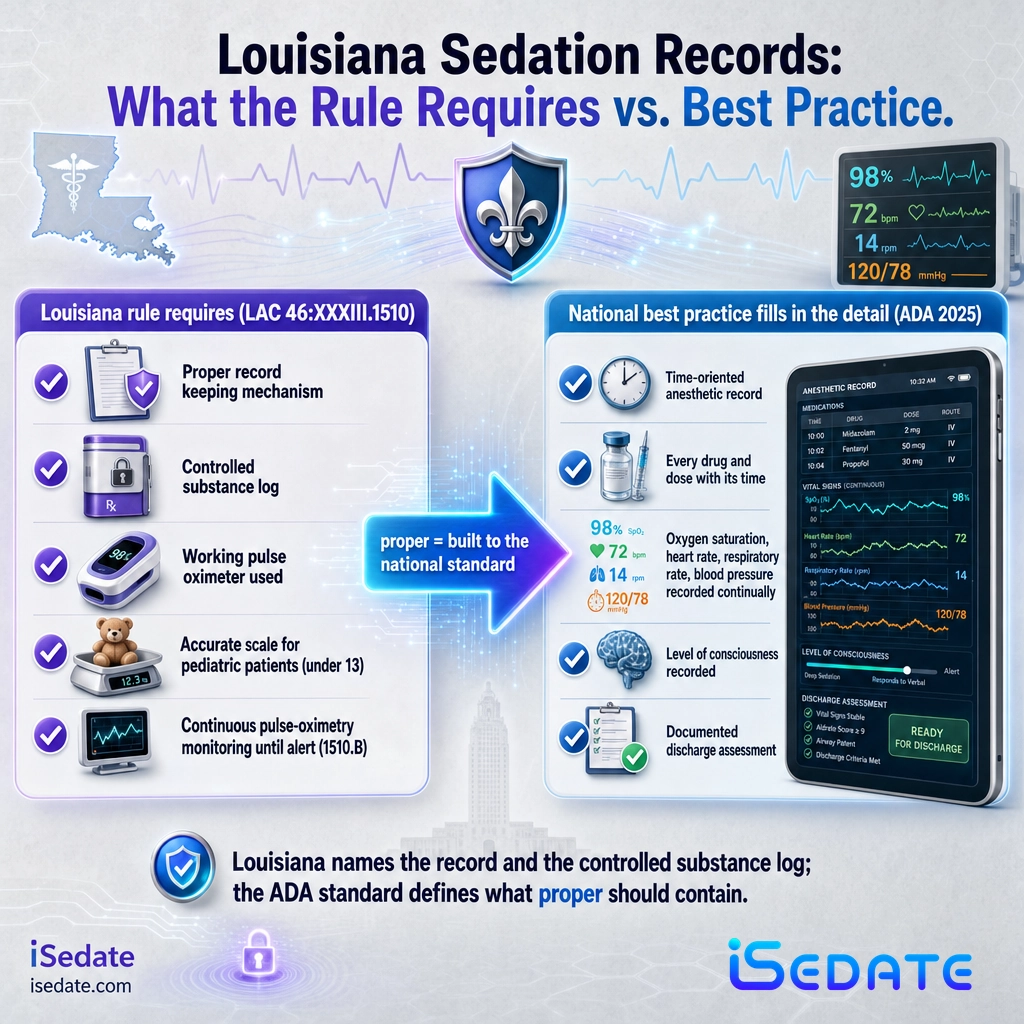
This is the section a reviewer reads first, and Louisiana's rule here is refreshingly plain. For moderate sedation, LAC 46:XXXIII.1510.A sets four conditions on the dentist, and two of them are documentation duties.
1. A proper record keeping mechanism
Under LAC 46:XXXIII.1510.A.3, the dentist must maintain a proper record keeping mechanism. That is Louisiana's phrasing, word for word, and it is important to be honest about what it does and does not say. It establishes that a sedation record must exist and be adequate to the procedure. It does not, unlike some states, itemize a time-oriented list of drugs, doses, and vital-sign readings logged at a stated interval. Louisiana leaves the form of the record to professional judgment, which puts the weight on the national best-practice standard covered in the next section.
2. A controlled substance log
Louisiana names a second, separate document. The same rule, 1510.A.3, requires a controlled substance log in addition to the patient record keeping mechanism. This is the running account of the scheduled sedation drugs that come into and leave the practice, distinct from any single patient's chart. Many state rules leave this to federal and pharmacy law, but Louisiana writes it directly into the dental sedation rule, so a complete sedation file in Louisiana has two legs: the patient record and the controlled substance log.
3. The pediatric scale and the pulse oximeter
The other two conditions in 1510.A round out the file. Under 1510.A.2 a working pulse oximeter must be used on patients, and under 1510.A.4 an accurate scale must be used on pediatric patients, defined by Louisiana as anyone under the age of 13, so that weight-based dosing is recorded against a real measurement rather than an estimate. Together with the emergency-kit contents list and check record required under 1511.A.8, these are the pieces the board's rule expects to find in a moderate-sedation file.
What Louisiana's Moderate-Sedation File Must Contain
- A proper record keeping mechanism, the patient's sedation record (LAC 46:XXXIII.1510.A.3)
- A controlled substance log, kept separately from the patient record (1510.A.3)
- Confirmation that a working pulse oximeter was used (1510.A.2)
- An accurate scale used on pediatric patients under age 13 (1510.A.4)
- The emergency-kit contents list and a record of when the kit was checked (1511.A.8)
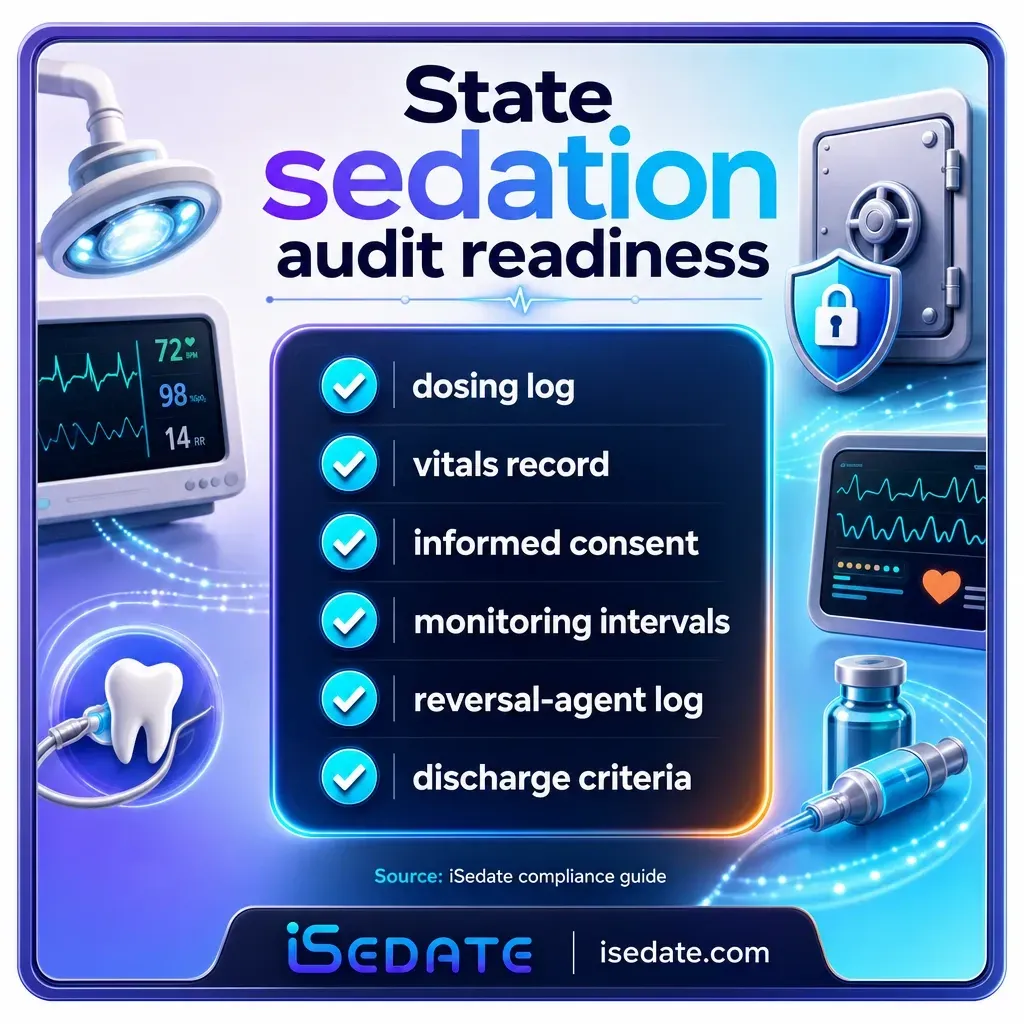
- Best practice fills in the detail: a time-oriented record of every drug, dose, and vital-sign reading (ADA national standard, not Louisiana law)
Source: LAC 46:XXXIII.1510.A and 1511.A.8
See how a time-oriented anesthesia record is built automaticallyWhere the Louisiana rule ends and best practice begins
Here is the part Louisiana dentists most need to understand. Because LAC 46:XXXIII.1510.A.3 requires a proper record keeping mechanism without defining its exact contents, the question in a board review or a lawsuit becomes simple and dangerous: proper by what measure? The answer, in practice, is the national professional standard.
The ADA Guidelines for the Use of Sedation and General Anesthesia by Dentists, updated in 2025, define what a complete moderate-sedation record looks like: a time-oriented anesthetic record listing every drug and dose with its administration time, and oxygen saturation, heart rate, respiratory rate, blood pressure, and level of consciousness recorded continually. That is not Louisiana statute, and this guide does not claim it is. It is the national best practice that a proper record keeping mechanism is expected to meet, and it is the benchmark a reviewing dentist or an opposing expert will reach for when they decide whether your record was proper.
Build to the national standard, not the floor. Louisiana's rule gives you latitude in the form of the record, but that latitude cuts both ways. A reviewer does not grade your sedation on how the patient did. They grade it on whether the record proves what you did and when. A thin record that meets the letter of "a proper record keeping mechanism" but lacks a time-oriented trail of drugs and vitals is the record that fails to defend you when it matters.
In short: Louisiana tells you a record must exist and be proper, and that a controlled substance log must sit alongside it. The ADA standard tells you what proper should contain. Meet the second, and you have satisfied the first with room to spare.
Source: LAC 46:XXXIII.1510.A.3 (state rule) | ADA Guidelines for the Use of Sedation and General Anesthesia by Dentists, 2025 (national best practice, not Louisiana law)
What a compliant record looks like on the page
Because Louisiana leaves the form of the record open, the practical question is what to actually put on the page. The simplified example below shows the cadence the ADA standard expects a proper record keeping mechanism to meet: a baseline reading before the drug, readings taken continually while the patient is sedated, and a post-operative reading in recovery, each line carrying the core parameters. This is best practice, not a Louisiana-mandated interval, but it is the shape a reviewer recognizes as complete. (Values are illustrative only, not a real patient record.)
| Time / interval | BP | HR | Resp | SpO2 | Drug / dose |
|---|---|---|---|---|---|
| Pre-op baseline | 126/80 | 74 | 16 | 99% | Triazolam 0.25 mg PO |
| Intra-op 00:15 | 120/76 | 70 | 14 | 98% | None |
| Intra-op 00:30 | 118/74 | 68 | 14 | 98% | None |
| Intra-op 00:45 | 122/78 | 71 | 15 | 99% | None |
| Post-op recovery | 124/80 | 73 | 16 | 99% | Alert, escorted |
A real case runs longer and carries more detail, and the controlled substance log, the signed consent, and the pulse-oximetry record sit alongside this grid. But the shape is the point: a reviewer can look at a record like this and see, line by line, that the patient was monitored and that the monitoring was documented against the clock. A record with a single pre-op reading and a single post-op reading, and nothing in between, meets the bare letter of the rule but fails the test of proving what happened during the case.
iSedate Insight
Louisiana's open rule is a trap for the confident. Because the state does not mandate an interval, it is easy to keep a thinner record than you would in a stricter state, and then discover in a review that "proper" was always measured against the national standard anyway. The practices that stay defensible in Louisiana chart as if a five-minute interval were required, keep the controlled substance log current, and retain the pulse-oximetry record with the chart rather than in a drawer.

Why a thin record is the real exposure
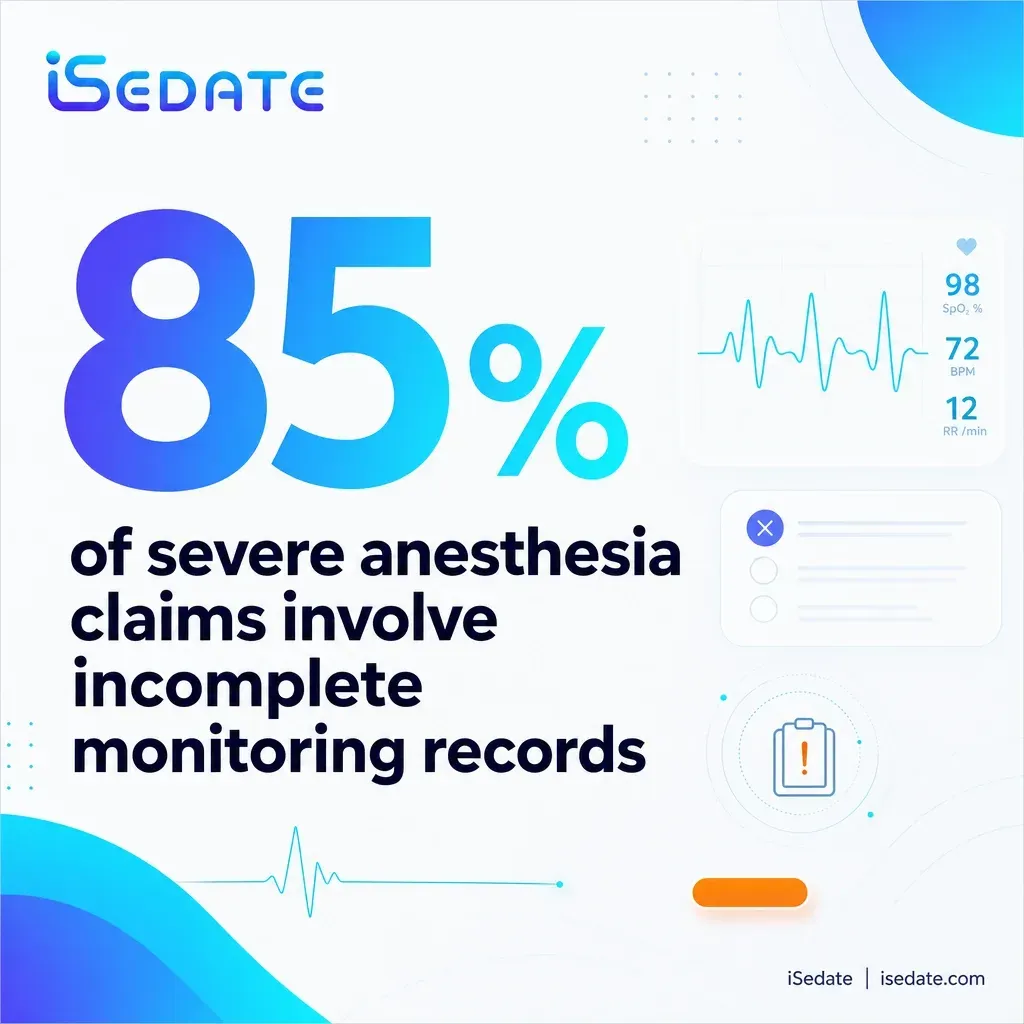
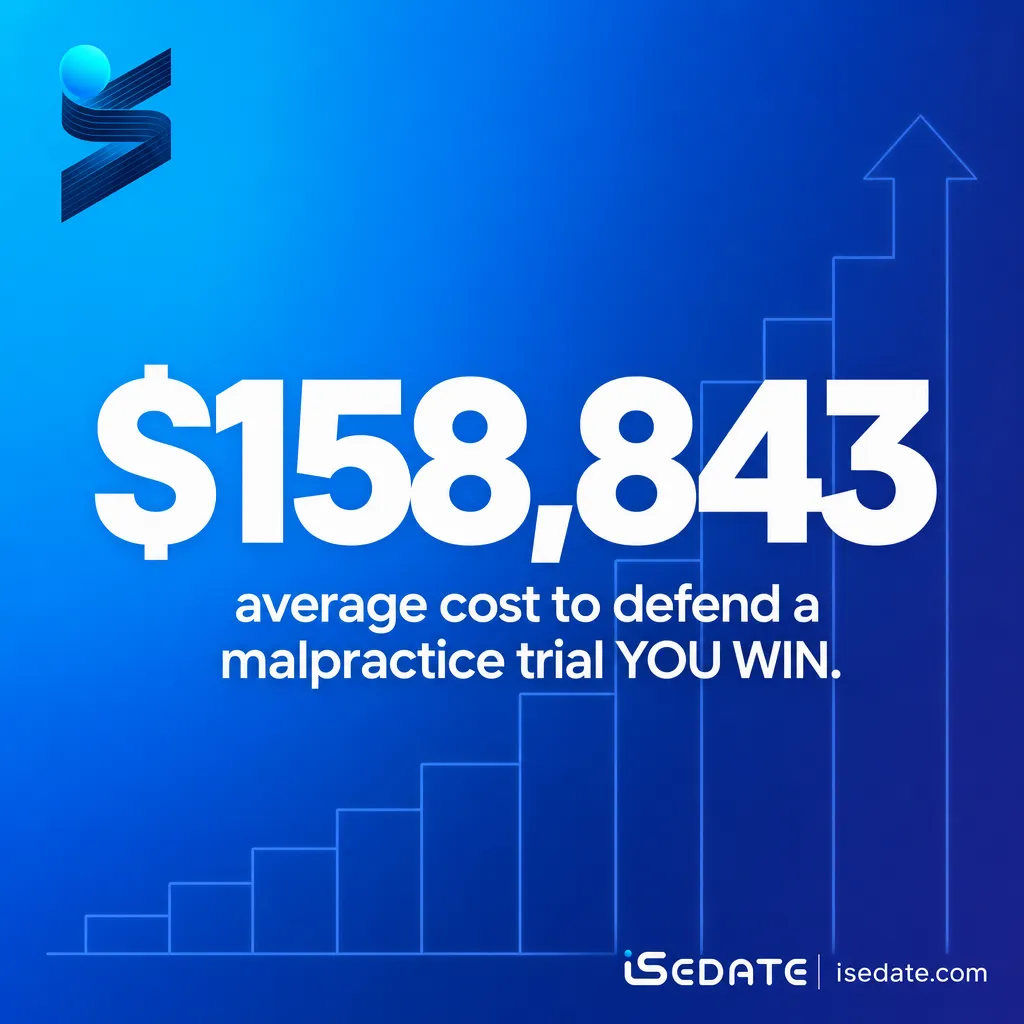
An incomplete sedation record is not a filing technicality. It is the evidence a board weighs when deciding whether the standard of care was met, and the same gaps that worry a reviewer are the gaps a plaintiff's attorney looks for in a malpractice claim. In both a board review and a lawsuit, the contemporaneous sedation record is the first thing requested and the hardest thing to reconstruct after the fact. When the chart does not prove continuous monitoring, the provider is left arguing memory against a document, and the document wins.
The data behind why these rules exist, and what a documentation failure actually costs when a case goes sideways, lives in our research roundups:
The Data Behind the Rule
Adverse-event reporting and enforcement
Louisiana backs its sedation rules with a statutory reporting duty that is tighter and more explicit than the recordkeeping rule. Under La. R.S. 37:793(E), a dentist must submit a written report to the Louisiana State Board of Dentistry within ten days of any mortality, or any injury requiring hospitalization, that occurs during or as a result of covered local anesthesia, sedation, or general anesthesia.
That report is where your contemporaneous record earns its keep. The statute requires the report to describe the dental procedure, the patient's physical condition before it, all drugs and dosages given, the techniques used to administer them, the adverse occurrence and the treatment provided, the patient's response, and the condition on termination. Every one of those items is something your sedation record should already contain. If the record is complete and time-oriented, the ten-day report writes itself from it. If the record is thin, the report becomes a reconstruction from memory at the worst possible moment.
Beyond the reporting trigger, the board can take disciplinary action for rule violations, including recordkeeping violations, under its general authority. The exact disciplinary schedule, any routine office-inspection cadence for permit holders, and the precise penalty amounts are administered by the board and can change, so confirm current details directly with the Louisiana State Board of Dentistry rather than relying on a figure that may be out of date. What does not change is the exposure created by a thin record.
Source: La. R.S. 37:793(E) | Louisiana State Board of Dentistry: Laws and Rules
The easy button: an audit-ready record
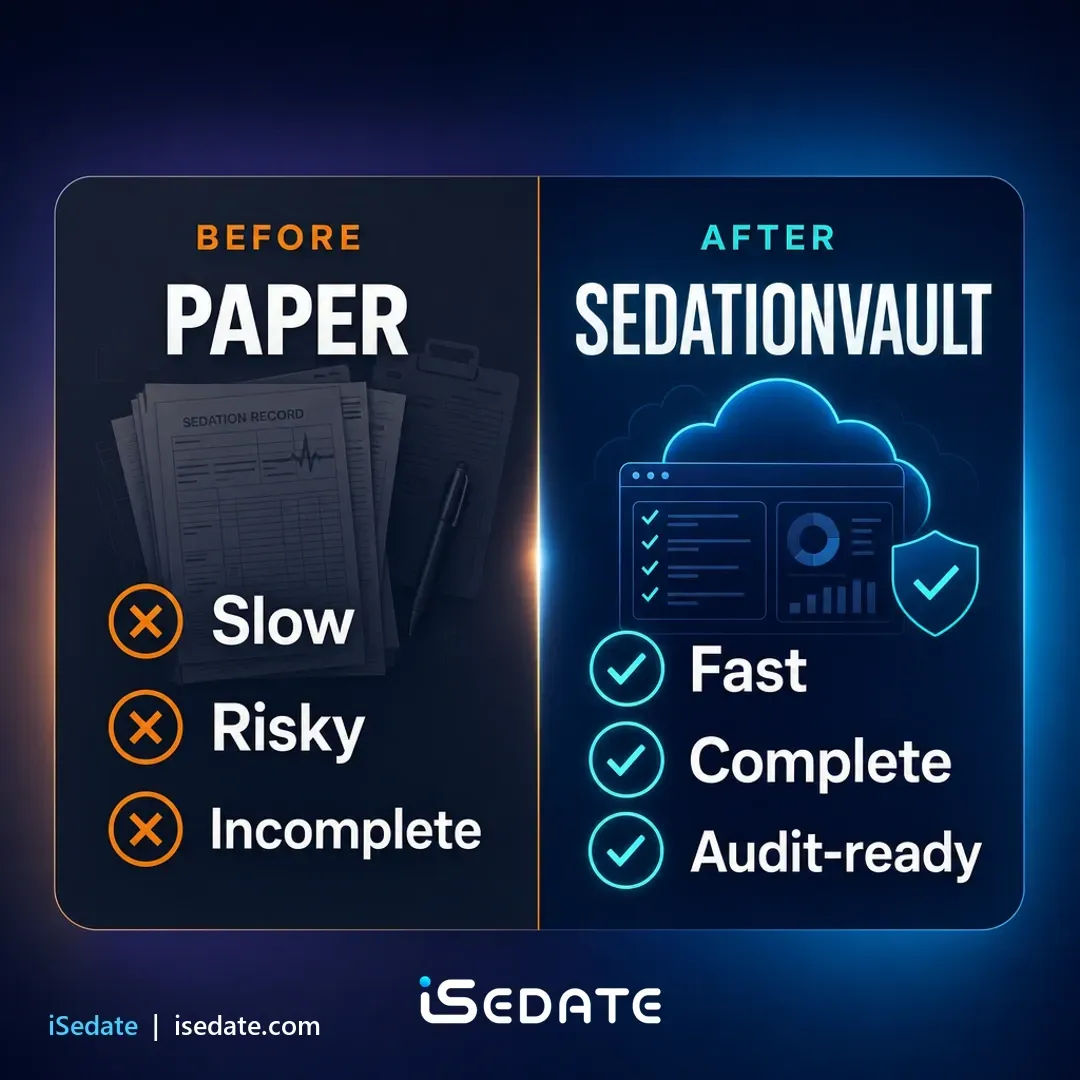
The gap between knowing the rule and surviving a review is almost always the same thing: a vitals log kept by hand during a live sedation case. When a team is managing an airway and an anxious patient, a reading written down every few minutes on paper is exactly where the record develops holes, a skipped reading here, a missing time stamp there, a drug given in the moment and logged later from memory. In Louisiana, that same manual gap can leave both the patient record and the controlled substance log incomplete.
That is the problem SedationVault by iSedate was built to remove. It connects wirelessly to the vitals monitor already in your operatory and captures pulse oximetry, heart rate, respiratory rate, and blood pressure live, on the clock, alongside the drug log, so a time-oriented anesthetic record, the kind the national standard expects a proper record keeping mechanism to be, writes itself as the case runs rather than being reconstructed afterward. When the board asks for the file, or when a La. R.S. 37:793(E) report comes due, the record exports as a one-click, audit-ready sedation visit report that already carries the start and stop times, the dosages, and the discharge assessment. The point is not fancier charting. It is turning what Louisiana requires, and what national best practice expects of it, into something the software guarantees are present and time-stamped, which is also what dental sedation compliance turns on. If you want to see the numbers first, start with SedationVault pricing.
Book a demo and see your Louisiana sedation record build itselfFrequently asked questions
Does Louisiana require a written sedation record?
How often must vitals be recorded during sedation in Louisiana?
What is a controlled substance log in Louisiana dental sedation?
Who regulates sedation records in Louisiana?
Does Louisiana require an adverse event report after sedation?
Related guides and neighboring states
Licensed in more than one state, or practicing near the Louisiana line? Documentation rules vary by state, so confirm the requirements where you provide sedation. See our same-silo guides for neighboring states:
- Arkansas Sedation Vitals Monitoring, Charting & Reporting Requirements
- Mississippi Sedation Vitals Monitoring, Charting & Reporting Requirements
- Texas Sedation Vitals Monitoring, Charting & Reporting Requirements
- All 50 states: Dental Sedation Vitals, Charting & Reporting Requirements by State
Sources and citations
This guide cites Louisiana's primary regulatory sources directly. Rule text is drawn from the Louisiana Administrative Code, Title 46, Part XXXIII, as published by the Louisiana State Board of Dentistry (May 2026 compilation), and the adverse-event reporting duty is from La. R.S. 37:793 as published by the Louisiana State Legislature. The ADA Guidelines are referenced only as a national professional standard and are not Louisiana law. Where a detail, such as the current penalty schedule, inspection cadence, board contact information, or permit fees, is administered by the board and subject to change, confirm it directly with the Louisiana State Board of Dentistry before relying on it. This guide is general information, not legal advice.
- Louisiana State Board of Dentistry (LSBD): Laws and Rules
- LSBD: Licensing Information (Anesthesia Permits)
- LAC Title 46 Part XXXIII, Louisiana State Board of Dentistry rules (Chapter 15: sedation and anesthesia; includes 1502, 1503, 1510, and 1511)
- La. R.S. 37:793: dental anesthesia and sedation (adverse-occurrence report, subsection E)