








Mississippi Sedation Vitals Monitoring, Charting & Reporting Requirements
If you administer sedation in Mississippi, the state rule is blunt about one thing: the record has to prove what you did. Board Regulation 30 requires appropriate documentation of the anesthetic experience in the patient record plus a controlled-substance inventory log, and when the Mississippi State Board of Dental Examiners evaluates a permitted office, it pulls at least ten charts and checks them for proper documentation. That rule lives in 30 Mississippi Administrative Code Part 2301, Rule 1.30, and it is the first thing a reviewer reads. This guide breaks down exactly what Mississippi requires you to monitor and document at each sedation class, where the state rule stops and national best practice takes over, what a compliant record looks like on the page, and how to make the file audit-ready.
Recent Updates
Last UpdatedNovember 16, 2026
- Re-verified every rule and section citation against Board Regulation 30 (30 Miss. Admin. Code Pt. 2301, Rule 1.30, "Administration of Anesthesia") as published by the Mississippi State Board of Dental Examiners.
- Replaced third-party aggregator links with the board's own official Regulation 30 filing, its Facility Inspections page, and the current Mississippi facility attestation form.
- Added a best-practice sample charting cadence showing what a complete sedation record looks like on the page, plus the class-specific facility inspection checklists an evaluator uses.
See full history of updates to this post
UpdatedMay 2026
- Aligned the rule text with Board Regulation 30, adopted effective May 10, 2021, which replaced the repealed Regulation 29.
- The core rule: Mississippi Regulation 30 (30 Miss. Admin. Code Pt. 2301, R. 1.30) §17(a)(5) requires appropriate documentation of the anesthetic experience, and §17(a)(6) requires a controlled-substance inventory log.
- Who enforces it: the Mississippi State Board of Dental Examiners, through on-site evaluations of permitted facilities under §17(c), measured against a class-specific facility inspection checklist.
- The audit hook: an on-site evaluation reviews at least ten charts for proper documentation, plus the office's documented emergency simulation training.
- What Mississippi does not spell out: Regulation 30 does not itemize a minute-by-minute time-oriented record, so the ADA national best-practice record is the benchmark your documentation is judged against.
- Adverse events must be reported to the Board within ten days under §20(a).

What This Guide Covers
- Who regulates sedation in Mississippi
- The Mississippi sedation permit classes
- What you must monitor during sedation
- What you must document: the compliance core
- What a compliant record looks like on the page
- How Mississippi audits records: the ten-chart review
- Why a thin record is the real exposure
- Penalties and adverse-event reporting
- The easy button: an audit-ready record
- Frequently asked questions
- Sources and citations
Who regulates sedation in Mississippi
Sedation and anesthesia in a Mississippi dental office are regulated by the Mississippi State Board of Dental Examiners, the state agency that issues anesthesia permits, evaluates permitted facilities, and takes disciplinary action. The rules are not scattered across general dental law. They sit in one place: Board Regulation 30, "Administration of Anesthesia", codified at 30 Mississippi Administrative Code Part 2301, Rule 1.30, adopted effective May 10, 2021 under the authority of Miss. Code Ann. §73-9-13. Regulation 30 replaced the older, now-repealed Regulation 29.
That matters for compliance because it means your documentation obligation is a named administrative rule with an exact citation, not a vague standard of care. When a reviewer asks whether your sedation record meets the requirement, the answer is measured against the specific sections of Regulation 30 below. It is also worth being precise about what the ADA is here, because dentists conflate it with federal law all the time.
Setting the Record Straight
Myth: The ADA sets federal sedation law that overrides whatever Mississippi says.
Fact: The American Dental Association publishes a national professional standard, not law. In Mississippi, the binding authority is Board Regulation 30, enforced by the Mississippi State Board of Dental Examiners.
Mississippi, like most states, leans on the ADA guidelines, so the clinical substance overlaps heavily. But if a reviewer cites a requirement, it comes from the state rule, not the ADA document. The real federal layers that do apply are separate: DEA controlled-substance rules, HIPAA, and CMS or accreditation standards where relevant.
For the clinical reasoning behind these requirements and a national comparison, see our hub guide on Dental Sedation Vitals, Charting & Reporting Requirements by State.
Source: Mississippi State Board of Dental Examiners: Facility Inspections (advanced anesthesia) | Regulation 30 (30 Miss. Admin. Code Pt. 2301, R. 1.30)
The Mississippi sedation permit classes
Mississippi uses its own permit structure, and knowing which class you hold tells you which rules apply. Regulation 30 §4 defines three permit classes by the depth of sedation intended. One thing to notice up front: Mississippi's numbering runs opposite to the way several states number their levels. Here, Class 1 is the deepest and Class 3 is the lightest.
| Mississippi permit | What it covers | Governing citation |
|---|---|---|
| Class 1 | Deep sedation or general anesthesia, the top tier; covers all lower levels | Reg 30 §4 |
| Class 2 | Moderate sedation, commonly called conscious sedation | Reg 30 §4 |
| Class 3 | Minimal sedation, the lightest; no parenteral route of administration | Reg 30 §4 |
Most general dentists work in the Class 3 and Class 2 range, offering minimal and moderate (conscious) sedation. Class 1, covering deep sedation and general anesthesia, is the top tier and is carried most often by dentist anesthesiologists and oral and maxillofacial surgeons. Two Mississippi-specific details are worth knowing. A Class 3 permit does not authorize a parenteral route, so minimal sedation in Mississippi is delivered enterally or by inhalation. And the deeper classes carry pediatric endorsement rules: Class 1 and Class 2 holders need a pediatric endorsement to treat patients seven years of age or younger, while a Class 3 holder needs one for ages eight through twelve. The documentation duties in §17 apply across these classes, so the compliance core below is what every permit holder is held to. If you are working out which permit to apply for, the training hours, or how to upgrade, that belongs in a separate process, covered in our guide to Mississippi Sedation Dentistry Licensing & Permit Requirements.
Source: Regulation 30 §4 (permit classes)
What you must monitor during sedation
In Mississippi, Regulation 30 sets the frame for monitoring without printing a single minute-by-minute interval table in its published text. What it does require is unambiguous and worth knowing by section.
- Presence through the critical portion. Under §1.j, the anesthesia provider must be present from induction until the patient is recovered. Recovery itself is defined, including oxygen saturation on room air of at least 95 percent, so the end of the case is a documented clinical determination, not a guess.
- Responsibility for the monitoring setup. Under §16.b, the dentist is responsible for appropriate assistant staffing and training, monitoring equipment, and emergency equipment and drugs. The rule puts the monitoring environment on the permit holder.
- Equipment that is checked and calibrated. Under §16.l, monitoring equipment must be checked and calibrated in accordance with the manufacturer's recommendations, documented on a yearly basis. A reviewer can ask to see that it was.
Regulation 30 does not publish explicit per-class vital-sign intervals in the fetched rule text, so Mississippi does not, by its own words, mandate a fixed logging cadence the way a handful of states do. This is exactly where the ADA national standard fills the gap as best practice: continual monitoring of oxygenation by pulse oximetry, ventilation, circulation through blood pressure and heart rate, and level of consciousness, with those parameters recorded. Treat the ADA parameters as the clinical floor you should be watching and recording; treat Regulation 30 as the Mississippi rule you are held to. If you need the board's view on specific per-level monitoring expectations, confirm it directly with the Mississippi State Board of Dental Examiners.
Myth, Busted
Myth: Mississippi does not spell out a minute-by-minute record, so a short summary note is enough.
Fact: Not for a board review. Regulation 30 §17(a)(5) requires appropriate documentation of the anesthetic experience, §17(a)(6) requires a controlled-substance inventory log, and §17(c) sends an evaluator through at least ten charts looking for proper documentation.
A note that a patient "tolerated sedation well" does not carry that weight, and the ADA national best-practice standard is a time-oriented record of drugs and vitals. The rule being less prescriptive than a state like Texas is not permission to document less; it just moves the measuring stick to the national standard.
Source: Regulation 30 §§1.j, 16.b, 16.l
What you must document: the compliance core
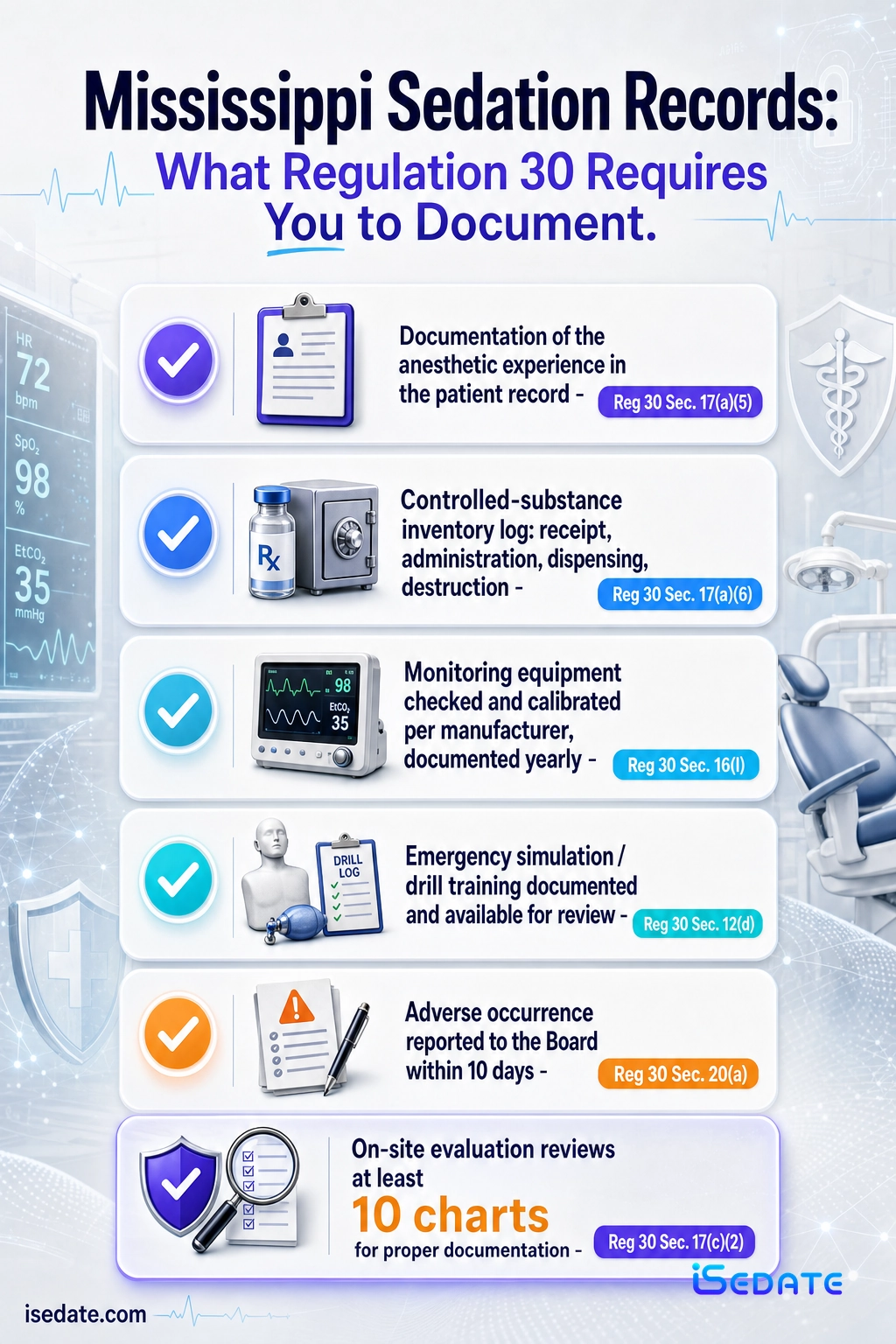
This is the section a reviewer reads first. For permitted sedation, Regulation 30 §17 spells out what the record must contain, and it has two documentation duties worth knowing by heart, plus the equipment, training, and incident records that sit alongside them.
1. Documentation of the anesthetic experience
Under §17(a)(5), the dentist must keep appropriate documentation of the anesthetic experience in patient records. That is the governing sedation recordkeeping duty in Mississippi. The rule does not print a template, which is why the honest way to meet it is to document the full arc of the case: the pre-sedation assessment and baseline vitals, the drugs and doses given with their times, the monitored physiological parameters, the course of the sedation, and recovery to the §1.j criteria. Mississippi does not, in Regulation 30, mandate a minute-by-minute time-oriented chart, but a record thin enough to raise questions is a record that fails an evaluation. The duty attaches to the depth of sedation, not the route, so whether a moderate case was reached with an oral pill or an IV, the same §17 documentation applies.
2. The controlled-substance inventory log
Under §17(a)(6), the dentist must keep proper documentation of the use of controlled substances, including an inventory log that complies with state and federal requirements, covering receipt, administration, dispensing, and destruction. This is a distinct, concrete duty separate from the anesthetic record, and it is one of the easiest things for an evaluator to check and the easiest to fall behind on. Every controlled drug that comes into the office has to be traceable from receipt to use to disposal, and the log must reconcile.
3. Equipment, training, and incident records
Three more records wrap around the two above. Under §16.l, monitoring equipment must be checked and calibrated per the manufacturer's recommendations and documented yearly. Under §12.d, emergency-drill or simulation training must be documented and available for review at on-site evaluations, which the evaluator confirms under §17(c). And under §20(a), an adverse occurrence triggers a complete written report to the Board within ten days. Together these turn "we do it right" into "here is the dated record that proves it."
What a Mississippi Sedation File Must Contain
- Appropriate documentation of the anesthetic experience, the patient's sedation record (Reg 30 §17(a)(5))
- A controlled-substance inventory log, kept to state and federal requirements (§17(a)(6))
- Recovery documented to the defined criteria, including SpO2 on room air of at least 95 percent (§1.j)
- Monitoring-equipment check and calibration records, documented yearly (§16.l)
- Documented emergency simulation / drill training, available at on-site evaluation (§12.d)
- Best practice fills in the detail: a time-oriented record of every drug, dose, and vital-sign reading (ADA national standard, not Mississippi law)
Source: Regulation 30 §17(a)(5) and (a)(6), §§12.d, 16.l, 20.a
See how a time-oriented anesthesia record is built automaticallyWhat a compliant record looks like on the page
Because Mississippi requires appropriate documentation without printing an interval, the practical question is what to actually put on the page. The simplified example below shows the cadence the ADA national standard expects a complete moderate-sedation record to meet: a baseline reading before the drug, readings taken continually while the patient is sedated, and a post-operative reading in recovery, each line carrying the core parameters. This is best practice, not a Mississippi-mandated interval, but it is the shape a reviewer recognizes as complete. (Values are illustrative only, not a real patient record.)
| Time / interval | BP | HR | Resp | SpO2 | Drug / dose |
|---|---|---|---|---|---|
| Pre-op baseline | 128/82 | 76 | 16 | 99% | Triazolam 0.25 mg PO |
| Intra-op 00:15 | 122/78 | 72 | 14 | 98% | None |
| Intra-op 00:30 | 120/76 | 70 | 14 | 98% | None |
| Intra-op 00:45 | 124/78 | 73 | 15 | 99% | None |
| Post-op recovery | 126/80 | 74 | 16 | 99% | Alert, SpO2 99% room air, escorted |
A real case runs longer and carries more detail, and the controlled-substance log, the signed consent, and the pulse-oximetry record sit alongside this grid. But the shape is the point: a reviewer can look at a record like this and see, line by line, that the patient was monitored and that the monitoring was documented against the clock, ending at the §1.j recovery criteria. A record with a single pre-op reading and a single post-op reading, and nothing in between, meets the bare letter of "appropriate documentation" but fails the test of proving what happened during the case.
iSedate Insight
Mississippi's open rule is a trap for the confident. Because the state does not mandate an interval, it is easy to keep a thinner record than you would in a stricter state, and then discover in a review that "appropriate" was always measured against the national standard anyway. The practices that stay defensible in Mississippi chart as if a five-minute interval were required, keep the controlled-substance inventory log current and reconciled for every case, and retain the pulse-oximetry record with the chart rather than in a drawer.

How Mississippi audits records: the ten-chart review
When the Board evaluates a permitted facility, it is not watching you sedate a patient. It is reading your files. Under Regulation 30 §17(c), an on-site evaluation of a permitted office covers the facility and equipment, emergency readiness, and documentation, and the documentation piece is specific: the evaluation includes a review of at least ten charts to assess for proper documentation, plus a review of the office's documented emergency simulation training. The board publishes the exact instrument it uses: a class-specific facility inspection checklist (a separate Class I, Class II, and Class III checklist) matched to the level of anesthesia, and a signed attestation form that accompanies it, so part of the review is checking your paperwork against your own attestation.
Here is where dentists get burned. It is rarely the clinical care that fails a review. It is the record: a controlled-substance log that does not reconcile, an anesthetic entry too thin to show the course of the case, an emergency drill that happened but was never written down. Ten charts is a small enough sample that one weak pattern shows up fast, and a large enough sample that systemic gaps are obvious.
The record is graded, not the sedation. A reviewer does not grade your sedation on how the patient did. They grade it on whether the record proves what you did. If the anesthetic documentation is thin or the controlled-substance log does not reconcile, the default assumption on review is that the practice behind it was loose too. Document the anesthetic experience fully and keep the controlled-substance inventory log current for every case.
Source: Mississippi State Board of Dental Examiners: Facility Inspections and class checklists | Mississippi facility attestation form
Why a thin record is the real exposure
An incomplete sedation record is not a filing technicality. It is the evidence a board weighs when deciding whether the standard of care was met, and the same gaps that fail an evaluation are the gaps a plaintiff's attorney looks for in a malpractice claim. In both a board review and a lawsuit, the contemporaneous sedation record is the first thing requested and the hardest thing to reconstruct after the fact. When the chart does not prove continuous monitoring, the provider is left arguing memory against a document, and the document wins.
The data behind why these rules exist, and what a documentation failure actually costs when a case goes sideways, lives in our research roundups:
The Data Behind the Rule
Penalties and adverse-event reporting
Regulation 30 is backed by enforcement under Miss. Code Ann. §73-9-13. Adverse-event reporting is mandatory and time-bound: under §20(a), a complete report of the incident must be submitted to the Board within ten days of an adverse occurrence. Mississippi also maintains a separate morbidity and mortality reporting rule, Board Regulation 31, so confirm which report applies to a given event with the board. Incomplete sedation records are not a filing technicality. They are the evidence a board weighs when deciding whether the standard of care was met, and the same gaps that fail an evaluation are the gaps a plaintiff's attorney looks for.
The exact disciplinary schedule, any routine inspection cadence for permit holders beyond the on-site evaluation, the record-retention period (governed by the board's separate patient-records rule), and the precise penalty amounts are administered by the Board and can change, so confirm current details directly with the Mississippi State Board of Dental Examiners rather than relying on a figure that may be out of date. What does not change is the exposure created by a thin record: in both a board review and a lawsuit, the contemporaneous sedation record is the first thing requested and the hardest thing to reconstruct after the fact.
Source: Regulation 30 §20.a
The easy button: an audit-ready record
The gap between knowing the rule and passing a review is almost always the same thing: a record kept by hand during a live sedation case. When a team is managing an airway and an anxious patient, the anesthetic note and the controlled-substance log are exactly where the record develops holes, a parameter captured late, a drug given in the moment and logged from memory, a dose that never makes it onto the inventory.
That is the problem SedationVault by iSedate was built to remove. It connects wirelessly to the vitals monitor already in your operatory and captures pulse oximetry, heart rate, respiratory rate, and blood pressure live, on the clock, alongside the drug log, so the anesthetic record builds itself as the case runs rather than being reconstructed afterward. That gives you the time-oriented record the ADA holds up as best practice, while making Mississippi's own duties, the documentation of the anesthetic experience under §17(a)(5) and the controlled-substance inventory under §17(a)(6), simply present and reconciled. When the Board pulls ten charts, each one exports as a one-click, audit-ready sedation visit report that already carries the drugs, doses, monitored vitals, and the recovery determination the rule asks for. The point is not fancier charting. It is turning the exact items Regulation 30 requires into something the software guarantees are present, which is also what dental sedation compliance turns on. If you want to see the numbers first, start with SedationVault pricing.
Book a demo and see your Mississippi sedation record build itselfFrequently asked questions
Does Mississippi require a written sedation record?
How often must vitals be recorded during sedation in Mississippi?
Who audits sedation records in Mississippi?
What are the Mississippi dental sedation permit classes?
Does Mississippi require reporting a sedation adverse event?
Related guides and neighboring states
Licensed in more than one state, or practicing near the Mississippi line? Documentation rules vary by state, so confirm the requirements where you provide sedation. See our same-silo guides for neighboring states:
- Alabama Sedation Vitals Monitoring, Charting & Reporting Requirements
- Arkansas Sedation Vitals Monitoring, Charting & Reporting Requirements
- Louisiana Sedation Vitals Monitoring, Charting & Reporting Requirements
- Tennessee Sedation Vitals Monitoring, Charting & Reporting Requirements
- All 50 states: Dental Sedation Vitals, Charting & Reporting Requirements by State
Sources and citations
This guide cites Mississippi's primary regulatory sources directly. Rule text is drawn from Board Regulation 30 (30 Miss. Admin. Code Part 2301, Rule 1.30, "Administration of Anesthesia," adopted effective May 10, 2021) as published by the Mississippi State Board of Dental Examiners, which is the regulator. The ADA national guidelines are referenced only as a professional best-practice standard, not as Mississippi law. The sample charting cadence is illustrative best practice, not a Mississippi-mandated interval or a real patient record. Where a detail, such as the current penalty schedule, inspection cadence, record-retention period, permit fees, or per-level monitoring intervals, is administered by the board and subject to change, confirm it directly with the Board before relying on it. This guide is general information, not legal advice.
- Board Regulation 30, "Administration of Anesthesia" (30 Miss. Admin. Code Pt. 2301, R. 1.30), official board filing
- Mississippi State Board of Dental Examiners: Facility Inspections (Regulation 30, Class I/II/III checklists, application)
- Mississippi facility self-audit / attestation form (current fillable version)
- Mississippi State Board of Dental Examiners: Approved Courses for Advanced Anesthesia
- Enabling statute: Miss. Code Ann. §73-9-13















