






Louisiana Sedation Dentistry Licensing & Permit Requirements
In Louisiana, you cannot sedate a patient on your dental license alone. Any dentist who administers nitrous oxide, oral sedation, IV sedation, or general anesthesia beyond minimal sedation must first hold the matching permit from the Louisiana State Board of Dentistry (LSBD), issued under Louisiana Administrative Code, Title 46, Part XXXIII. Louisiana runs two permits at once: a personal permit for the dentist and, above nitrous, an office permit for the facility. Getting them means meeting the training, certification, and clinical requirements for your level. Keeping them means your sedation records survive a board review. This guide walks both halves: how a Louisiana dentist gets a sedation or anesthesia permit, and what it takes to keep it.
Recent Updates
Last UpdatedNovember 16, 2026
- Verified every permit fee against the board's own published fee schedule: nitrous permit 50 dollars, and a moderate sedation or general anesthesia permit 400 dollars to apply, 200 dollars to renew.
- Confirmed the current sedation permit application forms and the office-inspection requirement for any level above nitrous, and added direct links to the board's licensing and forms pages.
- Confirmed the resuscitation rule against the board's continuing-education page: current ACLS for adult moderate sedation or general anesthesia, PALS for pediatric, and BLS maintained at all times.
- Replaced general references with direct links to the primary sources (the full Part XXXIII rules and La. R.S. 37:793).
- Louisiana issues personal sedation permits for nitrous oxide, moderate sedation (conscious sedation), and deep sedation or general anesthesia under LAC 46:XXXIII.1503, plus a separate office permit under LAC 46:XXXIII.1502 for any level above nitrous.
- Minimal sedation of an adult patient needs no board permit, and the board no longer issues a separate office permit for nitrous; everything above nitrous needs both a personal permit and an office permit at a level at least equal to the sedation performed.
- Moderate sedation requires course and clinical training plus current ACLS. Published figures describe roughly a 60-hour course and about 20 clinical patient cases, which should be confirmed with the board.
- The board's fee schedule puts the moderate sedation or general anesthesia permit at 400 dollars to apply and 200 dollars to renew; a nitrous permit is 50 dollars.
- CE under LAC 46:XXXIII.1611.H requires an in-person adult sedation course of at least 6 hours per license period (12 hours if pediatric certified), and La. R.S. 37:793(E) requires a written adverse-event report within 10 days. Incomplete records are where permits get challenged.
What This Guide Covers
- Who issues sedation permits in Louisiana
- The Louisiana permit structure
- How to get or upgrade each permit
- What the permit requires you to monitor
- Reporting obligations tied to your permit
- CE, ACLS, and recertification
- Inspections and record reviews
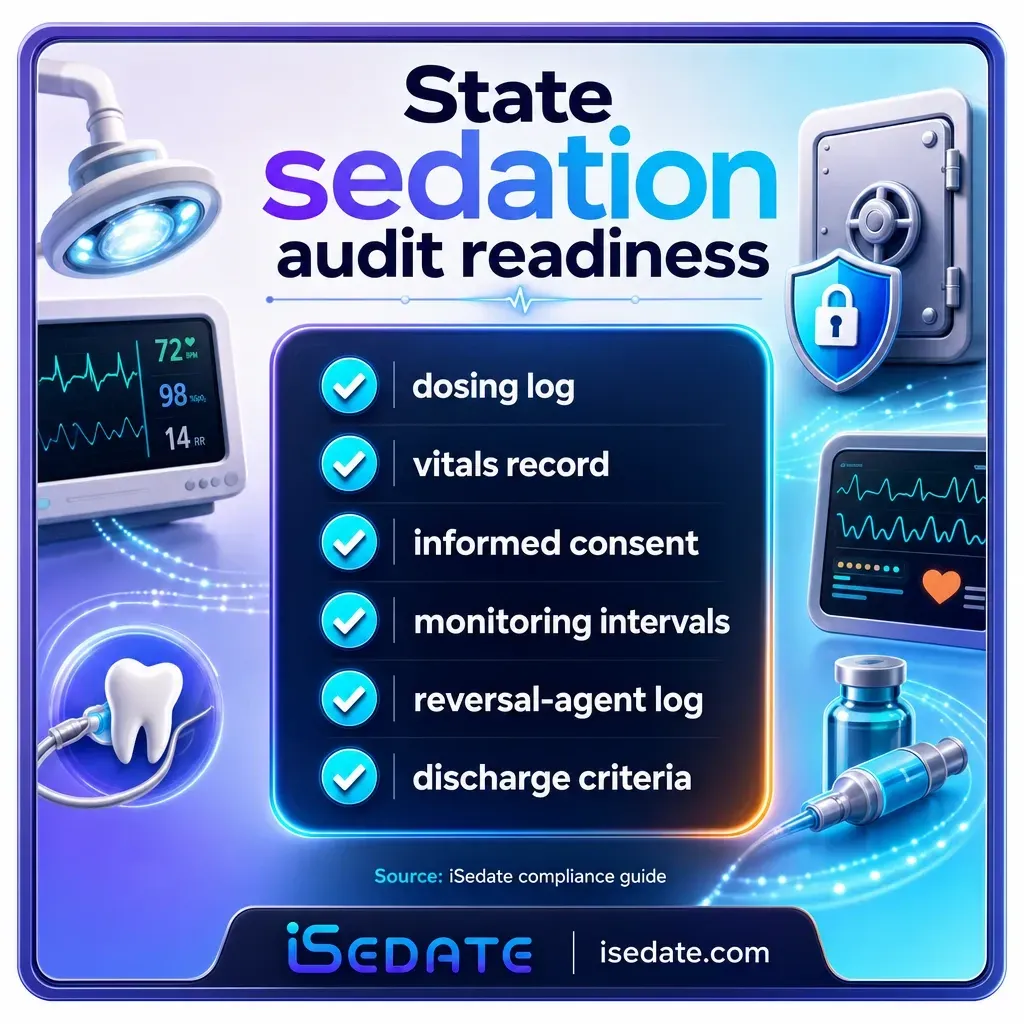
- Keeping the permit: audit-ready records
- Frequently asked questions
- Sources
Who issues sedation permits in Louisiana
Sedation dentistry in Louisiana is regulated by the Louisiana State Board of Dentistry, the state agency that licenses dentists and issues every sedation and anesthesia permit. The board, not any national body, decides who may sedate, runs the office inspections and record reviews, and takes disciplinary action. The rules live in Louisiana Administrative Code, Title 46, Part XXXIII, where Chapter 15 governs nitrous oxide analgesia, moderate sedation, and deep sedation and general anesthesia, and the underlying authority is La. R.S. 37:793. Every requirement below traces to one of those sources.
Myth, Busted
Myth: The ADA's national sedation guidelines are the law that governs a Louisiana dentist.
Fact: The American Dental Association is a private professional association, not a government agency. It does not license, inspect, or discipline you. In Louisiana your permit, your inspections, and your sanctions all come from the LSBD under LAC Title 46 Part XXXIII and La. R.S. 37:793.
Louisiana and most states lean on the ADA's sedation guidelines as the standard of care, and often incorporate them by reference. Treat the ADA guidance as best practice, and the Louisiana code as the rule you are actually held to. The federal layers that also apply are the DEA (controlled-substance records), HIPAA, and, where relevant, CMS or accreditation bodies, not the ADA.
Louisiana is also one of the states that separates the person from the place. Under LAC 46:XXXIII.1502, the board issues two kinds of permits: a personal permit that authorizes the dentist, and an office permit that authorizes the facility, which must be held at a level at least equal to the sedation performed there. The sedation permit applications themselves, with a separate form for each level, are published on the board's licensing information page.
Source: LAC 46:XXXIII.1502 (Part XXXIII rules) | La. R.S. 37:793
The Louisiana permit structure
Louisiana names its permits by the kind of sedation, not a numbered level, and above nitrous it layers a personal permit under an office permit. Here is the full structure, each rung with its governing section of Part XXXIII.
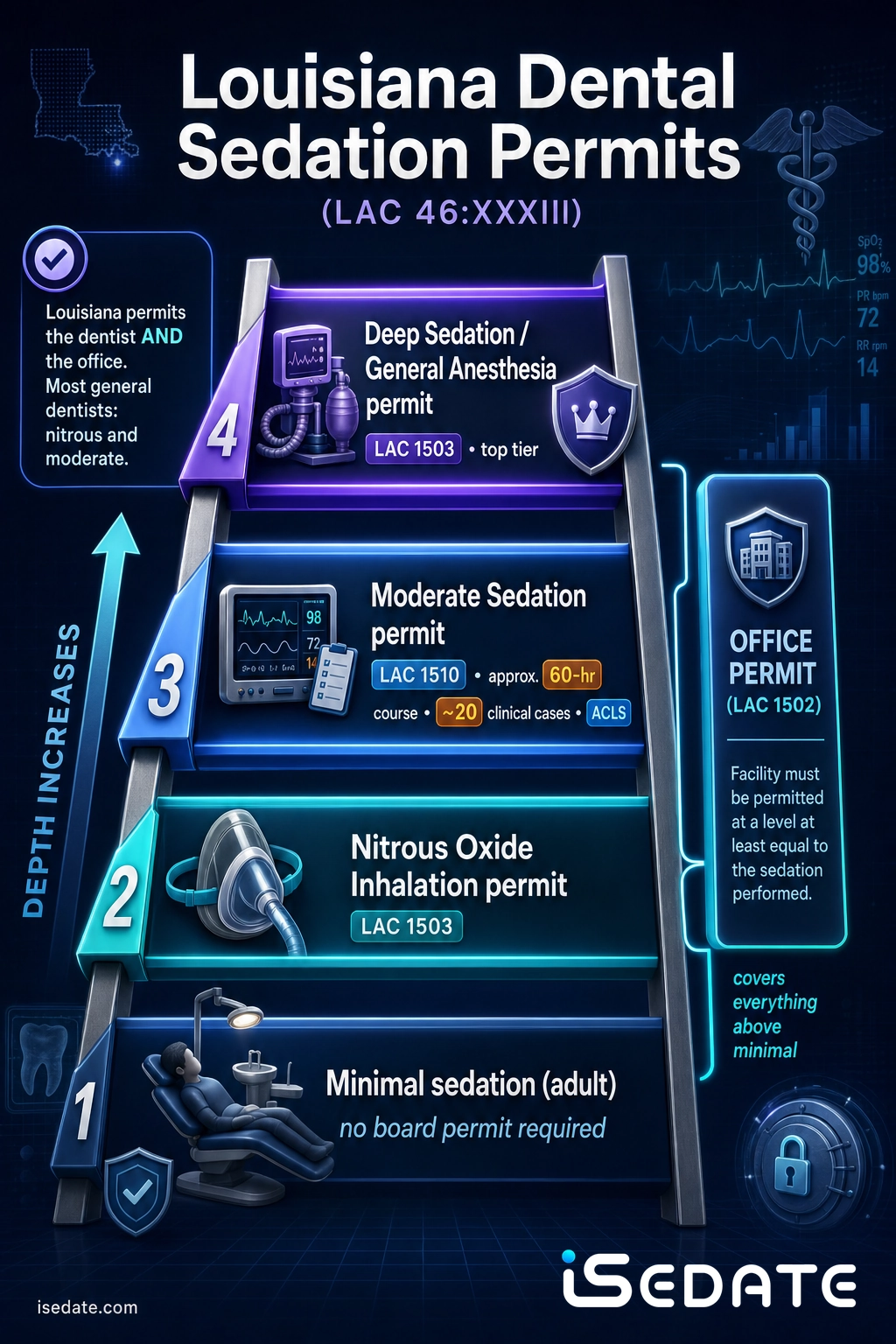
Minimal sedation needs no permit. Minimal sedation (anxiolysis) of an adult patient does not require a board sedation permit in Louisiana. It is the one rung on the ladder you can occupy on your dental license alone, though the general standard of care still applies.
Nitrous Oxide Inhalation permit (LAC 46:XXXIII.1503). The entry sedation permit. It authorizes nitrous oxide inhalation analgesia, the lightest form of anxiety control, where the patient stays fully responsive. It is the usual first permit for a general practice adding light sedation. Louisiana treats nitrous differently from every level above it: the board no longer issues a separate office permit for nitrous, so the personal nitrous permit is all that is required to administer it.
Moderate Sedation permit (LAC 46:XXXIII.1510). Authorizes moderate sedation, commonly called Conscious Sedation, by the enteral (oral) or parenteral (including IV) route. The patient responds purposefully to verbal or tactile stimulation and keeps their own airway. This is the workhorse permit for general dentists who do real oral or IV conscious sedation, and it is the level whose monitoring and record rules Louisiana states most explicitly, in LAC 46:XXXIII.1510 and 1511.
Deep Sedation or General Anesthesia permit (LAC 46:XXXIII.1503). The top tier. It authorizes deep sedation and general anesthesia, where the patient is not easily aroused or is unconscious and may need airway support. For most general dentists this tier is out of scope; it is largely the province of dental anesthesiologists and oral and maxillofacial surgeons. Louisiana defines it inside the permit framework of 1503 rather than a standalone section, and its full training specifics should be confirmed directly with the board.
Office permit (LAC 46:XXXIII.1502). On top of the personal permit, any office where moderate sedation, deep sedation, or general anesthesia is performed must itself carry an office permit at a level at least equal to the sedation performed. The facility must satisfy the required-facilities rule in LAC 46:XXXIII.1511, covering personnel, equipment, and emergency readiness, and an office inspection is required for any level above nitrous.
Source: LAC 46:XXXIII.1502, 1503, 1510, and 1511
How to get or upgrade each permit
Each permit has its own bar to clear: a course of training, resuscitation certification, and, for moderate sedation, supervised clinical patient cases. You move up by meeting the next permit's requirements and applying to the board on the form for that level. The figures below reflect Louisiana's permit framework and the board's published fee schedule; training-hour and clinical-case counts come from the course providers and should be confirmed against the board's current requirements.
| Permit | Route / depth | Training | Resuscitation | Fee (apply / renew) |
|---|---|---|---|---|
| Minimal (adult) | Anxiolysis, lightest | No board permit required | Per standard of care | None |
| Nitrous Oxide (1503) | Inhalation analgesia | Recognized nitrous course | BLS maintained | $50 / $50 |
| Moderate Sedation (1510) | Enteral (oral) or parenteral / IV | Approx. 60-hour course + approx. 20 clinical cases (confirm with board) | ACLS (PALS if pediatric) | $400 / $200 |
| Deep Sedation / GA (1503) | Deep sedation / general anesthesia | Advanced anesthesia training (see 1503; confirm with board) | ACLS (PALS if pediatric) | $400 / $200 |
| Office permit (1502) | Facility, at level of sedation performed | Facility must meet LAC 46:XXXIII.1511 + office inspection | Emergency kit and equipment per 1511 | Confirm with board |
Nitrous and minimal
Minimal sedation of an adult needs no board permit. The Nitrous Oxide Inhalation permit under LAC 46:XXXIII.1503 is the most accessible sedation permit and the usual first step for a general practice. The application is the Nitrous Oxide Application on the board's forms page, and because the board no longer issues an office nitrous permit, a personal nitrous permit is all you need to administer nitrous.
Moderate sedation: the workhorse permit
To hold a Moderate Sedation permit under LAC 46:XXXIII.1510, a dentist completes recognized moderate sedation training and holds current ACLS before administering oral or IV moderate sedation. Course providers publish figures of roughly a 60-hour course together with about 20 supervised clinical patient cases, and the permit covers both the enteral and parenteral (IV) routes. Because those exact figures are set outside the board's own published pages, treat them as a planning estimate and verify the current course length and clinical-case count before you enroll. You can take the required class through an ADA-recognized sedation education provider such as DOCS Education's Louisiana course page.
Board Rule
Deep sedation and general anesthesia
The Deep Sedation or General Anesthesia permit is the top tier and carries the heaviest training and facility requirements, defined within LAC 46:XXXIII.1503 and the facility rule in 1511. Its specific training hours and clinical requirements run beyond the scope of a general practice, so if you are pursuing it, work directly from the code with the board. For most general dentists, nitrous and moderate sedation are the two permits that matter.
Fees, forms, and the office inspection
For every permit, the application form, the fee, and any inspection requirement are set by the board. The LSBD fee schedule puts a personal nitrous permit at 50 dollars to apply and 50 dollars to renew, and a personal or office moderate sedation or general anesthesia permit at 400 dollars to apply and 200 dollars to renew. The separate application forms for each level, and the Anesthesia Inspection Sheet used for the office inspection on any level above nitrous, are published on the board's forms page.
Board Fee Schedule
Source: LSBD licensing information | LSBD fee schedule | LAC 46:XXXIII.1503 and 1510

What the permit requires you to monitor
A permit is permission plus obligation. Once you hold a moderate sedation permit, LAC 46:XXXIII.1510.B sets what you must monitor during the case:
- Oxygenation: continuous pulse-oximetry monitoring must be initiated with early signs of moderate sedation and continued until the patient is alert, and a working pulse oximeter is a condition of administering moderate sedation under 1510.A.2.
- Ventilation and rates: a precordial or pretracheal stethoscope must be available to assist intraoperatively in monitoring heart and respiratory rates.
- Circulation: a sphygmomanometer must be immediately available and used as needed throughout the procedure.
- Attendance: under LAC 46:XXXIII.1511.B, the patient must be constantly attended, under the direct supervision of the authorized dentist.
The facility rule in LAC 46:XXXIII.1511 adds the equipment floor: capnography to monitor the partial pressure of carbon dioxide under 1511.A.7.f, and a working EKG and defibrillator under 1511.A.7.g, both required for moderate, deep, and general anesthesia. For the full clinical breakdown of what to monitor and chart, including how Louisiana's record rule compares to the national standard, see the companion guide on Louisiana sedation vitals monitoring, charting and reporting requirements, and the national overview in our state-by-state sedation licensing hub.
Source: LAC 46:XXXIII.1510.B and 1511
Reporting obligations tied to your permit
Holding a permit also means holding a set of documentation and reporting duties, and these are exactly what a board review examines.
The sedation record. Under LAC 46:XXXIII.1510.A.3, a dentist administering moderate sedation must maintain a proper record keeping mechanism in addition to a controlled substance log. Louisiana names both documents, so a complete file carries the patient record and the controlled substance log side by side. The rule does not itemize a fixed charting interval, so the national ADA standard of a time-oriented record is the benchmark a reviewer measures a proper record against.
The pediatric scale. Under LAC 46:XXXIII.1510.A.4, an accurate scale must be used on pediatric patients, defined as anyone under the age of 13, so that weight-based dosing is recorded against a real measurement.
Adverse-event reporting. This is Louisiana's hardest reporting line. Under La. R.S. 37:793(E), a dentist must file a written report with the board within ten days of any mortality or any injury requiring hospitalization that occurs during or as a result of covered anesthesia or sedation, describing the techniques, drugs given, the adverse occurrence, the treatment, the patient's response, and the condition on termination.
State Law
Important
Every item that ten-day report must contain, the drugs given, the adverse occurrence, the treatment, and the patient's response, is something a complete sedation record already holds. A thin record turns the ten-day report into a reconstruction from memory, and incomplete records are exactly where a board review or a later malpractice claim finds its opening.
Source: LAC 46:XXXIII.1510 | La. R.S. 37:793(E)
CE, ACLS, and recertification
Your sedation permit is tied to your Louisiana dental license, and the board expects permit holders to stay current. Under LAC 46:XXXIII.1611.H, a sedation permit holder must complete an in-person adult sedation continuing-education course of at least 6 hours once per license period, or at least 12 hours if pediatric certified, beginning the second renewal period after the permit is issued.
State Law
On top of that sedation CE, the board's continuing-education rules require current resuscitation certification: ACLS for an adult moderate sedation or general anesthesia permit, PALS for a pediatric permit, and BLS maintained at all times (ACLS and PALS do not substitute for BLS). Fully online resuscitation courses are not accepted. General CE is reported through CE Broker by December 31 of the renewal year. The renewal cycle and the exact CE mix can be updated by board rule, so confirm your current requirements with the Louisiana State Board of Dentistry so your permit never lapses at renewal.
Source: LAC 46:XXXIII.1611.H | LSBD continuing education
Inspections and record reviews
This is where a permit is kept or lost. The permits that authorize moderate and deeper sedation carry the heaviest scrutiny, because that is where the risk is. Any office permit above nitrous requires an office inspection against the Anesthesia Inspection Sheet before it issues, and the office permit under LAC 46:XXXIII.1502 ties your facility's authorization to continued compliance with the required-facilities rule in 1511, which means your personnel, equipment, and emergency readiness are all fair game on review.
When a reviewer opens your file, they are checking the record, not your intentions. Louisiana's rule gives you latitude in the form of the record, but a thin record that technically meets a proper record keeping mechanism is exactly the record that fails to defend you. A board review, and any later malpractice claim, turns on whether your sedation record is complete, contemporaneous, and built to the national time-oriented standard.
Source: LSBD licensing information (office inspection) | LAC 46:XXXIII.1502 and 1511
Keeping the permit: audit-ready records
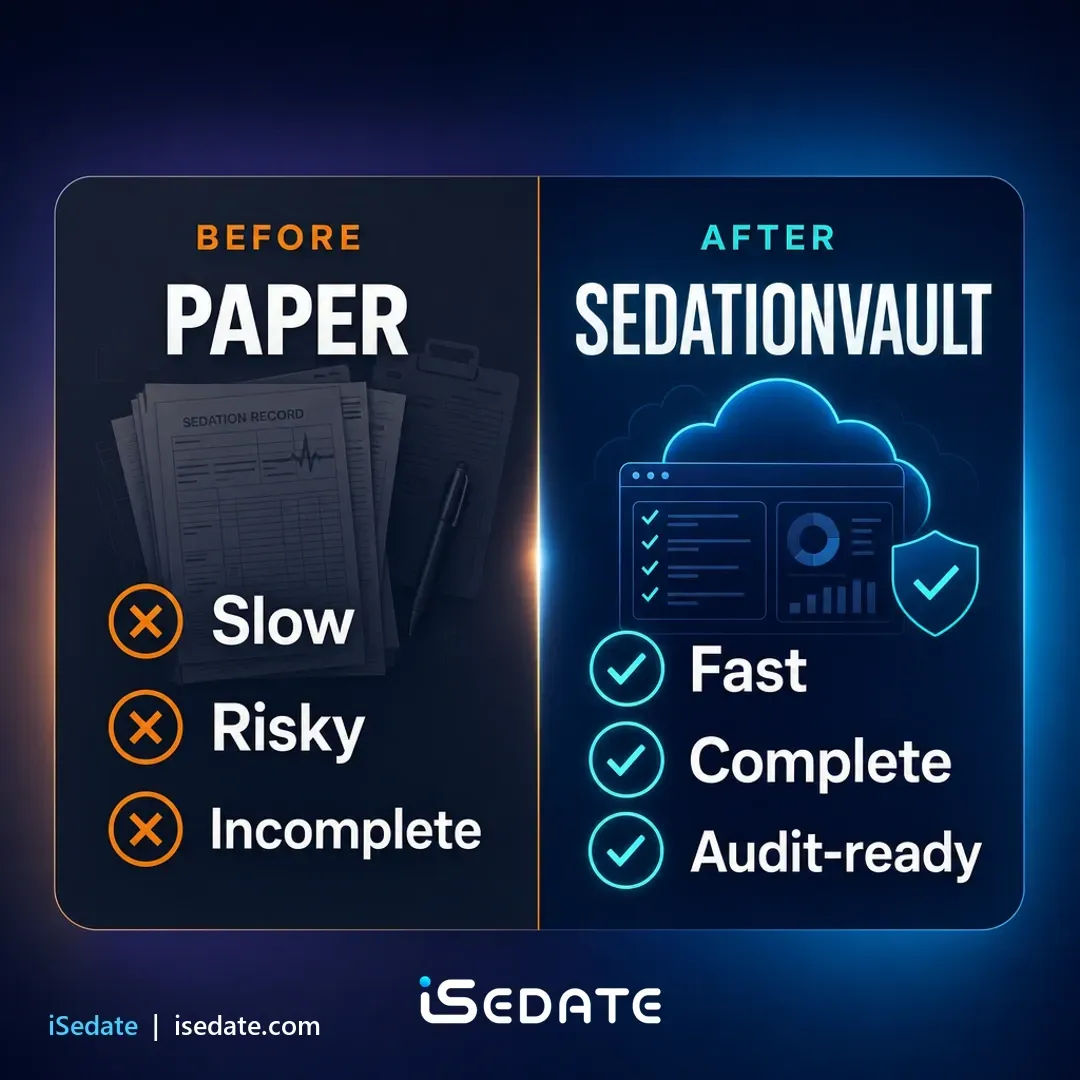
Everything above points to one truth: getting the permit is a one-time hurdle, but keeping it is a daily documentation discipline. A manual vitals log written by hand during a live case, between titrating a drug and watching an airway, is exactly where records go incomplete, and in Louisiana that same gap can leave both the patient record and the controlled substance log short. Incomplete records are what a board review and a malpractice claim both attack.
SedationVault removes that failure point. It captures live patient vitals and the drug log automatically into a time-oriented record, the kind the national standard expects a proper record keeping mechanism to be, so the record writes itself while you focus on the patient. When the board asks for the file, or a La. R.S. 37:793(E) report comes due, a complete record is a one-click export, not a scramble through paper. See how it maps to the rules on the dental sedation compliance and anesthesia record software pages.
Book a Demo of SedationVault See SedationVault PricingFrequently asked questions
What sedation permits does Louisiana offer?
What does a Louisiana dentist need to get a moderate sedation permit?
How much does a Louisiana sedation permit cost?
Does Louisiana require an office permit for nitrous oxide?
How often do you renew a Louisiana sedation permit and what CE is required?
Licensed in a Neighboring State?
If you practice across state lines, the permit framework changes at the border. See our sedation licensing and permit guides for the neighboring states:
Sources
- Louisiana State Board of Dentistry, Licensing Information (sedation and anesthesia permit applications, office inspection)
- Louisiana State Board of Dentistry, Forms (nitrous, moderate sedation, and general anesthesia permit applications, Anesthesia Inspection Sheet)
- Louisiana State Board of Dentistry, Fee Schedule (permit application and renewal fees)
- Louisiana State Board of Dentistry, Continuing Education (ACLS, PALS, BLS, CE Broker)
- LAC Title 46 Part XXXIII, Louisiana State Board of Dentistry rules (Chapter 15: sedation and anesthesia; 1502, 1503, 1510, 1511; 1611.H continuing education)
- La. R.S. 37:793 (dental anesthesia and sedation; adverse-occurrence report, subsection E)
This guide summarizes Louisiana sedation permit rules for general information and is not legal advice. The permit framework, monitoring, facility, fee, and continuing-education requirements are drawn from LAC Title 46 Part XXXIII and the Louisiana State Board of Dentistry's published licensing, forms, fee, and CE pages as cited, and the adverse-event reporting duty from La. R.S. 37:793. Moderate sedation training-hour and clinical-case counts come from course providers and are not stated on the board's own pages; the routine inspection cadence and deep sedation and general anesthesia training specifics should be confirmed directly with the board before you act.