






Arkansas Sedation Dentistry Licensing & Permit Requirements
In Arkansas, your dental license alone does not let you sedate a patient beyond the lightest level. A dentist who administers moderate sedation, deep sedation, or general anesthesia must first hold the matching permit from the Arkansas State Board of Dental Examiners (ASBDE), issued under the board's Rules of Practice, Article XIII (Ark. Admin. Code 115-1302 through 115-1307) and the enabling statute at Ark. Code 17-82-504. Nitrous oxide and minimal sedation need no permit, but they still carry a charting duty. Earning a sedation permit means clearing the training, certification, and live-patient bar for your level. Keeping it means your facility passes inspection, your sedation records survive a board review, and your renewal stays current. This guide walks both halves, with every requirement traced to the rule.
Recent Updates
Last UpdatedNovember 16, 2026
- Rewrote every requirement against the Arkansas State Board of Dental Examiners' own current permit applications and the verbatim recordkeeping rule in Article XIII (Ark. Admin. Code 115-1304), replacing third-party rule aggregators with the board's own sources.
- Replaced the outbound citations that pointed to law aggregators with direct links to the board's official pages: the board page, the applications and renewals index, the fee schedule, and the Dental Practice Act.
- Clarified that Arkansas's single Moderate Sedation permit covers both the oral and IV routes, so there is no separate "add IV" upgrade tier.
- Added the nine-item record list the board's sedation application enumerates, and kept fees and continuing-education hours as "confirm with the board" where the board sets them administratively.
- Arkansas regulates sedation through the Arkansas State Board of Dental Examiners under Ark. Code Title 17, Chapter 82 and the board's Rules of Practice, Article XIII. Permits are grouped by depth, not a numbered Level 1 to 4 ladder.
- Nitrous oxide and minimal sedation need no permit; the permit requirement starts at the Moderate Sedation permit, which in Arkansas covers both the oral (enteral) and IV (parenteral) routes under one permit.
- The Moderate Sedation permit requires at least 60 didactic hours, documented management of 20 live patients, and current ACLS or an equivalent dental sedation emergency course (Ark. Admin. Code 115-1302), and applies to patients 12 and older.
- Deep sedation and general anesthesia require a dentist permit plus a facility permit and an inspected office, and the staff who monitor the patient need a sedation monitoring permit (Ark. Admin. Code 115-1307).
- The permit is kept with the paperwork: permits renew annually with the dental license (Ark. Code 17-82-504), facilities can be inspected, and incomplete records are where permits get challenged.
What This Guide Covers
- Who issues sedation permits in Arkansas
- The Arkansas sedation permit tiers
- How to earn or upgrade each permit
- What the permit requires you to monitor
- Documentation and reporting duties
- Continuing education and renewal
- Inspections and keeping the permit
- Frequently asked questions
- Related guides and neighboring states
- Sources
Who issues sedation permits in Arkansas
Sedation dentistry in Arkansas is regulated by the Arkansas State Board of Dental Examiners, the state agency that licenses dentists and issues every sedation and anesthesia permit. The board, not any national body, decides who may sedate, inspects sedation facilities, runs the record reviews, and takes disciplinary action. Two bodies of law work together: the Arkansas Dental Practice Act in Ark. Code Title 17, Chapter 82, where Ark. Code 17-82-504 requires a dentist to apply for and hold a permit before administering general anesthesia or sedation, and the board's own Rules of Practice, Article XIII (cited as Ark. Admin. Code 115-1302 through 115-1307). Every requirement below traces to one of them.
Important
The ADA writes the standard; the board writes the law. The American Dental Association publishes sedation guidelines that Arkansas leans on, and the board's rules mirror the ADA's time-oriented anesthetic record. But the ADA is a professional association, not a government agency. It does not license you, inspect you, or discipline you. Your permit, your facility inspection, and any sanction come from the ASBDE under Article XIII. Treat the ADA guidelines as best practice and the board's rules as the law you are held to. The real federal layers are separate: the DEA for controlled-substance logs, HIPAA for patient records, and any accreditation body your facility answers to.
To apply, you work through the board's own process. The board publishes separate materials for the Moderate Sedation permit and for the General / Deep Sedation permit, and the deep-sedation materials include a facility-permit affidavit by which you confirm your office meets the board's equipment and recordkeeping requirements and authorize inspection. Pull the current forms from the board's applications and renewals page, and confirm the current fee on the board's fee schedule, because both are set administratively and change periodically. Do not rely on a number you read on a CE provider's page.
Source: Arkansas State Board of Dental Examiners | Arkansas Dental Practice Act (Title 17, Chapter 82)
The Arkansas sedation permit tiers
Arkansas does not number its sedation permits one through four. It groups sedation by depth, and the permit requirement starts at moderate sedation. Here is the ladder, each rung with its governing part of Article XIII.
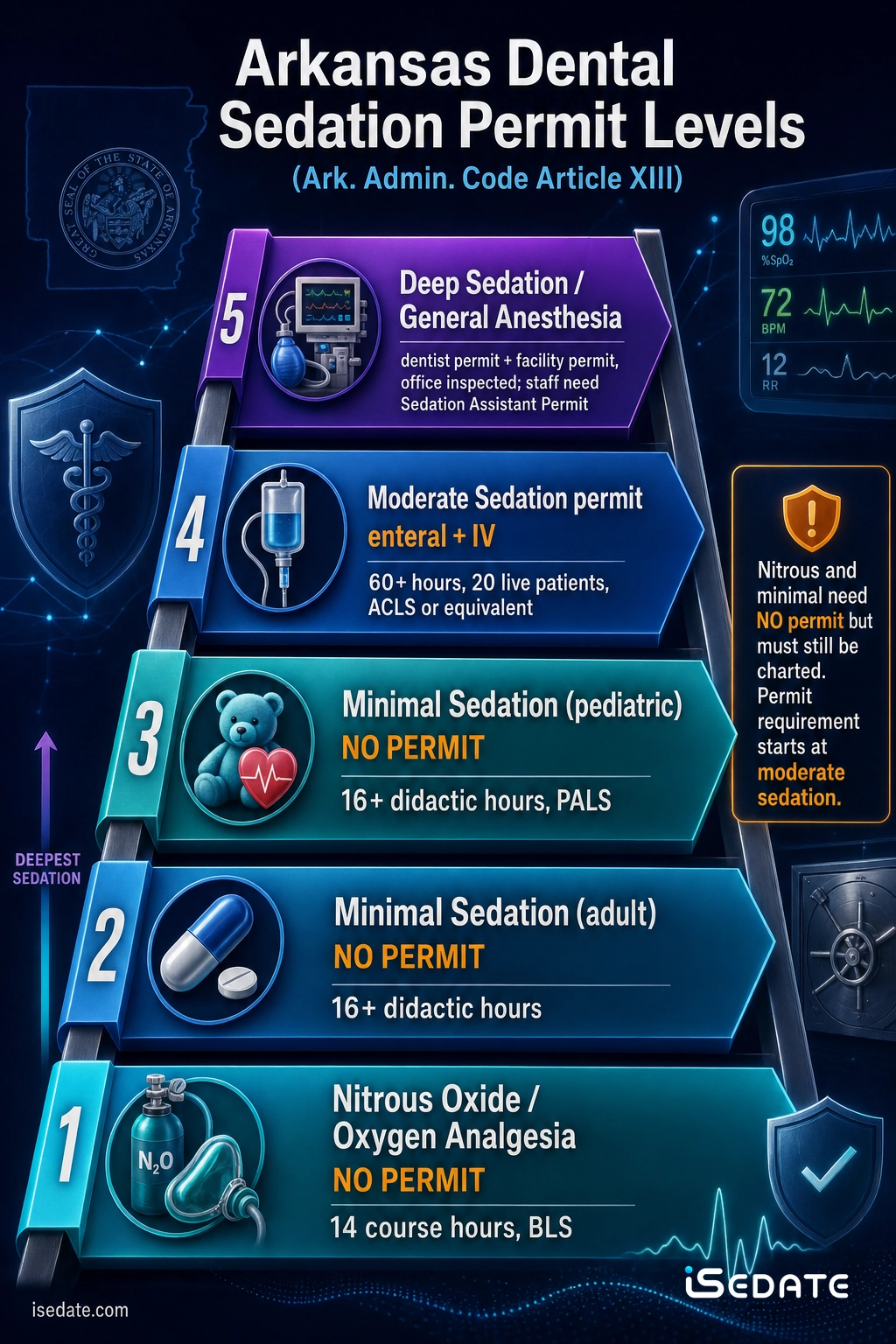
Nitrous oxide / oxygen analgesia (no permit required). The lightest form of anxiety control, where the patient stays fully responsive. Any Arkansas-licensed dentist may administer nitrous oxide without a sedation permit, though its use must still be recorded in the patient's chart and competency training is the standard of care.
Minimal sedation (no permit required). Minimal sedation, or anxiolysis, is typically a single oral drug where the patient responds normally to verbal command and airway and cardiovascular function are unaffected. No permit is required, but the sedation must be documented, and the oxygen saturation must be recorded before, during, and after the procedure under Ark. Admin. Code 115-1304.
Moderate Sedation permit (Ark. Admin. Code 115-1302 / 115-1305). The first permit tier. It authorizes moderate sedation, the level Arkansas and the ADA call Conscious Sedation, and in Arkansas a single Moderate Sedation permit covers both the enteral (oral) route and the parenteral (IV) route. The patient responds purposefully to verbal or tactile stimulation and keeps their own airway. The permit applies to patients 12 and older, and a moderate-sedation facility-permit office can be randomly inspected by the board.
Deep Sedation / General Anesthesia permit (Ark. Admin. Code 115-1305). The top tier. It authorizes deep sedation and general anesthesia, where the patient is not easily aroused or is unconscious and may need airway support. This level requires both a dentist permit and a facility permit, and the office must be inspected. Staff who monitor the patient need a sedation monitoring permit under Ark. Admin. Code 115-1307, and a dental assistant must first hold a board permit in nitrous oxide administration before applying for it. For most general dentists, deep sedation and general anesthesia are out of scope, so work directly from the board's general and deep sedation application if you are pursuing this level.
Source: ASBDE General / Deep Sedation Facility Permit application | ASBDE Moderate Sedation Facility Permit application
How to earn or upgrade each permit
Each level has its own bar to clear: a set number of training hours, resuscitation certification, and, for moderate sedation, a count of managed live patients. You move up the ladder by meeting the next level's requirements and applying to the board. The permit figures below come from Article XIII; the training benchmarks for the no-permit levels are what board-approved course providers teach as the standard of care, confirmed with the board.
| Level | Route / depth | Permit | Training | Live patients | Resuscitation |
|---|---|---|---|---|---|
| Nitrous oxide / oxygen analgesia | Inhalation, lightest | None required | Course training (standard of care) | Not specified | BLS (standard of care) |
| Minimal sedation | Minimal / anxiolysis, oral | None required | Course training (standard of care) | Not specified | Confirm with board |
| Moderate Sedation permit | Enteral and parenteral / IV | Moderate Sedation permit | At least 60 didactic hours | 20 live patients | ACLS or equivalent dental sedation emergency course |
| Deep Sedation / General Anesthesia | Deep sedation / general anesthesia | Dentist permit + facility permit (office inspected) | Confirm the current training path with the board | See board application | Confirm with board; monitoring staff need a sedation monitoring permit |
Nitrous oxide and minimal sedation: the no-permit levels
Neither nitrous oxide nor minimal sedation requires a sedation permit in Arkansas, but neither is unregulated. Both still carry the charting duty under Ark. Admin. Code 115-1304, and for minimal sedation the oxygen saturation must be recorded before, during, and after the procedure. Competency training is the practical standard of care: board-approved course providers such as DOCS Education's Arkansas sedation courses teach roughly 14 hours for nitrous oxide (with BLS) and at least 16 didactic hours for oral minimal sedation (with PALS added for pediatric patients). These are the usual first steps for a general practice offering light anxiety control. Confirm the current training expectation with the board rather than assuming a fixed number.
The Moderate Sedation permit
This is the first real permit hurdle, and because the single permit covers the IV route as well as the oral route, there is no separate "add IV" tier to upgrade into later. To hold it, you need at least 60 hours of didactic training, documented clinical management of 20 live patients, and current ACLS or an equivalent dental sedation emergency management course under Ark. Admin. Code 115-1302. The 20-patient clinical requirement exists because moderate sedation, especially by the IV route, demands hands-on titration competence a classroom cannot replicate. The permit applies to patients 12 and older.
Myth, Busted
Myth: Nitrous oxide and minimal sedation aren't really regulated in Arkansas, since neither needs a permit.
Fact: Both still carry a charting duty under Article XIII (Ark. Admin. Code 115-1304), and for minimal sedation the oxygen saturation has to be recorded before, during, and after the procedure.
The no-permit label is about who can administer the drug, not whether it has to be documented. A recordkeeping lapse on a nitrous or minimal case is still a rule violation the board can act on.
For every level, the application, the current fee schedule, and any exam requirement are set by the board and updated periodically. Confirm the exact forms and current fees on the board's applications and renewals page before you file. If your charting system also has to handle both the oral and IV moderate-sedation records on one permit, the iSedate anesthesia record software is built to match these permit categories.
Source: ASBDE applications and renewals | DOCS Education, Arkansas sedation training

What the permit requires you to monitor
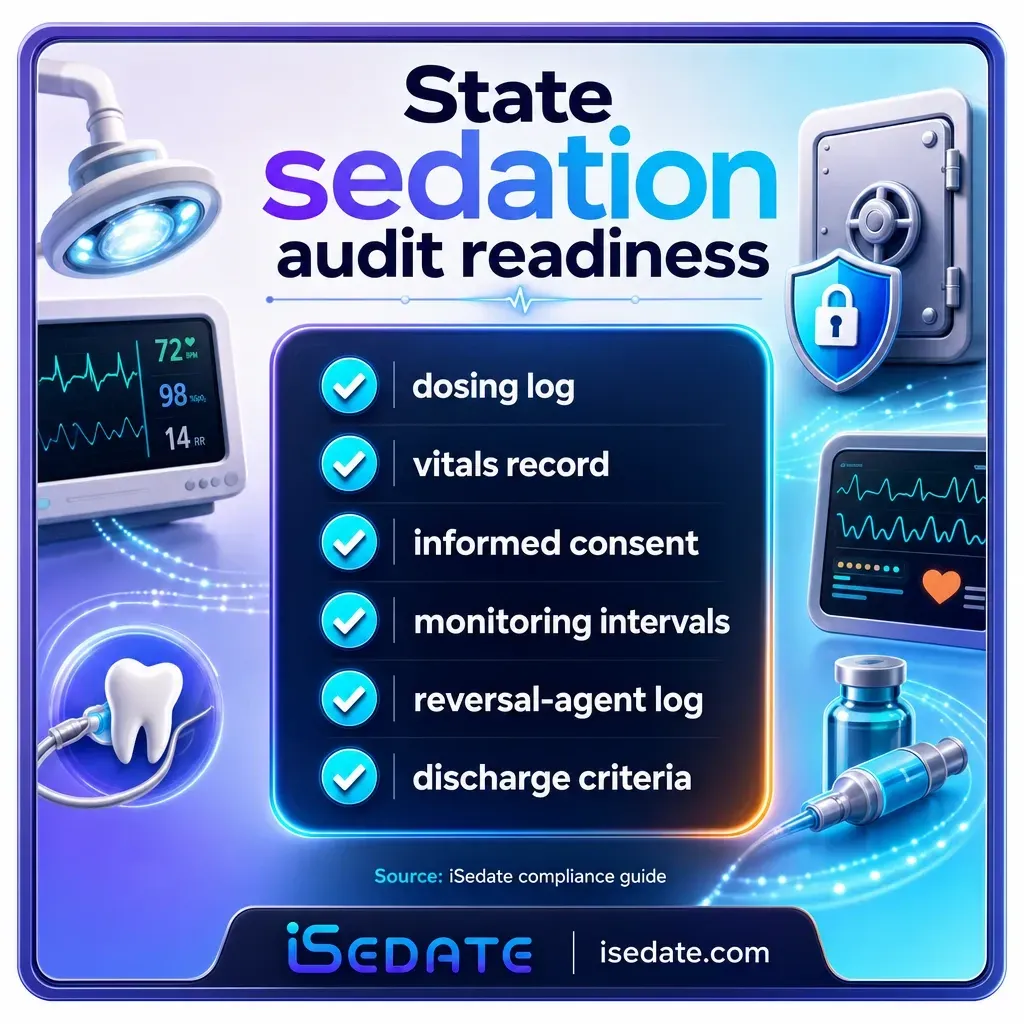
A permit is permission plus obligation. Once you hold a Moderate Sedation permit, the board's rules require the patient to be monitored continuously, with the vital signs captured in a time-oriented anesthetic record. The board's own sedation application lists the physiological parameters the chart must carry, as necessary across the case:
- Oxygenation: oxygen saturation (SpO2), monitored and recorded during the procedure.
- Circulation: blood pressure and heart rate.
- Ventilation: respiration rate.
- Consciousness: the patient's level of consciousness, which the record must show was satisfactory at discharge.
For moderate sedation, the rule requires those parameters to be captured in a time-oriented anesthetic record, and for minimal sedation the oxygen saturation must be recorded before, during, and after the procedure. Arkansas does not attach a fixed numeric minute interval to the time-oriented record, so the standard is a genuinely contemporaneous, complete timeline rather than a stopwatch count. Deep sedation and general anesthesia carry a heavier monitoring and emergency-equipment load, administered in an inspected facility; work from the board's deep-sedation application for those specifics. For the full clinical breakdown of what to monitor and chart at each depth, see the companion guide on Arkansas sedation vitals monitoring, charting, and reporting requirements.
Source: ASBDE General / Deep Sedation Facility Permit application (record rule, 115-1304) | ASBDE Moderate Sedation Facility Permit application
Documentation and reporting duties
Holding a permit also means holding a set of documentation duties, and these are exactly what a board inspection examines. The board's sedation application has the dentist confirm that each sedated patient has a defined set of information recorded in the treatment record.
What the Arkansas sedation record must contain
- Informed consent and the patient's health history.
- Blood pressure, heart rate, respiration rate, and oxygen saturation, as necessary across the case.
- The names of all drugs administered, with dosages, and the weight of any patient under 12.
- The local anesthetic record and a record of all procedures performed.
- The level of consciousness at discharge and the post-operative instructions given.
- A time-oriented anesthetic record for moderate sedation.
Discharge and discipline. The record must show the patient recovered to a satisfactory level of consciousness before release, along with the post-operative instructions. A lapsed permit ends your authority to sedate under Ark. Code 17-82-504, and rule violations, including recordkeeping violations, can lead to board disciplinary action under Title 17, Chapter 82. The specific penalty schedule and the current adverse-event reporting triggers and timelines are set by the board and change, so confirm the current reporting duties directly with the ASBDE.
Source: ASBDE General / Deep Sedation Facility Permit application | Arkansas Dental Practice Act, Ark. Code 17-82-504
Continuing education and renewal
Your sedation permit is tied to your Arkansas dental license and renews annually with it under Ark. Code 17-82-504. A permit that lapses ends your authority to administer sedation or general anesthesia until it is reinstated, so renewal is not a formality. The board also expects permit holders to stay current in the resuscitation certifications appropriate to their level (BLS, ACLS, or PALS as applicable).
iSedate Renewal Tip
Keep your resuscitation card and sedation CE dated and filed. Arkansas sets the exact number of sedation-specific continuing-education hours by board rule, and it is updated periodically, so this guide does not reproduce a figure that could be out of date. Confirm your current renewal cycle, CE hours, and resuscitation-certification requirements on the board's applications and renewals page or by calling the board at 501-682-2085, so your permit never lapses at renewal.
Source: Arkansas Dental Practice Act, Ark. Code 17-82-504 | ASBDE applications and renewals
Inspections and keeping the permit
This is where a permit is kept or lost. Under Ark. Admin. Code 115-1305, every office administering deep sedation or general anesthesia must hold a facility permit and be inspected, and the board may randomly inspect any moderate-sedation facility-permit office. The board's facility-permit application states plainly that its investigators may inspect the facility with written notice. The deeper the sedation you provide, the closer the scrutiny, because that is where the risk is.
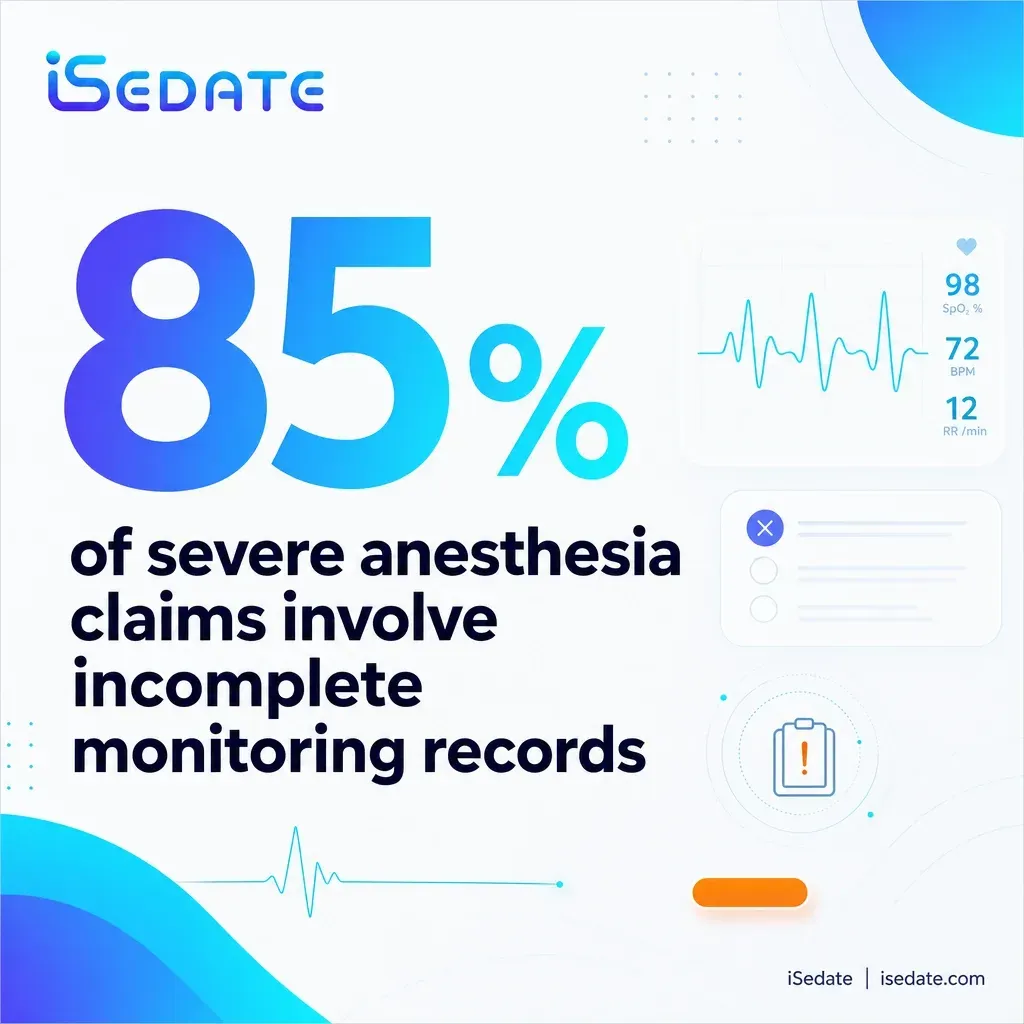
When a reviewer opens your file, they are checking the record, not your intentions. A board review turns on whether your time-oriented anesthetic record is complete and contemporaneous: every drug and dose logged, the weight recorded for any patient under 12, the vital signs present, and a documented level of consciousness at discharge. In the common case, the dentist did the sedation correctly and still lost on the paperwork.
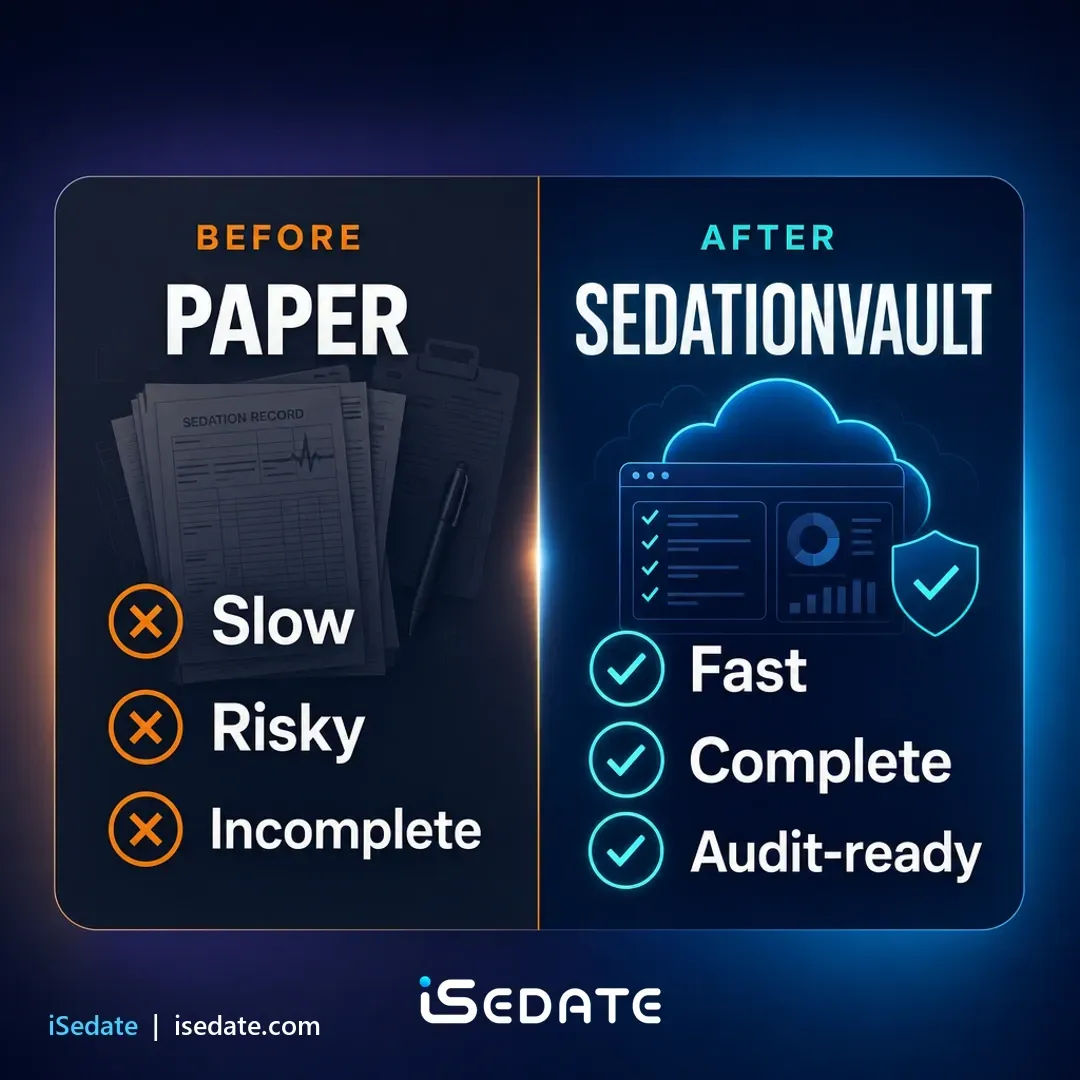
That is the failure point worth engineering out. A vitals log written by hand, between titrating a drug and watching an airway, is exactly where records go incomplete, and incomplete records are what a board inspection and a malpractice claim both attack. SedationVault captures live patient vitals and the drug log automatically into a time-oriented, Arkansas-aware anesthetic record, carrying the drug names and dosages, the weight for patients under 12, the vital signs, and the level of consciousness at discharge that Article XIII requires, so the record writes itself while you focus on the patient. When the board asks for the file, a complete record is a one-click export, not a scramble through paper. See how it maps to the Arkansas rules on the dental sedation compliance page.
Book a demo of SedationVault See SedationVault pricingSource: ASBDE General / Deep Sedation Facility Permit application | Arkansas State Board of Dental Examiners
Frequently asked questions
What sedation permits does Arkansas require?
How many hours do you need for a moderate (IV) sedation permit in Arkansas?
How often do you renew an Arkansas sedation permit?
Does Arkansas inspect sedation offices?
Does nitrous oxide need a permit in Arkansas?
Related guides and neighboring states
This guide is part of the iSedate state-by-state series on sedation licensing. For the companion Arkansas guide, see the Arkansas sedation vitals monitoring, charting, and reporting requirements. Licensed in a neighboring state? See our guides for Louisiana sedation dentistry licensing and permit requirements, Missouri sedation dentistry licensing and permit requirements, Mississippi sedation dentistry licensing and permit requirements, Oklahoma sedation dentistry licensing and permit requirements, Tennessee sedation dentistry licensing and permit requirements, and Texas sedation dentistry licensing and permit requirements, or start from the full Sedation Dentistry Licensing & Permit Requirements by State hub.
Sources
- Arkansas State Board of Dental Examiners (ASBDE, 501-682-2085)
- ASBDE applications and renewals (sedation permit forms and fees)
- Arkansas Dental Practice Act, Ark. Code Title 17, Chapter 82 (permit requirement and annual renewal, 17-82-504)
- ASBDE General / Deep Sedation Facility Permit application (record rule and facility inspection, Article XIII / 115-1304, 115-1305)
- ASBDE Moderate Sedation Facility Permit application
- DOCS Education, Arkansas dental sedation training courses (where to take the required class)
- ASBDE Rules of Practice, Article XIII (Ark. Admin. Code 115-1302 through 115-1307, Agency 038): training and qualifications (115-1302), documentation (115-1304), permits and facility inspection (115-1305), and sedation monitoring permit (115-1307). Official copies are held by the Arkansas Secretary of State's Administrative Rules division and the board.
This guide summarizes Arkansas sedation permit rules for general information and is not legal advice. Permit tiers, training hours, live-patient counts, resuscitation requirements, monitoring, and recordkeeping are drawn from Article XIII of the Rules of the Arkansas State Board of Dental Examiners (Ark. Admin. Code 115-1302 through 115-1307) and Ark. Code 17-82-504, current as of November 2026. Application forms, fees, the exact inspection cadence, continuing-education hours, the penalty schedule, and the full deep-sedation and general-anesthesia training specifics are set by the Arkansas State Board of Dental Examiners and should be confirmed directly with the board before you act.