






Missouri Sedation Dentistry Licensing & Permit Requirements
In Missouri, your dental license alone does not let you sedate a patient past minimal sedation. Before the first dose of moderate sedation, deep sedation, or general anesthesia, two things have to be in place: the dentist holds the matching permit from the Missouri Dental Board, and the office itself holds a site certificate. Both come from one chapter of state rule, 20 CSR 2110 Chapter 4, and the board can inspect your office and pull your records to check them. This guide walks the whole path: which permit each technique needs, how to qualify, how to renew, and the records that keep the credential from being challenged.
Recent Updates
Last UpdatedNovember 16, 2026
- Rewrote the guide against the current 20 CSR 2110 Chapter 4 text (amended February 2022, effective September 30, 2022) on the Missouri Secretary of State's site.
- Corrected the credential structure: moderate sedation is split into enteral, parenteral, and pediatric permits, and the moderate tier also requires an office site certificate, not just the deep sedation and general anesthesia tier.
- Added the verified renewal cycle (by June 1 every five years), the five-patient-record renewal submission, and the board's inspection authority.
- Replaced third-party statute mirrors with direct links to the official Secretary of State rule and the Missouri Dental Board's own rules and application pages.
- Missouri regulates sedation under 20 CSR 2110 Chapter 4. Minimal sedation needs no permit; every deeper level needs a Missouri Dental Board permit.
- Moderate sedation is three separate permits by technique: enteral, parenteral, and pediatric moderate sedation. Deep sedation and general anesthesia is a fourth permit.
- Every sedation level above minimal also requires the office to hold a site certificate. The credential is a pair: a permit for the dentist and a site certificate for the office.
- Permits and site certificates renew by June 1 every five years. A moderate renewal means submitting five complete patient records, so your charting is part of keeping the permit.
- Moderate sedation requires a time-oriented anesthesia record with vitals documented at least every 15 minutes (20 CSR 2110-4.030), and the board can inspect your office at any time.

What This Guide Covers
- Do you need a permit to sedate patients in Missouri?
- Who issues Missouri sedation permits
- The Missouri sedation credentials, level by level
- How to qualify for each permit
- What your permit requires you to monitor
- The records the board will check
- Renewal, fees, and inspections
- Keeping the permit: audit-ready records
- Frequently asked questions
- Sources
Do You Need a Permit to Sedate Patients in Missouri?
Usually, yes. Minimal sedation, the light anxiolysis that keeps a patient responsive and breathing on their own, needs no permit and no added sedation training in Missouri. Everything deeper does. Moderate sedation, deep sedation, and general anesthesia each require a permit the Missouri Dental Board issues to the dentist, and they each require the dental office to hold a separate site certificate for the level of care delivered there. You need both halves of the pair before you sedate: the dentist is permitted, and the office is certified.
That office certificate is the part dentists most often miss. A common assumption is that only deep sedation and general anesthesia makes the facility part of the credential. In Missouri, moderate sedation does too. An office that offers enteral or parenteral moderate sedation must hold a moderate sedation site certificate, not just a permitted dentist on staff.
Source: 20 CSR 2110-4.020 and 4.040 (Missouri Secretary of State)
Who Issues Missouri Sedation Permits
Sedation dentistry in Missouri is regulated by the Missouri Dental Board, part of the state's Division of Professional Registration. The board licenses dentists, issues every sedation permit and site certificate, inspects offices, and takes disciplinary action. The governing rules sit in the Missouri Code of State Regulations, Title 20, Division 2110, Chapter 4, titled "Sedation." Every requirement in this guide traces to a section of that chapter, and you can read the current text through the board's rules and statutes page.
Myth, Busted
Myth: The ADA guidelines are federal law, so meeting them is enough to sedate legally in Missouri.
Fact: The American Dental Association is a private professional association, not a government agency. It publishes sedation guidelines that states lean on, but it does not license, inspect, or discipline anyone. Your authority to sedate comes from a Missouri Dental Board permit under 20 CSR 2110 Chapter 4.
Federal rules still apply around the edges, the DEA governs controlled-substance records and HIPAA governs patient data, but the permit, the site certificate, and any sanction are the board's call under state rule.
To apply, you work through the board's own forms. The application packets, including the sedation permit and site certificate applications for each technique, live on the board's application forms page. The current fee schedule is set in a separate board rule and changes periodically, so confirm the exact forms and fee amounts directly with the board before you file.
Source: Missouri Dental Board rules and statutes | Missouri Dental Board application forms
The Missouri Sedation Credentials, Level by Level
Missouri does not number its permits "Level 1 through 4." It ties each credential to the sedation technique and the depth of sedation, and it issues a matching office site certificate for each tier. Here is the full ladder, each with its governing section of Chapter 4. Missouri's rule still uses the older term Conscious Sedation in places, the enteral and parenteral "conscious sedation" permits that predate the 2022 amendment now map to today's moderate sedation permits.
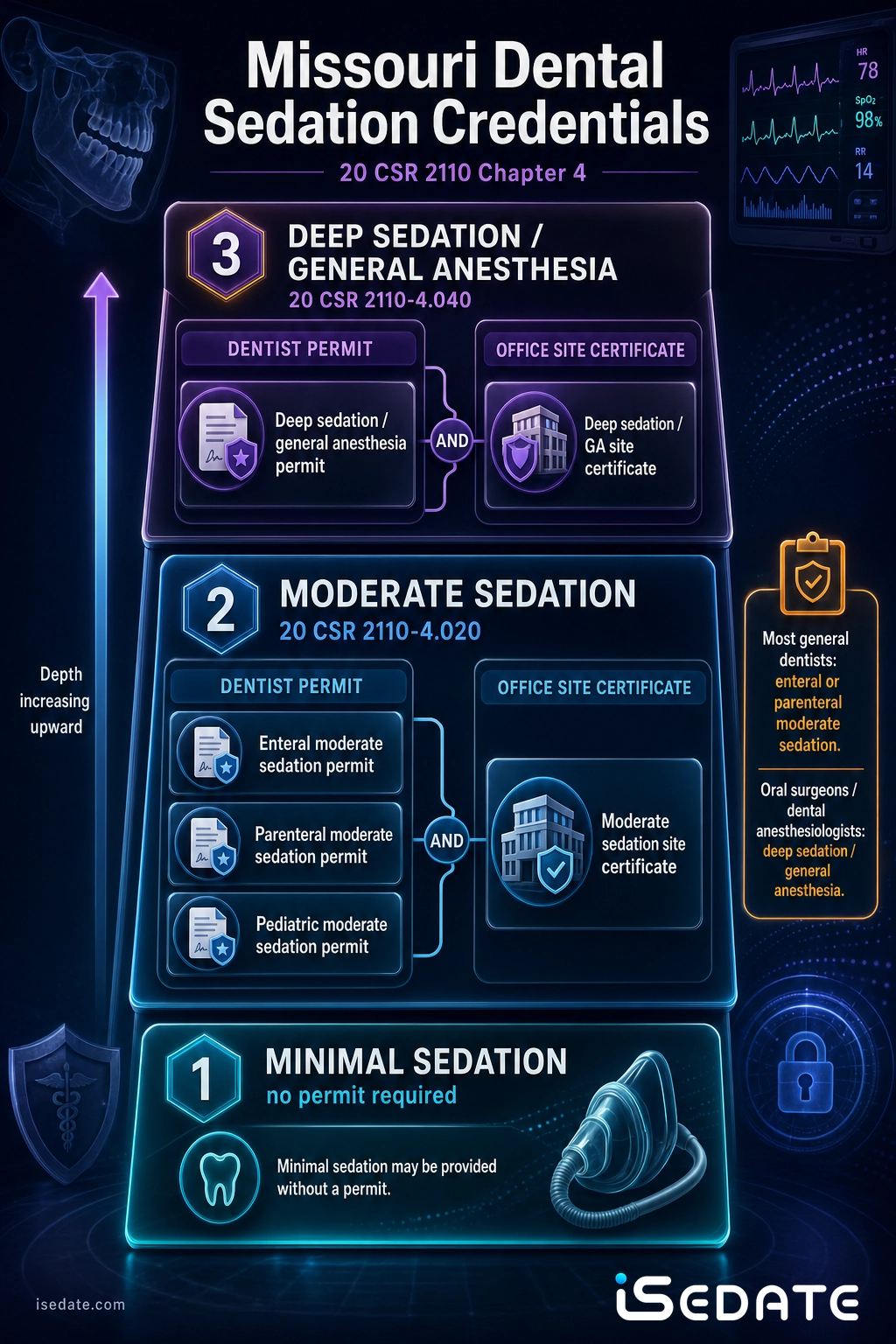
Minimal sedation, no permit. Minimal sedation, or anxiolysis, requires no permit and no added sedation training. The patient stays responsive to verbal command, and airway and cardiovascular function are unaffected. This is the entry point for light anxiety control.
Enteral moderate sedation permit (20 CSR 2110-4.020). Authorizes moderate sedation given by an enteral route, where the drug is absorbed through the gastrointestinal tract or oral mucosa, oral, rectal, or sublingual. This is the workhorse Conscious Sedation credential for general dentists who sedate orally.
Parenteral moderate sedation permit (20 CSR 2110-4.020). Authorizes moderate sedation given by a route that bypasses the gastrointestinal tract, intravenous, intramuscular, intranasal, subcutaneous, submucosal, or intraosseous. A parenteral permit holder may also use enteral moderate sedation without a separate enteral permit.
Pediatric moderate sedation permit (20 CSR 2110-4.020). Required to moderately sedate a pediatric patient, defined as age 12 and under, by either enteral or parenteral technique. Intravenous administration for these patients is restricted to qualified deep sedation and general anesthesia providers.
Deep sedation and general anesthesia permit (20 CSR 2110-4.040). Authorizes deep sedation or general anesthesia, where the patient is not easily aroused or is unconscious and may need airway support. This tier is largely the province of dental anesthesiologists and oral and maxillofacial surgeons and runs beyond the scope of a general practice, so if you are pursuing it, work directly from 20 CSR 2110-4.040 with the board.
Site certificates for the office (4.020 and 4.040). An office doing enteral, parenteral, or pediatric moderate sedation must hold a moderate sedation site certificate. An office doing deep sedation or general anesthesia must hold a deep sedation and general anesthesia site certificate. Because the office itself is credentialed, its facility, equipment, and emergency readiness are part of what qualifies.
State Law
Source: 20 CSR 2110-4.010 and 4.020 (Missouri Secretary of State, current Chapter 4)
How to Qualify for Each Permit
Each permit has its own bar to clear, and you move up the ladder by meeting the next technique's requirements and applying to the board. The paths differ by route.
Enteral moderate sedation
Document completion of an enteral moderate sedation training program. That can be an ADA-accredited post-doctoral program that trains you to administer enteral moderate sedation, or a board-approved enteral moderate sedation course. You also document current ACLS. Enteral applicants may be required to complete an on-site evaluation at the board's discretion.
Parenteral moderate sedation
Parenteral is the harder path because the airway risk is higher. The rule calls for a parenteral moderate sedation training program with documented successful management of parenteral moderate sedation patients and documented operating-room clinical experience in airway management, current ACLS, and a required on-site evaluation by board-appointed consultants.
State Law
Pediatric moderate sedation
Requires ADA-accredited post-doctoral training that affords comprehensive training in moderate sedation for pediatric patients, including didactic training in pain and anxiety control and documented sedation of 20 pediatric dental patients, plus current ACLS or PALS and a required on-site evaluation.
Deep sedation and general anesthesia
Requires either an ACLS course or board-approved equivalent within the past five years, or a minimum of 15 hours of board-approved continuing education on medical emergencies, anesthetic complications, or patient management under deep sedation and general anesthesia, and a successful on-site evaluation conducted under the current American Association of Oral and Maxillofacial Surgeons (AAOMS) Office Anesthesia Evaluation Manual. The office must separately earn its deep sedation and general anesthesia site certificate.
iSedate Pro Tip
Across every moderate tier, the whole sedation team matters, not just you. At least two team members plus the dentist must hold current BLS for the Healthcare Provider, and the team must complete a board-approved course in monitoring sedated patients within the past five years. Missouri does not accept online-only courses for BLS or ACLS, the testing has to be in person with an instructor present.
Whichever permit you seek, the board issues it after a completed application form, the fee set in 20 CSR 2110-2.170, proof you met the training section, and a determination that your dental license is in good standing. The requirements must be met within one year of filing. For enrollment in a board-recognized course, providers such as DOCS Education's Missouri course listings are one place to look, but always confirm the specific course is board-approved and verify the current requirements against the board's own pages.
Source: 20 CSR 2110-4.020 (Moderate Sedation) and 4.040 (Deep Sedation/General Anesthesia)
What Your Permit Requires You to Monitor
A permit is permission plus obligation. Once you hold a moderate sedation permit, 20 CSR 2110-4.030 requires the patient to be monitored under the direct and continuous supervision of a sedation team member, watching the systems the rule names:
- Oxygenation: oxygen saturation evaluated continuously by pulse oximetry.
- Circulation: initial blood pressure and pulse recorded, and thereafter as appropriate.
- Mechanical means: blood pressure and pulse rate, pulse oximetry, and, if appropriate, a pretracheal stethoscope, electrocardiogram, and temperature monitor.
- Recovery: monitoring continues until oxygenation, respiration, and circulation are stable and the patient is responsive enough for discharge.
For the full clinical breakdown of what to monitor and chart at each depth, see our companion guide on Missouri sedation vitals monitoring, charting, and reporting requirements, and the national overview in our Sedation Dentistry Licensing & Permit Requirements by State hub.
Source: 20 CSR 2110-4.030 (monitoring)

The Records the Board Will Check
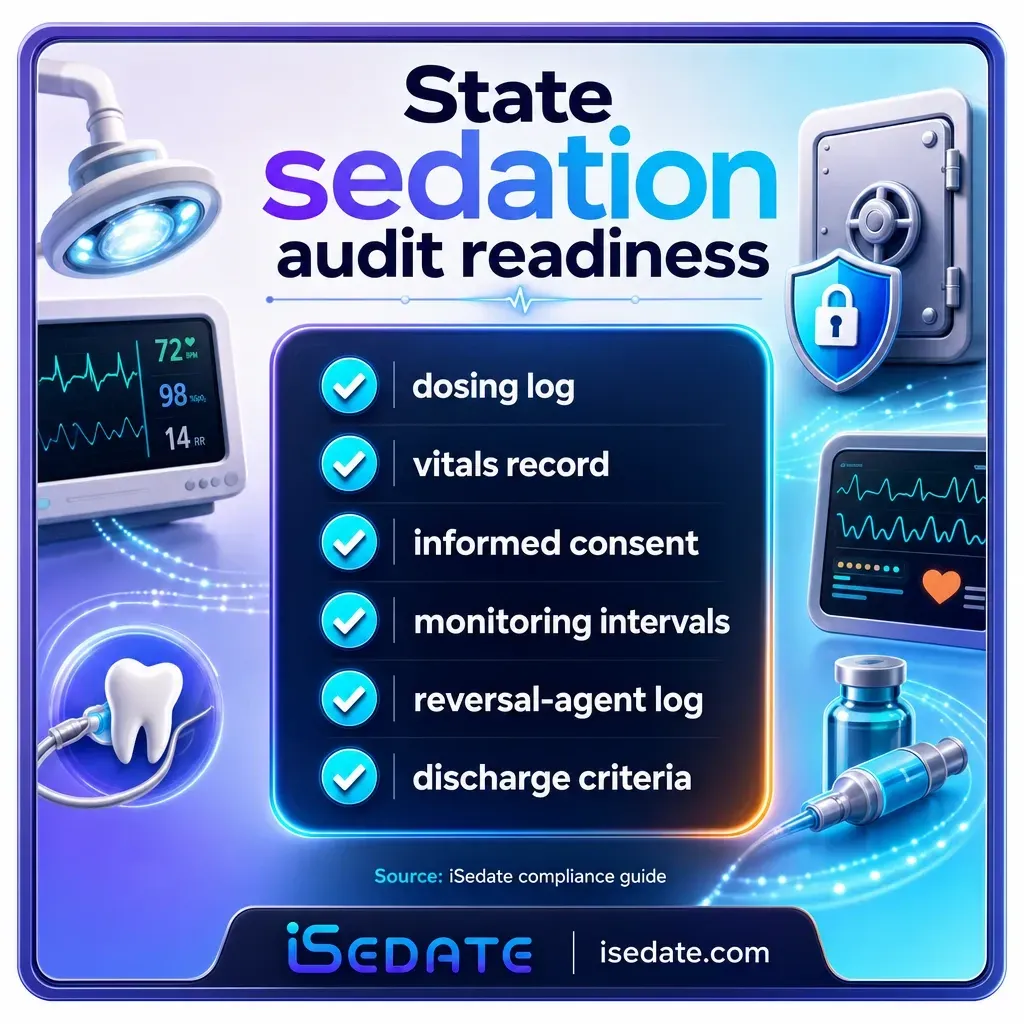
Holding a permit also means holding a set of documentation duties, and these are exactly what a board review examines first. Under 20 CSR 2110-4.030, a time-oriented anesthesia record must be documented for moderate sedation. It captures the dosage and administration of drugs and the physiologic data obtained during monitoring, along with the names of the provider and sedation team members, the date, NPO status, start and finish times, the agents delivered with name, dose, route, and flow rate, any complications, and the discharge status.
The vitals interval is the figure most often cited and most often missed. Blood pressure, pulse rate, and oxygen saturation must be recorded preoperatively, after initial medications, and at a minimum every 15 minutes throughout the procedure.
State Law
Important
A complete chart is what a board review turns on, not your clinical intent. The sedation can be textbook and the permit can still be challenged on the paperwork: a missed vitals interval, a drug logged without its route, a blank discharge status. Missouri even ties your renewal to this, a moderate permit renewal requires submitting five of your own complete patient records for the board to read.
Source: 20 CSR 2110-4.030 (records)
Renewal, Fees, and Inspections
Missouri runs every sedation credential on the same clock. Each permit and each site certificate renews by June 1 every five years from the year it was issued, and you file the renewal at least 90 days before expiration.
State Law
Moderate Permit Renewal Requirements
- Submit five unedited, complete patient records from the preceding five years that document your moderate sedation care under 20 CSR 2110-4.030.
- Pay the renewal fee specified in 20 CSR 2110-2.170, payable to the Missouri Dental Board.
- Document current BLS for the Healthcare Provider for the sedation team and the permitted dentist.
- Document that the team completed a board-approved course in monitoring sedated patients within the past five years.
- Undergo a facility inspection to confirm the office and the team still meet the standard.
- Maintain current ACLS the entire time the permit is active.
Fees are set in a separate board rule, 20 CSR 2110-2.170, and are updated periodically, so confirm the current amount with the board rather than relying on a figure you read elsewhere. On inspections, the board may inspect a dental office that administers enteral, parenteral, or pediatric moderate sedation at any time to verify compliance. If a holder is found to have fallen below the minimum qualifications, the board may pursue disciplinary action under the Missouri dental practice statute, section 332.321, RSMo.
Source: 20 CSR 2110-4.020 (renewal, inspection) | Missouri Dental Board rules and statutes
Keeping the Permit: Audit-Ready Records
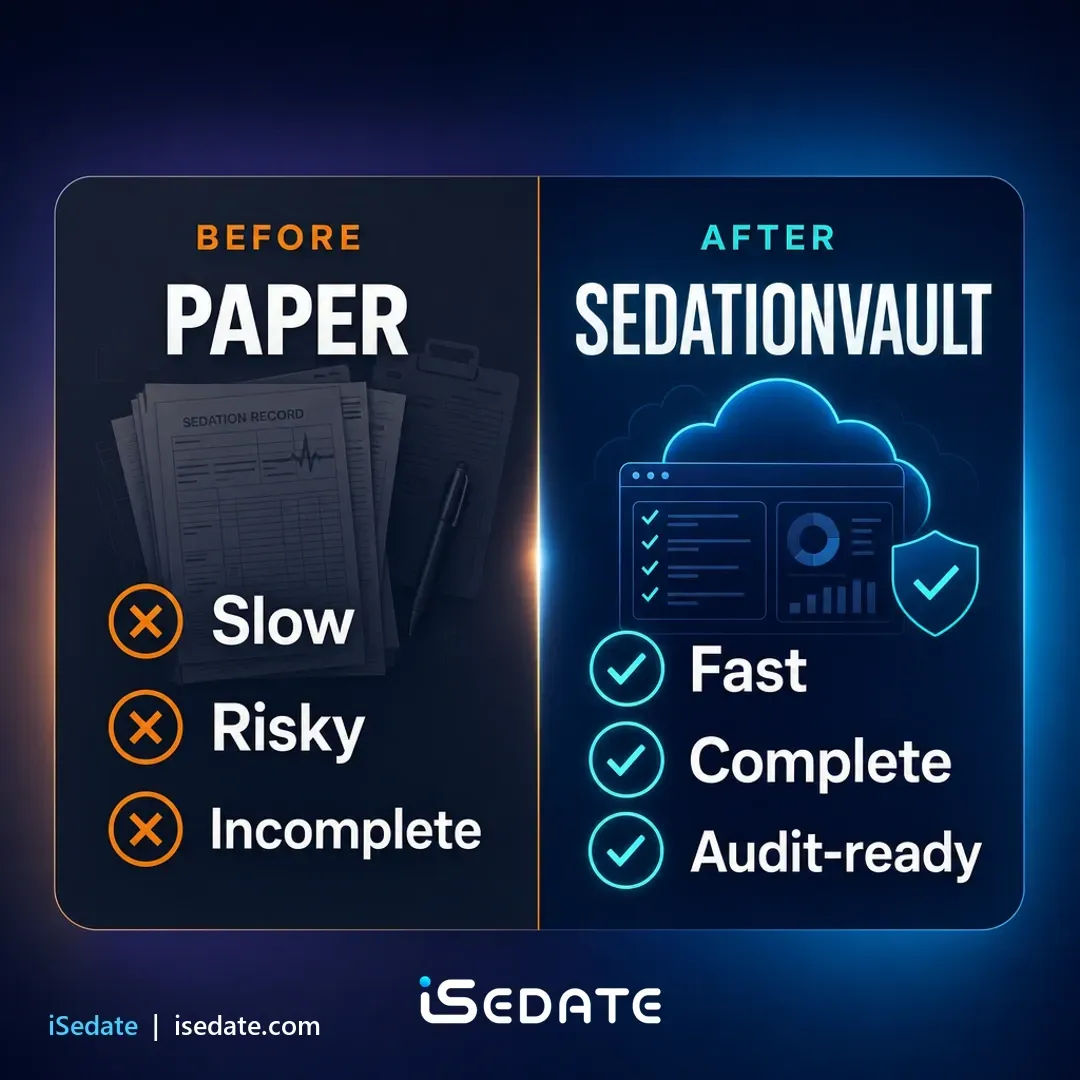
Everything above points to one truth: earning the credential is a one-time hurdle, but keeping it is a daily documentation discipline. A manual vitals log written every 15 minutes by hand, between titrating a drug and watching an airway, is exactly where records go incomplete, and incomplete records are what a board review and a malpractice claim both attack. In Missouri it is even more direct, because five of those records are what you hand the board at renewal.
SedationVault removes that failure point. It captures live patient vitals and the drug log into a time-oriented, Missouri-ready anesthesia record, holding the 15-minute interval that 20 CSR 2110-4.030 demands and logging each agent's name, dose, route, and flow rate, so the record builds itself while you focus on the patient. When the board asks for a file, a complete record is a one-click export, not a scramble through paper. See how it maps to the rules on the dental sedation compliance and anesthesia record software pages.
Book a Demo of SedationVault See SedationVault PricingFrequently Asked Questions
What sedation permits does Missouri require?
Does a Missouri dental office need a site certificate for moderate sedation?
How do you get a moderate sedation permit in Missouri?
How often do you renew a Missouri sedation permit?
What records does a Missouri moderate sedation permit require?
Can the Missouri Dental Board inspect my office?
Licensed in a Neighboring State?
Missouri's rules are its own. If you also practice across a state line, the permit levels, intervals, and renewal cycles change. See our guides for each neighbor, plus the all-50 overview:
- Arkansas Sedation Dentistry Licensing & Permit Requirements
- Illinois Sedation Dentistry Licensing & Permit Requirements
- Iowa Sedation Dentistry Licensing & Permit Requirements
- Kansas Sedation Dentistry Licensing & Permit Requirements
- Kentucky Sedation Dentistry Licensing & Permit Requirements
- Nebraska Sedation Dentistry Licensing & Permit Requirements
- Oklahoma Sedation Dentistry Licensing & Permit Requirements
- Tennessee Sedation Dentistry Licensing & Permit Requirements
- Sedation Dentistry Licensing & Permit Requirements by State
Sources
Sources & How We Verified This Guide
Every requirement above was checked against the current, official Missouri rule text (20 CSR 2110 Chapter 4, amended February 2022, effective September 30, 2022) and the Missouri Dental Board's own pages. Fee amounts in 20 CSR 2110-2.170 change over time and should be confirmed with the board before you file.
- 20 CSR 2110 Chapter 4: Sedation, current text (Missouri Secretary of State): definitions, moderate and deep sedation permits, site certificates, training, records, monitoring, renewal, and inspections.
- Missouri Dental Board rules and statutes: the board's link to 20 CSR 2110 and Chapter 332, RSMo.
- Missouri Dental Board application forms: the sedation permit and site certificate applications for each technique.
- Missouri Dental Board: contact and licensing information.
This guide summarizes Missouri sedation permit rules for general information and is not legal advice. Requirements are current as of November 2026. Confirm the current forms, fees, and any recent amendments directly with the Missouri Dental Board before you act.