






Iowa Sedation Dentistry Licensing & Permit Requirements
In Iowa, your dental license alone does not let you sedate a patient at the deeper levels. A dentist who provides moderate sedation, deep sedation, or general anesthesia must first hold the matching permit from the Iowa Dental Board, issued under rule 481 IAC 572.11 and governed by the clinical standards in 481 IAC Chapter 579, "Sedation and Nitrous Oxide." Earning the permit means meeting the training, certification, and facility-inspection requirements for your level. Keeping it means your sedation records survive a board review. This guide walks both halves: how an Iowa dentist gets a sedation or anesthesia permit, and what it takes to keep it.
Recent Updates
Last UpdatedNovember 16, 2026
- Updated every citation to Iowa's current rules. The state's dental sedation rules moved from the retired 650 IAC Chapter 29 to 481 IAC Chapter 579 (clinical standards) and 481 IAC 572.11 (the permits themselves), effective April 9, 2025, under the Iowa Department of Inspections, Appeals and Licensing.
- Added the verified permit fees ($500 to apply, $125 to renew) and the official moderate sedation training requirement, now confirmed in rule 481 IAC 572.11: at least 60 hours of instruction and the management of at least 20 patients.
- Replaced third-party legal-aggregator links with the original Iowa Dental Board and Iowa Administrative Code sources.
- Iowa issues dentists two sedation and anesthesia permits under rule 481 IAC 572.11: a Moderate Sedation permit and a General Anesthesia permit that covers both deep sedation and general anesthesia.
- Nitrous oxide (481 IAC 579.1) and minimal sedation (481 IAC 579.2) require no permit, but both still carry recordkeeping duties.
- A moderate sedation permit requires at least 60 hours of board-approved training plus 20 managed patients, current ACLS or PALS, and a facility that has passed a board inspection (481 IAC 572.11).
- Permits cost $500 to apply and $125 to renew, renew biennially with the dental license, and expire August 31 of every even-numbered year, with current ACLS (or PALS for pediatric) and six hours of sedation CE required at renewal.
- The board can inspect your facility and review your records, and an incomplete time-oriented anesthesia record is where a permit, and a malpractice defense, most often fail (481 IAC 579.7).
What This Iowa Permit Guide Covers
- Who issues sedation permits in Iowa
- Iowa's sedation categories and two permits
- How to get each permit, step by step
- Fees, forms, and where to apply
- What the permit requires you to monitor
- Recordkeeping obligations tied to your permit
- Renewal and continuing education
- Inspections and record reviews
- Keeping the permit: audit-ready records
- Frequently asked questions
- Related guides and neighboring states
- Sources
Who issues sedation permits in Iowa
Sedation dentistry in Iowa is regulated by the Iowa Dental Board, which now sits inside the state's Department of Inspections, Appeals and Licensing. The board licenses dentists and issues every sedation and anesthesia permit. It, not any national body, decides who may sedate at the deeper levels, inspects facilities, reviews records, and takes disciplinary action. The clinical rules live in 481 IAC Chapter 579, "Sedation and Nitrous Oxide," and the permits themselves are issued under 481 IAC 572.11. Both took effect April 9, 2025, when Iowa renumbered its dental rules from the former 650 IAC Chapter 29. Every requirement below traces to one of those rules.
Myth, Busted
Myth: Federal ADA sedation law overrides whatever the state says.
Fact: There is no federal ADA sedation law. The American Dental Association's anesthesia and sedation guidelines are a private professional standard, and your permit, your inspection, and any discipline all come from the Iowa Dental Board under 481 IAC Chapters 579 and 572.
Iowa, like most states, leans on the ADA guidelines as best practice, and the real federal layers are separate: the DEA for controlled-substance logs and HIPAA for records. Treat the ADA guidelines as the clinical bar and Iowa's rules as the law you are actually held to.
Because the board absorbed the former standalone Iowa Dental Board into a larger licensing department, application forms, fee schedules, and online filing all run through the board's current anesthesia permitting page. A 2026 rulemaking was also moving through the pipeline to add a "licensed sedation provider host permit," so confirm the current forms and any new permit type with the board before you file.
Source: Iowa Dental Board anesthesia permitting | 481 IAC Chapter 579
Iowa's sedation categories and two permits
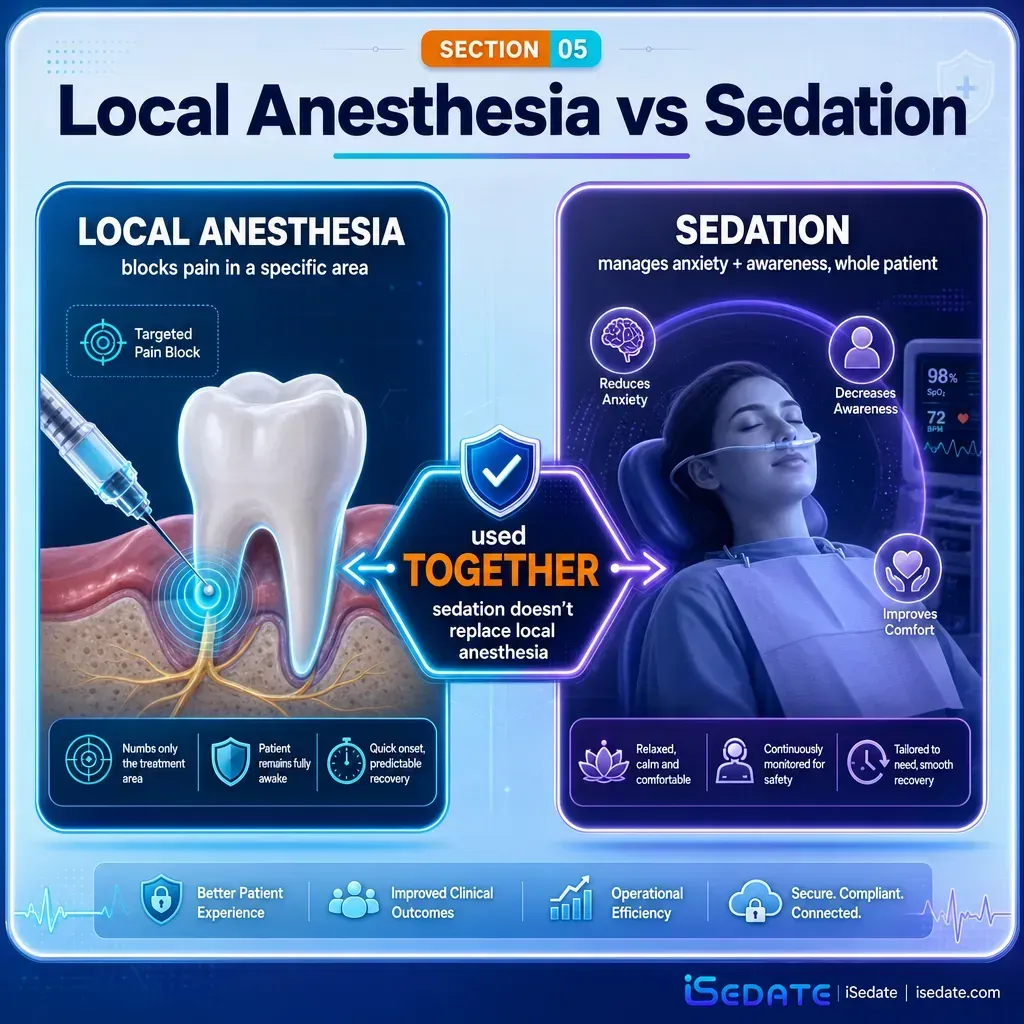
Iowa does not use a "Level 1 through 4" numbering. It defines its sedation categories by the depth of sedation, and only the two deeper ones require a board permit. The category reflects how deeply the patient is sedated, not just which drug or route is used, so a combination of oral drugs that pushes a patient past minimal sedation can move a case into permit territory.
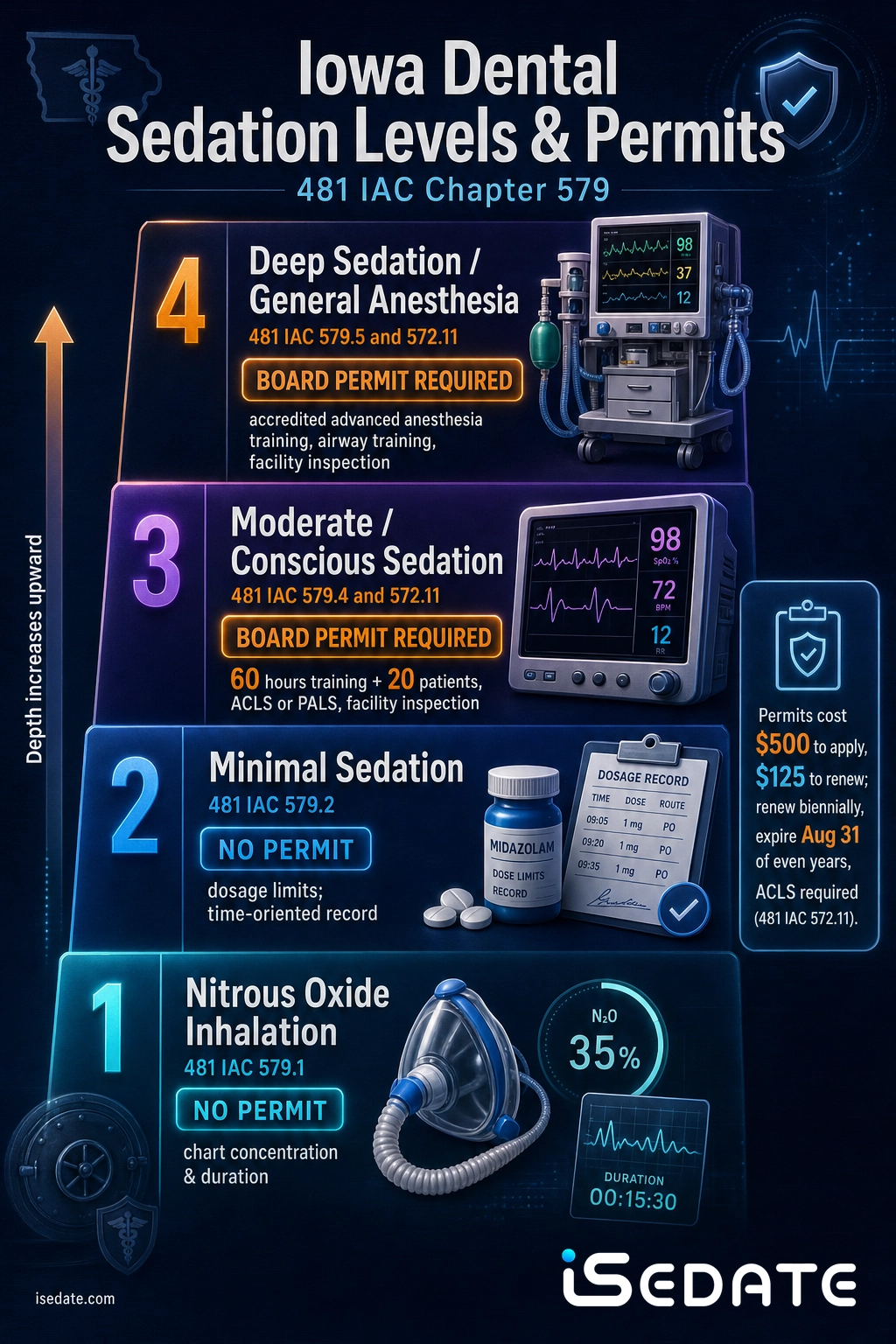
Nitrous oxide inhalation analgesia (481 IAC 579.1). No permit required. This is the lightest form of anxiety control, where the patient stays fully responsive. The chart still has to show the concentration administered, the duration, and any vital signs taken.
Minimal sedation (481 IAC 579.2). No permit required, but not unregulated. Minimal sedation (anxiolysis) is governed by dosage limits and still requires a time-oriented record of the drugs, doses, times, and monitored oxygenation, ventilation, and circulation. This is the common starting point for general dentists who offer light oral sedation.
Moderate Sedation permit. Required for moderate sedation, commonly called Conscious Sedation, where the patient responds purposefully to verbal or tactile stimulation and keeps their own airway. This is the workhorse permit for dentists who provide real in-office sedation, and its clinical standards in 481 IAC 579.4 carry a dedicated-monitor requirement and a capnography requirement.
General Anesthesia permit. The top credential. A single General Anesthesia permit covers both deep sedation and general anesthesia, where the patient is not easily aroused or is unconscious and may need airway support. This is largely the province of dental anesthesiologists and oral and maxillofacial surgeons; most general dentists operate at nitrous and oral conscious sedation and never need it. Its standards sit in 481 IAC 579.5, and its training path in 481 IAC 572.11.
Source: 481 IAC 579.1, 579.2, 579.4, 579.5 | 481 IAC 572.11
How to get each permit, step by step
Each permit has its own bar to clear under 481 IAC 572.11: board-approved training, resuscitation certification, and a facility inspection. You move up by meeting the next level's requirements and applying to the board.
| Category | Depth | Permit | What the rule requires |
|---|---|---|---|
| Nitrous oxide (579.1) | Lightest, fully responsive | None | No permit; chart concentration, duration, and any vitals |
| Minimal sedation (579.2) | Anxiolysis | None | No permit; dosage limits apply; time-oriented record required |
| Moderate / Conscious Sedation (579.4) | Purposeful response, own airway | Moderate Sedation permit | 60 hours of training plus 20 managed patients, current ACLS or PALS, facility inspection |
| Deep sedation / general anesthesia (579.5) | Not easily aroused or unconscious | General Anesthesia permit | Accredited advanced anesthesia training, airway training, current ACLS, facility inspection |
The Moderate Sedation permit
To hold a Moderate Sedation permit, rule 481 IAC 572.11 requires evidence of board-approved education and training that includes at least 60 hours of instruction and the clinical management of at least 20 patients, or an accredited residency with equivalent formal moderate-sedation training and experience. You must also hold current ACLS or PALS certification, and each facility where you intend to sedate must pass a board inspection before the permit issues. Dentists who plan to sedate pediatric or medically complex (ASA III and IV) patients face additional residency-level training requirements, so confirm those with the board if they apply to you.
The General Anesthesia permit
This top credential covers both deep sedation and general anesthesia under a single permit. Under 481 IAC 572.11, it requires completion of an accredited advanced education program covering moderate sedation, deep sedation, and general anesthesia, at least one year of advanced anesthesiology training beyond dental school, formal airway-management training, and current ACLS certification, along with the facility inspection that applies to every new permit. Because this is the deepest level, its clinical specifics run beyond the scope of a general guide; work directly from 481 IAC 579.5 and 572.11 with the board.
Fees, forms, and where to apply
Applications, fees, and renewals for Iowa dental sedation permits are filed through the Iowa Dental Board's online licensing system. The fees below are the current amounts published on the board's anesthesia permitting page; because the board can revise its fee schedule, confirm the current figures before you file.
Iowa Sedation Permit Fees
- Moderate Sedation permit application: $500
- General Anesthesia permit application: $500
- Permit renewal (each): $125
- Background-check packet: $46
- Late renewal: $100 in September, $150 in October of the renewal year
You apply, renew, and report through the board's online services portal, reached from the Iowa Dental Board's anesthesia permitting page. For the didactic and clinical training itself, Iowa accepts board-approved programs; a widely used option is a recognized continuing-education provider such as DOCS Education's Iowa sedation courses, which bundle the required hours and ACLS. Treat any CE provider's figures as secondary and confirm the requirement against the board's own rule before you enroll.
Source: Iowa Dental Board anesthesia permitting (fees and application) | 481 IAC 572.11

What the permit requires you to monitor
A permit is permission plus obligation. Once you hold a Moderate Sedation permit, 481 IAC 579.4 sets the monitoring standard, and the shared standards in 481 IAC 579.3 require a patient monitor who continually observes the patient until recovery:
- A dedicated qualified monitor: at least one patient monitor must observe the patient throughout moderate sedation, and under 481 IAC 579.6 that person must hold the required airway and resuscitation training (ACLS, PALS, or DAANCE, or equivalent airway-management training).
- Capnography: 481 IAC 579.4 requires capnography to monitor end-tidal carbon dioxide, unless its use is precluded or invalidated by the patient, procedure, or equipment, in which case a pretracheal or precordial stethoscope must continually monitor breath sounds.
- Recorded vitals: the time-oriented record must capture the monitored oxygenation, ventilation, and circulation, and for deep sedation or general anesthesia, pulse oximetry, heart rate, respiratory rate, and blood pressure must be recorded continually until the patient is fully ambulatory (481 IAC 579.7).
Deep sedation and general anesthesia raise the bar further: 481 IAC 579.5 requires at least two patient monitors, each holding current ACLS, PALS, or DAANCE certification. For the full clinical breakdown of what to monitor and chart at each depth, see the companion guide on Iowa's sedation vitals, charting, and reporting requirements.
Source: 481 IAC 579.3, 579.4, 579.5, 579.6
Recordkeeping obligations tied to your permit
Holding a permit also means holding a set of documentation duties, and these are exactly what a board review examines first.
The time-oriented anesthesia record. Under 481 IAC 579.7, a time-oriented anesthesia record must be maintained for moderate sedation, deep sedation, and general anesthesia. It must include the preoperative and postoperative vital signs, every drug administered (including local anesthetics and nitrous oxide) with dosages, the anesthesia time in minutes, the monitors used, and the monitored oxygenation, ventilation, and circulation. For deep sedation or general anesthesia, pulse oximetry, heart rate, respiratory rate, and blood pressure must be recorded continually until the patient is fully ambulatory, and the record should name the person to whom the patient was discharged.
Nitrous and minimal sedation records. Even where no permit is required, 481 IAC 579.7 still calls for a record that documents the nitrous concentration administered, any medication and dosage, the duration, and the vital signs taken.
Why This Matters
A board review turns on the record, not your intentions. The sedation can be clinically flawless and the record can still fail if a required element, like the continual vitals through to full ambulation or the discharge-to name, is missing. The same incomplete chart that fails a board review is the first thing a plaintiff's expert reaches for in a malpractice claim.
Source: 481 IAC 579.7
Renewal and continuing education
Your sedation permit is tied to your Iowa dental license, and the cycle is specific. Under 481 IAC 572.11, permits renew biennially with the license and expire on August 31 of every even-numbered year. Renewal requires an active dental license, the renewal fee, evidence of current ACLS certification (or PALS if you hold a pediatric moderate sedation permit), and at least six hours of continuing education in sedation, which may also count toward your license renewal.
Miss the window and the permit lapses after November 1 following expiration. A lapsed permit can be reactivated with a new application, and reactivation within six months may be approved administratively. Because fees and the fine print change, confirm your renewal details on the board's anesthesia permitting page so your permit never lapses at renewal.
Source: 481 IAC 572.11
Inspections and record reviews
This is where a permit is kept or lost. Under 481 IAC 572.11, before a new permit is issued, every facility where the applicant intends to provide sedation must pass an inspection by the board or a designated agent, and 481 IAC 579.8 sets the facility and equipment standards, including required emergency drugs and monitoring equipment, that the inspection checks against. Inspection authority does not end at licensure: the board or its designated agents may conduct facility inspections, and the on-site evaluation costs are the licensee's responsibility.
When a reviewer opens your file, they are checking the record. A review turns on whether your time-oriented anesthesia record is complete, contemporaneous, and carries the required elements: the pre and post-operative vitals, the anesthesia time in minutes, the monitors used, the continual vitals through to full ambulation, and the discharge-to name. Under 481 IAC 579.11, noncompliance is grounds for board discipline, up to suspension or revocation of the permit.
Source: 481 IAC 579.8, 579.11 | 481 IAC 572.11
Keeping the permit: audit-ready records
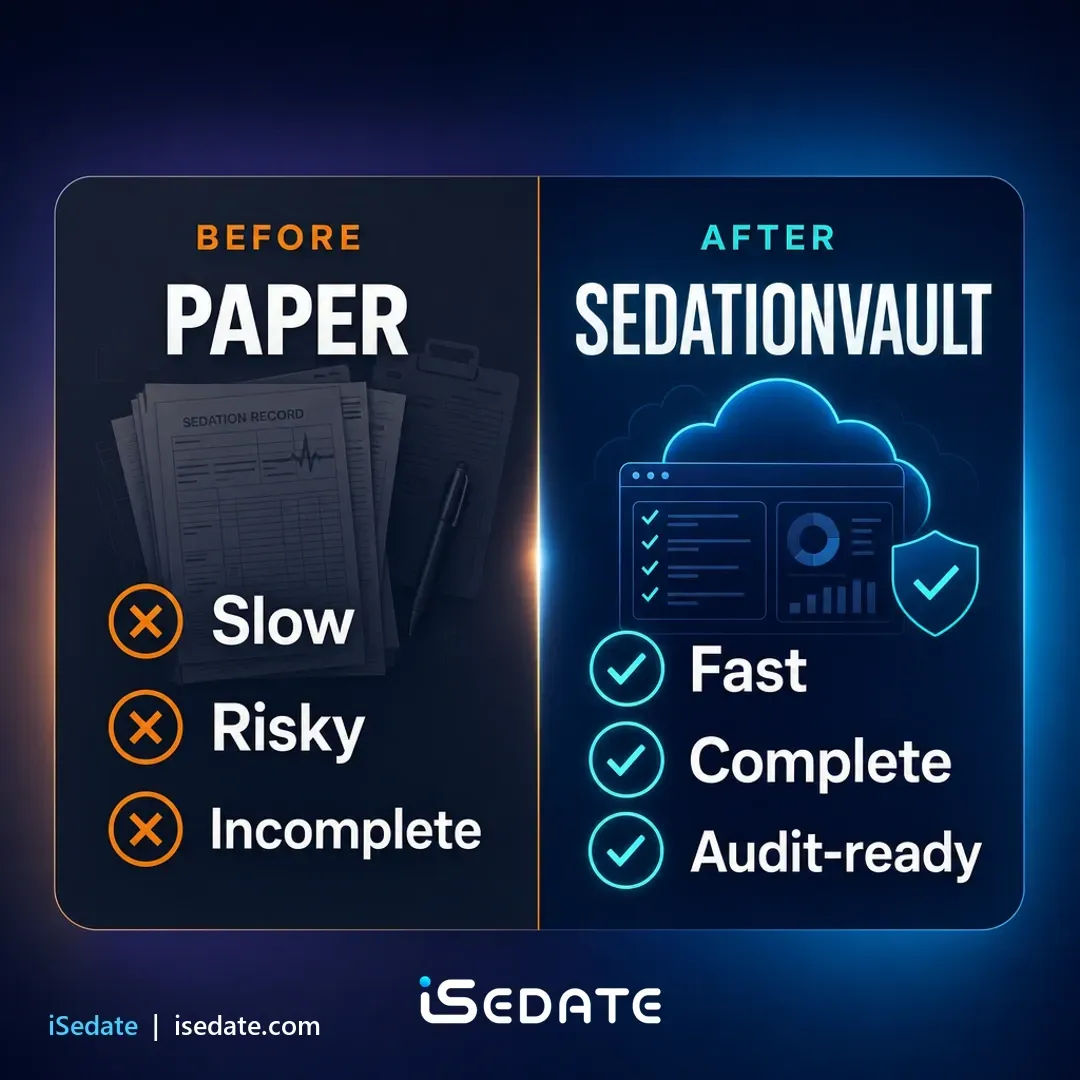
Everything above points to one truth: earning the permit is a one-time hurdle, but keeping it is a daily documentation discipline. A vitals log kept by hand, continually through a case, between titrating a drug and watching an airway, is exactly where records go incomplete, and incomplete records are what a board review and a malpractice claim both attack.
SedationVault removes that failure point. It captures live patient vitals and the drug log automatically into a time-oriented, Iowa-compliant anesthesia record, holding the "continually until fully ambulatory" standard that 481 IAC 579.7 demands, so the record writes itself while you focus on the patient. When the board asks for the file, a complete record is a one-click export, not a scramble through paper. See how it maps to the rules on the dental sedation compliance and anesthesia record software pages.
Book a demo of SedationVault See SedationVault pricingFrequently asked questions
What sedation permits does Iowa require?
How do you get a moderate sedation permit in Iowa?
How much is an Iowa sedation permit and how often does it renew?
Does nitrous oxide require a sedation permit in Iowa?
Do general dentists need a general anesthesia permit?
Which Iowa rules govern dental sedation?
Related guides and neighboring states
This page is part of our state-by-state series on sedation licensing. For the full clinical documentation rules that sit alongside your Iowa permit, read the companion Iowa sedation vitals, charting, and reporting requirements guide, or start from the national overview in our Sedation Dentistry Licensing and Permit Requirements by State hub.
Licensed in a neighboring state? See our permit guides for each of Iowa's neighbors:
- Minnesota Sedation Dentistry Licensing & Permit Requirements
- Wisconsin Sedation Dentistry Licensing & Permit Requirements
- Illinois Sedation Dentistry Licensing & Permit Requirements
- Missouri Sedation Dentistry Licensing & Permit Requirements
- Nebraska Sedation Dentistry Licensing & Permit Requirements
- South Dakota Sedation Dentistry Licensing & Permit Requirements
Sources
Sources & Verification
- Iowa Dental Board, Department of Inspections, Appeals & Licensing, anesthesia permitting (board, permit types, fees, online application)
- Iowa Administrative Code 481 Chapter 579, "Sedation and Nitrous Oxide" (clinical standards, monitoring, recordkeeping, facility, noncompliance; effective April 9, 2025)
- Iowa Administrative Code 481 IAC 572.11 (permit training, ACLS/PALS, facility inspection, expiration, renewal, CE)
- American Dental Association anesthesia and sedation guidelines (private professional standard, not law)
This guide summarizes Iowa sedation permit rules for general information and is not legal advice. The permit structure, training, monitoring, recordkeeping, facility inspection, and biennial renewal cycle are drawn from 481 IAC Chapter 579 and 481 IAC 572.11 as cited, current as of November 2026. Application forms, the exact fee schedule, any pediatric or ASA III/IV training add-ons, the board's phone number, and any 2026 rule changes (including a proposed licensed-sedation-provider host permit) are set or administered by the Iowa Dental Board and should be confirmed directly with the board before you act.